
Disability Insurance for Dentists
As an Independent Disability Insurance Broker, we have access to exclusive discounts and negotiated pricing most captive agents can’t offer — see the full breakdown near the end of this page.
Disability Insurance for Dentists

Jason Stolz CLTC, CRPC, DIA, CAA
As a dentist, your ability to earn income depends on physical dexterity, fine motor precision, postural endurance, and sustained concentration — capabilities that can be disrupted by conditions that would not prevent someone in a desk-based occupation from continuing to work. A hand tremor, carpal tunnel syndrome, a wrist or shoulder injury, a back condition, or neurological issue can end or severely limit a dental career while leaving general physical functioning largely intact. That is precisely why the definition of disability inside a dental professional’s policy matters more than almost any other contract feature — and why disability insurance for dentists requires a fundamentally different evaluation framework than disability coverage for general or white-collar occupations. At Diversified Insurance Brokers, we help dentists, dental specialists, and practice owners select coverage built around how dental income is actually earned — and how it would realistically be disrupted. Our resource on disability insurance services covers the full landscape, and our resource on disability insurance by occupation covers how occupational class affects available definitions, benefit amounts, and carrier selection across professional disciplines.
Dentistry is a specialty occupation where the clinical work itself — drilling, scaling, root canal instrumentation, impressions, surgical extractions — requires fine motor control that cannot be approximated or compensated for the way that many other occupations can adapt to physical limitation. An endodontist who develops a hand tremor can no longer perform root canals regardless of how functional they remain in other respects. An oral surgeon with a repetitive stress injury that prevents extended wrist use cannot perform the procedures that generate revenue. Under a true own-occupation disability policy, both of those dentists would qualify for benefits even if they could teach, consult, or work in an administrative capacity at full salary. Under an any-occupation or modified own-occupation policy, they might not — because they are still physically able to perform some work. That distinction, in a real claim scenario, is the difference between financial stability and financial crisis for a dental professional who spent years building a practice and carrying the debt load that comes with a dental education. Our resource on own-occupation disability insurance covers the definition in full detail, including how true own-occupation, modified own-occupation, and any-occupation policies differ in practice and which professionals absolutely require the strongest definition.
Average dental school debt runs approximately $293,000 as of recent data — one of the highest professional education debt loads among all healthcare disciplines. That debt does not pause during a disability. The mortgage or practice loan does not pause. Staff payroll does not pause. For dentists who own or co-own a practice, the financial exposure during a disability extends well beyond personal income, creating a dual protection need that requires coordinated planning across both personal disability income coverage and business overhead coverage. Our resource on is disability insurance worth it covers the financial risk calculation for high-income professionals, and our resource on how much disability insurance do I need covers the coverage sizing framework that determines the right monthly benefit amount given income level, debt obligations, practice overhead, and existing group coverage.
Get a Disability Insurance Quote for Dentists
Compare own-occupation and simplified options built for dental professionals — so your income is protected if you cannot perform procedures.
Get My Dental DI QuoteDental Disability Insurance — Key Coverage Dimensions for Dental Professionals
No two disability policies are identical in what they cover, when they pay, and what they pay. The table below maps the key design dimensions that determine real-world protection for dental professionals against the options available and what each choice means for a practicing dentist.
| Coverage Dimension | Why It Matters for Dentists | Recommended Structure | What to Avoid |
|---|---|---|---|
| Definition of disability | Dentistry’s dependence on fine motor skill means a condition that prevents clinical work may still leave the dentist fully capable of non-clinical employment — making the definition the single most consequential policy feature | True own-occupation: pays benefits if you cannot perform the material duties of your specific dental occupation, even if you are working in another capacity at full income | Any-occupation and modified own-occupation definitions that terminate benefits once you are capable of working in any field; group LTD policies that shift to any-occupation after an initial period (typically 2 years) |
| Monthly benefit amount | Dental income is typically high — general dentists average $175,000-$225,000+; specialists significantly more — requiring benefit amounts sized to actual income and financial obligations, not generic coverage caps | 60-70% of pre-disability gross income; general dentists may be eligible for up to $15,000-$20,000/month depending on carrier; individually owned policies with after-tax premiums produce tax-free benefits that functionally replace a higher percentage of take-home pay | Undersizing coverage relative to actual expenses and debt obligations; relying solely on employer group plans with fixed benefit caps that do not scale with income |
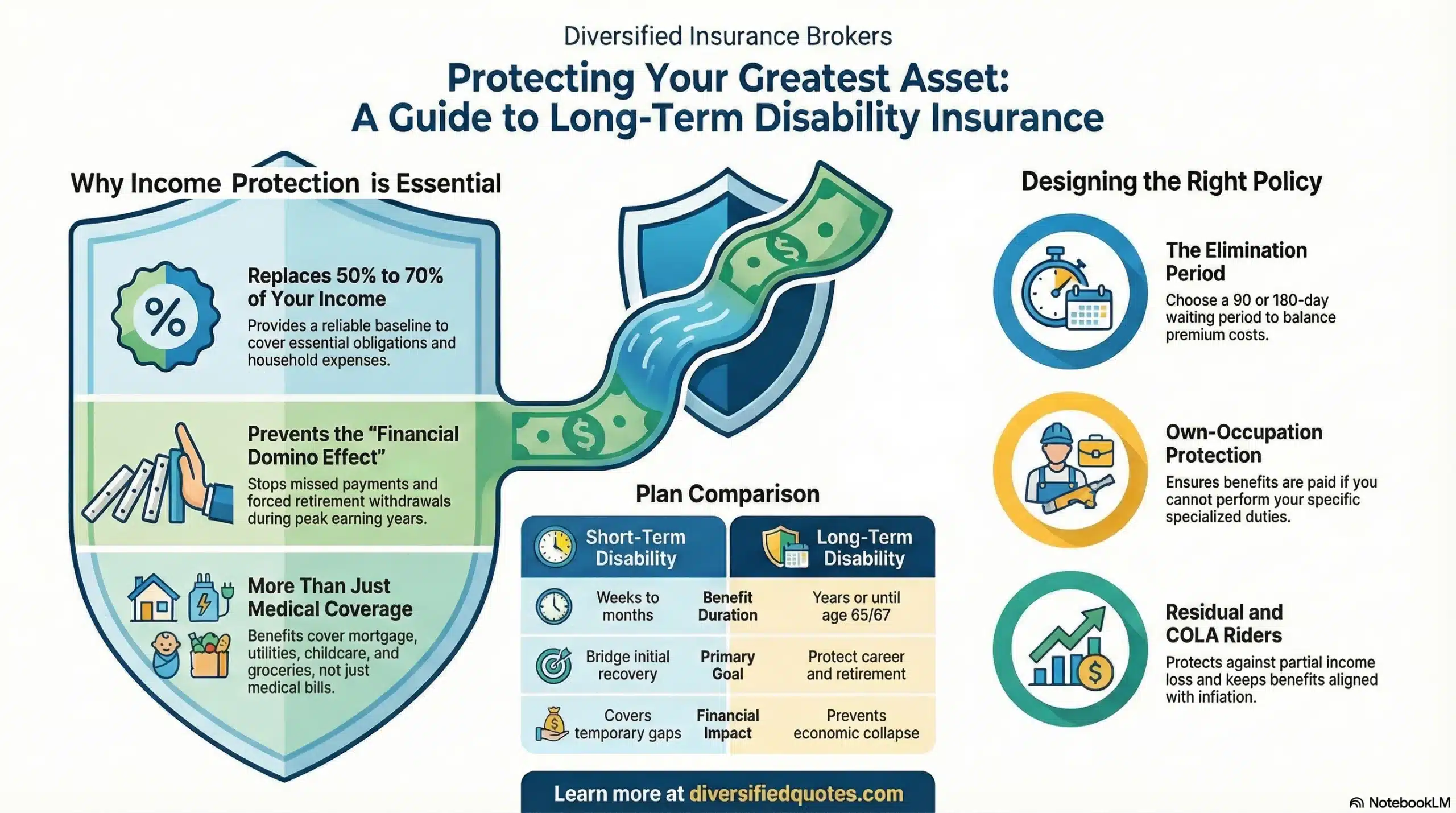
| Elimination period | The waiting period from disability onset to first benefit payment; must align with available savings, short-term disability coverage, and practice overhead obligations during the bridge period | 90 days is most common for practicing dentists with adequate emergency reserves; coordinate with any employer or group short-term disability to prevent income gap; practice owners should assess BOE coverage timing separately | Elimination periods longer than available emergency savings can bridge; misalignment between LTD elimination period and end of short-term disability benefits |
| Benefit period | A career-ending dental disability in a dentist’s 40s or early 50s could span 15-25 years before retirement; short benefit periods leave enormous financial exposure for long-term or permanent disabilities | To age 65 or to age 67 (aligning with Social Security Full Retirement Age); provides the strongest protection against career-ending disability without the extreme cost of lifetime benefits | 2-year or 5-year benefit periods for primary coverage; these may be appropriate for supplemental policies but are insufficient as the foundation of a dental professional’s disability protection |
| Residual / partial disability | Many real dental disability claims involve reduced procedure volume, limited days in the operatory, or restricted treatment scope before work stops entirely — not immediate total disability | Residual disability rider that pays benefits proportional to income loss when production drops by 20-25%+ due to a qualifying condition; benefits continue during recovery and return-to-work phases without requiring total disability throughout | Policies without residual coverage that require full total disability to trigger any benefit; conditions that cause gradual deterioration rather than sudden complete inability may never meet a total disability threshold without residual coverage |
| Student loan protection rider | Dental school graduates carry average debt of ~$293,000; student loan obligations continue during disability regardless of income loss | Student loan protection rider paying up to approximately $2,500/month directly to the lender during a qualifying disability period; available as an add-on from most major carriers for early-career dental professionals | Assuming regular monthly disability benefits will separately cover loan payments — in high-debt situations the loan payment alone can consume a significant portion of a standard benefit amount, leaving insufficient funds for living expenses |
| Business Overhead Expense (BOE) coverage | Practice owners face dual financial exposure during disability: personal income loss AND continuing fixed practice costs (rent, staff, equipment leases, lab fees, utilities); personal DI does not cover the practice | Separate BOE policy covering documented fixed monthly practice expenses during disability — typically for 12-24 months, allowing time to recover, find an associate, or arrange practice transition without immediate financial emergency | Using personal disability income benefit to cover both personal and practice expenses — this compromises both the personal income replacement function and leaves practice obligations underfunded during a disability |
| Non-cancellable and guaranteed renewable | The strongest policy form: locks premium and benefit terms for the life of the contract — the carrier cannot increase rates or change definitions as the dentist ages or as the career advances | Non-cancellable and guaranteed renewable should be the baseline policy form for any long-term individual disability policy; provides certainty that the coverage purchased today remains in force on the same terms for the rest of the career | Guaranteed renewable only (without non-cancellable) allows the carrier to adjust class rates; conditionally renewable policies can be modified or non-renewed based on the carrier’s underwriting judgment |
Policy terms, benefit amounts, available riders, and occupational classifications vary by carrier and state. Dental professional occupational class (typically Class 5-6 for general dentists; Class 3-4 for surgical specialists) affects available definitions and pricing. Individual disability income policies are underwritten based on medical history, prescription records, occupational duties, and financial documentation. This table is educational and does not constitute a quote, coverage commitment, or underwriting determination.
Why the Own-Occupation Definition Is Non-Negotiable for Dental Professionals
True own-occupation coverage is the definition that most disability insurance advisors specifically recommend for dental professionals — and the reason is straightforward. Dental practice is one of the most procedurally specific occupations in healthcare. An endodontist, periodontist, oral surgeon, or general dentist performing restorative procedures depends on capabilities — hand steadiness, grip strength, wrist flexibility, precise visual tracking, sustained postural tolerance — that are specific to clinical dentistry and that cannot be approximated by desk-based work alternatives. When any of those capabilities is meaningfully compromised, the ability to perform dental procedures is compromised — even if general physical functionality remains largely intact. Under a true own-occupation policy, a dentist in that situation qualifies for benefits. Under a modified or any-occupation policy, that same dentist might be denied because they could teach at a dental school, perform administrative work, or consult — even at a fraction of their clinical income. The claim outcome difference between these definitions, across a multi-year or career-ending disability, is enormous. For dental specialists whose procedures demand particularly refined fine motor capabilities — endodontists, oral surgeons, periodontists, pediatric dentists — the own-occupation definition is even more critical because the procedures they perform are less interchangeable than those of general practice. Our resources on disability insurance for orthodontists and disability insurance for dental hygienists cover the specialty-specific underwriting and definition considerations that apply to adjacent dental profession roles.
Occupational Class, Pricing, and Why Dentists Can Qualify for Favorable Rates
Disability insurance carriers assign occupational classes to professional roles based on the physical demands of the work, the income stability of the profession, and the historical claims experience for that occupation. General dentists are typically classified in Class 5 or Class 6 — the most favorable classes that offer the most competitive premium pricing — because the profession has a defined educational credential, high average income, and a well-understood risk profile. Oral surgeons, endodontists, and certain other specialists are often classified in Class 3 or 4 because their procedures are more physically demanding and require more refined fine motor skill, creating a slightly higher risk profile from a claims perspective. The classification matters because it determines the baseline premium rate, the definition options available, and the maximum monthly benefit the carrier is willing to issue. Our resource on disability insurance by occupation covers how occupational class works across different professions, and our resources on disability income insurance for doctors and physicians and disability insurance for physicians cover the physician specialty occupational class framework that is directly analogous to dental specialization. Our resources on adjacent healthcare professions — including disability insurance for anesthesiologists, disability insurance for chiropractors, and disability insurance for optometrists — provide the broader healthcare professional framework that dental professionals often review when benchmarking their own coverage structure. One important pricing factor specific to dental disability coverage: women typically pay approximately 40% more than men for identical coverage due to historical morbidity differences — a significant cost consideration for female dentists who are planning coverage and comparing benefit amounts against premium levels.
Riders That Determine Long-Term Policy Value for Dental Professionals
The base policy sets the foundational terms; the riders determine whether those terms remain adequate over the length of a dental career. Our resource on disability insurance riders explained covers the full rider landscape, and several are particularly important for dental professionals. The Future Increase Option (FIO) — also called the Future Purchase Option — allows additional coverage to be added as income grows without new medical underwriting. This is critical for early-career dentists whose income at practice establishment is significantly lower than it will be at peak production: the FIO locks in the right to buy more coverage even if health changes after policy purchase would otherwise prevent it. Our resource on disability insurance future insurability rider covers how this feature works and when to use it. The residual disability rider provides benefits when a dentist can work in a reduced capacity but experiences income loss — a particularly realistic scenario for conditions that allow partial but not full clinical function, such as a wrist condition that limits procedure hours or a back condition that limits the number of patients seen per day. Our resource on residual disability insurance benefits explained covers the mechanics of how residual benefits are calculated and triggered. The Cost-of-Living Adjustment (COLA) rider — our resource on disability income insurance with COLA covers this in detail — increases benefit amounts during long-term claims to offset inflation. Without COLA, a benefit adequate at claim onset may represent significantly less purchasing power 10-15 years into a career-ending disability. Our resource on long-term disability insurance covers the benefit period selection and rider framework for to-age-65 and to-age-67 coverage structures that provide the strongest protection against career-ending disability. Our resource on disability insurance elimination periods explained covers the waiting period structure and how to choose the right elimination period given available liquidity and any short-term coverage already in place.
Student Loan Coverage and Early-Career Planning
For dentists in the first decade of their careers, two features deserve specific attention: the student loan protection rider and the Future Increase Option. Average dental school debt runs approximately $293,000 — a monthly payment obligation that continues regardless of income interruption. The student loan protection rider pays directly to the lender during a qualifying disability period, typically up to approximately $2,500 per month, ensuring that loan obligations do not fall into default during a disability even when income stops. This is separate from and in addition to the standard monthly disability benefit, providing a dedicated funding mechanism for the specific debt obligation that new-graduate dentists carry. For dental residents and students who are not yet in practice, specialized resident and student disability programs allow low-cost coverage to be secured early — often with simplified underwriting — that transitions to full professional coverage at income verification upon completing training. Our resource on disability insurance for medical residency covers the equivalent framework for medical residents that applies similarly to dental residency programs. Our resource on disability insurance for new professionals covers the general early-career planning framework for newly licensed professionals entering high-income fields with significant debt loads.
No-Exam Options for Dental Professionals
Through qualifying programs — often structured for dental professionals through carrier partnerships or association programs — many dentists can access no-exam disability insurance with streamlined underwriting up to approximately $8,000 per month without a medical exam or income verification. These pathways can be useful when time is limited, when the application process needs to move quickly, or when a dental professional prefers to avoid a paramedical exam appointment. It is important to compare streamlined options against fully underwritten policies on definition strength, available riders, and long-term premium structure before choosing the simplified path — in some cases the fully underwritten policy at a carrier with strong dental professional guidelines produces a stronger contract even if the application process takes longer. Our resource on how to buy disability insurance online covers the digital application process for both simplified and fully underwritten policies.
Practice Owner Coverage — Personal Income and Business Overhead
Dentists who own or co-own a practice carry a dual financial exposure during disability that most individual disability income policies do not address. A standard personal disability income policy replaces your personal earned income. It does not cover the fixed expenses of the practice — rent or mortgage on clinical space, staff payroll, equipment leases, lab fees, utilities, and other overhead obligations that continue regardless of whether you are producing revenue. Our resource on business overhead disability insurance covers Business Overhead Expense (BOE) coverage, which specifically addresses this second layer of exposure. BOE policies pay documented fixed monthly practice expenses during disability, typically for 12-24 months — providing time to recover, recruit an associate to maintain the practice, or arrange an orderly transition. Without BOE coverage, a practice owner who becomes disabled faces a choice between using personal disability income to cover practice expenses (which leaves personal living expenses underfunded) or allowing the practice to deteriorate or close during recovery. Our resource on disability insurance for self-employed covers the broader planning framework for self-employed professionals whose personal and business finances are intertwined. Our resource on disability insurance for high earners and business owners covers the advanced planning dimensions for dental professionals operating as practice owners with significant business and personal income protection needs. Our resource on disability income insurance for key person employees covers how group practices can protect against the loss of a key producing dentist through key person coverage alongside individual policies.
Tax Treatment and How to Structure Benefits Correctly
When you purchase disability insurance with after-tax personal income — meaning the practice does not pay the premium and deduct it as a business expense — the benefits received during a disability are generally income-tax-free. That means each dollar of monthly benefit is designed to replace spendable income directly, without federal income tax reducing the effective replacement ratio. By contrast, when a corporation or practice entity pays premiums and deducts them as a business expense, the resulting benefits are typically taxable as ordinary income to the recipient. Our resource on are disability insurance payments taxable covers the tax treatment of benefits from individual policies, employer group plans, and entity-paid structures in detail — a critical planning consideration for practice owners deciding whether to structure premium payment personally or through the practice. For incorporated practices, the decision involves trade-offs between current tax deductibility of premiums and future tax-free status of benefits during a claim, and the correct structure depends on individual tax situation and income level. Our resource on how much does disability insurance cost covers premium ranges by occupation, benefit amount, elimination period, and benefit period — providing a realistic cost baseline for dental professionals planning coverage.
Integrating Disability Planning With Broader Financial Strategy
Disability coverage works best when integrated with the broader financial planning picture for a high-income dental professional. Cash-flow strategies, liquidity planning, and long-term income building all function differently when a meaningful monthly income protection policy is in place — because the existence of guaranteed income replacement during a disability changes how much liquidity the household needs to maintain in accessible savings and how aggressively other financial strategies can be pursued. Some dentists with high and stable income also explore whole life and infinite banking strategies — our resource on the be-your-own-banker strategy explained covers this concept, which some high-income professionals use in coordination with their disability planning as a liquidity reservoir. For dentists whose wealth-building goals extend beyond income protection into broader investment and estate planning, our concierge wealth services page covers the advanced planning resources available to high-income professionals. Some dental professionals also evaluate guaranteed income strategies — our current annuity rates page and our resource on annuity beneficiary death benefits are relevant when a dental professional is building retirement income alongside income protection coverage. Our resource on best upfront bonus annuity covers one annuity structure some high-income professionals evaluate for retirement accumulation. For long-term care exposure beyond disability — which dental professionals should also address separately — our resources on guaranteed issue long-term care insurance and affordable hybrid long-term care policies cover the LTC planning options relevant for a dental professional’s complete protection portfolio. For a comprehensive independent review of any existing or proposed disability quote, our resource on get a 2nd opinion on your disability insurance quote covers the review process.
Talk With an Advisor Today
Choose how you’d like to connect—call or message us, then book a time that works for you.
Schedule here:
calendly.com/jason-dibcompanies/diversified-quotes
Licensed in all 50 states • Fiduciary, family-owned since 1980
FAQs: Disability Insurance for Dentists
Why do dentists specifically need own-occupation disability insurance?
Dental practice depends on fine motor control, hand steadiness, postural endurance, and precise visual-motor coordination. Conditions like carpal tunnel syndrome, hand tremors, repetitive stress injuries, or back and neck problems can end clinical practice entirely while leaving a dentist physically capable of other employment. Under a true own-occupation policy, the dentist collects full benefits even while working in another capacity — teaching, consulting, or administrative work. Under an any-occupation or modified definition, a dentist capable of any other employment might be denied benefits entirely. Given the income level at risk and the specialized nature of clinical dental work, the definition distinction determines the real-world financial outcome of a disability claim.
What is a student loan protection rider and do dentists need it?
A student loan protection rider pays directly to the lender during a qualifying disability period — typically up to approximately $2,500 per month — ensuring student loan obligations are met when income stops. With average dental school debt around $293,000, loan payments can represent a significant monthly obligation that standard disability income benefits may not fully cover alongside living expenses. Early-career dentists with substantial loan balances should evaluate whether the rider is worth adding, particularly during the first decade of practice when debt-to-income ratios are highest. The rider pays separately from the base benefit, providing dedicated funding for the loan rather than competing with household living expenses for the same benefit dollars.
What is Business Overhead Expense coverage and do practice-owning dentists need it?
Business Overhead Expense (BOE) coverage pays documented fixed practice expenses during a disability — rent, staff payroll, equipment leases, lab fees, utilities — so the practice does not deteriorate or collapse while the owner-dentist recovers. Standard individual disability income policies replace personal income only; they do not cover practice overhead. A practice-owning dentist who becomes disabled faces dual financial exposure: personal income loss plus continuing fixed practice costs. BOE coverage provides a dedicated funding mechanism for the practice side, allowing time to recover, bring in an associate, or arrange a transition without immediate financial crisis. BOE policies typically cover 12-24 months of documented overhead and are separate from the personal disability income policy.
Can dentists get disability insurance without a medical exam?
Yes. Through qualifying programs — often structured for dental and healthcare professionals — many dentists can access simplified underwriting for up to approximately $8,000 per month without a medical exam or income verification. These pathways can be useful when time is limited or the applicant prefers to avoid a paramedical exam appointment. Before choosing a simplified option, compare the policy’s definition of disability, available riders, and long-term premium structure against fully underwritten alternatives — in some cases the fully underwritten policy at a carrier with favorable dental professional guidelines produces a stronger contract with better long-term value.
How much does disability insurance typically cost for a dentist?
Disability insurance for dental professionals typically costs between 1-4% of annual income, or approximately 2-6% of the monthly benefit amount in annual premium. For a general dentist in their mid-30s with a $5,000/month benefit, a 90-day elimination period, to-age-65 benefit period, true own-occupation definition, residual rider, COLA, and FIO, monthly premiums typically range from approximately $150-$350 depending on carrier, state, and gender (women pay approximately 40% more than men for equivalent coverage). Practice-owning dentists adding BOE coverage pay additional premium proportional to documented monthly practice overhead. Premiums from individually owned policies paid with after-tax dollars are not tax-deductible, but resulting benefits are generally income-tax-free — changing the effective cost-benefit calculation meaningfully compared to employer-paid arrangements.
How long can disability benefits last for a dentist?
Benefit periods range from 2 years to age 65 or 67. For dental professionals, a benefit period to age 65 or age 67 is strongly recommended as the foundation of personal coverage — this provides protection through the entire working career for permanent or long-term disabilities. A 2-year or 5-year benefit period may be appropriate for supplemental or group coverage but is insufficient to protect a dental professional against a career-ending disability in their 40s or early 50s, where the resulting income loss could span 15-25 years without an adequate benefit period in place.
About the Author:
Jason Stolz, CLTC, CRPC, DIA, CAA and Chief Underwriter at Diversified Insurance Brokers (NPN 20471358), is a senior insurance and retirement professional with more than 25 years of real-world experience helping individuals, families, and business owners protect their income, assets, and long-term financial stability. As a long-time partner of the nationally licensed independent agency Diversified Insurance Brokers, Jason provides trusted guidance across multiple specialties—including fixed and indexed annuities, long-term care planning, personal and business disability insurance, life insurance solutions, Group Health, Travel Medical and Evacuation Insurance, and short-term health coverage. Diversified Insurance Brokers maintains active contracts with over 100 highly rated insurance carriers, ensuring clients have access to a broad and competitive marketplace.
His practical, education-first approach has earned recognition in publications such as VoyageATL, and contributions from his agency featured in Kiplinger and GoBankingRates— highlighting his commitment to financial clarity and client-focused planning. Drawing on deep product knowledge and years of hands-on field experience, Jason helps clients evaluate carriers, compare strategies, and build retirement and protection plans that are both secure and cost-efficient. Visitors who want to explore current annuity rates and compare options across multiple insurers can also use this annuity quote and comparison tool.
Explore More Disability Insurance Options: Browse our complete guide to Disability Insurance for Nursing, Therapy & Allied Health — covering nurses, therapists, dental hygienists, pharmacists, lab techs & allied health professionals from 100+ carriers.
Last Reviewed: September 17, 2026 |
Reviewed by: Jason Stolz, CLTC, CRPC, DIA, CAA
Chief Underwriter, Diversified Insurance Brokers, Inc. | NPN: 20471358 | Diversified Insurance Brokers, Inc. — Licensed in all 50 states
Fact Checked by: Tonia Pettitt, CMIP©
Medicare Specialist, Diversified Insurance Brokers, Inc. | NPN: 14374308 | Diversified Insurance Brokers, Inc. — Licensed in all 50 states
Did you find this content helpful? Leave us a Google review — it helps others find trustworthy guidance too.
Editorial Standards: Diversified Insurance Brokers maintains rigorous editorial standards to ensure accuracy, clarity, and independence in all content. Learn more about our editorial standards and commitment to transparency.
