
Disability Insurance for Anesthesiologist
As an Independent Disability Insurance Broker, we have access to exclusive discounts and negotiated pricing most captive agents can’t offer — see the full breakdown near the end of this page.
Disability Insurance for Anesthesiologist

Jason Stolz CLTC, CRPC, DIA, CAA
Anesthesiology is one of the most procedurally demanding specialties in medicine. Every case requires a precise combination of fine motor control, sustained cognitive vigilance, crisis management capacity, and postural endurance — often across shifts that last many hours and demand uninterrupted focus on multiple simultaneous physiological variables. Unlike many internal medicine roles where cognitive or physical impairment might allow adaptation to modified duties, an anesthesiologist who cannot safely administer agents, manage airways, perform spinal placements, or maintain monitoring during a procedure is clinically unable to function in the role — regardless of how functional they remain in other respects. That specificity creates a disability risk profile that is more acute than many physicians realize and that requires insurance designed to match how the income is actually earned. The disability insurance services hub and the income protection insurance guide cover the broader framework — this page focuses on the unique risk dimensions and coverage design considerations specific to anesthesiology practice.
Anesthesiologists earn among the highest incomes of any medical specialty — median compensation routinely exceeds $300,000 annually, with many earning substantially more in private practice, group, or academic settings. That income is generated entirely by the ability to perform a narrow, highly specialized set of clinical functions. A tremor, cognitive change, substance use disorder, musculoskeletal condition affecting procedural posture, or any condition that compromises the sustained vigilance required for patient monitoring can end or severely limit anesthesiology practice while leaving the physician otherwise functional. The financial exposure is compounded by the debt load most anesthesiologists carry from medical school and residency, the overhead of group practice participation or private practice operation, and the long earnings horizon being protected when disability strikes mid-career. The disability insurance for physicians page and disability income insurance for doctors and physicians cover the physician-wide framework — anesthesiology introduces additional considerations on top of that baseline that deserve specific attention.
At Diversified Insurance Brokers, we help anesthesiologists design disability protection that reflects how their income is earned, what could realistically disrupt it, and what benefit design would create genuine financial stability during a career interruption. That means getting the definition right, sizing the benefit to actual expenses, selecting riders that address the real claim scenarios specific to the specialty, and coordinating personal income protection with any group practice or business exposure that a purely personal policy does not address.
Compare Disability Insurance for Anesthesiologists
We compare coverage across 100+ carriers and structure policies around anesthesiology’s specific income and occupational risk profile.
Request Disability Insurance OptionsAnesthesiologist Disability Insurance — Occupational Risk Factors and Coverage Design
Anesthesiology creates disability exposures that are different in kind, not just degree, from many other specialties. Understanding each exposure is the starting point for building a policy that actually provides protection when it is needed most.
| Risk Factor | How It Affects Anesthesiology Practice | Coverage Design Implication |
|---|---|---|
| Fine motor impairment | Spinal placements, epidural catheter insertion, IV line management, airway procedures, and drug preparation all require precise, steady hand control — even minor tremors or coordination changes can make these unsafe | True own-occupation definition essential — a condition that prevents these procedures may leave the anesthesiologist capable of other work (teaching, administration, consulting) without triggering any-occupation benefits |
| Cognitive and sustained attention impairment | Monitoring multiple physiological parameters simultaneously, anticipating hemodynamic changes, responding to intraoperative crises, and managing drug interactions require a level of sustained cognitive vigilance that is uniquely demanding — even subtle changes in concentration or processing speed create patient safety risk | Policy must cover cognitive conditions without strict time limits; many group plans cap mental/nervous benefits at 24 months — individual policies with unlimited mental/nervous benefit periods are standard for physician coverage |
| Musculoskeletal and postural conditions | Extended standing during lengthy surgical cases in positions requiring upper extremity precision creates chronic exposure to back, neck, shoulder, and repetitive strain conditions — cumulative musculoskeletal injury accounts for a significant share of disability claims among procedural specialists | Residual and partial disability coverage critical — musculoskeletal conditions often create graduated impairment that limits case volume and procedure types before resulting in complete inability to work; residual benefits address the income reduction phase |
| Substance use disorder risk | Anesthesiologists have occupational access to highly potent controlled substances — opioids, benzodiazepines, propofol, and other agents — at a level unmatched in most other specialties; medical literature documents an elevated risk of substance use disorders in this population, with career interruption occurring both during active disorder and during treatment and monitoring periods | Group plans frequently exclude or severely limit substance-related claims; individual policies with broad mental/nervous and substance use coverage and own-occupation definitions that do not carve out substance disorders are critical; this is one of the most important reasons individual coverage is essential alongside any group plan |
| Mental health and occupational stress | The high-stakes, high-consequence nature of anesthesiology — where errors can be immediately life-threatening — creates sustained occupational stress load that contributes to burnout, depression, anxiety, and PTSD at rates that exceed many other specialties; mental health conditions are among the leading causes of disability claims for physicians | Mental/nervous coverage without 24-month caps is a baseline requirement; own-occupation definition ensures that mental health conditions that prevent safe anesthetic practice trigger benefits even if the physician could theoretically work in a non-clinical capacity |
| High income and financial exposure | Anesthesiologist income typically ranges $300,000-$500,000+ annually; a mid-career disability lasting 10-20 years represents a $3M-$10M income loss before any savings drawdown — fixed obligations including medical school debt, mortgage, practice overhead, and investment commitments do not scale down proportionally | Most carriers cap individual policies at $15,000-$20,000/month; anesthesiologists at higher income levels may need policies from multiple carriers to achieve adequate replacement; sizing should be based on actual monthly essential expenses and debt service rather than just a percentage of gross income |
Own-Occupation — The Only Acceptable Definition for Anesthesiologists
For anesthesiologists, the definition of disability is not a secondary consideration — it is the most consequential decision in the entire policy. The distinction between true own-occupation and any-occupation or modified own-occupation language determines whether a condition that ends an anesthesiology career actually triggers benefits. True own-occupation pays benefits when you cannot perform the material duties of your specific specialty — administering anesthesia, managing airways, monitoring patients intraoperatively — even if you are fully capable of working as a hospitalist, in administration, in teaching, or in another medical context at full or partial income. Under an any-occupation definition, that same anesthesiologist could be denied benefits entirely because they are capable of other employment. The stakes are not hypothetical: an anesthesiologist who develops essential tremor, a cognitive condition affecting sustained vigilance, or a substance use disorder that results in privilege suspension may be entirely capable of a non-procedural medical role while being completely unable to continue anesthesiology practice. Without true own-occupation coverage, none of those scenarios produce a compensated claim. The own-occupation disability insurance page covers how this definition works in real claim scenarios and how to evaluate the language across carriers. Anesthesiologists reviewing how the occupational class framework applies across medical specialties will find useful context at disability insurance by occupation.
The Substance Use Disorder Risk — An Anesthesiology-Specific Exposure
Among the disability risks specific to anesthesiology, substance use disorder deserves particular attention because it is both well-documented in the medical literature and consistently underaddressed in group disability coverage. Anesthesiologists have occupational access to highly potent controlled substances — opioids including fentanyl and sufentanil, benzodiazepines, propofol, and other agents — at a level that creates a documented occupational hazard. Studies have documented elevated rates of substance use disorders among anesthesiologists compared to the general physician population, and the career consequences are significant: clinical privileges may be suspended during active disorder and throughout treatment and monitoring programs that can span years. Group disability plans frequently exclude substance-related disability claims or apply 24-month caps that are insufficient for the actual duration of career interruption in these cases. Individual policies with broad mental health and substance use coverage, true own-occupation definitions, and unlimited benefit periods for mental/nervous conditions are specifically designed to address this gap. When evaluating any group plan alongside a proposed individual policy, the substance use disorder coverage terms are among the first things to compare.
Occupational Class and How It Affects Coverage and Cost
Carriers assign occupational classes to physician specialties based on the physical demands, procedural risk, and historical claims experience of each role. Anesthesiologists are typically classified in the higher-risk occupational classes — alongside surgeons, interventional cardiologists, emergency medicine physicians, and other procedural specialists — rather than in the lower-risk classes that apply to internists, family practitioners, and non-procedural specialties. That classification affects both premium level and available policy features in ways that make carrier selection important. Different carriers classify anesthesiology differently — some are more favorable than others — and the occupational class can vary by one to two levels between competing insurers for the same specialty, which can produce meaningful premium differences for identical coverage. This carrier-specific variation is one of the strongest arguments for working through an independent broker who can compare the actual classification each carrier applies to anesthesiology before a single application is submitted. For anesthesiologists who want to compare how their risk profile maps against neighboring procedural specialties, the coverage design considerations for fields like dentistry, radiology, and other procedure-dependent specialties illustrate how the own-occupation principle and occupational class interact.
Sizing the Benefit for High-Earning Anesthesiologists
Anesthesiology income is typically high enough that the standard carrier maximum of $15,000-$20,000 per month represents a meaningful replacement rate for some anesthesiologists but leaves a significant gap for others. Sizing disability coverage requires honest assessment of monthly essential expenses — mortgage or rent, debt service on medical school loans, practice overhead obligations, insurance premiums, and living costs — rather than simply targeting a percentage of gross income. The disability insurance for high earners and business owners page covers the planning framework for income levels where standard coverage maximums create a gap, including the option of stacking policies from multiple carriers for anesthesiologists whose income exceeds any single carrier’s maximum individual benefit. The high income disability insurance page covers the benefit sizing mechanics in detail. A practical starting point for the calculation is at how much disability insurance do I need, which walks through the expense-based sizing method rather than using generic income percentages.
Riders That Matter Most for Anesthesiology Practice
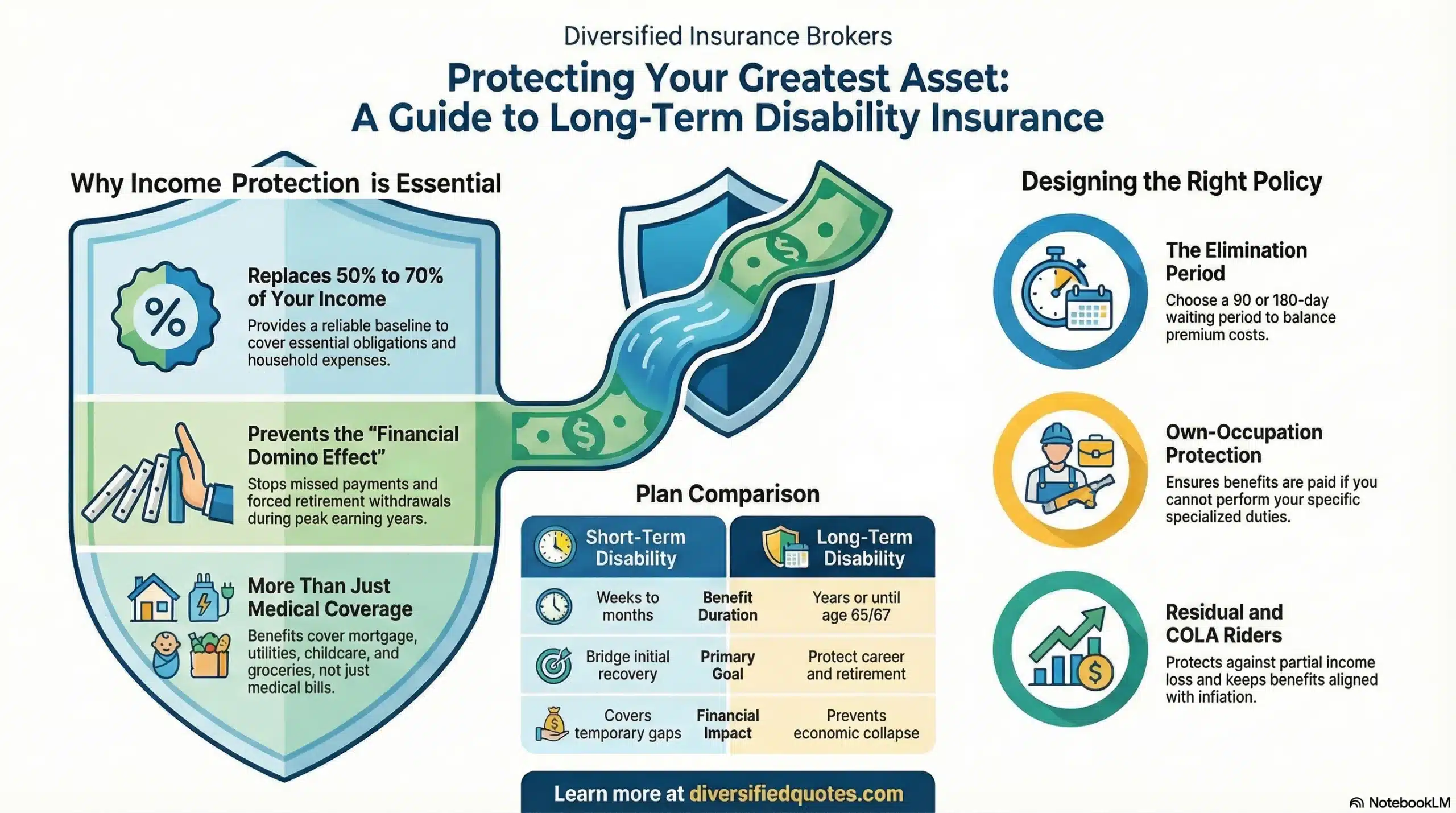
The base policy provides the foundational terms. The riders determine whether those terms remain adequate across a 25-year career. The full rider landscape is covered at disability insurance riders explained — for anesthesiologists, several deserve specific attention. The residual disability rider pays proportional benefits when you can work in a reduced capacity but experience income loss — a realistic scenario for musculoskeletal conditions that limit case volume or procedure types before resulting in complete inability to practice. Many anesthesiology disability claims involve a graduated reduction in clinical capacity rather than immediate total disability, making residual coverage among the most practically valuable features. The future increase option allows coverage to be expanded as income grows without new medical underwriting — critical for anesthesiologists early in their careers when income is still rising toward its peak and any health change after policy issue would prevent future applications for additional coverage. The cost-of-living adjustment rider increases benefits annually during a long-term claim to offset inflation — for a disability beginning at age 40 that continues for 20 years, the purchasing power difference between a static benefit and a 3% compounding COLA benefit is substantial. The non-cancellable and guaranteed renewable policy form — which locks both premium and benefit terms for the life of the policy — should be the baseline standard for any individual LTD policy purchased by a physician.
Tax Treatment and How to Structure Coverage
When an anesthesiologist pays disability insurance premiums with personal after-tax dollars — meaning neither the practice nor an employer funds the premium — the benefits received during a disability are generally income-tax-free. Every benefit dollar is available for personal use without a tax reduction at exactly the point when maximum liquidity matters most. This tax-free treatment is a significant planning advantage for individual LTD policies compared to employer-paid group arrangements, where premium deductibility makes benefits taxable to the recipient at claim time. The full tax framework for disability benefits across individual policies, group plans, and business-owned structures is covered at are disability insurance payments taxable. For anesthesiologists employed by a hospital or health system where the employer pays a group disability premium, evaluating the after-tax benefit amount — not the gross benefit — is essential for understanding the actual income replacement the group plan provides.
Group Practice and Business Overhead Considerations
Anesthesiologists in private group practices or independent contractor arrangements often have a dual financial exposure during a disability: personal income loss and continuing practice overhead obligations. Personal LTD addresses the household income side. Business Overhead Expense coverage addresses the fixed practice costs — medical malpractice insurance, office rent, staff payroll, equipment, and credentialing costs — that continue regardless of whether clinical production is occurring. For group practices where a specific anesthesiologist is responsible for a meaningful share of revenue or client-hospital relationships, key person disability insurance can provide a business-level funding mechanism separate from personal income replacement. The full long-term disability insurance framework, including benefit period selection and how to coordinate personal and business coverage layers, covers how these tools work together for practice-owning physicians.
Residents and Fellows — Why Early Application Matters
The best time for an anesthesiologist to apply for disability coverage is during residency or fellowship training, before any health history creates complications or before the high-stress demands of practice introduce conditions that would affect underwriting. Many carriers offer resident-specific programs that allow coverage to be secured at discounted rates during training with future increase options that allow the benefit amount to expand as attending income is reached — without requiring new medical underwriting for the increases. The disability insurance for medical residency page covers these programs in detail, including how to lock in coverage early and what to look for in a resident-phase policy. For anesthesiologists applying for the first time after completing training, no-exam disability insurance covers what simplified underwriting programs are available and when a fully underwritten policy at a carrier with favorable physician guidelines produces a stronger long-term outcome.
Working With an Independent Disability Insurance Broker
Disability insurance for procedural physicians is highly specialized, and the policy differences between carriers — in occupational class, definition wording, mental/nervous benefit terms, and substance use coverage — are significant enough that shopping the full market before submitting any application is essential. A captive or single-carrier agent can show you one company’s guidelines. An independent broker can identify which carrier classifies anesthesiology most favorably, compare the actual definition wording across multiple policies on a side-by-side basis, and submit to the right carrier the first time rather than allowing an adverse underwriting decision to enter the MIB record. Why work with an independent disability insurance broker covers the structural advantage of independent market access for specialty physician cases. For anesthesiologists who have received an existing quote or already hold a policy and want an independent evaluation before committing or renewing, get a 2nd opinion on your disability insurance quote covers what an independent review involves and what it typically reveals.
Talk With an Advisor Today
Choose how you’d like to connect—call or message us, then book a time that works for you.
Schedule here:
calendly.com/jason-dibcompanies/diversified-quotes
Licensed in all 50 states • Fiduciary, family-owned since 1980
FAQs: Disability Insurance for Anesthesiologists
Why is disability insurance especially critical for anesthesiologists compared to other physicians?
Anesthesiology income depends on the ability to perform a narrow, highly specialized set of clinical functions — administering anesthesia, managing airways, performing spinal and epidural placements, and maintaining intraoperative monitoring. Conditions that prevent these specific tasks, including fine motor impairment, cognitive changes affecting sustained vigilance, musculoskeletal conditions limiting procedural posture, substance use disorders, and mental health conditions, can end an anesthesiology career while leaving the physician otherwise functional. Without true own-occupation coverage, none of those scenarios necessarily trigger benefits under any-occupation or modified definitions. The specialty also carries a documented elevated risk of substance use disorder due to occupational access to controlled substances — a risk that group plans frequently exclude or cap at 24 months, making individual coverage essential.
What definition of disability should an anesthesiologist require in a policy?
True own-occupation is the only definition that provides adequate protection for anesthesiologists. This pays benefits when you cannot perform the material duties of your specific specialty — even if you can work in another medical role or non-clinical capacity at full income. Any-occupation and modified own-occupation definitions require that you be unable to work in any occupation you are reasonably suited for by education, training, or experience — a threshold that most career-limiting anesthesiology conditions do not meet. An anesthesiologist who cannot safely practice anesthesia but could work as a hospitalist, consultant, or administrator would receive no benefits under an any-occupation policy. True own-occupation ensures that the inability to practice the specialty is the standard, not the inability to work at all.
Does disability insurance cover substance use disorders for anesthesiologists?
Individual disability policies with broad mental and nervous coverage typically include substance use disorder claims without carving out the condition or limiting the benefit period to 24 months. Group disability plans commonly either exclude substance use claims or limit them to 24-month benefit periods — which is insufficient for the actual duration of privilege suspension, treatment, and monitoring that substance use disorder cases typically involve in anesthesiology. This is one of the most significant coverage gaps between group LTD and individual policies for this specialty, and one of the most important reasons anesthesiologists should maintain individual coverage independently of any employer-provided group plan. The substance use coverage terms should be explicitly reviewed before purchasing any policy.
How much disability coverage can an anesthesiologist buy?
Most individual disability insurance carriers cap monthly benefits at $15,000-$20,000 per month. For anesthesiologists earning $300,000-$500,000+ annually, a single policy may not provide adequate coverage to replace 60-70% of income. Anesthesiologists at higher income levels can stack policies from multiple carriers — each with their own cap — to achieve a combined benefit amount that provides meaningful income replacement. Financial documentation is required to support benefit amounts above certain thresholds, so having organized income records before applying is important. Benefits from individually owned policies paid with after-tax premiums are generally received income-tax-free, which improves the effective replacement ratio compared to the gross benefit percentage.
When is the best time for an anesthesiologist to apply for disability insurance?
The best time is during residency or fellowship training — before any health history creates underwriting complications and before the high-stress demands of anesthesiology practice introduce conditions that could affect future applications. Many carriers offer resident-specific programs with discounted premiums and future increase options that allow coverage to expand to attending-level income without new medical underwriting. Waiting until after training produces no coverage advantage and creates the risk that health changes during the residency period — which are not uncommon given the demands of anesthesiology training — could limit coverage options or increase premiums when an application is eventually submitted.
About the Author:
Jason Stolz, CLTC, CRPC, DIA, CAA and Chief Underwriter at Diversified Insurance Brokers (NPN 20471358), is a senior insurance and retirement professional with more than 25 years of real-world experience helping individuals, families, and business owners protect their income, assets, and long-term financial stability. As a long-time partner of the nationally licensed independent agency Diversified Insurance Brokers, Jason provides trusted guidance across multiple specialties—including fixed and indexed annuities, long-term care planning, personal and business disability insurance, life insurance solutions, Group Health, Travel Medical and Evacuation Insurance, and short-term health coverage. Diversified Insurance Brokers maintains active contracts with over 100 highly rated insurance carriers, ensuring clients have access to a broad and competitive marketplace.
His practical, education-first approach has earned recognition in publications such as VoyageATL, and contributions from his agency featured in Kiplinger and GoBankingRates— highlighting his commitment to financial clarity and client-focused planning. Drawing on deep product knowledge and years of hands-on field experience, Jason helps clients evaluate carriers, compare strategies, and build retirement and protection plans that are both secure and cost-efficient. Visitors who want to explore current annuity rates and compare options across multiple insurers can also use this annuity quote and comparison tool.
Explore More Disability Insurance Options: Browse our complete guide to Disability Insurance for Physicians & Medical Specialists — covering physicians, surgeons, anesthesiologists, radiologists, podiatrists & medical specialists from 100+ carriers.
Last Reviewed: June 5, 2026 |
Reviewed by: Jason Stolz, CLTC, CRPC, DIA, CAA
Chief Underwriter, Diversified Insurance Brokers, Inc. | NPN: 20471358 | Diversified Insurance Brokers, Inc. — Licensed in all 50 states
Fact Checked by: Tonia Pettitt, CMIP©
Medicare Specialist, Diversified Insurance Brokers, Inc. | NPN: 14374308 | Diversified Insurance Brokers, Inc. — Licensed in all 50 states
Did you find this content helpful? Leave us a Google review — it helps others find trustworthy guidance too.
Editorial Standards: Diversified Insurance Brokers maintains rigorous editorial standards to ensure accuracy, clarity, and independence in all content. Learn more about our editorial standards and commitment to transparency.
