
No Exam Disability Insurance
As an Independent Disability Insurance Broker, we have access to exclusive discounts and negotiated pricing most captive agents can’t offer — see the full breakdown near the end of this page.
No Exam Disability Insurance

Jason Stolz CLTC, CRPC, DIA, CAA
No exam disability insurance — also called simplified-issue disability insurance — gives qualified applicants the ability to secure real monthly income protection with a faster, lower-friction approval process than traditional disability underwriting requires. Instead of blood draws, paramed exams, full medical records requests, and weeks of back-and-forth underwriting, simplified-issue plans typically rely on a short health questionnaire, prescription history check, and basic occupational information. For many working adults, that means moving from “I should do this” to “I’m protected” without scheduling a single appointment or producing a filing cabinet of financial documents.
At Diversified Insurance Brokers, we specialize in disability income strategies designed for speed, flexibility, and real-world use. We help W-2 professionals, self-employed individuals, and 1099 contractors secure coverage that protects cash flow if illness or injury prevents them from working — without the delays that discourage most people from applying in the first place. The risk is always “now.” A no-exam policy in force today protects you. A fully underwritten policy you have been meaning to start does not.
Get No-Exam Disability Coverage Options
Answer a few questions and we’ll compare simplified-issue disability plans designed for fast approval — no medical exams required.
Request a QuoteLicensed nationwide • Independent comparisons • Clear plan design guidance
What Is No Exam Disability Insurance?
No exam disability insurance is individual disability income coverage built to remove the biggest barriers to getting approved. In traditional disability underwriting, carriers often request medical records, paramed exams, lab work, detailed income documentation, and extended follow-up — especially if the benefit amount is high or the applicant is self-employed. Simplified-issue disability coverage streamlines that process so the approval decision can be made faster and with fewer steps.
Most no-exam disability policies still involve underwriting — it is just simplified underwriting. Instead of a paramed exam, you complete a short health questionnaire and authorize access to prescription history. Carriers also review your occupation and employment structure to determine eligibility and monthly benefit limits. If approved, the policy pays a monthly benefit when a covered sickness or injury prevents you from performing your occupation based on the contract’s disability definition. That benefit can be applied to housing, utilities, groceries, insurance premiums, and other obligations — helping you remain financially stable while you recover.
It also helps to clarify what “no exam” does not mean. It does not mean “no questions.” It does not mean “guaranteed issue.” It means the carrier is offering a faster approval path using simplified underwriting rules designed for efficiency. For many people, that is exactly what they want: a clear process and a practical level of income protection without the delays, the exam scheduling, or the documentation demands that stop most people from ever completing a traditional disability application. If you want to understand the full disability insurance landscape before comparing options, our disability insurance services overview provides the foundational framework, and our resource on why people buy disability insurance explains the core protection logic that makes this coverage essential regardless of how it is underwritten.
| Feature | No-Exam Simplified Issue DI | Guaranteed Issue DI (Group / Worksite) | Fully Underwritten Individual DI | Best Fit |
|---|---|---|---|---|
| Medical exam required | No — health questions only; no blood draw or physical | No — no health questions at all during open enrollment | Yes — paramedical exam, blood panel, attending physician statements may apply | No-exam: fastest path to individual coverage without full medical underwriting |
| Typical monthly benefit maximum | Often $5,000–$10,000/mo depending on carrier and occupation | Often $2,000–$6,000/mo; employer plan limits apply | Up to 60–70% of income; highest benefit amounts available | Full underwriting: highest income replacement for professionals with high earnings |
| Definition of disability | Own-occupation available at select carriers; verify before applying | Usually any-occupation or modified own-occupation; rarely true own-occupation | True own-occupation available; strongest definition on the market | Full underwriting: best for professionals who need own-occupation protection |
| Benefit period options | 2 years, 5 years, or to age 65 depending on carrier | Typically 2–5 years; rarely extends to age 65 | 2 years, 5 years, 10 years, or to age 65/67; most flexible benefit period selection | Full underwriting: best for long benefit periods extending to retirement age |
| Elimination period options | 30, 60, 90, or 180 days depending on carrier and product | Often 60 or 90 days; limited flexibility in employer plan design | 30 to 730 days; widest selection for matching to savings and employer coverage | See elimination periods explained |
| Pre-existing condition coverage | May exclude or limit for conditions disclosed on application; varies by carrier | Pre-ex exclusions typically apply for 12–24 months from effective date during open enrollment | Full underwriting evaluates history; some conditions excluded, rated, or waived; some covered if stable | See DI with pre-existing conditions |
| Occupation classes accepted | Varies; some carriers limit higher-risk occupations; professional classes typically accepted | Employer plan covers all enrolled employees regardless of occupation | Full range; occupation class determines pricing and available benefit amounts | See DI by occupation |
| Available to self-employed / 1099 | Yes — individual policy; no employer required | Generally no — requires employer group or association | Yes — individual policy; income documentation required | See DI for self-employed and 1099 workers |
| Portability | Fully portable — individual policy follows you regardless of employer or job change | Typically not portable — tied to employer or group membership | Fully portable — individual policy; non-cancelable and guaranteed renewable available | Individual policies (no-exam or fully underwritten) provide the strongest long-term portability |
| Premium stability | Level premiums available; non-cancelable and guaranteed renewable options at select carriers | Premium can change at renewal; employer contribution may change | Non-cancelable and guaranteed renewable available; strongest premium protection | See best disability insurance rates |
| Time to approval | Often 24–72 hours after application; fastest path to individual coverage | Immediate during open enrollment window; no underwriting delay | 2–8 weeks depending on medical records and exam scheduling | No-exam: best when speed of coverage is a priority alongside individual policy portability |
Why People Choose No-Exam Disability Coverage
Most people do not delay disability insurance because they think it is a bad idea. They delay it because the process feels complicated, slow, or invasive. Simplified-issue disability insurance solves the friction problem directly. If you are busy, travel frequently, work long hours, or simply do not want to schedule exams and lab work around a demanding schedule, no-exam coverage is often the most realistic path to getting protected.
Speed matters in income protection because the risk is always present. You cannot schedule an illness or injury for a convenient time. A fast, streamlined approval process is a practical advantage if you have been meaning to apply but have not had the time — or if your household has become more dependent on your income due to a new mortgage, student loan obligations, childcare costs, or a shift to a single income. The financial pressure of a sudden disability is the same regardless of whether you have a fully underwritten policy or a simplified-issue one — the only difference is whether you have protection in place when it happens.
Another common reason people choose simplified disability is process certainty. Traditional underwriting can become a long, multi-stage process with unclear timelines and unpredictable requests. Simplified-issue designs are more predictable: the questions are defined, the timeline is shorter, and the outcome is clearer. While monthly benefit caps may be lower than fully underwritten policies, many applicants find the tradeoff worthwhile — getting meaningful baseline protection quickly is more valuable than indefinitely pursuing a maximum benefit amount through a process that may never get completed.
Who Qualifies for No-Exam Disability Insurance?
Simplified disability policies are generally designed for working adults in common working-age ranges with steady income who want efficient protection. Eligibility depends on the specific carrier and program, but benefit limits are typically determined by age, occupation class, and employment structure. Approval odds are strongest when health history is stable, occupational duties are clearly defined, and income is consistent.
W-2 employees often fit simplified underwriting well because income is straightforward to document and job duties are easier to classify. Many W-2 professionals appreciate the convenience of simplified underwriting because they can often avoid producing extensive financial records just to establish a baseline of income protection.
Self-employed professionals and 1099 contractors are also strong candidates for no-exam disability coverage — particularly when they want to avoid the documentation requirements that can slow traditional underwriting. Simplified-issue designs can reduce those requirements and provide a more accessible path to meaningful monthly protection. For a complete look at how disability insurance works for self-employed applicants, see our resource on disability insurance for the self-employed, and our resource on disability insurance for independent contractors covers the specific considerations for 1099 and contract-based income earners.
How Much Coverage Can You Get Without an Exam?
The monthly benefit available under no-exam disability policies depends on the carrier, your occupation class, age, and earnings. Many simplified-issue designs provide benefit amounts covering core monthly living expenses — housing, utilities, insurance premiums, minimum debt payments, and groceries — that keep a household financially stable through a recovery period. The right way to think about benefit amount is not “how high can I go?” but “how much monthly cash flow do I need to keep life stable if my paycheck stops?”
Simplified-issue coverage is also frequently used to fill gaps created by employer group plan caps and limitations. Group coverage often replaces a percentage of income but imposes a monthly payout ceiling, which creates a larger unprotected gap as income rises. A simplified individual policy can help reduce that exposure without requiring a full underwriting process. Our guide on how much disability insurance you need helps frame the right benefit amount around actual expenses and real risk windows, and our resource on guaranteed issue group disability insurance explains how group coverage is structured and where individual policies fill the consistent gaps it creates.
Benefit Periods, Elimination Periods, and Policy Structure
Even simplified-issue plans give you key design choices that shape both premium and real-world protection. The three primary variables are monthly benefit amount, elimination period (waiting period), and benefit period (how long benefits can last).
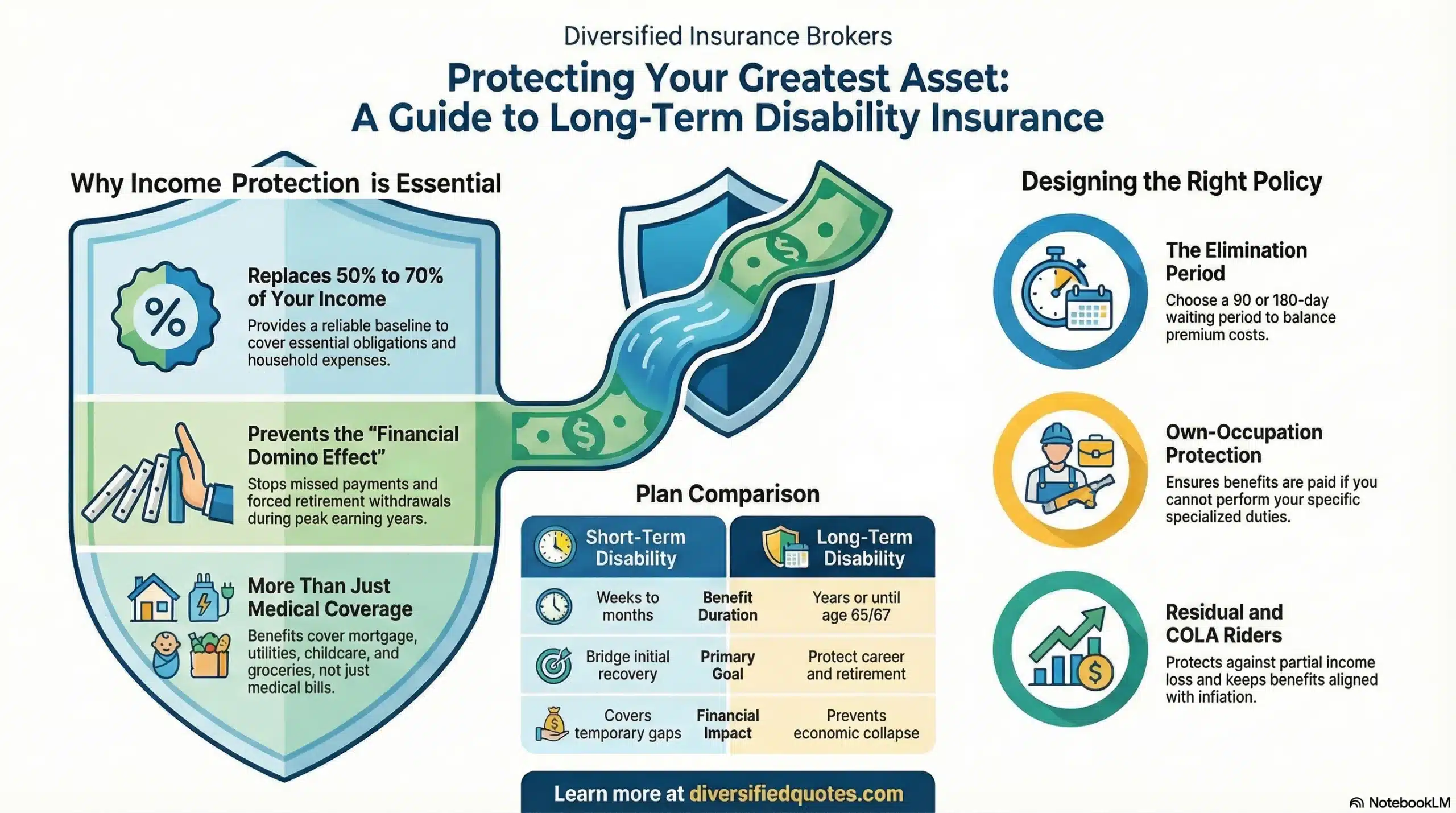
Elimination period: This is how long you must be disabled before benefits begin. A longer waiting period reduces premium because you are effectively self-insuring the early stage of the income interruption. Many people choose an elimination period that aligns with their emergency fund or any short-term disability resources they already have. If savings are limited, a very long waiting period can create financial stress at exactly the moment you are managing a medical disruption. Our resource on disability insurance elimination periods explained provides the full framework for calibrating this choice to your actual financial situation.
Benefit period: This is how long benefits can continue once you qualify. Some plans are designed for short-term protection of one to five years, while others extend to age 65 to protect the larger risk window of a career-length disability. The more your household and long-term financial plan depend on your income, the more important the benefit period becomes. A disability at age 38 that is covered only for five years still leaves 22 years of career income unprotected.
Definition of disability: Even in simplified plans, the definition of disability matters. Policies vary in how they define what it means to be disabled and what it takes to qualify for benefits. If your work is specialized — or your most realistic disability scenario involves reduced capacity rather than total incapacity — definition language can be the difference between meaningful protection and disappointment at claim time. For a detailed look at how definition structure works, see our resource on own-occupation disability insurance, which explains the most important definition distinction in disability insurance.
Residual and Partial Disability: Often More Valuable Than People Realize
Many people imagine disability as an all-or-nothing event — either you can work or you cannot. In reality, many disability claims involve reduced capacity and reduced income rather than complete inability to work. That is where residual or partial disability benefits become extremely valuable. These provisions can pay proportionately when you return to work on a reduced schedule or experience a loss of income due to a covered condition even if you are not totally disabled.
This matters for professionals who can still show up to work but cannot perform their job at full capacity, and for self-employed people whose income drops because they cannot maintain the same production, travel, or workload. A strong residual design prevents the coverage gap where you are medically affected but not “disabled enough” under a strict total-disability standard. When comparing simplified-issue options, residual benefit structure is one of the provisions we examine most carefully because that is often where real-world claim value shows up. Our resource on residual disability insurance benefits explained covers how proportionate benefits work in practice.
Tax Treatment: Why Disability Benefits Are Surprisingly Efficient
When premiums are paid with after-tax dollars, disability insurance benefits are typically received tax-free. This matters because the goal of disability coverage is to replace spendable income — not just taxable income. A tax-free benefit effectively covers a larger portion of your real monthly lifestyle than a taxable benefit of the same gross dollar amount would. For context on how this works in practice, our resource on whether disability insurance payments are taxable explains the rules clearly.
Tax treatment can vary depending on how coverage is structured — especially if an employer pays premiums or if premiums are deducted pre-tax — so it is important to understand how your specific arrangement works. But for most individuals buying personal disability coverage with after-tax dollars, the potential for tax-free benefits is one reason disability coverage delivers strong financial value relative to its premium cost.
A Strong Option for Self-Employed and 1099 Professionals
Self-employed individuals and independent contractors face income risks that are more acute than those of W-2 employees because there is no employer providing sick leave, no HR department processing short-term disability claims, and no group policy providing even a baseline of income replacement when work stops. Even a short disability interruption can strain both household and business finances simultaneously. No-exam disability insurance provides an accessible path to income protection without requiring the complex financial documentation that can slow traditional underwriting for self-employed applicants.
If you are self-employed, it is worth thinking about disability coverage in two layers. Personal disability protects your household income. If your business has fixed overhead that continues even when you cannot work — rent, payroll, utilities, insurance — Business Overhead Expense (BOE) coverage is the difference between “recovery” and “business crisis.” Our resource on business overhead disability insurance explains how BOE coverage works alongside personal disability protection for business owners and self-employed professionals. Our resource on disability business overhead expense coverage covers the specific expenses BOE policies reimburse and how the benefit calculation works.
How No-Exam Disability Fits With Short-Term and Long-Term Coverage
No-exam disability coverage works as a standalone solution but also functions well as part of a layered income protection strategy. Some people use simplified-issue coverage to get protected quickly, then later evaluate whether to add or supplement coverage through fully underwritten long-term disability. Others pair simplified long-term coverage with short-term disability protection so they have income replacement across both the early and extended phases of a disability — eliminating the coverage gap that exists when a long elimination period on the long-term policy has not yet been satisfied.
If you are primarily concerned about the first few months after a surgery, injury, or illness, short-term disability may be your first protection layer. If you are concerned about a longer interruption that threatens retirement savings and long-term financial stability, long-term disability is the critical layer. For a self-directed path to short-term coverage, see how to buy short-term disability insurance online, and our resource on short-term vs. long-term disability insurance explains how these two protection layers differ and how they work together.
Common Mistakes to Avoid With No-Exam Disability Insurance
Because simplified plans are easier to obtain, some people treat them as a quick checkbox purchase. The smarter approach is to treat simplified disability the same way you would treat any income strategy: match it to real obligations and real risk windows.
Choosing a benefit that is too low. A very small monthly benefit may feel inexpensive, but it may not protect the bills that matter. Start with essentials — housing, utilities, minimum debt payments, insurance premiums, and food — then choose the benefit that makes those obligations sustainable during a disability period.
Choosing a waiting period you cannot bridge. Premium savings are real when you extend the elimination period, but only if you have savings or other resources to cover the gap. If you do not, a long waiting period can become a financial stressor during an already stressful medical situation.
Ignoring definition and residual benefits. Even simplified policies have contract language that determines when and how benefits pay. If your job is specialized — or your most likely disability scenario involves reduced capacity rather than complete inability to work — residual benefits and definition structure can be where the real claim value lives.
Assuming employer coverage is enough. Group plans often cap benefits and lose portability when you change jobs. Simplified-issue individual coverage can be a practical way to reduce the gap without committing to a lengthy underwriting process. Our resource on whether disability insurance is worth it provides the value framework for evaluating coverage relative to the actual financial exposure a disability would create at your income level.
Why Work With Diversified Insurance Brokers
Diversified Insurance Brokers is a family-owned, fiduciary insurance agency licensed in all 50 states. Since 1980, we have helped individuals and business owners secure objective, carrier-neutral insurance solutions that protect income, assets, and families. We work with more than 75 A-rated insurance carriers and understand which companies offer the most competitive simplified-issue disability options for different occupations and income types. Our role is to compare plans, explain trade-offs clearly, and help you secure coverage that actually works when you need it — without pushing you into an overbuilt plan or an unnecessarily complicated process. Our resource on why working with an independent disability insurance broker matters explains how carrier-neutral advice produces better coverage outcomes than working with a single-carrier agent, and our resource on how to get the best disability insurance rates explains all the factors that determine both coverage quality and cost.
Request a No-Exam Disability Insurance Quote
Compare simplified-issue disability plans with fast approval and no medical exams. We’ll help you choose benefit amount, waiting period, and duration that fit real-world needs.
Get My QuoteQuestions? Call 800-533-5969
Related Disability Insurance Pages
Explore disability coverage types, definitions, and buying guides to compare options and close coverage gaps.
Related Planning and Income Continuity Pages
Disability protection is strongest when it supports the bigger plan — cash flow stability today and income continuity long-term.
Talk With an Advisor Today
Choose how you’d like to connect—call or message us, then book a time that works for you.
Schedule here:
calendly.com/jason-dibcompanies/diversified-quotes
Licensed in all 50 states • Fiduciary, family-owned since 1980
Frequently Asked Questions: No Exam Disability Insurance
No exam disability insurance — also called simplified-issue disability insurance — is individual disability income coverage that removes the medical exam and lab work requirements from the approval process. Traditional disability underwriting often requires blood draws, a paramed examination, full medical records, and extended financial documentation. Simplified-issue coverage replaces most of that with a short health questionnaire and a prescription history check, allowing approval decisions to be made in days rather than weeks or months.
It is important to understand that “no exam” does not mean “no questions” and does not mean “guaranteed issue.” Underwriting still happens — it is just faster and less invasive. The carrier makes a decision based on the information you provide and data they can access quickly, rather than requiring a full clinical workup. Our disability insurance services overview provides full context on how simplified-issue fits within the broader disability coverage landscape.
Simplified-issue disability insurance is generally available to working adults approximately ages 18 to 60 with steady income. Eligibility and benefit limits vary by carrier, but typical monthly benefit maximums are up to $8,000 per month for applicants ages 18 to 50 and up to $6,000 per month for applicants ages 51 to 60. W-2 employees may qualify for income-verification-free benefits up to $6,000 per month; self-employed and 1099 applicants typically qualify up to $4,000 per month without income documentation, subject to carrier-specific rules.
Approval odds are strongest when health history is stable, occupation is clearly defined, and income is consistent. Working with an independent broker who has experience placing simplified-issue applications across multiple carriers is the most effective way to identify the program that best fits a specific situation. Our resource on how to get the best disability insurance rates explains the factors that shape eligibility and cost.
Often no — up to the published benefit limits for your age and employment type. Many simplified-issue programs allow W-2 employees to qualify for a specified monthly benefit without submitting pay stubs or tax returns. Self-employed and 1099 applicants can qualify for a somewhat lower threshold without full income documentation. Above those limits, or for certain occupations or benefit amounts, carriers may request supporting documentation such as recent pay stubs or the prior year’s tax return.
This feature is particularly valuable for self-employed applicants who would otherwise need to produce multiple years of tax returns and financial statements under traditional underwriting. Our resource on disability insurance for the self-employed covers the full income documentation picture for self-employed applicants.
Many simplified-issue disability policies can be approved within a few business days once your application and electronic signatures are complete — significantly faster than traditional disability underwriting, which can take 4 to 8 weeks or more when medical records requests and paramed exams are involved. Coverage typically begins as soon as the policy is issued and the first premium payment is processed.
This speed is one of the most meaningful practical advantages of simplified-issue disability coverage. The financial risk of being unprotected exists every day you are working without a policy in force. A fast approval process eliminates the window of exposure that a lengthy traditional underwriting process creates.
When premiums are paid with after-tax dollars — the case for most individuals purchasing personal disability insurance independently — benefits are typically received tax-free. This is one of the most financially significant features of disability insurance: it replaces spendable income, not just gross income. A tax-free monthly benefit effectively covers a larger portion of your actual lifestyle expenses than a taxable benefit of the same dollar amount.
Tax treatment can vary depending on how coverage is structured. If an employer pays premiums on your behalf, or if premiums are deducted pre-tax through a Section 125 arrangement, benefits may be taxable as ordinary income. Our resource on whether disability insurance payments are taxable explains the rules in full and covers the situations where treatment differs.
The elimination period — the waiting period before benefits begin — should align with how long you could cover essential expenses from savings before needing benefits to start. Common options range from 30 to 180 days. A shorter elimination period costs more but provides earlier benefit access, which matters most when emergency savings are limited. A longer elimination period reduces premium but requires you to genuinely bridge the gap before benefits begin.
The benefit period — how long benefits can continue — should reflect the size of the income risk you are protecting. A one- to five-year benefit period addresses shorter disruptions. A benefit period to age 65 protects the largest risk: a disability that prevents you from working for a decade or more during peak earning years. The more your financial plan depends on your continued income, the longer the benefit period you need. Our resource on disability insurance elimination periods explained provides the full calibration framework for both choices.
Yes — many simplified-issue disability policies include residual or partial disability provisions, or offer them as an optional rider. Residual benefits pay a proportionate benefit when a covered disability reduces your income but does not completely eliminate your ability to work. This matters because many real-world disability claims involve reduced capacity, reduced hours, or reduced productivity that produces meaningful income loss without meeting a strict total-disability threshold.
For professionals who can still work but not at full capacity, or for self-employed individuals whose income drops because they cannot maintain the same workload, residual benefits provide income support that a total-disability-only policy would miss entirely. Our resource on residual disability insurance benefits explained covers how these provisions work and what to look for when comparing policies.
Coverage for mental health and nervous conditions varies by carrier, program, and state. Some simplified-issue disability policies include mental and nervous condition coverage but with a limited benefit period — commonly 24 months — while others provide coverage under the same terms as physical conditions. The specific mental health provisions in a given policy are one of the most important details to confirm before purchasing, as this can be a significant difference between otherwise similar plans.
If mental health coverage without a benefit period limitation is important for your situation, confirming that the selected policy does not apply a 24-month mental health cap is an essential evaluation step. Our resource on disability insurance riders explained covers how mental health provisions are structured across different policy types.
Premiums for simplified-issue disability insurance are competitive and in many cases comparable to fully underwritten policies for applicants in good health. The convenience and speed of simplified underwriting do not always come with a significant premium increase — particularly for younger applicants with clean health histories who represent favorable risks for carriers.
Where differences are most likely to appear is in benefit limits and available riders rather than in base premium cost. Fully underwritten policies can offer higher monthly benefit amounts, a wider range of optional riders, and in some cases stronger definition language. Simplified-issue policies trade some of that flexibility for speed and accessibility. Our resource on whether disability insurance is expensive provides a cost framework, and our disability insurance second opinion service provides an independent comparison if you have already received quotes.
Getting a quote is straightforward. Use our secure quote request form to share basic information about your occupation, income structure, and coverage goals. We compare simplified-issue disability options across multiple carriers and provide a clear comparison of benefit amounts, elimination periods, benefit periods, and premium ranges — so you can make an informed decision without navigating carrier-specific programs on your own.
There is no obligation and no exam required to get a quote. Once you review options and decide on a coverage structure, the application is typically completed electronically with e-signatures and approval decisions are usually returned within a few business days. Request a disability insurance quote here to get started, or call us at 800-533-5969 to speak with an advisor directly.
About the Author:
Jason Stolz, CLTC, CRPC, DIA, CAA and Chief Underwriter at Diversified Insurance Brokers (NPN 20471358), is a senior insurance and retirement professional with more than 25 years of real-world experience helping individuals, families, and business owners protect their income, assets, and long-term financial stability. As a long-time partner of the nationally licensed independent agency Diversified Insurance Brokers, Jason provides trusted guidance across multiple specialties—including fixed and indexed annuities, long-term care planning, personal and business disability insurance, life insurance solutions, Group Health, Travel Medical and Evacuation Insurance, and short-term health coverage. Diversified Insurance Brokers maintains active contracts with over 100 highly rated insurance carriers, ensuring clients have access to a broad and competitive marketplace.
His practical, education-first approach has earned recognition in publications such as VoyageATL, and contributions from his agency featured in Kiplinger and GoBankingRates— highlighting his commitment to financial clarity and client-focused planning. Drawing on deep product knowledge and years of hands-on field experience, Jason helps clients evaluate carriers, compare strategies, and build retirement and protection plans that are both secure and cost-efficient. Visitors who want to explore current annuity rates and compare options across multiple insurers can also use this annuity quote and comparison tool.
Explore More Disability Insurance Options: Browse our complete guide to Disability Insurance Planning & Education — covering how it works, riders, elimination periods, own occupation, costs & buying guides from 100+ carriers.
Last Reviewed: June 15, 2026 |
Reviewed by: Jason Stolz, CLTC, CRPC, DIA, CAA
Chief Underwriter, Diversified Insurance Brokers, Inc. | NPN: 20471358 | Diversified Insurance Brokers, Inc. — Licensed in all 50 states
Fact Checked by: Tonia Pettitt, CMIP©
Medicare Specialist, Diversified Insurance Brokers, Inc. | NPN: 14374308 | Diversified Insurance Brokers, Inc. — Licensed in all 50 states
Did you find this content helpful? Leave us a Google review — it helps others find trustworthy guidance too.
Editorial Standards: Diversified Insurance Brokers maintains rigorous editorial standards to ensure accuracy, clarity, and independence in all content. Learn more about our editorial standards and commitment to transparency.
