
Is Disability Insurance Expensive?
As an Independent Disability Insurance Broker, we have access to exclusive discounts and negotiated pricing most captive agents can’t offer — see the full breakdown near the end of this page.
Is Disability Insurance Expensive?

Jason Stolz CLTC, CRPC, DIA, CAA
Is disability insurance expensive? For most people, the honest answer is no — especially when you compare the cost of the premium to the size of the risk it protects. Disability insurance is income insurance. It replaces a portion of your paycheck if an illness, injury, or medical condition temporarily or long-term prevents you from working. If you rely on your income to pay for housing, family expenses, debt, and retirement progress, disability coverage is one of the most practical financial protections available because it defends the one thing that funds everything else: consistent cash flow.
What makes disability insurance feel confusing is that it is not priced like a simple one-size-fits-all product. The premium is driven by several design levers — your occupation class, your age, the monthly benefit amount, how long you want benefits to last, how long you are willing to wait before benefits begin, and the contract definition that determines when a claim pays. Once you understand those levers, you can almost always shape a policy that is strong enough to matter without being uncomfortable in your budget. At Diversified Insurance Brokers, we help people do exactly that: compare options, understand trade-offs, and choose a design that fits real life.
Another reason people ask “is disability insurance expensive?” is that they compare it mentally to other insurance types. With life insurance, you pay for a benefit that may never be used during your lifetime. With disability insurance, you are paying for a benefit that could be needed while you are alive and working — when losing income creates immediate financial pressure. That is why disability coverage often feels more immediately real than people expect. It protects against a scenario that is not dramatic or rare: being unable to work for a period of time because of something medical. According to the Council for Disability Awareness, just over one in four workers entering the workforce today will experience a disability before they reach retirement age. The risk is not hypothetical.
If you’re researching disability insurance cost, it also helps to read our deeper breakdowns on how much disability insurance costs and how to buy disability insurance online. Many people discover that coverage is more affordable than expected when it is designed correctly.
Estimate Your Disability Coverage Cost
Answer a few questions to see realistic pricing based on your age, occupation class, monthly benefit, and elimination period.
Quick, confidential, and designed for real-world budgets.
Why Disability Insurance Often Costs Less Than People Expect
Disability insurance feels expensive only when you look at the premium as “another monthly bill” rather than as protection for your most valuable financial asset. Your income is not just a paycheck — it is the engine behind your housing stability, your family’s security, your retirement accumulation, and your ability to handle unexpected expenses without stress. If that income stops for even a short period, many households solve the problem with tools that are far more expensive than an insurance premium: high-interest credit cards, early retirement account withdrawals with tax penalties, personal loans, or delayed mortgage payments that damage credit and create stress that compounds the medical problem.
The “real cost” of a disability is rarely just the missed income. It is the chain reaction. People pause retirement contributions and lose employer matching they can never recover. They liquidate investments at precisely the wrong moment — often during a period of market weakness or at a tax-inopportune time. They take on debt they spend years unwinding. A six-month disability that costs $40,000 in missed income can easily cost $60,000 or $70,000 in total financial impact when you account for the downstream decisions it forces. Short-term disability coverage can help prevent that chain reaction by replacing a portion of income during the most financially fragile period: the first weeks or months when a medical event disrupts your life and you want normal obligations to keep running without crisis management.
Disability coverage is also more flexible than most people realize. The policy can be shaped around your budget and your specific risk profile. If you want a lower premium, you can adjust the elimination period, modify the benefit duration, select a benefit amount that stabilizes essentials rather than replacing every dollar, or choose riders strategically. You can explore this approach through resources like how to buy short-term disability insurance online if you want a digital-first comparison path.
What Determines the Cost of Disability Insurance?
Disability insurance is priced based on risk and benefit design. The insurer evaluates the likelihood of a claim and the potential cost of paying benefits given your specific profile and the coverage structure you select. That sounds technical, but it becomes very practical once you understand the levers. Each one can be adjusted — either to reduce premium or to strengthen protection — and understanding the tradeoffs is the key to getting a policy that is both meaningful and sustainable.
1) Your Age at Application
Age is one of the most straightforward pricing factors because disability risk increases as people get older. Musculoskeletal conditions, cardiovascular events, cancer, and other leading causes of disability are more prevalent at older ages, and insurers price that risk accordingly. Buying coverage earlier typically results in a lower premium — and in most non-cancellable individual policies, that lower rate is locked in for the life of the policy. The insurer cannot raise your rate just because you age or because your health changes after the policy is issued.
The additional advantage of buying earlier is the ability to lock in future increase options while you are healthy and insurable — meaning your coverage can grow with your income without re-qualifying medically at each income milestone. If you are in your 20s or 30s and think disability insurance is something to handle “later,” the delay typically means paying more later, and it risks discovering that a minor health development — a back issue, a treated anxiety diagnosis, a change in bloodwork — creates exclusions or limitations you did not anticipate. Buying earlier is as much a “rate lock and insurability lock” strategy as it is a protection strategy.
2) Health and Underwriting Profile
Your health profile influences both your eligibility and your rate class. Underwriting typically evaluates your medical history, prescription medications, height and weight, any prior claims or treatments, and conditions that may increase the likelihood of a disability. A history of back problems, anxiety or depression, diabetes, or prior surgeries does not automatically mean you cannot get coverage — but it typically means the carrier will evaluate that history carefully and may price differently, add condition-specific exclusions, or request additional medical records.
The critical insight here is that different carriers evaluate the same health history differently. One carrier may offer a standard rate with a back exclusion rider on a history of treated lumbar disc issues, while another carrier may offer a rated policy at a higher premium, and a third may decline entirely. An independent brokerage approach reduces the guessing game by matching your specific health profile to the carriers most likely to offer favorable terms. Starting with a quote request is often the most efficient way to understand your actual options without assumptions.
3) Occupation Class
Occupation is one of the largest pricing drivers in disability insurance. Carriers classify occupations into tiers based on duties, physical risk exposure, income stability, and historical claim patterns. Professionals and office workers whose duties are primarily cognitive and sedentary typically qualify for the most favorable occupational classifications. Workers in physically demanding roles, hazardous environments, or trades tend to fall into higher-cost classifications — not just because of injury risk but because a physical limitation has more direct consequences on their ability to perform their specific job.
For professionals, occupation class is also closely tied to the contract definition. A physician, attorney, or dentist whose income depends on the ability to perform specific professional duties has a very different disability risk profile than a generalist who could perform a wide range of work activities. This is why many professionals prioritize own-occupation disability insurance — because that definition recognizes disability as the inability to perform your specific occupation, not just the inability to work in any capacity. For higher earners and executives who often discover their employer coverage caps out far below their actual income level, the framing is explored in detail in disability insurance for executives.
4) Monthly Benefit Amount
The monthly benefit is what the policy pays during an approved claim, and higher benefits mean higher premiums because the insurer assumes greater exposure. Most individual policies are structured to replace 60 to 70 percent of gross monthly income — not 100 percent — both because full replacement creates less financial incentive for recovery and because carriers underwrite to that range by design. At higher income levels, carrier benefit caps often mean that full replacement requires coverage from more than one policy.
A practical approach to sizing the benefit is to start with your monthly obligations that are genuinely non-negotiable: housing, utilities, food, insurance premiums, loan and debt payments, childcare — and then determine whether you also want the benefit to cover longer-term momentum items like retirement contributions. The goal is not to “max out” coverage. The goal is to cover what matters most reliably and sustainably. Our resource on how much disability insurance you need provides a structured framework for working through this calculation given your specific income and obligations.
5) Elimination Period (Waiting Period)
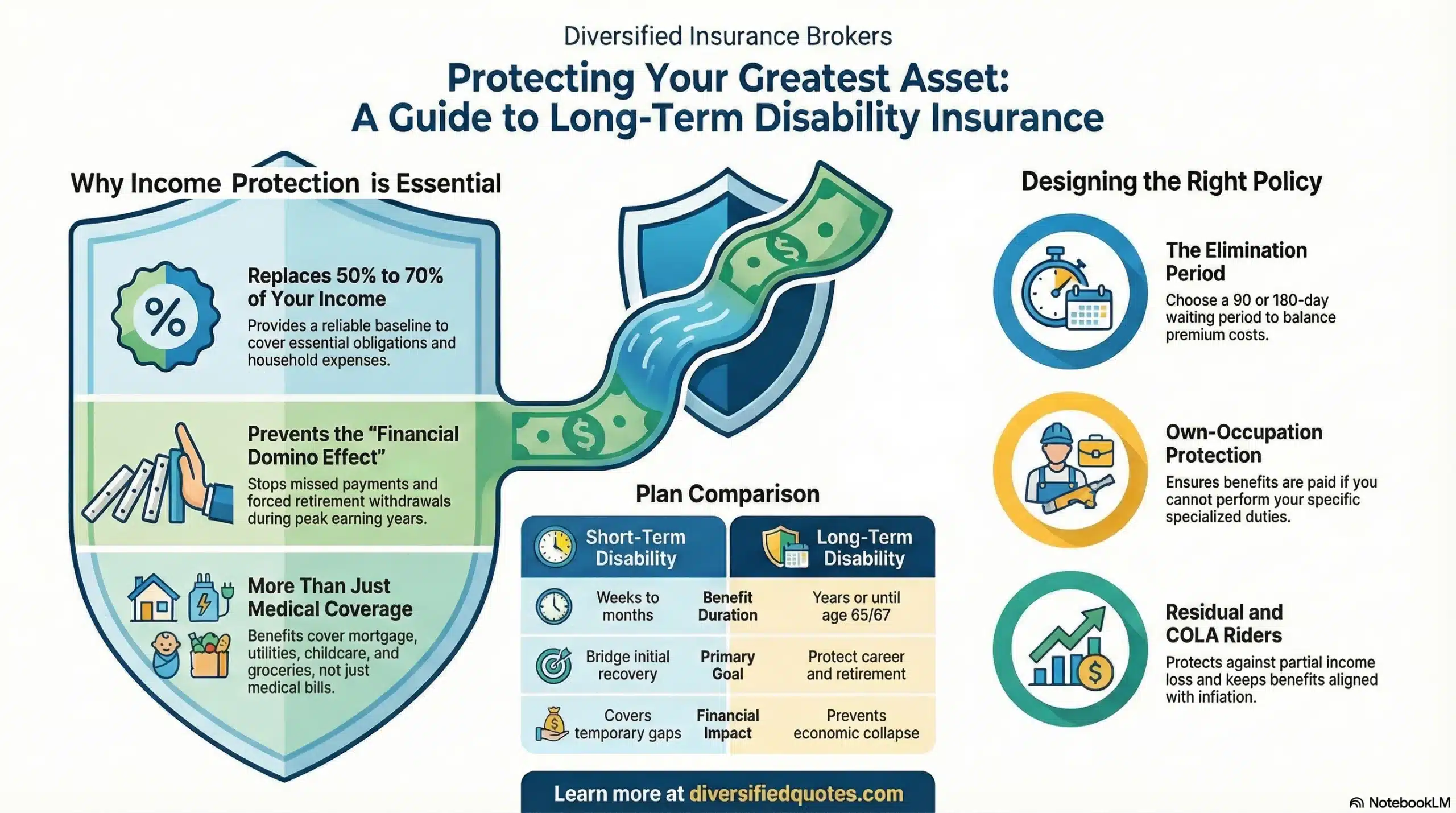
The elimination period is the length of time you must be continuously disabled before benefits begin. Common options are 30, 60, 90, or 180 days. Choosing a longer elimination period reduces the premium because you are self-insuring the early portion of any disability — the insurer’s financial exposure begins later, and short-duration claims that would trigger a 30-day elimination period do not trigger a 90-day one. The right elimination period depends on your cash reserves, any employer-provided sick leave, any short-term disability group coverage you have, and your honest assessment of how long you could sustain household obligations without income.
One of the most common and effective premium reduction strategies is extending the elimination period from 30 or 60 days to 90 days — if you have at least 90 days of genuine liquid reserves available. This often produces meaningful premium savings while still fully protecting against the scenario that creates real financial damage: an extended absence that depletes any emergency fund and threatens long-term financial stability. Many financial advisers explicitly recommend sizing the emergency fund to cover the elimination period as a coordinated planning decision.
6) Benefit Period (How Long Benefits Can Pay)
The benefit period determines the maximum duration over which the policy can pay benefits during a single claim. Options typically range from two years or five years to age 65 or to age 67. Shorter benefit periods reduce premium. Longer benefit periods cost more but protect against the scenario that actually has the most devastating financial consequences: a long-term or permanent disability that fundamentally alters a career and eliminates years or decades of planned income accumulation.
Many people underestimate how long recovery from common medical events can take — particularly for musculoskeletal conditions requiring surgical rehabilitation, neurological events, cancer treatment, and chronic conditions that may improve but not fully resolve. A policy with a two-year benefit period may handle a straightforward injury recovery but leaves no protection if the condition persists, recurs, or has lasting limitations. Benefit period selection should be made with the full risk timeline in mind, not just the optimistic scenario. Our resources on short-term disability and long-term disability insurance cover which risk window each protection layer addresses.
7) Policy Definition and Riders
In disability insurance, the contract language is the product. The definition of disability and the riders attached to the policy determine when benefits pay, how partial or residual disability is treated, whether benefits keep pace with inflation over a long claim, and whether coverage can grow with future income. For many professionals, paying a modestly higher premium for a stronger own-occupation definition is worth it because it makes the policy behave as expected when a claim actually occurs — rather than exposing the policyholder to a narrower definition that denies benefits for exactly the scenario they feared.
Common riders that influence both cost and value include the residual or partial disability benefit — which pays proportionally when you can work but earn less due to disability, an important protection for partial recovery scenarios — the cost-of-living adjustment rider, which increases benefits annually during a long-duration claim to prevent inflation erosion, and the future increase option, which allows benefit amounts to grow with income without new medical underwriting. The right approach is not to add every available rider. The right approach is to add the riders that solve genuine problems in your specific income model and skip the ones that do not.
How Gender Affects Disability Insurance Pricing
One factor that surprises many consumers is that gender can meaningfully affect disability insurance pricing on individual non-cancellable policies. Women statistically file disability claims more frequently and for longer durations than men across most occupational categories — a pattern reflected in actuarial data that carriers use to set rates. As a result, women often pay higher premiums than men for identical disability insurance coverage on individually underwritten non-cancellable policies.
Some carriers have moved to “gender-neutral” or “unisex” pricing that averages male and female rates, which can be advantageous for women applicants and less advantageous for men depending on the specific carrier and design. The pricing differential varies by carrier, occupation, and benefit design — which is another reason why comparing options across multiple carriers through an independent broker produces better outcomes than applying to a single carrier. For women who are aware that individual DI pricing may be higher, understanding which carriers offer the most competitive rates for their specific profile is particularly valuable.
The Real Cost Comparison: Premium vs. What a Disability Actually Costs
The most useful way to evaluate whether disability insurance is expensive is not to compare the premium to other insurance products — it is to compare the premium to the financial exposure it protects. Consider a 35-year-old earning $90,000 annually. If that person became disabled and could not work for 24 months, the direct lost income would be $180,000. But the total financial impact is typically larger: retirement contributions paused for two years, employer match lost, investments not purchased or liquidated, debt accumulated at interest, and emergency reserves depleted. A reasonable estimate of total financial impact from a 24-month disability at this income level could easily reach $250,000 or more when compounding effects and downstream financial decisions are included.
Now consider that a well-designed long-term disability policy for a 35-year-old professional in a favorable occupational class might cost $150 to $250 per month — roughly $1,800 to $3,000 annually. Over a full year of disability, that premium investment produces a monthly benefit that could pay $4,500 to $5,500 per month for the duration of the claim. The return on premium in a genuine long-term disability scenario is not comparable to any other financial product. The premium is not expensive relative to the asset it protects. It is small relative to the income stream it preserves.
This comparison is closely related to the broader financial philosophy explored in how the wealthy stay wealthy — protecting cash flow as a foundational layer of financial resilience that prevents catastrophic detours from derailing long-term wealth building.
So — Is Disability Insurance Expensive in Real Numbers?
In many cases, quality disability coverage falls in a range that surprises people — often roughly 1% to 3% of annual income for common designs, though the exact number depends heavily on the factors described above. Some people will be lower, some higher, and certain occupations and benefit structures will change the range meaningfully. What matters is not the average figure. What matters is designing a plan that protects your actual obligations without feeling like a financial strain — and that means working through the levers with someone who can compare real options across carriers.
When Disability Insurance Feels “Expensive” and How to Fix It
Disability insurance usually feels expensive in a few specific and addressable scenarios. If you choose a very short elimination period, the premium increases because the insurer is more likely to pay on routine short-term conditions. Extending the elimination period to 90 days — if reserves support it — often produces the most meaningful premium reduction without compromising protection against the genuinely threatening scenario. If the benefit period extends well beyond your likely working years or your realistic recovery risk window, trimming it can reduce cost while still protecting the timeline that matters. If the benefit amount is higher than your actual non-negotiable monthly obligations, sizing down to essentials first and expanding later is a sustainable approach that keeps coverage in force rather than eventually dropping it because the premium feels unmanageable.
If disability insurance feels expensive because your health profile has changed since you first looked into coverage, applying sooner rather than later is almost always the right answer. Health changes rarely make coverage cheaper or more available — they typically move in the other direction. And if the quote you received feels high compared to what you expected, the issue may not be disability insurance as a category — it may be that a different carrier or occupational classification would produce meaningfully different pricing for your specific profile. That is exactly where independent carrier comparison produces tangible value.
Group Coverage vs. Individual Coverage: Why the Cost Comparison Can Be Misleading
Many people compare the cost of individual disability insurance to what their employer deducts for group benefits and conclude that individual coverage is expensive. But group and individual disability insurance are structured differently in ways that matter enormously when a claim actually occurs. Employer group plans frequently cap monthly benefits at amounts well below actual income for higher earners — $5,000 or $10,000 per month caps are common in group plans even for employees earning two or three times that amount monthly. Group plans often use “any-occupation” or modified definitions after an initial own-occupation period, which can deny benefits to a professional who is disabled from their specific field but could theoretically do some other kind of work. Group benefits are generally taxable when the employer pays the premium — meaning the after-tax benefit is further reduced from the stated amount. And group coverage typically ends when employment ends, leaving a gap precisely when a new employer’s waiting period applies or when health changes make new individual coverage difficult to obtain.
Individual disability coverage is a personalized contract with definition, benefit structure, timing, and duration you control. It travels with you through every career change. It pays tax-free when you have paid the premiums personally. And the definition can be structured to recognize what a disability means for your specific occupation — not just whether you can perform some generic work activity. Our overview on disability insurance services provides broader context on how individual coverage complements rather than competes with any existing group coverage.
Short-Term vs. Long-Term Disability: Which One Is More Important?
Short-term and long-term disability solve different problems and often both deserve consideration in a complete income protection plan. Short-term disability stabilizes the earliest phase of a disability — when income disruption is immediate, household stress is highest, and the financial chain reaction is most likely to begin. Long-term disability protects against the scenario that permanently changes a career trajectory and eliminates decades of planned income accumulation. Many households find that their most realistic fear is not “I’m disabled forever” — it is “I cannot afford to miss a paycheck for several months.” That is precisely the risk short-term coverage is designed to address. For a digital-first path to coverage, our guide on how to buy short-term disability insurance online covers how to get there efficiently.
For business owners, the cost conversation extends beyond personal income replacement because disability affects the business as well as the individual. Fixed business costs — lease payments, staff wages, equipment financing, loan obligations — continue regardless of whether the owner can work. A layered strategy that includes business overhead expense coverage alongside personal income replacement ensures that both the household and the business can survive while the owner recovers. For key employees whose disability would disrupt a business’s operations or revenue, key person disability insurance addresses the organizational protection dimension that personal coverage alone does not cover.
Ways to Reduce Premium Without Weakening the Coverage
The most effective premium reduction strategies adjust the policy design intelligently rather than simply buying less insurance in a way that defeats the purpose. Extending the elimination period to 90 days when reserves support it is the most common and impactful lever. Selecting a benefit amount sized to essential monthly obligations rather than total income replacement produces meaningful savings while still protecting what cannot be absorbed. Choosing a benefit period that matches your actual risk window — for example, a five-year benefit period for someone with strong retirement assets who primarily fears a mid-career income disruption rather than lifetime disability — can reduce premium substantially while addressing the most probable scenario. Being selective about riders — starting with the definition and residual benefit, then adding others only when they solve a specific problem in your income model — keeps the policy cost-efficient.
Finally, carrier comparison matters. Two carriers can produce very different quotes for the same person because they classify occupations differently, apply different rate tables by age and health class, and have different underwriting appetites for specific medical histories. Working through a broker with access to multiple disability carriers is often the most reliable path from “this feels expensive” to “this feels right.”
Get a Personalized Disability Quote
See realistic options based on your occupation class, age, benefit amount, and waiting period — so you can choose coverage that fits your budget.
Financial Protection Essentials
Explore disability insurance resources to protect your income, understand your coverage options, and design a policy that fits your real-world budget.
Related Disability Insurance Pages
Continue learning with these disability-specific guides and coverage structures.
Related Business & Occupational Pages
If your income involves business ownership or high-responsibility roles, these pages connect coverage to real-world risk.
Talk With an Advisor Today
Choose how you’d like to connect—call or message us, then book a time that works for you.
Schedule here:
calendly.com/jason-dibcompanies/diversified-quotes
Licensed in all 50 states • Fiduciary, family-owned since 1980
FAQs: Is Disability Insurance Expensive?
Most people pay roughly 1% to 3% of their annual gross income for a well-designed individual long-term disability policy, though the actual figure varies significantly depending on age, occupation class, benefit amount, elimination period, benefit duration, and health profile. For a 35-year-old professional in a favorable occupational class seeking a $5,000 monthly benefit with a 90-day elimination period and benefits to age 65, monthly premiums commonly fall in the $100 to $200 range — though specific pricing requires a quote based on your actual profile. At higher income levels, larger benefit amounts or more comprehensive definitions will increase premium. Short-term disability policies covering a 3 to 6 month benefit period typically cost less than long-term policies. The most reliable way to understand your actual cost is to request a quote based on your specific age, occupation, benefit goals, and health history — because the range across those variables is wide enough that generalizations can be misleading in either direction.
Short-term disability policies are typically less expensive on a monthly premium basis because the maximum benefit duration is shorter — usually 3 to 6 months — which limits the insurer’s total exposure per claim. Long-term disability policies cost more because they can pay for years or decades for a qualifying disability, representing much greater financial exposure for the carrier. However, the comparison is not straightforward because the two products protect different risks. Short-term disability protects the early period of income disruption, when financial stress is immediate and households are most vulnerable to the chain reaction of debt and depleted reserves. Long-term disability protects against the scenarios that permanently alter a career and eliminate years of planned income. Many households benefit from having both — or from a long-term policy with a longer elimination period that effectively layers over any short-term coverage or sick leave reserve. The cost question should be answered alongside the risk question: which scenario are you most exposed to, and which protection layer addresses it most efficiently?
Yes — significantly. Occupation is one of the largest pricing drivers in individual disability insurance. Carriers classify occupations into tiers that reflect the physical demands of the work, the claim history for that type of work, and the extent to which a given condition would prevent someone from performing their specific duties. Office professionals, physicians, attorneys, and other professionals whose work is primarily cognitive and sedentary typically qualify for the most favorable occupational classes and lower premiums. Tradespeople, construction workers, and others in physically demanding or hazardous roles typically fall into higher-cost classifications. Beyond physical risk, occupation class also affects what definition is available — professionals in favorable classes are more likely to qualify for true own-occupation definitions, which recognize disability as the inability to perform your specific occupation rather than the inability to perform any work at all. If you are in a borderline or specialized occupation, comparing how different carriers classify your duties can produce meaningfully different pricing results for the same coverage.
Yes. Individual disability insurance is widely available for self-employed individuals, independent contractors, sole proprietors, and business owners — and it is often more important for the self-employed than for employees, because self-employed workers typically have no employer-provided group coverage, no sick pay, and no institutional income bridge between disability onset and benefit payment. Underwriting for self-employed applicants typically requires documentation of income — usually through federal tax returns (Schedule C, Schedule K-1, or business returns) — to establish the income base for benefit sizing. For self-employed individuals whose income flows through an S-corporation, partnership, or other business structure, the underwriting process evaluates total compensation including both salary drawn and business income distributions. In addition to personal income replacement coverage, self-employed individuals often benefit from business overhead expense coverage, which separately addresses the fixed business costs that continue during disability regardless of whether the owner can work.
The tax treatment of disability insurance premiums and benefits depends on who pays the premium and whether it is deducted as a business expense. When an individual pays disability insurance premiums with after-tax personal income — the most common scenario for individually purchased policies — the premiums are generally not deductible as a personal income tax expense, but the benefits received during a claim are generally income tax-free. This tax-free benefit is a significant advantage: the full monthly benefit payment arrives without federal income tax reduction, which improves the practical income replacement the policy provides. When a business pays disability insurance premiums and deducts them as a business expense — sometimes done by business owners or through group benefit arrangements — the premium deduction is taken by the business, but the disability benefits received by the employee or owner may be taxable as ordinary income. For business owners evaluating how to structure coverage, the premium deductibility and benefit taxability tradeoff should be evaluated with a tax adviser as part of the overall compensation and protection planning.
Yes — several design adjustments can reduce premium meaningfully without gutting the policy’s protective value. Extending the elimination period from 30 or 60 days to 90 days is often the most impactful single adjustment, producing premium savings while still covering the genuinely threatening scenario: an extended disability that depletes reserves and forces difficult financial decisions. This works best when you have genuine liquid reserves covering the waiting period. Sizing the monthly benefit to cover essential monthly obligations — housing, debt, insurance, utilities, childcare — rather than attempting full income replacement can reduce premium while still protecting what is non-negotiable. Selecting a benefit period appropriate to your risk window rather than automatically selecting the maximum available can produce savings for certain planning situations. Being selective about riders — prioritizing the policy definition and residual disability benefit, and adding cost-of-living or future increase options only when they solve a real problem in your income model — keeps the policy cost-efficient. Comparing across multiple carriers is also critical: the same person can receive quotes that differ by 20 to 40 percent across carriers depending on how each one classifies the occupation and evaluates the health profile.
The elimination period — sometimes called the waiting period — is how long you must be continuously disabled before benefits begin. It is one of the most effective premium levers in disability insurance design. A 30-day elimination period means the insurer can pay benefits starting after just one month of disability, which dramatically increases the probability of a paid claim and drives up premium. A 90-day elimination period reduces that probability significantly, because many short-term conditions resolve within 90 days without triggering a long-term claim, and the insurer’s exposure begins much later in the disability timeline. Moving from a 30-day to a 90-day elimination period on an otherwise identical policy can reduce annual premium by 15 to 30 percent or more depending on the benefit structure and carrier. The tradeoff is that you must self-fund the first 90 days of any disability from savings, sick leave, or other resources. This is why coordinating the elimination period with your actual emergency reserve is an important planning step — the elimination period should be the longest period you can genuinely cover from available liquid resources without financial hardship.
Not necessarily — but it depends on the condition, its severity, how it has been treated, and the carrier’s underwriting guidelines. Many common health conditions do not prevent coverage entirely; they may result in a condition-specific exclusion rider — meaning the policy covers all other causes of disability but excludes claims arising from the specific condition — or a rated policy at a higher premium to compensate for increased risk. For example, a history of treated anxiety or depression may result in a mental and nervous condition limitation or exclusion. A history of back problems may result in a musculoskeletal exclusion for the affected region. Some conditions may result in a decline from certain carriers while other carriers with different underwriting appetites may still offer coverage. This is one of the primary reasons working with an independent broker who can match your health profile to the most favorable available carrier produces better outcomes than applying to a single carrier. If you have health history concerns, the most useful step is to request a quote and be transparent with the broker about your history so they can identify the best placement before any formal application creates a record.
The definition of disability is the most important language in a disability insurance contract — it determines when the policy actually pays. An own-occupation definition recognizes disability as the inability to perform the material duties of your specific occupation, even if you could perform some other type of work. Under this definition, a surgeon with a hand tremor that prevents operating but who could still teach medicine or consult would qualify as disabled and receive full benefits. An any-occupation definition — which appears in many group and lower-cost individual policies, often after an initial own-occupation period — requires that you be unable to perform any gainful occupation for which you are reasonably suited by education, training, or experience. Under this definition, the same surgeon might be denied benefits because they could theoretically perform other professional work. Own-occupation definitions generally cost more because they are more likely to pay for professional disability scenarios where a specific physical or cognitive limitation prevents the person’s particular work while leaving some general capacity intact. For professionals whose income depends on specialized duties — physicians, dentists, attorneys, pilots, specialized tradespeople — the premium difference between own-occupation and any-occupation coverage is almost always worth paying.
For most professionals and higher earners, yes — individual disability insurance supplements employer group coverage in ways that address the most significant structural gaps group plans leave open. Group disability plans typically cap monthly benefits at amounts well below actual income for higher earners, often at $5,000 or $10,000 per month regardless of salary. Group benefits are generally taxable when the employer pays the premium, which reduces the net after-tax benefit further. Many group plans convert from an own-occupation definition to a more restrictive any-occupation definition after 24 months of disability, threatening benefits at exactly the point when a long-term condition becomes career-altering. And group coverage ends when employment ends — every job change, layoff, or transition creates a gap. An individual policy purchased while you are young and healthy supplements these gaps, travels with you through every career transition, and provides portable, non-cancellable protection that your employer cannot take away. For many professionals, the most appropriate strategy is to coordinate both — using the group plan as a baseline layer and individual coverage to fill the income gap and provide definitional and portability protection that the group plan cannot.
About the Author:
Jason Stolz, CLTC, CRPC, DIA, CAA and Chief Underwriter at Diversified Insurance Brokers (NPN 20471358), is a senior insurance and retirement professional with more than 25 years of real-world experience helping individuals, families, and business owners protect their income, assets, and long-term financial stability. As a long-time partner of the nationally licensed independent agency Diversified Insurance Brokers, Jason provides trusted guidance across multiple specialties—including fixed and indexed annuities, long-term care planning, personal and business disability insurance, life insurance solutions, Group Health, Travel Medical and Evacuation Insurance, and short-term health coverage. Diversified Insurance Brokers maintains active contracts with over 100 highly rated insurance carriers, ensuring clients have access to a broad and competitive marketplace.
His practical, education-first approach has earned recognition in publications such as VoyageATL, and contributions from his agency featured in Kiplinger and GoBankingRates— highlighting his commitment to financial clarity and client-focused planning. Drawing on deep product knowledge and years of hands-on field experience, Jason helps clients evaluate carriers, compare strategies, and build retirement and protection plans that are both secure and cost-efficient. Visitors who want to explore current annuity rates and compare options across multiple insurers can also use this annuity quote and comparison tool.
Explore More Disability Insurance Options: Browse our complete guide to Disability Insurance Planning & Education — covering how it works, riders, elimination periods, own occupation, costs & buying guides from 100+ carriers.
Last Reviewed: June 13, 2026 |
Reviewed by: Jason Stolz, CLTC, CRPC, DIA, CAA
Chief Underwriter, Diversified Insurance Brokers, Inc. | NPN: 20471358 | Diversified Insurance Brokers, Inc. — Licensed in all 50 states
Fact Checked by: Tonia Pettitt, CMIP©
Medicare Specialist, Diversified Insurance Brokers, Inc. | NPN: 14374308 | Diversified Insurance Brokers, Inc. — Licensed in all 50 states
Did you find this content helpful? Leave us a Google review — it helps others find trustworthy guidance too.
Editorial Standards: Diversified Insurance Brokers maintains rigorous editorial standards to ensure accuracy, clarity, and independence in all content. Learn more about our editorial standards and commitment to transparency.
