
Disability Income Insurance for Firefighters
As an Independent Disability Insurance Broker, we have access to exclusive discounts and negotiated pricing most captive agents can’t offer — see the full breakdown near the end of this page.
Disability Income Insurance for Firefighters

Jason Stolz CLTC, CRPC, DIA, CAA
Disability income insurance for firefighters is built around a simple but important truth: the physical and health demands of firefighting are unlike most occupations, and the disability benefits that departments and government systems provide — while real — routinely fall short of protecting what firefighters actually earn and need. Department disability provisions are typically calibrated to base pay, exclude overtime and specialty assignment income, require line-of-duty causation, or apply any-occupation standards that a firefighter who cannot perform fireground duties may not meet. Private individual disability insurance fills these gaps systematically and ensures that coverage reflects real take-home income rather than a base salary calculation that ignores how most firefighters actually structure their household budget. At Diversified Insurance Brokers, we help career and volunteer firefighters compare and structure disability coverage that works alongside whatever department or pension benefits exist — addressing the overtime income gap, the non-line-of-duty coverage problem, and the own-occupation protection that many pension disability systems don’t provide. The disability insurance services available to first responders and high-risk public safety professionals address these specific structural gaps, and understanding what drives the need for disability insurance is especially direct for firefighters whose income stops the day their body or health prevents them from working the job.
The injury and illness risks of firefighting are extensively documented, and the IAFF actively tracks them: cancer is now the leading cause of line-of-duty death for firefighters in the United States, surpassing traumatic injury, and more than 40 states have enacted some form of cancer presumption law recognizing specific cancers as occupational diseases for firefighters who meet service requirements. Cardiac events remain the second leading LOD cause, with federal presumptive coverage recognizing sudden cardiac events occurring within 24 hours of firefighting activities. PTSD and behavioral health conditions have emerged as a third major disability category, with a growing number of states expanding workers’ compensation coverage to include mental-only PTSD claims for first responders. Each of these represents a real disability risk that the firefighter’s income protection plan must address — and where department benefits, workers’ comp, and pension provisions each have documented limitations that individual coverage fills. The disability insurance by occupation framework covers how occupational class is assigned for hazardous first responder professions, and the disability insurance for high-risk occupations context covers how carriers evaluate the specific hazard profile of fire service work.
Compare Disability Insurance for Firefighters
We compare coverage options across 100+ carriers and structure plans that work with your department benefits, reflect your overtime income, and protect you for non-LOD conditions as well as LOD injuries.
Request Firefighter Disability QuotesDisability Insurance for Firefighters — Government Benefit Gaps, Risk Profile, and Coverage Design
| Coverage Dimension | The Firefighter Benefit Reality | What Individual Coverage Adds |
|---|---|---|
| Overtime and specialty pay income gap | Department disability provisions and pension disability calculations are typically based on base pay; overtime, holiday pay, and specialty assignment income — which represents a significant portion of many firefighters’ actual household income — is excluded from benefit calculations; a firefighter earning $85,000 base with $25,000 in overtime has a $25,000 income gap that department benefits will not replace | Individual disability policies can be sized to documented total earned income including overtime, averages over two to three years of W-2 earnings; the income gap between base pay benefits and actual take-home income is the most common and most preventable firefighter disability planning failure |
| Line-of-duty vs. non-line-of-duty coverage | Many department disability provisions provide more favorable benefits for LOD injuries and illnesses; non-LOD conditions — off-duty accidents, illness, cancer that doesn’t meet presumption thresholds, mental health conditions — may be covered at lower rates, subject to more restrictive eligibility, or handled through the regular pension disability system with any-occupation standards | Individual disability insurance covers disability from any cause — LOD and non-LOD equally; the 90%+ of disabling conditions that are illness-related rather than traumatic injury (including cancer, cardiac disease, and behavioral health) are fully covered regardless of service connection |
| Cancer — the leading LOD death cause | Cancer is now the leading cause of line-of-duty death for firefighters in the United States; over 40 states have cancer presumption laws covering specific cancer types after service minimums; but presumption laws cover workers’ compensation eligibility — they don’t determine how much income replacement a firefighter receives, which varies by state system and may still fall short of actual earnings needs | Individual disability policy provides income replacement during a cancer-related disability period that works alongside any workers’ comp cancer benefit; the benefit amount is based on documented income, not the state workers’ comp formula; supplemental IAFF programs (NTA Life, MetLife) also offer cancer-specific and critical illness coverage that pairs with individual LTD |
| Cardiac risk and federal presumption | Cardiac disease is the second leading cause of LOD firefighter death; federal presumptive law recognizes sudden cardiac events within 24 hours of firefighting activity; the heat stress, physical exertion, and cardiovascular demands of fireground operations are documented cardiac risk factors; cardiac events that occur outside the immediate 24-hour presumption window may face benefit eligibility questions | Individual disability insurance covers any cardiac disability from any cause — not subject to presumption law timelines or workers’ comp service-connection requirements; a firefighter who develops heart disease over a career of fireground exposure is protected by individual coverage for the resulting disability regardless of causation arguments |
| PTSD and behavioral health | PTSD and behavioral health conditions are a growing disability category for firefighters; a growing number of states now cover mental-only PTSD claims for first responders through workers’ compensation, but coverage is inconsistent and many states still do not include it; group LTD plans and department provisions typically cap mental/nervous benefits at 24 months even when physical benefits are unlimited | Individual policy with unlimited mental/nervous benefit period matching physical coverage; PTSD from cumulative traumatic exposure or specific critical incidents is covered without the 24-month cap that limits group and department plans; the behavioral health disability category is one of the most significant gaps between what department coverage provides and what individual policies can fill |
| Volunteer firefighters and full coverage gaps | Volunteer firefighters often receive minimal or no disability income protection from their departments; LOSAP (Length of Service Award Programs) address retirement but not income replacement during disability; some states provide workers’ comp coverage for volunteer LOD injuries but benefit amounts are minimal; volunteer firefighters have the same physical exposure as career firefighters with a fraction of the benefit protection | Individual disability insurance serves as the complete income protection plan for volunteer firefighters with no department coverage; benefit sized to documented earned income from other employment; occupational class based on primary paid employment rather than volunteer firefighting duties when that employment is less hazardous |
Cancer, Cardiac Risk, and the Presumption Law Landscape
The documented occupational health risk profile of firefighting has driven significant legislative action. The International Association of Fire Fighters (IAFF) maintains a Presumptive Health Initiative tracking cancer presumption laws across all 50 states, recognizing that firefighters are diagnosed with certain cancers at elevated rates and at younger ages than the general public. More than 40 states have enacted cancer presumption laws covering conditions including leukemia, prostate cancer, rectal cancer, multiple myeloma, non-Hodgkin’s lymphoma, brain cancer, testicular cancer, bladder cancer, and kidney or renal cell cancer, among others — typically after completing between 5 and 10 years of service. Federal presumptive law additionally recognizes sudden cardiac events and strokes occurring within 24 hours of engaging in firefighting activities. PTSD coverage has expanded through workers’ compensation in states including Minnesota, Florida, Washington, Texas, Colorado, and Nebraska, with more states adding first-responder mental health provisions regularly. What presumption laws establish is the causation link for workers’ comp eligibility — they do not determine how much income replacement a firefighter actually receives. A firefighter whose qualifying cancer is recognized through a state presumption law may still receive workers’ comp wage replacement at two-thirds of base pay, subject to state maximum caps, for a total benefit amount that substantially underreplaces their full household income. Individual disability insurance closes that replacement gap. The parallel public safety income protection needs are documented at disability income insurance for law enforcement, SWAT team members, FBI agents, and TSA employees whose government benefit structures create comparable income gaps.
The Overtime Problem — The Most Common Coverage Failure
The single most common disability planning gap we identify for career firefighters is the overtime income gap. Most firefighters count on overtime and specialty assignment pay to fund household budgets — mortgage payments, vehicle loans, savings goals, and living expenses that were set based on total take-home income rather than base pay alone. When a disability occurs, department provisions and pension disability calculations revert to base pay, and overtime-dependent income vanishes immediately. A firefighter with a base salary of $75,000 and consistent annual overtime bringing total earnings to $95,000 is living on a $95,000 income. Department disability based on 60% of base pay produces $45,000. The gap is $50,000 per year — enough to produce genuine financial crisis for a family whose expenses were scaled to actual take-home, not a disability benefit calculation that ignores how earnings were actually structured. Individual disability insurance sized to total documented W-2 income — averaged across two to three years to account for overtime variability — closes this gap directly. The income documentation and benefit sizing considerations are at how much disability insurance do I need. The full coverage picture including short-term bridge planning is at short-term disability and the benefit period framework is at long-term disability insurance to age 65. For firefighters who have already received a quote from IAFF supplemental programs or a single carrier, get a 2nd opinion on your disability insurance quote covers the independent review process. Ambulance drivers and EMTs who often staff the same fire stations face identical overtime-income documentation challenges. Dispatchers whose fire-service employment involves the same overtime patterns need the same income-inclusive benefit sizing.
Policy Design for Firefighters
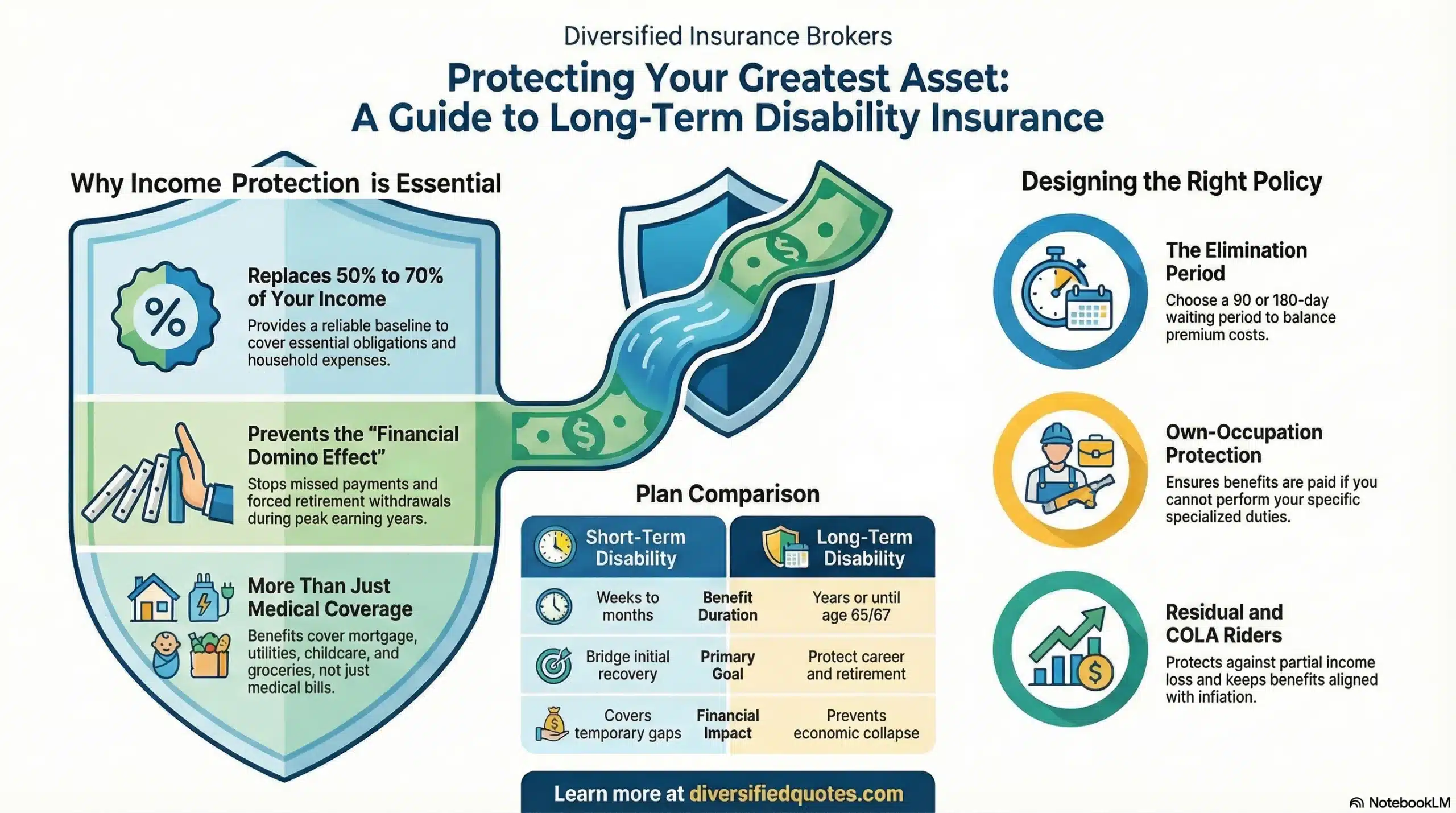
The own-occupation disability definition for a firefighter should reflect the specific physical demands of fireground operations — structural fire suppression, search and rescue, technical rescue, emergency medical response — not just “firefighting broadly” in a way that could be satisfied by a light-duty administrative assignment. A firefighter who cannot perform fireground duties but is reassigned to fire prevention inspection or administrative work has not been protected by an any-occupation policy. The elimination period should coordinate with available sick leave and any department short-term income continuation; most career firefighters can absorb a 90-day EP if department provisions cover the initial period. The residual disability rider captures partial income loss when a firefighter returns to light duty or restricted assignments at reduced earnings, a very common disability transition pattern in fire service careers. The COLA rider protects purchasing power for long-duration disability benefits — important for firefighters disabled early in their careers who may receive benefits for 20-30 years. The full rider framework is at disability insurance riders explained. Tax treatment of firefighter disability benefits — both government pension disability and individually owned policy benefits — is at are disability insurance payments taxable. For military-connected firefighters transitioning from service, the parallel benefit coordination considerations are at disability insurance for armed forces and military. The case for an independent broker comparison is strong for first responders because career-plan department benefit analysis requires comparing multiple carrier options against the specific benefit structure the individual firefighter has — a single-carrier quote cannot evaluate the fit against department provisions that vary by department and state.
Talk With an Advisor Today
Choose how you’d like to connect—call or message us, then book a time that works for you.
Schedule here:
calendly.com/jason-dibcompanies/diversified-quotes
Licensed in all 50 states • Fiduciary, family-owned since 1980
FAQs: Disability Income Insurance for Firefighters
My department has a pension disability plan. Why do I need individual disability insurance?
Department pension disability plans provide real value but have structural limitations that affect most career firefighters. The most common gap is overtime income: department plans typically base benefits on base pay, excluding overtime and specialty assignment pay that may represent a significant portion of total household income. A firefighter earning $75,000 base with $25,000 in overtime is living on $95,000. Department disability at 60% of base provides $45,000. The income gap is $50,000 annually. Other gaps include any-occupation standards that may not protect fireground-specific duties, 24-month caps on behavioral health benefits, and benefit calculations that may not coordinate well with the full income protection the household needs.
Do cancer presumption laws eliminate the need for individual disability insurance for firefighters?
Cancer presumption laws establish eligibility for workers’ compensation benefits — they don’t determine how much income replacement you receive. Workers’ comp cancer benefits typically pay approximately two-thirds of average weekly wages up to a state maximum, which may fall substantially below your actual household income needs. More than 40 states have presumption laws covering specific cancers after qualifying service periods, which is valuable. But a firefighter with $95,000 in total income receiving state workers’ comp cancer benefits at 66% of base pay is likely receiving $45,000-$50,000 per year in replacement. Individual disability insurance fills the income gap between what workers’ comp cancer benefits pay and what full income protection actually requires.
Is PTSD covered by disability insurance for firefighters?
Individual disability insurance with comprehensive mental/nervous condition coverage protects against PTSD and behavioral health conditions that prevent a firefighter from performing fireground duties. The critical advantage over group and department plans is the benefit period: most group LTD plans and department provisions cap mental/nervous benefits at 24 months. Quality individual policies provide unlimited mental/nervous benefit periods matching physical disability coverage. For firefighters whose cumulative traumatic exposure or a specific critical incident produces a serious, extended behavioral health condition, the 24-month group cap is a significant gap that individual coverage eliminates.
What disability protection do volunteer firefighters have?
Volunteer firefighters typically have minimal or no disability income protection from their departments. LOSAP programs address retirement but not income replacement during disability. Some states extend workers’ compensation coverage to volunteer firefighters for line-of-duty injuries and illnesses, but benefit amounts are based on average wages rather than firefighting income (which is $0 for volunteers), making the benefit amount reflect the firefighter’s day-job earnings if applicable. Individual disability insurance based on the volunteer’s primary employment income provides genuine financial protection if a disability prevents them from working that primary job. Occupational class is typically based on the primary paid occupation rather than volunteer firefighting, which often produces more favorable classification for volunteers employed in less hazardous professions.
What is own-occupation coverage for firefighters and why does it matter?
Own-occupation disability insurance pays benefits when you cannot perform the specific duties of your occupation — fireground operations including fire suppression, search and rescue, technical rescue, and emergency medical response — regardless of whether other work is possible. Without own-occupation language, a firefighter who cannot perform fireground duties but is capable of administrative, fire prevention, or light-duty roles may be denied benefits because “some work” remains possible. This is especially important because departments sometimes reassign injured firefighters to desk or inspection roles rather than separating them; any-occupation language would deny benefits during that period. Own-occupation language should be tied to the specific physical demands of fireground duty, not to firefighting work broadly.
About the Author:
Jason Stolz, CLTC, CRPC, DIA, CAA and Chief Underwriter at Diversified Insurance Brokers (NPN 20471358), is a senior insurance and retirement professional with more than 25 years of real-world experience helping individuals, families, and business owners protect their income, assets, and long-term financial stability. As a long-time partner of the nationally licensed independent agency Diversified Insurance Brokers, Jason provides trusted guidance across multiple specialties—including fixed and indexed annuities, long-term care planning, personal and business disability insurance, life insurance solutions, Group Health, Travel Medical and Evacuation Insurance, and short-term health coverage. Diversified Insurance Brokers maintains active contracts with over 100 highly rated insurance carriers, ensuring clients have access to a broad and competitive marketplace.
His practical, education-first approach has earned recognition in publications such as VoyageATL, and contributions from his agency featured in Kiplinger and GoBankingRates— highlighting his commitment to financial clarity and client-focused planning. Drawing on deep product knowledge and years of hands-on field experience, Jason helps clients evaluate carriers, compare strategies, and build retirement and protection plans that are both secure and cost-efficient. Visitors who want to explore current annuity rates and compare options across multiple insurers can also use this annuity quote and comparison tool.
Explore More Disability Insurance Options: Browse our complete guide to Disability Insurance for Public Safety, Military & Government — covering firefighters, law enforcement, military, pilots, TSA, SWAT & first responders from 100+ carriers.
Last Reviewed: June 6, 2026 |
Reviewed by: Jason Stolz, CLTC, CRPC, DIA, CAA
Chief Underwriter, Diversified Insurance Brokers, Inc. | NPN: 20471358 | Diversified Insurance Brokers, Inc. — Licensed in all 50 states
Fact Checked by: Tonia Pettitt, CMIP©
Medicare Specialist, Diversified Insurance Brokers, Inc. | NPN: 14374308 | Diversified Insurance Brokers, Inc. — Licensed in all 50 states
Did you find this content helpful? Leave us a Google review — it helps others find trustworthy guidance too.
Editorial Standards: Diversified Insurance Brokers maintains rigorous editorial standards to ensure accuracy, clarity, and independence in all content. Learn more about our editorial standards and commitment to transparency.
