
Disability Insurance for FBI Agents
As an Independent Disability Insurance Broker, we have access to exclusive discounts and negotiated pricing most captive agents can’t offer — see the full breakdown near the end of this page.
Disability Insurance for FBI Agents

Jason Stolz CLTC, CRPC, DIA, CAA
Disability insurance for FBI agents is an essential income protection planning consideration for federal law enforcement professionals who serve in one of the most demanding, high-stakes, and genuinely hazardous occupations in American public service — and whose federal benefits package, while meaningful, leaves income protection gaps that individual supplemental disability insurance specifically addresses. Whether you serve as an FBI special agent conducting criminal investigations, counterterrorism operations, counterintelligence work, or cyber investigations, work as an FBI intelligence analyst supporting field operations, or serve in any of the Bureau’s specialized operational roles — your professional income and the financial security of your household depend on your physical and cognitive capacity to continue serving in one of America’s most operationally demanding federal law enforcement agencies.
FBI special agents operate under a unique combination of professional demands that spans tactical law enforcement operations, complex long-term investigations, international assignments, high-stress surveillance and undercover operations, and regular physical readiness standards that agents must maintain throughout their careers. Published peer-reviewed research in BMC Public Health specifically documents that 35% of male and 42% of female FBI new agent trainees experience one or more injuries during training — with defensive tactics training accounting for 58% of all training injuries — establishing that physical injury risk is a documented and measurable feature of FBI operational demands from the first weeks of professional training forward.
At Diversified Insurance Brokers, we help FBI agents, FBI special agents, and federal law enforcement professionals understand exactly where the Federal Employees Retirement System’s disability provisions fall short of complete income protection — and structure individual supplemental disability insurance coverage that fills those specific gaps effectively.
Protect Your FBI Income
Compare disability insurance options designed for FBI agents, special agents, and federal law enforcement professionals managing the specific gaps in FERS disability coverage.
Understanding FERS Disability — What It Covers and Where It Falls Short
Most FBI agents are aware that the Federal Employees Retirement System includes disability retirement provisions — and many assume that these provisions constitute adequate income protection if a disability prevents continued service. A careful examination of what FERS disability retirement actually provides, and under what conditions it provides it, reveals the specific and meaningful gaps that individual supplemental disability insurance fills for FBI agents and other federal law enforcement professionals.
FERS disability retirement provides 60% of a qualifying employee’s High-3 average salary during the first year of disability, and 40% of the High-3 average salary every year thereafter until age 62. These percentages are applied to base salary only — not to availability pay, overtime compensation, hazard pay, or any other supplemental pay that may constitute a meaningful portion of an FBI special agent’s total annual compensation. For an FBI special agent earning $130,000 in total compensation but $95,000 in base pay, the FERS disability benefit calculates on the $95,000 base — leaving the $35,000 in supplemental compensation entirely unprotected. Additionally, FERS disability retirement benefits are fully taxable as ordinary income, while individual disability insurance benefits are typically received income tax-free — a difference that meaningfully affects the after-tax income protection value of each dollar of benefit.
The FERS disability retirement qualification process is also demanding and time-consuming. To qualify, the agent’s employing agency must certify that it cannot reasonably accommodate the medical condition in the current position and has considered the agent for reassignment to any vacant position at the same grade or pay level within the commuting area. The agent must also apply for Social Security disability benefits — and if approved for SSDI, the FERS benefit is reduced by 100% of the Social Security payment for the first year and 60% thereafter. The combination of the agency accommodation certification requirement, the SSDI application requirement, and the OPM processing timeline means that FERS disability retirement approval can take months to complete — during which the agent’s income protection depends on available sick leave, Federal Employees’ Compensation Act coverage for work-related injuries, and any individual supplemental coverage in place. The federal employee disability benefit gap and supplemental coverage need parallels that documented for other federal and state law enforcement officers, including game wardens and state wildlife officers managing the income protection gap between government group coverage and actual financial need.
The Occupational Hazard Profile of FBI Special Agents
FBI special agents face an occupational hazard profile that combines the violence and assault risks of law enforcement with the specific demands of high-stakes federal investigations, tactical operations, international assignments, and the physical and psychological demands of sustained high-stress operational work across a career that may span twenty-five or more years. Understanding this hazard profile is essential for structuring disability insurance coverage that addresses the specific conditions most likely to interrupt or end an FBI career.
Violence and assault represent the most acute disability risk for FBI special agents. Research examining law enforcement occupational fatalities documents that occupational homicide rates for law enforcement officers are 3 times the national average, and published research notes that LEOs not wearing body armor face 14 times greater risk of fatal injury compared to those with body armor — reflecting the genuine and documented lethality of the assault risk that federal law enforcement faces. FBI special agents who execute search warrants, conduct fugitive apprehensions, respond to active threat situations, and perform undercover operations face armed resistance scenarios that produce serious disabling injuries — gunshot wounds, explosive blast injuries, serious physical assault injuries — whose recovery timelines are measured in months and whose permanent consequences can include functional limitations that prevent return to active special agent duty.
Transportation incidents represent the second major acute disability risk category — parallel to the BLS finding that approximately 40% of law enforcement fatalities are caused by transportation incidents. FBI special agents drive extensively in the course of investigations, surveillance operations, and case assignments that require travel across wide geographic areas. Vehicle accidents during law enforcement operations — including pursuit driving, emergency response driving, and the sustained road travel of wide-area investigation work — produce serious orthopedic injuries, traumatic brain injuries, and spinal trauma that require extended recovery and may produce permanent functional limitations. The law enforcement transportation incident disability risk that FBI agents face parallels that documented for other federal and state agents in remote and high-demand law enforcement contexts, including forest and park rangers managing vehicle accident disability risk in their remote law enforcement patrol work.
Physical Training and Defensive Tactics — The Documented Injury Risk
Published peer-reviewed research specifically examining FBI agent training documents that 35% of male trainees and 42% of female trainees experienced one or more injuries during the 21-week new agent training program at Quantico. Defensive tactics training accounted for 58% of all injuries — reflecting the physically demanding nature of the combatives, arrest techniques, and physical control training that FBI agents receive and must maintain throughout their careers. Physical fitness training accounted for an additional 20% of training injuries.
The injuries documented in FBI training research — musculoskeletal injuries from defensive tactics, orthopedic injuries from physical fitness demands, and overuse injuries from sustained high-intensity training — reflect the physical capacity demands that FBI agents must maintain throughout active service. An agent who cannot meet the Bureau’s physical fitness standards due to a disabling musculoskeletal or orthopedic condition faces assignment restrictions that can affect total compensation and career progression even when the condition does not constitute total disability. The sustained physical fitness maintenance demands of FBI service create ongoing musculoskeletal injury risk across an agent’s entire career — not just during initial training — and the cumulative orthopedic loading of a twenty-five year FBI career produces the back, knee, and shoulder conditions that are the most prevalent disability-producing health outcomes in physically demanding law enforcement service.
The physical training and defensive tactics injury profile documented in FBI research parallels the sustained physical demand disability risk documented across other demanding federal law enforcement contexts, including investigators and field agents managing physical fitness and operational injury risk in demanding federal law enforcement roles.
PTSD and Psychological Disability — The Documented FBI Career Risk
FBI special agents are regularly exposed to traumatic content that creates genuine and documented psychological health disability risk across a career in federal law enforcement. The nature of FBI investigative work — particularly in areas such as crimes against children, violent crime, counterterrorism investigations involving mass casualty events, and undercover operations that require sustained persona maintenance and psychological strain — creates cumulative traumatic exposure that published law enforcement mental health research consistently documents as a risk factor for PTSD, occupational depression, and burnout-related disability.
FBI agents investigating crimes against children face some of the most psychologically damaging content exposure in any law enforcement specialization — reviewing material that produces documented vicarious trauma at rates that affect agents across their careers and can produce disabling psychological health outcomes that prevent continued service. Counterterrorism agents who respond to mass casualty events, international terrorism incidents, and sustained threat investigations carry the same cumulative traumatic exposure burden documented across all emergency response professions. And FBI undercover agents — who may maintain false identities and high-stakes deception operations for extended periods — face specific psychological stressors from the undercover role itself that are distinct from conventional law enforcement stress.
Individual disability insurance policies that provide full benefit period mental health coverage — rather than the 24-month limitation that many policies impose even when the base policy pays to retirement age — are essential for FBI agents whose career creates documented and ongoing psychological disability risk. The mental health disability dimension for FBI agents parallels that documented for other high-stress remote and specialized federal law enforcement professionals, including emergency responders and high-stress public safety professionals managing psychological disability risk from sustained traumatic exposure.
The Availability Pay Dimension — What FERS Misses
FBI special agents receive availability pay — a supplement equal to 25% of base salary — in recognition of the Bureau’s requirement that agents remain available for unscheduled duty beyond their regular hours. Availability pay is a standard and expected component of FBI special agent total compensation, and it meaningfully increases the income that agents earn above base salary. FERS disability retirement benefits, however, are calculated exclusively on base salary — entirely excluding availability pay from the benefit calculation regardless of how long an agent has been receiving it or how dependent their household has become on total compensation including the availability pay component.
For an FBI special agent with a base salary of $95,000 who also receives availability pay of $23,750 — totaling $118,750 in annual compensation — FERS disability retirement calculates on $95,000 base only, providing 60% of $95,000 ($57,000) in the first year and 40% ($38,000) in subsequent years before age 62. The availability pay component — $23,750 annually — is entirely unprotected by FERS. Individual disability insurance structured to cover total compensation including availability pay fills this specific and meaningful gap. The availability pay exclusion from government disability benefits parallels the hazard pay and supplemental compensation exclusion that affects other federal law enforcement officers, including pilots and federal transportation officers managing the gap between base salary protection and total compensation protection.
Case Study: FBI Special Agent Earning $118,750 Per Year
Consider a mid-career FBI special agent with 14 years of service, earning $95,000 in base salary plus $23,750 in availability pay for total compensation of $118,750. During an arrest operation, this agent sustains a serious gunshot wound requiring surgical treatment and twelve months of rehabilitation during which return to active special agent duty is medically prohibited.
| Scenario | FERS Disability Only | FERS + Individual Supplement |
|---|---|---|
| Annual Disability Benefit (Year 1) | $57,000 (60% of $95,000 base — taxable) | $57,000 FERS (taxable) + $24,000–$30,000 individual (tax-free) |
| Availability Pay Protected | $0 — entirely excluded from FERS calculation | Individual policy calibrated to total compensation including availability pay |
| Tax Treatment of Benefit | Fully taxable — after-tax value substantially lower | Individual supplement received income tax-free |
| Own-Occupation After Year 2 | FERS requires inability to perform position duties — agency reassignment considered | Individual own-occupation definition maintained for full benefit period |
Gunshot wounds sustained during law enforcement operations are a documented and recurring source of serious injury for FBI special agents across all field divisions. Disability insurance for FBI agents ensures that a line-of-duty injury does not produce a household financial crisis during recovery — particularly when the FERS benefit calculation excludes availability pay and the taxability of FERS benefits reduces after-tax income protection below what the gross benefit percentage suggests.
The Mandatory Retirement Age and Disability Planning Window
FBI special agents face a mandatory retirement age of 57 — a provision that reflects Congress’s recognition, going back to 1948, that federal law enforcement work is physically incompatible with service beyond middle age. The mandatory retirement age creates a specific disability planning consideration that differs from most other professions: an FBI agent’s productive career window is defined and limited, making the income each year of active service represents particularly valuable and particularly important to protect against premature loss from disability.
An FBI special agent who is disabled at age 42 loses not just current income but the entire remaining fifteen years of active career income that their service record was building toward — including the pension accrual on a higher final salary that career completion would have produced. The financial cost of a mid-career FBI disability is therefore substantially larger than the immediate income replacement need suggests, because it also includes the foregone pension accrual, TSP matching contributions, and full career earnings that the disability eliminates. Individual disability insurance with a long benefit period — ideally to age 65 — provides the income replacement stream that sustains the agent’s household through the years between a mid-career disability and the eventual pension and Social Security eligibility that retirement would have produced. The mandatory retirement age and career income protection planning context for FBI agents parallels that for other federal and professional law enforcement officers with defined career windows, including professional divers and other federal law enforcement officers with defined career duration and mandatory service standards.
International and Undercover Assignment Disability Risks
FBI legal attaché offices in U.S. embassies around the world deploy special agents to coordinate with international law enforcement partners on matters ranging from terrorism and organized crime to cybercrime and public corruption. FBI agents on international assignment may operate in countries with significantly limited emergency medical infrastructure, creating the same remote medical access risk that affects all professionals deployed to challenging international environments — where the quality of initial emergency medical care following a serious injury or acute illness directly affects both immediate outcomes and long-term disability consequences.
FBI undercover agents face a distinct and documented set of psychological and physical risks from the undercover role itself — the sustained maintenance of false identity under high-stakes conditions, exposure to criminal environments that carry physical danger from violent criminal organizations, and the psychological strain of extended undercover operations that has been specifically documented in federal law enforcement mental health research as a source of unique occupational stress. A disability arising from an undercover operation — whether from physical violence, from psychological harm from sustained undercover stress, or from an acute illness during a remote international assignment — has the same financial consequences as any other disabling event, and individual disability insurance provides the income replacement regardless of where or under what circumstances the disabling condition developed.
The assignment mobility and international deployment dimension of FBI work means that individual disability insurance is more portable and more consistently applicable than institutional benefits that may be complicated by the jurisdictional and assignment circumstances of federal law enforcement careers. The international assignment and specialized operational disability risk facing FBI agents parallels that facing other federal professionals in specialized remote and international operational roles, including federal professionals and specialized operators managing income protection across varied and demanding work environments.
Key Policy Features for FBI Agent Disability Insurance
Disability insurance for FBI agents should incorporate specific policy provisions that address the law enforcement hazard profile, the FERS benefit coordination requirements, the availability pay income gap, and the psychological disability risk of specialized federal law enforcement service. The own-occupation definition is foundational — ensuring that an FBI agent who cannot perform active special agent duties, including tactical operations, physical fitness standards, and the full scope of field investigative work, receives benefits regardless of theoretical capacity for desk-based government work. Our comprehensive resource on own-occupation disability insurance explained covers how this definition protects FBI agent income from the conditions most likely to end an active special agent career.
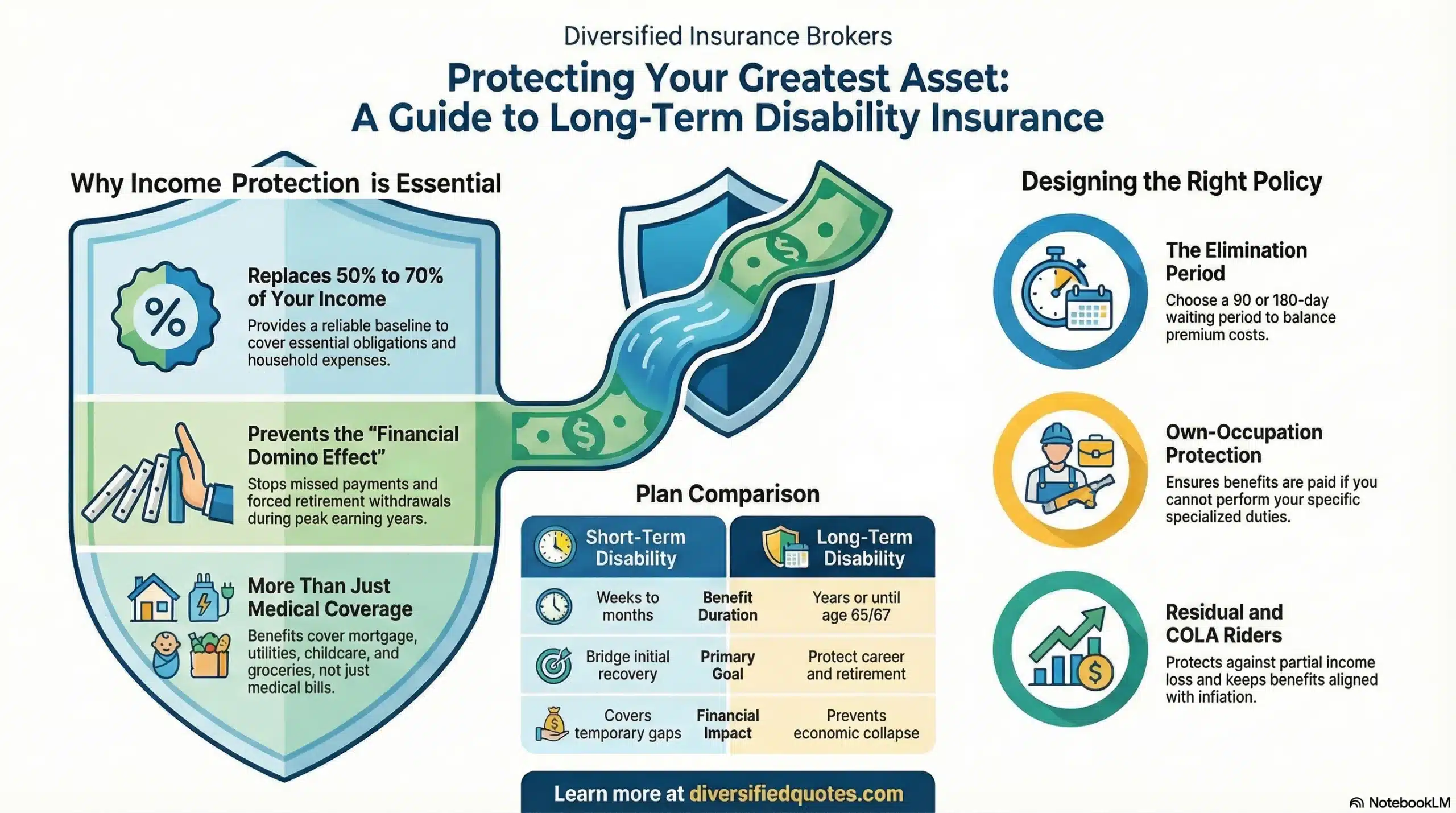
A residual disability rider is important for agents whose injuries or conditions may limit active field capacity without fully eliminating it — an agent who can perform analytical or administrative functions but cannot meet tactical fitness standards or return to full field operations earns reduced effective compensation without being totally disabled. Our resource on how residual disability insurance benefits work explains how partial disability coverage provides proportional income support. Mental health coverage provisions must be specifically evaluated for full benefit period coverage given the documented PTSD and psychological health risks of FBI operational work. The elimination period should account for sick leave accrual and Federal Employees’ Compensation Act coverage for work-related injuries — our guide on how disability insurance elimination periods work provides the complete framework. A cost-of-living adjustment rider preserves real benefit value across the potentially extended period from a mid-career disability to retirement age — our resource on disability income insurance with a COLA rider explains this protection. For FBI agents exploring short-term coverage options alongside long-term disability insurance, our guide on how to buy short-term disability insurance covers the complete income protection picture.
FERS Coordination — Structuring Individual Coverage Correctly
Structuring individual disability insurance for FBI agents requires careful coordination with FERS disability retirement provisions to avoid both over-insurance — which carriers check against — and under-insurance, which is the more common outcome for federal agents who rely solely on FERS. The goal is an individual policy that supplements FERS income replacement to a total that is both adequate for the household’s financial needs and appropriate relative to total pre-disability compensation.
Federal employees cannot access state disability insurance since they do not pay into state disability programs — meaning the individual policy and FERS are the two components of any disability protection structure, with no state disability benefit as an additional layer. Individual disability insurance benefits can be structured as either integrated with anticipated FERS benefits or as standalone coverage — and the appropriate structure depends on how likely the individual agent is to ultimately qualify for FERS disability retirement given the specific nature of their expected disability scenario. For disabilities that clearly and definitively prevent any federal service — serious spinal cord injury, severe traumatic brain injury — FERS qualification is typically achievable and the individual policy supplements FERS. For disabilities that involve more complex functional limitations where FERS qualification is less certain, the individual policy may provide the primary income protection while FERS qualification is pursued through the OPM process. The federal benefit coordination planning context for FBI agents closely parallels that for other federal law enforcement professionals, including self-employed and independent professional operators managing income protection without standard employer group disability plans.
Why FBI Agents Need an Independent Disability Insurance Broker
Disability insurance for FBI agents requires law enforcement occupational underwriting expertise, thorough knowledge of FERS disability retirement provisions and how they coordinate with individual coverage, understanding of availability pay documentation for benefit calculation, experience with mental health coverage evaluation for law enforcement PTSD risk, and the ability to identify carriers whose policy terms most effectively address the specific disability risks and benefit needs of federal law enforcement professionals.
At Diversified Insurance Brokers, we work with FBI agents, FBI special agents, and federal law enforcement professionals to structure supplemental disability coverage that fills the specific gaps in FERS protection — covering availability pay and supplemental compensation that FERS excludes, providing own-occupation protection for the full benefit period, delivering benefits tax-free rather than as taxable federal retirement income, and activating faster than the FERS qualification process can deliver benefits. Our dedicated resource on why independent disability insurance brokers matter explains the full value of this approach for federal law enforcement professionals with complex benefit coordination needs. And our resource on whether disability insurance is worth the investment provides the foundational financial rationale for supplemental coverage that applies with particular force to FBI agents whose FERS benefits leave meaningful and specific income protection gaps.
Final Thoughts on Disability Insurance for FBI Agents
FBI special agents and federal law enforcement professionals serve with distinction in some of the most demanding and genuinely hazardous positions in American public service — investigating the most serious federal crimes, protecting national security, and bearing the physical and psychological burdens of sustained high-stakes law enforcement work across careers that may span two and a half decades. The FERS benefits they receive are meaningful but specifically limited in ways that individual supplemental disability insurance directly addresses: availability pay exclusion, taxable benefits, demanding qualification procedures, and 40% income replacement after year one that falls short of what most households require to maintain financial stability.
Disability insurance for FBI agents — structured to cover total compensation including availability pay, delivered tax-free rather than as taxable income, built with own-occupation protection for the full benefit period, and coordinated with FERS provisions — provides the complete income protection that dedicated federal law enforcement professionals deserve for the hazardous service they perform.
Related Pages
Talk With an Advisor Today
Choose how you’d like to connect—call or message us, then book a time that works for you.
Schedule here:
calendly.com/jason-dibcompanies/diversified-quotes
Licensed in all 50 states • Fiduciary, family-owned since 1980
Disability Insurance for FBI Agents FAQs
Yes — FBI agents and federal law enforcement professionals can obtain individual disability insurance to supplement FERS disability retirement provisions. Federal employees are specifically eligible to purchase individual supplemental disability insurance that coordinates with anticipated FERS benefits to provide more complete income protection than FERS alone delivers. The underwriting process for FBI agent disability insurance accounts for the law enforcement occupational profile, the existence of FERS disability provisions, and the availability pay and supplemental compensation components of total FBI compensation that FERS excludes. Carriers who write supplemental disability insurance for federal law enforcement professionals understand the FERS coordination requirement and structure benefit amounts that supplement rather than duplicate FERS income replacement — providing total protection that more accurately reflects full pre-disability compensation. The most important planning considerations are ensuring that availability pay is included in the benefit calculation, securing own-occupation coverage for the full benefit period, and specifically evaluating mental health coverage provisions for the full benefit period rather than the 24-month limitation that many policies impose. For context on disability insurance for federal law enforcement professionals managing government benefit gaps, see our resource on disability insurance for federal and government professionals managing institutional coverage gaps.
FERS disability retirement carries several specific limitations that are particularly meaningful for FBI special agents. First, benefits are calculated exclusively on base salary — availability pay, which represents 25% of FBI special agent base salary, is entirely excluded from the FERS benefit calculation regardless of how long the agent has been receiving it. Second, FERS disability retirement benefits are fully taxable as ordinary income, while individual disability insurance benefits are typically received income tax-free — a meaningful difference in after-tax protection value. Third, the FERS qualification process requires the employing agency to certify that it cannot reasonably accommodate the medical condition in the current position and has considered the agent for reassignment to any vacant position at the same grade or pay level — a requirement that can complicate and delay qualification for agents whose conditions involve functional limitations rather than complete incapacity. Fourth, the FERS benefit drops from 60% of High-3 average base salary in year one to 40% in subsequent years before age 62 — replacement rates that fall short of the income continuity most households require during extended disability periods. And fifth, if an agent is approved for Social Security disability benefits, the FERS benefit is reduced by 100% of the SSDI payment for the first year and 60% thereafter, further reducing the net FERS benefit for agents with significant disability histories.
Individual disability insurance can be structured to cover total compensation including availability pay — filling the specific gap that FERS creates by excluding availability pay from its benefit calculation. Availability pay represents 25% of FBI special agent base salary and is a standard, expected component of special agent total compensation that reflects the Bureau’s requirement that agents remain available for unscheduled duty. When a disability prevents active special agent service, the availability pay component stops along with all other compensation — but FERS calculates benefits on base salary only, leaving the availability pay component entirely unprotected. Individual disability insurance carriers document total W-2 compensation including availability pay when determining the insurable income base, and a supplemental policy can be structured to address the specific availability pay component of the income protection gap that FERS leaves open. Working with an independent broker who understands FBI special agent compensation structure and knows how to document availability pay for underwriting purposes is essential for ensuring that the individual policy benefit amount accurately reflects total compensation rather than base salary alone.
The disability risk profile for FBI special agents reflects the combination of tactical law enforcement hazards, physical fitness demands, sustained operational stress, and psychological trauma exposure that defines FBI service. Gunshot wounds and serious physical injuries from law enforcement operations — arrest actions, search warrant executions, fugitive apprehensions, and active threat responses — represent the most acute disabling injury risk, with research documenting that occupational homicide rates for law enforcement are 3 times the national average. Transportation accidents during operational driving produce serious orthopedic injuries, traumatic brain injuries, and spinal trauma. Published peer-reviewed research documents that 35% of male and 42% of female FBI new agent trainees sustained injuries during training, with defensive tactics accounting for 58% — reflecting the sustained musculoskeletal injury risk of maintaining active physical fitness and combatives proficiency across a full FBI career. PTSD and psychological health disability from sustained exposure to traumatic investigation content — particularly for agents assigned to crimes against children, violent crime, and counterterrorism — represent a documented ongoing career risk. And the physical fitness standards that FBI agents must maintain create ongoing back, knee, and shoulder injury risk from the sustained musculoskeletal demands of active law enforcement service. For context on disability risks for other federal law enforcement professionals in high-hazard operational roles, see our resource on disability insurance for federal government professionals managing complex occupational risk profiles.
Own-occupation disability insurance pays benefits when a disabling condition prevents an FBI agent from performing the specific duties of their special agent role — tactical operations, physical fitness standards, active field investigations, firearms qualifications, and the full scope of physical and operational requirements that active special agent service demands — regardless of whether they could theoretically perform other less physically or operationally demanding government work. This is particularly important for FBI agents because FERS disability retirement itself uses a standard that requires the agency to consider reassignment to vacant positions at the same grade — meaning that an agent who is disabled from active special agent duties but could theoretically be reassigned to a less demanding analytical or administrative federal role might not qualify for FERS disability retirement at all. An individual own-occupation policy recognizes the genuine inability to continue active special agent duty and provides benefits accordingly — protecting the FBI career income that the agent has earned through years of service without requiring the reassignment evaluation that FERS demands. Own-occupation coverage is the policy definition that makes individual supplemental disability insurance genuinely valuable for FBI agents rather than merely theoretical supplemental protection.
The mandatory retirement age of 57 for FBI special agents creates a specific and important disability insurance planning context that differs from most other professions. An FBI agent’s active career window is defined — most agents enter service in their mid-to-late twenties and serve through age 57, creating a career of roughly 25 to 30 years during which their earnings, pension accrual, and TSP accumulation all occur. A disability at age 42 does not merely produce fifteen years of income replacement need — it eliminates fifteen years of active career income, fifteen additional years of pension accrual on a higher final salary, fifteen years of TSP matching contributions, and fifteen years of full compensation including availability pay. Individual disability insurance with a benefit period extending to age 65 provides the income stream that sustains the household through the years between a mid-career disability and the eventual pension, TSP, and Social Security income that retirement would have produced. The benefit period extension from age 65 versus a shorter period is more significant for FBI agents with their defined career window than for professionals with indefinite career trajectories, making a benefit period that spans from disability to normal retirement age a particularly important planning priority.
Many individual disability insurance policies cover PTSD, major depression, and serious anxiety disorders when they prevent performing occupational duties. For FBI special agents — whose career regularly involves exposure to crimes against children, mass casualty events, terrorism investigations, violent crime scenes, and the unique psychological stressors of undercover operations — PTSD and psychological health disability are documented occupational risks that deserve specific policy evaluation. The most important planning consideration for FBI agents is the mental health benefit period: many policies limit mental health disability benefits to 24 months even when the base policy pays to age 65. For an agent whose career involves sustained and repeated traumatic exposure across decades of FBI service, a 24-month mental health limitation may provide materially inadequate protection for serious occupational PTSD or depression that requires extended treatment and recovery. At Diversified Insurance Brokers, we specifically evaluate mental health benefit period provisions and identify carriers offering full benefit period mental health coverage when structuring disability insurance for law enforcement professionals with documented psychological occupational exposure. For context on mental health coverage evaluation for law enforcement professionals, see our page on disability insurance for federal and government professionals managing mental health coverage evaluation in their policy planning.
The tax treatment difference between FERS disability retirement benefits and individual disability insurance benefits is a meaningful financial planning consideration for FBI agents. FERS disability retirement benefits are fully taxable as ordinary income — meaning that the 60% of High-3 base salary provided in the first year, and the 40% in subsequent years, are both subject to federal income tax, state income tax where applicable, and any other income-based tax obligations the agent carries. Individual disability insurance benefits, when premiums are paid with after-tax dollars — which is the typical structure for individually purchased policies — are received income tax-free under current federal tax law. This tax treatment difference means that a dollar of individual disability insurance benefit is worth materially more in actual after-tax household income than a dollar of FERS disability retirement benefit. For an FBI agent in a 22% federal marginal bracket, $40,000 in FERS disability income retains approximately $31,200 after federal taxes, while $40,000 in individual disability insurance benefit retains the full $40,000. This after-tax equivalence difference is an important input into calculating the total individual coverage needed to achieve adequate after-tax income replacement when combined with FERS.
Elimination period selection for FBI agents should account for sick leave accrual, Federal Employees’ Compensation Act coverage for work-related injuries, and the timeline for FERS disability retirement approval. FBI agents who have accrued substantial sick leave — government employment typically allows meaningful sick leave accumulation — have a meaningful income bridge for the initial weeks of a disability, supporting a longer elimination period on the individual policy. For work-related disabling injuries, the Federal Employees’ Compensation Act provides workers’ compensation-style income continuation that can bridge the elimination period before individual benefits activate. For non-work-related disabilities — serious illness, off-duty injuries — only sick leave is available as a bridge, making the elimination period more directly relevant to available financial reserves. A 90-day elimination period is typically appropriate for FBI agents with strong sick leave banks and FECA coverage for work-related events, while agents with limited sick leave accrual should evaluate 30 or 60-day periods. The FERS disability retirement application process timeline — which can take many months to complete — means that individual disability insurance is not merely supplemental to FERS but may be the primary income source for a substantial period while FERS qualification is being processed and determined.
The best time is as early as possible in an FBI career — ideally within the first year or two of active service, before any occupational health consequences from defensive tactics training, physical fitness demands, or operational injuries have accumulated in the medical record. Disability insurance premiums are based in part on age and health status at the time of application, and younger agents in excellent health secure the most comprehensive coverage at the most favorable rates. Musculoskeletal conditions from defensive tactics training, orthopedic injuries from physical fitness demands, any mental health treatment related to occupational trauma exposure, and cardiovascular findings can all result in exclusion riders or restricted policy terms if documented at application. The non-cancelable and guaranteed renewable provision locks in the early-career health rating for the policy’s entire duration. A future purchase option rider secured early allows benefit amounts to grow with career income progression — particularly important for FBI agents whose compensation increases substantially from entry-level to senior agent grades — without requiring new medical underwriting when health may have changed from years of demanding law enforcement service. For context on the early career application timing rationale for law enforcement professionals, see our page on disability insurance for federal professionals managing early career coverage decisions and long-term income protection.
Individual disability insurance structured by an independent broker provides several advantages over group or association plans that are particularly significant for FBI agents. Individual policies are portable — they follow the agent through any career changes, reassignments, or departures from federal service without any impact on coverage continuation. Group association plans for federal employees may be designed with benefit structures that reflect a broad federal employee population rather than the specific income structure, benefit needs, and hazard profile of FBI special agents — potentially leaving availability pay uncovered or providing benefit period limitations that are inadequate for an agent’s specific situation. Individual policies secured through an independent broker can be specifically structured to address the availability pay gap, provide own-occupation coverage for the full benefit period, include full mental health benefit period coverage, and coordinate precisely with expected FERS benefits — none of which a standard group enrollment process optimizes for any individual agent’s specific profile. At Diversified Insurance Brokers, we work with FBI agents across all career stages to structure supplemental coverage that accurately addresses the specific gaps in FERS protection, the specific compensation structure of FBI special agent service, and the specific disability risks that FBI operational demands create.
About the Author:
Jason Stolz, CLTC, CRPC, DIA, CAA and Chief Underwriter at Diversified Insurance Brokers (NPN 20471358), is a senior insurance and retirement professional with more than 25 years of real-world experience helping individuals, families, and business owners protect their income, assets, and long-term financial stability. As a long-time partner of the nationally licensed independent agency Diversified Insurance Brokers, Jason provides trusted guidance across multiple specialties—including fixed and indexed annuities, long-term care planning, personal and business disability insurance, life insurance solutions, Group Health, Travel Medical and Evacuation Insurance, and short-term health coverage. Diversified Insurance Brokers maintains active contracts with over 100 highly rated insurance carriers, ensuring clients have access to a broad and competitive marketplace.
His practical, education-first approach has earned recognition in publications such as VoyageATL, and contributions from his agency featured in Kiplinger and GoBankingRates— highlighting his commitment to financial clarity and client-focused planning. Drawing on deep product knowledge and years of hands-on field experience, Jason helps clients evaluate carriers, compare strategies, and build retirement and protection plans that are both secure and cost-efficient. Visitors who want to explore current annuity rates and compare options across multiple insurers can also use this annuity quote and comparison tool.
Explore More Disability Insurance Options: Browse our complete guide to Disability Insurance for Legal, Finance & White Collar Professionals — covering attorneys, accountants, bankers, executives, financial planners & business professionals from 100+ carriers.
Last Reviewed: June 8, 2026 |
Reviewed by: Jason Stolz, CLTC, CRPC, DIA, CAA
Chief Underwriter, Diversified Insurance Brokers, Inc. | NPN: 20471358 | Diversified Insurance Brokers, Inc. — Licensed in all 50 states
Fact Checked by: Tonia Pettitt, CMIP©
Medicare Specialist, Diversified Insurance Brokers, Inc. | NPN: 14374308 | Diversified Insurance Brokers, Inc. — Licensed in all 50 states
Did you find this content helpful? Leave us a Google review — it helps others find trustworthy guidance too.
Editorial Standards: Diversified Insurance Brokers maintains rigorous editorial standards to ensure accuracy, clarity, and independence in all content. Learn more about our editorial standards and commitment to transparency.
