
Disability Insurance for Detectives
As an Independent Disability Insurance Broker, we have access to exclusive discounts and negotiated pricing most captive agents can’t offer — see the full breakdown near the end of this page.
Disability Insurance for Detectives

Jason Stolz CLTC, CRPC, DIA, CAA
Detectives and criminal investigators occupy a professional position that bridges two distinct disability risk worlds — the physical hazard exposure and occupational injury risk that law enforcement work carries, documented by the Bureau of Labor Statistics as producing some of the highest rates of workplace injuries and illnesses of all occupations, and the sustained mental health exposure from constant immersion in crime, violence, and human suffering that the investigative dimension of detective work specifically creates. BLS data places the median annual wage for detectives and criminal investigators well above the median for all U.S. occupations, with the occupation among the higher-paid in the law enforcement field — income that is earned through work that involves potential physical confrontation, exposure to violent crime scenes, irregular and demanding hours during active investigations, and the cumulative psychological toll of sustained engagement with the most difficult human experiences law enforcement encounters. When disability — physical or psychological — eliminates the ability to perform this specialized work, the income stops with it. Disability insurance for detectives provides the income floor that remains when the health event that ends investigative work arrives.
At Diversified Insurance Brokers, Jason Stolz, CLTC, CRPC, DIA, CAA works with detectives and criminal investigators across the range of settings the profession encompasses — sworn law enforcement detectives employed by municipal, county, and state agencies; federal criminal investigators with the FBI, DEA, ATF, Secret Service, and other agencies; and private sector investigators who operate independently or through private investigation firms. The income protection structure appropriate for a sworn law enforcement detective with pension, group benefits, and public safety disability provisions differs substantially from what a self-employed private investigator who carries no employer benefits needs — and both require specific attention to the disability risk pathways that detective and investigative work creates across the physical and psychological dimensions.
Compare Disability Insurance for Detectives
We review coverage options across 100+ carriers and identify the policy structure that fits your investigative income, employment setting, and occupational risk profile.
Detective Disability Risk — Physical Hazards, Mental Health Exposure, and the Income Protection Gap
| Risk Category | Source / Work Context | Resulting Disability Risk | Existing Coverage | DI Coverage Gap |
|---|---|---|---|---|
| Mental health — PTSD, anxiety, depression | Occupational health sources specifically document that detectives and criminal investigators are at risk of PTSD, anxiety, and depression from cumulative exposure to crime, violence, and human suffering; sustained engagement with violent crime scenes, victim trauma, and disturbing investigative material across a detective career | Disabling PTSD, anxiety disorder, or depressive condition preventing sustained investigative work — crime scene processing, victim interviews, suspect interrogations, and the cognitive demands of complex case management | Public safety disability provisions for sworn officers vary by jurisdiction; most employer group plans cap mental/nervous benefits at 24 months; private investigators carry no employer coverage | Critical gap at 24-month group plan limit; individual DI with unlimited mental health benefit period is essential for investigators with sustained trauma exposure |
| Physical injury from field operations | BLS documents police and detective work as physically demanding and dangerous; confrontations with suspects during arrests, search warrant executions, and field operations create physical injury risk that sworn law enforcement detectives share with patrol officers | Injuries from physical confrontations, falls during operations, and the physical demands of field investigation — fractures, soft tissue injuries, and conditions that may prevent sustained investigative field work | Workers’ comp covers sworn officers for acute work-related incidents; public safety disability provisions vary significantly by jurisdiction and are often contested; private investigators have no automatic coverage | Significant gap where public safety provisions fall short or are contested; full gap for self-employed private investigators |
| Ergonomic and sedentary strain from investigative desk work | Significant portions of detective work involve sustained desk-based activity — case file review, digital evidence analysis, report writing, surveillance footage review, and database research — creating the sedentary loading that affects all extended computer workers | Carpal tunnel syndrome, cervical and lumbar disc conditions, and chronic back conditions from sustained investigative desk work that complement the physical field work demands of detective careers | Cumulative ergonomic conditions disputed as occupational; not typically covered as acute workers’ comp incidents; private investigators carry no coverage | Gap for chronic ergonomic conditions; individual DI covers qualifying disability from any cause |
| Sleep disruption and chronic fatigue | Active investigations require extended hours including overnight surveillance, irregular shift patterns, and sustained working periods during critical case phases; BLS specifically notes that working around the clock in shifts is common for detectives | Sleep disorders, cardiovascular effects of chronic irregular schedule, and occupational fatigue — conditions documented as associated with sustained shift work and irregular sleep patterns in law enforcement populations | Not covered by workers’ comp as discrete incidents; not covered by employer group plans as illness arising from shift work patterns | Full gap; individual DI covers disability from illness-based conditions including those associated with occupational shift work patterns |
| Self-employment exposure (private investigators) | Private detectives and investigators frequently operate as self-employed sole proprietors or small agency owners; the self-employment structure eliminates the employer-provided benefit baseline that sworn law enforcement positions typically include | Any qualifying disability simultaneously eliminates private investigator income and, for agency owners, threatens the business’s ability to service overhead obligations | No employer coverage of any kind; no workers’ comp protection without specific election; individual DI is the entire protection system | Complete gap; individual DI + BOE together address both income and overhead layers for private investigation business owners |
| Illness-based disability (non-occupational) | Cancer, cardiac events, neurological conditions — health events entirely independent of investigative activity that eliminate the cognitive and physical capacity to perform detective work | Extended inability to perform case management, field investigation, crime scene processing, and the full range of detective duties | Not covered by workers’ comp; group plan mental health cap and definition transitions apply; public safety disability provisions vary | Approximately 90% of long-term disabilities are illness-based; individual DI to age 65 covers the dominant disability risk category |
The table maps the dual-dimension disability exposure that makes detective and criminal investigator work a distinctive disability insurance planning case — physical hazard from field operations on one side, and the documented psychological toll of sustained crime and trauma exposure on the other, with the mental health pathway carrying the most consequential group plan limitation in the 24-month cap that cuts off benefits at exactly the point where serious PTSD or depressive conditions prove themselves to be long-term. Disability insurance by occupation recognizes that detectives’ occupational classification — which varies by carrier based on the specific balance of desk-based and field-based work in the investigative role — produces a range of premium outcomes, and that identifying the carrier with the most favorable classification for a specific detective’s actual work profile requires independent broker comparison across the full market.
The Mental Health Dimension — Trauma Exposure and the 24-Month Group Plan Gap
Occupational health sources specifically document that detectives and criminal investigators are at risk of developing PTSD, anxiety, and depression from the cumulative effect of constant exposure to crime, violence, and human suffering. This is not a fringe concern or a reflection of individual psychological weakness — it is a documented occupational health risk of investigative work that involves sustained engagement with violent crime scenes, victim trauma interviews, disturbing digital and physical evidence, and the repeated immersion in the worst events that human communities produce. BLS acknowledges directly that detective work can be physically demanding, stressful, and dangerous — and the stress dimension encompasses the psychological weight of investigative work in addition to the physical risks of field operations.
The disability insurance planning implication for detectives is direct and consequential: most employer group long-term disability plans cap mental and nervous condition benefits at 24 months — terminating income replacement at exactly the point where serious PTSD or a disabling depressive condition has proven itself to be long-term and clinically persistent. A detective who develops disabling PTSD from sustained violent crime investigation receives 24 months of group LTD benefit and then faces the any-occupation definition transition that may deny further payments if any other work is theoretically possible. Individual disability insurance with unlimited mental health benefit periods and a true own-occupation definition extending to age 65 fills this gap — providing the protection that group plans specifically fail to deliver for the disability pathway most documentedly elevated in the detective profession. Long-term disability insurance without the 24-month mental health cap is the core planning priority for detectives in any employment setting. Short-term disability insurance fills the immediate recovery window following acute mental health events before long-term coverage activates. Disability insurance for high-risk occupations covers how trauma-related mental health disability pathways are evaluated in underwriting for law enforcement and investigative professionals.
Sworn Law Enforcement Detectives — Navigating Public Safety Benefits and Their Gaps
Sworn law enforcement detectives employed by municipal, county, state, or federal agencies typically have access to disability benefits beyond what the general employee population receives — public safety disability provisions, line-of-duty disability determinations, and pension systems that provide some income protection for qualifying disabilities. These provisions represent meaningful baseline protection that most private sector employees do not have. But they do not eliminate the need for individual disability insurance for three reasons that are specific to the sworn detective’s situation.
First, public safety disability provisions are not universal in their coverage or generosity. The qualifying standards, benefit amounts, and definitions of qualifying disability vary enormously between jurisdictions — what qualifies as a line-of-duty disability and generates meaningful income replacement at one agency may be contested or denied at another. Disability insurance for law enforcement professionals specifically addresses the gap between what public safety provisions promise on paper and what they deliver in practice for detectives who face contested claims or inadequate benefit amounts.
Second, the group LTD plan that many law enforcement agencies provide alongside public safety disability provisions typically carries the standard group plan limitations — the 24-month mental health cap, the 24-month own-to-any definition transition, the benefit amount cap relative to actual detective compensation — that affect sworn officers just as they affect any group plan participant. A federal criminal investigator earning above the group plan’s benefit cap receives only a fraction of their actual income in disability benefits from the plan alone.
Third, disability from causes that are not classified as line-of-duty — illness, off-duty injuries, conditions that develop independently of specific workplace incidents — may fall outside the enhanced public safety provisions and be addressed only by the standard group plan, which carries the limitations described above. The approximately 90 percent of long-term disabling conditions that are illness-based apply to detectives at population-average rates, and the illness-based disability events that account for most long-term disability are addressed through the group plan’s standard provisions rather than the enhanced public safety disability framework. Understanding why detectives buy disability insurance in addition to existing public safety benefits begins with this mapping of what existing protection actually covers versus what it does not.
Private Investigators — The Complete Coverage Gap
Private detectives and investigators who operate independently or through private investigation firms represent a distinct disability planning situation from sworn law enforcement detectives — because they carry none of the employer benefit baseline, public safety disability provisions, or institutional coverage structures that sworn officers typically have. BLS documents private detectives and investigators as a separate occupational category that includes corporate investigators, insurance fraud investigators, process servers, background check professionals, and the full range of non-sworn investigative professionals who gather facts, conduct surveillance, and collect evidence in private rather than governmental settings.
A self-employed private investigator who becomes disabled has experienced a disability event with zero workers’ comp coverage, no employer group plan, and no income replacement mechanism other than individual disability insurance. The personal income loss from being unable to conduct investigations is one layer. The business overhead — office or virtual office costs, professional licensing and bond fees, database and surveillance equipment subscriptions, vehicle costs, and any employee wages if the investigation firm has staff — is the second layer. Self-employed private investigators need individual disability insurance as the foundational income protection. For investigation firm owners, business overhead expense disability insurance addresses the second layer — paying a monthly benefit calibrated to the actual fixed costs of the investigation business during the disability period. The BOE structure preserves client relationships, professional licensing, and business infrastructure during the disability period rather than allowing the operation to dissolve against unmet overhead. Whether disability insurance is worth the cost for a private investigator is answered by calculating what a lost quarter of investigative income would cost against the annual premium of the policy that replaces it.
Own-Occupation Coverage — The Definition That Protects Detective Income
The disability definition determines whether PTSD that prevents active criminal investigation work but theoretically permits other employment generates a benefit payment or a denial. For a detective whose professional income derives from the specialized capacity to conduct criminal investigations — processing evidence, interviewing witnesses and suspects, managing complex cases, and applying the investigative judgment that years of law enforcement experience produces — the own-occupation definition is the policy language that determines whether the coverage is genuine.
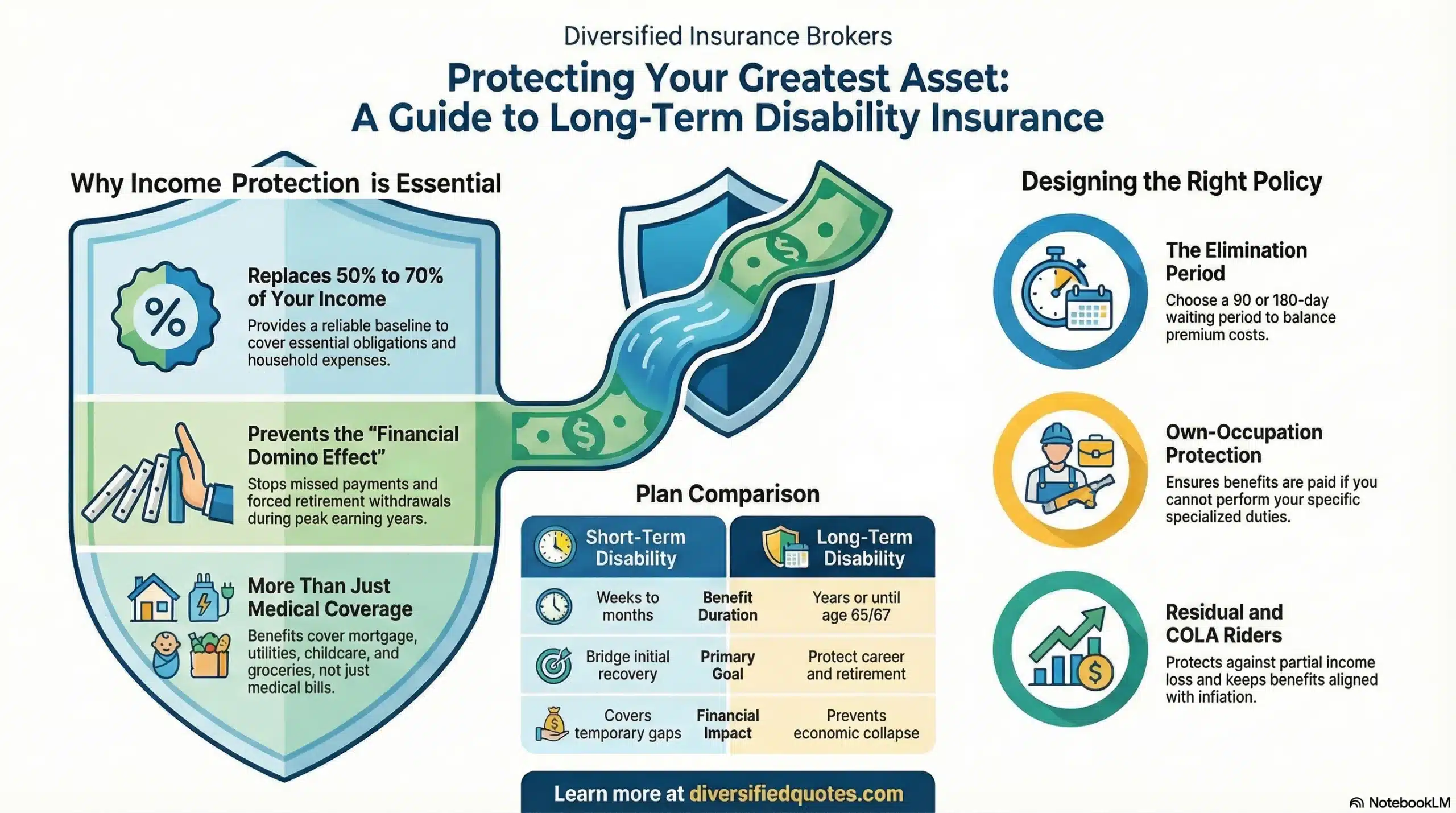
A true own-occupation disability insurance policy pays benefits when the insured cannot perform the material and substantial duties of their specific occupation — detective or criminal investigator — even if theoretically capable of other work. A detective who develops disabling PTSD from sustained violent crime investigation receives benefit payments regardless of whether they could theoretically perform a non-investigative role. The policy recognizes that the detective’s income derives from a specific professional capacity that the disability has eliminated. Understanding how short-term and long-term disability coverage interact is important for detectives whose disability scenarios span from recoverable events to the long-term conditions that result from sustained trauma exposure across investigative careers.
Occupational Class, Income Documentation, and Policy Design for Detectives
Detectives and criminal investigators receive middle to upper-middle occupational class assignments from most disability insurance carriers — a classification that reflects the balance of desk-based investigative work and field-based operations in the detective role. Sworn law enforcement detectives who can document that their work is primarily investigative and desk-based rather than patrol-based may receive more favorable classifications than patrol officers. Federal criminal investigators with primarily administrative and case-management profiles may receive classifications approaching the professional tier. Private investigators who conduct primarily surveillance and background research work receive classifications reflecting the specific balance of their actual activities.
Income documentation for sworn law enforcement detectives typically uses W-2 forms and agency pay records. For 1099-earning private investigators and independent contract investigators, Schedule C and business financials establish the income basis. How much disability insurance a detective actually needs depends on documented income, household financial obligations during a disability period, and for private investigation firm owners, the overhead obligations that BOE coverage addresses separately.
The elimination period should reflect actual financial reserves. The benefit period should extend to age 65. The rider options include the future insurability option and the cost of living adjustment rider. Detectives with documented mental health treatment histories — including PTSD treatment — should expect underwriting scrutiny of those histories. Disability insurance with pre-existing conditions is available through independent broker channels, and no-exam disability insurance may serve those whose health history makes traditional underwriting uncertain. Working with an independent disability insurance broker who understands how law enforcement and investigative occupation health histories — including mental health treatment records — are evaluated across the full carrier market produces better outcomes than a single-carrier direct application.
Get Your Detective Disability Insurance Review
We compare occupational class assignments, mental health benefit periods, and coverage structures across 100+ carriers to identify the policy that fits your investigative income and employment setting.
Talk With an Advisor Today
Choose how you’d like to connect—call or message us, then book a time that works for you.
Schedule here:
calendly.com/jason-dibcompanies/diversified-quotes
Licensed in all 50 states • Fiduciary, family-owned since 1980
FAQs: Disability Insurance for Detectives
What occupational class do detectives receive for disability insurance?
Detectives and criminal investigators typically receive middle to upper-middle occupational class assignments from most disability insurance carriers — a classification that varies based on the specific balance of desk-based investigative work and field-based operations in the detective’s actual role. A sworn law enforcement detective whose work is primarily case management, evidence analysis, and interview-based investigation may receive a more favorable classification than one with significant physical field work, arrest authority, and hazardous duty responsibilities. Federal criminal investigators with primarily administrative and supervisory profiles may receive classifications approaching the professional tier at some carriers. Private investigators who conduct primarily surveillance, background checks, and documentary research typically receive classifications reflecting their specific activity profile.
The practical implication of classification variation between carriers is that a detective who receives a middling quote from one carrier may receive a more favorable quote from another carrier that classifies detective work more generously based on how the investigative duties are described. A residual disability benefit provision is worth including for detectives, since realistic disability scenarios — a mental health condition that limits active case management and traumatic investigation but does not prevent all work, or a physical condition allowing desk-based investigation but not field work — frequently produce partial rather than total disability. A residual benefit pays proportionally based on actual income loss from partial disability.
Does disability insurance cover PTSD and mental health conditions for detectives?
Yes — individual disability insurance covers disability arising from PTSD, anxiety disorders, depression, and other psychiatric conditions when those conditions meet the policy’s definition of disability. This is one of the most critical coverage dimensions for detectives specifically, because occupational health sources document that detectives and criminal investigators are at risk of PTSD, anxiety, and depression from cumulative exposure to crime, violence, and human suffering — making mental health conditions one of the most documentedly elevated disability pathways in the investigative profession. A detective who develops disabling PTSD that prevents sustained engagement with violent crime scenes, victim trauma interviews, and the cognitively and emotionally demanding work of criminal investigation has experienced a genuine occupational disability that individual disability insurance with an own-occupation definition and unlimited mental health benefit period addresses directly.
The contrast with most employer group plans is stark and consequential for detectives. Group plans typically cap mental and nervous condition benefits at 24 months — terminating income replacement at exactly the point where PTSD or a serious depressive condition has proven itself to be long-term and clinically persistent. A detective whose PTSD from violent crime investigation requires more than two years of treatment before stable remission receives 24 months of group LTD benefit and then faces the any-occupation transition that may deny further payments. High-risk disability insurance options exist for detectives with existing documented mental health treatment histories, typically producing a partial exclusion rider for the specific prior condition while providing full coverage for all other causes of disability.
Are disability insurance benefits taxable for a detective or criminal investigator?
Tax treatment depends on how premiums are paid. For detectives who purchase individual disability insurance personally and pay premiums with after-tax personal income, monthly disability benefits received during a qualifying disability are generally received income-tax-free. The full benefit amount reaches the household without income tax reduction — a meaningful planning factor for investigators whose disability period may extend across months or years, and whose household financial obligations continue in full during the disability period. Whether disability insurance payments are taxable is particularly relevant for detectives when comparing the effective value of employer-paid group LTD benefits against individually purchased supplemental coverage.
For detectives whose employer pays group LTD premiums — as most government and law enforcement agencies do — the resulting disability benefits are typically taxable as ordinary income at claim time. A group plan stating 60 percent salary replacement may deliver significantly less than 60 percent of actual take-home pay after the income tax reduction. For detectives whose total compensation includes overtime pay and special pay categories that group plans typically exclude from the benefit calculation, the gap between stated and actual income replacement is further amplified. Self-employed private investigators who deduct disability insurance premiums as a business expense should confirm the specific tax treatment with a tax professional, as the deduction may affect benefit taxability when a claim occurs.
I’m a sworn detective with public safety disability benefits — why would I also need individual disability insurance?
Public safety disability provisions provide valuable baseline protection that most private sector employees lack — but they contain specific gaps that individual disability insurance is designed to fill for sworn investigators. The first and most significant gap for detectives is the mental health limitation in the employer group LTD plan that almost certainly supplements any public safety disability provisions: group plans cap mental and nervous condition benefits at 24 months regardless of the public safety designation, meaning the PTSD and trauma-related disabilities that are specifically documented as elevated risks in investigative work face a benefit ceiling that individual coverage lifts permanently.
The second gap is the any-occupation transition that group plans impose at 24 months — potentially denying continued benefits to a detective who cannot perform investigative work but could theoretically perform some other employment. A detective’s professional value derives from specialized investigative skills and experience; the any-occupation standard that terminates benefits when some other work is theoretically possible does not respect that specialized professional investment. The third gap is income replacement adequacy: public safety provisions and group plan benefits combined may still leave meaningful income unprotected, particularly for detectives whose total compensation includes overtime, specialty pay, or additional income that benefit calculations exclude. Individual disability insurance fills the mental health cap, the definition transition, and the income adequacy gaps simultaneously with a single additional policy that can be sized to the specific shortfall in existing coverage.
I run my own private investigation firm — what disability coverage structure do I need?
A private investigation firm owner who becomes disabled faces the two-layer financial crisis that all small professional services business owners face: personal income loss from not being able to conduct investigations, and the continuation of the firm’s fixed overhead that persists whether the owner is working or not. Professional licensing renewal fees, bonding costs, database and surveillance technology subscriptions, vehicle costs, professional liability insurance premiums, and any employee wages all continue during a disability period while the investigative revenue that funds them has stopped. A personal disability income policy — individual own-occupation coverage replacing your investigative income — addresses the personal income layer. Business overhead expense disability insurance addresses the firm’s fixed operating costs.
The private investigation firm context makes BOE coverage particularly valuable because client relationships and active case continuity are time-sensitive: clients who need surveillance or investigation work that cannot be completed during an owner disability may transfer to other firms, eroding the client base that represents years of professional reputation building. BOE funding during the disability period provides resources to maintain the firm infrastructure, fund any sub-contractor or associate investigator costs that keep active cases moving, and preserve the professional relationships that allow the firm to resume full operations when the owner recovers. The appropriate BOE benefit amount is determined by analyzing the actual monthly fixed costs of your specific investigation firm — a number that varies significantly between a sole-proprietor investigator operating from a home office and a multi-investigator firm with office space and staff. An independent broker familiar with private investigation firm structures can help size both the personal income and BOE layers correctly for your specific operation.
I have a prior PTSD treatment history — can I still get disability insurance as a detective?
Yes, though the underwriting outcome will depend on the severity, documentation, and current clinical status of the condition. For most documented prior PTSD or mental health treatment histories that are currently stable and managed, the standard underwriting outcome is a partial exclusion rider for that specific condition — providing coverage for all other causes of disability while excluding disability specifically attributed to the documented prior condition. This structure still provides meaningful protection for the full range of other health and injury events a detective faces — physical injuries, serious illness, other health conditions — while excluding the specifically documented prior mental health condition from the coverage.
The practical implication for a detective with a prior mental health treatment history is that the exclusion rider for that specific condition may leave a significant gap precisely where the detective profession’s documented primary disability risk is concentrated — in the PTSD and trauma-related conditions that sustained violent crime investigation specifically produces. This makes early career purchase — before mental health conditions develop or are documented — the most advantageous timing from a coverage completeness standpoint for investigators who are beginning their careers. Carrier guidelines for prior mental health treatment histories in law enforcement and investigative professionals vary significantly — a condition that produces a broad exclusion at one carrier may receive a narrower, more specific exclusion at another. An independent broker who understands how each carrier evaluates law enforcement mental health treatment histories is the most effective resource for identifying the best available outcome for a detective with a documented prior history. A second opinion on your disability insurance situation from an independent broker costs nothing and frequently reveals better available terms than a first-application outcome might suggest.
About the Author:
Jason Stolz, CLTC, CRPC, DIA, CAA and Chief Underwriter at Diversified Insurance Brokers (NPN 20471358), is a senior insurance and retirement professional with more than 25 years of real-world experience helping individuals, families, and business owners protect their income, assets, and long-term financial stability. As a long-time partner of the nationally licensed independent agency Diversified Insurance Brokers, Jason provides trusted guidance across multiple specialties—including fixed and indexed annuities, long-term care planning, personal and business disability insurance, life insurance solutions, Group Health, Travel Medical and Evacuation Insurance, and short-term health coverage. Diversified Insurance Brokers maintains active contracts with over 100 highly rated insurance carriers, ensuring clients have access to a broad and competitive marketplace.
His practical, education-first approach has earned recognition in publications such as VoyageATL, and contributions from his agency featured in Kiplinger and GoBankingRates— highlighting his commitment to financial clarity and client-focused planning. Drawing on deep product knowledge and years of hands-on field experience, Jason helps clients evaluate carriers, compare strategies, and build retirement and protection plans that are both secure and cost-efficient. Visitors who want to explore current annuity rates and compare options across multiple insurers can also use this annuity quote and comparison tool.
Explore More Disability Insurance Options: Browse our complete guide to Disability Insurance for Public Safety, Military & Government — covering firefighters, law enforcement, military, pilots, TSA, SWAT & first responders from 100+ carriers.
Last Reviewed: June 7, 2026 |
Reviewed by: Jason Stolz, CLTC, CRPC, DIA, CAA
Chief Underwriter, Diversified Insurance Brokers, Inc. | NPN: 20471358 | Diversified Insurance Brokers, Inc. — Licensed in all 50 states
Fact Checked by: Tonia Pettitt, CMIP©
Medicare Specialist, Diversified Insurance Brokers, Inc. | NPN: 14374308 | Diversified Insurance Brokers, Inc. — Licensed in all 50 states
Did you find this content helpful? Leave us a Google review — it helps others find trustworthy guidance too.
Editorial Standards: Diversified Insurance Brokers maintains rigorous editorial standards to ensure accuracy, clarity, and independence in all content. Learn more about our editorial standards and commitment to transparency.
