
Disability Insurance for Botanists
As an Independent Disability Insurance Broker, we have access to exclusive discounts and negotiated pricing most captive agents can’t offer — see the full breakdown near the end of this page.
Disability Insurance for Botanists

Jason Stolz CLTC, CRPC, DIA, CAA
Botanists occupy a professional position that most disability insurance discussions systematically underestimate — not because the hazard exposure is low, but because the disability risk profile of a plant scientist combines physical fieldwork demands, laboratory chemical exposure, and the cognitive and mental health vulnerabilities that documented research across the life sciences identifies as elevated in academic and research careers. The income at stake is real: Bureau of Labor Statistics data places botanists under the broader category of conservation scientists and foresters with a median annual wage of approximately $69,060, while specialized roles in biotechnology, pharmaceutical research, and government positions frequently exceed this figure substantially. That income depends on a botanist’s sustained ability to conduct research — through fieldwork that can be physically demanding, laboratory work that involves chemical and biological exposure, and the sustained cognitive function that scientific analysis, grant writing, publication, and academic instruction require. When any of those capacities is compromised by disability, the income stops. Disability insurance provides the income floor that remains in place when the disability event occurs, regardless of whether it arises from a fieldwork injury, a laboratory exposure, or an illness that develops entirely independently of professional activity.
At Diversified Insurance Brokers, Jason Stolz, CLTC, CRPC, DIA, CAA works with botanists across the range of professional settings the field encompasses — university and college faculty conducting research and teaching, government scientists with the U.S. Forest Service, Bureau of Land Management, and Department of Agriculture, environmental consulting professionals conducting plant surveys and ecological assessments, private sector botanists in biotechnology and pharmaceutical research, and independent botanical consulting practitioners who operate as self-employed professionals. The income protection structure appropriate for a tenured university professor with institutional group coverage is different from what an independent botanical consultant with no employer plan needs — and both differ from what a botanist in early-career postdoctoral research requires. Building the right coverage structure requires understanding how botanical work actually generates income and what specific disability events would interrupt it.
Compare Disability Insurance for Botanists
We review coverage options across 100+ carriers and identify the policy structure that fits your research income, employment setting, and occupational risk profile.
Request Disability Insurance OptionsBotanist Disability Risk — Work Settings, Hazard Exposure, and the Income Protection Gap
| Risk Category | Source / Context | Resulting Disability Risk | Workers’ Comp Coverage | DI Coverage Gap |
|---|---|---|---|---|
| Physical fieldwork demands | Hiking to remote collection sites, carrying equipment over challenging terrain, prolonged crouching and kneeling during specimen collection, exposure to inclement weather across extended field seasons | Back and knee injuries from terrain traversal and specimen collection postures; heat exhaustion; traumatic injury from falls in remote field environments | Covers employed researchers for work-related field incidents; independent consulting botanists excluded as self-employed; remote location complicates documentation | Full gap for self-employed consultants; significant gap for chronic musculoskeletal conditions developing from cumulative fieldwork loading |
| Toxic plant and biological exposure | Contact with toxic, allergenic, and sensitizing plant species during collection and study; exposure to plant-associated pathogens; handling of plant materials containing natural toxins | Severe allergic reactions; contact dermatitis; respiratory sensitization from pollen and plant dust; systemic reaction from toxin exposure | Acute occupational exposures covered for employed researchers; chronic sensitization conditions frequently disputed as occupational versus idiopathic | Gap for gradual-onset sensitization and allergic conditions; illness-based outcomes outside workers’ comp for self-employed botanists entirely |
| Laboratory chemical exposure | Solvents, fixatives, staining reagents, and other chemicals used in plant tissue analysis, preservation, and molecular biology research in botanical laboratories | Occupational respiratory conditions, skin sensitization, neurological effects from chronic solvent exposure, chemical burns from caustic reagents | Occupational disease provisions for employed researchers; self-employed consultants unprotected; chronic cumulative chemical exposure difficult to document as single incident | Significant gap for gradual-onset laboratory chemical conditions; individual DI covers qualifying disability from any cause |
| Mental health and cognitive disability | Documented elevated rates of depression, anxiety, and burnout in academic and research careers; grant funding pressure, publication demands, career precarity, and academic isolation | Disabling depression or anxiety preventing research performance; cognitive impairment from burnout; neurological conditions affecting analytical capacity | Not covered as workplace injury; mental health disability falls outside workers’ comp framework entirely for most research contexts | Full gap; most group plans cap mental/nervous benefits at 24 months; individual DI with unlimited period fills this gap |
| Ergonomic strain from extended lab work | Sustained microscopy work, extended computer use for data analysis and writing, repetitive fine motor tasks in laboratory specimen preparation | Carpal tunnel syndrome, cervical strain, visual stress conditions, repetitive strain injuries affecting laboratory productivity | Acute work incidents covered; cumulative ergonomic conditions disputed as occupational versus personal | Gap for chronic ergonomic conditions; illness-based musculoskeletal conditions outside workers’ comp entirely |
| Illness-based disability (non-occupational) | Cancer, cardiac events, neurological conditions, and other serious health events unrelated to professional activities | Extended inability to conduct research, perform fieldwork, fulfill teaching obligations, or produce scientific output | Not covered — workers’ compensation applies only to work-related injury and occupational disease | Approximately 90% of long-term disabilities are illness-based; complete gap for all workers regardless of employment structure |
What the table establishes is that the disability risk landscape for a botanist spans both the physical and the cognitive — the field and the laboratory on one side, and the mental health vulnerabilities that documented research in the life sciences has consistently identified as elevated in academic and research careers on the other. The approximately 90 percent of long-term disabling conditions that are illness-based apply to botanists at population-average rates regardless of their work setting, while the occupational pathways in fieldwork, laboratory exposure, and academic stress add specific risk factors on top of that baseline. Disability insurance by occupation recognizes that botanists’ upper-middle occupational class — reflecting their sedentary-to-moderately-physical work profile and advanced educational credentials — produces more favorable coverage terms than trade occupations while still requiring thoughtful policy design to address the full disability risk the profession carries.
Fieldwork Demands and the Physical Disability Pathways of Botanical Research
Botanical fieldwork is a defining element of many botanists’ careers — and the physical demands of that fieldwork create disability pathways that the profession’s association with sedentary academic settings tends to obscure. Field botanists conducting plant surveys, ecological assessments, and specimen collection work regularly travel to remote locations that require long hikes over varied terrain, traversal of dense vegetation, work in steep or unstable landscape features, and sustained specimen collection postures that load the back, knees, and lower extremities. The work often occurs in conditions — summer heat, high altitude, wet terrain, isolated terrain with no immediate medical access — that amplify the consequence of a disabling injury relative to the same injury occurring in an urban or institutional setting.
Research on botanist career demands specifically notes that physically intensive fieldwork is a core part of the role, requiring stamina, adaptability to weather changes, and occasional travel to remote sites that demands both physical endurance and flexibility. A botanist who sustains a significant knee injury during a field season — a ligament tear from traversing a rocky slope, a back injury from carrying heavy equipment over uneven ground — faces a recovery timeline measured in months during which field data collection is impossible, and a potential long-term functional limitation that affects whether field-dependent research can continue. Long-term disability insurance addresses the scenarios where that recovery extends beyond the acute period into months of income interruption that savings alone cannot sustain. Short-term disability insurance addresses the immediate recovery window following an acute field injury — filling the income gap during the weeks to months before long-term coverage would activate.
The remote location element of botanical fieldwork adds a layer of complexity to the disability risk that most other research professions do not face. A botanist conducting a plant survey in a national forest or a wilderness ecosystem who sustains a serious injury is potentially hours from emergency medical access, faces medical documentation challenges that can affect workers’ compensation claims, and may face a recovery complicated by delayed treatment. Individual disability insurance does not require the incident to be documented with the specificity that workers’ comp claims require — it requires the insured to meet the policy’s disability definition, which a documented injury preventing sustained research work satisfies.
Laboratory Exposure, Toxic Plants, and the Chemical Disability Pathways
The laboratory dimension of botanical science creates a separate disability pathway involving routine exposure to the chemical and biological agents that plant research requires. Solvents used in extraction and preservation procedures, fixatives including formaldehyde-based solutions used in histological preparation, staining reagents for microscopy, and the full range of molecular biology laboratory chemicals used in plant genomics and phylogenetics research all represent chemical exposure sources with documented respiratory and dermal health risks. A botanist who develops occupational asthma from laboratory formaldehyde exposure or chemical sensitization from sustained solvent work faces a disability that is entirely illness-based under the workers’ compensation framework — no single discrete workplace incident can be identified, the condition developed from cumulative chronic exposure, and the resulting workers’ comp claim is routinely disputed or denied. Individual disability insurance covers disability from qualifying causes regardless of whether a discrete workplace incident can be documented, making it the protection structure that actually works for the gradual-onset occupational conditions that laboratory exposure generates. Disability insurance for high-risk occupations covers how chemical and biological exposure pathways are evaluated in disability underwriting.
The toxic and allergenic plant exposure dimension is specific to botanical research and equally underappreciated as a disability pathway. Botanists who regularly collect and handle plant species — including species containing potent toxins, highly allergenic pollen, sensitizing resins, and contact-toxic compounds — face cumulative biological exposure that can produce occupational sensitization effects over a career. A field botanist who develops a progressive allergic sensitization to a plant family that dominates their research ecosystem faces both a professional disruption and a health condition that may limit continued field exposure. The inability to work safely in the plant environments a botanical career requires represents a genuine occupational disability that standard workers’ comp frameworks handle poorly and that individual disability insurance is designed to address.
The Mental Health and Cognitive Disability Risk in Academic Botanical Careers
For botanists who work in academic and research institutions — universities, research colleges, botanical gardens with research programs, and government research agencies — the mental health and cognitive disability risk dimension of the profession deserves specific planning attention. Research published in scientific literature on academic and researcher mental health consistently documents elevated rates of depression, anxiety, and burnout in life sciences academic careers. Studies of doctoral and postdoctoral researchers in life sciences fields have found prevalence rates for clinically meaningful depressive symptoms reaching approximately 20 to 25 percent, with burnout rates higher still — a reflection of the structural pressures that academic research careers impose: grant funding uncertainty, publication pressure, career trajectory precarity, intellectual isolation in specialized subfields, and the extended investment of years or decades in credential development before stable career positions become accessible. A 2017 survey published in Nature documented that 12 percent of PhD researchers had sought help for anxiety caused by their studies — a finding that represents reported cases in a population where mental health stigma affects disclosure rates significantly.
For disability insurance planning purposes, this mental health risk dimension matters because most group long-term disability plans — including those offered to faculty and researchers through universities and government agencies — cap mental and nervous condition benefits at 24 months. A botanist who develops a disabling depressive disorder or anxiety condition that prevents sustained research performance receives at most 24 months of group plan benefit for a condition that may require years of treatment before remission and return to full research capacity. Individual disability insurance policies with unlimited benefit periods for all qualifying causes — including mental and nervous conditions — fill this gap directly. The same academic career structure that creates the mental health risk also creates the group plan inadequacy that makes individual coverage essential for botanists who rely on their cognitive capacity as their primary professional asset. For botanists who serve as college professors or work alongside them in academic departments, this group plan gap is a shared structural vulnerability across the academic workforce. Disability insurance for white-collar professionals covers the specific policy design considerations that apply to cognitive and knowledge-based careers where mental and nervous conditions represent one of the most significant disability pathways.
Workers’ Compensation and the Botanist — What It Covers and Where It Falls Short
Workers’ compensation provides the baseline income protection for employed botanists — covering approximately two-thirds of wages up to state maximums for work-related injuries and occupational diseases. For a government agency botanist who sustains a documented field injury or an employed university laboratory researcher who develops a documented occupational exposure condition, workers’ comp provides the floor it is designed to provide. But for the substantial portion of the botanical workforce whose employment structure or health event does not fit the workers’ comp framework, the gaps are significant and in some cases complete.
Independent consulting botanists — professionals who conduct plant surveys, ecological assessments, environmental impact studies, and botanical inventories under contract arrangements — often operate as self-employed sole proprietors or single-member LLCs. These botanists have no workers’ comp coverage for their own injuries unless they have specifically and deliberately elected it, and most do not. A consulting botanist who sustains a field injury during a contracted survey project has no workers’ comp floor to stand on — the disability event and the workers’ comp protection gap arrive simultaneously. Understanding why botanists buy disability insurance begins with recognizing this structural reality: independent consulting botanical professionals are the professional services equivalent of any other skilled self-employed professional, and they carry the same workers’ comp gap that affects all self-employed workers.
The illness-based disability gap applies universally: workers’ compensation covers only work-related injuries and occupational diseases, not health conditions that develop independently of any specific workplace incident. The cardiac event, the cancer diagnosis, the neurological disorder — the health events that account for approximately 90 percent of long-term disabling conditions — generate no workers’ comp benefit regardless of employment status or how comprehensive the employer’s workers’ comp policy is. Whether disability insurance is worth the cost for a botanist is most clearly answered by calculating what an extended period of eliminated research income would cost against the annual premium of the policy that replaces it.
Own-Occupation Coverage — The Definition That Matters for Botanical Scientists
The disability definition in a policy determines whether a health event that prevents botanical research but theoretically permits other work generates a benefit payment or a denial. For a botanist whose career value derives from the intersection of plant science expertise, laboratory skills, and the ability to conduct fieldwork — a combination that took years of advanced education to develop and that constitutes genuinely specialized professional capacity — the own-occupation definition is the policy language that determines whether the coverage actually protects what was built.
A true own-occupation disability insurance policy pays benefits when the insured cannot perform the material and substantial duties of their specific occupation — botanical science — even if theoretically capable of some other gainful work. A botanist who develops a serious spinal condition preventing the field traversal their research requires, or a laboratory chemical sensitization preventing safe work in the chemical environments their research demands, receives benefit payments under an own-occupation policy regardless of whether they could theoretically work in a non-botanical capacity. The policy recognizes that the income derived from botanical expertise represents a specific career investment that the disability has compromised, and that this is a genuine economic disability regardless of what other employment might theoretically exist.
Understanding how short-term and long-term disability coverage interact is equally important for botanists planning a comprehensive income protection structure. The 24-month own-to-any transition common in group plans represents a particularly consequential limitation for a research professional whose disability — whether physical, chemical-exposure-based, or mental-health-based — proves to be long-term rather than a short-term recoverable event.
Income Documentation, Occupational Class, and Policy Design for Botanists
Botanists typically receive upper-middle occupational class assignments from disability insurance carriers — a classification that reflects the combination of non-hazardous primary work environment in laboratory and office settings, advanced educational credentials, and professional cognitive demands, balanced against the physical fieldwork component that varies significantly by subspecialty and employer. A botanist whose work is primarily laboratory and office-based research may receive a more favorable occupational class than one whose career involves substantial remote fieldwork in challenging environments. Identifying how specific carriers classify botanist roles — and whether the fieldwork component of a specific botanist’s job affects the classification — is one of the most important functions of working with an independent broker rather than applying directly to a single carrier.
Income documentation for botanists varies significantly by employment structure. University faculty and government agency scientists document income through W-2 forms and employer records. Independent consulting botanists document income through Schedule C or business financials, and 1099-earning contract researchers follow the same self-employed documentation framework. The maximum approvable monthly benefit is calculated as a percentage of documented net earned income — typically 60 to 70 percent — making income documentation the direct determinant of the coverage ceiling. How much disability insurance is actually needed depends on this documented income level and the household’s financial obligations during a disability period.
The elimination period — the waiting period between disability onset and first benefit payment — should reflect the botanist’s actual financial reserves rather than a generic default. The elimination period choice involves a direct trade-off between premium cost and income floor activation speed. The benefit period should extend to age 65 for most active botanical scientists — the chronic conditions, serious illnesses, and mental health events most likely to end a botanical research career are not short-term recoverable events. The rider options available on individual policies — including the future insurability option and the cost of living adjustment rider — add meaningful flexibility to a policy designed to protect a career with potential for significant income growth as research positions and consulting practices develop.
Pre-Existing Conditions and Coverage Access for Botanists
Botanists who approach the disability insurance market with an existing health history — a prior back condition from fieldwork, a documented respiratory condition, a mental health treatment history — will find that carrier guidelines for these histories vary significantly. The standard outcome for most prior conditions is a partial exclusion rider rather than a blanket decline — coverage provided for all causes of disability except the specifically excluded condition, still delivering meaningful protection for the full range of other health events the botanist faces. Disability insurance with pre-existing conditions is available through independent broker channels that compare the full market, and no-exam disability insurance options serve botanists whose health history makes traditional underwriting uncertain. Working with an independent disability insurance broker who understands how plant science and academic research occupational histories are evaluated across the carrier market produces consistently better outcomes than a direct single-carrier application for any botanist with a complex health or occupational background.
Get Your Botanist Disability Insurance Review
We compare occupational class assignments, policy definitions, and benefit structures across 100+ carriers to identify the coverage architecture that fits your research income and career setting.
Request Disability Insurance Options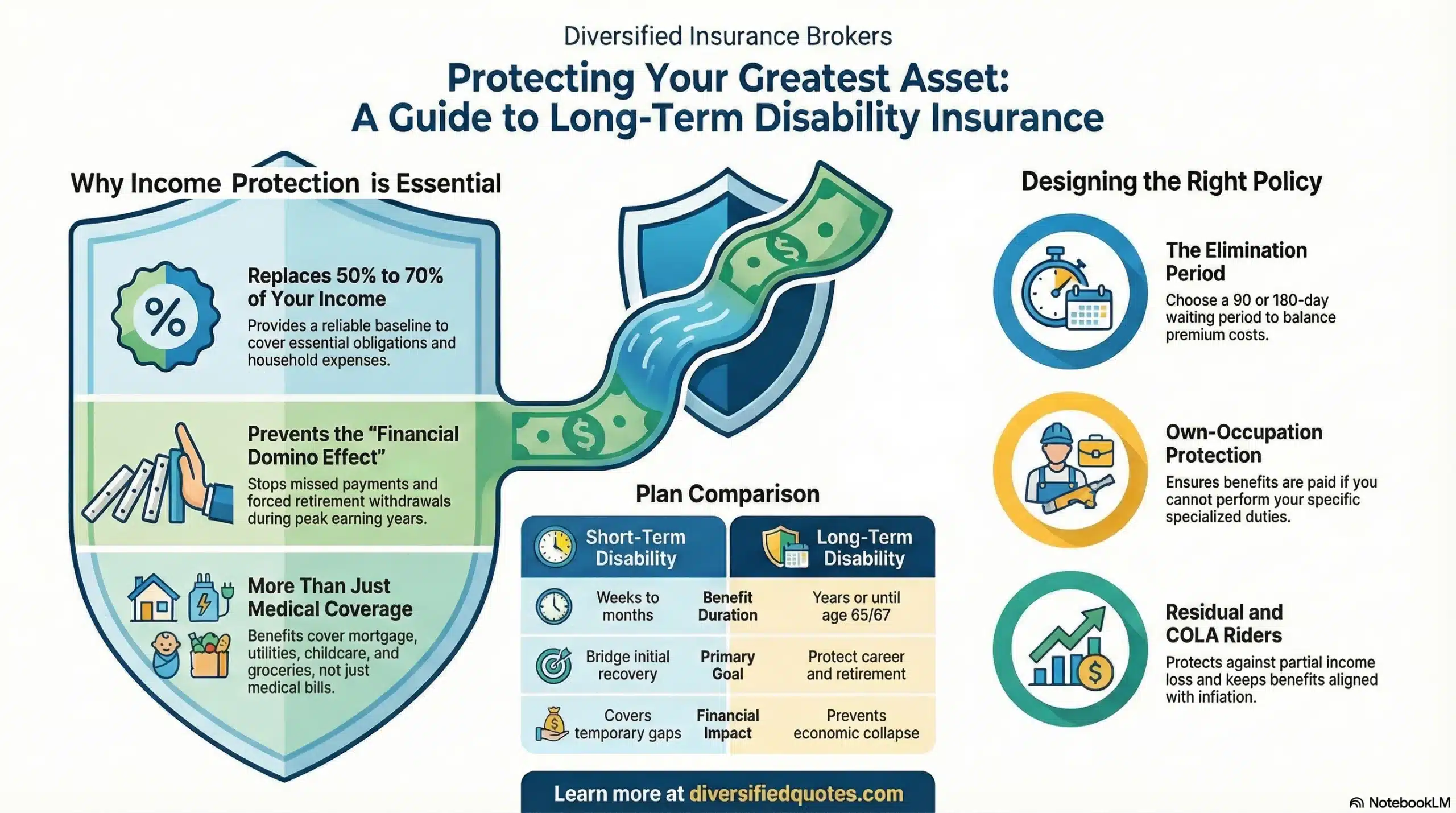
Talk With an Advisor Today
Choose how you’d like to connect—call or message us, then book a time that works for you.
Schedule here:
calendly.com/jason-dibcompanies/diversified-quotes
Licensed in all 50 states • Fiduciary, family-owned since 1980
FAQs: Disability Insurance for Botanists
What occupational class do botanists receive and how does it affect coverage?
Botanists typically receive upper-middle occupational class assignments from most disability insurance carriers — a favorable classification compared to physical trades and production occupations, reflecting the combination of non-hazardous primary work environments in laboratories and offices, advanced educational credentials, and professional cognitive demands. This classification produces lower premium rates per dollar of monthly benefit and higher maximum benefit ceilings than lower-tier occupations, making disability insurance genuinely affordable and comprehensive for most botanical science professionals.
The fieldwork component of a botanist’s specific role can affect the classification at some carriers. A botanist whose work is primarily laboratory research and data analysis may receive a different class than one whose career involves substantial remote fieldwork in physically demanding terrain environments. Identifying how specific carriers evaluate the role — and selecting the carrier whose classification produces the strongest combination of coverage terms and premium cost for a specific botanist’s actual work profile — is one of the most important outcomes of working with an independent broker rather than applying to a single carrier. A residual disability benefit is worth specifically requesting for botanists whose disability is more likely to produce partial reduced-capacity outcomes than total disability — a scenario particularly relevant for mental health and musculoskeletal conditions that limit productivity without eliminating all work capacity.
Are disability insurance benefits taxable for a botanist?
Tax treatment depends on how premiums are paid. For independent consulting botanists and self-employed plant scientists who pay disability insurance premiums with after-tax personal income, the monthly benefits received during a qualifying disability are generally received income-tax-free — meaning the full benefit amount reaches the household without income tax reduction. This is one of the most important financial characteristics of individual disability insurance for self-employed botanical professionals: whether disability insurance payments are taxable affects how much monthly benefit is actually needed to replace real take-home income during a disability period.
For employed botanists at universities, government agencies, or research institutions whose employer pays disability insurance premiums — whether through a group LTD plan or employer-paid individual coverage — the resulting benefit payments during a disability claim are typically taxable as ordinary income. This effectively reduces the real purchasing power of the benefit, a factor that employed botanical researchers should account for when evaluating whether the group plan coverage amount is genuinely adequate for their household during a disability period. The common design of university and government agency group LTD plans paying 60 percent of salary produces a net benefit closer to 40 to 45 percent of actual take-home pay after taxes — a gap that frequently surprises plan participants who assumed the stated coverage percentage was the effective replacement rate.
Does disability insurance cover mental health conditions for academic botanists?
Yes — individual disability insurance covers disability arising from mental health conditions including depression, anxiety, and burnout-related impairment when those conditions meet the policy’s definition of disability. This is one of the most significant advantages individual disability insurance holds over group plans for academic and research botanists: documented research across life sciences academic careers consistently shows elevated rates of depression and anxiety — with some studies finding clinically meaningful depressive symptoms in approximately 20 to 25 percent of doctoral-level researchers — and the most common group plan response to mental health disability is a 24-month cap on mental and nervous condition benefits. Individual disability insurance policies without this cap provide benefit periods extending to age 65 for qualifying mental health disability, filling the gap that group plans create at exactly the point where a serious mental health condition has proven itself to be long-term.
For a botanist whose professional value is substantially cognitive — whose ability to conduct research, analyze data, write grants and publications, and teach effectively depends on sustained mental health — a disabling psychiatric condition is an economic disability just as consequential as a physical injury. The policy definition that applies — own-occupation versus any-occupation — determines whether a botanist who can no longer perform academic research at a professional level due to a depressive disorder receives benefits or a denial based on the argument that they could theoretically perform some less demanding work. High-risk disability insurance options for botanists with existing mental health histories address the underwriting pathways available when prior treatment records are part of the application.
I’m a botanist who does fieldwork — does disability insurance cover injuries in remote locations?
Yes — individual disability insurance covers disability arising from injuries in fieldwork environments including remote locations, as long as the injury causes a qualifying disability as defined in the policy. The location of the incident does not determine whether a claim is valid — the policy definition of disability determines it. A botanist who sustains a serious back injury while traversing remote terrain during a field survey, or a knee injury from a fall in a steep botanical research site, qualifies for disability benefits under an own-occupation policy when the injury prevents them from performing the material duties of their botanical research career.
The distinction between individual disability insurance and workers’ compensation is particularly relevant for field botanists. Workers’ compensation requires a work-related incident to be documented with specificity — a challenge in remote field environments where immediate documentation may be impossible and where the lack of witnesses or medical records from the field setting can create claim disputes. Individual disability insurance relies on the insured meeting the policy’s disability definition — which a documented injury requiring treatment and preventing sustained research work satisfies regardless of where the incident occurred. Independent consulting botanists who conduct field surveys under contract arrangements are particularly reliant on individual disability coverage, as they carry no workers’ comp protection for their own field injuries as self-employed professionals. Getting a second opinion on any existing or proposed disability insurance quote is advisable for field-active botanists who want to confirm their coverage language actually protects them in field injury scenarios.
I’m a postdoctoral botanist with limited income — is disability insurance worth it at my career stage?
Early career is actually the most strategically optimal time to purchase disability insurance — and postdoctoral researchers in the botanical sciences are a specific population for whom this timing advantage is particularly significant. Disability insurance premiums are age-rated, meaning the younger the applicant at issue, the lower the annual premium locked in for the policy’s duration. A postdoctoral botanist who purchases coverage in their late twenties or early thirties locks in a substantially lower rate for a policy that can protect their income through the full trajectory of what may become a high-earning senior research or faculty career. Why young and healthy researchers need disability insurance is most directly answered by noting that the ability to secure coverage without pre-existing condition exclusions, without table ratings, and without the health complications that accumulate over a research career exists only while the health is genuinely clean.
The second consideration specific to postdoctoral botanists is the mental health risk documented in the research literature on early career researchers — the elevated depression and anxiety rates, the burnout from grant pressure and career precarity, the professional isolation of specialized research. A postdoctoral botanist who develops a serious mental health condition during the postdoctoral period and has not secured disability insurance before that development is now applying for coverage with a documented mental health history that will trigger an exclusion rider. Purchasing coverage before that history develops means full coverage — including mental and nervous conditions — is in force during exactly the career stage where that risk is most elevated. The disability insurance options for new professionals in scientific careers cover how early-career benefit amounts can be sized to match postdoctoral income and scaled upward as faculty or senior research positions are achieved.
I have university group disability coverage — do I need individual coverage too as a botanist?
Most university group long-term disability plans carry structural limitations that make individual supplemental coverage worth evaluating seriously for academic botanists. The limitations most relevant to the botanical science profession are: the 24-month cap on mental and nervous condition benefits — directly affecting the depressive and anxiety conditions that documented research identifies as elevated in academic careers — and the transition from own-occupation to any-occupation disability definition at 24 months, which shifts the benefit standard at exactly the point where a disability has proven itself to be long-term and persistent. A university botanist who develops a serious depressive disorder that prevents sustained research performance receives 24 months of group plan benefit — and then faces an any-occupation standard that may deny further benefit based on the argument that the botanist could perform some less cognitively demanding work.
Additional group plan limitations worth reviewing are the benefit cap relative to actual salary, the plan’s portability provisions if academic employment changes, and whether the plan covers disability from fieldwork-related injuries under its specific policy language. Individual disability insurance supplements group coverage by addressing these gaps — providing unlimited mental and nervous benefit periods, own-occupation language extending to age 65, portable coverage that follows the researcher regardless of institutional affiliation changes, and benefit capacity calibrated to actual research income rather than plan formulas. The combination of group and individual coverage, with each layer designed to address different gaps, produces the most complete income protection architecture for an academic botanist who relies on their cognitive and research capacity as their primary professional asset.
About the Author:
Jason Stolz, CLTC, CRPC, DIA, CAA and Chief Underwriter at Diversified Insurance Brokers (NPN 20471358), is a senior insurance and retirement professional with more than 25 years of real-world experience helping individuals, families, and business owners protect their income, assets, and long-term financial stability. As a long-time partner of the nationally licensed independent agency Diversified Insurance Brokers, Jason provides trusted guidance across multiple specialties—including fixed and indexed annuities, long-term care planning, personal and business disability insurance, life insurance solutions, Group Health, Travel Medical and Evacuation Insurance, and short-term health coverage. Diversified Insurance Brokers maintains active contracts with over 100 highly rated insurance carriers, ensuring clients have access to a broad and competitive marketplace.
His practical, education-first approach has earned recognition in publications such as VoyageATL, and contributions from his agency featured in Kiplinger and GoBankingRates— highlighting his commitment to financial clarity and client-focused planning. Drawing on deep product knowledge and years of hands-on field experience, Jason helps clients evaluate carriers, compare strategies, and build retirement and protection plans that are both secure and cost-efficient. Visitors who want to explore current annuity rates and compare options across multiple insurers can also use this annuity quote and comparison tool.
Explore More Disability Insurance Options: Browse our complete guide to Disability Insurance for Technology, Science & Education — covering software developers, engineers, scientists, teachers, architects & researchers from 100+ carriers.
Last Reviewed: June 7, 2026 |
Reviewed by: Jason Stolz, CLTC, CRPC, DIA, CAA
Chief Underwriter, Diversified Insurance Brokers, Inc. | NPN: 20471358 | Diversified Insurance Brokers, Inc. — Licensed in all 50 states
Fact Checked by: Tonia Pettitt, CMIP©
Medicare Specialist, Diversified Insurance Brokers, Inc. | NPN: 14374308 | Diversified Insurance Brokers, Inc. — Licensed in all 50 states
Did you find this content helpful? Leave us a Google review — it helps others find trustworthy guidance too.
Editorial Standards: Diversified Insurance Brokers maintains rigorous editorial standards to ensure accuracy, clarity, and independence in all content. Learn more about our editorial standards and commitment to transparency.
