
Disability Insurance for Authors and Writers
As an Independent Disability Insurance Broker, we have access to exclusive discounts and negotiated pricing most captive agents can’t offer — see the full breakdown near the end of this page.
Disability Insurance for Authors and Writers

Jason Stolz CLTC, CRPC, DIA, CAA
Writing is a profession built entirely on the uninterrupted relationship between cognitive function and output. The ability to generate ideas, hold narrative structure in working memory, sustain concentration through complex arguments, and convert creative thinking into polished prose is not something that has a physical substitute or an alternative process. When cognitive function is meaningfully impaired — through depression, anxiety, neurological conditions, burnout, chronic illness, or any of the health events that disproportionately affect people who produce under deadline and creative pressure — the quality and quantity of written output can decline dramatically before the writer even recognizes the problem as a medical one. The disability insurance services available to creative and intellectual professionals address this specific cognitive income risk, and the broader income protection insurance framework covers how individual policies are structured for professionals whose income flows from intellectual and creative output rather than physical labor or standardized service delivery.
Authors and writers who evaluate their disability risk realistically often discover that the occupation carries more exposure than its non-physical nature initially suggests. Cognitive disability — the category of conditions that most directly threatens a writing career — is one of the most prevalent causes of long-term disability among professionals in all fields. Depression and anxiety disorders, neurological conditions, traumatic brain injuries, and the cumulative cognitive effects of chronic illness represent a disability risk that affects knowledge workers and creative professionals at rates comparable to physical disabilities in other professions. The physical dimension also exists: carpal tunnel syndrome and repetitive strain conditions from extended daily typing are documented occupational risks for high-volume writers, and back, neck, and vision conditions from sedentary writing postures accumulate over careers. At Diversified Insurance Brokers, we help authors, journalists, copywriters, technical writers, screenwriters, and other writing professionals structure disability coverage that reflects both cognitive and physical exposure — and the variable income patterns that make benefit sizing more complex for writers than for most salaried professions.
Compare Disability Insurance for Authors & Writers
We compare options across 100+ carriers and structure coverage around creative careers, freelance income, and the cognitive demands of professional writing.
Request Disability Insurance OptionsDisability Insurance for Authors and Writers — Occupational Profile, Disability Risks, and Coverage Design
| Coverage Dimension | The Author and Writer Reality | What the Right Design Looks Like |
|---|---|---|
| Occupational class | Authors and writers typically qualify for the highest available occupational classes — reflecting the primarily cognitive, non-physical, and non-hazardous nature of writing work; this produces the most favorable premium rates and access to the strongest own-occupation definitions and to-age-65 benefit periods | The favorable occupational class makes high-quality coverage accessible at competitive premiums; the policy design investment should focus on definition quality, benefit period length, and the rider package rather than on occupational class negotiation — that battle is largely pre-won for writers |
| Income documentation — the primary underwriting challenge | Writing income is exceptionally variable: a book advance payment in one year followed by modest royalty-only income the next can produce wildly different annual tax return figures; passive royalties from past published work continue during disability but are not earned income for benefit sizing purposes; freelance income from contracts and retainers provides the most documentable active income baseline | Two to three years of tax returns averaged to establish an active earned income baseline; benefit sized to documented active writing earnings — not peak advance years — and not to passive royalty income that will continue regardless of disability; carriers with favorable entertainment and creative industry underwriting guidelines (some require stable employment history, contracts, and consistent work documentation) should be prioritized for application |
| Disability definition — cognitive impairment and professional quality | A writer who cannot produce professional-quality written work due to cognitive impairment may still be physically capable of other employment; under any-occupation language, the ability to do data entry, retail work, or any other job provides grounds to deny benefits; the cognitive capacity to write at a professional level — creativity, structure, original voice, complex argument — is not equivalent to the cognitive capacity for lower-demand work | Own-occupation coverage that evaluates whether the writer can perform the material duties of their specific writing specialty — generating original content, meeting creative and professional quality standards, meeting contracted deadlines — not just whether some type of employment is possible; the definition must reflect the cognitive specialization of the work |
| Cognitive disability — the dominant risk category | Depression, anxiety disorders, burnout, chronic fatigue, neurological conditions, and traumatic brain injury represent the most realistic disability categories for professional writers; these conditions may reduce output quality and quantity before completely stopping production — a gradual partial disability pattern rather than an on-off event | Mental/nervous benefit period matching physical disability coverage — not the 24-month group plan cap; residual disability rider that captures income loss when cognitive capacity is reduced but not eliminated; own-occupation language that covers reduced creative and productive function as a compensable disability even when some writing remains technically possible |
| Physical disability risks | Carpal tunnel syndrome and repetitive strain conditions from high-volume daily typing are documented occupational risks for professional writers; back, neck, and shoulder conditions from sedentary writing postures over long careers; vision deterioration from extended screen work; early application prevents carpal tunnel or musculoskeletal conditions from becoming pre-existing exclusions | Coverage for disability from any cause — physical and cognitive equally; applying before any pre-existing conditions develop locks in coverage without exclusions; carpal tunnel or wrist conditions that develop after policy issue are covered without restrictions; physical conditions are often more straightforwardly compensable under own-occupation language than cognitive ones |
| Royalty income and the disability income interaction | Passive royalties from published books, licensed content, and legacy intellectual property continue during disability without any active effort; this passive income stream does not reduce disability benefits in most individual policies but also cannot be used to support a higher benefit amount at application | Disability benefits are calculated on active earned income and are not offset by passive royalty income in most individual policy designs; both income streams — active disability benefit and passive royalties — continue simultaneously, providing more complete income replacement than either alone; confirm passive income offset provisions in specific policy language before purchase |
Cognitive Disability — The Risk Most Writers Underestimate
The disability risk profile for authors and writers is dominated by cognitive impairment rather than physical injury. Writing at a professional level requires sustained concentration, original creative generation, complex structural thinking, reliable memory access for research and narrative continuity, and the capacity to produce work that meets contractual or commercial quality standards under deadline pressure. Each of these functions can be genuinely and meaningfully impaired by conditions that leave the writer physically capable of most activities: severe depression that eliminates motivation and creative capacity, anxiety disorders that prevent the sustained focus extended writing requires, burnout that degrades the quality of cognitive output before completely stopping production, neurological conditions affecting memory and processing speed, and chronic illness effects on concentration and mental stamina.
What makes cognitive disability particularly challenging for writers is the gradual onset pattern: a novelist whose output is declining due to depression or cognitive fatigue may not recognize the medical dimension until contracts are missed, publisher relationships are strained, and income has been falling for months. This partial disability phase — reduced but not eliminated output, declining but not zero income — is the period where the residual disability rider delivers the most practical value. Residual benefits pay proportionally when income drops 20-25%+ from a qualifying condition, capturing the gradual decline that precedes complete inability to write. The critical framing for disability insurance purposes is that professional writing quality is a specialized cognitive capability — not equivalent to the ability to write emails or produce minimal-standard content for non-professional purposes. Own-occupation disability coverage that reflects this professional standard is the definition quality that makes coverage genuinely protective for writing careers. The cognitive professional parallel is well-illustrated at disability insurance for actuaries, whose precision cognitive work faces the same definitional challenge when cognitive impairment falls short of total inability to function but exceeds the threshold for professional competency.
The Income Documentation Challenge — Advances, Royalties, and Earned Income
Professional writers face a uniquely complex income documentation challenge for disability insurance purposes. A book publisher’s advance payment — which may be substantial in the year received but represents a multi-year writing commitment rather than annual earnings — can distort tax returns in ways that make it difficult to establish a consistent income baseline. Royalty income from published works continues regardless of whether new writing is being produced, meaning passive royalty revenue obscures the active writing income that disability benefits are meant to replace. Freelance writing income from contracts and content retainers provides the most straightforward active income documentation, but project-based income still fluctuates based on workload. Carriers require two to three years of tax returns to establish an average active earned income baseline, and the variability of creative income means working with an underwriter who understands publishing and freelance income structures is important to prevent the benefit amount from being substantially understated relative to actual active writing earnings. Some carriers have specifically updated their creative industry and entertainment professional guidelines — as Mass Mutual did in 2025, removing restrictive minimum elimination period requirements for entertainment professionals — to accommodate these income documentation patterns. Disability insurance for self-employed authors and disability insurance for 1099 workers cover the Schedule C and freelance income documentation framework that applies to most independent authors and contract writers. The benefit sizing calculation for variable-income creative professionals is at how much disability insurance do I need.
The Creative Professional Context — Adjacent Careers with Parallel Planning Needs
Authors and writers share fundamental disability planning challenges with other creative professionals whose income depends on consistent cognitive and creative output. Film and print editors whose concentrated creative-technical work requires sustained cognitive precision face the same definitional and documentation challenges. Radio and television media professionals whose content creation and on-air performance are directly income-dependent share the same group plan inadequacy issues. Musicians face the exact same royalty income documentation challenge — passive performance royalties continue during disability while active performance and recording income stops, creating the same benefit sizing complexity that authors face with book royalties. Actors and actresses navigate the most similar income documentation challenge: variable project-based income, residuals that continue passively during disability, and carrier underwriting that evaluates creative professionals differently than standard professional office workers. The broader entertainment industry disability insurance framework covers how carriers approach creative professionals across all disciplines, and the disability insurance for graphic artists and designers covers the cognitive-creative income protection parallel in visual creative work. Academic writing professionals are covered at disability insurance for college professors, and content strategy and brand narrative professionals at disability insurance for advertising executives whose writing-dependent work drives high-income executive roles. The disability insurance for white-collar professionals context covers the full occupational class framework for cognitive and creative professional roles. The disability insurance by occupation page shows how writers compare to other professional categories in occupational class and available coverage design.
Policy Design for Writing Professionals
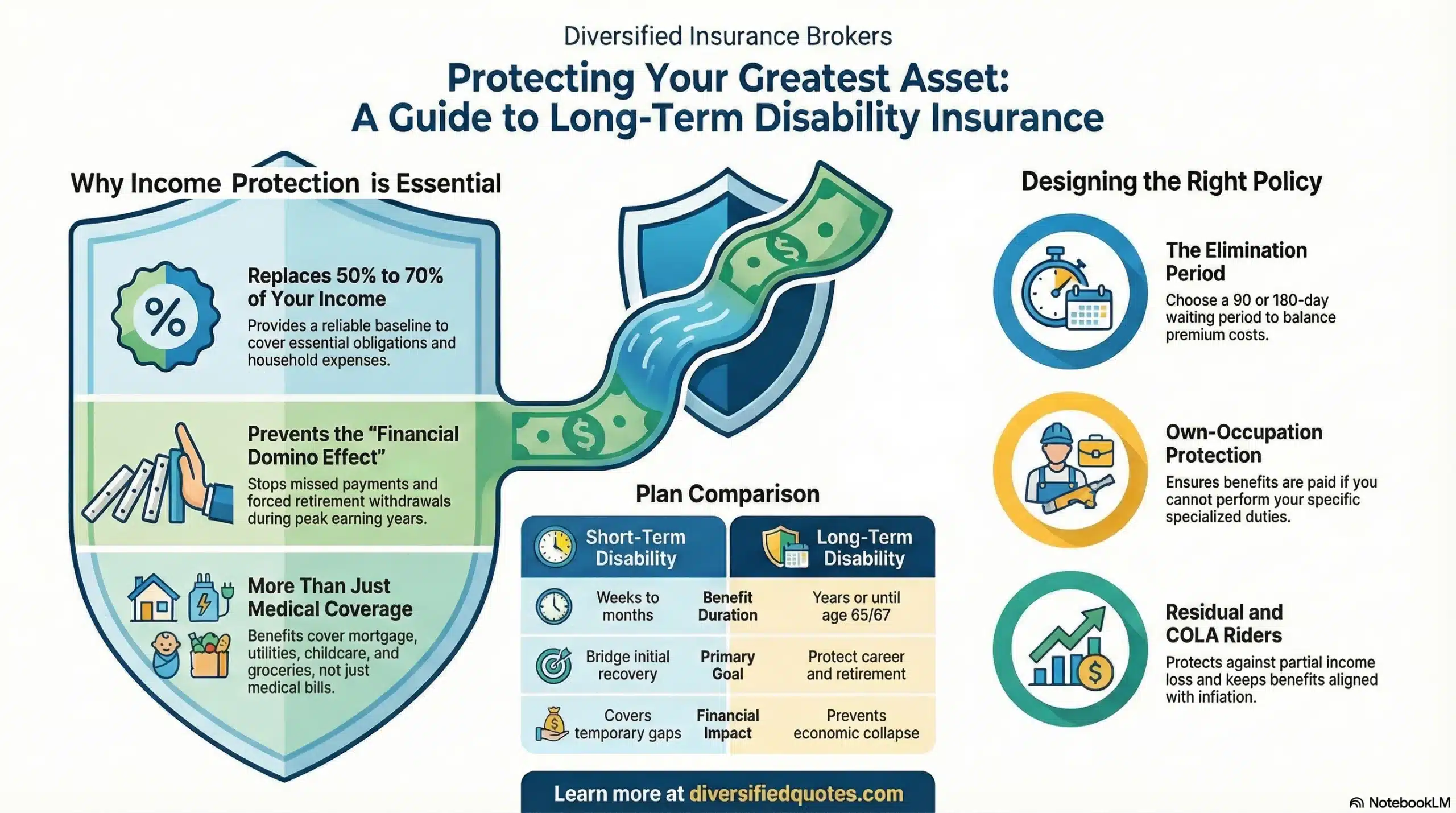
The benefit period for a writer’s disability policy should extend to retirement age — long-term disability insurance to age 65 protects against career-ending conditions during the decades of peak creative output. The elimination period selection should reflect available savings: writers without employer short-term backup need savings sufficient to bridge the gap before benefits begin. For freelance and independent authors, a 30-60 day period may be appropriate if cash reserves are limited; established writers with strong savings may comfortably absorb a 90-day EP. The future increase option is particularly valuable for early-career writers whose income is growing — locking in coverage early at lower entry-level income with the right to expand as earnings grow preserves insurability through career development without requiring new medical underwriting. The full rider framework is at disability insurance riders explained, and the COLA rider for long-duration benefit inflation protection is especially relevant for writers who may become disabled mid-career and receive benefits for 20-30 years. Tax treatment of benefits from individually owned policies — generally received income-tax-free with after-tax premium payment — is at are disability insurance payments taxable. For writers who have already received a quote or want an independent evaluation of current coverage, get a 2nd opinion on your disability insurance quote covers the review process. The case for working with an independent disability insurance broker is particularly strong for creative professionals where carrier selection and occupational description accuracy together determine both the available definitions and the premium outcomes.
Talk With an Advisor Today
Choose how you’d like to connect—call or message us, then book a time that works for you.
Schedule here:
calendly.com/jason-dibcompanies/diversified-quotes
Licensed in all 50 states • Fiduciary, family-owned since 1980
FAQs: Disability Insurance for Authors and Writers
What occupational class do authors and writers typically qualify for?
Authors and writers typically qualify for the highest available occupational classes across most major disability insurance carriers — reflecting the primarily cognitive, office-based nature of the work with no physical hazards. This top-tier classification produces access to the strongest own-occupation definitions, to-age-65 benefit periods, and the full rider menu at the most competitive premium rates. The occupational class advantage is one of the genuine benefits of writing as a profession from a disability insurance standpoint — the coverage available is high quality, and the premium cost is relatively favorable compared to professions with physical risk components.
How is the disability benefit amount calculated when income includes book advances and royalties?
Disability benefits are based on active earned income — the income generated by current writing activity — not passive royalty income from previously published work. A large advance payment in one tax year is not treated as equivalent to annual salary; it represents a multi-year writing commitment and is typically averaged across the years of the writing contract. Royalties from published works continue regardless of disability and are not counted as earned income for benefit sizing purposes — they also do not reduce disability benefits in most individual policy designs. Two to three years of tax returns establish the active writing income baseline used for benefit calculation, with variable income averaged across the documented period.
Does disability insurance cover cognitive disabilities like depression and burnout for writers?
Individual disability policies with comprehensive mental and nervous condition coverage protect against the disability categories most relevant to professional writers — clinical depression, anxiety disorders, burnout producing genuine functional impairment, and neurological conditions affecting creative and cognitive output. The critical distinction from group coverage is the benefit period: most employer group LTD plans cap mental/nervous benefits at 24 months. Quality individual policies provide unlimited mental/nervous benefit periods matching physical disability coverage. For writers whose career-ending disability is most likely to be cognitive rather than physical, the mental/nervous benefit period is arguably the most important coverage feature to evaluate.
Should freelance writers purchase disability insurance even if they have modest income?
Yes — the best time to purchase disability insurance is before health conditions develop, not after, because any pre-existing conditions at application may be excluded from coverage or create adverse underwriting outcomes. A freelance writer who purchases coverage early in their career with modest income, combined with a future increase option rider, can expand coverage as income grows without new medical underwriting. This locks in the right to protect higher future earnings even if health changes occur between the initial purchase and peak earning years. Waiting until income is higher to purchase is a common mistake that can result in paying much more for the same coverage — or being unable to get coverage at favorable terms if health has changed in the interim.
If I still receive royalties during a disability, will that reduce my disability benefit payments?
In most individual disability policies, passive income from royalties and licensing does not offset or reduce disability benefits. Disability benefits are designed to replace active earned income — the income generated by current writing activity. Royalties continue regardless of whether you are writing, so they are generally not treated as “income from work” that would trigger benefit offset provisions. This means both your disability benefit payments and your royalty income may continue simultaneously during a disability, providing more complete income replacement than either source alone. Confirm this in the specific policy language before purchase, as terms vary by carrier and policy design.
About the Author:
Jason Stolz, CLTC, CRPC, DIA, CAA and Chief Underwriter at Diversified Insurance Brokers (NPN 20471358), is a senior insurance and retirement professional with more than 25 years of real-world experience helping individuals, families, and business owners protect their income, assets, and long-term financial stability. As a long-time partner of the nationally licensed independent agency Diversified Insurance Brokers, Jason provides trusted guidance across multiple specialties—including fixed and indexed annuities, long-term care planning, personal and business disability insurance, life insurance solutions, Group Health, Travel Medical and Evacuation Insurance, and short-term health coverage. Diversified Insurance Brokers maintains active contracts with over 100 highly rated insurance carriers, ensuring clients have access to a broad and competitive marketplace.
His practical, education-first approach has earned recognition in publications such as VoyageATL, and contributions from his agency featured in Kiplinger and GoBankingRates— highlighting his commitment to financial clarity and client-focused planning. Drawing on deep product knowledge and years of hands-on field experience, Jason helps clients evaluate carriers, compare strategies, and build retirement and protection plans that are both secure and cost-efficient. Visitors who want to explore current annuity rates and compare options across multiple insurers can also use this annuity quote and comparison tool.
Explore More Disability Insurance Options: Browse our complete guide to Disability Insurance for Legal, Finance & White Collar Professionals — covering attorneys, accountants, bankers, executives, financial planners & business professionals from 100+ carriers.
Last Reviewed: June 6, 2026 |
Reviewed by: Jason Stolz, CLTC, CRPC, DIA, CAA
Chief Underwriter, Diversified Insurance Brokers, Inc. | NPN: 20471358 | Diversified Insurance Brokers, Inc. — Licensed in all 50 states
Fact Checked by: Tonia Pettitt, CMIP©
Medicare Specialist, Diversified Insurance Brokers, Inc. | NPN: 14374308 | Diversified Insurance Brokers, Inc. — Licensed in all 50 states
Did you find this content helpful? Leave us a Google review — it helps others find trustworthy guidance too.
Editorial Standards: Diversified Insurance Brokers maintains rigorous editorial standards to ensure accuracy, clarity, and independence in all content. Learn more about our editorial standards and commitment to transparency.
