
Disability Insurance for Advertising Executives
As an Independent Disability Insurance Broker, we have access to exclusive discounts and negotiated pricing most captive agents can’t offer — see the full breakdown near the end of this page.
Disability Insurance for Advertising Executives

Jason Stolz CLTC, CRPC, DIA, CAA
Advertising executives earn at the intersection of strategic intelligence, relational capital, and creative leadership. A Chief Creative Officer directing a major agency’s creative output, an SVP of Client Services managing a $50M book of business, or a VP of Strategy building brand frameworks for Fortune 500 clients — none of these roles produce income through physical effort or routine task execution. They produce income through the sustained application of cognitive capability, professional judgment, and the kind of industry relationships that take years to build. When any of those capabilities is disrupted by a health event — a neurological condition affecting strategic processing, a mental health condition preventing sustained executive function, a cardiac event requiring extended recovery — the income disruption is immediate and potentially permanent. Disability insurance services for high-income professionals are designed precisely for this scenario, and the income protection insurance framework covers how individual policies fill the gaps that employer group plans consistently leave for executives earning above the plan’s benefit cap.
The gap between what an advertising executive earns and what their group plan actually pays is one of the most significant financial planning exposures in this profession. A group LTD plan that promises 60% income replacement typically caps monthly benefits at $6,000 or $10,000 — a design decision that works reasonably well for employees earning $100,000-$150,000 but produces severe underinsurance for executives earning $200,000-$400,000 or more. At $300,000 in total annual compensation, a $6,000 monthly cap represents approximately 24% income replacement — not 60%. That gap, compounding across the months or years of a genuine disability, represents a financial exposure that individual disability coverage specifically addresses. The full framework for high-income executive income protection is at disability insurance for executives — why income protection is non-negotiable and disability insurance for high earners and business owners.
Compare Disability Insurance for Advertising Executives
We compare options across 100+ carriers and structure coverage around total compensation, variable income, and the specific cognitive demands of advertising leadership roles.
Request Disability Insurance OptionsDisability Insurance for Advertising Executives — Occupational Class, Group Plan Gaps, and Individual Coverage Design
| Coverage Dimension | The Advertising Executive Reality | What Individual Coverage Addresses |
|---|---|---|
| Occupational class | Advertising executives with primarily cognitive, strategic, and managerial duties and limited direct sales responsibilities typically qualify for the highest available occupational classes — producing the most favorable premium rates and access to the strongest own-occupation definitions; executives with heavy client development or sales duties may fall one class lower depending on how the carrier evaluates actual duties | Accurately describing actual duties on the application — the strategic, creative direction, and team leadership components alongside any sales or client-facing responsibilities — determines the class; the highest class opens access to the strongest definitions, to-age-65 benefit periods, and the full rider menu |
| Group plan benefit cap | Most employer group LTD plans cap monthly benefits at $6,000-$10,000 regardless of the executive’s actual compensation; at $250,000-$400,000 in total annual compensation, a $6,000 monthly cap delivers 18-29% income replacement — not the 60% the plan nominally promises | Individual supplemental policies that fill the gap between the group plan cap and actual compensation; individually owned with after-tax premiums, these policies produce tax-free benefits that do not compound the tax exposure created when employer-paid group plan benefits are received as taxable income |
| Variable compensation exclusion | Group LTD plans typically base benefits on base salary only — annual bonuses, performance incentives, profit-sharing, and equity compensation that may represent 30-50% of total compensation for senior advertising professionals are typically excluded from group plan benefit calculations | Individual policies sized to total documented compensation including variable components; carriers require income verification (tax returns and/or W-2s) to support variable comp in benefit calculations; benefit sizing should reflect total economic exposure, not just base salary |
| Mental/nervous benefit cap | Most group LTD plans cap mental health and nervous condition benefits at 24 months — a severe limitation for the occupational disability risks most relevant to advertising executives: burnout, clinical depression, anxiety disorders, and cognitive conditions from sustained high-pressure work | Individual policies with unlimited mental/nervous benefit periods — matching the physical disability benefit period — provide sustained protection for the most realistic disability scenario in high-pressure executive roles where mental health conditions represent a disproportionate share of long-duration claims |
| Definition of disability | An advertising executive whose cognitive impairment prevents performing at an executive level can still theoretically perform lower-level marketing work; under any-occupation language, that remaining capacity justifies denial even when the actual career is genuinely over | True own-occupation: pays benefits when you cannot perform the material duties of your specific executive role — campaign strategy, creative direction, client leadership, team management — even if you could perform other types of marketing or administrative work at a lower income level |
| Policy portability | Executive careers in advertising often involve agency transitions, employer changes, consulting arrangements, or entrepreneurial moves — employer group coverage terminates when employment terminates, creating coverage gaps precisely when health history may complicate new applications | Individually owned policies travel with the executive through all career transitions; coverage secured while healthy and working at a high income level remains in force regardless of subsequent employer changes, agency moves, or shifts to consulting or independent practice |
The Cognitive Disability Risk in Advertising Leadership
The primary disability risk for advertising executives is not a back injury or a physical accident — it is the category of conditions that impair the cognitive and emotional capabilities that executive advertising work demands. Strategic synthesis, creative judgment, sustained leadership attention, client-facing communication under high stakes, and the ability to process complex market dynamics and organizational pressures simultaneously are all cognitive functions. They can be genuinely and significantly impaired by clinical depression, anxiety disorders, burnout, PTSD, neurological conditions, and cognitive effects of cardiovascular events or other health crises — while leaving the person physically capable of many other activities. The BLS reports that only 27.1% of people with work-limiting health conditions participate in the labor force, compared with 74.7% of people without work-limiting conditions — a gap that reflects how decisively health events disrupt high-functioning careers. For advertising executives whose careers depend on consistently high cognitive output under deadline pressure, a condition that reduces executive function by 30-40% can be as career-limiting as a physical injury that prevents movement. The own-occupation definition is the only policy feature that captures this reality: it evaluates whether the person can perform the specific demanding duties of their particular executive role, not whether they could theoretically do something else.
The cognitive professional parallel is well-illustrated in adjacent fields. Accountants and CPAs — whose careers, like advertising executives’, depend on precise cognitive performance under deadline and accuracy requirements — face denied claims when any-occupation definitions allow insurers to argue that cognitive impairment doesn’t prevent all work. Disability income insurance for accountants covers this definitional dynamic in detail. Disability income insurance for attorneys covers the same pattern in legal practice, where cognitive and communicative capability drives all income. The disability insurance for white-collar professionals framework covers the full occupational class and definition landscape for cognitive-dependent careers.
How Variable Compensation Creates a Benefit Sizing Challenge
Advertising executive compensation is frequently structured as a base salary plus annual performance bonus, and at senior levels may include revenue-sharing arrangements, new business bonuses, equity grants, or agency ownership stakes. This structure creates a benefit sizing challenge that does not arise in purely salaried roles. The group LTD plan, which bases benefits on base salary only, already understates total compensation — a senior executive with a $200,000 base and $80,000 in annual bonus has $280,000 in total compensation that a base-salary group plan reduces to $200,000 for benefit calculation purposes, then caps the resulting benefit at a fixed monthly maximum that may represent a small fraction of even the base salary. Individual policies can be sized to total documented compensation including variable components, with income verification through tax returns and W-2 documentation supporting the broader benefit amount. High income disability insurance covers the benefit sizing framework and carrier guidelines for executives whose total compensation significantly exceeds their base salary. How much disability insurance do I need covers the calculation methodology for executives with mixed compensation structures.
Agency Owners, Independent Consultants, and the Self-Employed Advertising Professional
Not all advertising professionals work as employees of large agencies or media companies. Agency principals, independent creative directors, marketing consultants, and brand strategy advisors who operate independently or own their practices face the additional exposure of having no employer benefit safety net at all. For self-employed advertising and marketing professionals, the individual policy is the entire income protection plan — not a supplement to an existing group plan. Income documentation for agency owners or independent consultants requires Schedule C or S-corp K-1 documentation rather than W-2 statements, and benefit sizing must account for the business structure that may produce income differently from year to year. The disability insurance for consultants page covers the specific planning and underwriting considerations for consulting-based advertising and marketing professionals. Adjacent creative and strategic professionals — authors and writers whose creative output is their income, graphic artists and designers whose conceptual and technical work defines their career value, and film and print editors whose concentrated cognitive craft produces their income — all face the same self-employed disability planning challenge that independent advertising professionals navigate.
Policy Design for Advertising Executives — Benefit Period, Elimination Period, and Riders
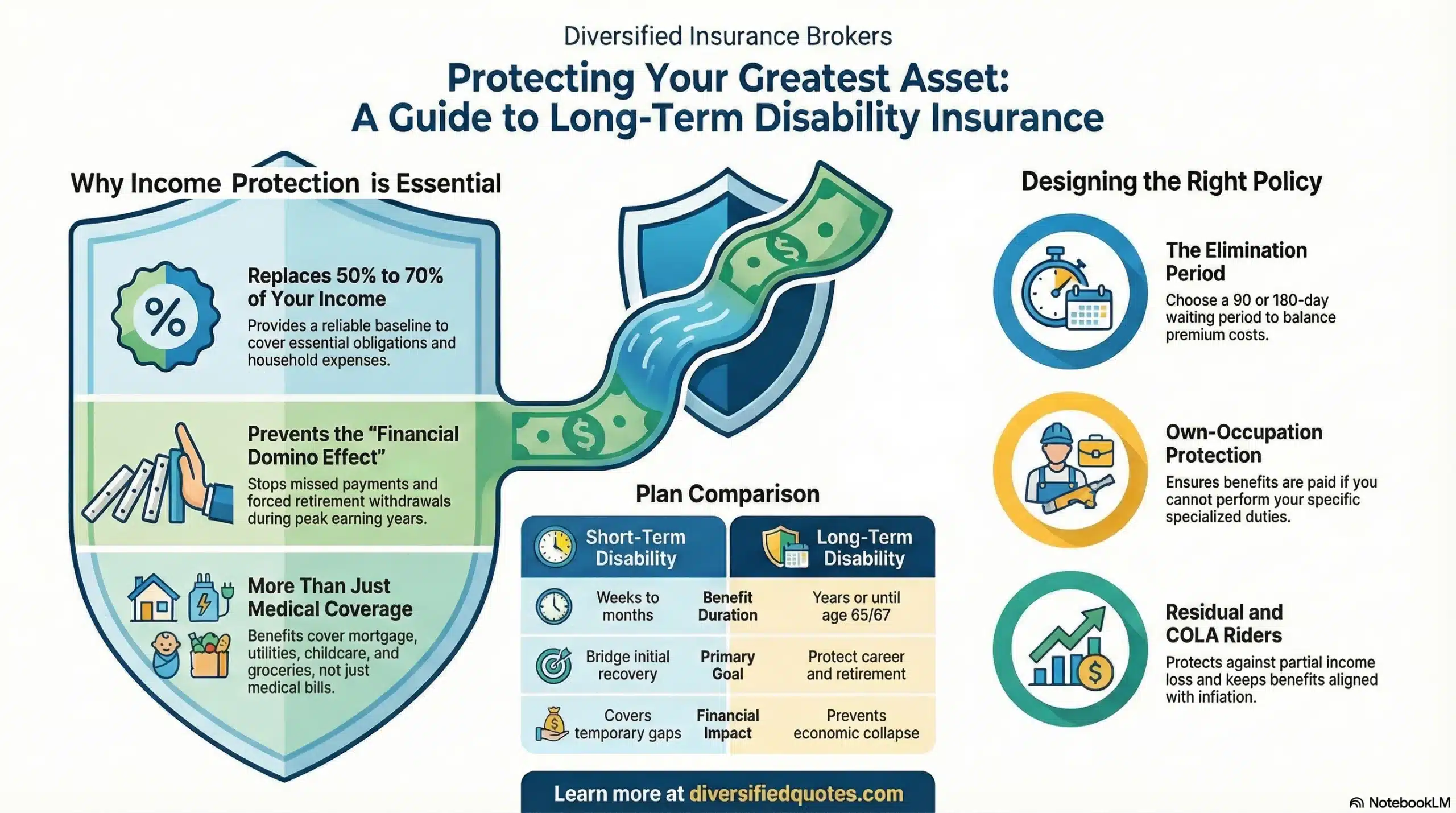
The benefit period for an advertising executive’s primary disability policy should extend to retirement age — long-term disability insurance with a to-age-65 or to-age-67 benefit period is the appropriate foundation for protecting a career with 20-30 years of high-income potential remaining. The elimination period — covered at disability insurance elimination periods explained — should reflect available bridge resources: an executive with meaningful savings and a group plan that pays during initial disability can comfortably absorb a 90-day elimination period on the individual supplemental policy. The residual disability rider is valuable for advertising executives whose conditions may produce partial capacity reduction before complete inability to work — a cognitive condition that reduces executive performance meaningfully but does not eliminate all function can produce real income loss that total disability thresholds do not capture. The future increase option is important for advertising executives whose compensation is still growing, allowing additional coverage to be purchased without new medical underwriting as income increases. The full rider framework is covered at disability insurance riders explained, and the tax treatment that makes individually owned policies particularly valuable for high-income executives is at are disability insurance payments taxable.
Working With an Independent Broker on Executive Disability Planning
Disability planning for advertising executives involves enough complexity — occupational class determination based on actual duties, variable comp documentation, supplemental benefit sizing against existing group coverage, and mental/nervous benefit period evaluation — that carrier selection matters meaningfully. Different carriers classify advertising executive duties differently, and the occupational class assigned affects both premium and available features in ways that make a comparison across multiple carriers more valuable than a single-carrier submission. Disability insurance by occupation covers the occupational classification framework and how advertising and media professionals are evaluated by carriers. Working with an independent disability insurance broker covers why independent market access produces better outcomes for high-income professionals whose cases involve multiple planning dimensions. For advertising executives who have received an existing quote or want an independent evaluation of whether their current coverage actually fills the group plan gap, get a 2nd opinion on your disability insurance quote covers that process.
Talk With an Advisor Today
Choose how you’d like to connect—call or message us, then book a time that works for you.
Schedule here:
calendly.com/jason-dibcompanies/diversified-quotes
Licensed in all 50 states • Fiduciary, family-owned since 1980
FAQs: Disability Insurance for Advertising Executives
If I already have group LTD through my employer, why do I need individual disability insurance?
Most employer group LTD plans cap monthly benefits at $6,000-$10,000 regardless of your actual salary. At $250,000 in annual compensation, a $6,000 monthly cap delivers approximately 29% income replacement — not the 60% the plan nominally promises. Group plans also typically exclude bonus, commission, and equity compensation from benefit calculations, covering base salary only. Benefits from employer-paid plans are usually taxable as income, further reducing the effective replacement. And group coverage ends when employment ends. Individual supplemental coverage fills the income gap, covers variable compensation, produces tax-free benefits when premiums are paid personally, and travels with you through career changes.
What occupational class do advertising executives typically qualify for?
Advertising executives with primarily cognitive, strategic, and managerial duties — directing creative strategy, managing campaigns, leading teams, overseeing client relationships — typically qualify for the highest available occupational classes, which produce the most favorable premium rates and access to true own-occupation definitions with to-age-65 benefit periods. The specific class depends on the carrier’s evaluation of actual duties rather than job title. Executives with heavy client development or new business sales responsibilities may be evaluated slightly differently by some carriers, which is one reason comparing across multiple carriers matters in this profession.
Are mental health conditions and burnout covered under disability insurance?
Individual disability policies with comprehensive mental and nervous condition coverage protect against the disability categories most relevant to high-pressure advertising roles — clinical depression, anxiety disorders, burnout that produces genuine functional impairment, and neurological conditions affecting cognitive performance. The critical distinction between individual and group coverage is the benefit period: most group LTD plans cap mental/nervous benefits at 24 months, which is insufficient for serious conditions that may require longer recovery. Quality individual policies provide unlimited mental/nervous benefit periods that match the physical disability benefit period, ensuring that the most realistic disability scenario for advertising executives is fully protected.
How is the benefit amount calculated when compensation includes bonus and variable pay?
Carriers require income verification to support benefit amounts, typically through tax returns and W-2 statements documenting total compensation including variable components. The benefit sizing analysis should reflect total economic exposure — base salary plus documented bonus and other variable compensation — rather than base salary alone. Carriers apply maximum benefit limits and may cap the percentage of total income that can be insured, so documenting all income sources accurately before application helps ensure the benefit amount reflects the actual financial exposure. Variable income that fluctuates year to year may be averaged across the two most recent tax years for benefit calculation purposes.
What happens to my group disability coverage if I leave my agency or move to consulting?
Employer group coverage terminates when employment terminates — and at the point of a career transition or move to independent consulting, securing new individual coverage requires new underwriting based on your current health status at that time. If health changes occur between now and a future career transition, a new application could produce adverse results that would have been avoided by securing individual coverage while healthy. An individually owned policy secured now travels through all career changes, agency transitions, and shifts to consulting without requiring re-qualification and without the risk that health changes between employment periods create a coverage gap precisely when a new application would be most difficult.
About the Author:
Jason Stolz, CLTC, CRPC, DIA, CAA and Chief Underwriter at Diversified Insurance Brokers (NPN 20471358), is a senior insurance and retirement professional with more than 25 years of real-world experience helping individuals, families, and business owners protect their income, assets, and long-term financial stability. As a long-time partner of the nationally licensed independent agency Diversified Insurance Brokers, Jason provides trusted guidance across multiple specialties—including fixed and indexed annuities, long-term care planning, personal and business disability insurance, life insurance solutions, Group Health, Travel Medical and Evacuation Insurance, and short-term health coverage. Diversified Insurance Brokers maintains active contracts with over 100 highly rated insurance carriers, ensuring clients have access to a broad and competitive marketplace.
His practical, education-first approach has earned recognition in publications such as VoyageATL, and contributions from his agency featured in Kiplinger and GoBankingRates— highlighting his commitment to financial clarity and client-focused planning. Drawing on deep product knowledge and years of hands-on field experience, Jason helps clients evaluate carriers, compare strategies, and build retirement and protection plans that are both secure and cost-efficient. Visitors who want to explore current annuity rates and compare options across multiple insurers can also use this annuity quote and comparison tool.
Explore More Disability Insurance Options: Browse our complete guide to Disability Insurance for Legal, Finance & White Collar Professionals — covering attorneys, accountants, bankers, executives, financial planners & business professionals from 100+ carriers.
Last Reviewed: June 6, 2026 |
Reviewed by: Jason Stolz, CLTC, CRPC, DIA, CAA
Chief Underwriter, Diversified Insurance Brokers, Inc. | NPN: 20471358 | Diversified Insurance Brokers, Inc. — Licensed in all 50 states
Fact Checked by: Tonia Pettitt, CMIP©
Medicare Specialist, Diversified Insurance Brokers, Inc. | NPN: 14374308 | Diversified Insurance Brokers, Inc. — Licensed in all 50 states
Did you find this content helpful? Leave us a Google review — it helps others find trustworthy guidance too.
Editorial Standards: Diversified Insurance Brokers maintains rigorous editorial standards to ensure accuracy, clarity, and independence in all content. Learn more about our editorial standards and commitment to transparency.
