
Disability Insurance for Economists
As an Independent Disability Insurance Broker, we have access to exclusive discounts and negotiated pricing most captive agents can’t offer — see the full breakdown near the end of this page.
Disability Insurance for Economists

Jason Stolz CLTC, CRPC, DIA, CAA
Disability insurance for economists is an essential component of financial planning for professionals whose careers are built entirely on intellectual capital — the ability to analyze data, construct economic models, interpret market behavior, and translate complex quantitative findings into actionable policy or business recommendations. Whether you work as a government economist shaping federal policy, a private sector economist advising corporate strategy, an academic economist conducting research and teaching at a university, or a consulting economist providing expert analysis to clients across industries, your income depends not on physical labor but on cognitive performance sustained at a very high level over a long career.
The income at stake for economists is substantial. The median annual salary for economists in the United States is approximately $115,440, with senior private sector economists, finance industry economists, and consulting firm economists regularly earning well above $200,000 annually. Academic economists at PhD-granting institutions commanded average starting salaries for assistant professors approaching $155,000 in recent years. These are not modest figures — they represent career-long earnings trajectories built on advanced education, specialized expertise, and intellectual output that cannot simply be replicated in a lower-skilled alternative role.
At Diversified Insurance Brokers, we help economists understand how disability insurance protects the income and career investment that a decade or more of graduate education and professional development represents. A well-structured disability insurance policy for an economist is not a generic financial product — it is a precisely calibrated protection for one of the most income-productive and cognitively intensive careers in the professional landscape.
Protect Your Income as an Economist
Compare disability insurance options designed for government economists, academic economists, private sector analysts, and economic consulting professionals.
What Economists Do and How Their Income Depends on Cognitive Capacity
Disability insurance for economists begins with a clear understanding of what economists actually do — because the specific cognitive demands of the profession define exactly what type of disability would be most likely to interrupt or end an economist’s career and income stream.
Economists collect and analyze data on economic phenomena — production, distribution, consumption, employment, prices, trade, and financial markets. They build quantitative models that forecast economic conditions, evaluate policy impacts, and explain market behavior. They communicate their findings through written reports, academic papers, policy briefs, presentations to executive leadership, Congressional testimony, and media appearances. The work requires sustained analytical thinking, mathematical and statistical facility, the ability to hold complex multi-variable relationships in working memory, verbal and written communication of technical findings to non-specialist audiences, and the judgment to make sound recommendations under conditions of uncertainty.
Government economists at agencies such as the Federal Reserve, the Bureau of Labor Statistics, the Congressional Budget Office, and the Treasury Department perform analytical work that directly informs the most consequential economic policy decisions in the country. Their income reflects the value of that expertise, and their ability to earn at the federal economist salary scale depends on maintaining the cognitive capacity to perform complex economic analysis. Private sector economists at major financial institutions, consulting firms, technology companies, and research organizations command even higher compensation — often substantially so — because their analysis directly influences billion-dollar business decisions. The income trajectory of an economist who builds expertise and reputation over a twenty or thirty-year career is precisely the type of human capital that disability insurance exists to protect.
The disability risk profile for economists is distinct from that of most other professionals precisely because it is entirely cognitive. There is no physical labor component, no occupational chemical exposure, no height or equipment hazard. What defines an economist’s ability to earn — and therefore what disability insurance for economists must protect — is the capacity for sustained, sophisticated analytical thinking. Any condition that impairs that capacity, regardless of whether it has any physical dimension, constitutes a genuine and potentially career-ending disability for a working economist. The same fundamentally cognitive income exposure applies equally to other high-earning analytical professionals, such as actuaries whose complex quantitative work defines their professional value.
The Occupational Classification Advantage for Economists
One of the most practically significant facts about disability insurance for economists is that the profession’s favorable occupational classification produces tangible benefits in terms of policy features, benefit limits, and premium competitiveness. Disability insurance carriers classify occupations based on the nature of the work, the estimated disability risk, and the level of education and specialization required. Economists — as exclusively office-based, non-manual, highly specialized analytical professionals — are typically classified at the 4A or high 3A occupational tier, which is among the most favorable classifications available in the individual disability insurance market.
This favorable classification has direct practical implications. Economists have access to the strongest available own-occupation policy definitions, which pay benefits when a condition prevents the economist from performing their specific professional duties regardless of whether other work is theoretically possible. They have access to the highest available monthly benefit limits — often up to $25,000 per month for 4A-classified professionals — which is essential for economists whose income substantially exceeds the benefit limits accessible to lower-classified occupational groups. And they qualify for the full range of supplemental riders — future increase options, cost-of-living adjustment riders, residual disability coverage, and non-cancelable guaranteed renewable provisions — that together create the most comprehensive possible income protection framework.
The favorable classification also means that premiums for disability insurance for economists are competitive relative to the income being protected. An economist earning $150,000 annually who secures a comprehensive disability policy paying $7,500 to $9,000 per month typically invests between 1% and 3% of annual income in premiums — a modest cost relative to the protection secured. Understanding how occupational classification translates into specific policy features is one of the most valuable services an independent broker provides, and it is a dimension of disability insurance planning that directly benefits from working with a broker who understands professional occupational classifications in depth. Our resource on own-occupation disability insurance explained provides a thorough foundation for any economist evaluating their coverage options.
The Disability Risks Economists Actually Face
Because economists work in office settings and face no physical occupational hazards, it is tempting to underestimate their disability risk. This underestimation is a significant financial planning error. The disability risks facing economists are different from those of physical tradespeople — but they are no less real, and for a high-income professional whose earning capacity is tied entirely to cognitive function, a condition that impairs that function is every bit as financially catastrophic as a physical injury is for a manual worker.
Neurological conditions are the most directly career-threatening disability category for economists. Traumatic brain injury — even a moderate concussion — can produce persistent cognitive symptoms including impaired processing speed, reduced working memory capacity, concentration difficulties, and problems with executive function that make the sustained analytical work of economics impossible to perform at a professional standard. Stroke, even a relatively mild one, can produce aphasia, calculation difficulties, or other cognitive impairments that directly undermine the quantitative and communication demands of the profession. Multiple sclerosis, which produces cognitive symptoms in many patients including slowed processing speed and impaired verbal memory, can gradually erode the cognitive performance on which an economist’s professional output depends.
Mental health conditions represent a significant and meaningful disability risk category for economists that is often not discussed openly but that is well-documented among highly educated, high-pressure analytical professionals. Major depression, severe anxiety disorders, and bipolar disorder can each produce periods of profound cognitive dysfunction — impaired concentration, inability to sustain analytical thinking, dramatically reduced intellectual productivity — that prevent an economist from meeting the professional standards their position demands. For academic economists facing publication pressure, grant competition, and tenure timelines, the cognitive demands are particularly intense, and the mental health burden of sustained high-stakes intellectual performance creates genuine disability risk over a career. Our guide on disability insurance for academic science professionals explores similar cognitive risk dynamics in a parallel research-focused career context.
Chronic conditions that produce fatigue, pain, or systemic health effects can impair an economist’s cognitive performance without producing visible physical disability. Chronic fatigue syndrome, fibromyalgia, autoimmune conditions, and other systemic health disorders can make sustained focused analytical work physically and mentally unsustainable even when the person appears outwardly functional. A senior economist at a major financial institution who can no longer sustain the concentration required for complex modeling work — even if they could theoretically perform a less demanding job — has experienced a genuine career-ending disability that own-occupation disability insurance is specifically designed to address.
Why Own-Occupation Disability Insurance Is Non-Negotiable for Economists
The most important decision an economist makes when purchasing disability insurance is the definition of disability written into the policy. For economists, own-occupation coverage is not merely preferable — it is the only definition that provides meaningful income protection against the conditions most likely to affect their careers.
Own-occupation disability insurance pays benefits when a condition prevents an economist from performing the material duties of their specific occupation — conducting economic analysis, building quantitative models, communicating complex findings — regardless of whether they could theoretically perform other types of work. This matters enormously for economists because the most likely disabling conditions they face — neurological impairment, significant mental health conditions, cognitive effects of chronic illness — may leave an economist unable to perform at the analytical standard their profession requires while retaining the ability to perform less cognitively demanding work.
An any-occupation policy would likely deny benefits in precisely these scenarios, because the economist can technically perform some other job. An own-occupation policy recognizes that the inability to perform economic analysis at a professional level is a genuine occupational disability — one that produces an immediate and material income loss relative to what the economist was earning — and pays benefits accordingly. For an economist whose specialized analytical skills represent decades of education and professional development, and whose income reflects that investment, the own-occupation definition is what actually protects what they have built. This is the same principle that makes own-occupation coverage essential for other cognitively intensive analytical professionals, such as chemists and research scientists whose career income depends on sustained scientific thinking.
Case Study: Private Sector Economist Earning $145,000 Per Year
Consider a private sector economist at a major financial services firm earning $145,000 annually, specializing in fixed income market analysis and economic forecasting. Following a moderate traumatic brain injury sustained in an automobile accident, this economist experiences persistent post-concussive symptoms including impaired processing speed, working memory deficits, and severe concentration difficulties that prevent the sustained complex modeling work their role requires. After nine months of recovery with partial return of function, the economist is cleared for limited cognitive activity but cannot perform the sustained high-intensity analytical work the position demands.
| Scenario | Without Disability Insurance | With Disability Insurance |
|---|---|---|
| Monthly Income During Disability | $0 after sick leave exhausted | $7,250–$8,700 |
| 12-Month Total Income | $0 | $87,000–$104,400 |
| Career and Professional Impact | Financial pressure forces premature return, risking further injury | Recovery supported on medical timeline without financial crisis |
| Long-Term Financial Outcome | Savings depleted, retirement contributions suspended, financial disruption | Financial stability maintained, long-term goals preserved |
Traumatic brain injury is a leading cause of disability among working professionals and can occur to anyone at any time — on the road, on a recreational weekend, or in any number of circumstances entirely unrelated to the economist’s professional environment. Disability insurance for economists does not prevent these events — but it ensures that a career-disrupting cognitive injury does not simultaneously produce a financial crisis that compounds the recovery challenge.
Disability Insurance for Academic Economists — The Tenure and Income Complexity
Academic economists face a disability insurance planning landscape that is more complex than that of most other economists, for several reasons that are specific to the structure of academic employment and compensation. Understanding this complexity is essential for academic economists who may be tempted to rely on university group benefit plans without evaluating whether those plans actually address their specific financial exposure.
University group disability plans typically replace 60% or less of base salary — but for academic economists, total compensation often extends significantly beyond base salary. Research grants that fund salary supplements, consulting income earned alongside academic employment, speaking fees, expert witness work, and other professional revenue sources that flow to productive senior economists are frequently excluded from group plan benefit calculations. An associate professor of economics earning $120,000 in base salary but $175,000 in total compensation — including research supplementation and consulting — who relies on the university group plan may discover that their policy covers only the base salary component, leaving a substantial income gap during a disability.
Academic economists who have not yet achieved tenure face an additional disability dimension: the potential loss of career trajectory that a disability-induced interruption in research productivity can produce. In academia, publication record and grant success during the pre-tenure years directly determine career outcomes. A disability that produces even a two or three-year interruption in research productivity during the pre-tenure period can have permanent career consequences that extend well beyond the disability period itself. This career trajectory risk is one of the reasons disability insurance for academic economists should include a future increase option rider — which allows coverage to be increased as income grows over a career without requiring new medical underwriting. Our resource on disability income insurance with a COLA rider provides related context on how benefit value is preserved across an extended career.
The Employer Group Plan Gap for Economists
Many economists — particularly those employed by government agencies, universities, research institutions, and large financial services organizations — have access to employer-sponsored group long-term disability plans. These plans provide a valuable baseline of protection, but they carry limitations that make supplemental individual disability insurance an important consideration for virtually every economist who earns a meaningful income.
Group disability plans typically replace 60% or less of base salary, calculated without bonuses, consulting income, speaking fees, or other supplemental compensation that frequently represents a meaningful portion of total economist earnings. They are owned by the employer — coverage terminates when employment ends, regardless of the reason. And many group plans include definition-of-disability provisions that are weaker than those available in individual policies, with own-occupation coverage that may be limited to the first two years of disability before shifting to a broader any-occupation standard that could deny continued benefits even if the economist cannot return to economic analysis work.
For economists who consult independently alongside employed positions, or who are entirely self-employed in economic consulting practices, the group plan question is moot — there is no employer group plan at all. Independent economic consultants, expert witnesses, and freelance research economists must rely entirely on individual disability insurance for income protection, making the quality and completeness of that coverage a direct determinant of their financial security during any disabling period. The same individual policy planning considerations apply to other independently employed analytical professionals navigating the market without employer group coverage, including independent management consultants managing self-employment income protection.
Key Policy Features for Disability Insurance for Economists
Beyond the own-occupation definition, disability insurance for economists should incorporate several specific policy provisions that address the realities of high-income, cognitively intensive professional careers. The non-cancelable and guaranteed renewable provision locks in both premium rates and coverage terms for the life of the policy — preventing the carrier from increasing premiums or altering coverage as the economist ages or accumulates health history. For an economist who secures a policy in their late twenties or early thirties, this provision ensures that the favorable rates locked in at that time remain in force through a full professional career.
A future increase option rider allows benefit amounts to be increased as income grows without requiring new medical underwriting. For economists whose incomes typically increase substantially over a career — from entry-level government positions through senior private sector or academic roles — this rider ensures that coverage keeps pace with earning capacity. Any condition that develops during the working career cannot prevent future benefit increases, which is particularly important for cognitive professionals whose career earnings growth may be interrupted by the very types of conditions that would otherwise affect future insurability.
A residual disability rider provides proportional benefits when a condition reduces an economist’s productive output without eliminating the ability to work entirely. An economist recovering from a significant mental health episode, a moderate neurological event, or a chronic condition affecting cognitive stamina may return to work at reduced capacity — fewer analytical hours, reduced research output, limited client engagement — without being totally disabled. A residual rider ensures the policy supplements reduced earnings during this transition, providing financial continuity throughout the recovery arc. Our detailed guide on how residual disability benefits work covers this essential feature in full.
The Elimination Period Decision for Economists
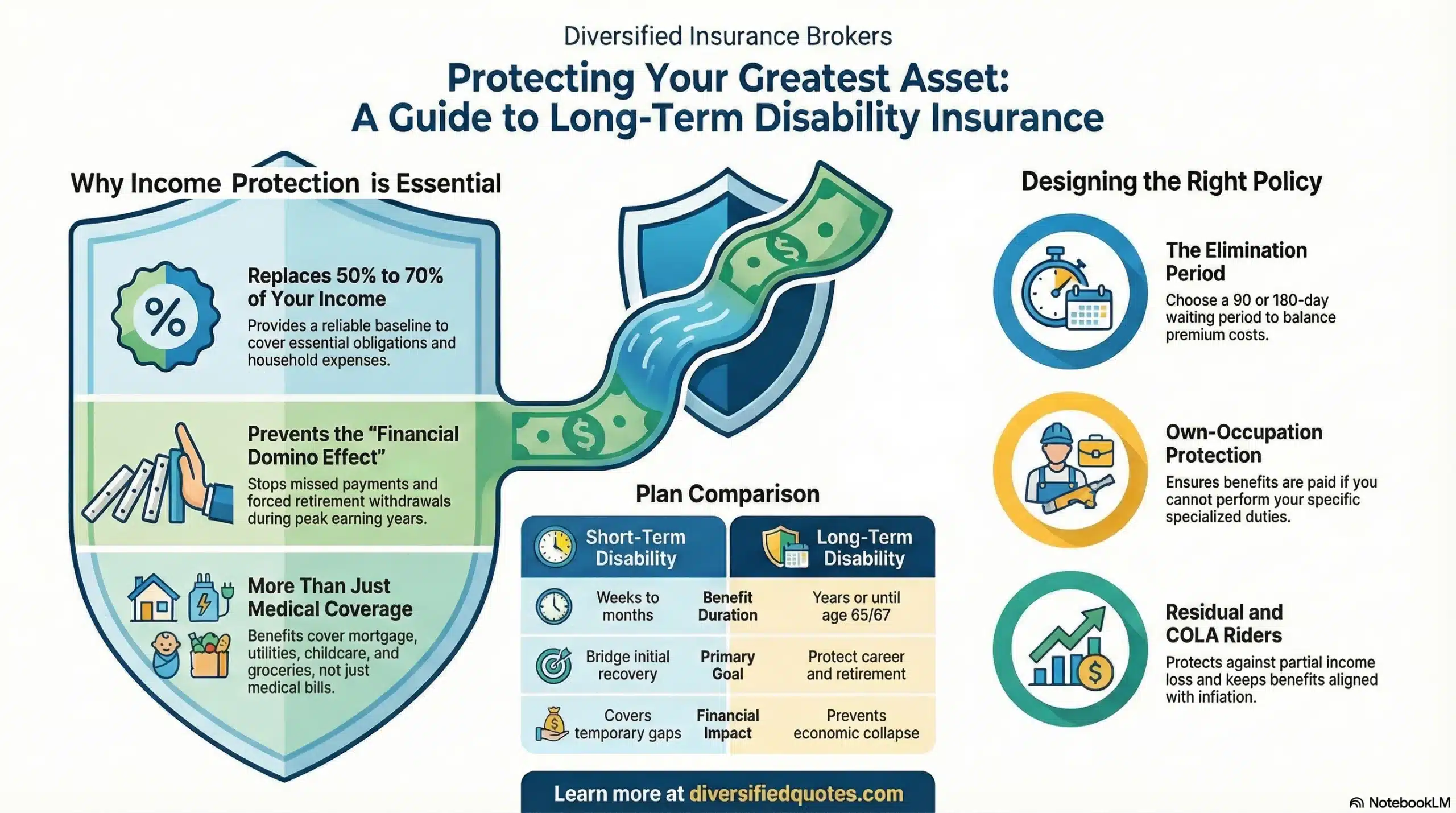
Selecting the appropriate elimination period — the waiting time before disability benefits begin — is an important calibration decision for economists. Most economists employed by universities, government agencies, or large organizations have access to some form of employer sick leave, short-term disability benefit, or savings cushion that can support a waiting period of 90 days or more before long-term disability benefits begin. A 90-day elimination period is the most common choice for professionals with adequate reserves, and it reduces premiums meaningfully compared to shorter waiting periods.
Academic economists with strong emergency savings and access to university sick leave may be comfortable with a 90-day or even 180-day elimination period. Self-employed economic consultants who have no employer sick pay and whose income depends entirely on client billings should evaluate shorter elimination periods more seriously — a 60 or 30-day period provides faster benefit access at a higher premium cost, but avoids the scenario where an independent consultant must sustain months of zero income from savings alone before benefits begin. Our full guide on how disability insurance elimination periods work provides the framework for making this calibration decision effectively.
Integrating Disability Insurance Into an Economist’s Financial Plan
For economists, disability insurance is the financial foundation that protects everything else — the mortgage, the retirement savings, the student loan repayment for graduate education, the family financial obligations, and the long-term wealth accumulation goals that a high-income professional career makes possible. A disabling condition that interrupts economist income without replacement coverage can derail all of these goals simultaneously and permanently within a matter of months.
Disability insurance for economists fits naturally alongside other financial planning priorities. Life insurance laddering strategies complement disability insurance by addressing the family financial security dimension alongside income protection. For economists at senior career stages beginning to think about retirement income planning, understanding how tools such as annuities create guaranteed income independent of cognitive performance adds an important dimension to a comprehensive financial plan that disability insurance anchors.
The combination of a properly structured individual disability policy, supplemental coverage above any employer group plan, and a thoughtful approach to the specific cognitive income risks of economic work creates the most resilient financial protection available to a working economist. Disability insurance for economists is not a generic professional financial product — it is a precisely calibrated protection for one of the most valuable intellectual skill sets in the professional workforce.
Why Economists Should Work with an Independent Disability Insurance Broker
Disability insurance policy structures, definitions, and carrier-specific features vary significantly — and for a high-income analytical professional like an economist, those differences translate into substantial differences in real financial protection. An independent broker who understands professional occupational classifications, who has access to multiple carriers competing for high-income professional business, and who can structure a policy around the specific cognitive income risk profile of economic work is categorically more valuable than a captive agent presenting a single carrier’s standard professional offering.
At Diversified Insurance Brokers, we work with economists across the full professional spectrum — government, academic, private sector, and independent consulting — and we understand the income complexity, the employer group plan limitations, and the cognitive disability risk that characterizes the profession. We compare options across multiple carriers, identify the strongest available policy definitions and rider combinations for each individual’s situation, and structure coverage that will actually perform when a disabling condition occurs. Our dedicated resource on why independent disability insurance brokers matter explains the full value of this approach for high-income professionals who cannot afford to discover coverage gaps at claim time.
Final Thoughts on Disability Insurance for Economists
Economists invest a decade or more in graduate education, professional development, and the accumulation of specialized expertise that generates some of the highest incomes available to analytical professionals. That investment — and the income stream it produces over a full career — deserves comprehensive, thoughtfully structured protection against the conditions most likely to interrupt or end it.
Disability insurance for economists is the financial tool that provides that protection. A well-structured policy — built around an own-occupation definition, maximum available benefit amounts, a full suite of riders including future increase options and residual disability coverage, and an elimination period calibrated to the individual’s financial situation — ensures that a neurological event, a mental health crisis, or any other disabling condition does not permanently erase the returns on a lifetime of intellectual investment.
Related Pages
Talk With an Advisor Today
Choose how you’d like to connect—call or message us, then book a time that works for you.
Schedule here:
calendly.com/jason-dibcompanies/diversified-quotes
Licensed in all 50 states • Fiduciary, family-owned since 1980
Disability Insurance for Economists FAQs
Yes, absolutely — and the misconception that office-based professionals face low disability risk is one of the most consequential financial planning errors an economist can make. While economists face no physical occupational hazards, their disability risk is entirely cognitive — and a condition that impairs the analytical thinking, quantitative modeling, and complex communication that economics demands can be every bit as career-ending as a physical injury is for a manual worker. Traumatic brain injury, stroke, neurological conditions like multiple sclerosis, significant mental health disorders including major depression and severe anxiety, and chronic systemic conditions that produce cognitive fatigue can all disable an economist from performing their specific professional duties while leaving them theoretically capable of other work. Without own-occupation disability insurance, that scenario produces an income loss with no policy benefit to replace it. One in four workers who are 20 years old today will experience a disabling condition before reaching retirement age — economists are not exempt from that statistical reality.
Economists are typically classified at the 4A or high 3A occupational tier — among the most favorable classifications available in the individual disability insurance market. This classification reflects the exclusively office-based, non-manual, highly specialized nature of economic work and produces several practical benefits for economists seeking disability coverage. At the 4A tier, economists have access to the highest available monthly benefit limits, the strongest own-occupation policy definitions, non-cancelable and guaranteed renewable policy provisions, and the full range of supplemental riders including future increase options, residual disability coverage, and cost-of-living adjustment protection. The favorable classification also means competitive premiums relative to the income being protected — typically in the 1% to 3% of annual income range for a comprehensive long-term disability policy. For more context on how the own-occupation definition works for professionals at favorable occupational tiers, our page on own-occupation disability insurance explained is essential reading.
The disability risk profile for economists is entirely cognitive, which means the conditions most likely to interrupt or end an economist’s career are those that impair analytical thinking, quantitative reasoning, memory, concentration, and complex communication. Traumatic brain injury — even a moderate concussion — can produce persistent post-concussive symptoms including impaired processing speed, working memory deficits, and concentration difficulties that make sustained economic analysis impossible at a professional standard. Stroke can produce aphasia, calculation difficulties, or cognitive impairments that directly undermine the quantitative and communication demands of economics. Neurological conditions like multiple sclerosis produce cognitive symptoms in many patients including slowed processing speed and verbal memory impairment. Major depression, severe anxiety, and bipolar disorder can produce periods of profound cognitive dysfunction that prevent professional analytical output. Chronic conditions including chronic fatigue syndrome, autoimmune disorders, and fibromyalgia can make sustained focused intellectual work physically and mentally unsustainable even without visible physical disability.
Own-occupation disability insurance pays benefits when a condition prevents an economist from performing the material duties of their profession — economic analysis, quantitative modeling, policy evaluation, research communication — regardless of whether they could theoretically perform other less cognitively demanding work. This matters enormously for economists because their most likely disabling conditions — neurological impairment, significant mental health disorders, cognitive effects of chronic illness — may leave them unable to perform at the analytical standard their position demands while retaining the ability to do simpler work. An any-occupation policy would deny benefits in precisely these scenarios, because the economist can technically perform some other job. An own-occupation policy recognizes the genuine occupational disability and pays accordingly. Given that economists’ incomes reflect their specialized analytical expertise — not general labor — an any-occupation policy provides almost no meaningful income protection for the conditions most likely to actually disable a working economist.
In most cases, no — and the gaps in employer group disability plans are particularly significant for economists. Group plans typically replace 60% or less of base salary and frequently exclude consulting income, research supplements, speaking fees, and other supplemental professional earnings that represent a meaningful portion of many economists’ total compensation. Group plans are owned by the employer, meaning coverage terminates when employment ends regardless of the reason. Many group plans also include own-occupation definitions that expire after two years of disability, shifting to a more restrictive any-occupation standard that could deny continued benefits even if the economist cannot return to economic analysis work. Supplemental individual disability insurance fills these gaps, covering total compensation more accurately, providing portable coverage that follows the economist through career changes, and maintaining strong own-occupation definitions for the life of the policy. For economists who consult independently alongside employed positions, the group plan shortfall is even more pronounced. Our resource on how residual disability benefits work covers another important dimension that group plans frequently fail to address adequately.
Academic economists face several disability planning complexities specific to the academic employment structure. University group disability plans typically cover base salary but not the full range of academic compensation — research grant salary supplements, consulting income, and other supplemental earnings are often excluded from benefit calculations. Pre-tenure economists face an additional dimension: a disability-induced interruption in research productivity during the pre-tenure period can produce permanent career consequences that extend well beyond the disability period itself, because publication record and grant success during those years directly determine tenure outcomes and long-term career trajectory. This career trajectory risk makes a future increase option rider particularly important for academic economists at early career stages, as it allows coverage to increase as compensation grows without requiring new medical underwriting. And because academic careers often involve salary growth across decades from assistant through full professor, ensuring coverage keeps pace with income through a future increase option is a critical long-term planning consideration. Our resource on disability income insurance with COLA protection addresses how benefit value is preserved during extended disability claims.
Residual disability coverage pays proportional benefits when a disabling condition reduces an economist’s productive output and earnings without eliminating the ability to work entirely. An economist recovering from a significant mental health episode, a moderate neurological event, or a chronic condition affecting cognitive stamina may return to work at reduced capacity — fewer analytical hours, reduced research or consulting output, limited client engagement — earning proportionally less than their pre-disability income without being considered totally disabled under a basic policy definition. Without a residual disability rider, a total-disability-only policy would pay nothing during this partial recovery period. A residual rider supplements reduced earnings proportionally throughout the return-to-work arc, providing continuous financial support from the onset of disability through to full return to normal professional productivity. For economists whose recoveries from cognitive conditions often follow gradual, non-linear timelines, this rider is essential for genuine income protection during the entire recovery period.
The elimination period — the waiting time between the onset of disability and when benefits begin — should be calibrated to the economist’s available financial reserves and employer sick leave access. Most economists employed by universities, government agencies, or large financial organizations have access to some employer sick leave or short-term disability benefit that can bridge the early weeks of a disability. For these economists, a 90-day elimination period is typically appropriate and reduces premiums meaningfully. Senior economists with substantial emergency savings or access to investment income may comfortably accept a longer 180-day elimination period. Self-employed economic consultants with no employer sick pay and income dependent entirely on client billings should evaluate shorter elimination periods — a 60 or 30-day period provides faster benefit access at a higher premium, but avoids months of depleting savings before long-term disability benefits begin. Our full guide on how elimination periods work provides the framework for making this decision effectively for each individual situation.
Many individual disability insurance policies do provide coverage for mental health conditions including major depression, anxiety disorders, and bipolar disorder when those conditions prevent the insured from performing their occupational duties. However, the terms vary significantly between carriers — some policies pay full benefits for mental health disabilities throughout the entire benefit period, while others limit mental health claims to a 24-month benefit period even when the base policy would otherwise pay to age 65. For economists, where mental health conditions represent a genuinely significant disability risk given the cognitive demands and professional pressures of the career, reviewing the specific mental health benefit period provisions of any policy before purchase is essential. At Diversified Insurance Brokers, we specifically evaluate mental health coverage provisions when structuring disability insurance for economists, because this is an area where policy fine print can make a substantial difference in real-world income protection for conditions that are genuinely likely to affect high-pressure analytical professionals.
The best time is as early as possible in an economics career — ideally while completing graduate education or entering the first professional position. Disability insurance premiums are based in part on age and health status at the time of application, and economists who apply in their late twenties or early thirties secure the most comprehensive coverage at the most favorable rates. More importantly, any health conditions that develop before application can result in exclusion riders, premium increases, or more restricted policy terms. An economist who applies at 28 in excellent health locks in comprehensive own-occupation coverage at favorable rates that remain stable through a non-cancelable guaranteed renewable policy, regardless of what health developments occur over a 35 or 40-year career. Waiting until mid-career — after potential health conditions have emerged or premiums have increased with age — consistently produces worse coverage outcomes than applying early. The future increase option rider available at early application stages then allows coverage to grow with income without additional medical underwriting as the economist’s earnings trajectory develops.
An independent broker has access to multiple disability insurance carriers and can compare policy definitions, occupational class assignments, mental health benefit provisions, rider availability, and premium structures across the full marketplace. For economists — high-income professionals who have invested heavily in specialized education and whose income depends on cognitive performance rather than physical labor — the differences between carriers in how they define disability for analytical professionals, how they treat mental health claims, and what maximum benefit amounts they offer can produce substantially different real-world income protection. A captive agent representing a single carrier can only present that company’s approach. At Diversified Insurance Brokers, we evaluate the full competitive landscape and structure coverage that reflects how economists actually earn, what conditions would actually disable them, and what policy features provide the most genuine financial protection for the income an economics career generates. Our resource on why independent disability insurance brokers matter explains this value for high-income professionals in full detail.
About the Author:
Jason Stolz, CLTC, CRPC, DIA, CAA and Chief Underwriter at Diversified Insurance Brokers (NPN 20471358), is a senior insurance and retirement professional with more than 25 years of real-world experience helping individuals, families, and business owners protect their income, assets, and long-term financial stability. As a long-time partner of the nationally licensed independent agency Diversified Insurance Brokers, Jason provides trusted guidance across multiple specialties—including fixed and indexed annuities, long-term care planning, personal and business disability insurance, life insurance solutions, Group Health, Travel Medical and Evacuation Insurance, and short-term health coverage. Diversified Insurance Brokers maintains active contracts with over 100 highly rated insurance carriers, ensuring clients have access to a broad and competitive marketplace.
His practical, education-first approach has earned recognition in publications such as VoyageATL, and contributions from his agency featured in Kiplinger and GoBankingRates— highlighting his commitment to financial clarity and client-focused planning. Drawing on deep product knowledge and years of hands-on field experience, Jason helps clients evaluate carriers, compare strategies, and build retirement and protection plans that are both secure and cost-efficient. Visitors who want to explore current annuity rates and compare options across multiple insurers can also use this annuity quote and comparison tool.
Explore More Disability Insurance Options: Browse our complete guide to Disability Insurance for Legal, Finance & White Collar Professionals — covering attorneys, accountants, bankers, executives, financial planners & business professionals from 100+ carriers.
Last Reviewed: June 7, 2026 |
Reviewed by: Jason Stolz, CLTC, CRPC, DIA, CAA
Chief Underwriter, Diversified Insurance Brokers, Inc. | NPN: 20471358 | Diversified Insurance Brokers, Inc. — Licensed in all 50 states
Fact Checked by: Tonia Pettitt, CMIP©
Medicare Specialist, Diversified Insurance Brokers, Inc. | NPN: 14374308 | Diversified Insurance Brokers, Inc. — Licensed in all 50 states
Did you find this content helpful? Leave us a Google review — it helps others find trustworthy guidance too.
Editorial Standards: Diversified Insurance Brokers maintains rigorous editorial standards to ensure accuracy, clarity, and independence in all content. Learn more about our editorial standards and commitment to transparency.
