
Disability Insurance for Stock Brokers
As an Independent Disability Insurance Broker, we have access to exclusive discounts and negotiated pricing most captive agents can’t offer — see the full breakdown near the end of this page.
Disability Insurance for Stock Brokers

Jason Stolz CLTC, CRPC, DIA, CAA
Stockbrokers, registered representatives, and licensed securities professionals occupy a professional category where the disability risk profile is almost entirely inverted from the physical trades: there is no machinery, no chemical exposure, no fall hazard, and no acute physical injury mechanism in the day-to-day work of a securities broker or investment advisor. The disability that ends a stockbroker’s career is almost always cognitive, neurological, or psychiatric — a TBI from a vehicle accident that impairs the complex analytical judgment the profession requires, a neurological condition that prevents the sustained attention and precision communication that client advisory demands, or a psychiatric condition — depression, anxiety, burnout — that eliminates the emotional resilience and relational capacity that building and maintaining a book of business requires over time. Bureau of Labor Statistics data documents the median annual wage for securities, commodities, and financial services sales agents at $78,140, with personal financial advisors at $102,140 and the high end of the compensation range documented at $215,210 — a compensation profile that makes the income being protected by disability insurance highly meaningful and the consequence of an unprotected disability correspondingly severe. The income structure of the stockbroker profession adds a specific dimension that makes disability insurance planning more urgent than the income level alone suggests: the book of business. A registered representative’s commission income is generated by an active client relationship — the ongoing advisory engagement that produces transaction commissions, asset management fees, and renewal compensation. During a disability, that client relationship does not pause; it deteriorates. Clients who cannot reach their broker for months migrate to other advisors. Books of business that took a decade to build can be significantly impaired by a disability that lasts only a year — producing a permanent income reduction that extends far beyond the disability period itself. For independent RIA firm owners and independent broker-dealer representatives whose practice is entirely self-built and self-maintained, that book-of-business deterioration during disability represents the most severe unprotected financial consequence in a profession where the individual professional relationship is the entire business. Understanding how disability insurance works across the full financial services professional spectrum begins with the own-occupation definition — the specific policy feature that determines whether a stockbroker’s policy pays benefits when cognitive or psychiatric disability prevents their specific advisory and client service functions, not merely when they cannot perform any work whatsoever.
At Diversified Insurance Brokers, Jason Stolz, CLTC, CRPC, DIA, CAA works with securities and investment professionals across the full range of the financial services industry’s employment and business structures — wirehouse-employed registered representatives at major broker-dealer firms whose employer group plan access may provide a benefit baseline but whose high income, commission-based compensation structure, and book-of-business vulnerability require comprehensive individual supplemental coverage, independent broker-dealer representatives whose affiliated but independent structure produces the self-employment characteristics that make business overhead expense coverage as relevant as personal disability income, RIA firm owners who have built independent registered investment advisory practices with meaningful overhead infrastructure, and fee-based financial advisors whose recurring revenue model from assets under management creates a specific disability income structure that differs from pure commission-based compensation. The coverage architecture for each requires specific attention to the own-occupation definition that encompasses the advisory, analytical, and client relationship functions that generate the securities professional’s income — not merely generic inability to perform sedentary work — and to the income documentation approach for professionals whose compensation combines W-2 base salary, 1099 commission income, and partnership distributions in structures that vary significantly by broker-dealer or RIA firm arrangement.
Compare Disability Coverage for Securities Professionals
We review coverage options across 100+ carriers and identify the own-occupation definition, income documentation approach, and coverage structure that fits your specific securities role and compensation model.
Request Disability Insurance OptionsStockbroker and Investment Advisor Disability Risk — Cognitive Function, Book of Business, and Compensation Structure
| Risk Category | Professional and Research Context | Resulting Disability Risk | Coverage Status | Income Protection Gap |
|---|---|---|---|---|
| Cognitive disability — TBI and neurological conditions | The stockbroker’s professional function depends entirely on cognitive capacity — complex market analysis, regulatory compliance judgment, portfolio risk assessment, and precise client advisory communication requiring sustained high-level cognition; TBI from vehicle accidents, strokes or other cerebrovascular events, or progressive neurological conditions (multiple sclerosis, Parkinson’s) can eliminate the specific analytical and communication capacity the profession requires while leaving general physical function intact; the FINRA-licensed professional whose cognitive impairment prevents accurate investment analysis and client communication has lost their specific professional function even if they can perform non-securities employment | Impaired analytical judgment preventing accurate investment analysis and recommendation; communication deficits preventing client advisory functions; sustained attention impairment preventing the complex multi-factor analysis that securities advisory requires; any neurological condition eliminating the specific cognitive professional function of securities work | Workers’ comp does not cover cognitive disability; employer group plans cap mental health at 24 months; own-occupation individual DI covering advisory and analytical functions specifically is the only comprehensive protection | Complete gap without own-occupation individual DI; any-occupation standards fail a broker who cannot perform securities advisory but could perform generic sedentary work — an inadequate outcome for the income being protected |
| Mental health — burnout, depression, and anxiety in high-pressure financial services | Financial services professionals face documented occupational stress from client portfolio accountability, market volatility, compliance pressure, and the sustained high-stakes performance demands of managing client assets; burnout — documented in financial services at significant rates — can eliminate the emotional resilience, relational engagement, and sustained performance capacity that maintaining a book of business requires; depression and anxiety disorders producing cognitive slowing, impaired concentration, and impaired client communication are genuine occupational disabilities for a profession whose deliverable is trusted advisory judgment | Disabling depression or anxiety preventing the sustained client advisory engagement and complex analytical work that securities professional income depends on; burnout eliminating the emotional capacity for client relationship maintenance; psychiatric conditions producing the impaired judgment that FINRA compliance standards require be self-reported, potentially triggering license implications alongside the disability itself | Employer group plans cap mental health at 24 months; own-occupation individual DI with unlimited mental health benefit period is the only protection adequate for the documented duration of serious professional burnout and psychiatric conditions | Significant gap from the 24-month group plan cap; unlimited mental health benefit period in individual own-occupation DI fills the gap that group plans leave for the most common professional disability pathway in financial services |
| Book of business deterioration during disability | The stockbroker’s commission income is generated by active client relationships — the ongoing advisory engagement that produces transaction commissions, AUM fee income, and renewal compensation; during a disability, the client relationship does not pause — it deteriorates; clients who cannot reach their advisor migrate to competitors; research on professional service practice attrition documents that extended unavailability produces significant client loss that produces permanent income reduction extending well beyond the disability period; a book of business built over ten years can be significantly impaired by a disability of one to two years | Permanent reduction in commission and AUM income from client attrition during disability — an income consequence that extends years beyond the disability period itself and that no disability insurance benefit directly replaces but that the residual benefit provision specifically addresses during the recovery and rebuilding period | Not an insurable loss itself; residual disability benefit specifically addresses partial income recovery during the rebuilding period following disability — paying proportionally as the broker returns and income gradually recovers | Residual disability provision is the specific policy feature that addresses the book-of-business income trajectory during the recovery and rebuilding phase — a critical coverage dimension for any commission-based financial services professional |
| Commission income volatility and documentation complexity | Stockbroker and registered representative compensation combines base salary (if any), commission income from transaction execution, trailing commissions from existing client assets, and performance bonuses in structures that vary significantly by firm, product, and performance tier; BLS documents the high end of the securities professional compensation range at $215,210 — with most commission-based professionals experiencing meaningful year-to-year income variation based on market activity, client asset levels, and new business production; this income variability creates specific benefit calculation complexity | Not a disability risk itself — but an income documentation challenge that requires specific planning to ensure the disability benefit accurately reflects total professional compensation across both its stable and variable components | Multi-year income averaging addresses variability; complete documentation of all income streams — base, commission, trailing revenue, bonuses — produces the most accurate and favorable benefit basis | Documentation gap closed through complete multi-source income reporting and multi-year averaging — a planning step that independent broker guidance specifically addresses before any application is submitted |
| RIA firm owner overhead exposure | Independent RIA firm owners who have built registered investment advisory practices with office infrastructure, compliance management systems, staff, technology platforms, and client service operations carry fixed monthly overhead obligations that continue during disability regardless of advisory revenue; an RIA firm whose principal advisor is disabled for three to six months continues incurring compliance software subscriptions, staff wages, office lease, technology costs, and professional association obligations against reduced or zero revenue | Fixed practice overhead accumulating against zero or reduced advisory revenue during the principal advisor’s disability — the two-layer financial exposure that any service practice owner carries, with the added intensity of client attrition risk during the overhead accumulation period | No automatic BOE coverage; personal DI addresses personal income only; BOE disability coverage specifically addresses practice overhead including staff, compliance, technology, and office costs | Critical gap for RIA firm owners; BOE alongside personal DI creates the complete two-layer protection |
The table documents the specific dimensions of stockbroker and investment advisor disability risk — cognitive and psychiatric disability as the primary pathway, book-of-business deterioration as the income consequence extending beyond any disability period, and commission income variability as the documentation challenge requiring specific planning. Why financial services professionals prioritize income protection is answered by the book-of-business reality: the income a securities professional generates depends on client relationships that actively deteriorate during any extended disability, meaning the financial consequence of a disability without adequate protection extends years beyond the disability period itself through permanent client attrition.
The Own-Occupation Standard — Protecting the Advisory Function Specifically
The disability definition is the single most consequential policy feature for any stockbroker or investment advisor — more consequential than benefit amount, elimination period, or any rider — because the profession’s primary disability scenarios involve cognitive and psychiatric conditions that prevent the specific advisory, analytical, and client service functions that generate securities income while leaving general physical and even general cognitive capacity available for other types of work. A registered representative whose TBI impairs the complex investment analysis and compliance judgment his FINRA-licensed role requires cannot perform securities advisory regardless of whether general mobility and routine cognitive function are preserved. A financial advisor whose severe depression has eliminated the emotional resilience, relational engagement, and client communication capacity that building and maintaining a book of business requires has lost the specific professional function that her income depends on, even if sedentary clerical or administrative work might theoretically be possible.
An own-occupation disability policy for a securities professional should encompass the specific advisory, analytical, client relationship, and compliance functions that constitute the FINRA-licensed professional’s occupational duties — not merely generic inability to perform any work. The distinction between an own-occupation definition and an any-occupation definition is the difference between a policy that pays when the stockbroker’s specific professional function is impaired and a policy that denies claims because some other employment might theoretically be possible. For financial services professionals whose income depends on specialized licensing, specific client relationships, and sophisticated analytical capacity, this distinction is the entire value proposition of disability insurance. The residual disability benefit provision is specifically important for stockbrokers because the book-of-business recovery trajectory following any disability involves a gradual return — clients coming back slowly, income rebuilding incrementally — producing partial income recovery rather than an immediate return to pre-disability production. A residual benefit pays proportionally based on actual income reduction during this recovery and rebuilding period, providing income support through the gradual trajectory that commission-based recovery actually follows. The white-collar professional disability framework provides context for how securities professionals fit within the occupational class structure that produces the most favorable premium rates available — typically 4A or 3A classification, the highest tier in the disability insurance system, reflecting the professional, office-based character of securities advisory work. How disability insurance applies to financial planning professionals broadly shares the same own-occupation and cognitive disability framework that specifically applies to securities-licensed brokers and advisors.
Income Documentation for Commission-Based Securities Professionals
The income documentation for a stockbroker’s or registered representative’s disability insurance benefit calculation requires capturing the full multi-stream compensation structure that securities professionals earn — not merely the W-2 base salary that standard employment benefit calculations might use. A registered representative at a wirehouse firm earning a $60,000 base salary plus $140,000 in annual commission income has a total compensation of $200,000 — but a disability insurance policy sized only to the W-2 base produces a benefit sized to $60,000 annually, representing only 30 percent of actual total compensation. The commission component is the dominant income stream for most active securities professionals and must appear in the income documentation for the disability benefit to reflect actual compensation.
W-2 compensation from the broker-dealer firm captures both the base salary and any commission income reported through payroll. For independent broker-dealer representatives whose commission income is paid on a 1099 basis through a grid arrangement with the BD firm, Schedule C documentation of the net commission income after business expenses is the appropriate documentation vehicle. RIA firm owners whose income includes management fee revenue distributed through the firm entity will document the income through whatever pass-through structure the entity uses — Schedule K-1 for partnership or LLC distributions, or W-2 from an S-corporation — in the amounts that reflect the owner’s actual economic compensation from the practice. High-earning securities professionals with documented compensation above $200,000 to $250,000 may need layered coverage from multiple carriers to reach total monthly benefit amounts that adequately replace 60 to 70 percent of total professional income, since single-carrier benefit ceilings may not accommodate the full replacement need at top-tier securities compensation levels. The 1099 income documentation framework applies to independent BD representatives who receive commission income as contractors rather than employees. How much disability income a stockbroker actually needs is calculated from total documented professional compensation — not base salary alone — and the household’s actual financial obligations during a disability period when neither base salary nor commission income may be available.
RIA Firm Owners — The Overhead Layer and Practice Continuity
For RIA firm owners and independent advisory practice principals who have built a practice with staff, office infrastructure, technology platforms, and compliance management systems, disability creates the same two-layer financial exposure as any service business owner — personal income loss and simultaneous overhead obligations continuing against reduced or zero advisory revenue. A registered investment advisor whose disability prevents client advisory for three to six months continues incurring compliance software subscriptions, custodial platform fees, staff wages, office lease or co-working costs, professional association memberships, and E&O insurance premiums during the period when no AUM fee revenue is being generated from active advisory relationships.
Business overhead expense disability coverage specifically addresses the RIA practice’s fixed operating costs during the principal advisor’s qualifying disability — staff wages, compliance costs, technology subscriptions, office costs, and professional insurance — preserving the practice infrastructure during recovery. The BOE benefit is sized to actual documented monthly fixed practice overhead rather than to AUM fee revenue. Personal disability income and BOE together create the complete protection architecture for an RIA firm owner. The elimination period reflects actual financial reserves — most established advisors can sustain 90 days; newer practices may require a shorter elimination period. The future increase option is specifically valuable for advisors in asset growth phases, allowing benefit increases as AUM grows without new medical underwriting. Cost of living adjustment protects purchasing power for permanent disability scenarios. Coverage for securities professionals with prior mental health treatment is available through independent broker comparison — the most common prior condition category in this profession — typically with partial exclusion riders for specific documented conditions and full coverage for all other disability causes. Specialty and modified options address advisors whose documented mental health or neurological history creates standard underwriting complexity. No-exam disability coverage provides streamlined approval at appropriate benefit amounts for healthy securities professionals. Guarantee issue options provide a last-resort access point when standard underwriting produces limited terms. Getting the best available rates as a securities professional means comparison across the full carrier market — the 4A occupational class that financial services professionals typically receive produces the most favorable premium rates in the disability insurance system, making comprehensive protection genuinely accessible relative to the income levels being protected. Why early-career securities professionals need coverage before any mental health or cognitive health history develops is answered by the career-long nature of book-of-business building: a disability at any career stage represents years of client relationship investment potentially lost, and the most comprehensive coverage at the lowest premium is available at career start before any occupational health record exists. Whether disability insurance is worth the cost for a stockbroker or advisor is answered by calculating what one year of disability-period client attrition represents against a career-long book of business — and recognizing that the financial consequence of that attrition extends years beyond the disability itself. Whether disability benefits are taxable: personally purchased individual policies paid with after-tax income generally produce tax-free benefits — the full monthly benefit reaches the household during a disability period when commission income has stopped. A second opinion on any disability insurance proposal for a securities professional specifically confirms the own-occupation language encompasses the advisory and analytical functions of the FINRA-licensed role, the income documentation captures total professional compensation rather than base salary alone, and the coverage structure addresses any practice overhead dimension before any premium commitment is made.
Get Your Securities Professional Coverage Review
We compare own-occupation definitions for advisory functions, income documentation approaches for commission-based compensation, and practice overhead structures across 100+ carriers to build the disability protection your securities career requires.
Request Disability Insurance Options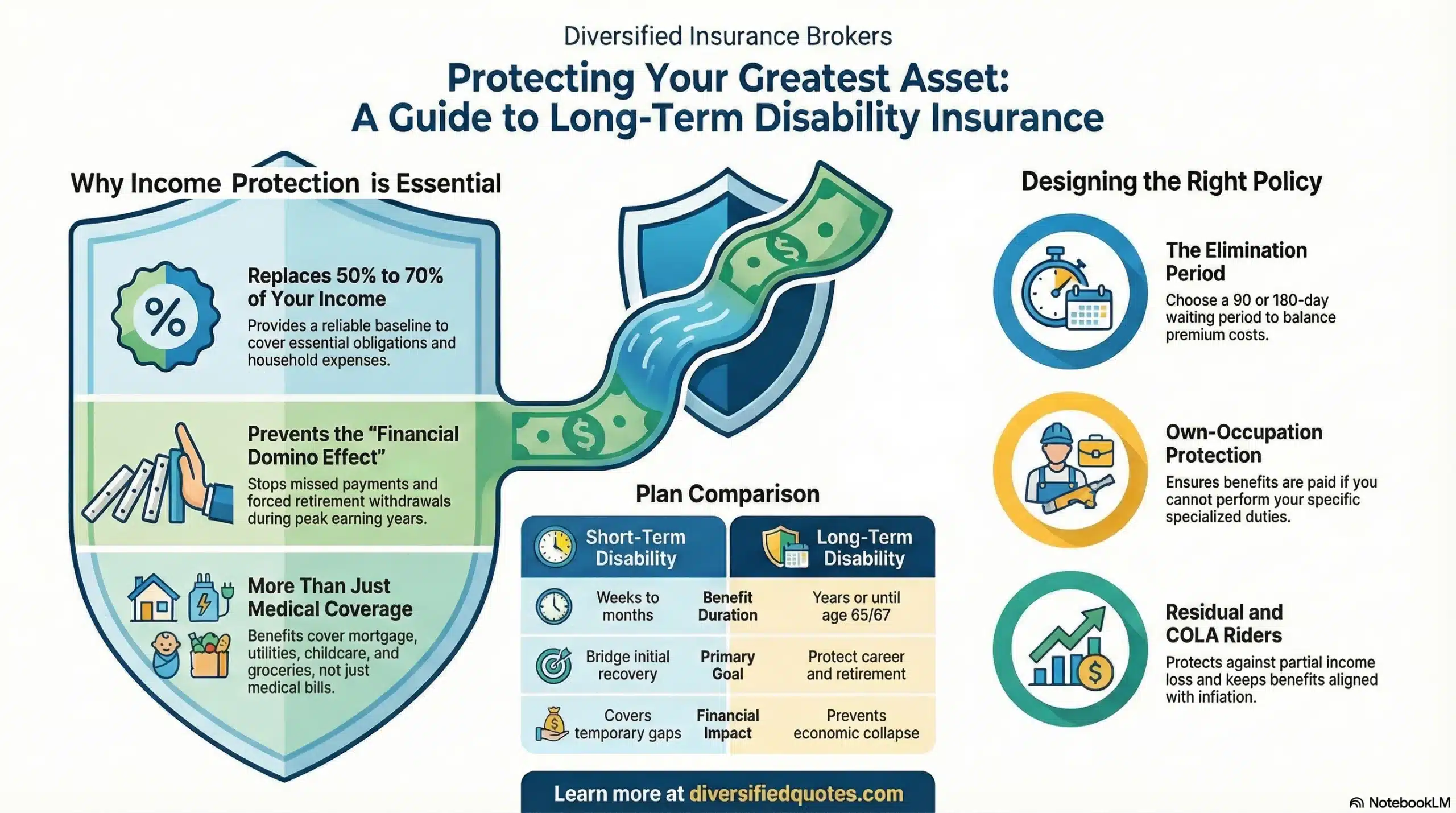
Talk With an Advisor Today
Choose how you’d like to connect—call or message us, then book a time that works for you.
Schedule here:
calendly.com/jason-dibcompanies/diversified-quotes
Licensed in all 50 states • Fiduciary, family-owned since 1980
FAQs: Disability Insurance for Stockbrokers and Investment Advisors
What kind of disability would actually prevent a stockbroker from working?
The disabilities that most commonly end or severely limit a stockbroker’s or investment advisor’s career are cognitive, neurological, and psychiatric — not physical. The professional function of a securities advisor depends on complex investment analysis, regulatory compliance judgment, precise communication of complex financial concepts, sustained attention across lengthy client advisory conversations, and the emotional resilience that maintaining a book of business through market volatility requires. Any condition that substantially impairs these specific functions creates a genuine occupational disability for a stockbroker regardless of whether general physical capacity is maintained.
The most commonly documented disability scenarios for financial services professionals include traumatic brain injury from vehicle accidents producing impaired analytical capacity and communication deficits; stroke or cerebrovascular events producing cognitive and language impairments; progressive neurological conditions such as multiple sclerosis affecting sustained attention and precision communication; and psychiatric conditions — depression, anxiety, and burnout — that eliminate the emotional capacity, sustained concentration, and relational engagement that client advisory relationships require. Depression is specifically consequential for securities professionals because FINRA’s regulatory framework requires brokers to self-report certain mental health adjudications and bankruptcies on Form U4 — meaning severe psychiatric conditions can have regulatory implications alongside the disability itself, potentially limiting the ability to maintain FINRA licensing while receiving disability benefits. An own-occupation disability policy specifically covering the advisory and analytical functions of securities work pays benefits when these cognitive, neurological, or psychiatric conditions prevent those specific professional functions — regardless of whether other employment is theoretically available to someone with the broker’s general abilities.
My income is mostly commissions that vary year to year — how does disability insurance handle that?
Commission-based securities professional income — which varies with market activity, client asset levels, new business production, and the natural cycle of a financial advisory practice — is addressed through the multi-year income averaging approach that disability insurance carriers apply to all variable professional compensation. Most carriers use a two to three year average of documented total professional income — base salary plus all commission and bonus income, from all documented sources — to establish the benefit calculation basis. This smooths year-to-year commission variability rather than penalizing a down market year or rewarding an exceptional production year, producing a sustainable average that reflects the career’s economic profile.
The critical documentation point for commission-based securities professionals is capturing all income streams in the documentation — not merely the W-2 base salary that employment records most prominently reflect. A registered representative earning $60,000 in base salary and $160,000 in annual commissions has $220,000 in total compensation, but a disability insurance policy sized only to the W-2 base produces benefits sized to $60,000 alone — covering less than 30 percent of actual income. Commission income documented through W-2 commission payments, 1099 commission distributions, or Schedule C net earnings should all be included in the income documentation presented at application. Trailing commissions, renewal income from previously placed products, and AUM fee income from managed accounts all represent ongoing income streams that should appear in the documentation to produce the most accurate and favorable benefit basis. An independent broker familiar with financial services professional income documentation is essential for ensuring the application captures total compensation rather than base salary alone. Whether disability benefits are taxable: personally purchased individual policies paid with after-tax income generally produce tax-free benefits — the full monthly benefit reaches the household during the disability period when commission income has stopped entirely.
What happens to my book of business while I’m disabled?
The book-of-business reality is the most specifically consequential disability planning fact for any commission-based securities professional — and it is the aspect of stockbroker disability risk that most distinguishes the financial consequences of disability in this profession from disability in a salary-based career. A salaried employee who becomes disabled and then recovers returns to the same salary. A stockbroker who becomes disabled and then recovers returns to a book of business that has been deteriorating for the duration of the disability: clients who could not reach their advisor migrated to competitors; market events during the disability period occurred without the broker’s guidance and perhaps damaged relationships; and new business referrals that would have come in during a productive period were lost. The income recovery following a disability is therefore gradual rather than immediate, with the rebuilt book of business progressively recovering toward pre-disability levels over months or years depending on the length and severity of the disability.
The residual disability benefit provision is the policy feature that specifically addresses this gradual recovery trajectory. During a period of residual disability — when the broker has partially returned to work but income has not yet recovered to pre-disability levels — the residual benefit pays proportionally based on actual income reduction, supporting the household through the gradual income rebuilding phase rather than cutting off benefits the moment any return to work begins. For a securities professional whose book-of-business recovery may take a year or more of active work to reach pre-disability production levels, the residual benefit provision is the specific coverage dimension that matches the actual financial reality of post-disability recovery in this profession. Broker-dealer firms and wirehouse arrangements vary in how they handle a registered representative’s book during disability — some assign the book to another advisor, some maintain it in inactive status — and understanding the specific firm’s policy for disability-related book management is important context for individual disability insurance planning and benefit sizing.
I’m a wirehouse-employed registered representative — doesn’t my employer’s group plan cover me?
Employer group LTD at a wirehouse or broker-dealer firm provides a meaningful income baseline — and enrolling at the maximum available group plan benefit is always the right starting point for any employed registered representative with access to a group plan. But the structural limitations of employer group disability plans are specifically consequential for commission-based securities professionals in ways that deserve direct examination. Most employer group LTD plans calculate the benefit amount based on base salary or a combination of base salary and a capped commission component — and for registered representatives whose total compensation is predominantly commission-based, the group plan benefit may represent a very small percentage of actual total compensation. A representative earning $250,000 total compensation from $50,000 base and $200,000 in commissions might receive a group LTD benefit sized to the $50,000 base alone — covering only 20 percent of actual income.
The 24-month own-to-any occupation definition transition is also specifically problematic for a licensed financial services professional: after 24 months, the group plan evaluates whether the insured can perform any occupation — and a stockbroker who cannot perform securities advisory but who could theoretically perform generic financial or administrative work may lose group plan benefits at 24 months under this standard, precisely when a serious psychiatric or neurological condition may require continued income support. The mental health benefit cap — also typically 24 months in most employer group plans — is specifically inadequate for the psychiatric conditions and burnout that represent the most common disability pathway in financial services. Individual own-occupation disability insurance purchased personally addresses all three structural gaps: it sizes the benefit to total professional compensation rather than base salary, it maintains the own-occupation standard beyond 24 months, and it provides unlimited mental health benefit coverage. The appropriate architecture pairs maximum group plan enrollment as an immediate baseline with individual own-occupation supplemental coverage that fills the compensation gap, the definition gap, and the mental health cap gap simultaneously. A second opinion specifically mapping the existing group plan’s terms against these three gaps is the starting point for any employed securities professional’s disability insurance review.
I own an independent RIA — what disability coverage do I need?
As an independent RIA firm owner whose practice depends on your personal advisory capacity, your disability exposure has two distinct financial layers. Personal disability income insurance replaces your earned compensation from the practice when a qualifying disability prevents you from providing client advisory services — sized to your documented compensation from the RIA practice across two to three years of income documentation. This policy addresses your household financial obligations during the disability period. Business overhead expense disability coverage addresses the practice’s fixed operating costs: staff wages, compliance software subscriptions, custodial platform fees, office lease or co-working costs, professional association memberships, and E&O insurance premiums — all continuing regardless of whether any advisory revenue is being generated during your disability.
The RIA firm owner disability scenario is particularly acute because the practice may have minimal ability to generate revenue without the principal advisor’s active participation — a solo or small-team practice where all client relationships flow through the principal means that a principal disability can create near-total revenue cessation alongside continuing overhead obligations. BOE coverage preserves the practice’s infrastructure during recovery, maintaining the compliance framework, the technology platform, and any staff relationships that allow an orderly return to advisory activity following the disability period. For RIA firms with multiple advisors where some revenue may continue during the principal’s disability, the BOE and personal income coverage should be sized to reflect the actual financial impact of the principal’s disability rather than the worst-case total revenue cessation. BOE disability coverage is sized to actual documented monthly fixed practice overhead, not to AUM revenue — covering what the practice costs to maintain rather than what it generates. Together, personal disability income and BOE create the complete protection architecture for any independent RIA firm owner.
When should a new securities professional or recent Series 7 licensee get disability insurance?
Career start — at FINRA licensing and the beginning of active book-of-business building — is the optimal time to establish disability insurance for a securities professional, and the cognitive and psychiatric disability risk profile of the financial services industry makes the timing argument more specific than in some occupations. The occupational stress of building a book of business from zero — the performance pressure, the market exposure, the client relationship demands, and the financial uncertainty of commission-based income in the early career — begins accumulating from the first day in production. The burnout and psychiatric conditions that research documents in financial services professionals compound with each year of sustained performance pressure.
A new Series 7 licensee or recently registered representative who establishes disability insurance at career start — before any mental health treatment, before any neurological health event, before any documented health history of any kind — secures comprehensive own-occupation coverage including unlimited mental health benefit coverage without exclusion riders that cannot be replicated after any treatment history has been documented. Premium rates are age-rated and lock in at policy issuance; a new advisor at 26 locks in substantially lower annual premiums than the same coverage at 36 after a decade of production has accumulated. The future increase option is specifically valuable for early-career advisors whose book is building — allowing benefit increases without new medical underwriting as production income grows from the small-book early career through established production levels. The book-of-business reality makes the timing argument particularly clear for securities professionals: every year of book-building represents client relationships and income history that a disability can impair, and the longer the disability period, the more severe the book-of-business attrition. Purchasing comprehensive disability insurance at career start protects the full career arc of book-building rather than only the income already generated.
About the Author:
Jason Stolz, CLTC, CRPC, DIA, CAA and Chief Underwriter at Diversified Insurance Brokers (NPN 20471358), is a senior insurance and retirement professional with more than 25 years of real-world experience helping individuals, families, and business owners protect their income, assets, and long-term financial stability. As a long-time partner of the nationally licensed independent agency Diversified Insurance Brokers, Jason provides trusted guidance across multiple specialties—including fixed and indexed annuities, long-term care planning, personal and business disability insurance, life insurance solutions, Group Health, Travel Medical and Evacuation Insurance, and short-term health coverage. Diversified Insurance Brokers maintains active contracts with over 100 highly rated insurance carriers, ensuring clients have access to a broad and competitive marketplace.
His practical, education-first approach has earned recognition in publications such as VoyageATL, and contributions from his agency featured in Kiplinger and GoBankingRates— highlighting his commitment to financial clarity and client-focused planning. Drawing on deep product knowledge and years of hands-on field experience, Jason helps clients evaluate carriers, compare strategies, and build retirement and protection plans that are both secure and cost-efficient. Visitors who want to explore current annuity rates and compare options across multiple insurers can also use this annuity quote and comparison tool.
Explore More Disability Insurance Options: Browse our complete guide to Disability Insurance for Legal, Finance & White Collar Professionals — covering attorneys, accountants, bankers, executives, financial planners & business professionals from 100+ carriers.
Last Reviewed: June 10, 2026 |
Reviewed by: Jason Stolz, CLTC, CRPC, DIA, CAA
Chief Underwriter, Diversified Insurance Brokers, Inc. | NPN: 20471358 | Diversified Insurance Brokers, Inc. — Licensed in all 50 states
Fact Checked by: Tonia Pettitt, CMIP©
Medicare Specialist, Diversified Insurance Brokers, Inc. | NPN: 14374308 | Diversified Insurance Brokers, Inc. — Licensed in all 50 states
Did you find this content helpful? Leave us a Google review — it helps others find trustworthy guidance too.
Editorial Standards: Diversified Insurance Brokers maintains rigorous editorial standards to ensure accuracy, clarity, and independence in all content. Learn more about our editorial standards and commitment to transparency.
