
Disability Insurance for Auditors
As an Independent Disability Insurance Broker, we have access to exclusive discounts and negotiated pricing most captive agents can’t offer — see the full breakdown near the end of this page.
Disability Insurance for Auditors

Jason Stolz CLTC, CRPC, DIA, CAA
Disability insurance for auditors is a financial protection decision that is frequently underestimated because the profession appears externally low-risk. Auditors sit at desks, work with data, and produce reports — none of which looks dangerous. What that surface-level view misses is the cognitive intensity that defines quality audit work: the sustained analytical precision required to identify material misstatements, the regulatory expertise needed to evaluate complex compliance questions, the judgment capacity that distinguishes a competent audit from a perfunctory one, and the mental endurance that carries audit professionals through 60-80+ hour weeks during busy season without errors in work that carries significant legal and financial consequences. When any of those cognitive capabilities is genuinely impaired, the work cannot simply be slowed down or modified — the audit either meets professional and regulatory standards or it does not, and the professional who cannot maintain those standards can no longer practice at their income level regardless of how much they want to. The disability insurance services available to analytical and financial professionals address this cognitive income risk, and the broader income protection insurance framework covers how individual policies are structured for knowledge workers whose value is inseparable from cognitive performance.
The good news for auditors seeking disability coverage is that the occupation typically rates in the highest available occupational classes — reflecting the cognitive, non-hazardous, desk-based nature of audit work and producing access to the strongest definitions, longest benefit periods, and most competitive premiums available in individual DI. The challenge is ensuring those favorable class assignments are paired with definitions that actually reflect what audit work requires, not simply “accounting work” broadly described. Carriers that mischaracterize audit work as simple sedentary bookkeeping — and use that characterization to deny legitimate cognitive disability claims — are a documented pattern in this field. At Diversified Insurance Brokers, we help auditors and accounting professionals structure coverage that reflects the actual analytical complexity of their work, not a simplified occupational description that benefits the carrier at claim time. The full disability insurance by occupation context covers how occupational class works across accounting and financial professional roles.
Compare Disability Insurance for Auditors
We compare options across 100+ carriers and structure coverage around the cognitive demands, credential status, and career trajectory of audit professionals.
Disability Insurance for Auditors — Occupational Profile, Cognitive Risk, and Key Coverage Decisions
| Coverage Dimension | The Auditor Reality | What the Right Design Looks Like |
|---|---|---|
| Occupational class and credential status | Credentialed auditors (CPA, CIA, CISA, CFE) typically receive the highest available occupational classes; the credential reflects the level of analytical specialization and education that qualifies the auditor for the most favorable classification tier; auditors without credentials but with 4-year accounting degrees receive the next-highest class; credential status is a direct driver of class assignment at most carriers | Ensure credential status is accurately disclosed and credited in the application; credentialed auditors should not accept classifications below the top tier; the occupational class advantage translates directly into premium savings and access to the strongest available definitions and benefit periods |
| Disability definition — the “sedentary desk work” denial risk | Disability carriers commonly attempt to characterize audit work as “simple sedentary work” — arguing that an auditor who cannot perform complex audit engagements could still do basic bookkeeping or administrative tasks; under any-occupation language, that argument succeeds in denying benefits; audit work requires cognitive complexity that basic desk work does not | Own-occupation coverage specifically tied to the analytical, regulatory, and precision demands of audit practice — not just “accounting work” broadly; the definition must reflect that an auditor who cannot perform complex financial analysis, regulatory compliance evaluation, and material misstatement identification is disabled for own-occupation purposes regardless of simpler task capability |
| Group plan gap — AICPA and employer group LTD | AICPA group disability plan provides accessible baseline coverage with simplified underwriting but caps benefits below what senior auditors and partners earn; uses broad accounting definitions rather than distinguishing audit, tax, advisory, and forensic specialties; most employer group LTD plans cap benefits at $8,000-$15,000/month regardless of actual compensation; both sources leave high-earning auditors meaningfully underinsured | Individual supplemental policy filling the gap between group plan caps and actual income; own-occupation definition that distinguishes audit specialty from generic accounting; for early-career auditors, AICPA or employer group coverage may serve as a foundation; for senior auditors and partners earning above group caps, individual coverage addressing the income gap is the essential layer |
| Mental health and burnout coverage | Burnout, major depression, anxiety disorders, and stress-related conditions from sustained 60-80+ hour busy seasons represent a documented and clinically significant disability risk in the accounting and audit profession; most group LTD plans cap mental/nervous benefits at 24 months — inadequate for serious conditions requiring extended recovery and often the only coverage available at major firms | Individual policy with unlimited mental/nervous benefit period matching physical coverage; own-occupation language covering cognitive impairment from any cause — mental health, neurological, or physical — that prevents the analytical precision audit work requires; the 24-month group cap is particularly dangerous for auditors given the profession’s documented burnout and stress-disorder risk profile |
| Career trajectory and partner-track income risk | A disability that interrupts an audit professional’s career during the partner-track or partnership years costs not just current salary but future income growth, bonus participation, partnership distributions, equity ownership, and pension accumulation; the compounding career impact of even a two-year disability during peak professional development years is substantially larger than the income replacement a group plan provides | To-age-65 benefit period protecting the full career trajectory; future increase option rider allowing benefit amounts to grow as income rises through the career without new medical underwriting; benefit amount reflecting current documented income with the FIO preserving the right to protect higher future income even if health changes before it is earned |
| Independent auditors and consultants | Auditors operating as independent consultants, self-employed practitioners, or through their own CPA firms have no employer group plan as a baseline; project-based and retainer income creates documentation variability; business overhead — software, professional memberships, office, staff — continues during disability regardless of whether engagements are active | Individual LTD policy as the complete income protection plan (not a supplement); income documented through 2-3 years of tax returns establishing average net earned income; separate Business Overhead Expense coverage for practice owners with meaningful fixed business costs that would continue during disability |
What Auditors Do and Why Income Depends on Cognitive Performance
Auditors are responsible for examining financial records, evaluating compliance with accounting standards and regulatory requirements, identifying material misstatements or compliance failures, and issuing professional opinions that carry legal and fiduciary weight. This work requires a level of analytical precision, regulatory knowledge, and professional judgment that goes well beyond generic financial literacy. A senior auditor evaluating whether a complex revenue recognition treatment complies with ASC 606 or whether a multinational’s transfer pricing methodology meets arm’s-length standards is performing work that demands sustained cognitive engagement at a level where even moderate impairment produces professionally unacceptable errors. The analogy to other analytical professions is direct: actuaries whose precision statistical modeling relies on the same uncompromised cognitive accuracy, economists whose quantitative modeling and analytical frameworks require intact cognitive processing, and high-pressure executive professionals whose sustained performance drives income and career advancement all face the same fundamental risk: when cognitive capability declines, income follows immediately. The disability insurance for white-collar professionals context covers how cognitive-dependent income exposure translates across knowledge-worker professions.
The “Sedentary Desk Work” Denial Risk and Why Own-Occupation Coverage Is Non-Negotiable
The most documented claims problem for auditors and CPAs seeking disability benefits is carrier mischaracterization of the occupation. Disability insurers frequently attempt to describe audit work as a “simple sedentary role” — implying that the applicant can still sit at a desk, do basic calculations, and perform administrative tasks. Under any-occupation language, that characterization provides grounds to deny benefits even when the auditor genuinely cannot perform audit engagements at professional standards. An audit partner who cannot manage the cognitive demands of complex audit engagements but could theoretically do basic bookkeeping would be denied under any-occupation language. Under true own-occupation disability insurance, the policy evaluates whether the auditor can perform the material duties of their audit specialty — not whether some form of desk work remains technically possible. For credentialed auditors whose income reflects deep specialization in financial statement audit, internal control assessment, forensic accounting, or IT audit, the own-occupation definition should reflect that specialty-specific work rather than generic “accounting duties.” The parallel for legal professionals is direct: attorneys face the identical carrier argument — that a lawyer who cannot practice law could still do administrative legal work — and the own-occupation defense is identical.
Group Plan Limitations — Where AICPA and Employer Coverage Fall Short
Many auditors at public accounting firms or corporations have access to group long-term disability coverage — either through their employer or through the AICPA’s member group plan. These plans provide genuine value as coverage foundations, particularly for early-career auditors without health conditions that complicate individual applications. But they leave senior and high-earning auditors meaningfully underinsured in three consistent ways. First, group plan benefit caps — typically $8,000-$15,000 per month — replace only a fraction of income for senior managers, directors, and partners whose compensation substantially exceeds those thresholds. Second, AICPA group coverage and most employer plans use broad accounting definitions rather than audit-specialty language, creating the same “sedentary desk work” denial risk at claim time. Third, the 24-month mental/nervous benefit cap in most group plans is particularly dangerous for the audit profession given its documented burnout and stress-disorder risk: a serious depressive episode requiring 18+ months of treatment and recovery may be partially covered, but ongoing claims that extend beyond the cap receive nothing. Individual supplemental coverage fills these specific gaps for mid-career and senior auditors. The parallel income gap exposure at other high-earning financial professional practices is covered at disability insurance for financial planners, disability insurance for bankers, and disability insurance for stock brokers. For partner-track professionals where disability at the wrong time ends not just current income but career advancement, disability insurance for executives covers the compounding career impact argument in detail.
Cognitive Risk, Burnout, and the Busy Season Pattern
Auditors face a disability risk profile shaped by the intensity of their work cycles. During busy season — year-end financial statement audits, SEC filing deadlines, and quarterly reporting peaks — audit professionals routinely work 60-80+ hours per week for sustained periods. This intensity creates conditions in which burnout, major depressive episodes, anxiety disorders, and stress-related health events develop at rates significantly higher than in lower-pressure desk work environments. The cognitive demands of audit work make these conditions particularly disabling: an auditor with major depression that reduces concentration, impairs working memory, and eliminates motivation to engage with complex technical analysis cannot produce acceptable audit work even when physically present at a workstation. Neurological conditions including multiple sclerosis, post-concussive syndrome, migraine disorders, and long COVID neurological sequelae — all of which impair the analytical precision and sustained concentration audit work requires — represent additional cognitive disability categories that are well-documented in this professional cohort. The analytical precision demands of audit work also mean that medication side effects from treatment of these conditions — cognitive dulling, slowed processing, and impaired executive function — can themselves constitute a disabling impairment even when the underlying condition is being managed. The same cognitive pressure and burnout risk profile is present for analytical professionals across the financial sector, as covered at disability income insurance for accountants and disability insurance for tax professionals who share the same seasonal intensity cycle.
Independent Auditors and the Self-Employed Coverage Gap
Auditors operating as independent consultants, principals of small CPA firms, or freelance internal audit contractors have no employer disability baseline. The individual policy is the entire income protection plan. Disability insurance for self-employed audit professionals and disability insurance for 1099 workers cover the income documentation and benefit sizing considerations that apply when two to three years of tax returns must establish the active earned income baseline for benefit calculation. Disability insurance for consultants covers the project-based and retainer income documentation challenges that independent auditors share with other professional service consultants. For practice owners with staff, office space, and professional membership costs that continue during disability, the business overhead layer is addressed at the BOE coverage resources linked in this page. The disability insurance for high earners and business owners framework covers the full planning architecture for audit firm owners and principals whose personal income and business obligations are intertwined.
Policy Design for Audit Professionals
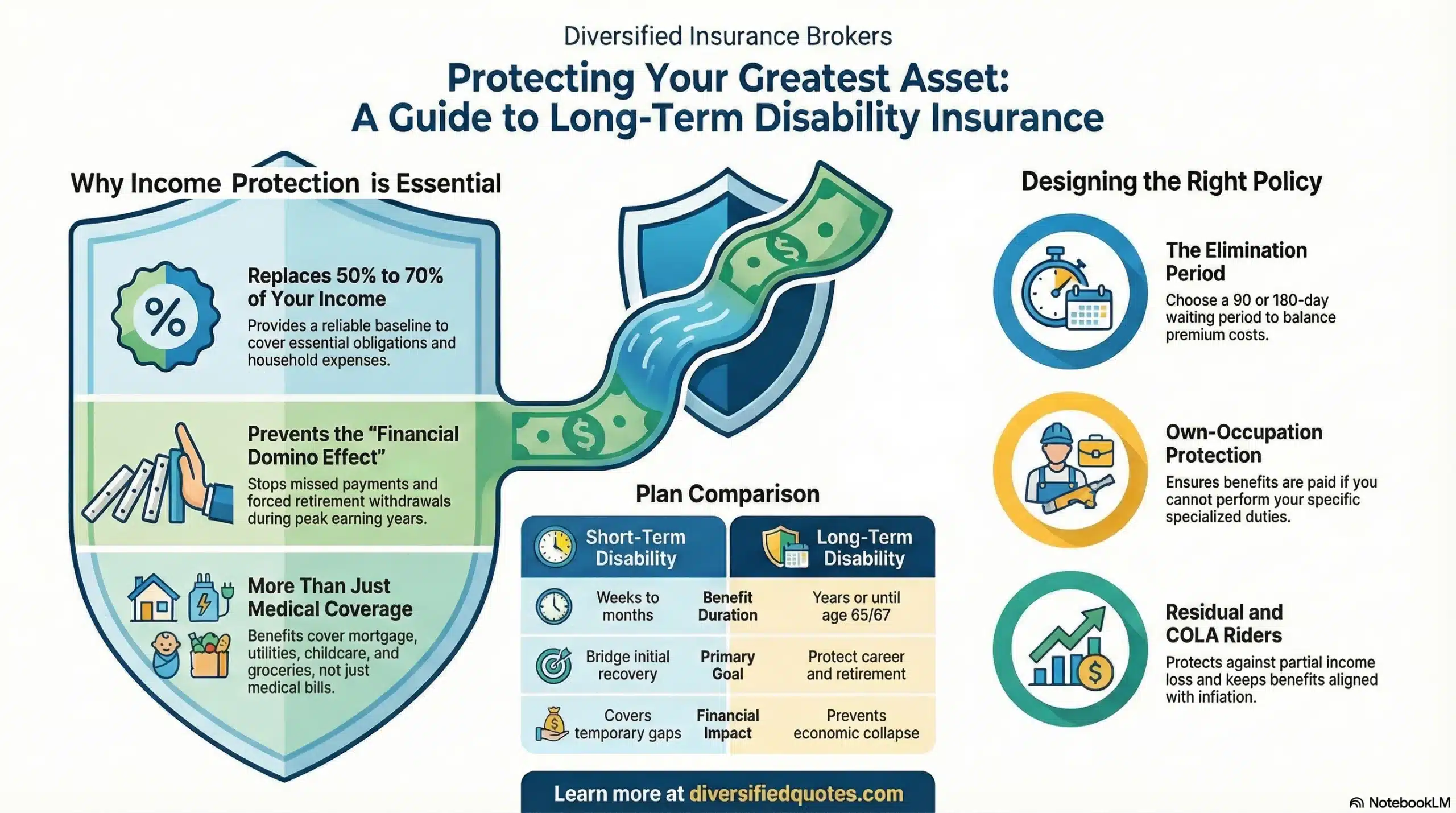
The benefit period for an auditor’s disability policy should extend to retirement age — long-term disability insurance to age 65 protects against career-ending conditions during the years when partnership track, equity accumulation, and pension credits are still building. The elimination period should be calibrated against actual available sick leave and short-term bridge resources; auditors at large firms with meaningful sick leave accruals may comfortably absorb a 90-day EP, while those at smaller practices or independent auditors should evaluate 30-60 day periods. The future increase option allows benefit amounts to expand as income grows through the career without new medical underwriting — critical for auditors in the early associate-to-manager-to-partner progression where income may triple over a decade. The residual disability rider captures the partial income loss period when cognitive capacity is reduced but not eliminated — the phase during which output quality and volume decline before a full disability threshold is met. The full rider framework is at disability insurance riders explained. Tax treatment of benefits from individually owned policies — generally received income-tax-free when premiums are paid personally after tax — is at are disability insurance payments taxable. For an independent evaluation of any existing or proposed policy, get a 2nd opinion on your disability insurance quote covers the review process.
Talk With an Advisor Today
Choose how you’d like to connect—call or message us, then book a time that works for you.
Schedule here:
calendly.com/jason-dibcompanies/diversified-quotes
Licensed in all 50 states • Fiduciary, family-owned since 1980
FAQs: Disability Insurance for Auditors
What occupational class do credentialed auditors typically qualify for?
Credentialed auditors — those holding CPA, CIA, CISA, CFE, or equivalent professional designations — typically qualify for the highest available occupational classes across most major disability carriers. The credential reflects the analytical specialization and educational depth that earns the top classification tier, which produces the most favorable premium rates, access to true own-occupation definitions, to-age-65 benefit periods, and the full rider menu. Auditors without credentials but with four-year accounting degrees typically qualify for the next-highest class. Accurately disclosing credential status in the application is important — some applicants inadvertently understate their qualifications and receive a less favorable class than they are entitled to.
My firm provides group LTD coverage — is that sufficient for a senior auditor or partner?
For most senior auditors and partners, employer group LTD is not sufficient as standalone income protection. Group plans typically cap monthly benefits at $8,000-$15,000 regardless of actual compensation — a managing director or partner earning $250,000-$400,000+ receives the same capped benefit as a staff associate at a fraction of that income. Group plans also use broad definitions rather than audit-specialty language, creating the “sedentary desk work” denial risk at claim time. Most group plans cap mental/nervous benefits at 24 months — inadequate for serious burnout or mental health conditions requiring extended recovery. Individual supplemental coverage fills all three gaps for auditors earning above group plan caps.
Why do insurance companies sometimes deny disability claims for auditors who can’t perform audit work?
The most common denial strategy is mischaracterizing audit work as “simple sedentary work” — arguing that because the auditor can theoretically sit at a desk and perform basic tasks, they are not disabled even when they genuinely cannot perform complex audit engagements. Under any-occupation policy language, that argument provides grounds for denial. Under true own-occupation coverage, the question is whether the auditor can perform the material duties of their specific audit practice — complex financial analysis, regulatory compliance evaluation, professional judgment on material misstatements — not whether some simpler type of desk work remains possible. This is why own-occupation language tied specifically to audit work is the essential coverage standard, not a premium add-on.
Does burnout qualify as a disability for auditors?
Burnout itself is not typically a recognized diagnostic code, but the clinical conditions that underlie severe professional burnout — major depressive disorder, anxiety disorders, chronic fatigue syndrome, and related conditions — are legitimate medical diagnoses that can qualify for disability benefits when they genuinely prevent the cognitive performance audit work requires. The key is demonstrating how the condition specifically impairs the analytical functions, sustained concentration, and professional judgment that audit work demands. Cognitive disability claims require comprehensive medical documentation showing not just the diagnosis but the functional limitations that prevent professional-level audit performance. Individual policies with unlimited mental/nervous benefit periods provide sustained coverage for the conditions most commonly associated with audit profession burnout.
What is the best time for an auditor to purchase disability insurance?
Early in the career — ideally at the associate or senior associate level — before any health conditions develop that could create exclusions or adverse underwriting. Disability insurance premiums are locked in at the issue age; a policy purchased at age 26 carries that premium rate for the life of the contract regardless of future age. The future increase option rider purchased early preserves the right to expand coverage as income grows through the manager-to-partner progression without new medical underwriting. Waiting until income is higher to apply is a common mistake: if health changes in the interim — a back issue, anxiety diagnosis, or any other condition — the ability to get coverage at favorable terms may be significantly impaired. Early purchase with a modest initial benefit and FIO is almost always preferable to waiting for a larger benefit at higher income with potentially compromised health.
About the Author:
Jason Stolz, CLTC, CRPC, DIA, CAA and Chief Underwriter at Diversified Insurance Brokers (NPN 20471358), is a senior insurance and retirement professional with more than 25 years of real-world experience helping individuals, families, and business owners protect their income, assets, and long-term financial stability. As a long-time partner of the nationally licensed independent agency Diversified Insurance Brokers, Jason provides trusted guidance across multiple specialties—including fixed and indexed annuities, long-term care planning, personal and business disability insurance, life insurance solutions, Group Health, Travel Medical and Evacuation Insurance, and short-term health coverage. Diversified Insurance Brokers maintains active contracts with over 100 highly rated insurance carriers, ensuring clients have access to a broad and competitive marketplace.
His practical, education-first approach has earned recognition in publications such as VoyageATL, and contributions from his agency featured in Kiplinger and GoBankingRates— highlighting his commitment to financial clarity and client-focused planning. Drawing on deep product knowledge and years of hands-on field experience, Jason helps clients evaluate carriers, compare strategies, and build retirement and protection plans that are both secure and cost-efficient. Visitors who want to explore current annuity rates and compare options across multiple insurers can also use this annuity quote and comparison tool.
Explore More Disability Insurance Options: Browse our complete guide to Disability Insurance for Legal, Finance & White Collar Professionals — covering attorneys, accountants, bankers, executives, financial planners & business professionals from 100+ carriers.
Last Reviewed: June 6, 2026 |
Reviewed by: Jason Stolz, CLTC, CRPC, DIA, CAA
Chief Underwriter, Diversified Insurance Brokers, Inc. | NPN: 20471358 | Diversified Insurance Brokers, Inc. — Licensed in all 50 states
Fact Checked by: Tonia Pettitt, CMIP©
Medicare Specialist, Diversified Insurance Brokers, Inc. | NPN: 14374308 | Diversified Insurance Brokers, Inc. — Licensed in all 50 states
Did you find this content helpful? Leave us a Google review — it helps others find trustworthy guidance too.
Editorial Standards: Diversified Insurance Brokers maintains rigorous editorial standards to ensure accuracy, clarity, and independence in all content. Learn more about our editorial standards and commitment to transparency.
