
Disability Insurance for Property Managers
As an Independent Disability Insurance Broker, we have access to exclusive discounts and negotiated pricing most captive agents can’t offer — see the full breakdown near the end of this page.
Disability Insurance for Property Managers

Jason Stolz CLTC, CRPC, DIA, CAA
Disability insurance for property managers is a critical form of income protection for professionals responsible for overseeing real estate assets, managing tenants, coordinating maintenance, and ensuring consistent cash flow from rental properties. Whether managing residential communities, commercial buildings, or mixed-use portfolios, property managers operate in a role that blends physical activity, administrative work, and financial oversight — a combination that creates a unique risk profile that neither pure office workers nor manual laborers face in quite the same way. At Diversified Insurance Brokers, we help property managers design disability insurance strategies that reflect the hybrid nature of their work, including both physical demands and income variability. A properly structured policy ensures that if your ability to work is interrupted, your financial stability remains intact.
Protect Your Income as a Property Manager
Compare disability insurance options designed for real estate professionals and operational managers.
Request Disability Insurance OptionsWhy Disability Insurance Is Essential for Property Managers
Property managers are responsible for maintaining the performance of real estate assets — overseeing tenants, coordinating repairs, handling emergencies, managing finances, and ensuring occupancy levels remain stable. These responsibilities require consistent involvement and the ability to respond quickly to issues as they arise. If a disability prevents active management, the consequences extend beyond lost income. Vacancies may increase, maintenance issues may escalate, and tenant satisfaction may decline. For those who are self-employed or operate their own management companies, the financial impact can be immediate and compounded over time.
Property management is a profession where physical presence matters. Unlike a fully remote knowledge worker who can adapt during a health event, a property manager whose duties include on-site inspections, contractor coordination, and tenant meetings faces a genuine disruption when physical capacity is limited. The income risk is not theoretical — it is immediate. A property manager who cannot conduct inspections, meet contractors, or be present for tenant concerns begins losing the activity that generates revenue within days, not months. Understanding the full disability risk profile of this profession is the starting point for designing coverage that actually works when it is needed. For a broader overview of how disability insurance works across professional occupations, our resource on disability insurance services provides useful context before examining property-management-specific considerations. For context on how independent disability insurance brokers access a broader range of carrier options than single-carrier agents, our resource on why working with an independent disability insurance broker matters explains the practical advantages for professions with hybrid work profiles like property management.
The Hybrid Nature of Property Management Work
One of the defining characteristics of property management is its hybrid occupational profile. On any given day, a property manager may be reviewing financial reports, negotiating leases, inspecting units, meeting contractors, or responding to tenant concerns. This mix of responsibilities requires both physical mobility and mental focus — and both dimensions carry distinct disability risk that a well-designed policy must address simultaneously.
Physical demands include walking properties, climbing stairs, inspecting units, and occasionally handling light maintenance tasks. Over time, this can lead to joint issues, back strain, or other physical limitations that are well-documented in operational real estate roles. Even minor injuries can make it difficult to perform site visits or respond to emergencies in the timely way that tenant relationships and property performance require. A property manager who cannot walk a property for 30 days after a knee injury is not “working from home” — they are genuinely impaired in the execution of a core occupational function that directly affects income.
At the same time, the role requires strong organizational and cognitive skills. Property managers must track leases, manage budgets, coordinate vendors, handle owner relations, and make decisions that impact profitability across the portfolio. Conditions that affect memory, focus, or decision-making — including stress-related illness, anxiety disorders, and cognitive health conditions — can significantly impair job performance in ways that may not be visible but are professionally debilitating. A property manager who develops a disabling anxiety disorder that prevents effective tenant communication, decision-making under pressure, or the consistent professional engagement that managing a portfolio requires is facing a genuine occupational disability even though no physical injury is involved. This dual physical-cognitive disability risk profile means that a well-designed disability policy must address both dimensions rather than focusing exclusively on physical injury. For property managers who also want to understand how disability risk interacts with long-term financial planning, our resource on whether disability insurance is worth it provides the foundational financial case for this coverage category.
Income Structure and Financial Exposure for Property Managers
Property managers may earn income through salaries, commissions, management fees, or a combination of these sources. In many cases, income is tied directly to the number of units managed, occupancy rates, and overall property performance. This variable income structure creates a scenario where income is not entirely fixed — if a disability reduces your ability to manage properties effectively, income may decline even if you are still partially working. A property manager who manages 200 units and experiences a health event that limits them to managing 100 may lose a proportional share of management fees and performance bonuses while still working, which makes partial disability coverage particularly important to have in place rather than discovering after a claim begins that the policy only pays for total inability to work.
For self-employed property managers operating their own management companies, the financial vulnerability is compounded significantly. There is no employer sick pay, no group disability plan, and no paid leave. Fixed business costs — office space, software subscriptions, staff payroll, vehicle and insurance costs — continue during any disability period regardless of whether management revenue is coming in. The monthly gap between ongoing business obligations and reduced management fee revenue can be substantial even during a partial disability event. A residual or partial disability rider is essential for property managers with variable income structures, ensuring that a disability reducing performance below normal levels triggers proportional income replacement rather than requiring total incapacity before any benefit is paid. Our resource on how residual disability insurance benefits work explains this feature in complete detail and why it is often the most practically important rider for professionals whose income is production-dependent rather than purely salaried.
Physical Injury Risks Specific to Property Management
The physical demands of property management create a meaningful acute and cumulative injury risk profile that many property managers underestimate because the work does not look like “dangerous” physical labor in the way construction or manufacturing does. Slip-and-fall injuries are among the most common in property management — inspecting properties in various states of maintenance, climbing stairs in buildings without elevators, walking wet parking lots, and navigating uneven landscaping creates consistent exposure to fall hazards that can produce fractures, ligament tears, and back injuries requiring extended recovery periods. A property manager who fractures a wrist on a wet walkway during a unit inspection or suffers an ankle injury on an exterior staircase faces weeks to months of physical limitation that directly compromises their ability to conduct the on-site presence their role requires.
Back injuries from the physical demands of property inspection — bending into crawl spaces, climbing attic access points, physically examining building systems in awkward positions, and carrying equipment during maintenance assessments — are a documented occupational hazard for property managers who personally inspect units. A property manager whose back injury prevents them from conducting the on-site presence their tenants and properties require faces a genuine disruption to income-generating activity even if they remain cognitively capable of all administrative functions. The insurance claim is not for total inability to work — it is for inability to perform the specific physical elements of their own occupation, which is why the disability definition in the policy matters so profoundly.
Vehicle accidents represent another meaningful risk for property managers whose daily work involves driving between properties, visiting contractor job sites, and meeting owners at multiple locations. A serious accident producing orthopedic injuries could prevent the on-site presence that property management requires for months. Understanding how the own-occupation disability definition protects professionals whose specific occupational duties are impaired — rather than requiring total inability to perform any work — is essential for property managers designing disability coverage. Our resource on own-occupation disability insurance explained covers how this definition works and why it produces meaningfully better income protection than any-occupation coverage for professionals with specific occupational skill requirements like property management.
Cognitive and Stress-Related Disability Risk in Property Management
Property management is among the more stressful professional roles in real estate — managing tenant conflicts, emergency maintenance situations, budget shortfalls, owner relations, contractor disputes, and regulatory compliance simultaneously creates sustained professional stress that, when compounding chronic work pressure over time, can contribute to burnout, anxiety disorders, depression, and other mental health conditions that are recognized as genuine disabling conditions under well-structured disability insurance policies.
The stress profile of property management is not abstract. Property managers are on call for tenant emergencies that can occur at any hour. They are responsible for owner profitability in ways that are scrutinized and measured monthly. They manage conflict between tenants, between owners and tenants, and between contractors and the property’s needs. They navigate regulatory compliance requirements that carry personal liability if mishandled. Over years of sustained exposure to this combination of stressors, a meaningful percentage of property managers develop clinical-level anxiety, depression, or burnout conditions that meet the functional limitation criteria for disability claims under appropriately structured policies.
Many disability insurance policies include coverage for mental health and nervous system conditions when those conditions produce the functional limitations that meet the policy’s disability definition — and policies that explicitly include mental health conditions in their coverage scope are particularly valuable for high-stress operational roles like property management. When comparing policies, confirming that mental health conditions are covered without restrictive exclusions or limited benefit periods is part of a complete policy evaluation for property managers. Some policies cap mental health benefits at 24 months even when physical conditions are covered for longer periods — this limitation can create a significant gap for a professional whose disabling condition is burnout or anxiety rather than a musculoskeletal injury. Identifying policies without these restrictive mental health caps, or understanding exactly what limits apply, is an important part of the coverage design process.
The Own-Occupation Disability Definition: Why It Matters for Property Managers
The disability definition in a policy is the most important contract provision for any working professional, and for property managers with a hybrid physical-administrative role, its implications are particularly significant. An own-occupation disability definition pays benefits when the insured cannot perform the material and substantial duties of their specific occupation — property management — even if they remain capable of performing other types of work. An any-occupation definition, by contrast, pays benefits only when the insured cannot perform the duties of any occupation for which they are reasonably suited by education, training, or experience.
The practical difference is enormous for a property manager. A property manager who develops a back condition that prevents the physical demands of property inspection — walking units, climbing stairs, managing access to mechanical systems — but who could theoretically work as an administrative office employee would receive no benefit under an any-occupation policy because they could perform other work. Under a true own-occupation policy, they would receive benefits because they cannot perform the specific duties of property management, regardless of what other occupations they might theoretically be able to do. For a professional who has built a career, client base, and management portfolio over years, the protection of the own-occupation definition ensures that a disability affecting their specific occupational capacity is covered — not just total incapacity to do any work at all. Our resource on own-occupation disability insurance covers how to evaluate this definition in specific policy language and what to watch for when comparing policies from different carriers.
Case Study: Property Manager Earning $95,000 Per Year
Consider a property manager earning $95,000 annually through a combination of salary and performance-based management fees. If this individual experiences a disability that prevents them from working for five years, the financial impact is substantial and compounds across multiple dimensions — personal income, household expenses, and ongoing business obligations if they operate their own management company.
| Scenario | Without Disability Insurance | With Disability Insurance |
|---|---|---|
| Annual Income | $0 | $55,000–$66,000 |
| 5-Year Income | $0 | $275,000–$330,000 |
| Operational Impact | Loss of contracts and tenants | Stability during recovery |
This example demonstrates how disability insurance not only protects income but also helps maintain operational continuity during recovery. For a property manager whose management contracts may be at risk during an extended absence — owners who need active management may begin reassigning contracts if the manager cannot demonstrate operational continuity — the stability that disability benefits provide can be the difference between a temporary disruption and a permanent loss of the management portfolio that has been built over years. A disability income that maintains personal financial stability also prevents the desperation-driven decisions — selling portfolio positions prematurely, taking on unsustainable debt, or accepting below-market management fee arrangements out of financial pressure — that often accompany uninsured income disruptions.
Designing a Disability Policy for Property Managers
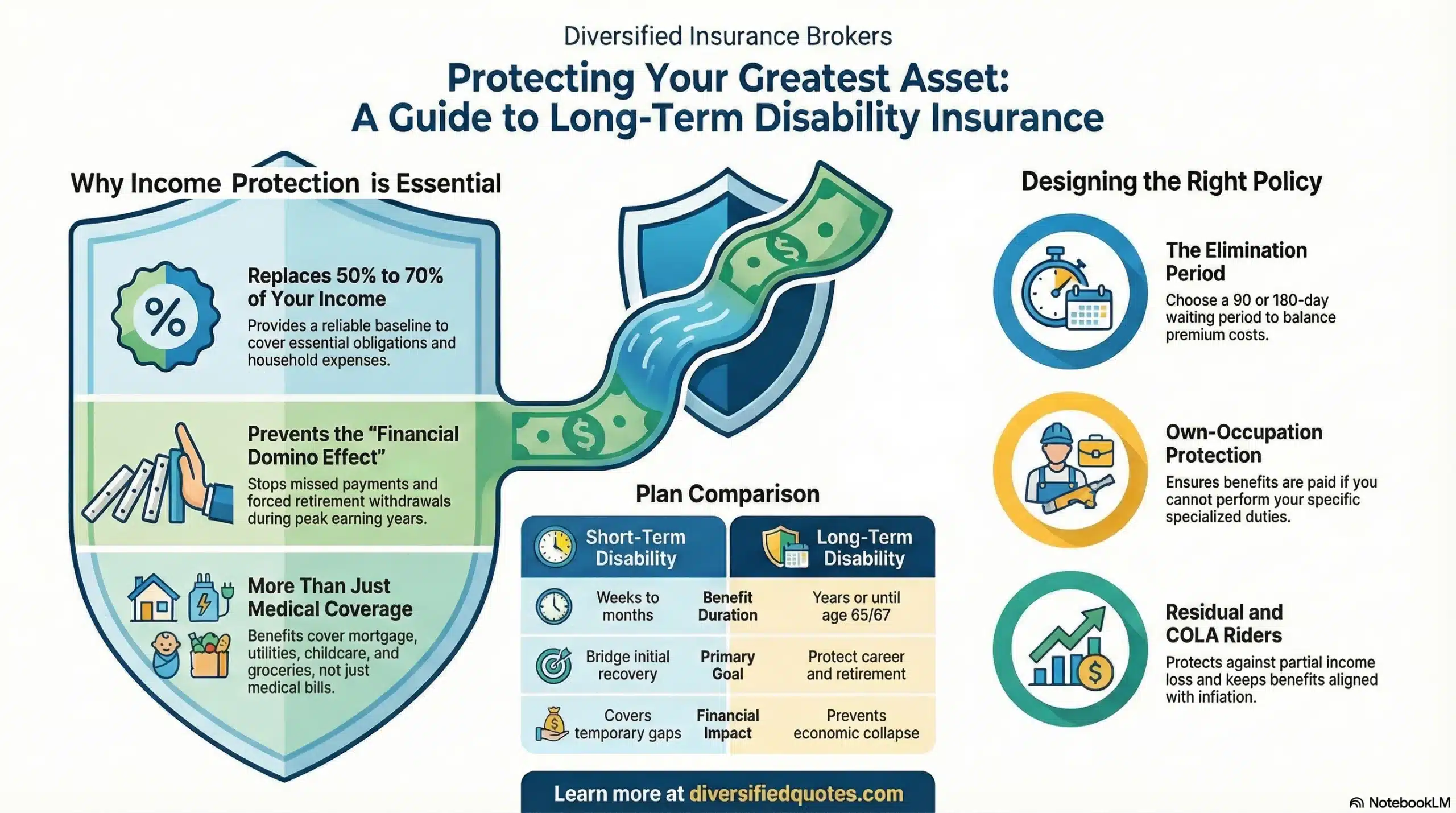
Disability insurance for property managers should reflect both income structure and occupational duties from the first day the policy is designed. Benefit amounts should align with total compensation, including bonuses and management fees where applicable — not just base salary, which may significantly understate actual income for property managers with performance-based fee structures. Carriers determine maximum benefit amounts using a formula applied to documented income — typically replacing 60 to 70 percent of pre-disability income — and presenting management fee income accurately and completely during the application process is essential for securing the benefit amount the income level actually supports.
Elimination periods — the waiting period between the onset of disability and the first benefit payment — should be selected based on available financial reserves and the urgency of income replacement if a disability were to begin. If you have sufficient savings to sustain both personal expenses and business fixed costs through a 90-day waiting period, a longer elimination period can meaningfully reduce premiums. If business fixed costs are substantial and personal savings are modest, a shorter waiting period of 30 or 60 days provides quicker access to benefits and is worth the additional premium cost. The elimination period decision is not about minimizing premium in isolation — it is about matching the policy’s structure to the actual financial exposure the property manager would face in the critical early weeks of a disability event.
Residual or partial disability benefits are particularly valuable in property management given the production-dependent income structure common in this profession. A property manager who can manage half their normal portfolio due to a health condition but not their full roster earns reduced income without being totally disabled — a residual rider supplements that reduced income proportionally, providing a benefit proportionate to the income loss rather than requiring total inability to work before any payment is made. Cost-of-living adjustment riders preserve purchasing power if a long-term disability claim extends across years or decades — without this rider, a fixed monthly benefit paid over a 10-year claim loses meaningful real value to inflation. For property managers evaluating how short-term disability coverage bridges the initial gap before long-term benefits begin, our resource on short-term vs. long-term disability insurance explains how the two products complement each other in a complete protection strategy. For a comprehensive overview of how disability insurance policies are structured including elimination periods, benefit periods, and key riders, our resource on disability insurance riders explained provides the foundational framework for comparing specific policy options across carriers.
Business Overhead Expense Coverage for Self-Employed Property Managers
Property managers who own and operate their own management companies face a disability risk layer that employed property managers do not: the ongoing expense of running the business during a period when revenue is disrupted. Business Overhead Expense (BOE) disability insurance is a specialized product designed specifically for this exposure — it reimburses the fixed operating costs of a business during the owner’s disability, including rent, staff salaries, software costs, insurance premiums, vehicle expenses, and other fixed obligations that continue regardless of whether the owner is generating revenue.
A self-employed property manager with $8,000 per month in fixed business overhead and a 90-day elimination period on their personal disability policy faces a $24,000 business obligation gap before any disability benefits begin — and that is on top of personal living expenses. BOE coverage, typically with a 30-day elimination period and a benefit period of one to two years, fills the business cost gap during a disability and prevents the liquidation of business assets or accumulation of business debt that would otherwise be necessary to keep the operation running during a recovery period. For property managers with employees, BOE coverage also protects the ability to maintain staffing during recovery — avoiding the loss of trained staff who cannot be retained without continued payroll.
BOE coverage is separate from personal disability income coverage and works in coordination with it: the personal disability policy replaces the owner’s income, and the BOE policy covers the business operating costs. Together they create a complete disability protection structure for a self-employed property manager that mirrors the protection an employed property manager receives from their employer’s payroll continuation and business continuity during the employee’s absence.
Occupational Classification and Carrier Selection for Property Managers
Disability insurance carriers classify occupations into risk categories that affect both premium levels and the policy provisions available. For property managers, the occupational classification can vary across carriers depending on how the insurer categorizes the balance between the physical field work and the administrative-professional components of the role. Some carriers classify property managers favorably within professional or administrative categories that provide access to own-occupation definitions and competitive rates. Others may weight the physical field component more heavily, producing a less favorable classification.
This carrier variation is one of the most practical reasons to work with an independent broker rather than applying to a single carrier without comparative knowledge. An independent broker who understands how different carriers classify property management — not just “real estate” generically — can identify the carrier where your specific occupational description produces the most favorable combination of definition quality and premium cost. The difference between a favorable and an unfavorable occupational classification can affect both the annual premium and the policy’s actual usefulness in a claim scenario — a policy that classifies the insured as a physical laborer rather than as a professional may not support an own-occupation claim for the specific physical impairments that most commonly affect property managers. Our resource on why working with an independent disability insurance broker matters explains how this comparison process works in practice and why carrier-specific knowledge of occupational classification guidelines produces better outcomes for professionals with hybrid work profiles.
Integrating Disability Insurance Into Your Financial Plan
For property managers, disability insurance is the foundational layer of a complete financial protection plan — it protects the income that supports lifestyle, investment contributions, debt service, and long-term financial goals. Without income protection, every other element of the financial plan is vulnerable: retirement savings contributions stop, mortgage payments become stressed, and the investment in building a management business is at risk during any extended health event. The portfolio of management contracts built over years — relationships with property owners, established maintenance vendor networks, tenant communities, and operational systems — has real economic value that can be preserved through a disability event when financial stability exists, but that can erode rapidly when financial pressure forces an inability to maintain the operational quality those relationships depend on.
For property managers who are also building personal investment portfolios or planning for retirement, disability insurance works in coordination with those strategies by ensuring the income engine continues functioning even during a health interruption. Exploring additional strategies such as how to protect your funds in retirement can complement income protection and help create a more resilient financial strategy across both the working and retirement years.
Get Disability Insurance Quotes for Property Managers
A well-structured policy can protect years of future income and support long-term financial goals. We compare options across carriers specifically for property management professionals.
Request Disability Insurance OptionsQuestions? Call 800-533-5969
Financial Protection Essentials
Disability insurance resources for real estate professionals, self-employed managers, and occupational income protection strategies.
Talk With an Advisor Today
Choose how you’d like to connect—call or message us, then book a time that works for you.
Schedule here:
calendly.com/jason-dibcompanies/diversified-quotes
Licensed in all 50 states • Fiduciary, family-owned since 1980
Disability Insurance for Property Managers FAQs
Yes, property managers typically qualify for individual disability insurance. Coverage is based on occupational duties and documented income, including salary, commissions, and management fees from all managed properties. Property management is generally classified in the 3A to 4A occupational tier by most disability insurance carriers — reflecting the hybrid nature of the work, which includes both on-site physical activity and administrative cognitive demands. This classification is favorable enough to provide access to own-occupation disability definitions, meaningful benefit periods, and a full range of supplemental riders. Property managers who operate their own management companies as self-employed professionals apply on the same basis as salaried employees but document income through tax returns and Schedule C net profit, which an independent broker can help present most favorably to underwriters. For a complete overview of how the disability insurance underwriting and application process works, our resource on how to apply for disability insurance walks through the steps from income documentation through policy issuance.
Property managers face a dual disability risk profile that combines physical and cognitive occupational hazards. On the physical side, the daily demands of property inspection — navigating properties in various maintenance states, climbing stairs, accessing mechanical systems, driving between properties — create meaningful exposure to slip-and-fall injuries, back and joint injuries, and vehicle accident risk. On the cognitive and stress side, the sustained professional demands of managing tenant relations, contractor coordination, budget oversight, and owner communications create chronic occupational stress that can contribute to burnout, anxiety disorders, and other mental health conditions that are recognized disabling conditions under well-structured disability policies. For self-employed property managers, the financial consequences of disability are compounded by the absence of any employer safety net — no sick pay, no group disability plan, no paid leave — making the income gap that disability produces immediate and complete from day one of any disabling event. Our resource on own-occupation disability insurance explains how the right disability definition protects professionals whose specific occupational duties — not just any employment capacity — are impaired.
Yes — and for property managers with variable income from management fees and performance components, partial disability coverage through a residual disability rider is often the most practically important feature of the policy. A residual or partial disability rider provides income support when a disabling condition reduces a property manager’s ability to manage their full portfolio without eliminating the ability to work entirely. For example, a property manager who develops a back condition preventing the full on-site presence required by their normal management responsibilities may be able to handle some administrative functions and manage a reduced number of units — earning reduced income without meeting the total disability threshold. A residual rider supplements that reduced income proportionally, providing continuous financial support throughout the graduated return-to-full-capacity period rather than requiring total incapacity before any benefit is paid. Without a residual rider, a total-disability-only policy provides no benefit during this graduated-return phase, which for many property managers is the longest portion of the recovery timeline. Our resource on residual disability insurance benefits explained covers this feature in complete detail.
Disability insurance carriers base benefit amounts on verified earned income — typically using the two most recent years of federal tax returns for self-employed property managers or employer-provided income documentation for salaried managers. For self-employed property managers, the Schedule C net profit is the primary figure, which means that significant business expense deductions — vehicle costs, office space, software, and any staff payroll — reduce the income figure available for coverage relative to gross management fee revenue. Salaried property managers with fixed compensation document income through W-2s and pay stubs. Property managers who earn both a base salary and performance-based management fees or commissions can typically insure based on total earned compensation when documented appropriately. For property managers whose income varies significantly across years based on portfolio size, occupancy performance, and bonus structures, using a weighted average of recent income years may produce a more favorable benefit calculation than a single-year snapshot during a lower-income period. An experienced independent broker who understands property management income structures can guide both the income documentation approach and the carrier selection to produce the most appropriate benefit amount for actual earning capacity.
Benefit periods vary by policy and can range from short-term coverage of one to two years — appropriate as a bridge for recovery from acute injuries — through long-term coverage lasting until retirement age at 65 or 67, which provides the most comprehensive income protection for a career-length disabling event. For property managers in their primary earning years, a benefit period extending to retirement age is typically the most appropriate choice because it ensures the policy provides genuine income replacement regardless of whether a disability proves to be temporary, extended, or permanent. Shorter benefit periods of two to five years cost less but may expire before recovery is complete for more serious disabling conditions. The benefit period decision should be made alongside elimination period selection — a shorter benefit period with a shorter elimination period may be appropriate for a short-term-focused strategy, while a benefit period to age 65 with a 90-day elimination period provides comprehensive long-term protection at a more moderate premium. Our resource on how disability insurance works explains how benefit period, elimination period, and benefit amount interact in structuring a complete disability policy.
The best time to apply for disability insurance is as early as possible in your property management career — while you are healthy, actively working, and before health history has accumulated conditions that could result in exclusion riders or restricted coverage terms. Disability insurance premiums are based in part on age at application, so younger property managers secure the most comprehensive coverage at the most favorable rates. More importantly, applying while in good health ensures coverage is in place before any of the occupational health conditions most likely to affect property managers — back injuries, joint conditions, stress-related illness — have developed in the medical record. A condition that exists at the time of application may result in an exclusion rider covering that specific condition, meaning the policy would not pay benefits for a claim arising from it. Securing disability insurance before these conditions develop ensures they are covered when they eventually emerge. The addition of a future increase option rider also allows benefit amounts to grow with increasing income as your management portfolio expands, without requiring new medical underwriting as the business develops and income rises.
About the Author:
Jason Stolz, CLTC, CRPC, DIA, CAA and Chief Underwriter at Diversified Insurance Brokers (NPN 20471358), is a senior insurance and retirement professional with more than 25 years of real-world experience helping individuals, families, and business owners protect their income, assets, and long-term financial stability. As a long-time partner of the nationally licensed independent agency Diversified Insurance Brokers, Jason provides trusted guidance across multiple specialties—including fixed and indexed annuities, long-term care planning, personal and business disability insurance, life insurance solutions, Group Health, Travel Medical and Evacuation Insurance, and short-term health coverage. Diversified Insurance Brokers maintains active contracts with over 100 highly rated insurance carriers, ensuring clients have access to a broad and competitive marketplace.
His practical, education-first approach has earned recognition in publications such as VoyageATL, and contributions from his agency featured in Kiplinger and GoBankingRates— highlighting his commitment to financial clarity and client-focused planning. Drawing on deep product knowledge and years of hands-on field experience, Jason helps clients evaluate carriers, compare strategies, and build retirement and protection plans that are both secure and cost-efficient. Visitors who want to explore current annuity rates and compare options across multiple insurers can also use this annuity quote and comparison tool.
Explore More Disability Insurance Options: Browse our complete guide to Disability Insurance for Legal, Finance & White Collar Professionals — covering attorneys, accountants, bankers, executives, financial planners & business professionals from 100+ carriers.
Last Reviewed: June 8, 2026 |
Reviewed by: Jason Stolz, CLTC, CRPC, DIA, CAA
Chief Underwriter, Diversified Insurance Brokers, Inc. | NPN: 20471358 | Diversified Insurance Brokers, Inc. — Licensed in all 50 states
Fact Checked by: Tonia Pettitt, CMIP©
Medicare Specialist, Diversified Insurance Brokers, Inc. | NPN: 14374308 | Diversified Insurance Brokers, Inc. — Licensed in all 50 states
Did you find this content helpful? Leave us a Google review — it helps others find trustworthy guidance too.
Editorial Standards: Diversified Insurance Brokers maintains rigorous editorial standards to ensure accuracy, clarity, and independence in all content. Learn more about our editorial standards and commitment to transparency.
