
Own Occupation Disability Insurance
As an Independent Disability Insurance Broker, we have access to exclusive discounts and negotiated pricing most captive agents can’t offer — see the full breakdown near the end of this page.
Own Occupation Disability Insurance

Jason Stolz CLTC, CRPC, DIA, CAA
Your career isn’t interchangeable — it’s built on years of training, credentials, and specialized skills. If an illness or injury prevents you from performing those duties, income can drop quickly, even if you can still “work” in some other capacity. Own-occupation disability insurance is designed to protect against that exact risk. In plain English: it pays benefits when you can’t perform the material and substantial duties of your specific occupation, even if you are capable of working in another role.
For professionals whose earnings depend on precision, judgment, physical ability, or specialized decision-making, own-occupation coverage is often the difference between maintaining financial stability and being forced into a lower-paying job after a disability. That’s why many physicians, dentists, attorneys, executives, and skilled professionals treat own-occ coverage as the gold standard in disability plan design — because it protects the income stream they spent years building. At Diversified Insurance Brokers, we help clients compare definitions, contract language, riders, and pricing across multiple top-rated carriers. If you want a broader starting point first, you can begin with our main Disability Insurance hub and then return here to dial in own-occupation details. Our resource on how to choose the right disability insurance policy provides a useful feature-by-feature evaluation framework before diving into definition specifics.
Protect Specialized Income with Own-Occupation Coverage
Compare true own-occupation policies, specialty-specific wording, and riders that protect how you actually earn income.
Get My Own-Occ QuoteIndependent comparisons • Contract-first guidance • Licensed nationwide
Why Own-Occupation Coverage Matters
Many disability policies use an “any occupation” definition, meaning benefits may only be paid if you are unable to work in any reasonable job based on your education, training, or experience. That can be a major problem for high earners and specialized professionals. If you can no longer perform the exact job that produces your high income, but you could still work in a different role, an any-occupation policy may deny or terminate benefits because you are still “capable” of employment.
Own-occupation coverage flips the focus to what you do today. Whether your work involves surgery, litigation, complex analysis, advanced procedures, hands-on technical work, or highly specialized client relationships, own-occ coverage is meant to protect your income if those specific duties become impossible — even if you could earn money in another job. That distinction is not academic. It affects real outcomes: lifestyle stability, savings rate, debt payoff strategy, college funding plans, retirement contributions, and business continuity. A disability that ends your specialty can be financially devastating even if you can still “work.” Own-occupation coverage helps prevent a forced career reset from turning into a permanent financial reset. Our resource on what is the primary reason people buy disability insurance provides foundational context on exactly how income loss during disability compounds into a crisis that weaker definitions leave unaddressed.
| Definition of Disability | How the Definition Works | Real-World Example | Who It Protects Well | Where to Learn More |
|---|---|---|---|---|
| True Own-Occupation | You are considered disabled if you cannot perform the material duties of your specific occupation — even if you can work in a different role or field. You collect full benefits and can still earn income from another position. | A surgeon loses fine motor control in one hand and cannot perform surgery. Under true own-occupation, she collects full disability benefits even if she transitions to teaching medicine or consulting — because she can no longer perform surgery specifically. | Surgeons, dentists, physicians, attorneys, and other specialists whose income depends on performing a specific technical skill set that cannot be replicated in another role | Physicians · Dentists · Attorneys |
| Modified Own-Occupation | You are considered disabled if you cannot perform the material duties of your occupation AND you are not working in any other occupation. If you take any other job — even a lower-paying one — benefits may stop or be reduced. | The same surgeon cannot perform surgery but accepts a consulting role. Under modified own-occupation, the carrier may reduce or eliminate benefits because she is earning income in a related field — even though her surgical career is over. | Professionals who plan never to work in any capacity if disabled — but a significant risk for those who might transition to teaching, consulting, or administrative roles in their field | Compare DI rates · Independent DI broker |
| Any-Occupation | You are considered disabled only if you cannot perform the duties of any occupation for which you are reasonably suited by education, training, or experience. Benefits require near-total inability to work in any capacity. | The surgeon cannot perform surgery but could theoretically work as a medical consultant or administrator. Under any-occupation, the carrier may deny benefits because she is capable of working in some capacity — even at a fraction of her prior income. | Lowest-cost option but weakest protection for professionals; most common in group employer plans and lower-cost individual policies where premium is the primary driver | Long-term disability · Short-term vs long-term DI |
| Residual / Partial Disability | A benefit provision — not a standalone definition — that pays proportional benefits when a disability reduces your income by a defined threshold (typically 15–20%) without making you fully disabled. Works alongside own-occupation definitions. | A financial planner develops a chronic condition that allows part-time work but reduces income by 40%. Residual disability pays a proportional benefit covering the income gap — even though she has not met the threshold for total disability. | Essential for professionals at risk of partial income loss from disability — particularly self-employed individuals, business owners, and commission-based earners whose income fluctuates | Residual disability explained · DI for self-employed |
| Own-Occupation with Income Replacement | A hybrid approach where true own-occupation definition applies in early years (typically years 1–2), then transitions to an income-based benefit that pays if post-disability earnings fall below a defined percentage of pre-disability income. | An engineer is injured and cannot perform his engineering role. In year one he receives full benefits under own-occupation. By year three, the policy transitions to income replacement — benefits continue only while his total income remains below the threshold set in the policy. | Common in mid-market individual policies and group long-term disability plans; stronger than pure any-occupation but less protective than true own-occupation held for the full benefit period | DI for engineers · How much DI do I need |
| High-Earner / Specialty Own-Occupation | True own-occupation policies with enhanced features specifically structured for high-income professionals — higher monthly benefit maximums, non-cancelable and guaranteed renewable provisions, COLA riders, and future increase options to grow coverage as income grows. | A cardiologist earning $600,000 annually secures a specialty own-occupation policy with a $20,000 monthly benefit, 90-day elimination period, to-age-65 benefit period, 3% COLA rider, and a future increase option to add coverage at next raise without new underwriting. | High-income specialists, business owners, and professionals for whom the definition of disability and long-term benefit stability are as important as the benefit amount | DI for high earners · Elimination periods explained |
How Own-Occupation Disability Insurance Works in Plain English
Disability insurance pays a monthly benefit after you satisfy a waiting period — often called the elimination period — and meet the policy’s definition of disability. In an own-occupation structure, the key question becomes: Can you perform the material and substantial duties of your occupation? If the answer is no, benefits may be payable even if you choose to work elsewhere.
This matters most in occupations where the income is concentrated in a narrow set of skills. A surgeon might be able to teach, consult, or do administrative work — but if they can’t operate, their income can drop dramatically. An attorney might still be able to work, but if they can’t do trial work, depositions, or sustained analysis due to a cognitive limitation, their earning power can change significantly. A dentist might still be able to manage a practice, but if they can’t perform procedures, production can decline quickly. Own-occupation coverage is designed for those real-world scenarios. For a broader overview of disability fundamentals and coverage types, visit our Disability Insurance overview. If you’re self-employed and want details on income verification and plan structure, our resource on disability insurance for the self-employed covers how income documentation and benefit sizing work for non-W-2 earners. For a practical look at cost expectations, our resource on how much disability insurance costs provides realistic premium ranges by occupation and benefit amount.
Understanding Own-Occupation Definitions — The Part Most People Miss
Not all own-occupation policies are created equal. Some policies use “true” own-occupation language. Others use transitional or modified definitions that change how benefits are paid if you earn income elsewhere. The difference can be enormous, especially for high earners who expect to remain productive in some capacity even if their specialty ends.
True own-occupation generally means the policy can pay benefits when you cannot perform your own occupation — even if you are working in another job and earning income. This is often what specialized professionals are trying to buy when they say “I want own-occ.” Transitional own-occupation typically pays benefits when you cannot perform your own occupation, but it may reduce or offset benefits depending on how much income you earn in another role. Some professionals prefer transitional definitions because they still provide meaningful protection while encouraging a return to productive work, but the offset mechanics must be understood clearly before purchasing. Modified or regular occupation structures can provide own-occ language for a period of time and then convert to a stricter definition later. For some buyers, this can be an acceptable tradeoff if it materially reduces premium, but it needs to be a deliberate choice — not an accident discovered during a claim. For a comprehensive look at the full range of riders and provisions that accompany these definitions in practice, our resource on disability insurance riders explained covers how each provision affects real-world claim outcomes. Because carriers use different wording and claim mechanics, comparing policies is not just rates — it’s contract language. Our job is to translate the differences into plain English so you know what you’re buying and why it matters.
Key Riders That Often Matter as Much as the Definition
In many real-world claims, riders determine how valuable the policy feels. A strong own-occ definition is important, but the rider set often determines whether benefits match the way disability actually happens in life — especially when someone can still work partially or returns gradually.
Residual / partial disability rider: Many disabilities reduce capacity rather than eliminate work completely. Residual benefits can pay proportionally when you can work part-time, your productivity drops, or your income declines due to a covered condition. For many professionals, residual benefits end up being one of the most valuable features of the entire policy. Our resource on how residual disability benefits work covers the proportional mechanics in detail.
Future increase / benefit update rider: If your income is likely to rise, a future increase option allows you to grow coverage later without repeating full medical underwriting. This is especially important early in a career or during growth years, because the risk is not just disability — it’s being underinsured when your income peaks. Our resource on the disability insurance future insurability rider explains exactly how this provision works and when it produces the most planning value.
Cost-of-living adjustment (COLA): If a claim lasts for years, inflation can erode the purchasing power of a fixed monthly benefit. COLA can increase benefits while on claim, which can be meaningful in long-duration disabilities. Our resource on disability income insurance with a COLA rider explains how inflation protection works and when it matters most.
Catastrophic disability rider: For severe impairments that affect daily living or independent functioning, catastrophic riders can add an additional layer of benefit. These aren’t always necessary, but in certain high-income planning scenarios they can provide added stability for extreme events.
Non-cancelable and guaranteed renewable: These provisions help ensure that as long as you pay premiums, the policy stays in force and the carrier cannot unilaterally change key terms. For specialized professionals, long-term contract reliability matters enormously — particularly for those who plan to hold a policy for 20 to 30 years through peak earnings and into retirement. The smartest approach is to start with the definition and the benefit period, then choose riders that solve real problems in your income model. Our resource on how disability insurance elimination periods work covers how waiting period selection affects both premium cost and the financial planning implications of a disability.
Case Example: When You Can Work — but Not Do Your Job
A 44-year-old interventional cardiologist earns $420,000 annually and spends most of his time performing procedures. After developing a wrist condition requiring surgery, fine motor control does not fully return. While he can still consult and teach, he can no longer safely perform procedures.
Because he owns a true own-occupation policy with a residual disability rider, benefits begin when he is unable to perform his procedural duties — even though he remains employed in a different capacity. The policy replaces lost income, stabilizes cash flow, and allows long-term financial plans to stay intact while his career evolves. This is the “own-occ moment” most professionals are trying to insure. The disability did not make him incapable of employment. It made him incapable of performing the duties that produced his specialized income. Our resource on is disability insurance worth it provides the financial framework for understanding how benefit amount and definition quality interact to determine whether a policy actually protects the income it was purchased to replace.
How Much Own-Occupation Coverage Is Appropriate?
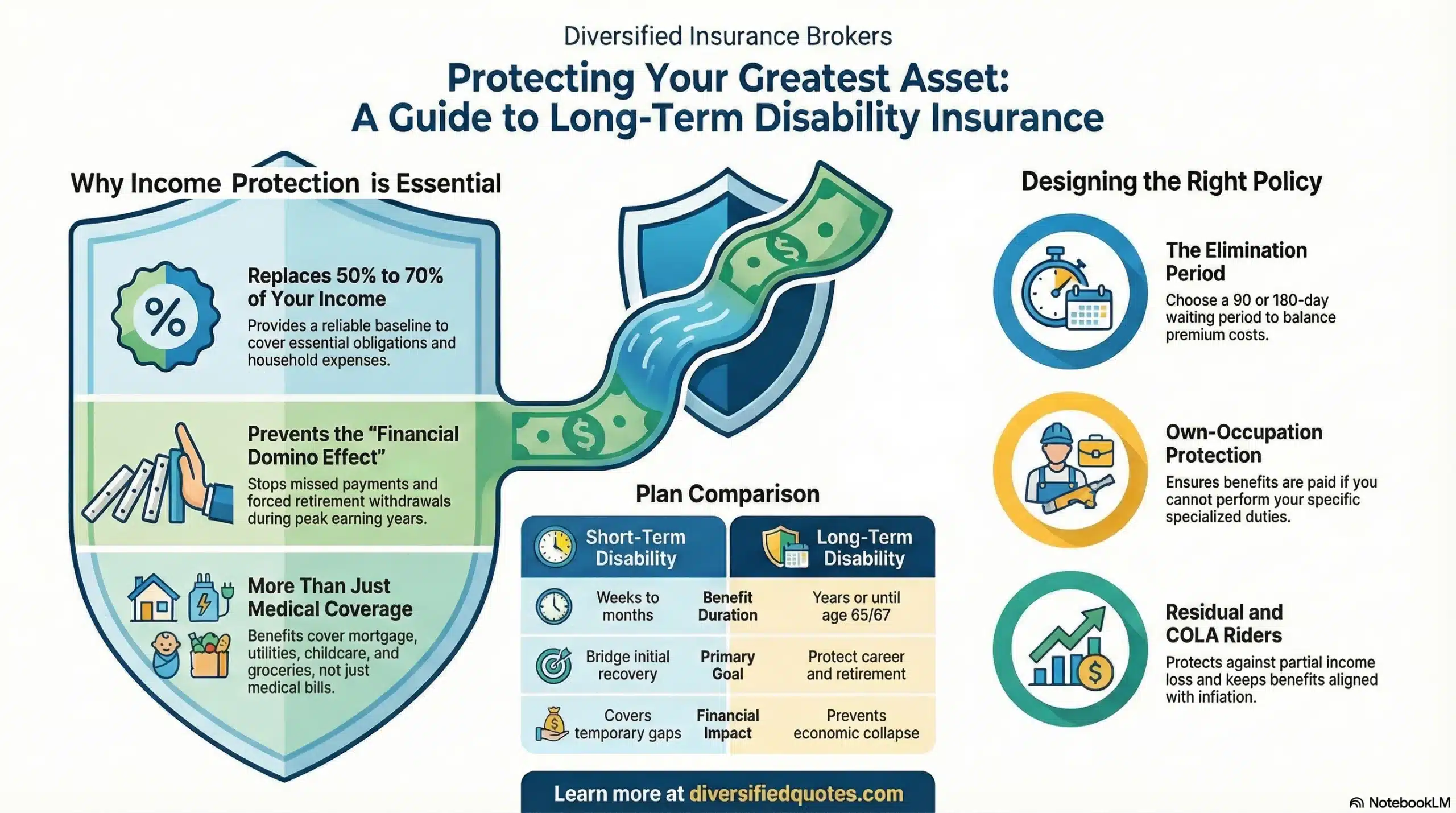
Many professionals target replacing roughly 60% to 70% of gross income when designing disability coverage, coordinated with savings, emergency reserves, and any employer-provided benefits. But the right benefit amount is not a generic percentage — it’s a cash-flow plan. The best design protects essentials, keeps long-term savings intact, and avoids forcing liquidation of assets during the wrong season.
Three decisions typically drive the structure. First is the elimination period, commonly 60 to 180 days, selected to match available cash reserves and realistic bridge resources. Second is the benefit period, often designed to age 65 or 67 for those who want to protect long-term career and retirement outcomes. Third is the policy definition and residual mechanics — because for many specialists, partial loss of duties and income is the most realistic claim pattern. Our resource on how much disability insurance you need provides a practical framework for sizing the right benefit amount relative to income, obligations, and existing coverage. If you already have group LTD through work, it’s still worth testing how it performs in a high-income, specialized scenario. Group plans often cap benefits and may use definitions that are less protective for specialists — which is why many professionals use an individual own-occupation policy to supplement employer coverage rather than relying on group LTD alone. Our resource on short-term vs. long-term disability insurance covers how different duration coverages address different phases of a disability event and how they coordinate in a complete income protection plan.
Who Own-Occupation Disability Insurance Is Best Suited For
Own-occupation coverage is most valuable when a person’s income depends on narrow skill sets and specialized duties. That includes many licensed and credentialed professions, but it can also apply to business owners and sales professionals whose income is tied to specific performance patterns.
Physicians and surgeons often focus on specialty-specific wording — where the own-occ definition needs to be calibrated to surgical, procedural, or diagnostic duties rather than a generic “physician” category. For a deeper look at how definitions and residual benefits align with real-world physician claims, see our resource on disability insurance for physicians. Dental professionals often want similar clarity around procedural versus administrative duties; our resource on disability insurance for dentists covers how the own-occ definition protects dental income in real claim scenarios. Attorneys and legal professionals whose income depends on sustained cognitive performance and specific litigation or transactional duties are well-served by true own-occupation coverage — our resource on disability income insurance for attorneys covers the specific definition and rider considerations for legal professionals. For software developers, engineers, and technology professionals whose income depends on cognitive and technical performance, our resource on disability income insurance for software developers provides occupation-specific context on how own-occ definitions protect technology careers.
Business owners can also benefit significantly, especially when their role is essential to revenue or operations. In business settings, own-occ personal coverage often pairs with business-focused disability planning. If the business has fixed expenses that continue when an owner is disabled, BOE coverage can keep the company stable; see Disability Business Overhead Expense coverage. If the risk is the disability of a key contributor to the business, see Key Person Disability Insurance. For high-income professionals specifically evaluating how to size and structure coverage at elevated income levels, our resource on high-income disability insurance covers the specific structuring considerations that apply above standard benefit thresholds.
Own-Occupation Coverage vs. “No Exam” and Online Disability Options
Some professionals want the strongest own-occ language available. Others want speed and simplicity. In practice, many people choose based on timeline and tolerance for underwriting. If you want faster approval and simplified underwriting, review our resource on No Exam Disability Insurance. If you prefer a self-directed digital process, see How to Buy Disability Insurance Online.
The key is not treating these as “either/or” choices. Some clients start with simplified coverage to get protected quickly, then layer or upgrade later. Others pursue fully underwritten own-occ coverage immediately to lock in specialty-specific language and higher benefit limits. The best approach depends on income, occupation, existing group benefits, and how quickly you want coverage in force. For professionals with existing health conditions that may complicate underwriting, our resource on disability insurance with preexisting conditions covers what coverage options remain available and how underwriters approach existing health history.
Coordinating Own-Occupation Disability Insurance with a Broader Strategy
Disability insurance works best when it’s coordinated with emergency reserves, life insurance, debt strategy, and long-term planning. Proper coordination ensures income remains protected not just during recovery, but throughout career transitions and major milestones. When the disability risk is “income disruption,” the solution should stabilize cash flow first and preserve long-term compounding second.
For employed professionals, understanding how individual own-occ coverage coordinates with existing group benefits — including how group plan definitions often weaken after 24 months and how benefit caps leave high earners significantly underinsured — is the starting point for a complete income protection strategy. For self-employed professionals, the combination of an own-occ income replacement policy and a business overhead expense policy addresses both personal income and business continuity simultaneously. Our resource on whether disability insurance payments are taxable clarifies how premium payment structure affects the tax treatment of benefits — an important planning consideration for business owners and those evaluating pre-tax versus after-tax premium arrangements. For a broader overview of how individual disability coverage fits into an overall protection plan, see our complete guide to Disability Insurance across all policy types and structures.
Lock In True Own-Occupation Protection
We’ll compare contract definitions and specialty-specific riders so your coverage protects the income you actually earn today.
Request a QuoteRelated Disability Insurance Pages
Related Business & Professional Protection Pages
Talk With an Advisor Today
Choose how you’d like to connect—call or message us, then book a time that works for you.
Schedule here:
calendly.com/jason-dibcompanies/diversified-quotes
Licensed in all 50 states • Fiduciary, family-owned since 1980
Own-Occupation Disability Insurance — FAQs
Own-occupation disability insurance pays benefits if you are unable to perform the material and substantial duties of your specific profession — even if you are able to work in another occupation. This is the most important distinction from weaker disability definitions: the policy focuses on what you do in your career today, not on your theoretical ability to perform any type of work. If a condition prevents you from practicing your specialty, own-occupation coverage pays benefits regardless of whether you could technically function in a different, lower-paying role. For professionals whose income depends on a narrow set of specialized skills — physicians performing procedures, attorneys doing trial work, engineers solving complex technical problems — this distinction determines whether a disability policy actually protects the income it was purchased to replace.
Any-occupation coverage requires that you be unable to work in any reasonable job based on your education, training, or experience. Own-occupation coverage focuses only on your trained profession, offering significantly stronger protection for specialized and high-income careers. The practical difference is most visible when someone can still perform some type of work but can no longer perform their specialty. A surgeon with a hand condition who can no longer safely operate but could still teach medical students would receive no benefits under an any-occupation policy — because they can “work.” Under an own-occupation policy, they would receive benefits — because they cannot perform the specific duties of their occupation. That gap in protection is why any-occupation definitions are generally inadequate for specialized, high-income professionals who have spent years building career-specific expertise that cannot be replicated in an unrelated role.
True own-occupation means benefits continue even if you earn income in a different role after becoming disabled. This is the strongest definition available and is especially valuable for physicians, dentists, attorneys, consultants, and other specialists who want to remain productive in some capacity without losing their disability benefits. Under a true own-occupation definition, you could be receiving full monthly benefits from your disability policy while simultaneously earning income in a teaching, consulting, or advisory role — because the policy pays based on your inability to perform your specialty, not on your total income. Transitional or modified own-occupation definitions may reduce benefits based on income earned in another role, which can be appropriate for some buyers but represents a meaningful reduction in the protection strength compared to true own-occupation language. The distinction matters most for high-income specialists who expect to remain professionally active even if their specific specialty-generating duties become impossible.
Professionals with specialized skills whose income depends on performing a specific set of duties benefit most from own-occupation coverage. This includes physicians and surgeons whose income is tied to procedural performance, dentists whose production depends on clinical work, attorneys whose earning power comes from specific litigation or transactional expertise, engineers and technical specialists whose value is concentrated in narrow analytical domains, executives and consultants whose income depends on specific judgment and relationship capabilities, and self-employed professionals who rely entirely on their own specialized capacity. The common thread is that these professionals’ incomes are not interchangeable — losing the specific ability to perform their specialty reduces their earning power in ways that unrelated work cannot compensate for. Any professional in that category is a strong candidate for true own-occupation coverage.
Most policies replace approximately 60 to 70 percent of gross earned income, depending on underwriting limits, occupation class, and existing group disability coverage. This percentage reflects the standard underwriting guideline most carriers apply to prevent over-insurance while providing meaningful income replacement. For a professional earning $300,000 annually, that produces a monthly benefit need of approximately $15,000 to $17,500. For higher earners, reaching that level may require coordinating individual policies with any existing group LTD coverage, or in some cases stacking multiple individual policies from different carriers when no single policy can reach the full target benefit amount. The right benefit amount is ultimately determined by actual monthly household obligations — mortgage, family expenses, debt service, retirement savings contributions — rather than by a generic percentage applied to income.
The most commonly added and most valuable riders in own-occupation policies include: the residual or partial disability rider, which pays proportional benefits when disability reduces income or work capacity without eliminating it entirely; the future increase or benefit update rider, which allows coverage to be increased as income grows without new medical underwriting; the cost-of-living adjustment rider, which increases benefits while on claim to offset inflation across multi-year disabilities; the catastrophic disability rider, which adds additional benefits for severe impairments affecting daily living; and the non-cancelable guaranteed renewable provision, which ensures the carrier cannot change terms or increase premiums as long as the policyholder continues paying. Of these, the residual disability rider is often the most consequential in real claims — because most disabilities reduce capacity rather than eliminating it entirely, and a total-disability-only policy provides nothing during partial disability periods.
Yes — own-occupation disability insurance is often the most important income protection tool available to self-employed professionals precisely because they have no employer-provided safety net of any kind. When a self-employed specialist cannot perform their specialty, income stops immediately and completely. The underwriting process for self-employed applicants involves income documentation through federal tax returns — typically Schedule C net profit or business entity distributions — rather than W-2 wages, which can require working with a broker who understands how to present self-employment income accurately for benefit amount calculations. The own-occupation definition is particularly critical for self-employed professionals because the gap between “cannot perform my specialty” and “cannot perform any work” is the entire difference between financial stability and financial crisis when there is no group plan, no sick pay, and no employer income cushion behind the individual.
With a residual or partial disability rider, you may receive proportional benefits if a disability reduces your income or ability to perform key duties — even if you are still working in some capacity. The residual benefit is typically calculated as a proportion of the monthly base benefit based on the percentage reduction in income from the pre-disability level. For example, if your disability reduces your specialty-related income by 50 percent, a residual rider would pay approximately 50 percent of the monthly base benefit. This matters enormously in real claims because most disabilities do not produce a clean binary outcome — they produce reduced capacity, partial return to duties, or a gradual recovery arc. A policy with only total disability coverage provides no benefits during the partial recovery phase, which for many professionals is the financially most vulnerable period. The residual rider bridges the gap from disability onset through to full return to normal professional capacity.
If premiums are paid with after-tax dollars — which is the case for most individually purchased disability policies — benefits are generally received tax-free. This is one of the most significant planning advantages of individually purchased disability insurance compared to employer-provided group coverage where premiums are often paid with pre-tax employer contributions. When an employer pays disability insurance premiums on a pre-tax basis, the resulting benefits are typically taxable as ordinary income. For individually purchased own-occupation policies where you pay premiums from personal after-tax income, benefits arrive tax-free — meaning the stated monthly benefit is the actual net amount received. This tax-free status affects how the benefit amount should be sized: a $10,000 monthly tax-free benefit may replace more actual purchasing power than a $12,000 monthly taxable benefit, depending on the individual’s marginal tax rate. Tax treatment can vary based on specific payment arrangements, so confirming the tax status of premiums and benefits with a qualified advisor is always advisable.
Many policies include future increase or benefit update riders that allow coverage to be increased later without new medical underwriting, subject to income verification showing that income has grown to support the higher benefit amount. This rider is particularly valuable for professionals in early or mid-career growth phases — residents and fellows in medicine, early-career attorneys, or business owners whose income grows substantially over time. Without a future increase option, every coverage increase requires full medical underwriting at the then-current health status, meaning conditions that have developed since the original policy was issued could produce exclusion riders on the increased coverage. With a future increase option, those increases are available based on income documentation alone regardless of health changes — the medical underwriting was done once, at the time of original application, and that health standard locks in for all future increases under the rider. This makes the future increase option one of the most consequential planning features for young, high-income professionals whose earnings are expected to grow substantially over a career.
About the Author:
Jason Stolz, CLTC, CRPC, DIA, CAA and Chief Underwriter at Diversified Insurance Brokers (NPN 20471358), is a senior insurance and retirement professional with more than 25 years of real-world experience helping individuals, families, and business owners protect their income, assets, and long-term financial stability. As a long-time partner of the nationally licensed independent agency Diversified Insurance Brokers, Jason provides trusted guidance across multiple specialties—including fixed and indexed annuities, long-term care planning, personal and business disability insurance, life insurance solutions, Group Health, Travel Medical and Evacuation Insurance, and short-term health coverage. Diversified Insurance Brokers maintains active contracts with over 100 highly rated insurance carriers, ensuring clients have access to a broad and competitive marketplace.
His practical, education-first approach has earned recognition in publications such as VoyageATL, and contributions from his agency featured in Kiplinger and GoBankingRates— highlighting his commitment to financial clarity and client-focused planning. Drawing on deep product knowledge and years of hands-on field experience, Jason helps clients evaluate carriers, compare strategies, and build retirement and protection plans that are both secure and cost-efficient. Visitors who want to explore current annuity rates and compare options across multiple insurers can also use this annuity quote and comparison tool.
Explore More Disability Insurance Options: Browse our complete guide to Disability Insurance Planning & Education — covering how it works, riders, elimination periods, own occupation, costs & buying guides from 100+ carriers.
Last Reviewed: June 15, 2026 |
Reviewed by: Jason Stolz, CLTC, CRPC, DIA, CAA
Chief Underwriter, Diversified Insurance Brokers, Inc. | NPN: 20471358 | Diversified Insurance Brokers, Inc. — Licensed in all 50 states
Fact Checked by: Tonia Pettitt, CMIP©
Medicare Specialist, Diversified Insurance Brokers, Inc. | NPN: 14374308 | Diversified Insurance Brokers, Inc. — Licensed in all 50 states
Did you find this content helpful? Leave us a Google review — it helps others find trustworthy guidance too.
Editorial Standards: Diversified Insurance Brokers maintains rigorous editorial standards to ensure accuracy, clarity, and independence in all content. Learn more about our editorial standards and commitment to transparency.
