
How to Choose the Right Disability Insurance Policy
As an Independent Disability Insurance Broker, we have access to exclusive discounts and negotiated pricing most captive agents can’t offer — see the full breakdown near the end of this page.
How to Choose the Right Disability Insurance Policy

Jason Stolz CLTC, CRPC, DIA, CAA
Choosing the right disability insurance policy is not a coverage comparison exercise — it is a language exercise. The most consequential differences between disability insurance policies are embedded in definitions, not dollar amounts. A policy that pays sixty percent of income is worth nothing if its definition of disability does not recognize the buyer’s actual condition as qualifying. A policy with a benefit period to age sixty-five is worth nothing if the elimination period is so long that the policyholder exhausts their savings before the first check arrives. Understanding what the policy says — precisely, in the specific language the carrier uses — is the only basis on which to evaluate whether coverage is actually adequate. At Diversified Insurance Brokers, Jason Stolz, CLTC, CRPC, DIA, CAA, has guided physicians, attorneys, business owners, and working professionals across all fifty states through the disability insurance selection process, using a multi-carrier independent comparison process that identifies the most favorable available terms for each buyer’s occupation, income, and health profile.
The statistical case for acting is unambiguous. The Social Security Administration projects that approximately one in four of today’s twenty-year-olds will be out of work for at least a year because of a disability before reaching retirement age. Three in ten workers entering the workforce today will become disabled before retiring. Approximately ninety percent of long-term disability claims are caused by illnesses — not accidents — meaning the common assumption that disability happens primarily through workplace injuries or car accidents severely underestimates the actual risk. Musculoskeletal disorders affecting the back and spine account for twenty-nine percent of long-term claims; mental health conditions, cardiovascular disease, and cancer represent most of the balance. The risk is predominantly medical, gradual, and far more common than most workers estimate. At age forty-two, a working professional is statistically four times more likely to suffer a serious disability than to die during their remaining working years — yet most households maintain life insurance without disability coverage of comparable quality. Our resource on why people buy disability insurance and the detailed argument at why you need disability insurance even if you are young and healthy provide the full context for the risk calculus.
Get a Personalized Disability Insurance Review
We compare multiple top-rated carriers, evaluate your current coverage, and help you understand true income replacement — clearly and without sales pressure.
Start Your Disability Insurance ConsultationThe Most Important Feature: Definition of Disability
No single feature in a disability insurance policy matters more than the definition of disability — the contractual language that determines whether a specific condition qualifies for benefit payment. The spectrum runs from the most protective to the most restrictive, and the difference between the two extremes can mean the difference between a policy that pays when needed and one that denies the claim despite a genuine inability to work.
Own-occupation disability insurance is the gold standard. Under a true own-occupation definition, the policy pays benefits if the insured cannot perform the material and substantial duties of their specific occupation — even if they are fully capable of working in a different field. A surgeon who develops a hand tremor that prevents operating in the operating room would receive full disability benefits under an own-occupation policy even while practicing as a medical consultant, teaching at a medical school, or serving as a hospital administrator. The benefit continues because they cannot perform the duties of their own occupation. This definition is especially critical for physicians, surgeons, dentists, attorneys, engineers, and other highly specialized professionals whose occupational skills are not transferable to alternative income sources at comparable earning levels. Our resource on own-occupation disability insurance covers this definition in full detail including how carriers differ in their own-occupation language.
Any-occupation disability insurance is the most restrictive definition and the most common in employer-provided group coverage. Under this definition, the policy pays benefits only if the insured is unable to perform any occupation for which they are reasonably suited by education, training, or experience. The surgeon with the hand tremor, if judged capable of consulting work, medical writing, or hospital administration, would receive no benefit under a strict any-occupation policy. Many group long-term disability plans transition from own-occupation to any-occupation definitions after a defined period — commonly twenty-four months — making the initial year’s protection materially stronger than the long-term protection. Buyers who rely solely on employer-provided coverage without understanding this transition often discover the limitation only at claim time. Modified own-occupation definitions add a condition that the insured is not working in any other gainful occupation — a critical restriction that can extinguish benefits if the disabled professional takes any alternative work, regardless of income level.
Key Policy Features: The Decision Matrix
| Feature | Stronger Protection | Weaker Protection | Why It Matters |
|---|---|---|---|
| Definition of Disability | True own-occupation | Any-occupation or modified own-occupation | Determines whether your specific condition qualifies for benefit payment |
| Benefit Period | To age 65 or lifetime | 2 or 5 years | Long-term disabilities average years; short benefit periods leave a gap |
| Elimination Period | 90 days (standard balance of cost and coverage) | 30 days (higher premium) or 365+ days (funding gap risk) | Determines how long you must self-fund before benefits begin |
| Monthly Benefit Amount | 60–70% of pre-disability income | Under 50% or capped far below income | Must cover actual fixed expenses including mortgage, living costs |
| Residual/Partial Disability | Included — pays proportional benefit if partially working | Total disability only — no benefit for partial income loss | Most returns to work are partial; residual coverage bridges the income gap |
| Non-Cancelable / Guaranteed Renewable | Non-cancelable: locked premium and terms | Conditionally renewable: carrier can change terms or cancel | Premium and benefit certainty over the full working career |
| Future Insurability Option | Included — can increase benefit as income grows, no new exam | Not available — fixed benefit amount regardless of income growth | Early-career buyers need coverage to grow without health re-underwriting |
The Elimination Period: Choosing the Right Waiting Period
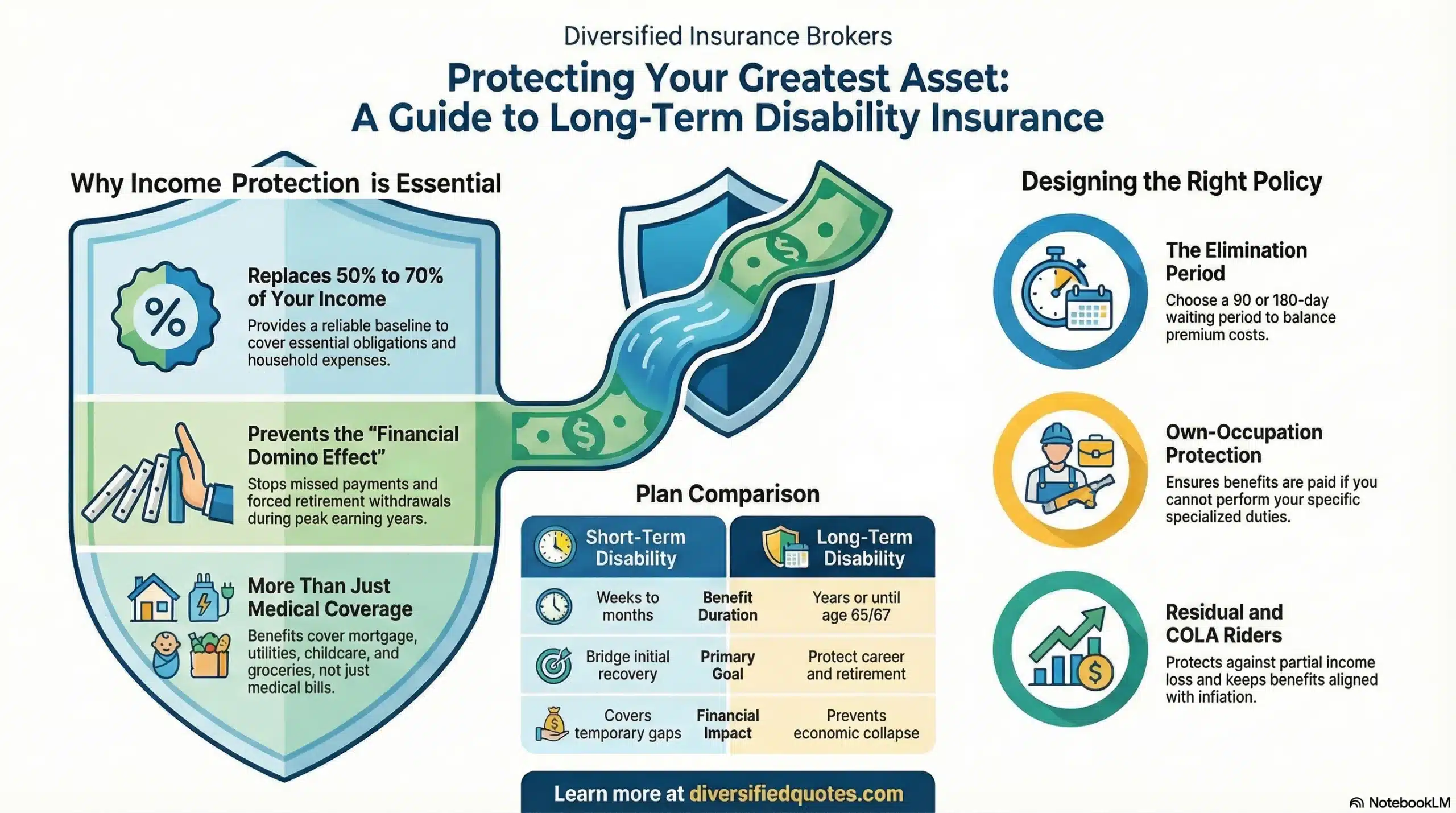
The elimination period — also called the waiting period — is the number of days you must be continuously disabled before the policy begins paying benefits. It functions as the deductible of a disability policy: longer elimination periods produce lower premiums, because the insurer is responsible for fewer total days of benefit across any given claim. Common elimination period options are thirty, sixty, ninety, and one hundred eighty days, with some policies offering options up to two years. The ninety-day elimination period represents the most widely used balance between premium cost and coverage access, and it aligns with the transition point at which most employer-provided short-term disability benefits exhaust.
Selecting the elimination period requires an honest assessment of the household’s liquid financial reserves. A buyer with three months of living expenses in accessible savings can sustain a ninety-day elimination period without financial crisis. A buyer with less than a month of accessible cash faces genuine hardship with any standard elimination period and may need to pair a longer-term individual policy with a short-term disability product to bridge the initial gap. The premium difference between a thirty-day and ninety-day elimination period can be substantial — in some cases nearly double — making the longer elimination period a meaningful cost lever for buyers who have the savings to self-fund the waiting period. Our resource on disability insurance elimination periods explained covers the calculation in detail, and the broader resource on short-term versus long-term disability insurance addresses how the two product types coordinate to eliminate the elimination period gap entirely.
Benefit Period: How Long Will the Policy Pay?
The benefit period determines how long the insurance company will pay monthly disability income benefits once a claim is approved and the elimination period has been satisfied. For long-term disability insurance, the benefit period options typically include two years, five years, to age sixty-five, and — from a limited number of carriers — lifetime or to age sixty-seven. The to-age-sixty-five benefit period is the most comprehensive practical option for most working professionals, because it aligns coverage with the expected end of earned income needs and transitions to Social Security retirement and accumulated retirement assets at the point when employment income would naturally conclude.
Two-year and five-year benefit periods represent meaningful coverage gaps for buyers who develop serious chronic conditions. An individual who becomes disabled at age forty with a back and spine condition — the leading category of long-term disability claims — and holds a two-year benefit period policy will exhaust coverage at forty-two and face the remaining twenty-three years before retirement age without the income protection they thought they had purchased. One in seven workers can expect to be disabled for five years or more before retirement, according to industry actuarial research. This statistic makes short benefit periods structurally inadequate for the precise disability scenarios that represent the largest financial risk. Our resource on long-term disability insurance covers the benefit period options in full, and the companion resource on short-term disability addresses the product designed for the initial phase of any disability event.
Residual Disability: The Feature Most Buyers Overlook
Residual disability — also called partial disability — is the policy feature that pays a proportional benefit when the insured is working in a reduced capacity due to illness or injury but has not stopped working entirely. It is one of the most practically important features in any disability policy and one of the least frequently evaluated during the purchase process. The statistical reality is that most disability claims do not involve complete inability to perform any work. The far more common scenario is a physician working reduced hours due to a chronic condition, an attorney managing a practice at fifty percent capacity during cancer treatment, or a contractor limited to sedentary project management while recovering from a surgical procedure. A policy without residual disability coverage provides no benefit in any of these situations because the insured is still working — even if their income has been cut in half.
A policy with a strong residual disability provision pays a benefit proportional to the income loss. If the insured’s earnings fall by fifty percent due to disability, the policy pays approximately fifty percent of the maximum monthly benefit. This provision is the difference between a policy that supports partial recovery — allowing the insured to return to work gradually without forfeiting all income replacement — and a policy that creates an all-or-nothing binary that can actually discourage gradual return to work. Our resource on residual disability insurance benefits explained covers the specific mechanics of how proportional benefits are calculated and what triggers them.
Non-Cancelable vs. Guaranteed Renewable: Premium Certainty Over Time
A non-cancelable, guaranteed renewable policy is the strongest available contract form for individual disability insurance. Non-cancelable means the insurer cannot cancel the policy, cannot change any policy terms, and cannot increase the premium above the rates specified at issue for as long as the policyholder continues to pay premiums — regardless of changes in the insured’s health, occupation, or claims experience. Guaranteed renewable means the insurer must renew the policy at the policyholder’s request but reserves the right to change premium rates for an entire class of policyholders with state regulatory approval.
For buyers who are purchasing a policy early in their careers and intend to maintain it for twenty to thirty years, the non-cancelable provision provides the certainty that the policy and its terms will remain exactly as purchased regardless of what happens to their health, their profession, or the carrier’s claims experience over that period. A conditionally renewable policy — the weakest form — can be cancelled or changed at the carrier’s discretion, providing none of the long-term protection certainty that the policyholder needs. The premium security of a non-cancelable policy is especially valuable for professionals in high-demand occupations where early purchase at favorable rates represents a significant long-term financial advantage.
Critical Riders That Complete a Disability Insurance Policy
The base policy definition, elimination period, and benefit period establish the foundational protection structure, but riders extend and customize coverage in ways that significantly affect the policy’s practical value over a working career. The future insurability option rider — also called the future purchase option or benefit increase rider — allows the policyholder to increase the monthly benefit amount at specified intervals without submitting new medical evidence of insurability. This rider is essential for early-career buyers whose income is expected to grow, because it allows the coverage to keep pace with income growth without requiring re-underwriting at older ages or with a health history that may have changed. Our resource on the disability insurance future insurability rider explains how this rider works and at what career stages it provides the most value.
The cost-of-living adjustment rider — COLA — automatically increases the monthly benefit during a disability claim to keep pace with inflation. Without a COLA rider, a buyer who becomes disabled at forty-five and receives benefits to sixty-five would receive the same nominal monthly amount throughout — an amount worth significantly less in real purchasing power at sixty-five than at forty-five after two decades of cumulative inflation. The COLA rider’s value is directly proportional to how long a disability claim lasts and how early in life the disability occurs. For young buyers with long benefit periods, the COLA rider represents one of the most valuable optional features available. Our resource on disability income insurance with COLA covers the mechanics, costs, and scenarios where this rider is most beneficial. The full menu of available riders is covered in our resource on disability insurance riders explained.
Group Coverage vs. Individual Coverage: Why Employer Plans Fall Short
Most employed professionals have access to group long-term disability coverage through their employer, and many assume this coverage is adequate without evaluating what it actually provides in the specific language of the group policy document. The limitations of standard employer-provided disability coverage are structural, not incidental, and they apply even to generous benefit programs at large employers. The most consequential limitation is the definition of disability. Group plans almost universally use an any-occupation or modified own-occupation definition, and plans that begin with an own-occupation definition for the first twenty-four months typically transition to any-occupation thereafter — providing comprehensive protection for short disabilities and significantly weaker protection for the extended disabilities that represent the largest financial exposure.
Group coverage is typically capped at a fixed dollar maximum — commonly $5,000 to $10,000 per month — regardless of the insured’s actual income. For a professional earning $20,000 per month, a $10,000 group benefit cap leaves fifty percent of income completely unprotected. When employer premiums fund the group plan, benefits received are taxable as ordinary income, which further reduces the effective replacement percentage. And because group coverage is tied to employment, it terminates when the policyholder changes jobs, is laid off, or transitions to self-employment — leaving them either uninsured or forced to apply for individual coverage at an older age or with a health history that has changed. Individual disability insurance follows the policyholder regardless of employment changes, making it the portable, permanent income protection foundation that group coverage cannot replicate. Our resources on whether disability insurance payments are taxable and the strategic overview at disability insurance for high earners and business owners address these limitations in the specific contexts where they are most consequential.
Disability Insurance by Occupation: Why Your Job Category Matters
Disability insurance carriers classify occupations into risk categories that directly affect both eligibility and premium pricing. A desk-based software engineer in occupational class 4A or 5A receives the most favorable available premiums; a manual tradesman in class 2A or 3A pays substantially higher premiums for the same benefit amount because the statistical probability of a disabling injury is higher across that occupational category. For professionals in the top occupational classes — physicians, dentists, attorneys, CPAs, engineers, and executives — own-occupation disability insurance with a benefit period to age sixty-five represents both the most important financial protection tool and the most favorable premium rate available relative to the benefit amount. Our disability insurance by occupation directory covers occupational class assignments across the full spectrum of professions, and condition-specific occupation resources — including physicians, attorneys, nurses, accountants, and software developers — address carrier selection and benefit design for the specific needs and classification characteristics of each profession.
Self-Employed, Independent Contractors, and Business Owners
Self-employed individuals and independent contractors face unique disability insurance challenges that make individual policy selection even more critical than for employed professionals. They have no employer-sponsored group coverage to supplement. Their income may fluctuate — making benefit amount determination more complex. And a disability that prevents them from working in their business may threaten not only their personal income but the viability of the business itself. Business overhead expense disability insurance — a separate and specialized product — covers fixed business operating expenses including rent, utilities, employee salaries, and loan payments when the owner is disabled and cannot generate revenue to cover those costs. Our resources on business overhead disability insurance, disability insurance for the self-employed, and whether you can get disability insurance if self-employed address the distinct protection architecture for this population. For partnerships, the buy-sell disability insurance strategy — funded by disability insurance to enable a buyout if one partner becomes permanently disabled — is covered in our resource on buy-sell disability insurance.
The Independent Broker Advantage in Disability Insurance
Disability insurance underwriting standards, occupational class assignments, definition language, and premium pricing vary more across carriers than in almost any other insurance product category. A carrier that is most competitive for a thirty-five-year-old healthy attorney may be significantly less competitive for a forty-two-year-old nurse practitioner with a prior back injury. A carrier that offers the broadest own-occupation language for surgeons may not offer the most favorable residual disability provision for self-employed business owners. Identifying the optimal combination of carrier, definition, elimination period, benefit period, and riders for a specific applicant’s occupation, income, age, and health profile requires access to multiple carriers — not a single-carrier recommendation from a captive agent.
Working with an independent disability insurance broker who contracts with multiple carriers and can run a genuine multi-carrier comparison produces consistently better outcomes — better definitions, more competitive premiums, and stronger policy features — than accepting the first proposal presented. For buyers who already have disability coverage and want to know whether it is adequate or whether better options exist, our second opinion on disability insurance frequently identifies superior alternatives. Our resources on finding the best independent disability insurance broker and why working with an independent disability broker matters explain the specific advantages of independent broker placement in this product category.
Talk With an Advisor Today
Choose how you’d like to connect—call or message us, then book a time that works for you.
Schedule here:
calendly.com/jason-dibcompanies/diversified-quotes
Licensed in all 50 states • Fiduciary, family-owned since 1980
Frequently Asked Questions: How to Choose the Right Disability Insurance Policy
What is the difference between own-occupation and any-occupation disability insurance?
Own-occupation disability insurance pays benefits if the insured cannot perform the material and substantial duties of their specific occupation — even if they are capable of working in a different field. Any-occupation disability insurance pays benefits only if the insured cannot perform any occupation for which they are reasonably suited by education, training, or experience. The practical difference is enormous for specialized professionals. A surgeon who develops a hand tremor and can no longer operate would receive full disability benefits under an own-occupation policy while working as a medical consultant or administrator. Under an any-occupation policy, that same surgeon might receive no benefit at all because they are technically capable of other work. True own-occupation coverage is the standard for individually purchased policies from leading carriers, particularly for physicians, dentists, attorneys, and other highly specialized professionals. Many employer-provided group plans use any-occupation definitions or transition from own-occupation to any-occupation after twenty-four months, which is why group coverage alone is typically inadequate for professionals. For a complete explanation of own-occupation coverage, see our resource on own-occupation disability insurance.
How much disability insurance coverage do I need?
The standard benchmark for individual disability insurance benefit sizing is sixty to seventy percent of gross pre-disability income, which approximates the after-tax take-home pay most professionals actually spend on living expenses. This range reflects the fact that disability benefit payments from individually purchased policies (where premiums are paid with after-tax dollars) are received income-tax-free, creating net income replacement close to actual take-home pay at the sixty-to-seventy percent gross replacement level. The coverage need should be calibrated against the household’s actual fixed monthly obligations — mortgage, car payments, student loans, insurance premiums, childcare, and living expenses — not against a generic percentage formula. For high-income earners, carriers impose monthly benefit maximums — typically expressed as a percentage of earned income — which can limit individual coverage below the desired level and may require supplemental group disability or high-limit disability products to reach full income protection. Group employer coverage should be subtracted from the total need when calculating the individual policy benefit amount required. Our resource on how much disability insurance you need provides the full calculation framework, and our page on high-income disability insurance covers the supplemental strategies for earners whose income exceeds standard benefit caps.
What elimination period should I choose?
The elimination period — also called the waiting period — is the number of days you must be continuously disabled before benefit payments begin. Choosing the right elimination period requires comparing premium savings against the personal financial risk of self-funding through the waiting period. A ninety-day elimination period is the most common choice and represents the standard balance between affordability and coverage timing — it aligns with the point at which most employer short-term disability plans exhaust, and it requires approximately three months of accessible savings to bridge. A thirty-day elimination period provides faster coverage access but at meaningfully higher premium. Extending beyond ninety days — to one hundred eighty days or longer — reduces premium further but requires six-plus months of liquid savings to bridge without financial stress. Buyers who have a well-funded emergency account covering three to six months of expenses are strong candidates for the ninety-day elimination period. Those with more modest liquid reserves may need to consider either a shorter elimination period or a short-term disability product to cover the initial gap before long-term benefits begin. The premium impact of elimination period length can be significant: extending from a thirty-day to a ninety-day elimination period can reduce premium by close to half. See our resource on disability insurance elimination periods for a full cost-benefit comparison by elimination period length.
Is employer-provided disability insurance enough?
For most working professionals, employer-provided disability coverage is insufficient as a standalone income protection strategy, for three structural reasons. First, group plans almost universally use any-occupation or modified own-occupation disability definitions, which provide weaker protection than the true own-occupation definition available in individual policies — particularly after the initial twenty-four-month benefit period when many group plans transition to any-occupation standards. Second, group plans typically cap monthly benefits at $5,000 to $10,000 regardless of income, leaving high earners significantly underinsured. Third, group coverage is tied to employment and terminates when the policyholder changes jobs, is laid off, or becomes self-employed — forcing a coverage gap at exactly the time when applying for new individual coverage may be more difficult due to age or health changes. Additionally, when employers pay group disability premiums, the benefits received during a claim are taxable as ordinary income, reducing the effective replacement percentage below the stated sixty percent of salary figure. Individual disability insurance, purchased with after-tax personal premiums, produces tax-free benefit payments and follows the policyholder regardless of employment changes. Most working professionals benefit from supplementing group coverage with an individual policy rather than relying on employer coverage alone. For a detailed breakdown of the group coverage limitations, see whether disability insurance payments are taxable.
What is residual disability and why does it matter?
Residual disability — also called partial disability — is the policy provision that pays a proportional benefit when the insured is working in a reduced capacity due to illness or injury but has not stopped working entirely. It matters because the majority of actual disability situations involve partial rather than total inability to work. A policyholder receiving cancer treatment may be able to work two days per week instead of five. A professional with a chronic pain condition may be able to handle administrative work but not client-facing responsibilities that require sustained concentration or physical presence. A policy without residual disability coverage provides no benefit in either of these scenarios because the insured is technically still working. A policy with a strong residual provision pays a benefit proportional to the income loss — if earnings have fallen fifty percent due to disability, the policy pays approximately fifty percent of the maximum monthly benefit. This feature also facilitates gradual return to work by allowing the insured to increase work hours incrementally while still receiving partial benefits, rather than facing a cliff where returning to any work at all eliminates all benefits. The specific mechanics of how proportional benefits are calculated vary by carrier and should be evaluated in the policy language before purchase. See our resource on residual disability insurance benefits explained.
What is the future insurability rider and do I need it?
The future insurability option rider — also called the future purchase option or benefit increase rider — gives the policyholder the contractual right to increase the monthly disability benefit at specified future dates without submitting new evidence of insurability. This means coverage can grow as income grows regardless of any health changes that occurred since the original policy was issued. It is most valuable for early-career buyers who are purchasing disability insurance before their income has reached its full potential. A physician in residency purchasing disability coverage on a resident’s salary needs the ability to increase coverage substantially when they begin attending-level earnings — the future insurability rider provides that right without requiring a new medical examination. Without this rider, a buyer who develops a health condition after purchase may be permanently locked at their original coverage level and unable to increase protection as their income grows. For any buyer under age forty-five whose income is expected to increase materially over the next ten to fifteen years, the future insurability rider is typically worth the additional premium. See our resource on the disability insurance future insurability rider for specific mechanics and trigger conditions.
Can I get disability insurance if I am self-employed or a 1099 contractor?
Yes — and the need is arguably more acute for self-employed individuals than for employees, because they have no employer-sponsored group coverage to supplement. Self-employed individuals and independent contractors can purchase individual disability insurance policies with own-occupation definitions, ninety-day elimination periods, and benefit periods to age sixty-five, just as employed professionals can. The primary underwriting consideration for self-employed applicants is income documentation — carriers require evidence of earned income to justify the benefit amount applied for, typically using tax returns, profit and loss statements, or business financial records. Income fluctuation common in self-employment does not preclude coverage, but it may affect the maximum benefit amount available. Self-employed business owners also need to separately address business overhead expense coverage, which covers fixed operating costs — rent, employee salaries, utilities, loan payments — during a disability when the owner cannot generate revenue. Individual personal disability coverage and business overhead expense coverage serve distinct purposes and most self-employed business owners need both. For the full coverage architecture, see our resources on disability insurance for the self-employed and business overhead disability insurance.
What is non-cancelable disability insurance and why does it matter?
A non-cancelable, guaranteed renewable disability policy is the strongest contract form available for individual disability insurance. Non-cancelable means the insurer cannot cancel the policy, cannot change any policy terms, and cannot increase the premium above the rates specified at issue — as long as the policyholder continues to pay premiums. This applies regardless of changes in the insured’s health, occupation, claims history, or the carrier’s broader claims experience for the policy class. Guaranteed renewable, the next-strongest form, requires the carrier to renew the policy at the policyholder’s request but permits premium increases for entire classes of policyholders with state regulatory approval. Conditionally renewable policies — the weakest form — allow the carrier to change terms or decline renewal under specified conditions. For a working professional who intends to maintain disability coverage for twenty to thirty years, the non-cancelable provision provides certainty that the definitions, riders, and premium established at issue remain exactly as purchased regardless of what happens over that period. This is particularly valuable for buyers who purchase coverage in their twenties or thirties, when premiums are lowest and health is best, but who need the protection to remain in force and unchanged through their peak earning years into their fifties and sixties. See our long-term disability insurance resource for a comprehensive overview of contract forms and carrier distinctions.
About the Author:
Jason Stolz, CLTC, CRPC, DIA, CAA and Chief Underwriter at Diversified Insurance Brokers (NPN 20471358), is a senior insurance and retirement professional with more than 25 years of real-world experience helping individuals, families, and business owners protect their income, assets, and long-term financial stability. As a long-time partner of the nationally licensed independent agency Diversified Insurance Brokers, Jason provides trusted guidance across multiple specialties—including fixed and indexed annuities, long-term care planning, personal and business disability insurance, life insurance solutions, Group Health, Travel Medical and Evacuation Insurance, and short-term health coverage. Diversified Insurance Brokers maintains active contracts with over 100 highly rated insurance carriers, ensuring clients have access to a broad and competitive marketplace.
His practical, education-first approach has earned recognition in publications such as VoyageATL, and contributions from his agency featured in Kiplinger and GoBankingRates— highlighting his commitment to financial clarity and client-focused planning. Drawing on deep product knowledge and years of hands-on field experience, Jason helps clients evaluate carriers, compare strategies, and build retirement and protection plans that are both secure and cost-efficient. Visitors who want to explore current annuity rates and compare options across multiple insurers can also use this annuity quote and comparison tool.
Browse More Resources: Return to our complete Health Insurance, Dental, Vision & Disability guide — covering short term health, dental, vision, group health & disability.
Last Reviewed: June 11, 2026 |
Reviewed by: Jason Stolz, CLTC, CRPC, DIA, CAA
Chief Underwriter, Diversified Insurance Brokers, Inc. | NPN: 20471358 | Diversified Insurance Brokers, Inc. — Licensed in all 50 states
Fact Checked by: Tonia Pettitt, CMIP©
Medicare Specialist, Diversified Insurance Brokers, Inc. | NPN: 14374308 | Diversified Insurance Brokers, Inc. — Licensed in all 50 states
Did you find this content helpful? Leave us a Google review — it helps others find trustworthy guidance too.
Editorial Standards: Diversified Insurance Brokers maintains rigorous editorial standards to ensure accuracy, clarity, and independence in all content. Learn more about our editorial standards and commitment to transparency.
