
Disability Income Insurance for Accountants
As an Independent Disability Insurance Broker, we have access to exclusive discounts and negotiated pricing most captive agents can’t offer — see the full breakdown near the end of this page.
Disability Income Insurance for Accountants

Jason Stolz CLTC, CRPC, DIA, CAA
Accountants and certified public accountants occupy one of the most cognitively demanding professional roles in the economy — analyzing complex financial data, preparing and reviewing multi-entity tax returns, conducting audits under regulatory scrutiny, advising clients on strategy under conditions where errors carry significant financial and legal consequences, and managing client relationships through periods of intense deadline pressure. The profession requires sustained analytical focus, precise memory for regulatory detail, and the ability to maintain accuracy at a professional level across long work cycles. That cognitive demand creates a disability risk profile that is less obvious than a construction worker’s physical risk but equally consequential when it materializes — and the disability insurance services available to professionals in the highest occupational classes are specifically designed to address it. The broader framework for income protection insurance for knowledge-work professionals applies directly to accounting, and the considerations specific to white-collar professional income — occupational class, definition quality, and cognitive coverage terms — are covered at disability insurance for white-collar professionals.
The financial exposure for accounting professionals is significant and grows across the career arc. Entry-level accountants progress through staff, senior, manager, and partner tracks that produce meaningfully increasing income at each stage. CPAs working in public accounting, corporate finance, tax advisory, forensic accounting, or independent practice often reach their highest earnings in mid-to-late career. A disability that interrupts income at age 45 with 20 years of peak earnings remaining represents a fundamentally different financial event than a disability near retirement — and a policy structured to protect through that full window produces outcomes that are dramatically different from one with a 2- or 5-year benefit period. For high-earning accounting professionals, the planning stakes include not just household income but the equity, client relationships, and business value built into a CPA firm or advisory practice over decades of professional development.
At Diversified Insurance Brokers, we help accountants, CPAs, auditors, and accounting firm owners structure disability coverage that reflects the actual demands of the profession — including the cognitive risk dimensions that are frequently underestimated by insurers who characterize accounting as simply “sedentary, low-stress desk work.” That characterization leads to denied claims and inadequate coverage. The right approach requires understanding how accounting income is generated, what conditions can prevent a professional from doing the work at the required accuracy level, and how policy language either supports or undermines a legitimate claim when cognitive impairment is the underlying issue.
Compare Disability Insurance for Accountants & CPAs
We compare options across 100+ carriers and structure coverage around your specific designation, income level, and practice arrangement.
Request Disability Insurance OptionsDisability Insurance for Accountants — How Occupational Class, Specialty, and Policy Design Determine Real-World Protection
The features that matter most in an accountant’s disability policy are not always the ones that get the most attention in marketing materials. The table below maps the critical coverage dimensions against the specific situations accounting professionals actually face.
| Coverage Dimension | Why It Matters for Accountants | What the Right Design Looks Like | Common Gap or Risk |
|---|---|---|---|
| Occupational class | CPAs are typically rated in the highest occupational class, producing the most favorable premium rates available among non-physician professionals; non-CPA accountants with four-year degrees typically qualify for the second-highest class | CPAs should specify their CPA designation on all applications; the classification difference between CPA and “accountant” without designation can meaningfully affect both pricing and available policy features across carriers | Not specifying the CPA designation or applying through a channel that classifies all accountants in a single category rather than distinguishing by credential |
| Definition of disability | Cognitive impairment is the primary disability mechanism for accounting professionals — slowed processing, difficulty concentrating, memory lapses, or reduced mental endurance can make complex audit, tax, and advisory work impossible while leaving the person able to do administrative or clerical work. Any-occupation definitions deny these claims. | True own-occupation: pays benefits if you cannot perform the material duties of your specific accounting specialty — complex tax preparation, audit management, financial advisory, forensic analysis — even if you can work in another capacity | Group plans and some individual policies use broad “accounting” definitions that don’t distinguish between performing complex audits and doing basic data entry; a partner unable to manage sophisticated engagements but capable of simple review work could be denied under these definitions |
| Mental and nervous coverage terms | Depression, severe anxiety, burnout, and neurological conditions affecting cognitive function account for a meaningful share of long-term disability claims among white-collar professionals whose work depends on sustained mental performance | Individual policies with unlimited mental/nervous benefit periods — or at minimum, benefit periods that match the physical disability benefit period — rather than 24-month caps that cut off benefits before full recovery occurs | Most group LTD plans limit mental/nervous benefits to 24 months — far shorter than the duration of many cognitive disability claims; this is the most frequent gap that leads to claim termination for accountants who develop cognitive conditions |
| Residual / partial disability | Many accounting disabilities involve gradual onset or partial impairment — a CPA who can handle routine correspondence but cannot manage complex multi-entity returns, or who can work 20 hours per week but not the 50+ hours required during peak season, may experience significant income loss without meeting total disability criteria | Residual disability rider that pays proportional benefits when income drops 20-25%+ from a qualifying condition; prevents the all-or-nothing claim outcome that leaves partially impaired professionals with no support | Policies without residual coverage that force accountants to choose between working beyond safe limits or experiencing complete income loss; the partial recovery period — where the accountant can work but not at full capacity — is not covered |
| AICPA group plan limitations | The AICPA disability plan offers accessible baseline coverage but uses broad accounting definitions, caps benefits below partner-level income, and provides limited residual coverage; it is a useful starting point but rarely sufficient as the only disability protection for senior accounting professionals | Individual supplemental policies that fill the gaps: own-occupation language distinguishing the specific accounting specialty, higher benefit caps for partners and CFOs whose income exceeds group plan maximums, and unlimited mental/nervous benefit periods | Relying solely on the AICPA group plan without evaluating the definition quality and benefit cap against actual income and specialty complexity; partners in particular typically need individual supplemental coverage |
| Practice owner overhead | Independent CPAs and accounting firm owners carry business overhead obligations — rent, staff, software subscriptions, professional liability insurance, CPA licensing fees — that continue regardless of whether the owner can work | Personal LTD policy for income replacement + Business Overhead Expense policy for fixed practice costs; these solve two different problems and are commonly structured together for practice-owning CPAs | Assuming personal disability income will cover both household expenses and practice overhead; deploying personal benefits for business costs compromises both the personal income replacement function and the ability to maintain the practice during recovery |
Why Cognitive Impairment Is the Primary Disability Risk — Not Physical Injury
The most important and least understood fact about disability claims for accountants is that cognitive impairment — not a physical injury — is the primary mechanism by which accounting careers are disrupted. Disability carriers frequently characterize accounting as a sedentary, low-stress occupation and assume that all it takes to be an accountant is to sit at a desk for a few hours per day. That characterization fails completely to capture what accounting work actually requires at a professional level. A CPA spending tax season reviewing complex multi-entity returns under significant accuracy requirements, advising on tax strategy under conditions where errors carry financial and legal consequences for clients, managing regulatory compliance under strict deadlines, and maintaining client relationships at a professional standard is engaging in sustained, high-demand cognitive work where even moderate impairment makes the job impossible. Slowed processing, difficulty concentrating under deadline pressure, memory lapses affecting recall of regulatory details, or reduced mental endurance that limits productive work hours can prevent a senior accountant from performing their specific work at the required accuracy level — while still leaving them capable of low-complexity administrative tasks. Without true own-occupation disability coverage, that distinction evaporates: the accountant can still do “some work,” the insurer denies the claim, and the professional is left without benefits despite a genuine career-ending limitation. The issue is well-documented in disability claim litigation involving CPAs — the pattern is consistent: insurers minimize cognitive disabilities as “subjective” or claim the professional can still perform administrative work, denying claims that would be clearly compensable under true own-occupation language.
Occupational Class — The CPA Advantage in Disability Pricing
Disability insurance carriers assign occupational classes based on risk profile, work environment, and claims experience. CPAs are typically rated in the highest available occupational class — alongside attorneys, physicians in low-risk specialties, and other credentialed professionals — which produces the most favorable premium rates across individual disability policies. This is a significant financial advantage: a CPA purchasing own-occupation disability coverage generally pays less per thousand dollars of monthly benefit than many other professions with equal or lower income. Non-CPA accountants with four-year accounting degrees are typically rated in the highest or second-highest class depending on the carrier. Disability insurance for auditors covers the occupational class considerations specific to audit professionals. Disability insurance for bookkeepers covers the class considerations for accounting professionals without four-year credentials, where the classification may differ by one or two levels. The full occupational class framework across all professions is covered at disability insurance by occupation. The practical implication of high occupational class is that CPAs can often access to-age-65 benefit periods, comprehensive rider packages, and true own-occupation definitions at premium levels that are more affordable than many people expect relative to income — making the decision to purchase quality coverage a strong value proposition.
Accounting Specialization and Why Generic Definitions Fall Short
Accounting is not a monolithic profession. An audit partner directing complex SEC-reporting engagements, a forensic accountant investigating financial fraud, a tax partner advising on complex partnership structures, and a management accountant preparing monthly operational budgets are performing materially different work that requires different cognitive capabilities at different intensity levels. The AICPA group disability plan — which offers CPAs accessible baseline coverage — uses a single broad definition of “accounting work” that does not distinguish between these specialties. An audit partner who develops a cognitive condition preventing them from managing complex audit engagements may face claim denial because the plan evaluates “accounting” broadly and concludes that simpler review or administrative accounting functions remain possible. Individual policies with specialty-specific own-occupation language, or at minimum true own-occupation language that focuses on the “material and substantial duties” the professional actually performs, close this gap. Professionals in adjacent financial roles — attorneys in tax and estate planning practice and financial planners and advisors — face similar definitional issues where the generic description of their profession understates the cognitive demands that make specific work possible at a professional level. The disability insurance for executives page covers how this issue applies to senior accounting professionals in CFO, partner, and C-suite roles where the cognitive requirements are highest and the income at risk is greatest.
Independent CPAs and Practice Owners — A Two-Layer Planning Need
For CPAs who own or operate an independent accounting practice, a disability creates two simultaneous financial problems that require two different policy solutions. The first is personal income replacement — the household income that stops when clinical work stops. This is what a personal LTD policy addresses. The second is business overhead: rent on office space, staff payroll, professional liability insurance premiums, CPA licensing fees, software subscriptions, and other fixed costs that continue regardless of whether the owner is producing client work. The disability business overhead expense policy and business overhead disability insurance cover this second layer specifically — paying documented fixed practice costs during a disability period so the practice can survive the disruption without forcing the owner to deplete personal benefits on business obligations. For accounting practices where a specific senior CPA generates a significant share of client revenue, key person disability insurance provides a business-level funding mechanism separate from personal coverage. The full planning framework for self-employed CPAs — including how income documentation works for variable-income principals and how benefit amounts are sized when income fluctuates — is at disability insurance for self-employed professionals.
Residual Disability and the Partial Recovery Problem
Many accounting disabilities do not follow the all-or-nothing pattern that a simple “total disability” policy addresses. A CPA recovering from a serious illness may be able to handle routine client calls and correspondence but unable to manage complex audit or tax work. They may be able to work 20 hours per week but not the 55+ hours that busy season demands. They may be able to service smaller, less complex clients but unable to maintain their partnership-level engagements. All of these scenarios involve meaningful income loss without meeting the total disability threshold — which is exactly what the residual disability rider is designed to address. Residual benefits pay proportionally when income drops 20-25%+ from a qualifying condition, supporting the partial recovery period without requiring total disability. For an independent CPA or a partner who can begin returning to work at reduced capacity, residual coverage is frequently more valuable in practice than the total disability benefit — because that partial return-to-work period can span months or years during which income is meaningfully reduced but not eliminated.
Riders That Matter for Accounting Professionals
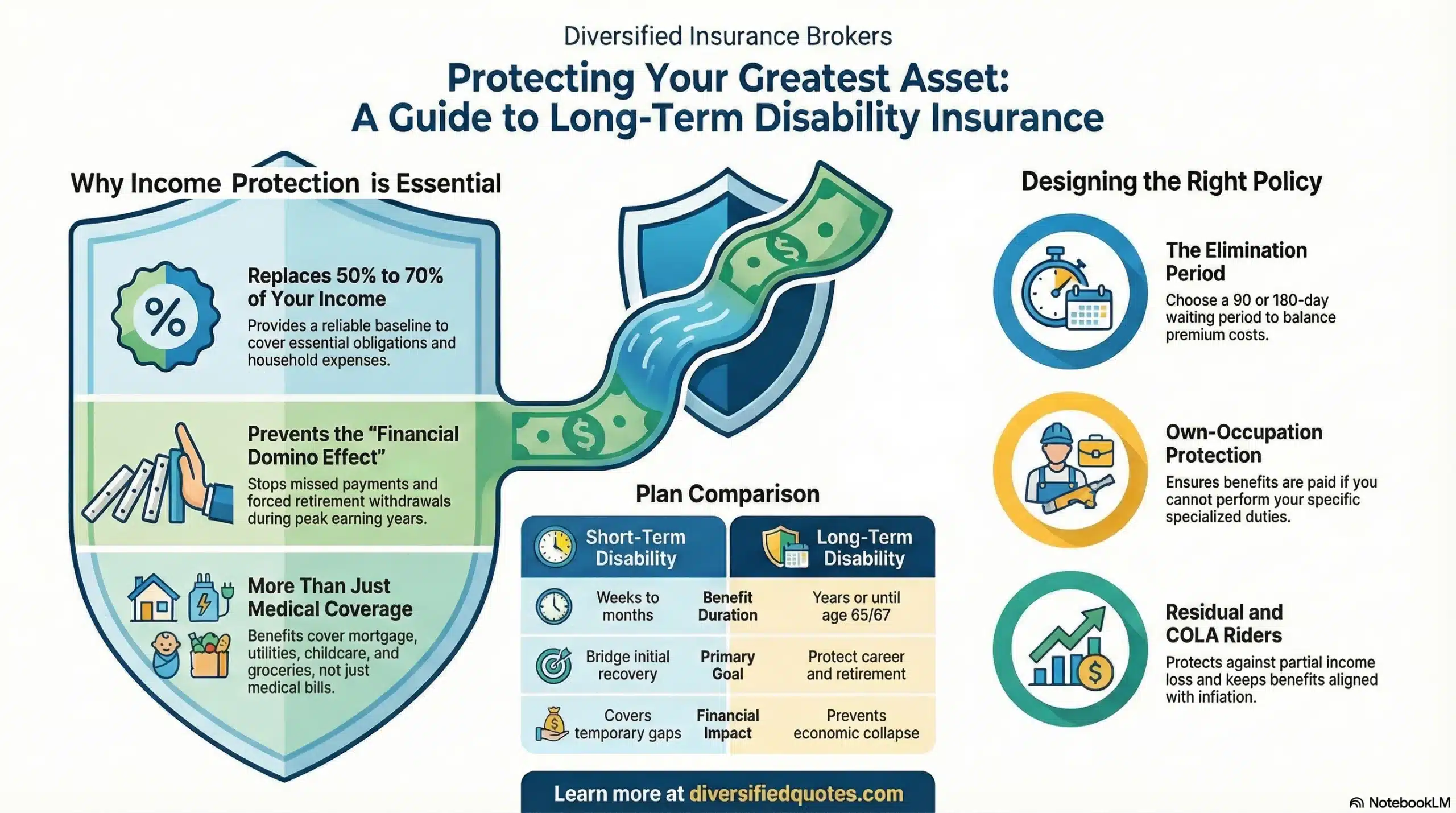
The disability insurance riders that most affect long-term policy value for accounting professionals follow a predictable pattern. The future increase option — covered in detail at disability insurance future insurability rider — allows benefit amounts to expand as income grows without new medical underwriting, making it particularly valuable for CPAs in the staff-to-partner progression whose income will grow substantially from year to year. The cost-of-living adjustment rider, covered at disability income insurance with COLA, increases benefit amounts annually during a long-term claim to offset inflation — essential for disabilities that begin mid-career and continue for many years. The elimination period — how to choose the right one is covered at disability insurance elimination periods explained — should be coordinated with emergency savings, any employer-provided short-term disability, and the seasonal cash flow patterns of accounting practice, where liquidity is not uniform across the calendar year. The benefit period for primary coverage should extend to retirement age — long-term disability insurance covers how benefit period selection affects the real-world protection window for mid-career professionals.
Tax Treatment and How Benefit Structure Affects Real Income
When an accountant pays disability insurance premiums with personal after-tax dollars — as is standard for individually owned policies — the benefits received during a disability are generally income-tax-free. This makes the effective replacement ratio meaningfully higher than the gross percentage: a 60% gross income replacement paid tax-free functions closer to 70-75% of take-home pay for professionals in higher tax brackets. The full breakdown of how tax treatment works across individual policies, employer group plans, and practice-owned structures is at are disability insurance payments taxable. For CPAs specifically — who are well-positioned to understand the tax implications — the trade between current premium deductibility and future tax-free benefit receipt is an informed choice rather than a surprise. Most choose the individually owned, non-deductible premium structure to preserve the tax-free benefit at claim time. Sizing the right benefit amount, including how to calculate it against essential monthly obligations and existing coverage, is at how much disability insurance do I need.
Early Career Accountants and the Cost of Waiting
The best time for an accountant to apply for disability insurance is early in their career — before any health history creates underwriting complications and while premium rates are lowest. Premiums for individual LTD policies are locked in at the issue age and do not increase with each passing year the way that other insurance costs might. A CPA who applies at 28 and a CPA who applies at 38 will pay dramatically different annual premiums for identical coverage — and both will pay those rates for the duration of the policy. The future increase option makes early application even more advantageous: securing coverage at entry-level income levels with the right to expand it to partner-level income without medical underwriting protects against the scenario where health changes between the first policy and the time income growth warrants more coverage. Disability insurance for new professionals covers the early-career planning framework, including how to structure initial coverage during the first years of practice when income is still growing toward its peak.
Talk With an Advisor Today
Choose how you’d like to connect—call or message us, then book a time that works for you.
Schedule here:
calendly.com/jason-dibcompanies/diversified-quotes
Licensed in all 50 states • Fiduciary, family-owned since 1980
FAQs: Disability Income Insurance for Accountants
Do accountants and CPAs need disability income insurance?
Yes — accounting professionals face meaningful disability risk because their income depends entirely on cognitive performance: sustained concentration, analytical accuracy, regulatory recall, and the ability to manage complex work under deadline pressure. These capabilities can be impaired by neurological conditions, severe mental health conditions, chronic fatigue, and even physical conditions whose pain, medication effects, or fatigue impair cognitive function. Since 1 in 4 workers entering the workforce will experience a qualifying disability before age 67 according to the Social Security Administration, the risk is not theoretical — and accounting careers represent decades of growing income that is worth protecting through a disability that strikes mid-career.
What occupational class do CPAs qualify for?
CPAs are typically rated in the highest available occupational class across most major carriers — alongside attorneys, physicians in low-risk specialties, and other credentialed professionals — which produces the most favorable premium rates available. Non-CPA accountants with four-year accounting degrees typically qualify for the highest or second-highest class. Auditors generally rate high, though sometimes one class below CPAs. Bookkeepers and accounting professionals without four-year degrees fall in the middle of the rating categories. The CPA designation should be specified on all applications to ensure the highest available classification is assigned.
Why is own-occupation coverage especially critical for accountants?
Cognitive impairment is the primary disability mechanism for accounting professionals. Even moderate impairment in concentration, processing speed, or memory can make complex audit, tax, or advisory work impossible at the required accuracy level — while still leaving the professional able to do administrative or basic clerical tasks. Without true own-occupation coverage, insurers typically deny these claims on the basis that the person can still do “some work.” True own-occupation language focuses on whether you can perform the material duties of your specific accounting specialty — complex tax preparation, audit management, forensic analysis, advisory work — not whether you can sit at a desk. This distinction is the most common point of dispute in CPA disability claims, and it is why any-occupation or modified definitions are inadequate for accounting professionals.
Is the AICPA group disability plan sufficient for CPAs?
The AICPA plan provides accessible baseline coverage with simplified underwriting but has limitations that make individual supplemental coverage important for most senior CPAs. The plan uses broad “accounting” definitions that do not distinguish between specialties — an audit partner unable to manage complex engagements but capable of basic review work might face claim denial under these terms. The plan caps benefits below what partners and senior professionals typically earn. Residual disability coverage is limited. Individual policies with specialty-specific own-occupation language, higher benefit caps, and unlimited mental/nervous benefit periods fill these gaps. Partners and high-income CPAs should evaluate individual coverage alongside — not instead of — any association plan.
Do independent CPAs need separate business overhead coverage?
Yes — independent accounting practices carry fixed overhead costs that personal disability income policies do not cover. Rent, staff payroll, professional liability insurance, CPA licensing fees, and software subscriptions continue even when the owner cannot work. A personal LTD policy replaces personal income to cover household expenses. A Business Overhead Expense policy covers documented fixed practice costs so the practice can survive the disability period rather than forcing the owner to deplete personal disability benefits on business obligations. Most practice-owning CPAs structure both: a personal policy sized to household needs and a BOE policy sized to actual documented monthly practice overhead.
About the Author:
Jason Stolz, CLTC, CRPC, DIA, CAA and Chief Underwriter at Diversified Insurance Brokers (NPN 20471358), is a senior insurance and retirement professional with more than 25 years of real-world experience helping individuals, families, and business owners protect their income, assets, and long-term financial stability. As a long-time partner of the nationally licensed independent agency Diversified Insurance Brokers, Jason provides trusted guidance across multiple specialties—including fixed and indexed annuities, long-term care planning, personal and business disability insurance, life insurance solutions, Group Health, Travel Medical and Evacuation Insurance, and short-term health coverage. Diversified Insurance Brokers maintains active contracts with over 100 highly rated insurance carriers, ensuring clients have access to a broad and competitive marketplace.
His practical, education-first approach has earned recognition in publications such as VoyageATL, and contributions from his agency featured in Kiplinger and GoBankingRates— highlighting his commitment to financial clarity and client-focused planning. Drawing on deep product knowledge and years of hands-on field experience, Jason helps clients evaluate carriers, compare strategies, and build retirement and protection plans that are both secure and cost-efficient. Visitors who want to explore current annuity rates and compare options across multiple insurers can also use this annuity quote and comparison tool.
Explore More Disability Insurance Options: Browse our complete guide to Disability Insurance for Legal, Finance & White Collar Professionals — covering attorneys, accountants, bankers, executives, financial planners & business professionals from 100+ carriers.
Last Reviewed: June 5, 2026 |
Reviewed by: Jason Stolz, CLTC, CRPC, DIA, CAA
Chief Underwriter, Diversified Insurance Brokers, Inc. | NPN: 20471358 | Diversified Insurance Brokers, Inc. — Licensed in all 50 states
Fact Checked by: Tonia Pettitt, CMIP©
Medicare Specialist, Diversified Insurance Brokers, Inc. | NPN: 14374308 | Diversified Insurance Brokers, Inc. — Licensed in all 50 states
Did you find this content helpful? Leave us a Google review — it helps others find trustworthy guidance too.
Editorial Standards: Diversified Insurance Brokers maintains rigorous editorial standards to ensure accuracy, clarity, and independence in all content. Learn more about our editorial standards and commitment to transparency.
