
Best Annuity Rates for Seniors
As an Independent Annuity Broker, we compare rates across 100+ carriers and 1,000 different annuities— not just one company’s product offerings — to find the best fit for your goals.
Best Annuity Rates for Seniors

Jason Stolz CLTC, CRPC, DIA, CAA
Finding the best annuity rates for seniors requires more than scanning a rate table and selecting the highest number. The best annuity rates for seniors depend on the type of annuity being evaluated, the specific goal — accumulation, income, or legacy — the amount being placed, the senior’s age at purchase, the deferral period before income begins, and the financial strength of the issuing carrier. The result is that two seniors with identical premium amounts can achieve dramatically different outcomes depending entirely on which product type they select, which carrier they use, and whether the rate being compared is a declared accumulation rate, an income payout rate, or a bonus enhancement. Understanding these distinctions before selecting a product is the foundation of genuinely securing the best annuity rates for seniors — not the best-marketed rate, not the most prominently advertised number, but the rate that produces the best outcome for a specific person’s retirement income plan.
At Diversified Insurance Brokers, we work with more than 75 A-rated insurance carriers nationwide. That independence means we are not promoting any single company’s products or constrained by any single carrier’s rate sheet. When a senior asks us to identify the best annuity rates for seniors right now, we run real-time comparisons across the full market — fixed MYGA rates, fixed indexed annuity crediting terms, bonus annuity enhancements, and income payout rates — and present the results side by side so the comparison is based on actual current data rather than promotional material. Since 1980, this approach has consistently produced better outcomes for retirees than working with captive agents or single-carrier platforms, where the “best available” rate is limited to whatever one company offers that week.
This resource covers the full landscape of best annuity rates for seniors: how each annuity type structures its rate, what the rate actually means and what it produces in practice, how age affects payout rates, how interest rate environments shift the competitive landscape, how to evaluate bonus products correctly, how qualified rollovers work inside annuities, and how to avoid the most common mistakes seniors make when comparing rates across carriers. The goal is to give you the framework to evaluate annuity rates for seniors the way a professional does — with context, not just numbers. Our broader resource on Annuities 101 provides the foundational framework before diving into the rate comparison mechanics covered here, and our common annuity myths resource addresses the misconceptions that most frequently lead seniors to make suboptimal product decisions.
Ensure you are receiving the absolute top rates
Current Fixed Annuity Rates
Compare today’s best fixed annuity rates from top carriers.
Current Bonus Annuity Rates
See which annuities offer the highest upfront bonus today.
Request an Annuity Quote
Submit our annuity request form to get personalized rate options.
Best Annuity Rates for Seniors: Rate Type by Product and Goal
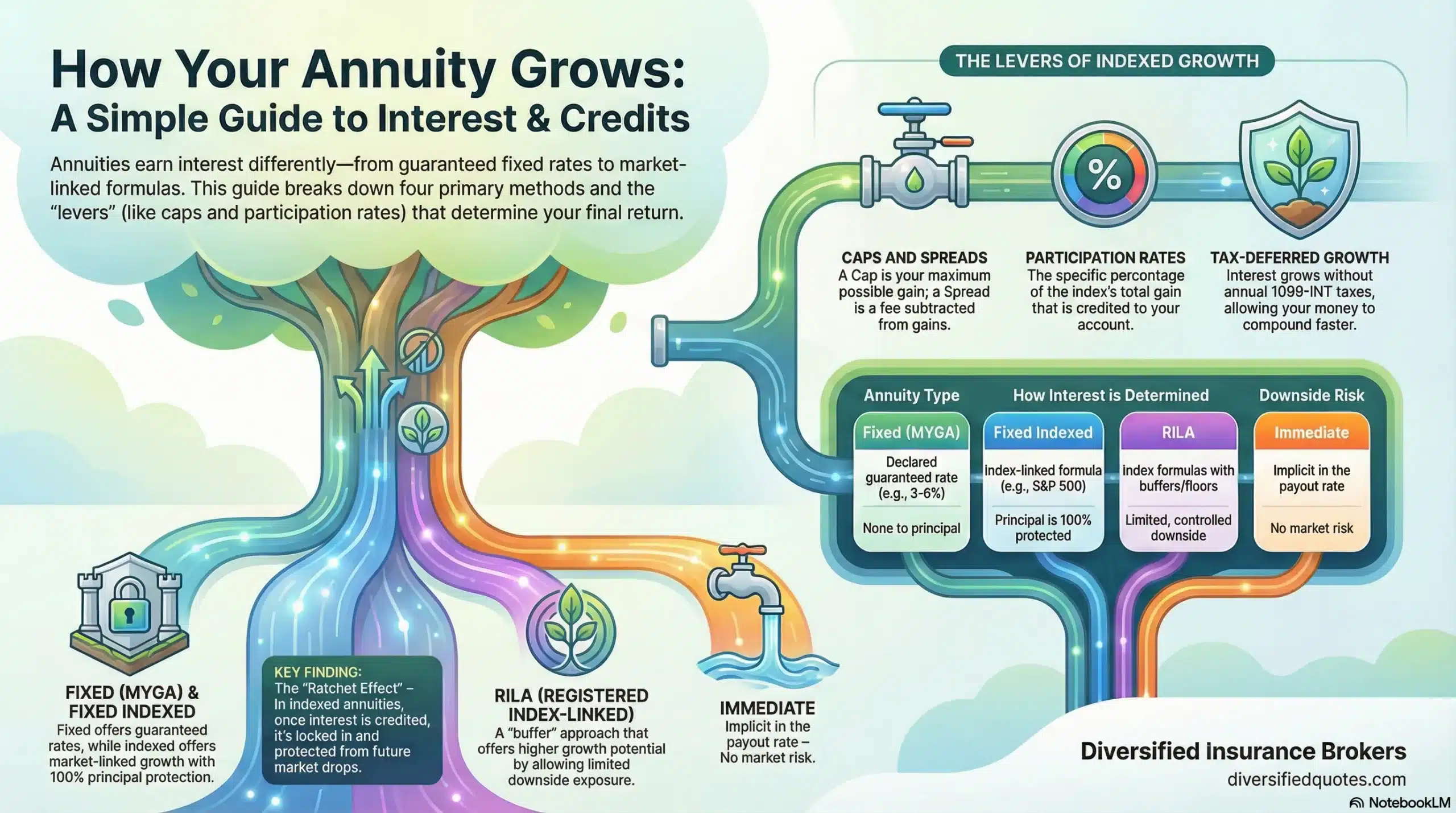
The single most important concept for seniors comparing annuity rates is that the rate being quoted means something fundamentally different depending on the product type. An MYGA rate is a declared interest rate credited annually to the contract value. A fixed indexed annuity rate is a potential crediting amount determined by index performance subject to caps or participation limits — not a guaranteed number. An income annuity rate is a payout expressed as a percentage of premium or as a monthly dollar amount per $100,000 placed. A bonus annuity rate is an upfront enhancement to the income base or contract value. These are four different things, and comparing them without understanding the distinction is one of the most common errors in annuity research.
The table below provides a reference framework for the four primary annuity types most relevant to seniors, organized by how the rate is structured, what the rate produces in practice, and which goal each type serves best.
Best Annuity Rates for Seniors: Product Type Comparison Reference
| Product Type | How the Rate Works | What It Produces | Primary Goal | Rate Changes After Purchase? |
|---|---|---|---|---|
| MYGA (Multi-Year Guaranteed Annuity) | Declared fixed interest rate credited annually; tax-deferred | Guaranteed accumulation over a set term (2–10 years) | Principal-certain accumulation; CD alternative | Guaranteed for declared term; renewal rate set at end of term |
| Fixed Indexed Annuity (FIA) | Interest linked to market index performance, subject to cap or participation rate; floor at zero | Principal protection with market-linked growth potential; optional lifetime income rider | Growth with downside protection; lifetime income planning | Caps/participation rates can change at renewal; floor and rider payout rate generally fixed |
| SPIA (Single Premium Immediate Annuity) | Lump sum converted to guaranteed monthly income; begins within 12 months of purchase | Contractual lifetime income; cannot be outlived | Immediate, guaranteed lifetime income | Payout fixed at purchase; does not change |
| DIA (Deferred Income Annuity) | Lump sum converted to deferred lifetime income; actuarial growth credited during deferral period | Higher monthly income than SPIA for same premium due to deferral; begins at future date | Longevity protection; future income planning | Payout fixed at purchase; does not change |
| Bonus Annuity (FIA with Premium Enhancement) | Upfront bonus of 5–20%+ credited to income base or contract value at deposit | Enhanced income base produces higher lifetime income withdrawals; typically requires longer deferral | Accelerated income base; best for seniors deferring income 5–10+ years | Bonus credited once; subsequent crediting terms subject to same FIA renewal rules |
The table above establishes the framework — but each row reflects product mechanics that have important conditions and nuances the summary cannot fully capture. The sections below expand each product type with the depth needed for genuine planning decisions. Our resource on whether annuities have fees adds a critical parallel layer to any rate comparison, since products with similar stated rates can produce materially different net outcomes when fee structures are accounted for.
MYGA Rates: The Clearest Comparison in the Best Annuity Rates for Seniors Landscape
Multi-year guaranteed annuities are the most straightforward product for seniors focused on the best annuity rates for seniors in an accumulation context. A MYGA works similarly to a bank certificate of deposit but is issued by an insurance carrier, with all credited interest growing tax-deferred until withdrawal. The rate is fixed for the full guarantee period — typically two to ten years — and does not change during that term regardless of what happens to prevailing interest rates. At the end of the term, the carrier sets a new renewal rate based on current conditions, and the senior can elect to renew, withdraw, or reposition the funds into a new product.
The MYGA category typically offers the most transparent comparison among all product types in the best annuity rates for seniors search because the rate is declared and guaranteed. Two MYGA products from two different carriers with five-year terms can be compared almost entirely on: declared rate, free withdrawal provisions, surrender schedule, renewal rate guarantee (if any), and the carrier’s financial strength rating. Rate differences between the most competitive and least competitive carriers on a five-year MYGA can exceed 75 to 100 basis points — which on a $250,000 premium compounded over five years represents meaningful thousands of dollars in additional accumulation at no additional risk to the senior.
Tax deferral gives MYGAs a material advantage over bank CDs at the same stated rate for seniors who do not need annual income from the account. A senior in the 22% tax bracket who owns a taxable CD paying 4.5% effectively earns significantly less than 4.5% after-tax on an annual basis because interest is reported as income each year. The same 4.5% MYGA rate grows entirely tax-deferred during accumulation, with taxes only due at distribution. Our resource on fixed annuities versus CDs models this comparison directly and shows the after-tax accumulation difference over five and ten year periods. For seniors comparing best annuity rates for seniors against bank alternatives, this comparison is often the most persuasive single piece of evidence for shifting funds. Our regularly updated fixed annuity rates page shows current MYGA yields across terms and carriers.
Fixed Indexed Annuity Rates: How the Best Rates for Seniors Work in Practice
Fixed indexed annuities represent the most nuanced product category in the best annuity rates for seniors discussion because the rate is not declared in advance — it is determined retrospectively based on index performance subject to crediting method parameters. Understanding what those parameters are and how they affect real outcomes is essential before selecting a fixed indexed annuity as part of a best annuity rates for seniors strategy.
The three most common crediting methods each use a different constraint on index-linked growth. Cap rate strategies limit the maximum credited interest in any contract year to a specified ceiling — if the S&P 500 gains 18% and the cap is 8%, the contract is credited 8%. Participation rate strategies credit a specified percentage of the index gain without a cap — a 60% participation rate on an 18% index gain produces 10.8% credited interest. Spread strategies subtract a fixed percentage from the index gain before crediting — a 2% spread on an 18% index gain produces 16% credited interest. Each method has trade-offs, and different carriers offer different combinations. The best annuity rates for seniors in the FIA category depend on comparing these parameters honestly across carriers, not simply accepting the first illustration provided.
The floor — typically zero percent — is the bedrock guarantee of any fixed indexed annuity. In a year where the tracked index loses value, the contract credits zero rather than reflecting the loss. This principal protection is the core trade-off: in exchange for eliminating downside, the senior accepts caps or participation limits on upside. For seniors who experienced the 2008-2009 market decline and the sequence-of-returns destruction it caused for early retirees, the value of that downside floor is not abstract — it is the difference between a secure retirement income and a permanently impaired portfolio. Whether you can lose principal in an indexed annuity is one of the most commonly searched questions, and our dedicated resource addresses it directly. For the honest limitations of these products, our resource on the downside of fixed indexed annuities provides a balanced assessment. And understanding whether fixed indexed annuity rates change at renewal helps seniors plan for what happens after the initial guarantee period.
When income riders are added to a fixed indexed annuity, the product becomes a primary vehicle for the best annuity rates for seniors seeking guaranteed lifetime income. The rider creates a separate income base — distinct from the accumulation value — that grows at a declared roll-up rate (often 5–8% per year compounded or simple) during the deferral period. When the senior activates income, the carrier calculates a guaranteed withdrawal based on the income base and the senior’s age at activation. The roll-up rate and the payout percentage at each age are the key metrics for income comparison — not the index crediting rate, which affects the accumulation value but not directly the income base in most rider structures. Our resource comparing roll-up rates versus payout rates is essential reading before comparing income riders across carriers.
Income Annuity Rates: SPIA and DIA Payouts as the Best Annuity Rates for Seniors
For seniors whose retirement income plan requires guaranteed cash flow rather than asset accumulation, single premium immediate annuities and deferred income annuities represent the purest form of the best annuity rates for seniors question — and often produce the highest guaranteed income per dollar placed of any financial product available. No investment account, no bond ladder, and no CD portfolio can guarantee that income will continue regardless of how long the senior lives. Income annuities make that guarantee contractually.
A SPIA begins payments within 12 months of purchase and is the most direct solution for a senior who needs income immediately. The best SPIA rates for seniors are quoted as a monthly payment per $100,000 of premium at a given age. A senior at age 70 placing $200,000 into a SPIA with a life-only payment option will receive a different monthly amount from different carriers — and shopping that differential matters. Because carriers use their own actuarial assumptions and investment strategies, payout quotes from five different carriers for the same age and premium can vary meaningfully. Using an independent broker who can run quotes across all five simultaneously is the most reliable way to identify the best annuity rates for seniors in the SPIA category. Understanding the full mechanics of how annuities pay income for life — including joint life, period certain, and inflation-adjustment options — helps seniors select the right payout structure before locking in.
A DIA defers the income start date to a future point, often five to fifteen years from purchase, in exchange for a substantially higher monthly payout when income eventually begins. The actuarial mechanics behind this enhancement are straightforward: the carrier is collecting the premium today and investing it for a longer period before beginning payments, and the senior’s expected payment period is shorter at an older income-start age than it would be at a younger age. A senior who places $150,000 into a DIA at age 65 with income beginning at age 80 will typically receive a dramatically higher monthly amount than if the same $150,000 had been placed in a SPIA beginning immediately at 65. Understanding how deferred income annuities work and when they produce the strongest lifetime value helps seniors decide whether near-term income or maximum long-term income is the right priority.
How Age Determines the Best Annuity Rates for Seniors on Income Products
Age at purchase is the most powerful single variable in the best annuity rates for seniors equation for income products. Insurance carriers use actuarial life expectancy tables to calculate income payouts, and older seniors receive higher monthly payments per dollar placed because the statistical payment period is shorter. The mathematical relationship is direct: each year of age at income start typically increases the guaranteed monthly payout meaningfully. A senior beginning lifetime income at 78 will receive a materially higher monthly amount per $100,000 than a senior beginning at 68, all else equal.
This age-driven payout increase creates an important planning decision for seniors who can afford to defer income. Covering near-term expenses through other sources — existing savings, Social Security, part-time work, or a portfolio — while allowing an income annuity’s income base to grow through a roll-up rider or through deferred income actuarial credits can produce a much stronger guaranteed income stream when payments eventually begin. The planning question is whether the near-term cash flow sacrifice is worth the long-term income enhancement. Our resources on the retirement income gap and lifetime income planning provide the broader strategic framework within which this deferral decision sits.
Age also interacts with required minimum distributions for seniors who hold qualified annuities inside an IRA. At age 73, current law requires minimum annual distributions from traditional IRA accounts, including annuity contracts held inside IRAs. The interaction between the annuity contract’s income provisions, surrender schedule, and RMD requirements can create complications if the annuity was not purchased with this interaction in mind. Seniors purchasing annuities inside IRAs should confirm that the product’s structure accommodates RMDs without triggering surrender charges or other penalties. Our resource on how an IRA works and the in-service 401(k) transfer resource cover the account-level rules that interact with annuity product decisions for qualified money.
Bonus Annuity Rates: How to Evaluate Best Annuity Rates for Seniors With Upfront Enhancements
Bonus annuities represent both one of the most compelling offerings and one of the most misunderstood categories in the best annuity rates for seniors marketplace. A premium bonus credits an immediate enhancement — typically ranging from 5% to 20% or more of the initial deposit — to the income base, the accumulation value, or both, at the time of purchase. A 15% bonus on a $200,000 deposit means the senior’s income base or contract value starts at $230,000 rather than $200,000 on day one. For seniors planning to defer income for five to ten years before activating withdrawals, this enhanced starting point can translate to meaningfully higher guaranteed lifetime income than a non-bonus product, even if the non-bonus product has a slightly higher crediting rate.
However, the most important principle in evaluating bonus annuities for the best annuity rates for seniors is that the bonus must be modeled in the context of the full product design — not evaluated in isolation. Bonus products frequently carry longer surrender periods (eight to ten years is common), which reduces liquidity compared to products with five-to-seven-year surrender schedules. Some bonus products also apply vesting schedules that require the senior to hold the contract for a minimum period before the full bonus is non-forfeitable. And the crediting terms — caps, participation rates — on some bonus products may be less competitive than on non-bonus alternatives, partially offsetting the bonus advantage over time.
The correct way to evaluate a bonus annuity against a non-bonus alternative for the best annuity rates for seniors purposes is to model the projected income base at the intended income start date under both products and compare the guaranteed monthly income amounts. This projection — not the headline bonus percentage — is what determines which product serves the senior’s income goals better. Our resource on bonus annuities with 20%+ enhancements explains the highest-bonus products currently available and provides the framework for evaluating them correctly. For seniors who currently hold annuity contracts that underperform current market options, our annuity rescue plan outlines repositioning strategies that can capture better rates and terms.
How Interest Rate Environments Shift the Best Annuity Rates for Seniors
The broader interest rate environment is one of the most important external factors determining what constitutes the best annuity rates for seniors at any given point in time. Insurance carriers invest premium funds primarily in investment-grade fixed income instruments — corporate bonds, agency securities, and other intermediate- to long-duration instruments. When prevailing interest rates rise, carriers earn higher yields on new investments, which enables them to offer more competitive rates on MYGA products, higher caps on FIA crediting strategies, and more competitive SPIA and DIA payout amounts. When rates decline, the same carriers must offer less competitive guarantees to maintain financial soundness.
The practical implication for seniors comparing best annuity rates for seniors is that rate levels change continuously — sometimes meaningfully from one month to the next. A MYGA rate that was 4.5% in January may be 4.0% in April from the same carrier on the same term if the carrier’s investment portfolio conditions have shifted. This means that the most useful rate comparison is always a current one, run specifically for the premium amount, term length, and product type being evaluated. Historical rate tables and remembered quotes from previous discussions are unreliable references for what is actually available right now.
Rate timing also creates a legitimate planning question: should a senior wait to purchase in hopes of better rates, or purchase now to lock in current guarantees? The honest answer depends on the interest rate outlook, the senior’s income timeline, and the cost of waiting — specifically, whether delaying purchase means also delaying income that the household needs. Our current annuity rates page and fixed indexed and income annuity rates page are updated regularly to reflect current market conditions, and our advisors can discuss rate trajectory context at the time of comparison.
Fees, Surrender Charges, and What They Mean for Best Annuity Rates for Seniors
Any honest discussion of best annuity rates for seniors must address fees and surrender charges, because products with similar stated rates can produce materially different net outcomes depending on their cost structures. The fee landscape in annuities varies significantly by product type, and understanding it is essential for making valid comparisons.
Most MYGA products carry no annual fees. The carrier’s margin is built into the spread between what it earns on investments and what it credits to the contract. For these products, the rate comparison is relatively clean: compare the guaranteed credited rate, the surrender period, annual free withdrawal provisions, and the carrier’s financial strength rating. For basic fixed indexed annuities without income riders, fees are also often minimal or nonexistent, with the carrier’s margin embedded in the cap rates and participation rate structures.
Income riders, when added to a fixed indexed annuity, typically carry annual fees ranging from approximately 0.5% to 1.5% of the income base, debited from the accumulation value. This fee structure means the accumulation value and the income base can diverge over time — the accumulation value is depleted by rider fees while the income base grows at the declared roll-up rate. For seniors who intend to activate income through the rider, this divergence does not necessarily create a problem; the income guarantee is based on the income base, not the accumulation value. But for seniors who might want to surrender the contract for its cash value at some future point, the accumulated rider fees represent real cost. Fully understanding the fee implications before comparing best annuity rates for seniors with income riders attached is essential — our dedicated resource on whether annuities have fees covers every fee type and where it appears in the contract.
Surrender charges protect the carrier’s ability to invest premiums in longer-duration instruments that support competitive rates. They are not punitive by design — they exist precisely because the higher rates carriers can offer are possible only when they can commit to longer investment horizons. For seniors who are confident they will not need the full contract value during the surrender period, the surrender charge is mostly irrelevant in practice. For seniors with uncertain liquidity needs, shorter surrender periods — or products with more generous free withdrawal provisions — represent important criteria in identifying the truly best annuity rates for seniors for their specific situation.
Best Annuity Rates for Seniors in IRAs and Qualified Rollover Scenarios
A substantial portion of seniors evaluating best annuity rates for seniors are doing so with IRA or 401(k) assets. Qualified annuities — those purchased with pre-tax retirement funds — function identically to non-qualified annuities in terms of rate mechanics. The guaranteed rates, principal protection features, and income guarantees are the same regardless of whether the premium comes from qualified or non-qualified sources. What changes is the tax treatment at distribution and the interaction with required minimum distribution rules.
Because IRA and 401(k) funds are already pre-tax and growing tax-deferred, the additional tax-deferral advantage that a non-qualified MYGA offers over a taxable CD does not apply inside a qualified account. However, the other advantages — guaranteed principal, competitive rates versus Treasury alternatives, and the potential for lifetime income guarantees — remain fully intact and often compelling for seniors repositioning qualified savings into structured retirement income.
The RMD interaction deserves particular attention when evaluating best annuity rates for seniors for qualified rollovers. At age 73, traditional IRA holders must begin taking required minimum distributions based on the account value and the applicable distribution period. Annuity contracts held inside IRAs must accommodate these distributions. Some MYGA products allow penalty-free RMD withdrawals even during the surrender period. Income annuities that produce regular payments may satisfy RMD requirements naturally if the payments are sufficient. SPIA products inside IRAs are specifically designed to satisfy RMD requirements through their ongoing income stream, which makes them a natural fit for seniors who want to convert IRA assets to guaranteed income while also addressing the mandatory distribution requirement.
For seniors evaluating whether to roll 401(k) assets into an IRA annuity versus keeping funds in the employer plan, understanding the full rollover framework is important. Our resource on in-service 401(k) transfers covers rollover mechanics, and our resource on how an IRA works clarifies the distribution rules and tax treatment that apply to qualified annuity distributions. For seniors also considering Roth conversion strategies as part of their tax planning, our Roth conversion insights resource covers how conversions interact with annuity income planning.
Long-Term Care Riders and Hybrid Products: A Special Category of Best Annuity Rates for Seniors
An increasingly important category in the best annuity rates for seniors landscape is the hybrid annuity — products that combine traditional annuity guarantees with long-term care or extended care benefits. These products address one of the most significant financial risks in retirement: the possibility that the senior will need extended care services — assisted living, memory care, or home health care — that cost far more than a fixed income stream can comfortably support.
Hybrid annuity-LTC products typically provide a base annuity with competitive accumulation or income rates, combined with a multiplier that increases the available benefit if the owner needs qualifying care services. A product might offer a 2x or 3x multiplication of the annuity value for qualifying care expenses, allowing the same premium to address both retirement income and catastrophic care costs in a single contract. For seniors who could not qualify for traditional long-term care insurance due to health history or who find standalone LTC premiums unaffordable, hybrid annuity products can represent a compelling alternative — and the annuity component’s rate remains part of the best annuity rates for seniors evaluation.
Our resource on tax-efficient long-term care solutions covers the tax treatment of LTC benefits distributed from annuity hybrid products, and our comprehensive guide to long-term care insurance provides context for how standalone LTC, hybrid annuities, and annuities with care riders compare in addressing extended care risk. For seniors building a retirement income plan that addresses both income security and care risk, coordinating these two planning dimensions is where the most comprehensive planning value is created.
How Social Security Coordination Affects Best Annuity Rates for Seniors in Income Planning
The timing of Social Security benefits and the selection of the best annuity rates for seniors for income purposes are closely linked planning decisions. Social Security claiming strategy determines both the amount of guaranteed base income available and the gap that an annuity income product needs to fill. A senior who delays Social Security to age 70 and receives a maximum benefit may need far less annuity income than a senior who claims Social Security at 62 and receives a permanently reduced benefit. The annuity’s income role in the overall plan changes depending on the Social Security decision.
For seniors with Social Security income that covers most essential expenses, the best annuity rates for seniors strategy may focus on accumulation products — MYGAs or fixed indexed annuities — rather than immediate income products, with the annuity serving as a tax-deferred growth vehicle for discretionary spending rather than a primary income source. For seniors with smaller Social Security benefits or those who claimed early, the annuity income role becomes more central and the income payout rate becomes the primary metric in identifying the best annuity rates for seniors for their plan. Our resource on how Social Security and annuities work together covers the coordination framework directly, and our Social Security planning service helps seniors maximize the foundational income before layering in annuity income on top.
Why Working With an Independent Broker Produces Best Annuity Rates for Seniors
The single most important practical step in finding the best annuity rates for seniors is working with an advisor who has access to the full market. Captive agents and bank representatives typically offer products from one or a very small number of insurance carriers. Their version of best annuity rates for seniors is the best rate within their limited product portfolio — not the best rate across the full market. For most seniors, this distinction means leaving meaningful money on the table, whether in the form of lower MYGA accumulation, lower income payout amounts, or less favorable bonus terms.
An independent advisor with 75+ carrier contracts can simultaneously compare MYGA rates across eight carriers, income payout rates across twelve SPIA carriers for the same age and premium, bonus annuity income projections across four competing products, and FIA crediting terms across six indexed annuities — and present the results in a standardized side-by-side illustration that makes the comparison objective and clear. This market breadth is what makes the best annuity rates for seniors actually achievable rather than theoretical. Our resource on what the best independent annuity broker provides explains the structural advantages of this approach, and our second opinion on your annuity quote service is available for seniors who want to verify whether their current contract or pending purchase represents the best available terms. Our no-cost policy review provides the same assessment for contracts already in force.
Since 1980, Diversified Insurance Brokers has helped retirees nationwide evaluate annuity options with clarity and confidence. We provide side-by-side illustrations, transparent explanations of surrender schedules and fee structures, and personalized income projections so you understand exactly how your annuity will perform before you commit. If you are currently comparing best annuity rates for seniors across products or evaluating whether your existing annuity contract is still competitive, we provide objective multi-carrier analysis designed to help you secure the strongest available guarantees in today’s market.
Lifetime Income Calculator
Use our calculator to see how much guaranteed income your annuity can provide.
Ready to Compare the Best Annuity Rates for Seniors?
We compare MYGA rates, indexed annuity crediting terms, income payout rates, and bonus structures across 75+ A-rated carriers — side by side, using your actual age and premium amount.
Request a Personalized Rate ComparisonRelated Annuity Rate and Planning Pages
Continue exploring annuity rate comparisons, product mechanics, and retirement income planning strategies.
Financial Protection Essentials
Coordinate annuity income with Social Security, long-term care, Medicare, and retirement tax planning.
Talk With an Advisor Today
Choose how you’d like to connect—call or message us, then book a time that works for you.
Schedule here:
calendly.com/jason-dibcompanies/diversified-quotes
Licensed in all 50 states • Fiduciary, family-owned since 1980
Frequently Asked Questions: Best Annuity Rates for Seniors
What is the difference between a “rate” on a MYGA versus a “rate” on an income annuity?
These are fundamentally different numbers that measure different things. A MYGA rate is a declared interest percentage credited annually to the contract value — similar to a CD rate. A 4.5% MYGA rate on a $200,000 deposit means $9,000 of interest is added to the contract value each year, all tax-deferred. At the end of the term, the senior has the accumulated value including all credited interest. The best MYGA rates for seniors are evaluated by comparing this declared rate, the guarantee term length, free withdrawal provisions, and carrier financial strength.
An income annuity rate is expressed as a monthly or annual payout per dollar placed — for example, $650 per month per $100,000 placed for a life-only payment at age 72. This rate reflects the carrier’s actuarial calculation combining interest, mortality credits, and the probability-weighted payment period. The best income annuity rates for seniors produce the highest sustainable monthly payment per premium dollar for the senior’s age and payment preferences. Comparing these two rate types as if they were equivalent is one of the most common errors in annuity research.
How do I know if a bonus annuity truly offers the best annuity rates for seniors?
A bonus annuity’s value cannot be determined from the headline bonus percentage alone. The correct evaluation compares what the bonus produces in guaranteed monthly income at the intended income start date — not the size of the bonus at purchase. A 15% upfront bonus on a product with a lower roll-up rate and less favorable payout percentage may produce lower guaranteed income at age 75 than a zero-bonus product with stronger roll-up and payout terms.
The framework for evaluating bonus annuities as part of the best annuity rates for seniors analysis involves: modeling the income base at the planned activation date under both bonus and non-bonus products; applying the carrier’s payout percentage for the senior’s age at income start; and comparing the resulting monthly income guarantee. Only when this projection is run can you know which product truly produces the best outcome. Our resource on bonus annuities with 20%+ enhancements walks through this comparison methodology with specific examples.
Can annuity rates change after I purchase, and what should seniors expect at renewal?
For MYGA products, the declared rate is guaranteed for the entire stated term — there is no rate change during that period. At the end of the term, the carrier sets a new renewal rate based on current market conditions, which may be higher or lower than the original rate. At renewal, the senior typically has a window — often 30 days — during which they can withdraw funds, transfer to a new product, or renew at the new rate without surrender charges.
For fixed indexed annuities, the crediting parameters — caps, participation rates, spreads — can change on new contract segments (typically annually) within limits defined in the contract. The carrier sets these each year based on its general account investment conditions. The principal protection floor remains fixed, and income rider payout percentages established at activation are generally contractually guaranteed. Understanding how indexed annuity rates change helps seniors plan for renewal periods appropriately. For income annuities (SPIA and DIA), the payout amount is fixed at purchase and never changes — it is the most stable of all annuity rate types once the product is issued.
What are the tax implications of annuity income for seniors?
Tax treatment depends on whether the annuity is qualified (funded with pre-tax IRA or 401(k) dollars) or non-qualified (funded with after-tax savings). Qualified annuity distributions are fully taxable as ordinary income when received, since no taxes were paid on the original contributions or growth. For seniors managing the best annuity rates for seniors inside qualified accounts, this means annuity income adds to other taxable income — including Social Security — and affects both the tax bracket and the percentage of Social Security benefits subject to federal tax.
Non-qualified annuity distributions are taxed differently: only the earnings portion is taxable as ordinary income; the principal (already after-tax) is returned tax-free. For non-qualified income annuities, IRS exclusion ratio calculations determine what portion of each payment is taxable earnings versus tax-free return of principal. This tax-advantaged treatment makes non-qualified annuities particularly valuable for seniors in higher tax brackets who want to generate income efficiently. Our resources on Roth conversions and annuity placement strategy can help optimize the tax picture across multiple income sources.
How do the best annuity rates for seniors compare to Treasury bonds and bank CDs?
For accumulation-focused seniors, MYGA rates from competitive insurance carriers typically exceed Treasury yields of comparable duration and bank CD rates meaningfully, with the additional advantage of tax deferral on non-qualified accounts. The effective yield advantage — after accounting for the annual tax drag on CDs versus the deferred tax treatment on MYGAs — can be substantial for seniors who do not need annual income from the account and who are in tax brackets where the annual tax cost is material.
Treasury bonds offer the ultimate credit backing (U.S. government), while annuity guarantees are backed by the insurer’s claims-paying ability plus state guaranty association protection. For most seniors working with A-rated carriers, this distinction is theoretical rather than practical — but it is a legitimate distinction to acknowledge. Bank CDs offer FDIC insurance up to $250,000 per depositor per institution. Our direct comparison resource on fixed annuities versus CDs models the after-tax accumulation difference across five and ten year periods.
Can I roll over my 401(k) or IRA into an annuity to capture the best annuity rates for seniors?
Yes. Trustee-to-trustee transfers and direct rollovers from traditional IRAs and 401(k) plans into annuity contracts preserve tax deferral and do not trigger current income tax. The funds move into the annuity contract in their pre-tax status, and income taxes are owed only when distributions are taken. This rollover mechanism is one of the most common ways seniors position retirement savings into guaranteed accumulation or income products.
The key considerations for qualified rollovers include: the annuity product’s accommodation of required minimum distributions after age 73; the surrender period relative to when the senior may need liquidity; and whether the income structure of the annuity aligns with the RMD amount or can be coordinated with it. Our resource on how an IRA works covers the distribution rules that apply, and our advisors can structure the rollover to ensure the annuity product’s provisions are compatible with the qualified account requirements.
How do I evaluate whether an annuity with a long-term care rider offers the best annuity rates for seniors?
Hybrid annuity products with long-term care or extended care riders require evaluation on two dimensions simultaneously: the annuity’s base rate performance (accumulation or income) and the value of the care benefit enhancement. A product with a slightly lower base annuity rate may be the better choice overall if its care enhancement provides a 3x benefit multiplier, because the combined value across both use cases exceeds what a higher-rate product without care benefits provides.
The planning question is whether the senior wants or needs to address long-term care risk within the same product structure. For seniors who could not qualify for standalone LTC insurance, or for whom standalone LTC premiums are financially impractical, hybrid products that deliver both income and care benefits through a single premium can be the most efficient overall structure. Our resource on tax-efficient long-term care solutions covers the tax treatment of care benefits from hybrid products, and our long-term care insurance guide provides the comparative framework across LTC product types.
What is the most common mistake seniors make when searching for the best annuity rates?
The most common mistake is evaluating a single metric in isolation — most often the headline bonus percentage or the declared MYGA rate — without placing it in the context of the full product design, the surrender terms, the fee structure, and what the rate actually produces in practice given the senior’s specific age, timeline, and goals. A 20% bonus with a 10-year surrender period and a modest payout percentage may produce less guaranteed lifetime income than a zero-bonus product with a 7-year surrender period and strong payout terms. The headline number doesn’t tell that story — only a full side-by-side projection does.
The second most common mistake is working with a single carrier or a captive agent whose “best annuity rates for seniors” is limited to their portfolio rather than the full market. Rate differences between the most and least competitive carriers for the same product type can be meaningful — and those differences compound significantly over time. An independent broker with 75+ carrier contracts eliminates this limitation and ensures the comparison is genuinely market-wide rather than artificially constrained.
About the Author:
Jason Stolz, CLTC, CRPC, DIA, CAA and Chief Underwriter at Diversified Insurance Brokers (NPN 20471358), is a senior insurance and retirement professional with more than 25 years of real-world experience helping individuals, families, and business owners protect their income, assets, and long-term financial stability. As a long-time partner of the nationally licensed independent agency Diversified Insurance Brokers, Jason provides trusted guidance across multiple specialties—including fixed and indexed annuities, long-term care planning, personal and business disability insurance, life insurance solutions, Group Health, Travel Medical and Evacuation Insurance, and short-term health coverage. Diversified Insurance Brokers maintains active contracts with over 100 highly rated insurance carriers, ensuring clients have access to a broad and competitive marketplace.
His practical, education-first approach has earned recognition in publications such as VoyageATL, and contributions from his agency featured in Kiplinger and GoBankingRates— highlighting his commitment to financial clarity and client-focused planning. Drawing on deep product knowledge and years of hands-on field experience, Jason helps clients evaluate carriers, compare strategies, and build retirement and protection plans that are both secure and cost-efficient. Visitors who want to explore current annuity rates and compare options across multiple insurers can also use this annuity quote and comparison tool.
Explore More Annuity Options: Browse our complete guide to Current Annuity Rates — covering current fixed, bonus, MYGA & income annuity rates by term from top carriers from 100+ carriers.
Last Reviewed: August 3, 2026 |
Reviewed by: Jason Stolz, CLTC, CRPC, DIA, CAA
Chief Underwriter, Diversified Insurance Brokers, Inc. | NPN: 20471358 | Diversified Insurance Brokers, Inc. — Licensed in all 50 states
Fact Checked by: Tonia Pettitt, CMIP©
Medicare Specialist, Diversified Insurance Brokers, Inc. | NPN: 14374308 | Diversified Insurance Brokers, Inc. — Licensed in all 50 states
Did you find this content helpful? Leave us a Google review — it helps others find trustworthy guidance too.
Editorial Standards: Diversified Insurance Brokers maintains rigorous editorial standards to ensure accuracy, clarity, and independence in all content. Learn more about our editorial standards and commitment to transparency.
