
Fixed Annuity Rates
Fixed Annuity Rates

Jason Stolz CLTC, CRPC, DIA, CAA
Fixed Annuity Rates Today — What You Can Actually Lock In and Why It Matters
Fixed annuity rates — also called MYGA rates, for multi-year guaranteed annuity — let you lock in a contractually guaranteed interest rate for a defined term, with no market risk, no annual fees, and tax-deferred growth on all credited interest until withdrawal. As of current market conditions, top fixed annuity rates from A-rated carriers are running approximately 5.00% to 5.75% depending on term length and deposit amount — levels that represent near 15-year highs and that compare favorably to bank CD rates by approximately 0.50%–0.75% on equivalent terms, with the additional advantage of tax-deferred compounding that CDs do not provide. The rate environment created by the Federal Reserve’s tightening cycle produced MYGA rates that significantly exceed what conservative savers had available for most of the prior decade, and those elevated rates remain available now — though they are expected to gradually move lower as monetary policy eases. For any pre-retiree or retiree with funds sitting in CDs, savings accounts, or money market accounts earning lower guaranteed rates, the fixed annuity comparison is one of the most direct planning opportunities currently available in the principal-protected accumulation market. At Diversified Insurance Brokers, Jason Stolz, CLTC, CRPC, DIA, CAA compares fixed annuity rates across more than 100 carriers — evaluating not just the headline rate but the full combination of rate, term length, carrier financial strength, renewal terms, minimum guaranteed interest rate floor, and liquidity provisions that together determine which contract delivers the best guaranteed growth for each client’s specific timeline and premium amount. What a fixed annuity is and how it differs from fixed indexed annuities, immediate annuities, and variable annuities establishes the product category context that makes fixed annuity rate comparisons meaningful — the rate is only the starting point, not the complete picture.
What Drives Fixed Annuity Rates — and Why the Same Rate Is Not Available Everywhere
Fixed annuity rates are not set arbitrarily by insurance carriers — they reflect the yield that the carrier’s general account investment portfolio earns on the assets backing the contract, minus the spread that funds carrier operations, reserves, and agent compensation. When insurance carriers earn higher yields on their fixed income portfolios — which happens when the broader interest rate environment is elevated — they can offer higher guaranteed rates to policyholders while still maintaining required reserve levels and operating margins. When interest rates fall, the carrier’s portfolio yield falls with it, and the guaranteed rates available on new contracts decline accordingly. This mechanism is why MYGA rates have been near 15-year highs in recent years — the sustained elevated interest rate environment allowed carriers to offer rates well above what the prior low-rate decade made possible — and why locking in current rates before anticipated Fed rate cuts reduce available yields is a genuine timing consideration for buyers evaluating fixed annuities now.
Several factors beyond the broad rate environment affect the specific rate any individual buyer receives. Term length is typically the most significant: longer terms allow carriers to invest for a longer horizon without repricing, which generally supports higher credited rates — a 7-year MYGA typically offers a higher rate than a 3-year MYGA from the same carrier at the same time, because the carrier can commit to a longer investment strategy. Premium amount matters at some carriers through rate banding — contracts funded above defined premium thresholds (often $100,000 or $250,000) may qualify for higher credited rates than smaller premium amounts at the same carrier. State availability affects which products are accessible — MYGA products are approved at the state level, and a carrier offering a specific rate in one state may not have the same product approved in another. Carrier financial strength ratings affect pricing too — a carrier willing to accept lower-quality fixed income investments to earn higher yields can sometimes offer higher credited rates, but at the cost of lower carrier financial strength; higher-rated carriers typically price conservatively but with stronger long-term claims-paying assurance. Comparing rates across the full market rather than accepting a single carrier’s offering — or a single agent’s inventory — is how buyers access the full range of available rates and identify the best combination of yield and carrier quality for their specific needs. What annuity guarantees mean in the context of fixed annuity contracts — the contractual rate guarantee backed by carrier reserves and state guarantee associations — establishes the security framework within which the guaranteed rate promise is made. Whether an annuity can lose money in the fixed MYGA context clarifies the specific scenarios — early surrender charges, not market performance — that represent the only realistic risk to the guaranteed outcome.
Ensure you are receiving the absolute top rates
Current Fixed Annuity Rates
Compare today’s best fixed annuity rates from top carriers.
Current Bonus Annuity Rates
See which annuities offer the highest upfront bonus today.
Request an Annuity Quote
Submit our annuity request form to get personalized rate options.
Lifetime Income Calculator
Use our calculator to see how much guaranteed income your annuity can provide.
How to Evaluate Fixed Annuity Rates — Beyond the Headline Number
| Evaluation Factor | What It Is | Why It Matters |
|---|---|---|
| Guaranteed rate and term | The contractually stated interest rate credited for the full guarantee period — typically 2, 3, 5, 7, or 10 years; the rate does not change during the guarantee period regardless of what the broader interest rate environment does; it is the rate the carrier is legally obligated to credit for every year of the selected term | This is the primary number buyers compare — but the headline rate from any single carrier is only meaningful in the context of the term attached to it; a 5.50% 7-year rate and a 5.50% 3-year rate are not equivalent because the longer lock-in carries more rate renewal risk at maturity; comparing rates at equivalent terms across multiple carriers is the accurate comparison |
| Minimum Guaranteed Interest Rate (MGIR) | The contractual floor below which the carrier cannot reduce the credited rate at renewal — typically 1%–3% depending on the contract and state; the MGIR is disclosed in the contract and represents the absolute worst-case renewal scenario regardless of how low market interest rates fall during or after the guarantee period | The MGIR matters most for owners who intend to renew the contract at maturity rather than repositioning to a new carrier or product; in an environment where rates fall significantly between the initial guarantee period and renewal, the MGIR ensures the renewal rate cannot fall below a defined floor; confirming the MGIR before purchase establishes the worst-case growth scenario across the full holding period |
| Free withdrawal provision | The percentage of account value — typically 10% annually — that can be withdrawn each year during the guarantee period without triggering a surrender charge; most contracts allow the free withdrawal beginning in contract year one or two; some contracts offer interest-only withdrawals rather than account value percentage withdrawals in early years | The free withdrawal provision defines the practical annual liquidity available during the guarantee period; buyers who may need access to funds during the term should confirm the specific free withdrawal structure before committing to a term length; matching the term and free withdrawal provision to the buyer’s actual liquidity needs prevents the scenario of needing funds and encountering surrender charges that were not anticipated |
| Market value adjustment (MVA) | A contract provision that adjusts the surrender value up or down based on interest rate movements at the time of early surrender — when rates have risen since the contract was issued, an MVA reduces the surrender value; when rates have fallen, an MVA increases it; not all fixed annuity contracts include an MVA, and its presence or absence is disclosed in the contract | The MVA creates an additional surrender value consideration beyond the stated surrender charge schedule — in a rising rate environment, surrendering an MVA contract early can result in receiving less than the account value even after considering the free withdrawal allowance; buyers who want the simplest surrender mechanics should confirm whether an MVA applies and understand how it would affect any early exit scenario |
| Carrier financial strength | The rating assigned by independent rating agencies — most commonly AM Best — that reflects the carrier’s financial stability, reserve adequacy, and long-term claims-paying capacity; the AM Best rating scale runs from A++ (superior) through D (poor); most financial professionals recommend limiting fixed annuity purchases to carriers rated A- or better | The guaranteed rate is only as reliable as the carrier making the guarantee; a higher rate from a lower-rated carrier represents a different risk profile than a slightly lower rate from an A+ carrier; state guarantee associations provide insolvency protection up to defined limits (typically $100,000–$500,000 depending on the state), but the claims process in an insolvency is far more complex than a claim from a financially healthy carrier |
The five evaluation factors documented in the table together constitute the complete picture of any fixed annuity contract — not just the headline rate. Surrender charges and their interaction with MVA provisions is the exit cost analysis that every fixed annuity buyer should understand before the term length is selected. The free withdrawal rules across different contract designs establish the practical liquidity available during the term and the conditions under which that liquidity applies.
Term Length Selection — Matching Your Money to Your Timeline
The most consequential decision in fixed annuity rate selection after carrier financial strength is term length — and the right term is almost never simply the longest or highest-rate option available. Term selection is a planning decision that requires matching the guarantee period to the owner’s actual timeline for the funds: when they might be needed, whether they serve an accumulation objective or a near-term distribution objective, and whether the rate environment favors locking in for a longer or shorter period given current yield levels and the expected direction of rates. The most common term lengths available — 3, 5, 7, and 10 years — each serve a different planning profile, and understanding which profile applies to any specific buyer is the starting point for term selection rather than simply defaulting to the highest-rate option available.
A 3-year fixed annuity serves buyers whose funds may be needed within a few years — a planned home purchase, a vehicle replacement, a healthcare expense, or a short runway to retirement distribution — where maximizing yield for the full term is less important than ensuring the funds are accessible without surrender charges at the anticipated need date. A 5-year fixed annuity is the most commonly selected term for pre-retirees who want to lock in current elevated rates for a meaningful period without committing to a decade-long horizon — the 5-year term provides a competitive rate at current market levels and a defined maturity date within a planning horizon most buyers find manageable. A 7-year term typically offers the highest rates for buyers who will not need the funds during the guarantee period and who want maximum guaranteed yield over a longer accumulation window. A 10-year term is most appropriate for IRA money or long-horizon funds where the primary objective is maximum guaranteed accumulation over a defined period and liquidity is not a planning concern during the term. MYGA laddering — splitting a lump sum across multiple terms rather than placing it all in one contract — provides staggered access to funds at different maturity dates while still locking in current rates, trading a modest yield reduction for meaningfully improved liquidity planning across the full portfolio. The 3-5-7 year ladder is a common design that creates maturity events at 3, 5, and 7 years from purchase, giving the owner three windows to reassess, reposition, or access funds without surrender charges. Fixed annuities versus fixed indexed annuities is the closest comparable product comparison — the MYGA’s guaranteed rate versus the FIA’s index-linked crediting with a 0% floor represents the simplicity-versus-upside-potential tradeoff within the principal-protected accumulation category. How tax deferral creates compounding advantage is specifically relevant for MYGA holders who are comparing the net after-tax return of a MYGA against a CD — the tax-deferred compounding on MYGA credited interest produces meaningfully better outcomes than the annually-taxed CD interest over multi-year holding periods at identical stated rates. How 1035 exchanges work for fixed annuity repositioning — transferring the accumulated value at maturity to a new fixed annuity contract at then-current rates without triggering ordinary income tax — is the renewal strategy that preserves tax deferral across multiple guarantee periods.
The Fixed Annuity Market — Products Across Carriers Worth Knowing
The fixed annuity market includes products from dozens of carriers at any given time, each with different rate structures, term options, liquidity provisions, and renewal terms. The best available rate in the market at any specific time depends on which carrier is aggressively pricing for asset growth and what the prevailing interest rate environment supports for each term length. The American Gulf Anchor MYGA combines guaranteed growth with liquidity features designed for buyers who want principal protection and defined access during the guarantee period. The American Life Classic MYGA delivers predictable growth without market risk across a straightforward single-rate guarantee structure. The Aspida Synergy Choice MYGA builds in liquidity provisions alongside the fixed rate guarantee — a design for buyers who want both rate certainty and access flexibility; Aspida’s carrier financial profile provides the security context for evaluating this product’s long-term guarantees. The Athene MaxRate annuity offers fixed growth with flexible term options across multiple durations — useful for buyers who want to compare rate levels at different guarantee periods from a single carrier. The FG Guarantee Platinum delivers predictable growth with multi-year fixed rates in a straightforward structure designed for simplicity. The Global Atlantic SecureFore 5 provides guaranteed growth with flexibility across a 5-year guarantee period; Global Atlantic’s financial strength profile establishes the carrier quality supporting these guarantees. The Integrity Life MultiVantage offers locked-in rates with a first-year interest boost — a design that front-loads additional credited interest in the contract’s opening year alongside a competitive multi-year guarantee rate. The National Life Group RetireMax Secure is specifically designed around flexibility and predictable growth for retirees managing accumulation alongside distribution planning; National Life Group’s carrier profile provides context for evaluating this product’s institutional backing. The Oxford Life Multi-Select offers multiple term options within a single carrier relationship — a useful design for buyers who want to compare rate levels across 3, 5, and 7-year terms at a single carrier. The Sentinel Security Personal Choice MYGA provides straightforward fixed accumulation with the term and rate flexibility the product name suggests; Sentinel Security Life’s financial profile establishes the carrier context. The Silac Secure Savings annuity delivers fixed growth with liquidity and long-term stability in a product designed for conservative savers prioritizing simplicity; Silac’s carrier ratings support the product evaluation. The Wichita National Life Security 5 rounds out the MYGA product landscape with a safe, predictable structure specifically positioned for retirement growth planning. Annuities for conservative investors as a planning framework establishes where fixed annuities sit within the full annuity product spectrum — at the conservative end, offering maximum predictability and simplicity at the cost of upside potential above the guaranteed rate. Fixed indexed annuities as an alternative for buyers who want principal protection with market-linked upside potential above a guaranteed floor represents the next step up on the risk-return spectrum from a pure MYGA position. How Social Security and annuities coordinate in a retirement income plan establishes the income architecture within which MYGA accumulation serves its specific role — building a defined accumulation base that converts to income at or near retirement while Social Security provides the baseline guaranteed monthly income floor. Guaranteed income from annuities across all structures — from MYGA-funded income conversion to GLWB riders on FIAs — is the distribution-phase counterpart to the accumulation-phase fixed rate focus. Annuity income as a monthly retirement income source translates the MYGA’s accumulated value into the income planning context — what the matured MYGA balance can produce when converted to a lifetime income stream. The annuity rescue plan process specifically reviews existing fixed annuity and MYGA positions to confirm they remain competitive relative to current market offerings — and evaluates whether repositioning through a 1035 exchange would improve the net outcome given the current rate environment and the owner’s updated planning objectives.
Get Your Fixed Annuity Rate Comparison
We compare guaranteed rates, term options, carrier financial strength, surrender schedules, and renewal terms across 100+ carriers — identifying the specific contract that delivers the best combination of yield, security, and liquidity for your timeline.
Request a Personalized Quote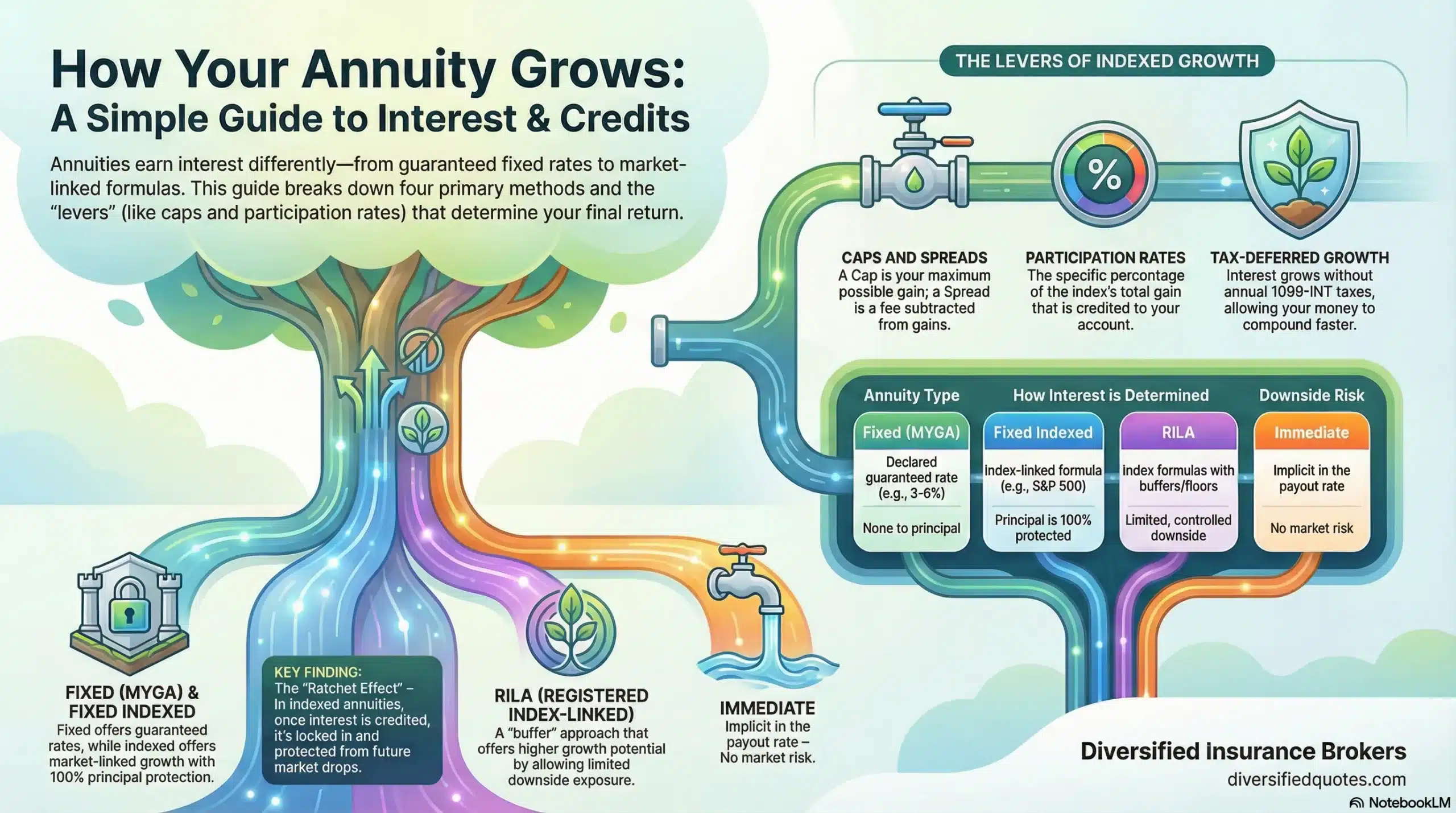
Talk With an Advisor Today
Choose how you’d like to connect—call or message us, then book a time that works for you.
Schedule here:
calendly.com/jason-dibcompanies/diversified-quotes
Licensed in all 50 states • Fiduciary, family-owned since 1980
FAQs: Fixed Annuity Rates
How do current fixed annuity rates compare to bank CDs?
At current market levels, top fixed annuity rates from A-rated carriers are running approximately 5.00%–5.75% depending on term length and deposit amount — roughly 0.50%–0.75% above the best available bank CD rates on equivalent terms. That rate premium is meaningful on its own, but the more significant advantage of a fixed annuity over a CD is the tax treatment of credited interest. A CD’s annual interest is taxable as ordinary income in the year it is earned, regardless of whether the funds are withdrawn. A fixed annuity’s credited interest accumulates tax-deferred — no tax is owed on the credited interest until funds are withdrawn from the contract. Over a multi-year term, this difference in tax treatment creates meaningfully different after-tax accumulated values even when the stated rates are identical.
A simple illustration: $100,000 in a 5-year CD earning 5% annually, taxed at 25% each year, nets approximately $114,700 after five years of after-tax compounding. The same $100,000 in a 5-year MYGA at the same 5% rate, with all interest compounding tax-deferred, accumulates to approximately $127,600 before taxes — and if the funds are distributed in a lower-bracket retirement year, the effective after-tax outcome can exceed the CD significantly. The fixed annuity does not eliminate taxes — it defers them — but the deferral advantage is real and compounding over the full term. The CD’s advantage is simplicity and FDIC insurance up to applicable limits; the fixed annuity’s advantages are the higher stated rate, tax-deferred compounding, and potentially higher after-tax accumulation over multi-year holding periods.
What happens to my money when a fixed annuity’s guarantee period ends?
At the end of the guarantee period — called the maturity date — most fixed annuity contracts provide several options. The most common options are: renew into a new guarantee period at then-current rates offered by the same carrier; withdraw the full accumulated value, which is available without surrender charges during the window following maturity; transfer the accumulated value to a different carrier or different annuity product through a 1035 exchange, which moves the full balance including deferred earnings without triggering ordinary income tax; or begin receiving income payments through annuitization or by directing the balance into a product with an income rider. The critical planning point is that inaction — failing to elect an option at maturity — typically results in automatic renewal at the carrier’s current rate for a new term. That automatic renewal rate may be higher or lower than the maturing contract’s rate depending on market conditions at renewal. It can never fall below the contract’s Minimum Guaranteed Interest Rate, but the renewal rate is not guaranteed to match the original term’s rate.
The maturity window — typically a 30-day period after the guarantee period ends — is the owner’s opportunity to act without surrender charges. Waiting beyond that window may result in the automatic renewal locking in a new surrender period at the renewal rate. Monitoring the maturity date and making an intentional decision about how to direct the accumulated value during the maturity window — rather than allowing automatic renewal by default — is the most important planning discipline for MYGA holders approaching maturity. Diversified Insurance Brokers monitors existing fixed annuity positions and notifies clients approaching maturity so the comparison and election process can be completed thoughtfully rather than reactively.
Should I choose the longest term to get the highest rate?
Not necessarily — and defaulting to the longest available term purely for the highest rate is the most common fixed annuity planning error. The right term is determined by when the funds are actually needed, not by which term offers the highest headline rate. A 7-year MYGA at 5.55% is not better than a 5-year MYGA at 5.25% for a buyer who needs the funds in year 5 — because accessing the 7-year contract before maturity triggers surrender charges that can eliminate the rate advantage and potentially reduce the net return below what the 5-year contract would have provided. The rate premium from the longer term is only captured by buyers who hold the full term without needing to access the funds.
The practical term selection framework is: identify the earliest date the funds might realistically be needed, select a term that ends at or before that date, and compare rates at that term length across multiple carriers. If multiple terms are genuinely appropriate — funds that are definitively not needed for at least 7 years — then comparing the rate at 5 and 7 years to determine whether the rate premium justifies the additional 2-year commitment is a reasonable analysis. For buyers with genuinely long-horizon funds — IRA money not expected to be touched for a decade or more — the 7 or 10-year term can be justified by both the higher rate and the tax-deferred compounding advantage of a longer accumulation window. The decision should always start with the timeline, not with the rate.
What is a MYGA ladder and should I consider one?
A MYGA ladder splits a total premium allocation across multiple fixed annuity contracts with different term lengths — for example, allocating one-third of the premium to a 3-year MYGA, one-third to a 5-year MYGA, and one-third to a 7-year MYGA. At the end of each term, the maturing contract provides access to that portion of the capital without surrender charges, with the option to withdraw, reinvest, or direct the funds to income. The laddering structure provides staggered maturity dates across the full premium allocation rather than a single maturity event at the end of one term.
The primary advantage of laddering is liquidity planning — the owner has guaranteed access to a portion of the total premium at 3, 5, and 7 years without surrendering any contract before its term ends. The primary cost of laddering is a modest yield reduction — the 3-year portion earns the 3-year rate rather than the 7-year rate, and the blended weighted average rate across the ladder is lower than the rate available on the full premium placed in the longest-term contract. For buyers who genuinely need staggered access points and who value the predictability of knowing exactly when each portion of their capital will be accessible without penalty, the rate cost of laddering is typically a reasonable tradeoff for the liquidity benefit it provides. For buyers whose full premium is long-horizon capital with no anticipated access needs across the full 7 or 10 years, a single longer-term contract at the best available rate is simpler and more yield-efficient than a ladder. The decision depends entirely on the buyer’s actual liquidity needs, not on a general preference for flexibility.
Are fixed annuity rates going up or down?
This is guessing — and any confident directional prediction about future rates is speculation rather than fact. That said, there are observable market conditions that inform the directional expectation as of current reporting. The Federal Reserve began cutting interest rates in late 2025, having held rates at elevated levels for an extended period to address inflation. MYGA rates closely track the broader interest rate environment through the mechanism of insurance carrier portfolio yields, so Fed rate cuts are expected to gradually pull MYGA rates lower from their current near-15-year-high levels over the coming years. The pace and magnitude of that decline is genuinely uncertain — it depends on the Fed’s ongoing assessment of economic conditions, inflation, and employment data, none of which can be predicted with precision.
The practical planning implication — from the perspective of someone deciding whether to lock in current rates or wait — is that current rates are near multi-year highs and are expected to trend lower rather than higher based on the current monetary policy trajectory. Waiting for rates to increase further before locking in would require a reversal of the current rate direction, which is possible but contrary to the current policy signal. For buyers who have been considering a fixed annuity but have been waiting, the current rate environment represents a more favorable entry point than most of the prior decade offered, and the expected direction of rates from here is downward rather than upward. This is not a guarantee — rates could surprise in either direction — but it is the honest characterization of the current rate environment and the direction market indicators suggest it will move. Always confirm current rates directly with a quote at the time of purchase, since rates can change between the date of research and the date of application.
Can I use a fixed annuity inside my IRA or 401k?
Yes — fixed annuities, including MYGAs, can be purchased as qualified contracts using IRA or 401k funds through a direct rollover or trustee-to-trustee transfer. The resulting contract is a qualified fixed annuity where all distributions are taxed as ordinary income, because the original contributions were made on a pre-tax basis. There are no contribution limits on the annuity itself — the limits are on the IRA or 401k from which the funds originate. The tax-deferred growth that makes fixed annuities attractive to non-qualified buyers is already provided by the IRA’s qualified account status, meaning the annuity’s tax deferral layer does not add incremental tax benefit inside a traditional IRA. The annuity adds its other features — the contractually guaranteed rate, principal protection, and defined maturity mechanics — on top of the existing tax-deferred account structure.
For qualified annuity buyers, the value proposition centers on the guaranteed rate and principal protection rather than the additional tax deferral, which the IRA already provides. A retiree who has rolled over a 401k into an IRA and wants to place a portion of those funds in a principal-protected guaranteed rate vehicle — rather than keeping them in market-exposed mutual funds — uses a qualified MYGA to accomplish exactly that. Required minimum distribution rules apply to qualified fixed annuities at the same ages as standard IRAs, which means the maturity date selection should account for the RMD timeline to avoid the surrender charge risk of needing to take RMDs during a surrender period that would otherwise make those distributions subject to charges. Coordinating the MYGA term with the owner’s age and anticipated RMD obligations is an important step in the qualified fixed annuity purchase process.
About the Author:
Jason Stolz, CLTC, CRPC, DIA, CAA and Chief Underwriter at Diversified Insurance Brokers (NPN 20471358), is a senior insurance and retirement professional with more than 25 years of real-world experience helping individuals, families, and business owners protect their income, assets, and long-term financial stability. As a long-time partner of the nationally licensed independent agency Diversified Insurance Brokers, Jason provides trusted guidance across multiple specialties—including fixed and indexed annuities, long-term care planning, personal and business disability insurance, life insurance solutions, Group Health, Travel Medical and Evacuation Insurance, and short-term health coverage. Diversified Insurance Brokers maintains active contracts with over 100 highly rated insurance carriers, ensuring clients have access to a broad and competitive marketplace.
His practical, education-first approach has earned recognition in publications such as VoyageATL, and contributions from his agency featured in Kiplinger and GoBankingRates— highlighting his commitment to financial clarity and client-focused planning. Drawing on deep product knowledge and years of hands-on field experience, Jason helps clients evaluate carriers, compare strategies, and build retirement and protection plans that are both secure and cost-efficient. Visitors who want to explore current annuity rates and compare options across multiple insurers can also use this annuity quote and comparison tool.
Explore More Annuity Options: Browse our complete guide to Current Annuity Rates — covering current fixed, bonus, MYGA & income annuity rates by term from top carriers from 100+ carriers.
Last Reviewed: June 9, 2026 |
Reviewed by: Jason Stolz, CLTC, CRPC, DIA, CAA
Chief Underwriter, Diversified Insurance Brokers, Inc. | NPN: 20471358 | Diversified Insurance Brokers, Inc. — Licensed in all 50 states
Fact Checked by: Tonia Pettitt, CMIP©
Medicare Specialist, Diversified Insurance Brokers, Inc. | NPN: 14374308 | Diversified Insurance Brokers, Inc. — Licensed in all 50 states
Did you find this content helpful? Leave us a Google review — it helps others find trustworthy guidance too.
Editorial Standards: Diversified Insurance Brokers maintains rigorous editorial standards to ensure accuracy, clarity, and independence in all content. Learn more about our editorial standards and commitment to transparency.
