
Travel Medical and Evacuation from East Timor
Travel Medical and Evacuation from East Timor

Jason Stolz CLTC, CRPC, DIA, CAA
East Timor — Timor-Leste — is one of Asia’s youngest and least-visited nations, a small half-island country at the eastern end of the Indonesian archipelago whose combination of Portuguese colonial history, extraordinary World War II resistance heritage, dramatic mountainous interior, and Red Sea-quality coral diving along its untouched south coast has begun attracting a specific kind of traveler: adventurous, independent, and entirely unprepared for what happens when something goes medically wrong 90 kilometers from the nearest hospital. The country’s appeal is genuine and its tourism footprint is legitimately underdeveloped in ways that create an experience impossible to replicate in Bali or Bangkok — but that same underdevelopment extends to the healthcare infrastructure in ways that make travel medical and evacuation insurance from East Timor not a precaution but the actual emergency response plan for any traveler who has thought honestly about what happens in a serious medical event 400 kilometers from Darwin.
At Diversified Insurance Brokers, we help travelers, NGO staff, contractors, researchers, educators, and diaspora families match coverage design to the actual logistics of Timor-Leste rather than the generic “developing country” template that misses the country’s specific medical geography. The assistance team coordination capability — specifically whether the team has operational experience with the Darwin evacuation corridor and the Bali alternative routing — matters as much as the benefit limit on the policy declaration page. Darwin Airport’s proximity to Dili (roughly 90 minutes by air), Royal Darwin Hospital’s role as the established receiving facility for Timorese medical cases, and the specific gap between what Guido Valadares National Hospital in Dili can handle and what it cannot are the operational details that distinguish a plan that works from one that looks adequate on paper. For the broader framework of how medical risk assessment should shape coverage selection for remote destinations, the framework for assessing destination medical risk is a useful foundation before engaging with Timor-Leste’s specifics.
Secure Travel Medical & Evacuation Coverage for East Timor
Apply online for coverage designed for destinations where advanced care may require evacuation to a regional medical hub.
The Medical Geography of Timor-Leste: What Actually Exists and What Doesn’t
Dili has the country’s most capable medical infrastructure, which is faint praise in a country of 1.3 million people whose healthcare system was effectively destroyed during the Indonesian occupation and the violence of 1999. Guido Valadares National Hospital — the national referral hospital — provides emergency care, basic surgical capability, and inpatient services, but operates under significant resource and staffing constraints that affect both the speed and depth of specialist response. The hospital has benefited from international assistance since independence in 2002, including support from Australian, Cuban, Portuguese, Chinese, and Japanese medical teams, but its specialist depth in cardiology, neurology, advanced trauma surgery, and critical care falls meaningfully short of what a serious emergency may require. Private clinics in Dili — including several run by international NGOs and one operated by the International SOS network — provide better primary and urgent care access for international visitors than the national hospital, but similarly have limited specialist capability for complex events.
Outside Dili, the medical picture deteriorates rapidly. Baucau, the country’s second largest city on the northeast coast, has a regional hospital but with very limited specialist depth. Maliana in the west, Same in the south, and Lospalos in the far east all have district hospitals providing basic care that is appropriate for uncomplicated presentations but not for the kinds of serious events that justify the cost of travel medical insurance in the first place. The country’s mountainous interior — where the coffee farming highlands around Ermera and Aileu sit at elevations above 1,500 meters — has community health posts that provide basic primary care but no meaningful emergency capability. The south coast between Suai and Viqueque, one of Timor-Leste’s most extraordinary and least-visited stretches of coastline, is accessible primarily via rough roads that in wet season become impassable and in dry season remain challenging, placing travelers in a position where the nearest functional hospital is 3–6 hours away by ground transport on good days. Atauro Island, 25 kilometers north of Dili by boat and home to some of the world’s highest recorded coral species diversity, has a community health post and nothing else — any serious medical event on Atauro requires boat transport to Dili followed by the Dili-to-Darwin evacuation pathway if the event exceeds national hospital capability. For travelers comparing Timor-Leste’s internal geography challenge to similar Pacific and Southeast Asia environments, the page on travel medical and evacuation from Vietnam covers a country where the same concentration of care in major cities and sparse rural infrastructure creates directly comparable planning considerations.
East Timor Travel Medical: Coverage Priorities by Location and Traveler Type
| East Timor Location / Traveler Type | Medical Access Reality | Most Critical Coverage Priority | Primary Evacuation Route |
|---|---|---|---|
| Dili — expat / diplomatic / NGO / tourism base | Guido Valadares National Hospital and International SOS clinic provide best available in-country care; specialist depth limited; complex cardiac, neurological, and trauma events regularly exceed in-country capability; Portuguese and Tetum language environment creates communication barriers for non-Portuguese speakers | Evacuation limits adequate for Darwin routing; assistance team with demonstrated Timor-Leste operational experience including Guido Valadares familiarity; pre-existing condition terms reviewed; organizational group coverage for NGO and diplomatic staff | Darwin as primary — Royal Darwin Hospital receives the large majority of serious Timorese medical evacuations; approximately 90 minutes by air charter from Presidente Nicolau Lobato International Airport; Bali as secondary for some cases |
| Atauro Island — diving / ecotourism | Community health post only; boat transport 45–90 minutes to Dili depending on sea conditions and boat type; extraordinary coral diving with depths reaching 60+ meters creates serious decompression illness risk; no hyperbaric chamber on island or in Timor-Leste | Scuba diving explicitly confirmed as covered; decompression illness evacuation pathway pre-established with assistance team; evacuation limits covering boat-to-Dili plus Dili-to-Darwin air transport chain; nearest hyperbaric in Darwin or Bali | Boat to Dili; air charter to Darwin for hyperbaric recompression at Royal Darwin Hospital; multi-leg chain requires assistance team pre-engagement before departure for Atauro |
| Highland interior — Ermera / Aileu / Maubisse | District health posts in larger towns; 1.5–3 hours from Dili by road depending on road conditions and season; altitude 1,200–1,800 meters creates cardiovascular considerations; motorbike travel on steep, narrow mountain roads is the most common serious injury mechanism | Maximum evacuation limits; road accident coverage including motorbike; ground transport coordination from highland locations to Dili staging before international evacuation; assistance team familiarity with wet-season road access constraints | Ground transport to Dili for initial stabilization at Guido Valadares or International SOS; air charter to Darwin for events exceeding Dili capability; timing critical given ground transport duration before air segment |
| South coast — Suai / Viqueque / Same | Most remote medical environment in Timor-Leste; district hospitals in regional centers with very limited capability; south coast road in poor condition; 4–8 hours from Dili by ground depending on location and season; some areas accessible only by 4WD or motorbike | Maximum evacuation limits; satellite communication plan essential before departure; assistance team pre-briefed on south coast itinerary; air transport as only viable response for serious events given ground transport duration | Air charter from nearest accessible airstrip to Dili; Dili to Darwin for definitive care; the south coast evacuation chain is among the longest and most complex in Southeast Asia for accessible tourist destinations |
| NGO / humanitarian / long-term contractors | Deployment locations may include district centers outside Dili with minimal care; long assignment durations significantly increase cumulative medical probability; field environments create occupational health risk; organizational medical protocols may not align with insurance authorization requirements | Group or organizational coverage with consistent benefit levels; assignment-length plan structure; international health insurance evaluation for assignments exceeding 90 days; organizational emergency protocols pre-coordinated with assistance team before deployment | Darwin as primary for all assignment location evacuations; organizational protocols typically parallel individual plan assistance team processes — alignment between the two before deployment prevents conflict under emergency conditions |
The Darwin Corridor, Atauro Diving, and Road Accident Risk: The Three Coverage Scenarios That Define Timor-Leste Planning
Three scenarios define the coverage planning conversation for East Timor more than any other: the Darwin evacuation corridor, Atauro Island diving, and motorbike road accident risk on Timor-Leste’s roads. Understanding each of these concretely is more useful than generic developing-country coverage advice, and they collectively explain why evacuation limits and assistance team operational experience matter more for Timor-Leste than they do for destinations with denser medical infrastructure.
The Darwin corridor is the central fact of medical evacuation planning for Timor-Leste. Royal Darwin Hospital, approximately 90 minutes by air from Dili’s Presidente Nicolau Lobato International Airport, is the established receiving facility for serious medical cases from Timor-Leste — it has accumulated decades of experience with Timorese patients, including trauma, infectious disease, obstetric emergencies, cardiac events, and neurosurgical cases that exceed what Dili’s Guido Valadares can manage. Darwin’s proximity is an enormous geographic advantage relative to most developing-nation medical evacuations: 90 minutes of air transport is a dramatically shorter chain than the hours of multi-leg transport that define evacuations from Central Africa or Pacific Island states. But that proximity only translates into outcome advantage if the assistance team can execute the air charter arrangement from Dili quickly and without authorization delay — and that execution requires an assistance team that has pre-established relationships with air charter operators in Dili and a working protocol with Royal Darwin Hospital for emergency patient intake. The plan’s evacuation limit must be adequate for an air medical charter from Dili to Darwin — currently ranging from approximately USD 15,000 to USD 40,000 depending on aircraft type, medical staffing level, and urgency — plus emergency treatment and stabilization at Guido Valadares before transport. Bali serves as an alternative for cases where the event type, clinical condition, or logistical circumstances make Indonesia a more appropriate routing than Australia, and for multi-country itineraries that combine Timor-Leste with Indonesian destinations, the page on travel medical and evacuation from Vietnam covers the comparable regional context. For the most demanding regional evacuation environments that provide calibration context for Timor-Leste’s complexity level, the pages on travel medical and evacuation from Pakistan and travel medical and evacuation from Cuba cover destinations where similar limitations on in-country specialist capability make evacuation the realistic primary response for serious events.
Atauro Island’s coral diving is extraordinary — marine biologists have recorded some of the highest documented reef fish species diversity on Earth in the waters around Atauro, and the island’s reputation in the global diving community has grown significantly in recent years. The diving itself is not the coverage concern: it is what happens when decompression illness occurs 45–90 minutes by boat from Dili on an island with no hyperbaric capability, no physician, and intermittent communication with the mainland. Decompression sickness — the physiological consequence of ascending too rapidly and allowing nitrogen bubbles to form in tissues and blood — requires recompression treatment in a hyperbaric chamber, and treatment outcomes are strongly time-dependent: the longer the interval between symptom onset and recompression, the greater the risk of permanent neurological damage. There is no hyperbaric chamber in Timor-Leste. The nearest confirmed facilities are at Royal Darwin Hospital in Australia and at clinics in Bali — meaning a decompression incident on Atauro requires boat transport to Dili, immediate air charter to Darwin or Bali, and hyperbaric treatment at the receiving facility. The full chain from symptom onset to recompression can easily exceed four hours under favorable conditions and significantly longer under adverse ones. Pre-trip assistance team engagement to establish the exact evacuation routing and logistics plan for a decompression scenario — before entering the water, not during the emergency — is the operational prerequisite that makes coverage actually functional in the scenario where it is most critically needed. For the broader evacuation logistics framework relevant to travel and medical insurance for high-risk travel applies here specifically because Atauro diving puts travelers at the intersection of remote location, specific treatment requirement, and time-sensitive outcome.
Road accident risk in Timor-Leste deserves explicit coverage attention because it is the most statistically common mechanism for serious trauma across all traveler categories. Timor-Leste’s road network ranges from the reasonably maintained Dili-Baucau coastal road to the deeply challenging mountain routes that access the highland interior and south coast. Motorbike transport — whether rented independently or hired as local transport — is the standard mode of access for many destinations off the main roads, and the combination of steep terrain, road surface variability, wet season conditions, shared road use with livestock and pedestrians, and variable lighting creates accident rates that experienced travelers in the region consistently note as higher than regional norms. A serious motorbike accident producing head injury, spinal trauma, internal injuries, or complex fractures creates exactly the scenario where Timor-Leste’s medical geography becomes most consequential: the injury profile may exceed what Guido Valadares can definitively treat, requiring Dili stabilization followed by Darwin evacuation, and the time from accident to stabilization depends entirely on where in the country the accident occurred. Motorbike use must be explicitly confirmed as a covered activity in the plan — some plans restrict or exclude motorized vehicle operation by the insured — and this verification should occur before departure rather than after the accident. High-risk travel insurance covers the specialized product category designed for environments where this kind of activity risk is a defining planning factor. For extended Timor-Leste assignments — NGO deployments, contractor work, academic research — where a short-term travel plan’s limitations become structurally relevant, international health insurance covers the structural alternative, and emergency medical evacuation insurance covers the authorization sequence and evacuation mechanics in depth. For travelers combining Timor-Leste with Australia on the same itinerary, the page on travel medical and evacuation from Australia provides the receiving-destination context that complements the Timor-Leste evacuation planning framework. For Belarus comparison as an entirely different type of complex destination, travel medical and evacuation from Belarus illustrates how destination complexity takes different forms across political and infrastructure environments.
Get Covered Before You Travel
Apply online in minutes to secure travel medical and evacuation coverage for East Timor.
Related Travel Medical Pages
If you are comparing plan types or planning a route across multiple countries, these pages help you match coverage design to real-world medical access and evacuation logistics.
Related Destination Pages
Use these destination pages to compare how coverage needs change with infrastructure, distance to advanced care, and evacuation routing.
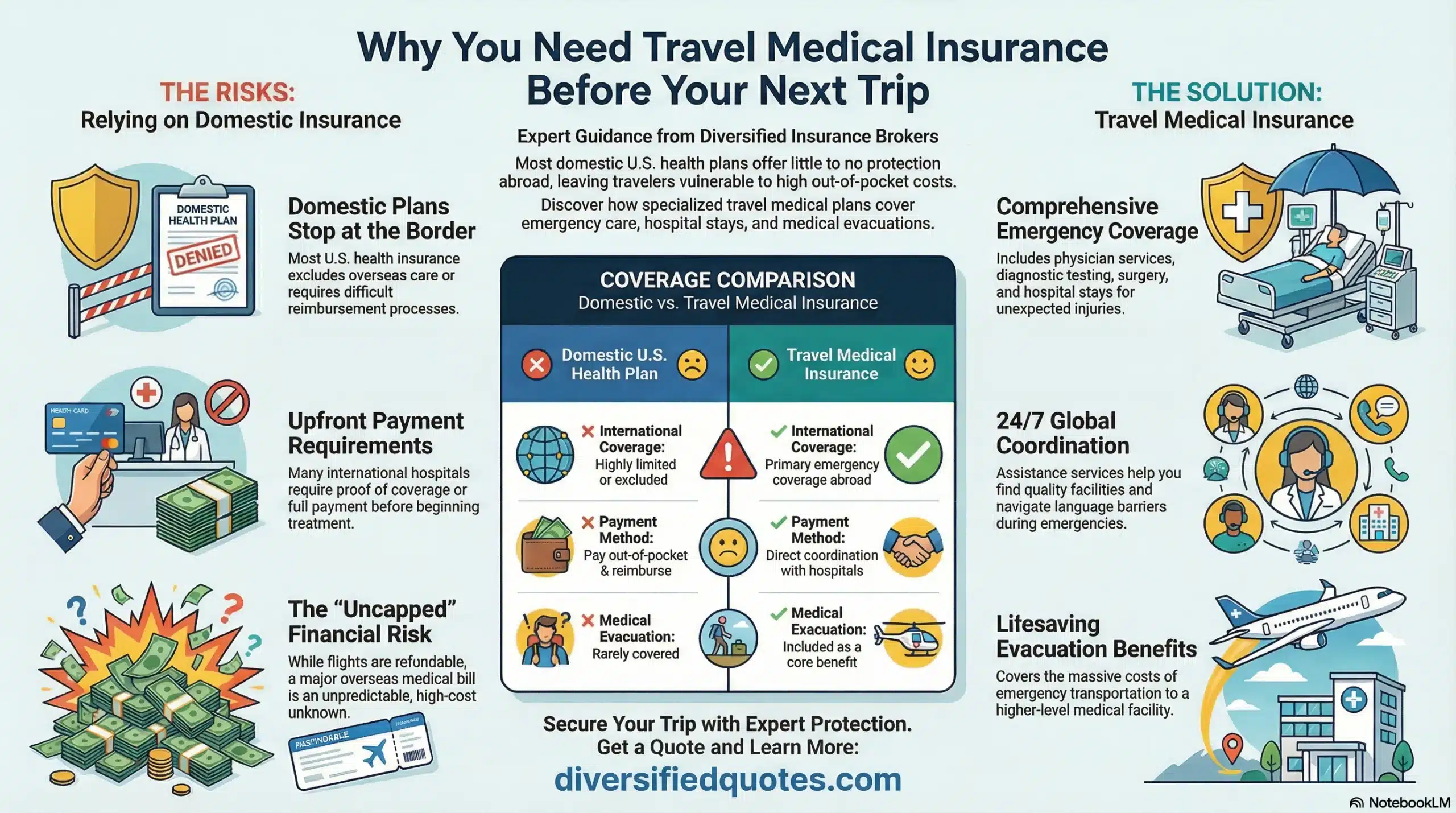
Talk With an Advisor Today
Choose how you’d like to connect—call or message us, then book a time that works for you.
Schedule here:
calendly.com/jason-dibcompanies/diversified-quotes
Licensed in all 50 states • Fiduciary, family-owned since 1980
Frequently Asked Questions: Travel Medical and Evacuation Insurance for East Timor
Where would a serious medical evacuation from East Timor typically go?
Darwin, Australia receives the large majority of serious medical evacuations from Timor-Leste. Royal Darwin Hospital is approximately 90 minutes by air charter from Presidente Nicolau Lobato International Airport in Dili — close enough that an early-morning cardiac event in Dili can reach Darwin’s emergency department before noon if the assistance team can execute the charter arrangement without delay. Royal Darwin Hospital has accumulated decades of experience with Timorese patients across trauma, cardiac events, infectious disease, neurosurgical cases, and obstetric emergencies — it functions as Timor-Leste’s de facto tertiary care facility in all but name. Bali serves as an alternative primary destination for cases where clinical condition, logistics, or multi-country itinerary context makes Indonesia more appropriate than Australia. For the highest-complexity events requiring European or North American tertiary subspecialty care, onward routing from Darwin is possible after initial stabilization. The specific routing for any case is determined by the assistance team’s real-time assessment of clinical condition, required specialty, available charter aircraft, and receiving facility acceptance.
What can Guido Valadares National Hospital in Dili actually handle?
Guido Valadares National Hospital provides the best available medical care in Timor-Leste and handles a large volume of emergency presentations across Dili and the surrounding districts. It performs basic surgery including appendectomy, fracture stabilization, and obstetric procedures; provides emergency stabilization for trauma, cardiac events, and acute medical illness; has diagnostic imaging including X-ray and basic ultrasound; and has a blood bank and basic laboratory services. What it consistently cannot deliver for serious events is the depth of specialist response that complex cases require: interventional cardiology for STEMI presentations, neurosurgical capability for significant traumatic brain injury or spinal cord injury, advanced trauma surgery for complex internal injuries, specialist ICU management for multi-system failure, and oncological or transplant-related care. The International SOS clinic in Dili provides better initial primary and urgent care for international visitors than the national hospital, but faces the same specialist depth limitations for serious events. For travelers, the practical consequence is that Guido Valadares is the right first stop for stabilization and initial assessment, and the Darwin evacuation is the realistic next step for any event that falls into the categories above.
I’m diving on Atauro Island. What coverage do I specifically need in place?
Four non-negotiable items for Atauro Island diving. First, confirm scuba diving is explicitly listed as a covered activity in the specific plan — do not assume general language covers it. Second, confirm decompression illness treatment is covered under emergency medical or evacuation provisions, because hyperbaric recompression is the specific and expensive treatment required and not all plans cover it explicitly. Third, there is no hyperbaric chamber in Timor-Leste — the nearest are at Royal Darwin Hospital in Australia and at Bali’s clinics — so the evacuation chain for a decompression incident runs boat-to-Dili (45–90 minutes depending on sea conditions and vessel), Guido Valadares for initial stabilization, and air charter to Darwin or Bali for hyperbaric treatment. Confirm the assistance team has an established protocol for this exact chain before you enter the water. Fourth, carry maximum evacuation limits — the full chain from Atauro decompression incident to Darwin hyperbaric treatment can cost USD 30,000–60,000 in transport alone before treatment begins, and a low evacuation limit turns a coverable event into a financial catastrophe.
What coverage limits should I carry for East Timor travel?
For Dili-concentrated stays, emergency medical limits of $100,000 or more with evacuation limits of $250,000 or more are a reasonable baseline. For itineraries that include Atauro Island diving, highland interior travel, south coast exploration, or any movement that puts you more than two hours from Dili, evacuation limits of $500,000 or more better reflect the realistic cost of the multi-leg transport chains that serious events in these locations require. The south coast and far east are among the most logistics-intensive evacuation environments in Southeast Asia for accessible destinations, and a $150,000 evacuation limit that might be adequate for a straightforward Dili-to-Darwin air charter can be exhausted before treatment begins when the chain includes ground transport from a remote location to an airstrip, air charter to Dili for stabilization, and then a second international air charter to Darwin. For NGO deployments and extended assignments, the upper end of those ranges reflects the extended time at risk and the field deployment scenarios where the full evacuation chain is most likely to be activated.
What specific health risks should East Timor travelers prepare for?
Malaria is present in Timor-Leste, particularly below 1,500 meters elevation including coastal areas and the country’s lowland districts — chemoprophylaxis and consistent insect precautions are standard pre-travel preparation, and severe malaria can progress to a life-threatening emergency requiring ICU-level management that is not reliably available in Timor-Leste. Dengue fever transmission is year-round with seasonal peaks during the wet season from November to April, when accumulated rainfall creates breeding conditions across Dili and lowland areas. Typhoid, hepatitis A and B, rabies risk from stray animal contact, and gastrointestinal illness from food and water exposure are all relevant travel health risks requiring vaccination and behavioral preparation. Heat illness is a genuine risk during the dry season (May–October) in lowland areas, and altitude-related considerations apply in the highland coffee-farming regions above 1,500 meters for travelers with cardiac history. Road traffic accidents — particularly motorbike incidents — are the most statistically frequent mechanism for serious injury across all traveler categories in Timor-Leste, and the road surface quality, terrain steepness, and wet season conditions in the interior and south coast create accident rates that experienced Southeast Asia travelers consistently note as among the highest in the region.
Does riding a motorbike in East Timor affect my coverage?
Motorbike operation by the insured is treated differently across travel medical plans — some cover it without restriction, some require a valid motorcycle license, some restrict coverage to engine sizes below a certain threshold, and some exclude motorized vehicle operation by the insured entirely. The distinction between being a passenger on a motorbike taxi versus operating a rented motorbike yourself also matters under some plan definitions. For Timor-Leste specifically, this is not a theoretical concern: motorbike travel is how most independent travelers access the highland interior, south coast, and areas off the main road network, and motorbike accidents are the most common serious injury mechanism in the country. The pre-departure verification step is unambiguous — confirm the plan’s treatment of motorbike operation before you rent the bike, not after the accident. If the plan excludes it and you want motorbike access for your Timor-Leste itinerary, select a plan that covers it rather than assuming it will be fine. A serious motorbike accident producing internal injuries or head trauma in the Ermera highlands, where the nearest stabilization is 2–3 hours by road, under a plan that excludes the activity is a financially catastrophic outcome that is entirely preventable at the plan selection stage.
What is the correct emergency response sequence for a serious event in East Timor?
Seek immediate care at the nearest available facility first — in Dili, that means Guido Valadares National Hospital or the International SOS clinic; outside Dili, the nearest district hospital or health post for initial stabilization while the evacuation chain is simultaneously initiated. Contact the plan’s 24/7 assistance team as early as possible after initial stabilization — for events in remote locations, initiate the assistance team contact while still in the field rather than waiting until you reach a facility, because the assistance team’s air charter arrangement needs maximum lead time. For Atauro diving incidents, the assistance team contact should happen simultaneously with the boat departure from Atauro — the two processes run in parallel, not sequentially. Store the assistance team’s 24/7 contact number offline in phone contacts and on a physical card with the passport, and share it with a home contact outside Timor-Leste before departure. For NGO and organizational deployments, brief the team leader and a designated backup contact on the assistance team number and the authorization process before the assignment begins — emergency coordination decisions made by people who have never seen the plan documentation under time pressure consistently produce worse outcomes than pre-established protocols.
About the Author:
Jason Stolz, CLTC, CRPC, DIA, CAA and Chief Underwriter at Diversified Insurance Brokers (NPN 20471358), is a senior insurance and retirement professional with more than 25 years of real-world experience helping individuals, families, and business owners protect their income, assets, and long-term financial stability. As a long-time partner of the nationally licensed independent agency Diversified Insurance Brokers, Jason provides trusted guidance across multiple specialties—including fixed and indexed annuities, long-term care planning, personal and business disability insurance, life insurance solutions, Group Health, Travel Medical and Evacuation Insurance, and short-term health coverage. Diversified Insurance Brokers maintains active contracts with over 100 highly rated insurance carriers, ensuring clients have access to a broad and competitive marketplace.
His practical, education-first approach has earned recognition in publications such as VoyageATL, and contributions from his agency featured in Kiplinger and GoBankingRates— highlighting his commitment to financial clarity and client-focused planning. Drawing on deep product knowledge and years of hands-on field experience, Jason helps clients evaluate carriers, compare strategies, and build retirement and protection plans that are both secure and cost-efficient. Visitors who want to explore current annuity rates and compare options across multiple insurers can also use this annuity quote and comparison tool.
Explore More Travel Medical Insurance Options: Browse our complete guide to Africa & Middle East Travel Medical Insurance — covering medical evacuation coverage for Africa, Middle East & high risk destinations.
Last Reviewed: August 28, 2026 |
Reviewed by: Jason Stolz, CLTC, CRPC, DIA, CAA
Chief Underwriter, Diversified Insurance Brokers, Inc. | NPN: 20471358 | Diversified Insurance Brokers, Inc. — Licensed in all 50 states
Fact Checked by: Tonia Pettitt, CMIP©
Medicare Specialist, Diversified Insurance Brokers, Inc. | NPN: 14374308 | Diversified Insurance Brokers, Inc. — Licensed in all 50 states
Did you find this content helpful? Leave us a Google review — it helps others find trustworthy guidance too.
Editorial Standards: Diversified Insurance Brokers maintains rigorous editorial standards to ensure accuracy, clarity, and independence in all content. Learn more about our editorial standards and commitment to transparency.
