
Travel and Medical Insurance for High Risk Travel
Travel and Medical Insurance for High Risk Travel

Jason Stolz CLTC, CRPC, DIA, CAA
Travel and medical insurance for high-risk travel is built for trips where standard travel insurance leaves meaningful gaps that only become apparent at the worst possible moment. If you are traveling to a remote region, an area with limited hospital resources, a destination where access to quality care can change quickly based on geography or infrastructure, or an environment where political instability or natural disaster risk elevates the probability of a disruptive event, the consequences of inadequate coverage are not inconvenience — they are the cost of urgent medical treatment in an unfamiliar system, the complexity of coordinating care across language and logistical barriers, and the financial impact of emergency evacuation when local treatment facilities cannot handle the condition you are facing.
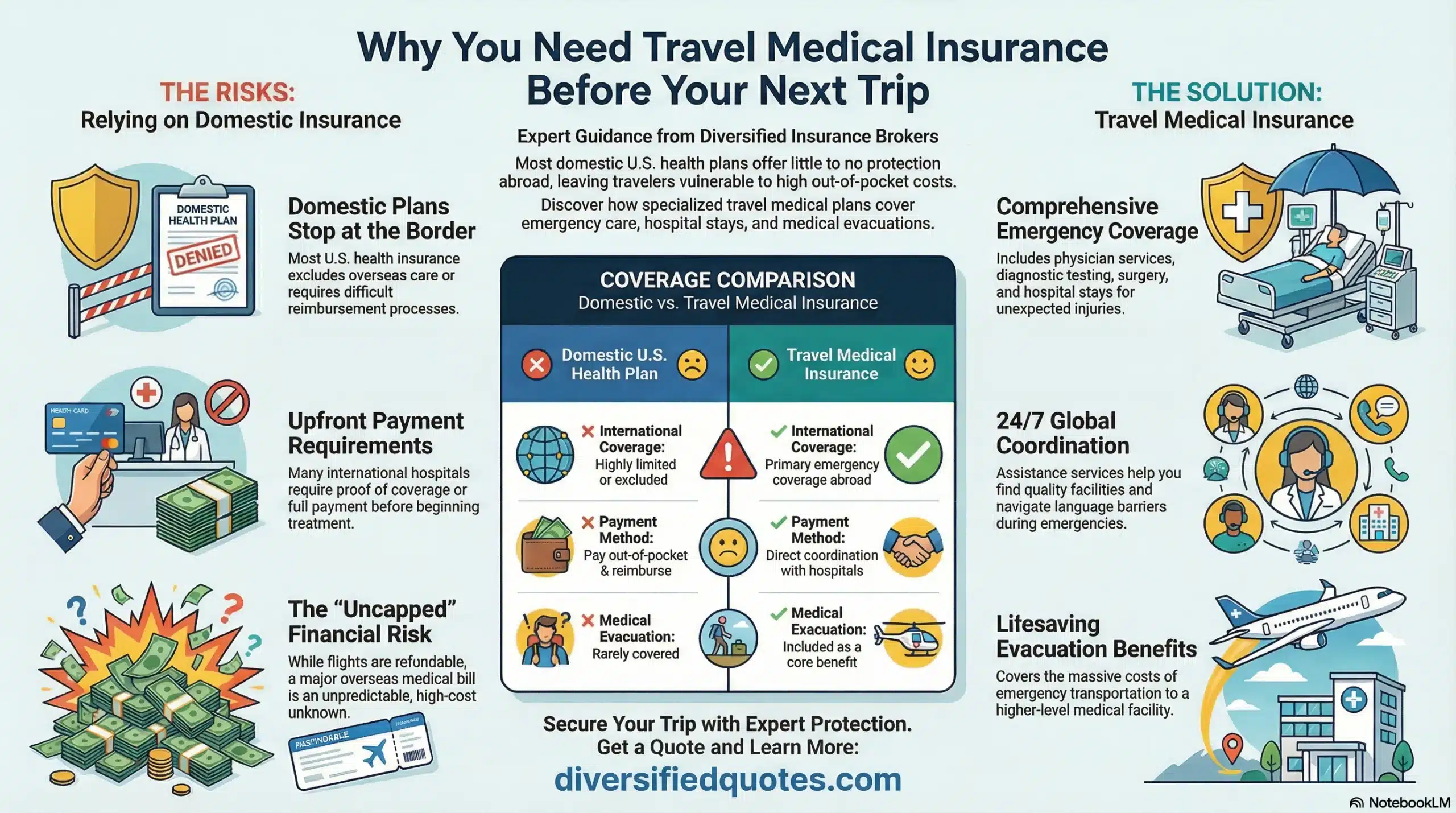
At Diversified Insurance Brokers, we help travelers secure travel medical coverage designed for real-world emergencies rather than optimistic scenarios. When you are far from home in a challenging environment, the most important protection is the type that responds to hospital bills, specialist treatment, emergency procedures, and the logistics of getting you to the right facility if your current location cannot handle the situation — not just the type that covers your luggage or reimburses a cancelled flight. Many travelers assume high-risk travel only applies to extreme sports enthusiasts or journalists in active conflict zones, but the reality is considerably broader. A trip can become higher risk simply because the closest advanced hospital is hours away, local providers require upfront payment before treatment begins, language barriers slow the coordination of care, or the destination has limited medical infrastructure that makes even a straightforward emergency more complicated to resolve. Even a healthy traveler with no pre-existing conditions and no high-risk activities planned can encounter a crisis abroad that becomes expensive, logistically difficult, and financially damaging without the right insurance structure in place before departure. High-risk travel insurance covers the specialized coverage options and carrier designs for travelers whose destinations or activities require protection beyond what standard travel plans provide. What is the primary reason people buy travel medical insurance covers the core risk calculation that drives the purchase decision across different trip types, destinations, and traveler profiles.
High-Risk Travel Medical Insurance
Get coverage designed for higher-risk destinations, medical needs, and emergency evacuation.
What Makes Travel High Risk?
Insurance carriers and travel medical underwriters generally consider travel higher risk when it involves limited healthcare access, locations with fewer or lower-quality medical resources, extended stays abroad that increase cumulative exposure to unexpected events, or destinations where reaching a modern hospital capable of treating complex injuries and illnesses may require significant ground transport or flight coordination. Some trips are labeled high risk because of specific geopolitical concerns — active conflict zones, regions under travel advisories, areas experiencing civil unrest or infrastructure breakdown — but many more are considered higher risk simply because emergency care is less accessible, slower to reach, or less equipped for the full range of medical situations that can develop from an initial acute event.
High-risk travel is also common for travelers who will be far from major urban centers, staying for extended periods in remote or rural areas, working abroad for an employer with international operations, volunteering with humanitarian organizations in underserved regions, or spending time in areas where medical standards, facility capabilities, and provider payment expectations can vary significantly from what the traveler is accustomed to at home. In those scenarios, insurance is not a comfort item or an administrative formality — it is the mechanism that determines whether a medical emergency results in appropriate care at a manageable financial cost, or in a combination of delayed treatment, inappropriate care, and financially catastrophic out-of-pocket costs. The risk in high-risk travel is often not the medical event itself but the chain reaction that follows it: hospital admission that requires a deposit before treatment begins, care decisions delayed while providers attempt to validate coverage, evacuation that cannot be self-coordinated during an active emergency, and post-event financial damage that extends well beyond the medical bills into lost income, flight changes, and extended recovery abroad. Emergency travel health insurance covers the emergency-first coverage design that addresses the most acute financial and logistical consequences of a serious health event abroad.
High-Risk Travel: Standard Plan Gaps vs. Specialized Coverage
| Coverage Feature | Standard Travel Plan | High-Risk Travel Medical Plan | Why It Matters in High-Risk Environments |
|---|---|---|---|
| Medical limits | Often lower — may be adequate for minor events but insufficient for complex inpatient care, surgery, or specialist treatment | Higher limits — designed to absorb the full cost of a serious medical event including hospitalization, surgery, and specialist care | A single serious event abroad can generate costs that exceed standard plan limits — inadequate limits leave the traveler personally liable for the remainder |
| Evacuation coverage | Often limited — may cover only transport to “nearest adequate facility” regardless of whether it can provide appropriate care | Comprehensive — covers transport to the most appropriate facility, including cross-border transport and repatriation when necessary | In remote or low-resource destinations, the nearest facility may be inadequate — “nearest” vs. “most appropriate” is a critical policy language distinction |
| Coordination assistance | Minimal or reimbursement-only — traveler arranges care, pays upfront, submits claim afterward | Real-time coordination — assistance teams locate providers, arrange transport, communicate with facilities, and manage the logistics of the emergency | High-risk travelers cannot coordinate a medical evacuation alone during an active emergency — real-time assistance is the difference between organized response and crisis |
| Geographic restrictions | May exclude specific regions, countries under travel advisories, or destinations flagged for political instability | Broader geographic scope — designed to cover destinations where standard plans restrict or exclude coverage | Many high-risk destinations are excluded under standard plan geographic restrictions — confirming destination coverage before departure is essential |
| Activity coverage | May exclude recreational and transportation activities common in high-risk destinations — motorbikes, off-road vehicles, adventure activities | Broader activity coverage — includes or allows endorsements for activities typical of high-risk travel environments | Activity exclusions in standard plans frequently cover things that are ordinary transportation or recreation in high-risk destinations, not specialized extreme sports |
| Pre-existing condition treatment | Often broadly excluded — any care related to pre-existing conditions may be denied regardless of how stable the condition was before travel | Varies by plan — some provide acute-flare coverage for stable pre-existing conditions; careful review of specific policy language required | In high-risk environments, a pre-existing condition flare-up in the wrong location can be expensive — confirming exact pre-existing condition language before purchase is critical |
Why Standard Travel Insurance Often Falls Short for High-Risk Travel
Many standard travel insurance plans are designed primarily around trip interruptions, flight delays, trip cancellation, and baggage loss — the category of travel problems that are inconvenient and financially disruptive but not life-threatening. Those benefits can still be useful, but in high-risk travel scenarios, the dominant financial exposure is medical and evacuation — not the cost of a cancelled flight or a delayed bag. The structural problem is that basic travel policies carry lower medical limits calibrated for routine medical events in destination countries with accessible and affordable care, evacuation language that focuses on the nearest facility rather than the most appropriate facility, and geographic exclusions that may apply precisely to the high-risk destinations the traveler is entering.
When you are traveling in a high-risk setting, the medical coverage structure should be the centerpiece of the plan rather than an ancillary feature alongside trip cancellation. A single emergency room visit in the wrong location can cascade into specialist evaluation, diagnostic imaging, inpatient hospitalization, surgical intervention, medication costs, extended recovery care, and follow-up treatment — all before evacuation logistics are even considered. The evacuation dimension, when it becomes necessary, can independently generate costs that exceed the entire medical coverage limit of a standard travel plan — because evacuation involves not just transport but medical staff, equipment, international clearances, receiving facility coordination, and the logistical complexity of moving a patient across borders under time pressure. These are the scenarios that high-risk travel medical insurance is designed to absorb, and the scenarios where a standard plan’s apparent adequacy evaporates in the first hours of an actual emergency. Travel medical insurance covers the full range of emergency-focused travel medical coverage options for international travelers across different risk profiles and destination types. International health insurance covers how longer-term international medical coverage is structured for travelers or expats who need benefits closer to a comprehensive health plan than emergency-only travel coverage.
Emergency Medical Evacuation: The Foundation of High-Risk Travel Coverage
For many higher-risk trips, emergency medical evacuation is the benefit that most separates adequate coverage from inadequate coverage — because in certain environments, the medical issue is not whether care exists but whether the care that exists is appropriate for the condition being treated. A traveler might need evacuation because the local facility can stabilize an acute event but cannot perform the surgery required to treat the underlying condition, cannot safely manage the complications that have developed, lacks the equipment and staff needed for the specific intervention required, or is operating in an environment where sanitation, supply, or staffing constraints introduce risks that the traveler’s medical situation cannot absorb. In each of these scenarios, the traveler’s survival and recovery outcome may depend directly on the speed and quality of the evacuation response — and evacuation coverage is what makes that response organizationally and financially possible.
Evacuation is expensive for reasons that are not immediately obvious to travelers who have never needed it. It is not simply a long-distance flight — it involves medical staff qualified to manage the patient’s condition during transport, specialized aircraft or ground vehicles with medical equipment, international regulatory clearances, advance coordination with the receiving facility to confirm capacity and capability, and logistics that must be executed under time pressure without the benefit of advance planning. The aggregate cost of a properly executed medical evacuation can reach tens to hundreds of thousands of dollars depending on the distance, the patient’s condition, the origin and destination countries, and the transport modality required. A plan that provides strong routine medical coverage but inadequate evacuation limits leaves the traveler financially exposed at precisely the moment when financial exposure is most dangerous — when the decision must be made and cannot be deferred. Emergency medical evacuation insurance covers evacuation coverage mechanics, trigger conditions, coordination processes, and limit adequacy in detail for travelers evaluating whether their evacuation protection matches their destination risk profile. Emergency travel medical insurance for US citizens covers the specific coverage considerations for American travelers whose domestic plans typically provide no meaningful international emergency coverage.
Pre-Existing Conditions and High-Risk Travel Insurance
Pre-existing condition exclusion language is one of the most consequential differences between travel medical plans and one that matters disproportionately in high-risk travel because the elevated medical exposure of challenging environments means that any gap in pre-existing condition coverage can generate large out-of-pocket costs. Some travel medical plans exclude pre-existing conditions entirely under all circumstances — meaning any care that is in any way related to a condition that existed before the trip, regardless of how stable or well-managed it was, will be denied at claim time. Other plans provide limited protection for an acute and unexpected flare-up of a stable pre-existing condition, defining stability through a lookback window of typically 90 to 180 days during which the condition required no new treatment, medication changes, or unscheduled medical attention.
The gap between these two approaches can represent the entire claim value for a traveler with a chronic condition who experiences an acute exacerbation abroad. A traveler with well-controlled hypertension, diabetes, a history of cardiac events, or respiratory conditions who enters a high-risk environment without confirming exactly how their plan treats pre-existing condition care may discover at claim time that the benefits they believed were in place were excluded by the specific language of the plan they purchased. The correct planning approach is not selecting the plan with the highest benefit limits and assuming pre-existing condition coverage is included — it is reading the exact policy language for pre-existing condition definitions, stability requirements, and coverage provisions, and confirming that the language accurately describes the coverage you will have for your specific medical history at your specific destinations. How to get the best travel medical insurance rates covers the comparison methodology that produces the most appropriate coverage for any given health profile, destination set, and trip duration. How to get travel medical insurance last minute covers options available when coverage needs arise close to departure — a practical scenario for travelers whose plans change quickly. Emergency travel health insurance for foreign nationals covers the coverage options for non-US citizens traveling internationally who need emergency medical protection abroad. International travel health coverage covers the full spectrum of international medical protection options across different duration, benefit structure, and risk profiles.
How Claims Work in High-Risk Travel Scenarios
In an emergency abroad in a high-risk environment, the immediate priority is getting care, not managing paperwork — and the value of a well-designed travel medical plan is most visible in how quickly and effectively the assistance infrastructure responds to that priority. The difference between coordinated assistance and reimbursement-only structures is most significant in high-risk scenarios because the organizational complexity of finding an appropriate provider, arranging transport, communicating across language barriers, and managing insurance authorization with a foreign facility is beyond what most travelers can accomplish alone during an active emergency. Plans that provide real-time assistance coordination — where the insurer’s operations center actively manages the situation rather than simply promising to reimburse costs that the traveler arranges independently — are structurally superior for high-risk travel even when the benefit limits appear equivalent on paper.
For less severe medical events, the traveler may pay out of pocket and submit a reimbursement claim with documentation — medical records, receipts, treatment summaries, and physician notes that support the claim. For more severe medical events involving inpatient hospitalization, surgical intervention, or evacuation, coordination and prior authorization from the insurer’s assistance team can become central to both the medical outcome and the financial outcome. Hospitals in high-risk destinations may require documented proof of coverage, advance payment deposits, or direct billing arrangements before proceeding with certain treatments — situations where the insurer’s assistance team can directly contact the facility, confirm coverage, and arrange direct payment, removing the traveler from a negotiation that they are ill-positioned to conduct alone under medical duress. Life insurance for foreign travel and residency covers the life insurance considerations for travelers and expats whose extended international presence affects policy portability and beneficiary planning. Business travel accident insurance covers the accident coverage that addresses travel-related injury risk for business travelers making frequent international trips to elevated-risk destinations.
Why the Right Coverage Must Be Selected Before Departure
High-risk travel requires proactive planning because coverage gaps cannot be corrected after the trip begins. Once an emergency happens abroad, it is not possible to retroactively add evacuation benefits that were not in the original plan, increase medical limits that were set too low at purchase, or adjust geographic restrictions that excluded the specific destination where the emergency occurred. The window for correcting these decisions closes at the moment of departure — or more precisely, at the moment of the first medical event, because many plans exclude conditions that arise after departure from any amendments or upgrades attempted mid-trip. Selecting the correct plan before departure while full options are available is the only mechanism the traveler has to ensure that the coverage they believe they have is actually the coverage that will respond when it matters.
The practical consequence of this irreversibility is that the traveler who spends fifteen minutes comparing plans on a generic aggregator and selecting the lowest-cost option has effectively locked in their risk exposure for the duration of the trip — including all of the scenarios they did not read the exclusions for, all of the activity restrictions they did not confirm, and all of the evacuation limit inadequacies they did not evaluate against the actual cost of evacuation from their specific destinations. The traveler who takes the time to review plan language, confirm destination coverage, evaluate evacuation limits against realistic cost scenarios, and verify pre-existing condition treatment for their specific medical history has made decisions that will determine the actual financial protection available during a real emergency. The cost difference between the lowest-cost generic plan and the appropriately designed high-risk plan is typically modest compared to the cost of a single serious event — and the difference in protection delivered at claim time can be the difference between a manageable emergency and a financially catastrophic one. Cheap travel insurance covers cost-forward coverage options for travelers where budget is a primary driver, with guidance on where cost reduction is appropriate and where it creates critical gaps. International health insurance covers the longer-term international medical coverage option for travelers whose high-risk travel has evolved into extended international residence requiring comprehensive ongoing medical benefits.
Explore High-Risk Travel Medical Insurance
Compare medical and evacuation coverage options built for higher-risk travel situations.
Related Pages
Explore more travel medical and evacuation coverage options. These pages help you compare plan types, coverage limits, and destination-specific needs before you travel.
Talk With an Advisor Today
Choose how you’d like to connect—call or message us, then book a time that works for you.
Schedule here:
calendly.com/jason-dibcompanies/diversified-quotes
Licensed in all 50 states • Fiduciary, family-owned since 1980
Frequently Asked Questions: Travel and Medical Insurance for High-Risk Travel
What qualifies as high-risk travel from an insurance perspective?
From an insurance underwriting perspective, travel is generally considered higher risk when it involves destinations with limited hospital infrastructure, areas where reaching advanced care requires significant transport, locations under active travel advisories or political instability, extended stays that increase cumulative exposure, or environments where the quality and availability of medical care varies significantly from destination to destination. High-risk travel is not limited to extreme sports or conflict zones — a trip to a rural area, a remote island, a mountainous region, or a developing-market country with limited hospital access can qualify as higher risk even when the traveler’s activities are entirely ordinary. The risk is defined by the environment and the medical access limitations of the destination, not solely by what the traveler is doing there.
Why is evacuation coverage particularly important for high-risk travel?
Emergency medical evacuation is often the benefit that most directly determines the outcome of a serious medical event in a high-risk destination. In environments where the nearest hospital is technically capable of stabilizing an acute event but lacks the surgical capability, staffing, or equipment needed for definitive treatment, evacuation to a more appropriate facility may be the only path to a good medical outcome. Evacuation is expensive — involving medical staff, specialized aircraft or vehicles, international regulatory clearances, receiving facility coordination, and logistics executed under time pressure — with costs routinely reaching tens to hundreds of thousands of dollars. A plan that covers routine medical care but has inadequate evacuation limits leaves the traveler financially exposed at exactly the moment when the stakes are highest and the decision cannot be deferred.
What is the difference between “nearest adequate facility” and “most appropriate facility” in evacuation coverage?
This distinction in evacuation policy language is one of the most consequential differences between standard travel plans and high-risk travel medical plans. “Nearest adequate facility” language authorizes evacuation only to the closest hospital that meets a minimum adequacy threshold — which in a high-risk destination may be a facility that can stabilize the patient but cannot provide the specialized treatment the condition requires. “Most appropriate facility” language authorizes evacuation to the facility that can best treat the specific condition, which may require bypassing the nearest facility for a more distant but more capable one. For travelers in high-risk destinations where the nearest facility is limited in its capabilities, the difference between these two phrases can determine whether the evacuation actually results in appropriate care or simply relocates the patient to a marginally better facility that still cannot provide what the condition requires.
How do pre-existing conditions affect high-risk travel insurance coverage?
Pre-existing condition treatment is one of the most significant variables between travel medical plans and one that requires careful review before purchasing for high-risk travel. Some plans exclude all care related to pre-existing conditions regardless of how stable or well-managed the condition was before travel. Others provide limited coverage for an acute and unexpected flare-up of a condition that was medically stable during a defined lookback period — typically 90 to 180 days without new treatment, medication changes, or unscheduled medical attention. In high-risk environments, the cost of a pre-existing condition event can be substantial — making the difference between broad exclusion and acute-flare coverage financially significant. Confirming the exact pre-existing condition language, stability requirements, and coverage provisions of any plan before purchase is essential for travelers with chronic conditions or medical history that could create coverage ambiguity during a claim.
Can I purchase high-risk travel medical insurance if my destination is under a travel advisory?
Some travel medical plans include geographic restrictions or exclusions that apply to destinations under specific levels of government travel advisory. The coverage availability depends on the specific plan, the carrier, the advisory level for the destination, and the nature of the risk that triggered the advisory. Plans specifically designed for high-risk travel often have broader geographic coverage and fewer advisory-based exclusions than standard travel plans — which is part of what differentiates them. The critical step is confirming destination coverage explicitly before purchasing any plan for a trip to a destination that may be subject to travel advisories, rather than assuming coverage applies based on the plan’s general description. Coverage gaps discovered after a medical event in an excluded destination cannot be corrected retroactively.
About the Author:
Jason Stolz, CLTC, CRPC, DIA, CAA and Chief Underwriter at Diversified Insurance Brokers (NPN 20471358), is a senior insurance and retirement professional with more than 25 years of real-world experience helping individuals, families, and business owners protect their income, assets, and long-term financial stability. As a long-time partner of the nationally licensed independent agency Diversified Insurance Brokers, Jason provides trusted guidance across multiple specialties—including fixed and indexed annuities, long-term care planning, personal and business disability insurance, life insurance solutions, Group Health, Travel Medical and Evacuation Insurance, and short-term health coverage. Diversified Insurance Brokers maintains active contracts with over 100 highly rated insurance carriers, ensuring clients have access to a broad and competitive marketplace.
His practical, education-first approach has earned recognition in publications such as VoyageATL, and contributions from his agency featured in Kiplinger and GoBankingRates— highlighting his commitment to financial clarity and client-focused planning. Drawing on deep product knowledge and years of hands-on field experience, Jason helps clients evaluate carriers, compare strategies, and build retirement and protection plans that are both secure and cost-efficient. Visitors who want to explore current annuity rates and compare options across multiple insurers can also use this annuity quote and comparison tool.
Explore More Travel Medical Insurance Options: Browse our complete guide to Travel Insurance Planning & Education — covering how it works, costs, last minute coverage, high risk travel & buying guides.
Explore More: Browse our complete Travel Medical Insurance guide — covering international health coverage, medical evacuation & trip protection plans from 100+ carriers.
Last Reviewed: June 17, 2026 |
Reviewed by: Jason Stolz, CLTC, CRPC, DIA, CAA
Chief Underwriter, Diversified Insurance Brokers, Inc. | NPN: 20471358 | Diversified Insurance Brokers, Inc. — Licensed in all 50 states
Fact Checked by: Tonia Pettitt, CMIP©
Medicare Specialist, Diversified Insurance Brokers, Inc. | NPN: 14374308 | Diversified Insurance Brokers, Inc. — Licensed in all 50 states
Did you find this content helpful? Leave us a Google review — it helps others find trustworthy guidance too.
Editorial Standards: Diversified Insurance Brokers maintains rigorous editorial standards to ensure accuracy, clarity, and independence in all content. Learn more about our editorial standards and commitment to transparency.
