
Emergency Travel Heath Insurance for US Citizens
Emergency Travel Health Insurance for US Citizens

Jason Stolz CLTC, CRPC, DIA, CAA
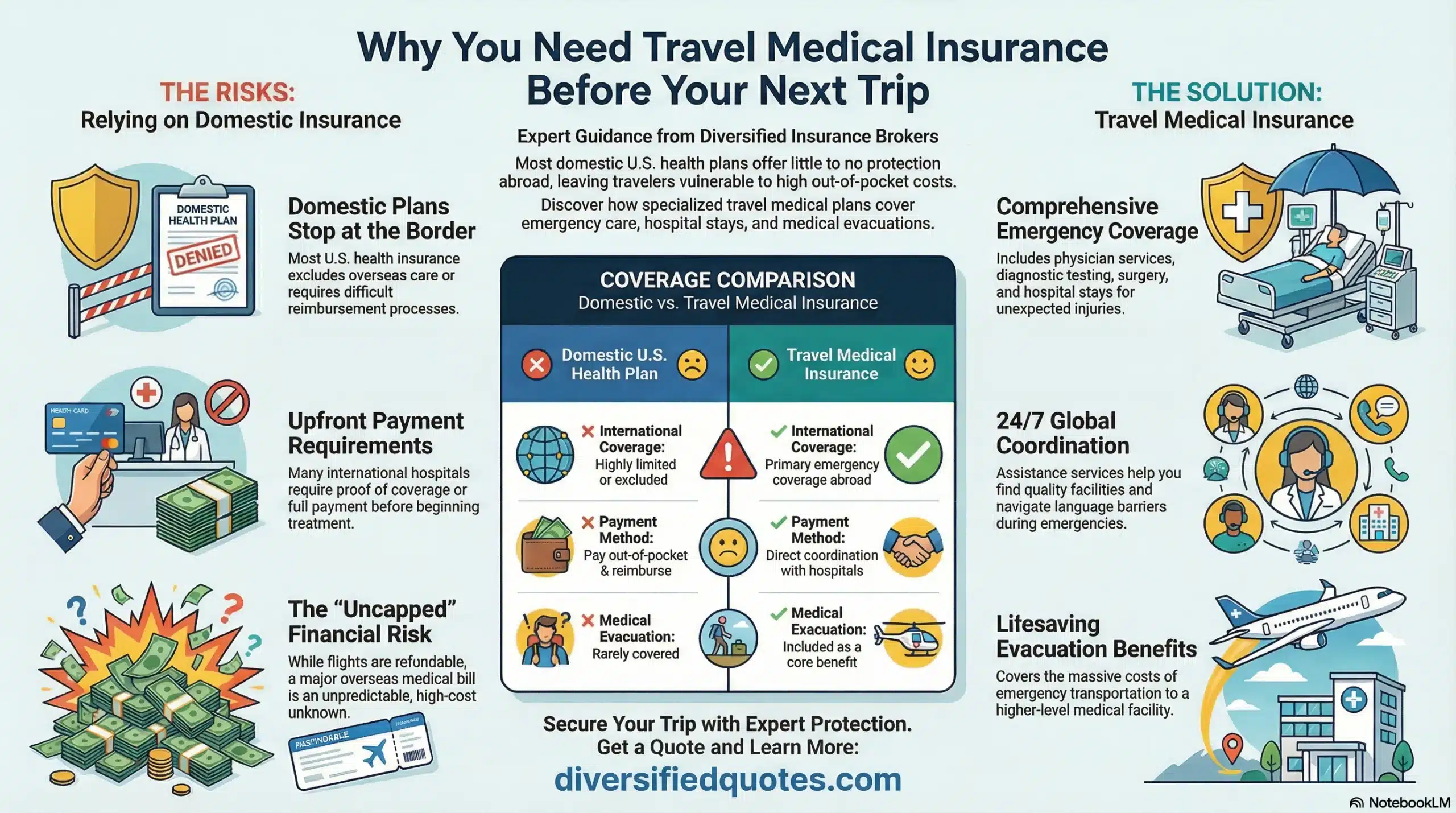
At Diversified Insurance Brokers, we help U.S. travelers secure emergency travel health insurance that provides meaningful protection beyond domestic health coverage once you leave the United States. Even short international trips can expose travelers to costly medical bills, limited provider access, unfamiliar healthcare systems, and serious logistical complications when care is needed in an emergency. A purpose-built emergency travel medical policy addresses the specific realities of international medical events — urgent treatment abroad, emergency medical evacuation coordination, and repatriation benefits that most domestic health plans do not include and are not designed to provide.
For most U.S. travelers, the most significant financial and logistical risk of international travel is not a routine physician visit — it is a situation that escalates rapidly. An injury requiring imaging and specialist evaluation. A hospitalization after an infection that does not respond to initial treatment. A medical complication requiring transfer to a facility with capabilities that the nearest local hospital cannot provide. A scenario where the “nearest appropriate facility” is in a different city or a neighboring country. These are not exotic scenarios limited to remote travel — they occur in major tourist destinations and business travel hubs regularly, and the financial and logistical consequences for an uninsured or underinsured traveler can be severe and immediate. Travel medical coverage is most effectively treated as part of the trip planning process rather than an optional afterthought decided at the last moment.
For a broader framework of travel medical plan structures and how coverage works across different destination types, our overview on international travel health coverage provides useful context. If your itinerary includes remote locations, limited local infrastructure, or activity profiles that increase medical and evacuation exposure, reviewing high-risk travel insurance helps you understand how plan wording and benefit structure differ when risk is elevated.
Get Emergency Travel Health Coverage
Fast, secure online quote and enrollment for U.S. travelers heading abroad.
Start Your QuoteWhat Emergency Travel Health Insurance Typically Covers
Emergency travel health insurance is specifically designed to help U.S. travelers manage the medical and logistical realities of an unexpected illness or injury overseas. Rather than relying on domestic health coverage that may reimburse overseas care poorly, subject to complex out-of-network rules, or not at all for certain benefit categories, travel medical coverage provides a benefit structure and an assistance infrastructure built specifically for international medical emergencies. For many travelers, the assistance framework is as valuable as the financial benefit — because the assistance team’s ability to identify appropriate facilities, coordinate care authorization, and manage transfer logistics in real time during a stressful event can determine whether the outcome is manageable or chaotic.
Typical benefits include emergency physician and specialist services, urgent care, emergency room evaluation and treatment, inpatient hospital care when medically necessary, outpatient diagnostic testing including laboratory work and imaging when clinically indicated, and prescription medications directly related to a covered condition. Many plans include medically necessary evacuation and repatriation benefits for situations where local care is insufficient — though those benefits carry important coordination requirements that travelers need to understand before departure. Our guide to Emergency Medical Evacuation Insurance explains in detail how evacuation is triggered, why coordination through the assistance provider is required, and what “medically necessary” means in the context of evacuation approval.
Some plans include limited trip interruption benefits tied to a covered medical event that may help with costs of returning home early when medically appropriate — but for most U.S. citizens traveling internationally, the primary financial protection value is emergency medical care, meaningful evacuation coverage, and a reliable 24/7 assistance team that can guide decisions under pressure in an unfamiliar system.
Want Us to Confirm the Plan Fits Your Trip?
Send your travel dates, destinations, ages, and activity profile and we’ll point you to a plan structure that avoids common gaps.
Request a Coverage CheckWho This Coverage Is Best For
Emergency travel health insurance is appropriate for U.S. citizens traveling internationally for any purpose — leisure travel, business trips, study abroad programs, visiting family residing overseas, mission and volunteer trips, cruises that include international ports of call, or itineraries that include remote or higher-risk regions. It is particularly important for travelers whose domestic health plans have limited or no overseas benefits, high out-of-network cost-sharing that would apply to foreign providers, no emergency evacuation coverage, or reimbursement-only structures that require paying large sums upfront and then submitting claims — a process that can be logistically complex and financially stressful during a medical event.
Frequent international travelers often benefit from considering multi-trip annual plans that provide coverage for all international trips taken within a 12-month period, typically up to a maximum trip duration per journey, rather than purchasing separate single-trip policies for each departure. For travelers who take three or more international trips per year, annual multi-trip coverage often provides better value and eliminates the administrative burden of separate enrollment before each trip. The right structure depends on travel frequency, typical trip duration, and whether the coverage limits and evacuation terms of annual multi-trip products are appropriate for the types of travel undertaken. If any trips involve significantly elevated risk — remote destinations, high-risk activities, or unstable political environments — reviewing travel and medical insurance for high-risk travel ensures the coverage selected matches the specific risk profile of each itinerary.
How Emergency Travel Medical Plans Are Structured
Emergency travel medical plans for U.S. citizens traveling internationally are designed as short-term coverage that applies while the insured is outside the United States. Coverage begins on the effective date specified at enrollment and ends when the policy period concludes or when the insured returns to the U.S., whichever occurs first under the plan’s specific terms. Plans do not cover events that occurred before the effective date, which is why purchasing before departure — rather than after an event has already begun — is essential for coverage to apply.
The primary structural decisions at enrollment are the medical benefit maximum, the deductible, and the coinsurance structure. The medical maximum should reflect the realistic cost of emergency medical care and potential evacuation in the destinations you are visiting — a maximum appropriate for travel in Western Europe may be inadequate for travel in regions where evacuation costs are likely to be higher due to geographic remoteness or limited local care. The deductible is the amount you pay before the plan begins covering eligible expenses. A higher deductible reduces the premium but increases what you pay when a covered event occurs — the right balance depends on your budget for coverage and your comfort level with out-of-pocket exposure in a medical event scenario. Coinsurance — the percentage of eligible costs above the deductible that the plan pays versus what you pay — also affects total out-of-pocket exposure, particularly for hospitalizations where total covered costs are high enough that even a modest coinsurance percentage represents a meaningful amount.
Destination scope is another important structural consideration. Most travel medical plans provide worldwide coverage with certain exclusions — typically sanctioned countries and, in some cases, regions with active travel advisories at specified warning levels. If your travel includes any destination that may be subject to restrictions, confirming coverage applicability for that specific destination before purchasing avoids discovering an exclusion during the enrollment process or, worse, during a claim. For travelers trying to manage premium cost, our resource on cheap travel insurance helps identify the trade-offs that budget plans typically make and which of those trade-offs create meaningful coverage gaps in emergency and evacuation scenarios.
Not Sure What Limits to Choose?
Tell us where you’re going and how long you’ll be abroad, and we’ll recommend a sensible coverage range for your specific trip.
Request Limit GuidanceKey Questions to Answer Before You Buy
Pre-existing conditions are one of the most important factors to verify before purchasing any travel medical plan, and the variation across plans in how pre-existing conditions are defined and handled is significant. Some plans exclude pre-existing conditions entirely, meaning any condition diagnosed, treated, or for which medication was prescribed or modified before the policy effective date is not covered for treatment or evacuation during the trip. Other plans provide limited “acute onset” coverage — covering sudden, unexpected, severe symptoms of a stable pre-existing condition that require immediate emergency treatment — while excluding ongoing management or non-emergency care of the underlying condition. Some plans include pre-existing condition coverage for conditions that meet a defined stability threshold: no new diagnoses, no medication changes, no hospitalization, and no treatment modifications during a specified look-back period before the policy begins. The correct plan for any traveler with a meaningful medical history is the one whose specific pre-existing condition terms — not general category descriptions — are compatible with that traveler’s actual health situation.
Activity coverage is a second important pre-purchase verification. Standard travel medical plans are designed for typical leisure and business travel activities, and most routine tourism and business activities are covered without special considerations. However, certain activities that appear in some travelers’ itineraries — mountaineering at significant elevation, technical diving, backcountry skiing, remote trekking in areas with limited evacuation access, or other activities classified as hazardous by the plan — may require an additional rider or may be excluded from coverage. If your planned activities extend beyond standard tourism, verifying the plan’s specific activity definitions and obtaining any necessary riders before departure is essential.
Direct billing availability varies by destination and facility. In major international destinations with established medical tourism infrastructure or major private hospitals, direct billing arrangements through the assistance provider may be available, reducing the need to pay large amounts upfront. In other locations, particularly at smaller facilities, rural clinics, or in destinations with less established insurance infrastructure, upfront payment followed by reimbursement claim submission may be the realistic process. Understanding which payment arrangement is likely in your specific destination helps you prepare financially for a medical event rather than being surprised by the process during a stressful situation.
How Diversified Insurance Brokers Helps U.S. Travelers
As an independent brokerage, Diversified Insurance Brokers evaluates and compares emergency travel health options for U.S. citizens across multiple carriers to align benefit structures, coverage terms, exclusion profiles, and pricing with the specific parameters of each traveler’s itinerary. We help travelers select appropriate medical maximums and evacuation limits for higher-risk or higher-cost destinations, verify that activity coverage is appropriate for planned itineraries, confirm that pre-existing condition terms are compatible with individual health profiles, and identify the assistance services that are most operationally relevant for the specific destinations involved. Our goal is to reduce the probability of unwelcome surprises at claim time — when the plan’s actual terms and the traveler’s expectations diverge — by ensuring the selection process is based on specific, accurate plan information rather than general category assumptions.
For foreign nationals traveling to the United States — visitors, family members coming to visit U.S. relatives, students, or temporary workers — a different coverage structure is appropriate. Our resource on emergency travel health insurance for foreign nationals addresses coverage designed for inbound visitors to the U.S. who need protection during their stay.
What You’ll Need to Enroll
Enrolling in emergency travel health coverage for international travel is straightforward and can typically be completed online in minutes. You will need basic traveler information including names and dates of birth for all insured travelers, proof of U.S. residency or citizenship as applicable to the plan’s eligibility requirements, your specific travel dates including departure and return, all destination countries including transit stops and cruise ports of call, and your planned activity profile if activities beyond standard tourism are involved. Medical history documentation is not typically required at enrollment for short-term travel medical plans — coverage begins at the effective date regardless of health history, subject to the plan’s pre-existing condition terms. Deductible and coverage limit selections are made during enrollment and can often be adjusted before the effective date if circumstances change before departure.
Once enrolled, keep your policy ID card and the assistance team’s 24/7 emergency phone number accessible at all times — saved in your mobile phone and written down separately in case your phone is unavailable. Store both with your passport or other primary travel documents. If a medical situation develops during your trip, contact the assistance team as early as possible in the process — before making independent decisions about facilities, treatment approaches, or transport — so the assistance team can provide guidance, coordinate with local providers, and ensure the process unfolds in a way that supports both the best medical outcome and a smooth claims experience. Contacting the assistance team early does not commit you to a particular course of action; it gives you informed guidance and ensures the claim pathway is documented from the beginning of the event.
Ready to Enroll?
Start Your QuoteTraveling for a Program, Mission, or Group Trip?
We can confirm evacuation rules, activity coverage, and documentation requirements so your group is aligned on dates and benefits before departure.
Request a Group Coverage CheckFinancial Protection Essentials
Explore emergency travel health coverage, international health insurance, and evacuation resources for U.S. citizens traveling abroad.
Related Travel Medical Pages
Related Evacuation and Special Travel Guides
Talk With an Advisor Today
Choose how you’d like to connect—call or message us, then book a time that works for you.
Schedule here:
calendly.com/jason-dibcompanies/diversified-quotes
Licensed in all 50 states • Fiduciary, family-owned since 1980
FAQs: Emergency Travel Health Insurance for U.S. Citizens
For most U.S. travelers going abroad, the answer is yes — and understanding why requires understanding the specific limitations of domestic coverage in international settings. Most U.S. employer-sponsored and marketplace health plans provide very limited coverage for services received outside the United States. Typical domestic plans either exclude international care entirely outside of genuine emergencies, subject international services to out-of-network cost-sharing rules that can leave the traveler responsible for 40 to 50 percent of covered costs or more, or require payment upfront by the traveler with reimbursement processed after submission of foreign medical documentation — a process that can be logistically complex and financially stressful. Domestic plans essentially never include emergency medical evacuation coverage, which is the single most financially significant risk of international travel for many destinations and itineraries. Travel medical insurance is specifically designed to fill these gaps: it covers emergency medical care abroad with benefit structures built for the international context, includes evacuation coverage with assistance coordination, and provides a 24/7 support team that can guide next steps in real time during a medical event in an unfamiliar system.
Emergency travel health insurance for U.S. citizens traveling internationally typically covers emergency medical events — unexpected illnesses or injuries — that occur during the covered travel period. Covered benefits commonly include emergency physician and specialist services, urgent care visits for acute conditions, emergency room evaluation and treatment, inpatient hospitalization when medically necessary, outpatient diagnostic testing including laboratory work and imaging when clinically indicated as part of a covered evaluation, prescription medications directly related to a covered condition, and surgical and anesthesia services when required. Most plans designed for international travel also include emergency medical evacuation — coordinated, medically necessary transport to an appropriate facility when local care is insufficient — and repatriation of remains in the event of death abroad. Many plans include 24/7 emergency assistance services that help travelers locate appropriate providers, coordinate care authorization and documentation, and manage logistics during a medical event. The specific coverage terms, benefit limits, deductibles, and exclusions vary significantly across plans, making direct comparison of policy documents rather than marketing summaries the appropriate basis for plan selection.
Many travel medical plans include emergency medical evacuation as a covered benefit, but evacuation coverage carries specific requirements and conditions that travelers must understand before assuming it will apply in a given situation. Evacuation is typically covered only when it is “medically necessary” — meaning the traveler’s medical condition cannot be adequately treated at the local facility and transfer to a more capable facility is clinically required, not merely preferred for convenience or comfort. Evacuation generally must be arranged and authorized through the plan’s assistance provider rather than independently arranged by the traveler or their family — independently arranged transport that was not authorized through the assistance process may not be covered even when the underlying medical need was legitimate. The evacuation benefit covers transport to the “nearest appropriate facility” as determined by the plan’s medical team in consultation with the local treating physician — which may be in a different city or a neighboring country rather than back to the United States specifically. Understanding these requirements before departure — and knowing to contact the assistance team immediately when a medical situation begins to escalate — ensures the evacuation benefit can be properly activated when it is genuinely needed.
Pre-existing condition coverage is one of the most variable and most consequential elements across travel medical plans, and it requires explicit review rather than assumption. Some plans exclude pre-existing conditions entirely — any condition diagnosed, treated, or for which medication was prescribed before the policy effective date is not covered for treatment or evacuation during the trip. Other plans provide “acute onset” coverage for sudden, unexpected severe manifestations of stable pre-existing conditions — covering the emergency treatment of a condition that was stable before travel but presents acutely while abroad, while excluding ongoing management or routine care of the underlying condition. Some plans include more comprehensive pre-existing condition coverage for conditions that meet a defined stability standard — typically no new diagnoses, no medication changes, no hospitalization, and no treatment modifications during a look-back period of 60, 90, or 180 days before the effective date. For travelers with any meaningful medical history — cardiac conditions, diabetes, asthma, prior surgeries, ongoing prescription medications — reviewing the specific plan’s pre-existing condition definition and stability requirements against their actual medical profile before purchasing is the only way to confirm that the coverage will apply to the realistic medical scenarios they might face during the trip.
Many travel medical plans allow purchase after the traveler has already departed the United States, but with an important limitation: coverage can only begin on the effective date selected at enrollment and will not apply to any medical event or condition that began or manifested before that effective date. A traveler who purchases coverage after departure and then files a claim for a condition that began before the purchase date will typically have that claim denied on the grounds that the condition predated the coverage effective date. Purchasing before departure is strongly recommended for several practical reasons: it ensures coverage begins on the first day of travel including any transit days, it eliminates any question about whether a pre-existing condition developed before or after coverage began, it provides time to review the policy terms and confirm they match the trip’s requirements, and it ensures the assistance team’s contact information and policy details are accessible before a medical event occurs rather than being obtained in the middle of one. For travelers who need to add or extend coverage while already abroad, contacting the carrier or broker directly rather than initiating a new application through an online portal typically produces better results and clearer guidance on applicable terms.
The deductible is the amount of covered eligible expenses the insured pays before the plan begins to reimburse covered costs. A plan with a $250 deductible requires the traveler to pay the first $250 of covered eligible expenses in a claim event before the plan’s benefit applies. A plan with a $0 deductible begins covering eligible costs from the first dollar. Higher deductibles reduce the plan premium because the traveler is accepting a larger first-layer financial responsibility; lower deductibles increase the premium but reduce out-of-pocket exposure in any covered event. The right deductible level depends on the traveler’s financial comfort with first-layer out-of-pocket costs and the balance between premium savings and cost exposure that makes sense for the specific trip. Coinsurance is the percentage sharing of covered costs above the deductible between the plan and the insured. A plan with 100 percent coinsurance after deductible means the plan pays all covered eligible costs above the deductible up to the benefit maximum — the insured pays nothing beyond the deductible for covered services. A plan with 80/20 coinsurance means the plan pays 80 percent of covered eligible costs above the deductible and the insured pays 20 percent. For hospitalizations or other high-cost events where total covered costs are substantial, the difference between 100 percent and 80 percent coinsurance can represent thousands of dollars of additional out-of-pocket exposure, making coinsurance structure a meaningful factor in plan evaluation rather than a minor technical detail.
Standard travel medical plans cover the routine activities of most leisure and business travelers — walking tours, beach vacations, city exploration, resort activities, business meetings, and typical tourism — without specific activity limitations. However, activities categorized as hazardous or high-risk under the plan’s definitions may be excluded from coverage or may require an optional rider to be covered. Activities that commonly appear in plan exclusion lists or hazardous activity definitions include technical mountaineering and rock climbing, SCUBA diving at advanced levels or to significant depths, backcountry skiing or snowboarding outside marked runs, paragliding and hang gliding, bungee jumping, whitewater rafting above specified class ratings, and any organized competitive sporting events. The specific definition of what constitutes a hazardous activity varies across plans — an activity that is excluded under one plan’s definitions may be covered under another. If your travel plans include any activity beyond standard tourism, reviewing the specific plan’s activity definitions and confirming coverage or obtaining a rider before departure is the correct approach. Discovering that an activity is excluded after an injury occurs during that activity is a common and avoidable situation that results in denied claims for travelers who did not verify coverage in advance.
The claims process for international medical events works most smoothly when the assistance team is contacted early — ideally as soon as a medical situation develops and before significant treatment decisions are made. The assistance team can often facilitate direct billing arrangements with certain facilities, particularly major private hospitals in well-traveled international destinations, reducing the need for the traveler to pay large sums upfront. Where direct billing is not available, the traveler pays for care and submits a reimbursement claim with supporting documentation — itemized bills, payment receipts, medical records, physician notes, and diagnostic results. Documentation is the most important practical step: obtain written documentation of every service, every charge, and every payment from every provider encountered during the medical event, regardless of whether the document is in English or a local language. Missing documentation is the most common reason reimbursement claims are incomplete or delayed. Contact the assistance team’s 24/7 number as early as possible in any medical event so they can guide the documentation process, coordinate with local providers, and ensure the claim pathway is properly established from the beginning of the event rather than being reconstructed after the fact.
Travel medical insurance and international health insurance serve different purposes and are designed for different types of international presence, and understanding the distinction helps travelers select the appropriate coverage structure for their situation. Travel medical insurance is short-term, emergency-focused coverage designed for travelers who are temporarily abroad — typically for trips ranging from a few days to several months — and are primarily concerned with emergency medical events, evacuation, and the support infrastructure to navigate medical care in an unfamiliar environment. The coverage is generally limited to medically necessary emergency and urgent care and does not typically extend to routine care, ongoing management of chronic conditions, or elective procedures. International health insurance is designed for individuals who are living or working abroad for extended periods — expatriates, long-term assignment workers, international students, and others who reside outside their home country for a year or more — and provides broader access to both emergency and routine care, ongoing condition management, preventive services, and in some cases specialist care for non-emergency conditions. International health plans typically have higher benefit maximums, renewable annual structures, and coverage features that address the full spectrum of healthcare needs for someone living abroad rather than just emergency protection for a traveler passing through. Our resource on international health insurance covers the options for travelers who need longer-term or more comprehensive coverage.
About the Author:
Jason Stolz, CLTC, CRPC, DIA, CAA and Chief Underwriter at Diversified Insurance Brokers (NPN 20471358), is a senior insurance and retirement professional with more than 25 years of real-world experience helping individuals, families, and business owners protect their income, assets, and long-term financial stability. As a long-time partner of the nationally licensed independent agency Diversified Insurance Brokers, Jason provides trusted guidance across multiple specialties—including fixed and indexed annuities, long-term care planning, personal and business disability insurance, life insurance solutions, Group Health, Travel Medical and Evacuation Insurance, and short-term health coverage. Diversified Insurance Brokers maintains active contracts with over 100 highly rated insurance carriers, ensuring clients have access to a broad and competitive marketplace.
His practical, education-first approach has earned recognition in publications such as VoyageATL, and contributions from his agency featured in Kiplinger and GoBankingRates— highlighting his commitment to financial clarity and client-focused planning. Drawing on deep product knowledge and years of hands-on field experience, Jason helps clients evaluate carriers, compare strategies, and build retirement and protection plans that are both secure and cost-efficient. Visitors who want to explore current annuity rates and compare options across multiple insurers can also use this annuity quote and comparison tool.
Explore More Travel Medical Insurance Options: Browse our complete guide to Groups & Specialty Travel Insurance — covering church groups, missionaries, volunteers, students, expats, digital nomads & more.
Last Reviewed: September 16, 2026 |
Reviewed by: Jason Stolz, CLTC, CRPC, DIA, CAA
Chief Underwriter, Diversified Insurance Brokers, Inc. | NPN: 20471358 | Diversified Insurance Brokers, Inc. — Licensed in all 50 states
Fact Checked by: Tonia Pettitt, CMIP©
Medicare Specialist, Diversified Insurance Brokers, Inc. | NPN: 14374308 | Diversified Insurance Brokers, Inc. — Licensed in all 50 states
Did you find this content helpful? Leave us a Google review — it helps others find trustworthy guidance too.
Editorial Standards: Diversified Insurance Brokers maintains rigorous editorial standards to ensure accuracy, clarity, and independence in all content. Learn more about our editorial standards and commitment to transparency.
