
Emergency Travel Health Insurance
Emergency Travel Health Insurance

Jason Stolz CLTC, CRPC, DIA, CAA
Every year, hundreds of thousands of American travelers abroad discover the same hard truth at the worst possible moment: their domestic health insurance provides little to no meaningful coverage outside the United States. A broken leg in Portugal, a cardiac event in Thailand, an appendicitis in rural Costa Rica, a serious infection in Kenya — these are not exotic edge cases. They are the real medical events that happen to real travelers on normal trips, and without emergency travel health insurance specifically designed for international use, the financial and logistical consequences can be devastating regardless of how comprehensive your domestic plan appears on paper.
Emergency travel health insurance is purpose-built for exactly this gap. It provides coverage for emergency physician services, urgent care, hospitalization, diagnostics, and prescription medications related to a covered condition while you are outside the United States — along with the emergency medical evacuation and repatriation benefits that can be the difference between adequate care and inadequate care when the nearest appropriate facility is not the nearest facility. At Diversified Insurance Brokers, we help U.S. travelers secure emergency travel medical coverage that fits their specific itinerary, activity profile, and health situation — not a generic product sold as one-size-fits-all travel insurance. Our broader resource on international travel health coverage provides the full framework for understanding how travel medical protection works across different trip types, destinations, and traveler profiles.
Get Emergency Travel Health Coverage
Fast, secure online quote and enrollment for U.S. travelers heading abroad. Immediate coverage available before departure.
Start Your QuoteQuestions? Call 800-533-5969
Why Your Domestic Health Insurance Fails Abroad
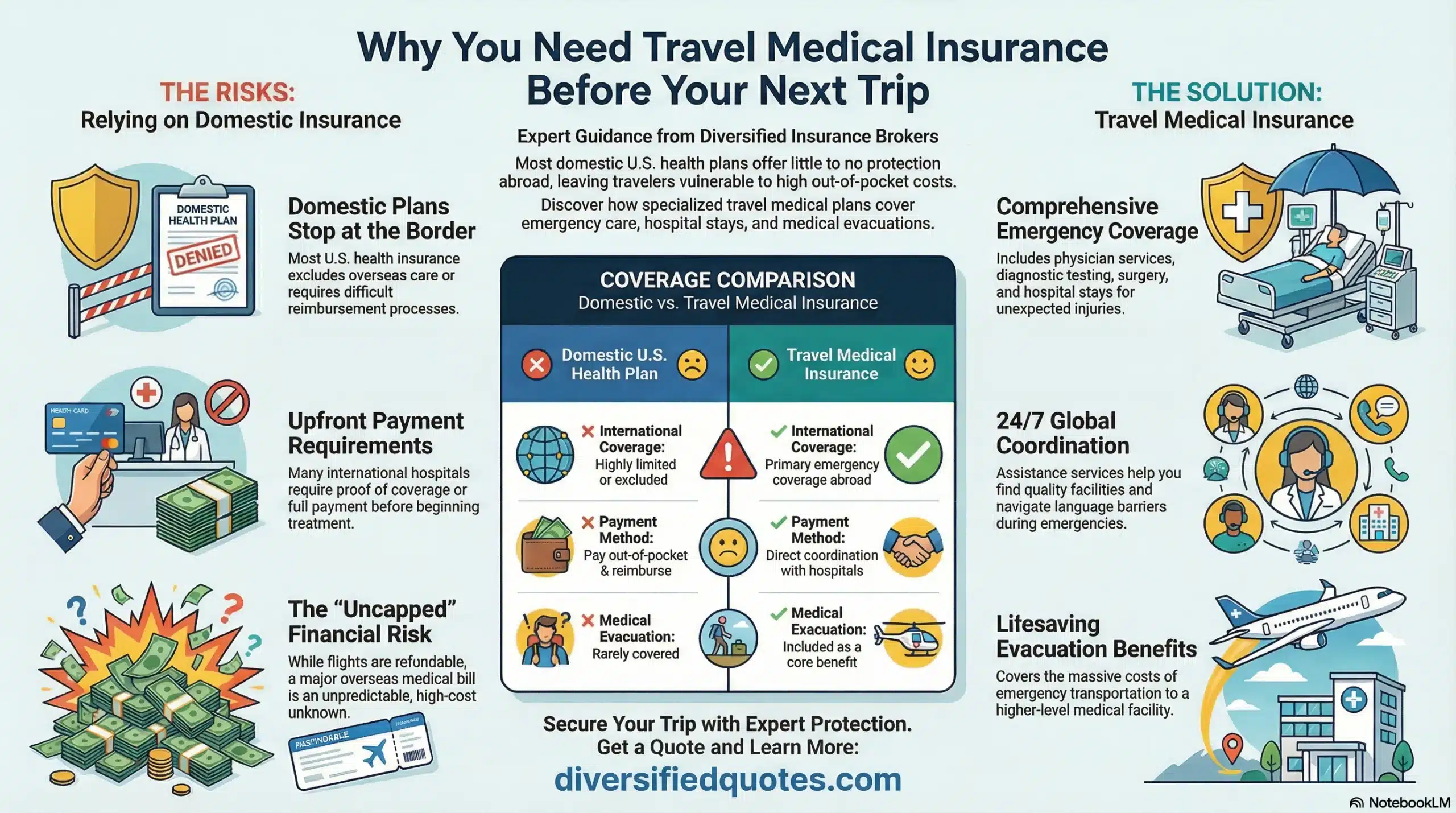
The gap between what domestic health insurance promises and what it delivers for international medical emergencies is one of the most consistently misunderstood aspects of personal insurance planning. Most American travelers assume their employer-sponsored plan or marketplace coverage will “work” outside the United States in some meaningful way — and in the most limited technical sense, some do. They may provide reimbursement for emergency care at out-of-network rates. What they almost never provide is adequate coverage that makes overseas care financially manageable and logistically navigable.
The most significant domestic coverage problems for international travelers fall into four categories. First, most domestic plans have no overseas provider networks — which means every international provider is automatically out-of-network, triggering the highest possible cost-sharing under the plan’s out-of-network deductible and coinsurance structure. If your domestic plan has a $5,000 out-of-network deductible and 40% coinsurance above that, you are facing $5,000 plus 40% of all costs above $5,000 before domestic coverage contributes meaningfully. Second, most domestic plans have no direct billing relationships with overseas hospitals — which means you are typically required to pay the full bill upfront and submit a claim for reimbursement after the fact. In many countries, overseas hospitals require payment guarantees or cash deposits before treatment begins for non-emergency care. Third, domestic plans almost never include meaningful emergency medical evacuation benefits — and evacuation costs are where the largest single bills in international medical events occur, regularly exceeding $100,000 to $500,000 for air ambulance evacuation from remote or distant locations. Fourth, Medicare — which covers a significant portion of the senior traveler population — provides essentially no coverage outside the United States in most circumstances, with very limited exceptions for certain border situations. For Medicare beneficiaries traveling internationally, emergency travel health insurance is not optional — it is the only meaningful coverage they will have abroad.
Emergency travel health insurance addresses all four of these domestic coverage failures: it provides an overseas-specific benefit structure, includes direct billing assistance and assistance team coordination, includes emergency medical evacuation as a standard benefit in most policies, and applies to all travelers regardless of their domestic plan or Medicare enrollment status.
What Emergency Travel Health Insurance Typically Covers
Emergency travel medical plans provide a benefit structure designed for the medical and logistical realities of international health events. Understanding what the standard benefits cover — and equally importantly, what they are designed to address versus what requires additional coverage — allows travelers to select the right plan for their specific situation rather than assuming all travel medical coverage is equivalent.
Emergency physician and hospital services are the core medical benefit of all emergency travel health plans. Emergency room evaluation, emergency physician services, hospitalization including room and board at a semi-private room rate, inpatient nursing care, medically necessary surgery, anesthesia, and intensive care unit services when required are all typically covered up to the plan’s medical maximum. For most trip destinations and durations, a medical maximum of $100,000 to $500,000 is appropriate for standard leisure travel. For longer trips, remote destinations, or regions with higher medical cost environments (Western Europe, Japan, Australia, New Zealand), higher maximums are advisable. Our resource on travel medical insurance provides guidance on appropriate coverage level selection by destination type.
Urgent care and outpatient services cover non-emergency treatment that is still medically necessary — a respiratory infection that needs antibiotics, a sprained ankle that requires imaging, a minor laceration that needs suturing. These situations represent the most common reason travelers use their travel medical coverage, even though they are not the most financially consequential. Having coverage for urgent care means travelers can seek appropriate treatment without the out-of-pocket deterrent that makes people delay care until a manageable condition becomes a serious one.
Emergency medical evacuation is the benefit that most distinguishes good travel medical coverage from domestic health insurance — and the benefit that most travelers understand the least. Medical evacuation covers the cost of transporting you from the location where you receive initial care to the nearest appropriate medical facility capable of treating your condition, or in some circumstances, back to the United States when that is the medically appropriate decision. Air ambulance evacuation is the most expensive component of many international medical emergencies — costs regularly range from $50,000 to $200,000 for air medical transport from Asia, Africa, or remote regions of Latin America. Most domestic health plans cover none of this. Our dedicated resource on emergency medical evacuation insurance explains in detail how evacuation benefits work, what “medically necessary” means in practice, and why the coordination requirement is critically important for the benefit to function properly.
Repatriation of remains covers the costs of transporting a deceased insured’s remains back to the United States when a traveler dies abroad — a benefit that domestic health insurance and life insurance typically do not cover, and one whose costs can be substantial (commonly $10,000 to $25,000 or more depending on the country of death and distance of transport).
Trip interruption related to a medical event is included in many travel medical plans as a secondary benefit — covering transportation costs to return home early when that is medically appropriate following a covered emergency. This should not be confused with comprehensive trip cancellation/interruption insurance, which covers a broader range of trip disruption scenarios. The medical trip interruption benefit in a travel medical plan is specifically tied to a covered medical event.
24-hour assistance services are a frequently overlooked but critically important component of quality travel medical coverage. The assistance team provides medical referral to appropriate facilities when you are in an unfamiliar location, medical monitoring of hospitalized insured travelers, translation assistance, direct billing coordination with hospitals where available, evacuation coordination and approval, and emergency contact with family members at home. In a genuine overseas medical emergency, having a 24-hour assistance line that speaks your language and knows the local medical infrastructure is often more valuable than any specific benefit limit — because it guides decision-making and coordination that a traveler facing a medical crisis in a foreign country cannot easily manage alone.
Want Us to Confirm the Plan Fits Your Trip?
Send your travel dates, destinations, ages, and activity profile and we’ll point you to a plan structure that avoids common gaps for your specific itinerary.
Request a Coverage CheckQuestions? Call 800-533-5969
Who Emergency Travel Health Insurance Is Best For
Emergency travel health insurance is appropriate for virtually any U.S. citizen traveling outside the United States who does not have a comprehensive international health plan that provides meaningful overseas coverage. Several traveler profiles have the most acute coverage needs and benefit most clearly from having dedicated emergency travel medical coverage in place before departure.
Medicare beneficiaries represent the traveler population with the most significant gap between domestic coverage and overseas need. Medicare Part A and Part B provide essentially no coverage outside the United States in most circumstances — limited exceptions apply only for certain emergency situations in Canada when traveling between Alaska and the contiguous 48 states, or for certain emergency situations in Mexico when traveling along the southern U.S. border. For all other international travel, Medicare beneficiaries have no meaningful coverage for overseas medical events unless they have purchased a Medicare Supplement plan that includes the limited foreign travel emergency benefit (which provides up to 80% coverage after a $250 deductible for foreign emergency care during the first 60 days of each trip, subject to a $50,000 lifetime maximum). For most serious international medical events, the Medicare Supplement foreign travel benefit is inadequate — particularly for evacuation costs — making dedicated emergency travel health insurance the right approach for Medicare-age travelers. Our resource on travel medical insurance for seniors addresses the specific coverage considerations for older travelers including Medicare-age individuals.
Leisure and vacation travelers on international trips of any length need emergency travel health insurance if their domestic plan provides inadequate overseas coverage — which it almost always does. Even a week-long trip to a well-developed country like France, Italy, or Japan can produce medical bills of $20,000 to $100,000 or more if hospitalization is required. Without coverage specifically designed for international use, the financial exposure is significant and the logistical burden of navigating a foreign healthcare system without assistance support is genuinely daunting.
Business travelers making frequent international trips need emergency travel health insurance that matches their travel pattern. Single-trip policies work well for occasional international business travel. Frequent travelers often benefit from annual multi-trip policies that provide coverage for all international trips during a 12-month period without requiring separate enrollment for each trip.
Students studying abroad typically need coverage that spans a full academic semester or year, satisfies the host institution’s insurance requirements, and provides adequate medical access in the destination country. Our resource on travel medical insurance for studying abroad addresses the specific coverage considerations and institution requirement compliance for study abroad programs.
Mission and humanitarian travelers often travel to regions where local medical infrastructure is limited, evacuation risk is elevated, and the typical tourist travel medical plan may have inadequate coverage for the destination or activity profile. Our resources on mission trip travel insurance and travel insurance for humanitarian aid workers address the specific coverage needs for these traveler profiles.
Adventure and active travelers whose itineraries include activities beyond standard tourism — hiking, diving, skiing, kayaking, mountaineering, or other higher-risk activities — need to confirm that their travel medical coverage extends to those activities and does not exclude them as “hazardous sports” without a specific rider. Our resource on high risk travel insurance and our resource on travel and medical insurance for high-risk travel address how activity risk affects coverage and what to look for in plan language when your trip includes elevated activity exposure.
Understanding Plan Design: The Decisions That Determine Real Coverage Quality
Emergency travel health insurance plans are not all equivalent, and the decisions made when selecting a plan — the medical maximum, deductible, coinsurance, evacuation benefit structure, and pre-existing condition provisions — determine whether the policy provides genuinely useful protection or disappoints at claim time. Understanding each design element clearly is the prerequisite for a good selection decision.
Medical maximum. The medical maximum is the total benefit available for medical services during the policy period. It should be set based on the realistic cost of a serious medical event in the destination country — not on the cost of a routine doctor visit. Hospitalization costs in Western Europe, Japan, and Australia can easily exceed $5,000 to $15,000 per day for intensive care. A cardiac event requiring surgery in a major European city can produce bills of $80,000 to $150,000 or more before evacuation is even considered. For most international leisure travel, a minimum medical maximum of $100,000 is appropriate, and $250,000 to $500,000 is preferable for longer trips or higher-cost destinations. Lower medical maximums — $50,000 or below — may be adequate for very short trips to lower-cost destinations but should be selected with explicit awareness of their limitations.
Deductible and coinsurance. Most travel medical plans offer a choice of deductible — typically ranging from $0 to $500 or higher — with lower deductibles producing higher premiums. Coinsurance may or may not apply after the deductible depending on the plan; some plans pay 100% of covered costs above the deductible up to the medical maximum, while others apply 80/20 or similar coinsurance above the deductible. Zero deductible plans provide the cleanest cost certainty in a medical event but cost more in premium. For travelers whose primary concern is avoiding large surprise out-of-pocket bills, a zero or low deductible plan with 100% coverage above the deductible produces the most predictable outcome.
Emergency medical evacuation limit and structure. The evacuation benefit should be a standalone, high-limit benefit — not embedded in the medical maximum where it competes with medical cost reimbursement. Air ambulance evacuation from Asia, Africa, or remote regions of Latin America can cost $100,000 to $500,000 or more depending on the distance, level of medical care required during transport, and aircraft type required. An evacuation benefit limit of $500,000 to $1,000,000 is appropriate for itineraries that include significant distance from advanced medical facilities or air transport hubs. Lower evacuation limits — $100,000 or below — may be adequate for travel within Western Europe where high-quality care is broadly available and evacuation distances are limited, but are inadequate for travel to Africa, Southeast Asia, or other regions where evacuation is both more likely to be needed and more expensive to execute.
The coordination requirement for evacuation. This is one of the most critical and least understood aspects of evacuation coverage. In virtually all travel medical plans, emergency medical evacuation must be coordinated and approved by the plan’s assistance team before evacuation occurs — except in situations where immediate life-threatening emergency prevents prior notification, in which case the insured must notify the assistance team as soon as reasonably possible. This coordination requirement exists because the plan, not the insured, is responsible for arranging and paying for the evacuation — and unauthorized evacuations arranged independently by the traveler or their family may not be covered or may be covered only at a lower benefit level. Understanding this requirement before departure — and having the assistance phone number accessible — is critical for the evacuation benefit to function when it is needed.
Pre-Existing Conditions: The Most Important Variable to Confirm Before Purchase
Pre-existing medical conditions represent the most consequential variable in emergency travel health insurance selection for a large portion of the traveling population — particularly for travelers over 50, who are more likely to have documented health histories that could affect coverage. Understanding exactly how the plan you are considering handles pre-existing conditions before purchasing is not optional due diligence — it is the difference between having coverage when you need it and having an exclusion applied at claim time that you did not anticipate.
Plan approaches to pre-existing conditions vary significantly. Some plans exclude pre-existing conditions entirely — any medical event that is causally related to a condition that was diagnosed, treated, or symptomatic within the “look-back period” (commonly 60, 90, or 180 days before the policy effective date) is not covered. For travelers with chronic but managed conditions — controlled hypertension, managed diabetes, a history of cardiac events that are currently stable — full pre-existing condition exclusions can eliminate coverage for the medical events most likely to occur during their trip.
Other plans offer “acute onset of pre-existing condition” coverage — a provision that covers emergency treatment for a sudden, unexpected medical crisis related to a pre-existing condition even when that condition is technically excluded from routine coverage. The acute onset provision is meaningful protection for travelers with chronic conditions: it covers the emergency treatment of a heart attack, a diabetic crisis, or an acute complication of a managed condition that requires immediate emergency intervention, even when the underlying condition is excluded from comprehensive coverage. The definition of “acute onset” and the benefit limits that apply under it vary by plan — confirming the specific language before purchase is essential.
Some plans offer time-sensitive pre-existing condition waivers — optional provisions that waive the pre-existing condition exclusion entirely for travelers who purchase coverage within a defined number of days of their initial trip deposit payment. These waivers, when available and when the eligibility criteria are met, provide the most complete coverage for travelers with pre-existing conditions. The availability, cost, and eligibility requirements for these waivers vary significantly by carrier and plan type. Our resource on international health insurance provides broader context for travelers who need more comprehensive coverage that includes ongoing management of pre-existing conditions rather than just emergency coverage for acute events.
Travel Medical Insurance for Special Trip Types and Traveler Profiles
Emergency travel health insurance is not a single product — it is a category of coverage that needs to be tailored to the specific characteristics of each traveler and trip. Several traveler profiles and trip types have specific coverage requirements that differ meaningfully from standard leisure travel needs.
Senior travelers and Medicare beneficiaries need plans that specifically address the Medicare coverage gap, provide adequate medical maximums for the destination, include robust evacuation coverage, and clearly address pre-existing conditions in a way that provides meaningful protection for the managed chronic conditions common in older travelers. Our resource on travel medical insurance for seniors covers these considerations specifically.
Group travelers — whether traveling as part of a church group, mission team, volunteer organization, student program, or corporate group — benefit from group travel medical enrollment that provides consistent coverage for all group members, simplified administration, and in some cases group pricing that reduces per-person cost. Our resources on travel medical insurance for large groups, travel medical for religious groups, and travel medical for volunteer groups address group enrollment options and considerations.
Long-term travelers, digital nomads, and expats whose international presence extends beyond a typical short-term trip need coverage structures that accommodate extended duration — often annual plans with rolling trip limits or dedicated expat health plans that provide comprehensive international coverage rather than emergency-only coverage. Our resources on travel medical insurance for expats and travel insurance for digital nomads address coverage structures for travelers whose international presence is long-term or continuous.
Travelers to remote or high-risk destinations — including sub-Saharan Africa, remote Asia, regions with political instability, or destinations with limited local medical infrastructure — need evacuation benefits that are specifically adequate for those environments, higher medical maximums to account for the possibility of inadequate local care requiring more expensive evacuation and treatment, and careful review of destination exclusions in the policy language. Our resource on high risk travel insurance explains what changes in plan design and benefit structure when travel involves elevated risk profiles.
How to Purchase and What to Have Ready
The purchase process for emergency travel health insurance is designed to be straightforward — most plans can be enrolled online in minutes once the required information is available. Having the following information ready before beginning the enrollment process makes the process faster and ensures the policy is issued correctly.
Traveler information needed includes full legal name as it appears on the passport, date of birth, U.S. state of residence (because coverage regulations and some benefit provisions vary by state), and the same information for any additional travelers being enrolled on the policy. Trip information includes the departure date from the United States, the return date to the United States, and the countries or regions to be visited — including cruise ship itineraries where the ship visits multiple countries, since coverage must extend to all destinations visited during the policy period. Coverage elections include the medical maximum, deductible level, coinsurance structure, and any optional riders being added — the enrollment tool walks through these elections and shows the premium impact of different choices.
Timing matters. Emergency travel health insurance must be purchased before departure from the United States — coverage cannot be purchased after you have already left or after a medical event has already occurred. If you are considering a time-sensitive pre-existing condition waiver, the purchase deadline is typically within 10 to 21 days of your initial trip deposit payment, depending on the specific plan. Purchasing early also provides peace of mind and allows you to save the policy documents and assistance contact information before departure.
After purchase: Keep your policy ID card and the 24-hour assistance phone number accessible throughout your trip — ideally saved in your phone, carried in your wallet, and shared with a trusted travel companion. In a genuine medical emergency abroad, the most important first step (after securing immediate care if life-threatening) is to contact the assistance team. They coordinate with the local treating facility, confirm coverage, arrange evacuation if needed, and guide the claim process so you are not navigating an unfamiliar medical and administrative system alone.
Ready to Enroll or Have Questions?
Questions? Call 800-533-5969
Traveling for a Program, Mission, or Group Trip?
We can confirm evacuation rules, activity coverage, and documentation so your group is aligned on dates and benefits before departure.
Request a Group Coverage CheckRelated Travel Medical Pages
Explore travel medical resources that help you choose the right emergency structure for overseas trips.
Related Evacuation and Special Travel Guides
Use these guides to understand evacuation coordination, higher-risk travel structure, and visitor-to-U.S. coverage.
Financial Protection Essentials
Additional coverage resources for travelers, seniors, and those building complete financial protection plans.
Talk With an Advisor Today
Choose how you’d like to connect—call or message us, then book a time that works for you.
Schedule here:
calendly.com/jason-dibcompanies/diversified-quotes
Licensed in all 50 states • Fiduciary, family-owned since 1980
FAQs: Emergency Travel Health Insurance
What is emergency travel health insurance?
Emergency travel health insurance is short-term medical coverage for U.S. travelers designed specifically for unexpected illnesses or injuries that occur while outside the United States. It provides coverage for emergency room visits, urgent care, hospitalization, outpatient diagnostics, surgery, and prescription medications related to a covered condition — along with emergency medical evacuation and repatriation benefits that most domestic health plans do not include. The coverage is designed to function where domestic health insurance fails: in overseas provider environments where there are no network relationships, no direct billing arrangements, and no evacuation coordination.
The most important distinction from domestic coverage is not just the benefit structure — it is the 24-hour assistance team that comes with quality travel medical coverage. The assistance team provides medical referral, direct billing coordination, translation support, evacuation coordination and approval, and emergency family notification. In a genuine overseas medical emergency, having a dedicated assistance team guiding decisions and coordinating care is often as valuable as any specific benefit limit.
How is emergency travel health insurance different from trip cancellation insurance?
Trip cancellation or comprehensive travel insurance focuses primarily on financial protection for the trip itself — covering non-refundable trip costs when the trip must be cancelled or interrupted due to covered reasons including illness, injury, or other qualifying events. Emergency travel health insurance focuses exclusively on medical treatment and evacuation while abroad — covering the cost of care for unexpected medical events during the trip. Many travelers carry both: trip cancellation insurance to protect the financial investment in the trip, and emergency travel health insurance to protect their physical wellbeing and manage the cost of care if something goes wrong medically while traveling.
Some comprehensive travel insurance packages combine both types of coverage in a single policy, but the quality and limits of the medical coverage in bundled packages is often lower than in standalone emergency travel medical policies. Travelers with significant medical risk exposure — seniors, those with pre-existing conditions, or travelers to remote destinations — generally benefit from evaluating standalone emergency travel medical coverage that provides adequate medical maximums and evacuation limits rather than accepting the medical coverage embedded in a trip cancellation package.
Does emergency travel health insurance cover pre-existing conditions?
It depends on the specific plan, and this is the most important variable to confirm before purchasing coverage if you have any documented health history. Plan approaches range widely. Some plans exclude pre-existing conditions entirely — any medical event causally related to a condition diagnosed, treated, or symptomatic within the look-back period (commonly 60 to 180 days before the policy effective date) is not covered. Other plans offer “acute onset of pre-existing condition” coverage — a provision that covers emergency treatment for a sudden unexpected medical crisis related to a pre-existing condition even when that condition is technically excluded from routine coverage. Some plans offer time-sensitive waivers that eliminate pre-existing condition exclusions entirely for travelers who purchase within a defined number of days of their initial trip payment.
If you have managed chronic conditions — controlled hypertension, diabetes, cardiac history, respiratory conditions — confirming the plan’s specific pre-existing condition language before purchase is not optional due diligence. It determines whether you have coverage for the medical events most likely to occur during your trip. When in doubt, contact our team and we will help identify which plan structures provide the most appropriate coverage for your specific health situation.
Does Medicare cover medical emergencies abroad?
Medicare provides essentially no coverage outside the United States in most circumstances. Limited exceptions apply for emergency situations in Canada when traveling between Alaska and the contiguous 48 states, and for certain emergency situations in Mexico when traveling close to the southern U.S. border. For all other international travel, Medicare provides no coverage. Medicare Supplement plans with the foreign travel emergency benefit provide some limited overseas coverage — up to 80% after a $250 deductible during the first 60 days of a trip, subject to a $50,000 lifetime maximum — but this benefit is inadequate for serious medical events, particularly for evacuation costs that can exceed $100,000 to $500,000.
For Medicare beneficiaries traveling internationally, emergency travel health insurance is not optional — it is the only meaningful medical coverage they will have abroad. The appropriate coverage includes a medical maximum adequate for the destination ($100,000 to $500,000 depending on trip length and destination), robust evacuation coverage, and pre-existing condition provisions that provide meaningful protection for the managed chronic conditions common in the senior traveler population. Our resource on travel medical insurance for seniors addresses coverage considerations specific to Medicare-age travelers.
What does medical evacuation coverage actually include?
Emergency medical evacuation covers the cost of transporting you from your location to the nearest appropriate medical facility capable of treating your condition, when that facility is not available where you are currently located. In some circumstances, when appropriate care cannot be provided anywhere in the region, evacuation to the United States may be authorized. The coverage includes air ambulance when medically necessary, accompanying medical personnel during transport when required, and coordination of transport logistics by the assistance team.
Two aspects of evacuation coverage are frequently misunderstood. First, evacuation must be medically necessary — it is not a transportation benefit that allows you to choose to receive care at home rather than locally when adequate local care is available. The decision that evacuation is medically necessary is made in conjunction with the assistance team’s medical directors based on your clinical situation and the availability of appropriate care at the location. Second, most plans require that evacuation be coordinated and approved by the assistance team before it occurs — unauthorized evacuations arranged independently may not be covered or may be covered at a reduced benefit level. Our dedicated resource on emergency medical evacuation insurance explains these mechanics in full detail.
Are adventure activities and sports covered?
Standard emergency travel health insurance policies may exclude certain hazardous activities — activities classified as “hazardous sports” in the policy’s exclusion language. Activities that commonly appear in exclusions include mountaineering above specified elevations, BASE jumping, racing, free diving, and some organized contact sports. Activities like recreational scuba diving, hiking, skiing, and kayaking may be covered under the base policy at some carriers and require optional riders at others.
If your itinerary includes any activities beyond standard tourism, confirming the policy’s specific activity language before purchase is important. Many carriers offer optional adventure sports riders that extend coverage to a defined list of higher-risk activities for a modest additional premium. If your travel is inherently higher-risk due to the activity profile, reviewing our resource on high risk travel insurance will help you understand what plan language characteristics matter most for active travelers.
How do deductibles and provider networks work in international travel medical?
You choose a deductible level at the time of purchase — options typically range from $0 to $500 or more, with lower deductibles producing higher premiums. Unlike domestic health insurance where you encounter provider networks before the deductible applies, travel medical insurance applies to overseas care where there is no domestic network. The deductible applies per policy period in most plans — you pay the deductible once across all covered medical events during the trip, not a separate deductible for each event.
Many travel medical plans provide access to international provider networks in certain destination countries where the carrier has established direct billing relationships with hospitals and clinics. Where direct billing is available, the hospital bills the insurance company directly and you pay only your cost-sharing. Where direct billing is not available — which is common in many countries — you pay the bill upfront and submit a claim for reimbursement. Keeping itemized medical bills, receipts, and medical records from all providers is essential for the reimbursement process. The assistance team can help identify direct-billing facilities in your destination when that option is available.
When should I purchase emergency travel health insurance?
Purchase coverage before you depart the United States — ideally as early as possible after confirming your travel plans, and in any case before your departure date. Coverage cannot be purchased after departure or after a medical event has already occurred. If you are considering a time-sensitive pre-existing condition waiver, the purchase deadline is typically within 10 to 21 days of your initial trip deposit payment, depending on the specific plan — which means purchasing early is especially important if this waiver is relevant to your situation.
After purchasing, save your policy ID card, policy number, and the 24-hour assistance phone number in your phone and share them with your travel companion. These are the most important items to have accessible in an actual emergency — the assistance team is your first call when a medical event occurs abroad, and having their contact information readily available can meaningfully affect the quality and speed of your care coordination.
Browse Groups & Specialty Travel Insurance
About the Author:
Jason Stolz, CLTC, CRPC, DIA, CAA and Chief Underwriter at Diversified Insurance Brokers (NPN 20471358), is a senior insurance and retirement professional with more than 25 years of real-world experience helping individuals, families, and business owners protect their income, assets, and long-term financial stability. As a long-time partner of the nationally licensed independent agency Diversified Insurance Brokers, Jason provides trusted guidance across multiple specialties—including fixed and indexed annuities, long-term care planning, personal and business disability insurance, life insurance solutions, Group Health, Travel Medical and Evacuation Insurance, and short-term health coverage. Diversified Insurance Brokers maintains active contracts with over 100 highly rated insurance carriers, ensuring clients have access to a broad and competitive marketplace.
His practical, education-first approach has earned recognition in publications such as VoyageATL, and contributions from his agency featured in Kiplinger and GoBankingRates— highlighting his commitment to financial clarity and client-focused planning. Drawing on deep product knowledge and years of hands-on field experience, Jason helps clients evaluate carriers, compare strategies, and build retirement and protection plans that are both secure and cost-efficient. Visitors who want to explore current annuity rates and compare options across multiple insurers can also use this annuity quote and comparison tool.
Explore All Travel Medical Insurance Options: Browse our complete Travel Medical Insurance guide — covering international coverage, medical evacuation, group travel & high risk destinations.
Last Reviewed: June 17, 2026 |
Reviewed by: Jason Stolz, CLTC, CRPC, DIA, CAA
Chief Underwriter, Diversified Insurance Brokers, Inc. | NPN: 20471358 | Diversified Insurance Brokers, Inc. — Licensed in all 50 states
Fact Checked by: Tonia Pettitt, CMIP©
Medicare Specialist, Diversified Insurance Brokers, Inc. | NPN: 14374308 | Diversified Insurance Brokers, Inc. — Licensed in all 50 states
Did you find this content helpful? Leave us a Google review — it helps others find trustworthy guidance too.
Editorial Standards: Diversified Insurance Brokers maintains rigorous editorial standards to ensure accuracy, clarity, and independence in all content. Learn more about our editorial standards and commitment to transparency.
