
Cheap Travel Insurance
Cheap Travel Insurance

Jason Stolz CLTC, CRPC
Cheap travel insurance does not have to mean “bare minimum” protection. The best cheap travel insurance stays affordable because it is built efficiently: strong on the risks that can blow up a budget, lighter on extras most people will never use, and sized to the way you actually travel. When the plan is structured correctly, cheap travel insurance can still help with overseas medical emergencies, evacuation coordination, and trip disruption scenarios without forcing you to overpay. At Diversified Insurance Brokers, we help travelers compare low-cost options with a simple goal: value. That means matching your destination, trip length, and risk profile to coverage that would actually respond in a real scenario.
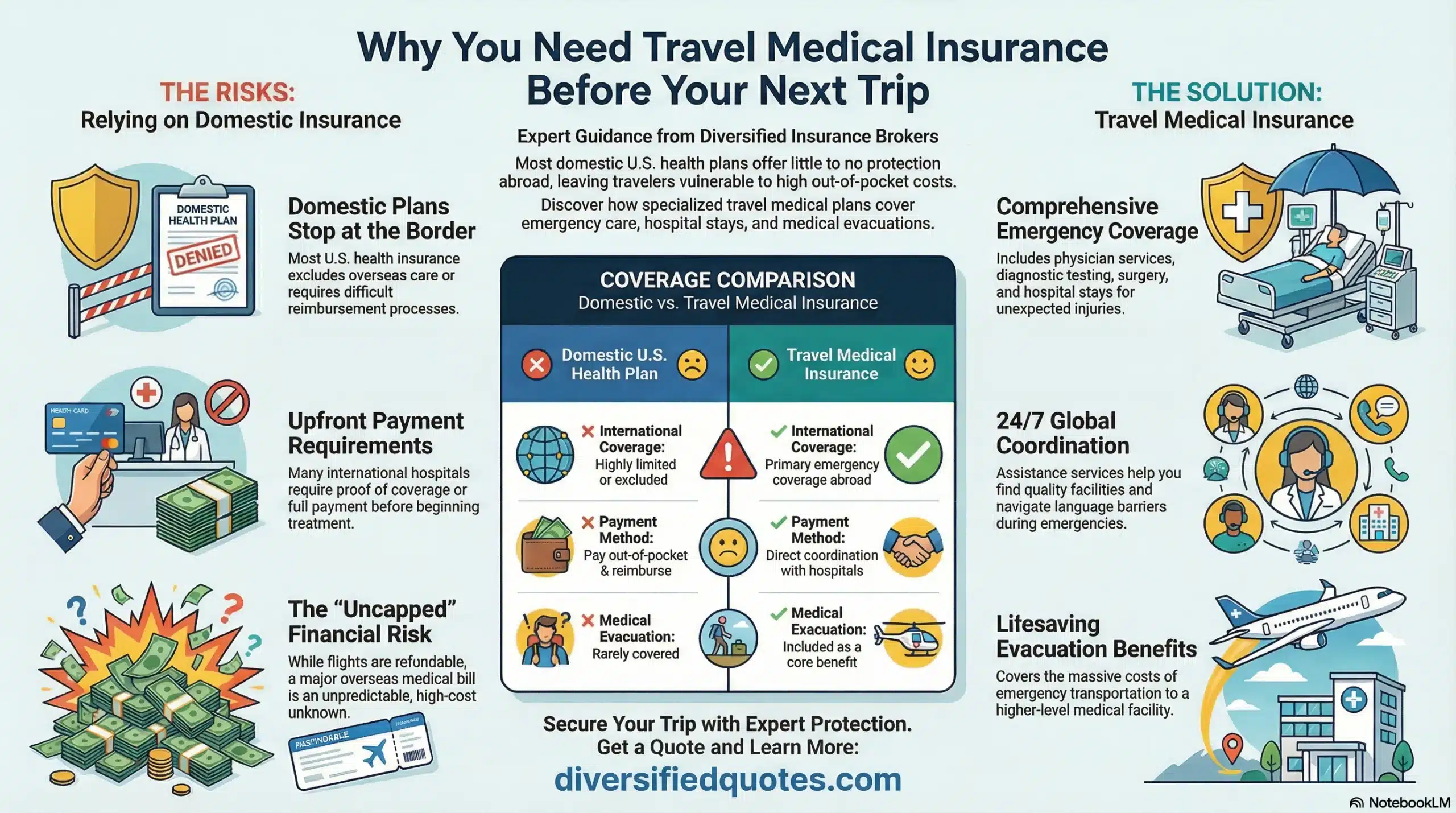
Cheap travel insurance becomes especially important once you are outside the United States because many domestic health plans and Medicare typically provide little to no coverage overseas. Even minor treatment can require payment at the time of service, and evacuation can become a separate coordination problem that is expensive when you have to solve it quickly. For a foundational overview of how travel medical coverage is structured before comparing specific plan types, our Travel Medical Insurance guide explains how benefit categories, limits, and assistance services work across the full range of plan designs.
Compare Cheap Travel Insurance Plans
See affordable travel insurance options and enroll online in minutes.
Find Cheap Travel Insurance Today
Compare affordable travel insurance plans and enroll online in minutes.
What Makes Travel Insurance “Cheap” and Still Worth It
Cheap travel insurance is usually inexpensive for one of two reasons. Sometimes it is cheap because it is thoughtfully designed around essential protections with sensible limits and a clean structure. Other times it is cheap because important benefits are capped too low, defined too narrowly, or excluded in ways that only show up after a claim. The difference is not always obvious from the marketing page — which is why plan structure matters more than the sticker price. For most international trips, the real value of cheap travel insurance comes from staying focused on the risks that cause large financial outcomes: medical emergencies, medically necessary evacuation coordination, and trip interruption situations tied to illness or injury. When travelers keep those priorities front and center and avoid stacking expensive upgrades that overlap or are unlikely to be used, cost stays low without undermining the protections that matter.
A cheap plan can still be strong when the deductible and benefit limits match the destination and your travel style. Many travelers also keep costs down by insuring only the days they actually need and selecting coverage that aligns with how they would realistically use it if something happened. For travelers comparing whether evacuation coverage is strong enough under a budget plan, our resource on emergency medical evacuation insurance explains what “nearest appropriate facility” means, how the coordination process works, and what minimum evacuation limits are realistic for different destination types.
Want Us to Sanity-Check a “Cheap” Plan Before You Buy?
Send your trip details and we’ll flag the exclusions that turn cheap travel insurance into expensive regret.
Who Cheap Travel Insurance Is Best For
Cheap travel insurance is often a strong fit for travelers who want meaningful protection but do not need every possible add-on. This commonly includes leisure travelers on short international trips, business travelers who want medical and evacuation protection while abroad, and students or remote workers who need straightforward coverage that is easy to activate in an emergency. It can also be a practical solution for travelers who are most concerned about medical and evacuation exposures and less concerned about premium trip cancellation features. In many cases, you can build a low-cost travel protection strategy by prioritizing medical and evacuation design first and then deciding whether trip-related benefits are worth adding based on what you have at risk financially.
If your itinerary involves elevated risk — remote destinations, limited healthcare infrastructure, or more hazardous activities — cheap travel insurance may still work, but only if it is structured with the right limits and definitions. In those situations, it is smart to review the broader framework in our resource on high-risk travel insurance so you understand which benefits become non-negotiable when conditions are less predictable. For senior travelers specifically, medical cost exposure abroad can be disproportionately large due to the higher probability of needing specialist care — our resource on travel medical insurance for seniors covers the specific planning considerations that apply to older travelers evaluating affordable coverage options.
Why Medical Coverage Abroad Matters Most
Many travelers assume their domestic health plan follows them internationally. Often it does not. Even when some reimbursement is possible, it may require paying out of pocket first, dealing with paperwork after you return, and navigating coverage rules that were not built for international systems. Medicare is commonly a surprise for travelers because it typically does not cover routine medical care outside the United States — even a short trip to Canada or Mexico can create unexpected out-of-pocket medical bills for Medicare beneficiaries who assumed they were covered.
Cheap travel insurance can still provide meaningful medical protection when it covers emergency physician visits, urgent care, hospital stays, diagnostics, and prescriptions related to a covered illness or injury. Where many travelers get blindsided is evacuation. Evacuation is less about reimbursement and more about coordination and capability. When appropriate care is not available locally, the ability to coordinate transport to a facility that can treat you can matter more than the cost of the initial doctor visit. Understanding definitions like “nearest appropriate facility” helps you choose coverage designed to respond instead of simply sounding good on a quote page. For travelers comparing how travel medical coverage compares to employer-provided insurance for covering gaps abroad, our resource on travel medical insurance covers how the two types of coverage interact and where domestic plans typically leave travelers exposed.
Not Sure What Limits You Actually Need?
We’ll help you right-size medical and evacuation limits so you stay protected without over-insuring.
How to Keep Travel Insurance Costs Low Without Getting Burned
Keeping travel insurance inexpensive is usually about making a few disciplined choices. First, focus on what you are truly trying to protect — if medical and evacuation exposures are the biggest risk, prioritize those benefits and be careful about loading the plan with trip cancellation features that may not match what you have financially at risk. Second, choose benefit limits that make sense for the destination: a plan can be cheap because the limits are too low for the region you are visiting, which defeats the purpose. Third, use the deductible as a lever — a modest deductible can reduce premium meaningfully while still keeping out-of-pocket exposure reasonable. Fourth, insure only the days you need, since many travelers unintentionally overpay by extending coverage beyond the actual travel window. Finally, confirm definitions and authorization requirements for evacuation-related benefits, because coordination rules often matter more than most people realize.
One of the most practical ways to control costs is to start with a travel-medical-first design and then evaluate whether trip cancellation add-ons make financial sense for the specific trip. A $500 trip to a resort has very different cancellation risk than a $6,000 international itinerary with non-refundable flights and prepaid tours. The more financially meaningful the non-refundable exposure, the more trip cancellation coverage justifies its cost. If you want to compare how a travel-medical-first structure differs from longer-term global medical coverage, our resource on international health insurance clarifies why cheap travel insurance can be excellent for short trips but may not be the best structure for long-term international living or extended travel. For groups or volunteer travelers who want low-cost coverage that still covers multiple people on a single itinerary, our resource on cheap group travel insurance covers how group plan structures reduce per-person cost without sacrificing core medical and evacuation protection.
Cheap Travel Insurance vs. No Insurance
Skipping coverage can feel like saving money, but it creates an asymmetric risk. A single overseas medical emergency can exceed the total cost of multiple trips’ worth of insurance premiums. This is why cheap travel insurance can be such a practical tool: it is a relatively small premium that transfers a potentially large financial and logistical burden to an insurer built to coordinate the response. Cheap travel insurance is not about predicting what will happen. It is about removing the scenario where a medical emergency forces you to make a fast, expensive decision without support. Even when a plan is inexpensive, having a structured process — assistance contacts, defined benefits, and clear triggers — can change outcomes dramatically. For travelers evaluating specific high-risk destination coverage where the stakes of going uninsured are particularly high, our destination-specific pages cover the planning considerations unique to each region.
Have a Unique Itinerary or Multiple Countries?
Multi-country itineraries and trips to less-visited destinations create specific coverage planning considerations. A plan that covers “international travel” generically may have coverage territory limitations that exclude certain regions, or may have lower evacuation limits that are inadequate for destinations far from major medical centers. When your itinerary spans multiple countries or includes destinations with limited healthcare infrastructure, confirming that the plan’s covered territory explicitly includes all your destinations is a necessary step before purchase. For travelers heading to specific destinations that require higher evacuation limits or have unique medical access challenges, our destination-specific travel medical pages cover the planning considerations that apply. We’ll help you avoid cheap plans that exclude what your trip actually involves.
Find Cheap Travel Insurance Today
Compare affordable travel insurance plans and enroll online in minutes.
Financial Protection Essentials
Travel medical coverage comparisons, evacuation planning resources, international health insurance, and senior travel protection guides.
Related Travel Medical Pages
Related Coverage & Agency Pages
Talk With an Advisor Today
Choose how you’d like to connect—call or message us, then book a time that works for you.
Schedule here:
calendly.com/jason-dibcompanies/diversified-quotes
Licensed in all 50 states • Fiduciary, family-owned since 1980
Cheap Travel Insurance FAQs
Cheap travel insurance is a lower-cost policy that focuses on core protections — emergency medical coverage, trip interruption, and in many cases emergency medical evacuation — without requiring you to pay for add-ons you may never use. The cost savings typically come from one of two sources: either the plan is thoughtfully designed around essential protections with sensible limits, or benefits are capped lower, defined more narrowly, or more heavily exclusion-dependent. The key to identifying cheap travel insurance that is actually worth having is focusing on the benefit categories that create the largest financial risk — medical emergencies and evacuation — and confirming those are structured with realistic limits for your destination, rather than evaluating the plan by its marketing headline alone. A $30 monthly premium plan that has a $10,000 medical maximum may be inadequate for a trip to Europe or Asia where a serious hospital stay can exceed that limit. A $60 monthly premium plan with a $100,000 medical maximum and meaningful evacuation coverage is still inexpensive in absolute terms while providing far more useful protection. Our resource on travel medical insurance explains how to evaluate benefit structure across different plan designs before making a purchase.
It can be — and for many travelers, the better question is whether skipping coverage is financially rational given what is at stake. A single overseas emergency room visit can easily cost $3,000 to $10,000 or more depending on the country, and a hospital admission for a serious condition — cardiac event, fracture requiring surgery, severe infection — can quickly exceed $50,000 or more at international facilities where no negotiated rate exists. The annual premium for a year of cheap travel insurance covering multiple trips is typically a fraction of a single ER bill. Even one covered medical event in a lifetime of travel more than justifies the cost of the premiums paid over that period. The qualification is that “cheap” is only worth it when the plan’s coverage is structured to actually respond to the scenarios most likely to create financial hardship. A cheap plan with a $5,000 medical maximum that covers only catastrophic hospitalization while excluding the ER visit that triggered the hospitalization is not worth it at any price. A cheap plan that provides meaningful medical coverage, evacuation coordination, and 24/7 assistance for a modest monthly premium is genuinely good value. The difference is in the details of benefit structure, not the headline premium.
Many budget-friendly travel insurance plans cover emergency medical care (physician visits, urgent care, hospital stays, diagnostics, and prescriptions related to a covered illness or injury that occurs after the policy effective date), emergency medical evacuation to the nearest appropriate facility when local care is inadequate, and trip interruption benefits for situations where you must cut a trip short due to a covered medical event. Some plans also include limited baggage delay or loss benefits, accidental death and dismemberment coverage, and 24/7 emergency assistance services — which can be one of the most practically valuable features, as the assistance team coordinates care and evacuation logistics when you are dealing with a medical situation abroad. What many cheaper plans do not include is comprehensive trip cancellation coverage for a wide range of “for any reason” or discretionary cancellation scenarios. Trip cancellation that pays for the cost of a cancelled trip regardless of reason typically costs more, and many travelers on a budget find that focusing on medical and evacuation coverage provides more useful protection dollar-for-dollar. For travelers specifically evaluating whether trip cancellation coverage is worth the added cost, the calculation depends primarily on how much in non-refundable prepaid travel expenses is at risk if you cannot take the trip.
Sometimes, but many low-cost plans focus primarily on travel medical benefits rather than including comprehensive trip cancellation coverage. When trip cancellation is included in a budget plan, it typically covers a limited set of covered reasons — serious illness, death of an insured or immediate family member, certain natural disasters, or airline-initiated cancellations — rather than providing “cancel for any reason” flexibility. Comprehensive trip cancellation coverage, and especially “cancel for any reason” coverage, typically adds meaningfully to the premium cost because it covers a wider range of scenarios that are more likely to occur. The practical guidance is this: if you have significant non-refundable prepaid expenses — expensive flights, fully prepaid tours, non-refundable lodging — trip cancellation coverage may be worth the added cost. If your trip has modest non-refundable exposure, focusing premium budget on medical and evacuation benefits may produce better value. Many travelers find that a travel-medical-first plan structure protects them well for everyday international travel risks while keeping cost minimal, particularly for shorter trips with lower financial cancellation risk.
Some plans offer a pre-existing condition waiver that provides coverage for eligible pre-existing conditions, but typically only if you purchase coverage within a required time window after your first trip deposit and meet the plan’s specific eligibility rules (often including being medically fit to travel at the time of purchase). When the pre-existing condition waiver is available and the eligibility conditions are met, you can receive coverage for sudden acute events related to the pre-existing condition during travel. Without the waiver, most plans exclude pre-existing conditions — meaning claims related to a condition that existed, was diagnosed, or for which you received treatment or medical advice during a look-back period before the policy start date may not be covered. For travelers with significant ongoing medical conditions, evaluating whether a plan includes a pre-existing condition waiver opportunity and confirming the eligibility timing is an important step before purchase. Travelers with complex or unstable medical conditions should also evaluate whether a more comprehensive international health insurance plan rather than short-term travel insurance is more appropriate for their coverage needs. Our resource on travel medical insurance covers how pre-existing condition provisions work across different plan types.
Often not — and this surprises many travelers who assume their domestic coverage extends internationally. Medicare typically does not cover medical care received outside the United States, with narrow exceptions for emergency care at Canadian or Mexican hospitals that are closer to a US border crossing than a US hospital. Private domestic health insurance plans vary, but many provide either no international coverage, reimbursement-only coverage (where you pay out of pocket and file for reimbursement after returning), or coverage only in networks that do not exist internationally. Even when domestic plans provide some reimbursement for overseas care, they do not typically coordinate emergency medical evacuation — the logistics of arranging transport to a facility capable of treating you are left to the traveler and are not reimbursed. Travel insurance fills these gaps specifically: it is designed for the international context, provides benefits that activate based on events that occur during travel, and includes the 24/7 assistance infrastructure that coordinates care and evacuation when domestic plans are silent. For Medicare beneficiaries specifically who travel internationally, the absence of overseas coverage makes travel medical insurance not just useful but practically essential for any trip where medical care might be needed. Our resource on travel medical insurance for seniors covers how to evaluate plan options for Medicare-age travelers.
The most effective strategies for keeping travel insurance costs low without sacrificing meaningful protection are: choosing a travel-medical-first plan that prioritizes emergency medical coverage and evacuation rather than loading up on trip cancellation and baggage loss features you may not need; selecting a plan with a reasonable deductible, since a $100 to $250 deductible can meaningfully reduce premium while keeping out-of-pocket exposure manageable in an emergency; insuring only the actual days of travel rather than adding buffer days you don’t need; choosing benefit limits appropriate to your destination rather than defaulting to the highest available, since a trip to Western Europe may need different limits than a trip to Southeast Asia; and comparing multiple plans rather than buying from the first source encountered. Travelers on a genuine budget often find that a travel-medical-only plan — focused exclusively on emergency medical and evacuation — provides the most important protection at the lowest cost, with the option to add trip cancellation coverage only for higher-stakes trips where the non-refundable financial exposure justifies the added premium.
Travel medical insurance focuses primarily on healthcare-related costs incurred abroad — emergency physician visits, urgent care, hospital stays, diagnostics, prescriptions, and in most designs, emergency medical evacuation to the nearest appropriate facility when local care is inadequate. The benefit is activated by a medical event that occurs after the policy effective date. Trip insurance (often called comprehensive travel insurance) typically bundles travel medical benefits together with trip cancellation coverage, trip interruption, baggage loss and delay, and sometimes travel delay benefits. Trip insurance is generally more expensive because it covers a wider range of scenarios, including non-medical trip disruptions. For travelers whose primary concern is being medically protected abroad without paying for trip cancellation features, a travel-medical-only plan is typically the more cost-effective choice. For travelers with significant prepaid trip costs who also want to be protected against having to cancel before departure, comprehensive trip insurance may justify the higher cost. The choice depends on what financial scenarios you are most concerned about: the scenario where a medical emergency strands you abroad, or the scenario where you need to cancel before you leave, or both.
The most important step in using travel insurance effectively during a medical emergency is to contact the plan’s 24/7 assistance hotline as early in the situation as possible — ideally before seeking care or at minimum as soon as you have accessed initial care. The assistance team can help you locate appropriate nearby medical facilities, confirm your coverage, coordinate direct billing with the facility when possible, and initiate evacuation logistics if the situation requires transport to a higher-level facility. Keep your policy number and the assistance hotline number in multiple accessible locations: on your phone, written on paper with your travel documents, and shared with a travel companion. If you must pay out of pocket — which can happen at smaller clinics or facilities without established billing relationships with international insurers — documentation is critical for reimbursement: obtain itemized receipts, medical records, diagnosis notes, and treatment documentation. Taking photos of receipts immediately after receiving them prevents the loss of documentation in a stressful travel situation. Most plans require claims to be filed within a specified timeframe after the medical event, so initiating the claims process promptly after returning home prevents administrative delays from creating coverage complications.
Many plans allow last-minute enrollment — sometimes with coverage beginning as soon as the next day — which is one of the practical advantages of travel medical insurance over other types of insurance. However, certain time-sensitive benefits require purchasing within a specific window: pre-existing condition waivers often require purchase within 14 to 21 days of your first trip deposit, and some trip cancellation benefits have similar eligibility requirements. If you want access to these features, purchasing earlier is always better. For pure travel medical coverage without trip cancellation or pre-existing condition waiver benefits, last-minute purchase is generally fine as long as the policy effective date begins before your departure. The practical guidance is to purchase as soon as your trip is confirmed rather than waiting until departure — earlier purchase eliminates the risk of forgetting to buy, ensures all time-sensitive benefit windows are open, and gives you time to review the policy terms rather than rushing through a purchase at the airport. For travelers who travel frequently and want continuous coverage rather than purchasing per-trip, annual multi-trip travel insurance plans can be more cost-effective than purchasing individual trip coverage for each journey.
Browse Travel Insurance Planning Guides
About the Author:
Jason Stolz, CLTC, CRPC, DIA, CAA and Chief Underwriter at Diversified Insurance Brokers (NPN 20471358), is a senior insurance and retirement professional with more than 25 years of real-world experience helping individuals, families, and business owners protect their income, assets, and long-term financial stability. As a long-time partner of the nationally licensed independent agency Diversified Insurance Brokers, Jason provides trusted guidance across multiple specialties—including fixed and indexed annuities, long-term care planning, personal and business disability insurance, life insurance solutions, Group Health, Travel Medical and Evacuation Insurance, and short-term health coverage. Diversified Insurance Brokers maintains active contracts with over 100 highly rated insurance carriers, ensuring clients have access to a broad and competitive marketplace.
His practical, education-first approach has earned recognition in publications such as VoyageATL, and contributions from his agency featured in Kiplinger and GoBankingRates— highlighting his commitment to financial clarity and client-focused planning. Drawing on deep product knowledge and years of hands-on field experience, Jason helps clients evaluate carriers, compare strategies, and build retirement and protection plans that are both secure and cost-efficient. Visitors who want to explore current annuity rates and compare options across multiple insurers can also use this annuity quote and comparison tool.
Explore All Travel Medical Insurance Options: Browse our complete Travel Medical Insurance guide — covering international coverage, medical evacuation, group travel & high risk destinations.
Last Reviewed: June 2, 2026 |
Reviewed by: Jason Stolz, CLTC, CRPC, DIA, CAA
Chief Underwriter, Diversified Insurance Brokers, Inc. | NPN: 20471358 | Diversified Insurance Brokers, Inc. — Licensed in all 50 states
Fact Checked by: Tonia Pettitt, CMIP©
Medicare Specialist, Diversified Insurance Brokers, Inc. | NPN: 14374308 | Diversified Insurance Brokers, Inc. — Licensed in all 50 states
Did you find this content helpful? Leave us a Google review — it helps others find trustworthy guidance too.
Editorial Standards: Diversified Insurance Brokers maintains rigorous editorial standards to ensure accuracy, clarity, and independence in all content. Learn more about our editorial standards and commitment to transparency.
