
What is the Primary Reason People Buy Travel Medical Insurance
What is the Primary Reason People Buy Travel Medical Insurance

Jason Stolz CLTC, CRPC, DIA, CAA
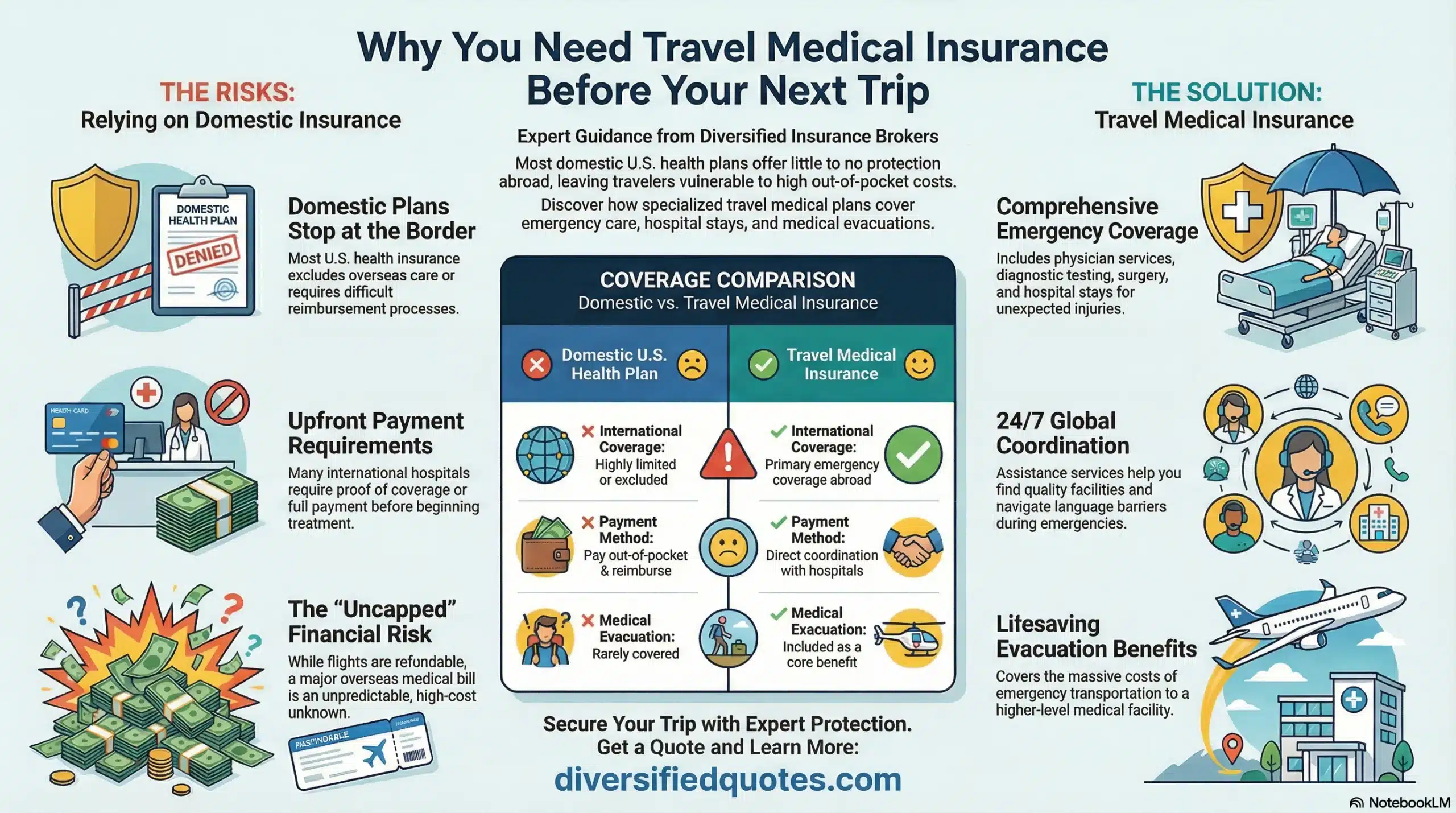
The primary reason people buy travel medical insurance is to protect themselves from unexpected healthcare expenses while traveling outside their home country. Medical care abroad can be extraordinarily expensive, and the domestic health insurance plans that most American travelers rely on at home provide little or no coverage for treatment received overseas. Medicare and Medicaid — the coverage that millions of older and lower-income Americans depend on — do not pay for medical expenses abroad under standard conditions. Most employer-sponsored group health insurance plans are similarly restricted, designed to work within domestic provider networks that simply do not extend to foreign hospital systems. When a traveler becomes ill or injured in another country, they are in most cases financially on their own unless they have specifically purchased travel medical insurance before departure.
The scale of that financial exposure is larger than most travelers appreciate before they experience it. According to data from the U.S. State Department and the CDC, emergency medical evacuations to the United States from abroad can cost upward of $200,000 depending on location and the severity of the condition requiring transport. Hospital stays in foreign private hospitals — particularly in countries where medical tourists and foreign nationals are treated differently from local patients — can run thousands of dollars per day, with costs for surgery, intensive care, or extended treatment compounding rapidly. Research from travel insurance industry data shows that over 27% of all travel insurance claims stem from a medical emergency, and while the average payout per medical claim is approximately $1,816, the actual costs that travel medical insurance prevents can be far larger depending on the complexity of the medical event. These are not edge-case scenarios reserved for extreme adventurers or travelers to remote locations — nearly one in four Americans experiences medical problems while traveling internationally, according to a 2023 survey sponsored by GeoBlue and conducted by Harris Poll. The statistical probability that a given trip will involve some medical need is meaningful, and the financial consequence of being uninsured when that need arises can be severe.
Travel insurance planning often intersects with broader financial risk management thinking. Many individuals who plan their finances carefully also explore strategies like investment risk analysis to better understand how unexpected events can affect financial stability — and travel medical coverage operates on the same protective logic, limiting the exposure created by events that cannot be predicted or controlled but can be prepared for in advance.
Speak With an Insurance Advisor
Why the Gap in Domestic Coverage Creates the Need for Travel Medical Insurance
The foundational problem that travel medical insurance solves is a coverage gap that most travelers do not discover until they need care abroad and find themselves without the protection they assumed they had. Most U.S. health insurance plans are designed to work within domestic provider networks — the contractual relationships between insurers and specific hospitals, physician groups, and medical facilities in the United States. When a covered person travels internationally, they step outside those networks entirely. The foreign hospital treating them has no relationship with the American insurer, no contracted rate for services, and no obligation to accept the insurance card the traveler presents. In most cases, the insurer will simply deny the claim as “out of network” or “not a covered service,” leaving the traveler responsible for the full cost of treatment at whatever rates the foreign provider charges.
This gap affects travelers across all types of domestic coverage. According to the U.S. Department of State, the U.S. government does not pay medical costs for American citizens traveling abroad — and most domestic policies follow the same principle. Medicare, which covers tens of millions of retired and disabled Americans, provides no coverage for medical services received outside the United States in standard circumstances. Medicaid similarly offers no international coverage. A retired traveler visiting another country on Medicare assumes they have health coverage — but in a medical emergency abroad, they have none. The same is true for the millions of Americans covered through employer-sponsored group health plans, most of which explicitly exclude treatment received outside the United States or limit international coverage to a narrow and often inadequate benefit amount.
The 2023 GeoBlue/Harris Poll survey that found nearly one in four Americans experiencing medical problems while traveling internationally also revealed a striking misunderstanding: 46% of respondents said they planned to use their existing domestic health insurance to pay for medical treatment abroad. This means that nearly half of American international travelers are operating under a false assumption about their coverage — and discovering the reality of that gap only after a medical event has already created costs they cannot cover. Travel medical insurance exists precisely to prevent that discovery from occurring at the worst possible moment, when a traveler is already in a foreign hospital, possibly unable to communicate effectively, and facing bills that may require immediate payment before treatment continues.
Travel Medical Insurance — What It Covers, What It Costs, and Why It Matters
Before examining each dimension of travel medical insurance in depth, the table below maps the core coverage categories, their real-world cost exposure, what travel medical insurance provides, and what travelers face without it — so the value of coverage is visible across each specific risk rather than stated only in general terms.
| Coverage Category | Typical Cost Without Insurance | What Travel Medical Insurance Provides | Does Domestic Health Insurance Cover This? | Key Consideration |
|---|---|---|---|---|
| Emergency Medical Treatment | Hundreds to thousands of dollars per day for hospitalization; emergency surgery can reach $20,000–$50,000+ depending on country and facility | Reimburses or pays directly for hospital stays, physician fees, ER treatment, diagnostic testing, ambulance transport, and prescription medications related to the covered event | Typically no — U.S. health plans are designed for domestic networks; Medicare and Medicaid provide no international coverage; most employer plans exclude overseas treatment | Over 27% of all travel insurance claims involve a medical emergency; average payout per claim is $1,816 but serious events cost far more — coverage limits should be selected based on destination and health profile |
| Emergency Medical Evacuation | $100,000–$250,000+ for air ambulance evacuation from remote international locations to the nearest appropriate hospital or back to the United States | Coordinates and pays for transport to the nearest suitable medical facility, or to the home country when medically necessary; typically paid directly by the insurer rather than requiring upfront payment and reimbursement | No — the U.S. government does not pay medical evacuation costs for American citizens abroad; domestic health insurance and Medicare do not cover international evacuation | The U.S. State Department and CDC both recommend evacuation coverage specifically; this is considered one of the most critical travel insurance benefits because of the high cost and the absence of any domestic safety net |
| Medical Repatriation | Tens of thousands of dollars for commercial medical escort or air transport home after stabilization; cost of repatriation of remains can reach $10,000–$25,000 depending on origin country | Covers transport of a stabilized patient back to their home country for ongoing care, or repatriation of remains to the home country in the event of death during travel | No — repatriation is not covered by domestic health plans or Medicare; families bear the full cost without travel medical insurance that specifically includes this benefit | Repatriation costs are the same regardless of the quality of healthcare at the origin — a traveler in a high-quality healthcare country still faces the same transport costs to return home as a traveler in a developing country |
| 24/7 Assistance Services | No direct cost alternative — travelers without assistance services must navigate foreign healthcare systems independently, often without language support, provider knowledge, or payment coordination capability | Multilingual medical assistance lines, physician and hospital referrals, payment guarantees to foreign hospitals, coordination of medical transport, and guidance on local care options — available around the clock regardless of time zone | Not applicable — domestic insurers provide no international assistance infrastructure; this service is exclusive to travel medical and international health insurance products | Particularly valuable in countries where the traveler does not speak the language, where hospital systems require upfront payment, or where identifying the appropriate facility for the specific medical need requires professional local knowledge |
| Emergency Dental Treatment | Varies widely by country; emergency dental work abroad can range from a few hundred to several thousand dollars depending on the procedure and destination | Many travel medical policies include limited emergency dental coverage — typically for sudden pain or injury rather than routine dental care — up to a defined benefit limit | Domestic dental insurance typically has no international coverage; standard travel health plans do not always include dental as a core benefit — review policy terms to confirm | Dental emergencies — broken teeth, abscesses, injuries to the mouth — are among the more common travel medical events; confirming whether a policy includes dental coverage before departure avoids surprises during a claim |
| Pre-Existing Condition Coverage | Full out-of-pocket cost for any treatment related to a pre-existing condition if the policy does not cover it — potentially the largest single exposure for travelers with chronic conditions | Some policies include a pre-existing condition waiver when purchased within a defined window of initial trip deposit — typically 10 to 21 days — and when the condition is stable for a defined period prior to travel | Not applicable — domestic plans provide no international coverage for pre-existing or any other conditions in most cases | Travelers with chronic conditions must review pre-existing condition provisions carefully before purchasing; buying coverage early in the trip-planning process typically provides the most options for pre-existing condition inclusion |
| Total Premium Cost | $0 upfront — but uninsured exposure to the costs above is unlimited and unpredictable, with catastrophic scenarios reaching $200,000+ for evacuation plus treatment costs | Approximately $5 per day on average for a healthy adult traveler for comprehensive travel medical coverage including emergency treatment, evacuation, and assistance services | Not applicable | The ratio of premium to financial exposure makes travel medical insurance one of the most cost-effective risk management purchases available — a two-week policy protecting against $200,000+ in potential exposure typically costs $70 to $150 |
What Travel Medical Insurance Actually Covers — The Core Benefits
Travel medical insurance policies are specifically designed to cover the types of healthcare expenses that arise during international travel, in the destinations where those expenses occur, with benefits structured to address the specific financial risks of medical events abroad. Understanding what a travel medical policy covers — and how those benefits work in practice — helps travelers make informed decisions about coverage limits, deductible selections, and the distinction between primary and secondary coverage designs.
The core benefit in virtually every travel medical policy is emergency medical treatment coverage. This benefit reimburses or pays directly for hospital stays, physician services, emergency room treatment, ambulance transport, prescription medications related to the covered illness or injury, diagnostic testing, and in some cases emergency dental treatment for sudden pain or injury. Coverage limits for emergency medical treatment vary across policies and should be selected based on the destination and the traveler’s specific health profile — a traveler visiting a country with expensive private hospital infrastructure may need higher limits than one visiting a country where medical costs are substantially lower. Some policies offer emergency medical limits of $50,000 to $100,000, while others provide limits of $250,000 or $500,000 — and for travelers at elevated health risk or traveling to destinations with expensive medical systems, higher limits are generally advisable.
Emergency medical evacuation is often described as the most critical benefit in a travel medical policy, and the cost data explains why. The U.S. State Department and CDC note that emergency medical evacuations to the United States from abroad can cost upward of $200,000 depending on the origin location, the level of medical support required during transport, and whether the evacuation involves air ambulance or standard commercial transport with medical escort. Evacuation is necessary when the local medical infrastructure cannot provide the level of care the patient’s condition requires — which can occur in remote locations, developing-world destinations, or simply in situations where a highly specialized procedure is needed that the nearest available hospital cannot perform. Medical evacuation insurance coordinates the logistics of transport and pays the substantial cost of moving a patient safely to an appropriate facility, whether that is a better-equipped hospital in the same country or the patient’s home country. Without this coverage, travelers or their families face the prospect of either financing a $100,000+ evacuation out of pocket or accepting a lower standard of care than their condition warrants because transport is unaffordable.
Medical repatriation coverage — the return of a patient to their home country for ongoing care after stabilization, or the repatriation of remains in the event of death — is a separate but related benefit included in most comprehensive travel medical policies. This coverage addresses the period after the immediate emergency is managed but before the patient can travel commercially, and it ensures that the traveler’s ongoing care can be managed in their home medical system with their regular physicians rather than indefinitely in a foreign hospital. The combined value of evacuation and repatriation coverage is difficult to overstate for travelers who understand the actual costs involved — these two benefits alone justify the cost of comprehensive travel medical coverage for most international trips.
Many travel medical policies also include 24/7 assistance services — multilingual support lines staffed by medical professionals who can help travelers locate appropriate care facilities, coordinate with hospitals and insurers, arrange medical transportation, and provide guidance on how to manage a medical situation in an unfamiliar healthcare system. For travelers who become ill or injured in countries where they do not speak the language, where medical systems operate very differently from what they are accustomed to, or where navigating care without professional guidance would be genuinely difficult, this assistance service is a practical benefit that complements the financial coverage and makes the insurance function as a complete support system rather than just a reimbursement mechanism.
Primary vs. Secondary Travel Medical Coverage — Understanding the Key Distinction
Travel medical insurance policies are structured as either primary coverage or secondary coverage, and this distinction has meaningful practical consequences for how claims are processed and how the traveler experiences the coverage in an emergency. Understanding the difference helps travelers select the right policy design for their specific situation.
A primary travel medical policy pays claims first, before any other insurance is applied. If a traveler with primary coverage receives $15,000 in emergency medical treatment abroad, they file the claim with the travel medical insurer and the travel insurer pays, up to the policy limits, regardless of what other coverage the traveler may carry. This design is simpler, faster, and avoids the coordination-of-benefits process that secondary coverage requires. For travelers whose domestic health insurance provides no meaningful international coverage — which describes most American travelers — a primary policy is functionally equivalent to a secondary one, because there is no other coverage to coordinate with. For travelers with some international coverage through their domestic plan, a primary travel medical policy avoids the requirement to first exhaust the domestic plan’s benefits before the travel policy pays.
A secondary travel medical policy pays after all other applicable insurance coverage has been applied. The traveler must first submit the claim to any other applicable insurer, receive a denial or partial payment determination, and then submit the remainder to the travel medical insurer for coverage up to the policy limit. For travelers whose domestic plan provides no international benefits, this process is largely academic — the domestic plan denies the claim, and the travel policy then covers the expenses. For travelers with partial international coverage, secondary design requires more administrative steps but may be available at a lower premium. The choice between primary and secondary design typically comes down to the traveler’s existing coverage, their premium budget, and their preference for administrative simplicity during what may be a stressful medical situation abroad.
The Specific Situations Where Travel Medical Insurance Is Most Essential
While travel medical insurance benefits virtually any international traveler, the situations where its value is clearest are those involving the highest financial exposure and the most complex care logistics. Understanding these situations helps travelers assess their personal risk profile and calibrate their coverage selections accordingly.
Emergency hospital admission is the highest-cost scenario in most travel medical claims. A traveler who requires overnight hospitalization in a foreign private hospital faces daily room rates that can range from several hundred to several thousand dollars depending on the destination, before accounting for physician fees, specialist consultations, diagnostic imaging, laboratory work, medications, and any surgical procedures required. A hospitalization lasting even a few days can generate bills in the tens of thousands of dollars. In countries where hospitals require a deposit or proof of insurance before admitting patients for treatment, the ability to present a travel medical insurance card or to contact an insurer’s 24/7 assistance line who can provide a payment guarantee to the hospital is practically essential for receiving care without significant delay.
Adventure travel and outdoor recreation activities create specific medical risk profiles that make travel medical coverage particularly important. Hiking, skiing, scuba diving, mountaineering, cycling, and similar activities carry meaningful injury risk, and injuries sustained in remote or wilderness environments often require the kind of evacuation coverage that costs the most to deploy. A skier who sustains a serious injury on a mountain in another country may require helicopter rescue, ground ambulance transport, emergency surgery at a regional hospital, and eventually air transport home for rehabilitation. The total cost of that chain of medical events can easily exceed $100,000, and without evacuation coverage specifically designed to handle each step, the traveler or their family faces either enormous out-of-pocket costs or inadequate care because the more expensive transport options are financially out of reach.
Common illness during travel — food poisoning, respiratory infections, gastrointestinal illness, severe allergic reactions, and similar conditions that might seem minor in a domestic context — can require meaningful medical treatment when they occur in an environment where the traveler has no established provider relationships, no knowledge of local pharmacy or urgent care options, and no ability to reach their regular physician. Even a condition that would typically be managed with a single clinic visit at home can require emergency room treatment abroad when the traveler does not know which local options are appropriate, does not speak the local language, and cannot access over-the-counter medications that are familiar to them. Travel medical insurance’s 24/7 assistance services help bridge this gap by providing professional guidance on where to seek care, what to expect from local medical facilities, and how to communicate about the condition with foreign providers.
Pre-existing conditions create a specific planning consideration for many travelers. Some travel medical policies include coverage for pre-existing conditions under specific circumstances — often requiring that the policy be purchased within a defined number of days of the initial trip deposit and that the pre-existing condition be stable for a defined period prior to travel. Travelers with chronic conditions who are considering international travel should review the pre-existing condition provisions of any policy carefully before purchasing, and should consider whether the activity and destination carry elevated risk given their specific health history. The alternative — traveling without coverage because pre-existing conditions complicate the purchase process — exposes the traveler to exactly the financial risk that travel medical insurance exists to prevent, and in many cases the right policy can still be obtained with appropriate provisions if the traveler begins the process early and works with a knowledgeable broker.
Who Should Buy Travel Medical Insurance — and Who Cannot Afford Not To
The CDC and the U.S. Department of State both recommend that travelers purchase travel medical insurance before any international trip, and that recommendation reflects a straightforward risk assessment: the financial exposure created by an uninsured medical emergency abroad is large relative to the cost of coverage, and the probability of needing medical care during international travel is meaningful enough that the expected value of the risk reduction justifies the premium in most circumstances. Within that broad recommendation, some traveler profiles have particularly compelling reasons to prioritize travel medical coverage.
Older travelers face higher baseline medical risk than younger travelers — both because age-related health conditions create more frequent need for medical attention and because the physiological effects of travel (disrupted sleep, different food and water, changes in altitude or climate, increased physical exertion) can interact with existing conditions in ways that create acute health events. A traveler in their 60s or 70s who would never consider traveling without domestic health insurance is in a dramatically more exposed position when traveling internationally without travel medical coverage than they realize, because the domestic coverage that provides their at-home protection typically provides nothing once they cross the border. For Medicare-covered travelers specifically, the absence of any international coverage makes travel medical insurance not optional but necessary if healthcare emergencies abroad are not to create catastrophic out-of-pocket costs.
Travelers visiting countries with limited medical infrastructure face a different risk profile than those visiting developed nations — not necessarily higher baseline medical probability, but significantly higher consequences if a medical event occurs. A traveler who falls ill in a major European city has access to hospital systems that, while they operate differently from American facilities, are generally capable of providing a high standard of care. A traveler who becomes seriously ill in a rural area of a developing country may face a situation where the nearest facility capable of managing their condition is hours away, and where evacuation to a higher-standard facility requires the kind of coordinated, expensive medical transport that only travel medical insurance can fund reliably. The destination is one of the most important variables in assessing how much travel medical coverage is appropriate and how comprehensive the evacuation benefit needs to be.
Long-term travelers and expatriates have coverage needs that exceed what standard short-term travel medical policies address. Travelers on extended assignments, study abroad programs, international volunteer placements, or retirement travel itineraries that span several months need coverage designed for extended international stays — which typically means international health insurance rather than a short-term travel medical policy. These longer-horizon products provide broader coverage including routine care in some cases, not just emergency treatment, and they are structured for the reality that the traveler’s primary healthcare will be occurring abroad for an extended period rather than in the home country with travel as an occasional exception. An independent broker who specializes in international coverage can help long-term travelers identify the right product category for their specific situation rather than attempting to extend short-term travel medical coverage beyond its intended parameters.
Business travelers who make frequent short international trips sometimes underestimate their exposure because each individual trip feels low-risk. But the statistical reality is that cumulative international travel creates cumulative medical risk, and a business traveler who makes a dozen international trips per year without travel medical coverage is creating a dozen separate windows of uninsured exposure. Multi-trip annual travel medical policies exist specifically for this population — providing coverage across a defined number of trips within a policy year at a premium that is typically more cost-efficient than purchasing individual policies for each trip. The convenience of a multi-trip annual policy also eliminates the friction of purchasing coverage before each departure, which is the most common reason frequent travelers end up without protection: they simply forget to buy it before a particular trip.
Travelers planning to participate in adventure activities, high-altitude trekking, water sports, winter sports, or other activities with elevated injury profiles should verify that their travel medical policy specifically covers those activities, as some policies exclude injuries sustained during activities the insurer classifies as hazardous. Many standard policies can be extended with riders or selected at a tier that includes hazardous sports coverage, but confirming this in advance — rather than discovering the exclusion during a claim — is an important step in ensuring that the coverage actually matches the itinerary. Financial planning for travel often encompasses these considerations as part of a broader risk management perspective — the same mindset that drives interest in resources like downside protection strategies applies equally to the question of how to limit financial exposure from events that are statistically possible even when they feel unlikely.
How Travel Medical Insurance Differs From Trip Cancellation and Comprehensive Travel Insurance
Travel medical insurance is specifically focused on healthcare costs incurred during travel — it is not the same as comprehensive trip insurance or trip cancellation insurance, and understanding the distinction helps travelers make appropriate coverage decisions rather than assuming that one type of coverage addresses all travel-related financial risks. Trip cancellation insurance reimburses prepaid, non-refundable trip costs — airfare, hotel bookings, cruise deposits, tour packages — when the trip must be cancelled or interrupted due to a covered reason such as sudden illness, a death in the family, or a natural disaster at the destination. Trip cancellation insurance protects the investment made in the trip itself, not the traveler’s health while on it.
Comprehensive travel insurance bundles trip cancellation coverage with travel medical coverage, evacuation coverage, and often additional benefits like lost luggage protection, travel delay reimbursement, and emergency travel assistance into a single policy. For travelers who have made significant non-refundable trip investments — cruise deposits, international airfare, guided tour packages, resort bookings — comprehensive travel insurance provides financial protection across the full range of risks that can affect a trip’s financial outcome. The premium for comprehensive travel insurance is higher than standalone travel medical coverage because it covers more categories of loss, and the appropriate choice between comprehensive and standalone medical depends on how much the traveler has invested in prepaid trip costs and how much flexibility exists in the trip’s structure.
For travelers whose primary concern is healthcare — particularly those who are flexible with their itinerary or who are traveling on tickets and bookings that carry meaningful refund eligibility — standalone travel medical insurance provides the most essential protection at the lowest premium. Many travelers also carry travel credit cards that provide some level of trip cancellation or interruption coverage on bookings made with the card, which can reduce the marginal value of comprehensive trip coverage while leaving the healthcare coverage gap unaddressed. In those situations, standalone travel medical insurance addresses exactly the gap that matters most without duplicating coverage the traveler already has through other channels. Many individuals who are evaluating comprehensive retirement travel planning alongside healthcare — including questions about Social Security coordination and Social Security advice relevant to extended travel during retirement years — find that understanding the travel medical component clearly is the most important first step in building a complete protection strategy for international travel at any life stage.
The Financial Argument — Why the Premium Is Small Relative to the Exposure
Travel medical insurance is one of the most cost-effective risk management purchases available to any consumer, measured by the ratio of premium to financial exposure. Industry data suggests that comprehensive travel medical coverage averages approximately $5 per day for a healthy adult traveler — a premium that provides protection against financial events that can cost tens or hundreds of thousands of dollars. The arithmetic of that ratio makes the decision to travel without coverage difficult to justify on financial grounds once the actual exposure is understood clearly.
The financial impact scenarios are not hypothetical. A traveler who is hospitalized for four days in a foreign private hospital, requires emergency surgery, and then needs medical air transport home could face costs of $150,000 or more. The travel medical insurance policy that would have covered that outcome cost them perhaps $200 to $400 for the trip duration. The comparison is not between the cost of insurance and the expected value of a claim in the actuarial sense — it is between a defined, small, certain cost (the premium) and a catastrophic, uncertain, but entirely possible outcome (a major medical event abroad). Most travelers who would never consider declining homeowner’s insurance because their house is unlikely to burn down are making an equivalent choice when they travel internationally without travel medical coverage, and they are doing so in a context where the statistical probability of needing some healthcare is actually meaningfully higher than the probability of a house fire in any given year.
For travelers who have developed a comprehensive approach to personal financial protection — including life insurance, disability coverage, long-term care planning, and retirement income security — travel medical insurance is the logical extension of that framework to the specific risk environment of international travel. Resources like the long-term care planning playbook address the financial risks of extended healthcare needs in retirement, and the same planning discipline that makes long-term care coverage valuable makes travel medical insurance valuable for the subset of life lived internationally. Protecting financial stability from unexpected events — whether those events occur at home or abroad — is the unifying principle of a well-designed personal financial protection strategy.
Speak With an Insurance Advisor
Related Pages
Talk With an Advisor Today
Choose how you’d like to connect—call or message us, then book a time that works for you.
Schedule here:
calendly.com/jason-dibcompanies/diversified-quotes
Licensed in all 50 states • Fiduciary, family-owned since 1980
FAQs: What Is the Primary Reason People Buy Travel Medical Insurance?
Does my regular U.S. health insurance cover me when I travel internationally?
In most cases, no — U.S. health insurance plans are designed to work within domestic provider networks and provide little or no coverage for medical treatment received outside the United States. Medicare and Medicaid do not cover medical expenses abroad under standard conditions, leaving millions of retired and lower-income travelers with no healthcare protection the moment they cross an international border. Most employer-sponsored group health insurance plans are similarly restricted, either excluding international treatment entirely or providing a narrow benefit amount that is inadequate for a serious medical event abroad. A 2023 survey by GeoBlue and Harris Poll found that 46% of American international travelers planned to use their domestic health insurance to pay for treatment abroad — a misunderstanding that could expose them to tens or hundreds of thousands of dollars in out-of-pocket costs if a medical emergency occurred. Travel medical insurance specifically addresses this gap by providing coverage designed for the healthcare costs, provider relationships, and logistical challenges of receiving medical care in a foreign country.
How much does medical evacuation actually cost, and why does it matter?
Medical evacuation is one of the most significant financial risks in international travel because the costs are both extremely large and entirely unpredictable in advance. The U.S. State Department and CDC note that emergency medical evacuations to the United States from abroad can cost upward of $200,000 depending on the origin location, the severity of the condition, and the level of medical support required during transport. Air ambulance evacuation from remote international locations — Africa, Southeast Asia, South America — where a traveler has sustained a serious injury or illness that the local medical infrastructure cannot adequately manage often runs $100,000 to $250,000 for the transport alone, before accounting for the medical care received at the destination. Without travel medical insurance that includes an emergency evacuation benefit, a traveler in this situation faces three options: pay the evacuation cost out of pocket, accept a lower standard of care than their condition warrants because transport is unaffordable, or depend on emergency assistance from the U.S. government — which does not provide financial assistance for medical costs or evacuation expenses. Travel medical evacuation coverage eliminates that exposure by coordinating and paying for the transport, often with the 24/7 assistance of professionals who specialize in exactly this type of international medical logistics.
What is the difference between primary and secondary travel medical insurance?
Primary travel medical insurance pays claims first, before any other applicable insurance is applied. When a traveler with primary coverage submits a medical claim, the travel insurer pays up to the policy limit without requiring the traveler to first submit the claim to another insurer. This design is simpler to use, faster in processing, and more practical in an emergency when the traveler needs care immediately and cannot wait for a coordination-of-benefits process to unfold. Secondary travel medical insurance pays after all other applicable insurance has been applied — the traveler must first submit the claim to their domestic health insurer, receive a determination, and then submit the unpaid balance to the travel medical insurer. For most American travelers whose domestic health insurance covers nothing abroad, the practical difference between primary and secondary design is minimal, because there is no other coverage to coordinate with. For travelers with some international benefits through their domestic plan, primary coverage provides administrative simplicity worth the slightly higher premium. The U.S. Department of State recommends that travelers purchase travel medical insurance that includes emergency medical coverage and evacuation regardless of which payment design they select.
Do I need travel medical insurance if I’m only traveling to a country with good healthcare?
Yes — even when traveling to countries with high-quality healthcare systems, the absence of travel medical insurance creates significant financial exposure that the quality of the local healthcare does not eliminate. A foreign hospital with excellent care can also charge thousands of dollars per day for that care, and without a travel medical insurance policy, the traveler is responsible for paying those costs out of pocket — often at rates that foreign nationals pay rather than the lower rates that local residents pay through their national health systems. Some countries with nationalized healthcare provide emergency treatment to foreign visitors, but the scope and duration of that coverage varies enormously, and it typically does not extend to transport, specialized care, or extended hospitalization. Medical evacuation costs are the same regardless of the quality of the healthcare available at the origin — if a traveler in a high-quality healthcare country develops a condition that requires them to return home for ongoing treatment, the repatriation cost is just as high as it would be from a location with limited medical infrastructure. Industry data shows that over 27% of all travel insurance claims stem from a medical emergency, and the average payout of $1,816 per claim substantially understates the exposure for travelers who experience serious rather than routine medical events. The cost of coverage — approximately $5 per day for a healthy traveler — makes travel medical insurance cost-effective for virtually any international destination.
About the Author:
Jason Stolz, CLTC, CRPC, DIA, CAA and Chief Underwriter at Diversified Insurance Brokers (NPN 20471358), is a senior insurance and retirement professional with more than 25 years of real-world experience helping individuals, families, and business owners protect their income, assets, and long-term financial stability. As a long-time partner of the nationally licensed independent agency Diversified Insurance Brokers, Jason provides trusted guidance across multiple specialties—including fixed and indexed annuities, long-term care planning, personal and business disability insurance, life insurance solutions, Group Health, Travel Medical and Evacuation Insurance, and short-term health coverage. Diversified Insurance Brokers maintains active contracts with over 100 highly rated insurance carriers, ensuring clients have access to a broad and competitive marketplace.
His practical, education-first approach has earned recognition in publications such as VoyageATL, and contributions from his agency featured in Kiplinger and GoBankingRates— highlighting his commitment to financial clarity and client-focused planning. Drawing on deep product knowledge and years of hands-on field experience, Jason helps clients evaluate carriers, compare strategies, and build retirement and protection plans that are both secure and cost-efficient. Visitors who want to explore current annuity rates and compare options across multiple insurers can also use this annuity quote and comparison tool.
Explore More Travel Medical Insurance Options: Browse our complete guide to Travel Insurance Planning & Education — covering how it works, costs, last minute coverage, high risk travel & buying guides.
Last Reviewed: June 20, 2026 |
Reviewed by: Jason Stolz, CLTC, CRPC, DIA, CAA
Chief Underwriter, Diversified Insurance Brokers, Inc. | NPN: 20471358 | Diversified Insurance Brokers, Inc. — Licensed in all 50 states
Fact Checked by: Tonia Pettitt, CMIP©
Medicare Specialist, Diversified Insurance Brokers, Inc. | NPN: 14374308 | Diversified Insurance Brokers, Inc. — Licensed in all 50 states
Did you find this content helpful? Leave us a Google review — it helps others find trustworthy guidance too.
Editorial Standards: Diversified Insurance Brokers maintains rigorous editorial standards to ensure accuracy, clarity, and independence in all content. Learn more about our editorial standards and commitment to transparency.
