
How to Get Travel Medical Insurance Last Minute
How to Get Travel Medical Insurance Last Minute

Jason Stolz CLTC, CRPC, DIA, CAA
The decision to purchase travel medical insurance rarely feels urgent until departure is hours away. Whether a trip was planned at the last minute, coverage was overlooked during booking, or a traveler simply assumed domestic health insurance would follow them abroad, the reality is the same: most U.S. health insurance plans provide little to no meaningful coverage once you leave the country. Understanding why travelers buy travel medical insurance makes it clear that the stakes extend well beyond a minor inconvenience — a single emergency hospitalization abroad, or a medical evacuation back to the United States, can generate expenses ranging from tens of thousands to well over $200,000 depending on location and condition severity. The good news is that securing coverage even at the last minute is genuinely possible, and understanding how to navigate the process quickly makes all the difference.
Last-minute travel medical insurance is not a compromise product. For the core coverages that matter most — emergency medical treatment, hospitalization, and medical evacuation — policies purchased the morning of departure offer the same protections as policies purchased weeks in advance. The meaningful differences emerge in supplemental benefits: pre-existing condition waivers, trip cancellation, cancel-for-any-reason upgrades, and interruption coverage generally require purchase within a defined window after initial trip booking, typically ten to twenty-one days. Travelers seeking only medical protection abroad face far fewer restrictions when buying at the last minute. Knowing which benefits remain available and which are foreclosed by timing is the essential first step. At Diversified Insurance Brokers, Jason Stolz, CLTC, CRPC, DIA, CAA, helps travelers across all fifty states find the right travel medical insurance quickly, with access to a competitive carrier network that spans more than 100 options.
Get Same-Day Travel Medical Insurance Help
Leaving soon and need coverage fast? Let us compare options for your destination and departure date right now.
Request Travel Insurance AssistanceHow Last-Minute Travel Medical Insurance Actually Works
The mechanics of purchasing travel medical insurance at the last minute are simpler than most travelers expect. Most carriers allow purchase up until 11:59 p.m. the day before departure, and some plans — particularly those designed specifically for the last-minute traveler — can be activated on the day of departure itself, right up until the moment you leave home. Coverage typically takes effect the following day for plans purchased the night before, or immediately for same-day activation plans. This distinction matters: if your flight departs at noon and you purchase a policy at 8:00 a.m. that morning, confirm whether coverage starts immediately or after a waiting period before assuming you are protected.
There is no price penalty for buying late. Travel medical insurance premiums are calculated based on your destination, the length of the trip, your age, and the coverage level you select — not how far in advance you purchased. A policy bought the evening before departure costs the same as the identical policy purchased six weeks earlier, assuming the same trip parameters. What changes is your access to certain time-sensitive benefits. For travelers who want only emergency medical and evacuation protection — which is often the primary need — late purchase creates no meaningful coverage gap. Understanding whether travel medical insurance is expensive relative to what it covers often changes how travelers view the last-minute decision entirely, especially when evacuation costs are factored in.
What You Can and Cannot Get at the Last Minute
Clarity about which benefits remain available with last-minute purchase and which are restricted by timing prevents unpleasant surprises. Emergency medical coverage is fully available regardless of when you purchase relative to departure — this is the category that covers physician visits, urgent care, emergency room treatment, hospitalization, surgery, and inpatient care required due to an unexpected illness or injury abroad. Medical evacuation coverage is similarly available without timing restrictions; this benefit transports you to the nearest appropriate medical facility or back to the United States when local care is inadequate. Given that medical evacuation by air ambulance can cost between $25,000 and $250,000 or more depending on location and complexity according to U.S. State Department guidance, this is often the single most valuable benefit in any travel medical policy.
What becomes restricted with last-minute purchase is the class of benefits that depend on pre-departure risk. Pre-existing condition waivers, which extend coverage to medical events related to conditions you had before the trip, typically must be purchased within fourteen days of your initial trip deposit. Cancel-for-any-reason upgrades, which allow reimbursement of fifty to seventy-five percent of non-refundable costs for virtually any cancellation reason, generally must be added within ten to twenty-one days of booking. Trip cancellation coverage for specific covered reasons may still be purchased closer to departure, but the window for the broadest protections has passed. Travelers who need comprehensive pre-trip and during-trip protection should understand that getting the best travel medical insurance rates and terms requires acting earlier, while last-minute purchase still fully protects the medical side of the trip.
Last-Minute Travel Medical Insurance: Coverage Comparison
| Benefit Type | Available Last Minute? | Typical Timing Restriction | Why It Matters |
|---|---|---|---|
| Emergency Medical Treatment | Yes — no restriction | None | Covers hospital, ER, surgery abroad |
| Medical Evacuation | Yes — no restriction | None | Can cost $25,000–$250,000+ without coverage |
| Repatriation of Remains | Yes — no restriction | None | Covers return of remains if death occurs abroad |
| Pre-Existing Condition Waiver | Rarely | Usually within 14 days of booking | Extends coverage to known conditions |
| Trip Cancellation (specific reasons) | Sometimes | Varies by carrier | Reimburses pre-paid non-refundable costs |
| Cancel for Any Reason (CFAR) | No | Within 10–21 days of first trip payment | Broadest cancellation protection available |
| Baggage Loss or Delay | Yes — no restriction | None | Reimburses lost or delayed luggage |
| Accidental Death and Dismemberment | Yes — no restriction | None | Benefit paid for accidental death or loss of limb |
Why U.S. Health Insurance Falls Short Abroad
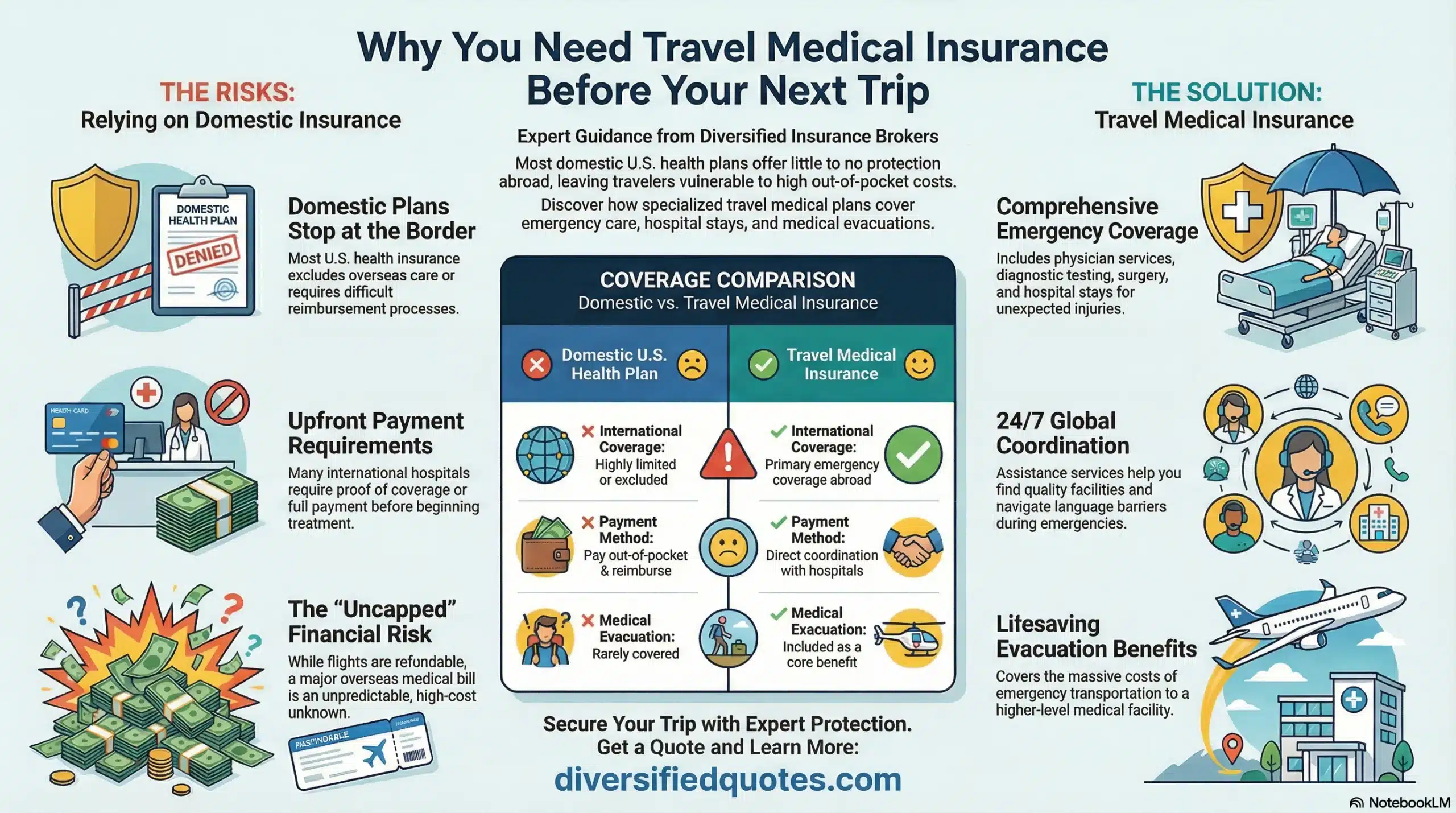
A common assumption among travelers is that their employer-sponsored health plan, Medicare, or individual marketplace coverage will handle a medical emergency abroad the same way it does at home. This assumption is almost always incorrect and can be financially catastrophic. Most U.S. domestic health insurance plans explicitly exclude or severely limit coverage for care received outside the United States. Medicare, in particular, provides no coverage for medical care abroad in the vast majority of situations — and since Medicare covers tens of millions of Americans who travel internationally, this gap affects an enormous number of travelers who may not realize their exposure. Seniors who rely on Medicare for all their domestic health coverage should review travel medical insurance options designed specifically for seniors before any international trip.
Even private plans that nominally offer some international coverage typically pay only a fraction of actual costs, apply high deductibles that reset for out-of-network or out-of-country care, and rarely if ever cover medical evacuation. A hospital in many popular international destinations may require a cash deposit or full payment before admitting a patient for non-emergency care, and even emergency admissions often require payment guarantees that domestic insurance companies abroad cannot easily provide. Travel medical insurance bridges this gap by providing a dedicated policy that functions as primary or supplemental international coverage with the infrastructure — including 24-hour emergency assistance lines and direct-pay relationships with hospitals internationally — that makes coverage practically useful in a crisis. For Americans traveling abroad specifically, emergency travel medical insurance for U.S. citizens addresses these gaps directly.
Medical Evacuation: The Hidden Financial Risk
Of all the benefits available through travel medical insurance, medical evacuation coverage is the one most travelers underestimate until they need it. A medical evacuation transports an injured or critically ill traveler from the location where an emergency occurred to the nearest facility capable of providing appropriate treatment, or back to their home country when local medical infrastructure is insufficient. According to guidance from the U.S. State Department, medical evacuation by air ambulance back to the United States can cost between $20,000 and $200,000 depending on the traveler’s location and medical condition — and that figure covers transportation only, not the treatment itself. In particularly remote or logistically complex situations, evacuation costs can exceed $250,000.
These are not theoretical numbers. Air ambulance flights require specialized aircraft, medical personnel on board, coordination with receiving hospitals, international regulatory compliance, and fuel for potentially very long distances. A traveler injured in a remote area of a developing country may require a helicopter transfer to a regional airport, then a dedicated medical aircraft back to the United States with physicians and nurses aboard for a flight that may last many hours. Without coverage, this expense falls entirely on the traveler or their family. With adequate emergency medical evacuation insurance, the carrier manages the logistics and absorbs the cost. This benefit alone often justifies the entire premium of a travel medical policy many times over, which is why medical evacuation coverage should be a non-negotiable element of any plan selected at the last minute.
What to Prioritize When Time Is Short
When purchasing travel medical insurance at the last minute, the decision framework should be deliberately simplified. With limited time to review every policy detail, focusing on the three most financially significant exposures produces the best outcome. Emergency medical coverage limits should be adequate for the destination — a minimum of $100,000 in emergency medical benefits is a reasonable baseline for most international travel, with $50,000 representing an absolute floor for short trips to countries with accessible healthcare. For cruise travel or travel to remote or developing-world destinations, coverage limits of $250,000 or more are advisable. Medical evacuation coverage should be at least $250,000 and ideally $500,000 or higher, given that evacuation costs are highly variable and the downside of underinsurance is severe.
The third consideration is the carrier’s emergency assistance infrastructure. A travel medical policy is only as useful as the support available when a claim occurs. Look for plans with 24-hour multilingual emergency assistance lines, direct-billing arrangements with hospitals abroad, and demonstrated experience handling claims in the destination region. This is where working with an independent broker who knows the carrier landscape provides real value — the difference between a carrier with strong in-country relationships in your destination and one without can determine whether coverage is practical or theoretical when an emergency occurs. Travelers heading to higher-risk destinations or regions with limited medical infrastructure should also look at travel and medical insurance specifically designed for high-risk travel, which often includes enhanced evacuation benefits and security-related coverage that standard plans do not provide.
Destination-Specific Considerations for Last-Minute Buyers
The appropriate coverage structure varies significantly by destination, and this remains true whether you purchase weeks in advance or hours before departure. Travel to countries within Europe generally involves access to healthcare systems that, while not identical to the U.S. system, maintain relatively high standards and are navigable with assistance. Medical costs in Western Europe are substantial by global standards, but the logistics of treatment and communication are typically less complicated. Travelers heading to destinations in Latin America, Africa, the Middle East, Southeast Asia, or other regions with less developed medical infrastructure face qualitatively different risks, where evacuation to a higher-level facility is more frequently necessary and the cost of that evacuation is higher. Destination pages such as travel medical and evacuation coverage for Colombia, travel medical and evacuation coverage for Egypt, or travel medical and evacuation coverage for Haiti address the specific coverage considerations for those regions.
Some destinations involve elevated risk profiles that go beyond medical emergencies to include political instability, civil unrest, or active conflict. Travelers to regions such as Ukraine or areas of ongoing concern like Gaza require policies that specifically address security evacuation — a distinct and separately priced benefit from medical evacuation. Standard travel medical policies frequently exclude coverage for events arising from war, civil war, or terrorism, meaning travelers to high-risk areas need to carefully verify what their policy covers and what it excludes before departure. The high-risk travel insurance category is specifically designed for these situations and remains purchasable at the last minute in most cases. For travelers to extreme-risk environments such as active conflict zones, specialized policies including those covering travel medical and evacuation coverage for Afghanistan exist within the specialty market.
Special Traveler Populations and Last-Minute Needs
Certain traveler categories face distinct considerations when purchasing travel medical insurance at the last minute. Seniors represent the group with the most to lose from delayed purchase decisions, because age-related health conditions increase the likelihood that a medical event will occur during travel and also increase the cost of any treatment needed. Seniors on Medicare face the specific gap described above — Medicare does not follow them abroad — while those with Medicare Supplement (Medigap) plans may have limited foreign emergency coverage under certain plan types, typically subject to a lifetime cap and applicable deductibles. Purpose-built travel medical insurance for seniors addresses these gaps with appropriate coverage structures.
International students studying abroad face a different but equally significant exposure. Most university health plans provide limited or no coverage outside the United States, and the academic environment — including travel for breaks, research trips, or internships in third countries — creates extended international exposure that standard single-trip policies may not fully address. Dedicated travel medical insurance for students studying abroad and travel medical coverage for international students provide the continuous, semester-length protection this population needs. Remote workers and digital nomads who travel continuously without a fixed home base represent another distinct need — travel insurance for digital nomads is structured for ongoing, multi-country coverage rather than single discrete trips.
Group travelers — whether traveling for mission work, humanitarian assignments, or organized events — also have last-minute purchase options, though group policies require slightly more lead time in some cases. Travel medical insurance for large groups, mission trip travel insurance, and travel insurance for humanitarian aid workers each address the unique coverage requirements of organized international travel, including professional liability considerations and security-related evacuation provisions that standard individual policies typically do not include.
The Relationship Between Travel Medical Insurance and Long-Term Care
One of the less-discussed gaps that drives last-minute travel insurance purchases is the realization that long-term care insurance policies, designed to cover chronic care needs in domestic settings, do not provide meaningful coverage for acute medical emergencies abroad. Some long-term care policies include limited provisions for care outside the United States, but these provisions are generally narrowly defined, subject to significant benefit caps, and focused on extended custodial care rather than acute emergency treatment or evacuation. A traveler who discovers the day before a trip that their long-term care insurance does not cover them overseas is correctly identifying a real gap — and travel medical insurance is the appropriate solution. Similarly, short-term health insurance policies purchased for domestic coverage gaps provide no meaningful international medical protection; short-term health insurance and travel medical insurance are distinct products serving different needs.
For travelers with pre-existing conditions who are concerned about coverage, the absence of a pre-existing condition waiver in a last-minute policy does not mean all coverage is voided for those conditions. Most travel medical policies still cover acute emergencies and life-threatening events related to pre-existing conditions even without a formal waiver — they simply may not cover non-emergency care or routine management of those conditions. The specific language varies by carrier and policy, making it essential to review the policy terms carefully or work with a broker who can identify which plans provide the most favorable treatment of pre-existing conditions within the constraints of a last-minute purchase. For travelers with particularly complex medical histories, international travel health coverage options that include medically underwritten structures may provide more certainty about what is and is not covered.
How to Buy Travel Medical Insurance at the Last Minute: A Practical Framework
The purchase process itself should take no more than fifteen to thirty minutes when approached with the right information in hand. You will need your travel dates, destination country or countries, the ages of all travelers to be covered, and a sense of whether you want coverage limited to medical and evacuation or broader trip protection. Online comparison tools allow you to generate multiple quotes simultaneously, though the volume of options and the variation in policy language can make quick decisions difficult without expertise in reading policy terms. This is where engaging an independent broker even at the last minute adds genuine value — a phone call or message that takes a few minutes can result in a comparison of carrier options tailored to your destination, age, and coverage priorities rather than a generic list of plans.
Once you select a policy, the application process is entirely digital in most cases and takes minutes to complete. Confirmation and policy documents are delivered by email immediately upon payment. Save copies to both your phone and a cloud storage location before departure, and share the emergency assistance phone number — typically printed prominently on the policy ID card — with a trusted contact at home. Some carriers have dedicated apps that allow digital access to your policy documents and one-touch connection to their emergency assistance teams while abroad. In a genuine emergency, you or someone with you should contact the insurer’s emergency assistance line before making treatment decisions when possible — the assistance team can help direct you to preferred providers, arrange direct payment to hospitals, and coordinate evacuation logistics in ways that are far more difficult to manage after the fact. For further context on what coverage encompasses, our travel medical insurance overview covers the full range of available options and how they compare.
Talk With an Advisor Today
Choose how you’d like to connect—call or message us, then book a time that works for you.
Schedule here:
calendly.com/jason-dibcompanies/diversified-quotes
Licensed in all 50 states • Fiduciary, family-owned since 1980
Frequently Asked Questions: Last-Minute Travel Medical Insurance
Can I really buy travel medical insurance on the day of departure?
Yes. Many travel medical insurance carriers allow purchase up until 11:59 p.m. the day before departure, and some plans specifically designed for last-minute travelers can be purchased the morning of departure right up until you leave home. Coverage activation timing varies — some policies take effect the following calendar day, while certain same-day plans activate immediately upon purchase confirmation. If you are purchasing on the day of your flight, confirm the exact activation time with the carrier before assuming protection begins at the moment of purchase. The application and payment process is entirely online and takes minutes to complete, with policy documents delivered to your email immediately. There is no underwriting review or waiting period for standard travel medical coverage. Price does not increase because you purchased late — premiums are based on your destination, trip length, and age, not on how far in advance you bought.
What is the most important coverage to have in a last-minute travel medical policy?
Emergency medical coverage and medical evacuation are the two benefits that matter most in any last-minute travel medical policy, and both are available without timing restrictions. Emergency medical coverage pays for hospital care, physician treatment, surgery, and related services when you experience an unexpected illness or injury abroad. Medical evacuation pays for transportation to an appropriate medical facility — or back to the United States — when local care is insufficient. According to U.S. State Department guidance, medical evacuation by air ambulance can cost between $20,000 and $200,000 or more depending on location and condition severity, not including the cost of treatment itself. Without evacuation coverage, this expense falls entirely on the traveler. A minimum of $100,000 in emergency medical coverage and $250,000 in medical evacuation coverage is a reasonable starting benchmark, with higher limits recommended for remote destinations, developing countries, or cruise travel where logistical complexity increases costs significantly.
Does last-minute travel medical insurance cover pre-existing conditions?
This depends on the specific policy and the nature of the condition. Full pre-existing condition waivers — which explicitly extend coverage to medical events related to conditions you had before the trip — typically must be purchased within fourteen days of your initial trip deposit to qualify. If you are buying at the last minute, you have almost certainly missed this window. However, the absence of a formal waiver does not mean all care related to pre-existing conditions is categorically excluded. Many travel medical policies still cover acute life-threatening emergencies related to pre-existing conditions even without a waiver, on the basis that the emergency was unforeseeable. The language varies significantly across carriers and policies. For travelers with serious pre-existing conditions planning international trips, the best practice is to review policy terms for the specific language about pre-existing conditions or work with a broker who can identify which available plans provide the most favorable treatment within the constraints of last-minute purchase.
Does Medicare cover medical emergencies abroad?
In the vast majority of situations, Medicare provides no coverage for medical care received outside the United States. This is one of the most significant and underappreciated gaps in retirement health coverage. Original Medicare (Parts A and B) excludes international care with very narrow exceptions, and Medicare Advantage plans generally follow similar restrictions. Some Medicare Supplement plans (Medigap) do include limited foreign travel emergency coverage under specific plan types, typically subject to a lifetime maximum benefit and applicable deductibles. However, even Medigap foreign travel benefits are designed for emergency coverage only, usually capping at $50,000 lifetime after a deductible — far below what a serious medical event or evacuation abroad could cost. Seniors who rely on Medicare as their primary health coverage should treat travel medical insurance as an essential purchase rather than an optional add-on before any international trip, regardless of how close to departure the purchase occurs.
How much does last-minute travel medical insurance typically cost?
Travel medical insurance premiums are generally quite affordable relative to the financial exposure they cover, and the cost does not increase because you are purchasing at the last minute. Pricing is determined by destination, trip duration, traveler age, and coverage limits selected. A healthy adult in their forties taking a two-week trip to Europe might pay anywhere from $50 to $150 for a solid travel medical policy depending on coverage limits. Older travelers and those selecting higher coverage limits pay more. Plans focused exclusively on medical and evacuation coverage — without trip cancellation or other pre-trip protections — tend to be at the lower end of the cost range because they cover only the in-trip exposure period. When weighed against the potential out-of-pocket cost of a single emergency hospitalization abroad or a medical evacuation, which can reach six figures without insurance, the premium represents a straightforward value proposition regardless of when in the planning process it is purchased.
Can I buy travel medical insurance after I have already departed?
Some carriers do allow purchase after departure, but with meaningful limitations. Post-departure policies typically include a waiting period — often 24 to 72 hours — before coverage activates, which exists to prevent travelers from purchasing coverage only after an illness or injury has already occurred. During that waiting period, no claims are payable. Additionally, a known-event exclusion applies regardless of timing: if you were already aware of a medical issue before purchasing the policy, coverage for that specific condition will be denied. Post-departure options are genuinely more limited than pre-departure options and should be treated as a last resort rather than a strategy. The practical takeaway is to purchase before departure whenever possible, even if that means buying the morning you leave. The few minutes spent securing coverage before boarding is vastly preferable to navigating post-departure purchase restrictions while already abroad.
What should I do first in a medical emergency abroad?
If you or a traveling companion experiences a medical emergency abroad, the first priority is getting appropriate immediate care. Do not delay emergency treatment while attempting to navigate insurance details — life-threatening situations require medical response first. Once the situation is stabilized, contact your travel medical insurance carrier’s emergency assistance line as quickly as possible. This number should be saved in your phone before departure and is typically printed on your policy ID card. The emergency assistance team can help identify the most appropriate facility for further treatment, arrange direct billing so you do not have to pay out-of-pocket and seek reimbursement later, coordinate medical evacuation if needed, and communicate with your family or contacts at home. Attempting to manage an international medical emergency without activating your insurer’s assistance team is a common mistake that can lead to higher costs, logistical complications, and delayed evacuation decisions. The assistance infrastructure is one of the primary things you are paying for in a travel medical policy.
Is travel medical insurance required for international travel?
Some countries require proof of travel medical insurance meeting minimum coverage standards as a condition of entry, while others have no such requirement. The Schengen Area in Europe has historically required visitors on certain visa types to carry travel medical insurance with minimum emergency and repatriation coverage. Some Caribbean nations have implemented similar requirements at various points. Requirements change, and entry rules evolve, making it important to check current requirements for your specific destination through official government travel advisories before departure. Even where coverage is not legally required, it is practically essential: a country does not need to mandate insurance for the financial and logistical consequences of traveling without it to be severe. The question of legal requirement is somewhat secondary to the question of financial exposure — both answer in favor of coverage regardless of the destination’s formal entry rules.
What is the difference between travel medical insurance and a comprehensive travel insurance plan?
Travel medical insurance is focused specifically on the health and medical exposure of international travel — it covers emergency medical treatment, hospitalization, medical evacuation, and repatriation, and often includes accidental death and trip interruption related to medical events. Comprehensive travel insurance packages combine these medical benefits with pre-trip protections including trip cancellation coverage, cancel-for-any-reason upgrades, baggage protection, and travel delay benefits. The comprehensive packages cost more and include the time-sensitive benefits that are no longer fully accessible when purchasing at the last minute. For a traveler buying coverage the day before departure who has already paid for a non-refundable trip, the practical calculus often favors a travel medical plan — the trip cancellation benefit is no longer relevant once departure is imminent, and the medical protections that remain available cover the exposures that matter most during the trip itself.
About the Author:
Jason Stolz, CLTC, CRPC, DIA, CAA and Chief Underwriter at Diversified Insurance Brokers (NPN 20471358), is a senior insurance and retirement professional with more than 25 years of real-world experience helping individuals, families, and business owners protect their income, assets, and long-term financial stability. As a long-time partner of the nationally licensed independent agency Diversified Insurance Brokers, Jason provides trusted guidance across multiple specialties—including fixed and indexed annuities, long-term care planning, personal and business disability insurance, life insurance solutions, Group Health, Travel Medical and Evacuation Insurance, and short-term health coverage. Diversified Insurance Brokers maintains active contracts with over 100 highly rated insurance carriers, ensuring clients have access to a broad and competitive marketplace.
His practical, education-first approach has earned recognition in publications such as VoyageATL, and contributions from his agency featured in Kiplinger and GoBankingRates— highlighting his commitment to financial clarity and client-focused planning. Drawing on deep product knowledge and years of hands-on field experience, Jason helps clients evaluate carriers, compare strategies, and build retirement and protection plans that are both secure and cost-efficient. Visitors who want to explore current annuity rates and compare options across multiple insurers can also use this annuity quote and comparison tool.
Explore More Travel Medical Insurance Options: Browse our complete guide to Travel Insurance Planning & Education — covering how it works, costs, last minute coverage, high risk travel & buying guides.
Last Reviewed: June 11, 2026 |
Reviewed by: Jason Stolz, CLTC, CRPC, DIA, CAA
Chief Underwriter, Diversified Insurance Brokers, Inc. | NPN: 20471358 | Diversified Insurance Brokers, Inc. — Licensed in all 50 states
Fact Checked by: Tonia Pettitt, CMIP©
Medicare Specialist, Diversified Insurance Brokers, Inc. | NPN: 14374308 | Diversified Insurance Brokers, Inc. — Licensed in all 50 states
Did you find this content helpful? Leave us a Google review — it helps others find trustworthy guidance too.
Editorial Standards: Diversified Insurance Brokers maintains rigorous editorial standards to ensure accuracy, clarity, and independence in all content. Learn more about our editorial standards and commitment to transparency.
