
Can you use Long Term Care Insurance Overseas
Can you use Long Term Care Insurance Overseas

Jason Stolz CLTC, CRPC, DIA, CAA
Long term care insurance overseas is available — and with the right policy structure, it is available without geographic restriction, benefit reduction, or the requirement to return to the United States to maintain payments. The answer to “can you use long term care insurance overseas?” is yes, but only when two conditions are met: the policy uses an indemnity payment structure rather than a reimbursement structure, and the specific contract does not contain geographic limitation provisions that cap, restrict, or eliminate benefits when care occurs outside U.S. borders. These two conditions are not met by every long term care insurance policy currently in the market, which is why the question deserves a more careful answer than a simple yes or no.
The demand for long term care insurance overseas has grown in direct proportion to the number of Americans seriously considering — or actively pursuing — retirement outside the United States. Expatriate retirement destinations in Central America, Southeast Asia, Southern Europe, and South America have attracted millions of U.S. retirees drawn by lower costs of living, favorable climates, high-quality medical care at a fraction of U.S. prices, and lifestyle considerations that make aging abroad genuinely appealing. Many of these retirees have Social Security income, IRA distributions, pension payments, and investment portfolios that travel with them across borders without restriction. What frequently does not travel seamlessly is the long term care protection they purchased years earlier — or that they are now considering — because many long term care insurance policies were designed for domestic care delivery in a U.S. provider network framework that simply does not apply outside the country. Understanding which policy structures solve this problem and which create it is the most important planning task for any retiree considering aging outside the United States. At Diversified Insurance Brokers, we work with the carriers and policy designs that provide genuine long term care insurance overseas — and we help clients assess whether an existing policy actually delivers what it appears to promise for international use. Our resource on long-term care insurance services covers the full LTC planning landscape, and our resource on long-term care planning strategies covers how international considerations fit within a comprehensive retirement protection framework.
Verify which long term care insurance structures provide 100% international benefits — and compare indemnity hybrid designs against traditional reimbursement policies.
Why Long Term Care Insurance Overseas Matters More Than Most Retirees Realize
The financial case for long term care insurance overseas rests on the same foundation as domestic long term care planning — the projected cost of formal paid care, the probability that care will be needed, and the gap between what Medicare and personal savings can sustain and what comprehensive care actually costs. Milliman’s 2025 Long-Term Care Index projects that the average lifetime cost of formal paid long term care for a 65-year-old is approximately $135,000, with women facing roughly $171,000 and men approximately $98,000 reflecting women’s longer average longevity. These projections assume services are paid at commercial market rates without Medicaid offsets, and actual costs range from under $30,000 for short-duration needs to over $660,000 for extended care at high-acuity levels. (This is approximate data from Milliman’s published index — verify current figures directly for planning purposes.)
For retirees planning to age internationally, the financial picture has an additional layer of complexity and, in some respects, opportunity. Care costs in many international retirement destinations are substantially lower than comparable care in the United States — professional in-home care, assisted living, and memory care facilities in countries such as Mexico, Costa Rica, Portugal, Thailand, and Malaysia can cost a fraction of what equivalent services cost in American markets. This cost differential means that a well-structured long term care insurance overseas benefit pool may effectively provide longer duration coverage internationally than the same benefit would provide domestically, because each monthly benefit stretches further against lower local care costs. That cost advantage, however, is only realized when the policy’s payment structure allows access to the full benefit pool overseas without restriction. A policy that limits international benefits to 50% of the maximum benefit, or caps overseas payments at 24 months, forfeits precisely this advantage at the moment it matters most.
The Critical Difference That Determines Overseas Long Term Care Coverage Quality
The single most important structural distinction for long term care insurance overseas is the payment mechanism: indemnity versus reimbursement. This distinction — which many policyholders and even some financial advisors do not fully understand — determines whether international coverage works seamlessly or creates exactly the kind of logistical problems it was supposed to prevent.
An indemnity-based long term care insurance policy pays a defined cash benefit directly to the policyholder once eligibility for chronic illness benefits is established through the required certification process. The payment is not tied to specific care providers, invoices, facility billing systems, or documentation of expenses incurred. The certified chronically ill policyholder receives the contracted monthly benefit — in cash — and uses those funds to arrange whatever combination of care best serves their situation in their location. For long term care insurance overseas, this indemnity structure is transformative: the benefit flows to the policyholder regardless of where they live, regardless of whether local providers meet U.S. licensing standards, regardless of whether foreign billing documentation matches U.S. reimbursement formats, and regardless of currency or local regulatory environment.
A reimbursement-based long term care insurance policy works fundamentally differently. Instead of paying cash to the policyholder, it reimburses documented eligible care expenses submitted with supporting provider invoices and records. The policy defines what types of providers and care settings qualify for reimbursement — and those definitions are written for a U.S. domestic care delivery context. This creates compounding problems for long term care insurance overseas: foreign providers may not carry U.S.-equivalent state licensing; billing documentation from non-English-speaking providers may not meet carrier formatting requirements; claims processing may require translation and international communication that creates significant delays; and in some cases, the carrier’s reimbursement guidelines require residency in the United States, effectively making the policy non-functional for a permanent expatriate.
How Traditional Standalone LTC Policies Fail International Retirees
Traditional standalone long term care insurance policies — the kind sold primarily between the 1980s and 2010s that provide a daily or monthly benefit for qualifying care expenses — handle international coverage in a range of ways, and none of them provide the seamless, unrestricted access that an indemnity-based hybrid delivers. Understanding these limitations before purchasing or committing to a domestic-only policy is essential for anyone whose retirement plans include significant time outside the United States.
Some standalone LTC policies provide no international coverage at all. The policy defines covered care as care delivered within the United States, and any care received outside U.S. borders is simply not a covered expense regardless of medical necessity, caregiver qualifications, or clinical appropriateness. For policyholders who purchased these policies without asking about international provisions — and many did, because their financial advisor was not thinking about international retirement scenarios at the time of purchase — discovering this limitation when the need for care arises abroad represents a significant planning failure.
Other standalone LTC policies provide limited international coverage — typically capped in duration (commonly 6 months to 2 years from the date of the first covered expense abroad), capped as a percentage of the maximum benefit (commonly 50% of the domestic daily or monthly maximum), or restricted to specific care settings (nursing home care only, for example, excluding home care and assisted living that might be more appropriate for international care arrangements). These limited provisions provide some protection but are structurally inadequate for a retiree who intends to age primarily or permanently outside the United States, because the duration and benefit limitations will eventually require either a return to the U.S. to continue receiving full benefits or absorption of care costs beyond the capped international provision.
Long Term Care Insurance Overseas: How Policy Structures Compare
| Policy Structure | Payment Mechanism | International Duration | Benefit Amount Overseas | Provider Requirement | Best For Expats? |
|---|---|---|---|---|---|
| Indemnity hybrid (e.g., John Hancock LifeCare) | Cash to policyholder upon certification | Full benefit pool — no time cap | 100% of maximum monthly benefit | None — funds paid to policyholder | Yes — optimal structure |
| Reimbursement standalone — limited international | Reimburses documented expenses | Typically 6 months to 4 years maximum | 50% of maximum or less | Foreign providers must meet U.S.-equivalent standards | Partially — short-term or travel only |
| Reimbursement standalone — no international | Reimburses U.S. documented expenses only | Zero — no international benefit | 0% — must return to U.S. for coverage | U.S. licensed providers required | No — policy non-functional overseas |
| Reimbursement hybrid with partial international | Reimburses documented expenses abroad | Variable — carrier-specific | Reduced percentage or capped dollar amount | Qualifying foreign providers required | Partially — read geographic clauses carefully |
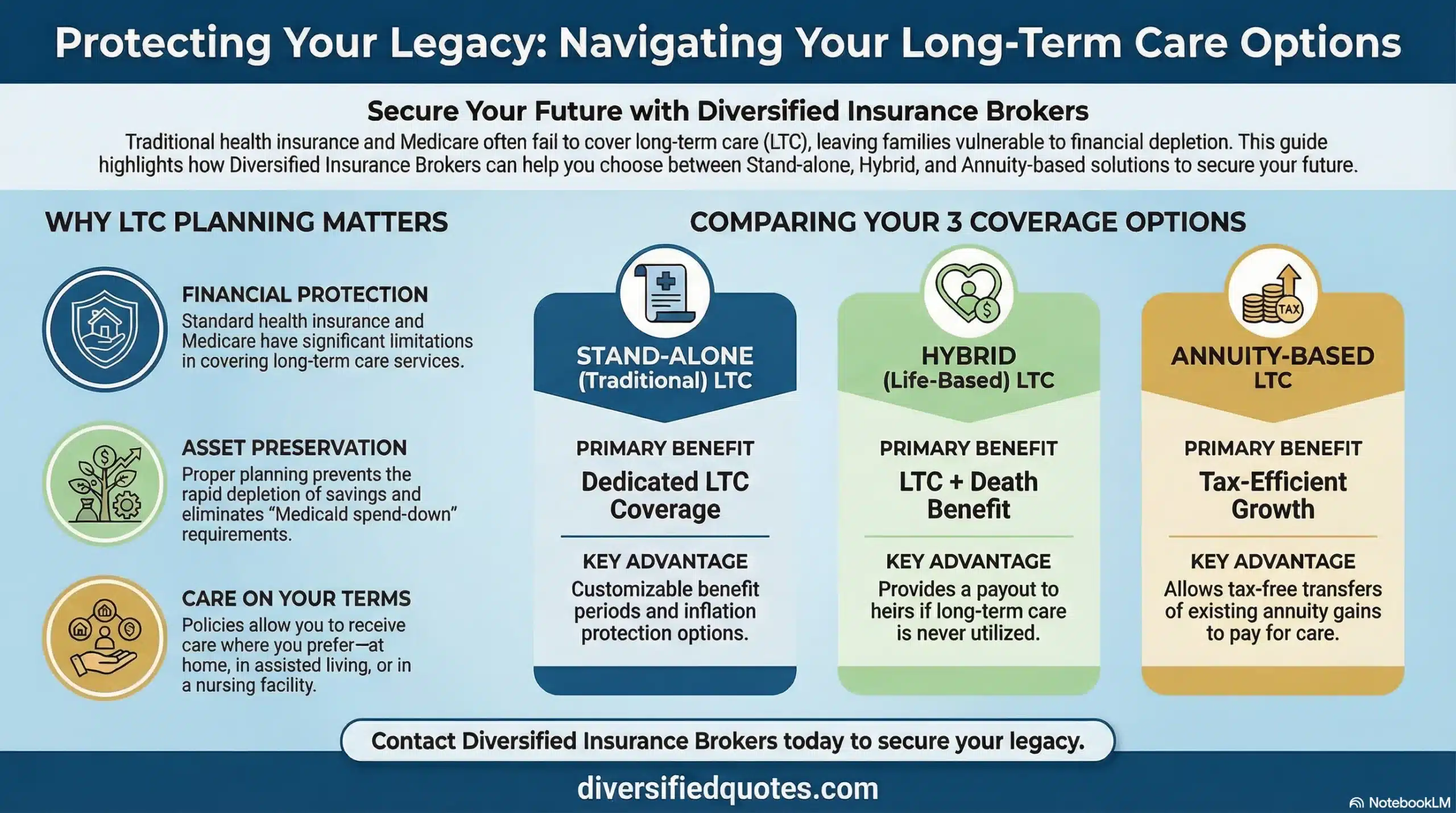
The table illustrates why indemnity-based hybrid long term care insurance overseas is structurally superior to all alternatives for retirees who plan to age internationally. The other structures impose exactly the limitations — benefit reductions, time caps, and provider restrictions — that make long term care insurance overseas practically difficult to access when it is needed most. Our resource on the John Hancock LifeCare Hybrid Life-LTC policy covers the specific indemnity hybrid design that provides 100% international access, and our resource on hybrid life vs traditional long term care insurance covers the broader structural comparison between these two policy approaches.
How Medicare Fails International Retirees Seeking Long Term Care Coverage
One of the most consequential misconceptions in retirement planning for international retirees is the assumption that Medicare will provide meaningful long term care coverage abroad. This assumption is incorrect in two distinct ways: Medicare does not cover custodial long term care anywhere, and Medicare generally does not provide any benefits outside the United States even for skilled nursing care it would otherwise cover domestically.
On the first point: Medicare’s coverage of nursing home and assisted living care is severely limited even within the United States. Medicare Part A covers skilled nursing facility care only following a qualifying hospital stay of at least three days, only for the first 100 days, only when skilled care (not custodial care) is medically necessary, and only in a Medicare-certified skilled nursing facility. The personal assistance with activities of daily living that constitutes the bulk of actual long term care need — help with bathing, dressing, toileting, eating, continence, and mobility — is classified as custodial care by Medicare and is not covered at all, anywhere. This gap is why long term care insurance planning exists in the first place.
On the second point: Medicare’s geographic coverage is restricted to the United States, with very limited exceptions for emergency care near the Canadian or Mexican border in certain circumstances. A permanent resident of Spain, Costa Rica, or Thailand has no Medicare coverage for any medical or nursing services received in those countries — not for skilled nursing care, not for skilled therapy, and not for any other covered service. Medicare does not travel with the policyholder internationally. Our resource on whether Medicare covers long term care covers this gap in comprehensive detail, and our resource on whether Medicare and long term care insurance are the same covers the foundational distinction between these two types of coverage.
The Cost Advantage of Long Term Care Overseas
One of the most compelling — and least appreciated — aspects of long term care insurance overseas for expatriate retirees is the cost differential between U.S. care and comparable care in popular international retirement destinations. Care costs in the United States have escalated significantly: the national median annual cost of a private room in a nursing home is approximately $108,000 to $110,000 per year (this is approximate — verify current figures with the Genworth or Brightspring cost of care surveys for planning purposes), and home health aide services average $25 to $35 per hour in many U.S. markets.
In many of the most popular international retirement destinations, equivalent or comparable care is available at dramatically lower cost. In-home caregiving assistance in Mexico, Costa Rica, Thailand, and Malaysia can be arranged for a fraction of U.S. hourly rates. Assisted living facilities in these markets that meet high standards of care frequently operate at monthly costs equivalent to mid-range American apartment rentals. Memory care and skilled nursing facilities in countries with strong medical tourism infrastructure often provide quality care at 20% to 40% of equivalent U.S. costs.
This cost differential has a direct implication for long term care insurance overseas benefit planning: the same monthly benefit amount that might sustain 2 to 3 years of home care in a high-cost U.S. market could sustain 5 to 7 years or more of comparable care in a lower-cost international market. A policy benefit pool that appears barely adequate for domestic care can become genuinely comprehensive for international care, provided the policy structure allows full access to the benefit pool overseas. This cost amplification effect is one of the strongest financial arguments for purchasing long term care insurance overseas coverage — and for ensuring the policy structure is indemnity-based so the benefit amplification can actually be realized. Our resource on the cost of long term care by state calculator provides the domestic cost baseline that helps frame the international cost differential.
Who Most Needs Long Term Care Insurance Overseas
The profile of retirees for whom long term care insurance overseas is most urgently important has expanded significantly as international retirement has moved from a niche choice to a mainstream retirement option. Several categories of retirees should treat international LTC coverage as a planning priority rather than an optional consideration.
Permanent expatriates — retirees who have relocated their primary residence outside the United States and do not plan to return for care — have the most acute need for long term care insurance overseas. For these individuals, a policy without full international access is not a safety net; it is a document that provides false security until the moment of need, at which point it either requires a medically disruptive return to the United States or provides a fraction of the contracted benefit. The permanent expatriate needs a policy whose international coverage provision is identical in scope to its domestic provision — not a policy with a capped or time-limited international add-on.
Dual residents — retirees who split time between the United States and one or more international locations — face a different but related challenge. Their care need may arise in either location, and a policy that provides full coverage domestically but limited or no coverage internationally creates an asymmetric risk exposure based purely on geography at the time of need. An indemnity-based policy that pays the same monthly cash benefit regardless of location eliminates this geographic asymmetry entirely.
Extended international travelers — retirees who spend 3 to 6 months annually in international destinations without permanently relocating — may also encounter the international coverage gap if a care need arises during an extended international stay. A reimbursement policy that caps international benefits at 6 months provides no coverage for someone in the fourth month of an extended stay who needs care and cannot immediately return to the United States for domestic policy benefits to activate. Our resource on long term care insurance for seniors covers the planning considerations across different retirement lifestyle profiles.
How Chronic Illness Certification Works for Long Term Care Insurance Overseas Claims
Both traditional and hybrid long term care insurance policies require a formal certification of chronic illness before benefit payments begin. This certification process — which establishes that the policyholder meets the contract’s definition of chronic illness and qualifies for LTC benefits — operates in a specific way for international claims that policyholders planning to use long term care insurance overseas must understand.
Under most indemnity hybrid policies, the certification must be provided by a U.S. Licensed Health Care Practitioner — a physician, registered nurse, or other health professional licensed under state law in the United States. For a policyholder residing abroad, this requirement does not mean the practitioner must be physically present at the certification; it means the certifying practitioner must hold a U.S. license. This requirement typically means the policyholder needs access to either a U.S.-licensed physician practicing internationally or a telemedicine provider operating under U.S. licensure. Telehealth services have expanded significantly, making this less of a practical barrier than it was in prior years, but it remains an administrative requirement that international policyholders must plan for.
Certification is typically updated annually — but not more frequently than every 90 days — for ongoing benefit payments. Once the initial certification establishes chronic illness eligibility and indemnity payments begin, the ongoing requirement is periodic re-certification confirming continued chronic illness status. For permanent expatriates with established relationships with U.S.-licensed telemedicine providers, this annual certification process is manageable but requires advance planning. For policyholders whose care needs are long-term and stable, some carriers simplify the ongoing certification process once the initial determination is well-established. Confirming the specific certification requirements with the carrier before committing to an expatriate retirement location prevents surprises at the claims stage. Our resource on how to qualify for long term care insurance covers the eligibility and certification framework in detail.
Tax Treatment of Long Term Care Insurance Benefits Paid Overseas
The federal income tax treatment of qualified long term care insurance benefits does not change based on where the policyholder receives care. Qualified long term care insurance benefits — including indemnity payments from hybrid policies that meet the IRS definition of qualified long term care contracts under Internal Revenue Code Section 7702B — are generally excludable from federal gross income within the IRS per diem limits that apply each year. This income tax exclusion applies whether the care is received in a U.S. nursing home or in a private residence in Portugal.
The per diem limitation is the one variable that policyholders should understand in the context of long term care insurance overseas. IRS per diem limits for long term care insurance indemnity payments (updated annually) establish the maximum daily benefit that can be received income-tax free without documentation of actual care expenses. Benefits within this limit are fully excludable from gross income. Benefits above this limit are also excludable, but only to the extent they equal or are less than the actual long term care expenses incurred. For expatriate retirees whose actual care costs are very low (due to the lower cost of care in international markets), the per diem limit may be more relevant to tax planning than it would be for domestic retirees whose care costs routinely exceed the limit. Our resource on whether long term care benefits are taxable covers the complete federal tax treatment framework, and our resource on tax advantages of long term care insurance covers the premium deductibility and benefit exclusion landscape.
How to Evaluate Whether Your Existing Policy Works for Long Term Care Insurance Overseas
For retirees who already own a long term care insurance policy and are now considering or planning an international retirement, the most practical immediate action is a systematic review of the existing policy’s international provisions. Most policyholders do not know the answer to the question “does my LTC policy work overseas?” without actively reviewing the contract language, because international provisions are typically not prominent in policy summaries or initial disclosure materials.
The review should focus on three specific provisions within the policy contract. First, locate the definitions section and identify how “covered care” and “covered facility” are defined — specifically whether those definitions require U.S. licensure or U.S.-equivalent certification for qualifying care. Second, locate any geographic limitation language — often found in a “benefit period,” “covered services,” or “limitations and exclusions” section — that restricts benefits to care received within the United States or within specific geographic boundaries. Third, identify the payment mechanism: reimbursement (paid upon submission of covered expense documentation) versus indemnity (paid in cash upon certification of chronic illness). These three elements together determine whether the existing policy is functional for long term care insurance overseas or whether a supplemental or replacement solution needs to be considered.
If the existing policy is reimbursement-based with limited or no international provisions, the options range from keeping the policy for potential domestic use (if the retiree may return to the United States for care) to supplementing it with a hybrid indemnity policy that provides the overseas coverage gap the existing policy cannot fill, to systematically evaluating a replacement with a hybrid that fully covers the international retirement plan. Our resource on getting a second opinion on a long term care insurance quote covers how to evaluate existing coverage against current market alternatives.
International Financial Planning Considerations That Complement Long Term Care Insurance Overseas
Long term care insurance overseas planning does not exist in isolation from the broader financial planning architecture of international retirement. Several interconnected planning considerations affect how long term care coverage fits into a comprehensive expatriate retirement strategy.
Social Security income is one of the most portable U.S. income sources for expatriate retirees — it continues to be paid regardless of residence outside the United States for most retirees, with the exception of certain restricted countries. Understanding how annual cost-of-living adjustments protect the purchasing power of this foundational income source is relevant to the overall income sufficiency analysis. Our resource on how COLA is calculated covers the adjustment mechanics for Social Security income.
IRA and 401(k) distributions continue regardless of international residence, and the tax treatment of those distributions under the applicable tax treaty between the United States and the country of residence may affect after-tax income meaningfully. Estate planning considerations also shift for international retirees — how U.S. accounts, international assets, and life insurance or hybrid LTC policies interact with estate tax rules across jurisdictions is a planning dimension that advisors specializing in expatriate retirement address directly. Our resource on what a step-up in cost basis is covers one estate planning concept that retains importance for international retirees with U.S. investment assets, and our resource on the stretch IRA ten-year rule covers inherited IRA distribution requirements that apply to U.S. accounts regardless of beneficiary residence.
International health coverage — distinct from long term care coverage — is also a critical planning element for expatriate retirees. Medicare does not cover routine medical care outside the United States, so expatriate retirees need a separate international health insurance policy to cover medical expenses in their country of residence. Our resources on international health insurance, international major medical insurance, and international travel health coverage cover the health insurance solutions that complement long term care insurance overseas in a complete expatriate retirement protection plan.
Speak With an International LTC Specialist
We’ll compare indemnity hybrid designs with full international access against your existing coverage — and show you exactly what each structure provides for long term care insurance overseas.
Request My International LTC ReviewRelated Long-Term Care Insurance Planning Pages
Explore hybrid policies, benefit structures, qualification requirements, and comprehensive LTC planning resources.
Financial Protection Essentials for International Retirees
Coordinate long term care insurance overseas with international health coverage, Medicare planning, and retirement income resources.
Talk With an Advisor Today
Choose how you’d like to connect—call or message us, then book a time that works for you.
Schedule here:
calendly.com/jason-dibcompanies/diversified-quotes
Licensed in all 50 states • Fiduciary, family-owned since 1980
Frequently Asked Questions: Long Term Care Insurance Overseas
Can you use long term care insurance overseas?
Yes — with the right policy structure. Indemnity-based hybrid life insurance with long term care riders provides cash benefits directly to the certified chronically ill policyholder regardless of where they live, allowing full access to the benefit pool internationally with no geographic restriction. Traditional standalone long term care insurance policies typically either limit international benefits (to 50% of the maximum benefit, or for 6 months to 4 years maximum), or exclude international coverage entirely. The policy structure — indemnity versus reimbursement — and the specific geographic provisions in the contract determine whether long term care insurance overseas actually works as intended. If you are planning to age outside the United States, confirming that your policy provides full international access before committing to the policy or to the international retirement plan is essential planning due diligence.
What is the difference between indemnity and reimbursement for LTC overseas?
An indemnity-based long term care policy pays a defined monthly cash benefit directly to the policyholder once chronic illness is certified — no invoices, no documentation of expenses, no provider billing requirements. This structure works seamlessly internationally because it is not dependent on foreign providers meeting U.S. licensing standards or producing U.S.-compatible billing documentation. A reimbursement-based policy reimburses documented covered expenses — and is written for a U.S. domestic care delivery context. Overseas, reimbursement policies create problems because foreign providers may not qualify under U.S. licensing definitions, documentation may not meet U.S. reimbursement formatting requirements, and some policies require U.S. residency to receive benefits. For long term care insurance overseas, indemnity is structurally superior in every way.
Does Medicare cover long term care outside the United States?
No on both counts. Medicare does not cover custodial long term care (personal assistance with activities of daily living) anywhere — domestically or internationally. And Medicare generally does not cover any medical or nursing services outside the United States, with very limited exceptions for emergency care near the Canadian or Mexican border in specific circumstances. An American retiree living permanently in Portugal, Mexico, Thailand, or any other international destination has no Medicare coverage for care received in that country. Long term care insurance overseas, combined with international health insurance for routine medical care, fills the coverage gap that Medicare cannot address for expatriate retirees.
Do I need to return to the United States to keep receiving LTC benefits?
With an indemnity-based hybrid policy, no. Indemnity cash benefits continue to be paid to the policyholder as long as the chronic illness certification requirements are met — annual certification by a U.S.-licensed health care practitioner confirming continued chronic illness status. The certification must come from a U.S.-licensed practitioner but does not require physical presence in the United States; telemedicine services operating under U.S. licensure can satisfy this requirement for many international retirees. With a reimbursement-based policy that limits international coverage, a return to the United States may be required after the international benefit duration is exhausted in order to access remaining domestic policy benefits.
Are LTC insurance benefits taxable when received overseas?
Qualified long term care insurance benefits — including indemnity payments from hybrid policies that meet IRS Section 7702B requirements — are generally excludable from federal gross income within annual IRS per diem limits. This income tax exclusion applies whether the care is received domestically or internationally; the geographic location of care does not change the federal tax treatment of qualified LTC benefits. Benefits within the per diem limit are fully excluded from income. Benefits above the per diem limit are excluded to the extent they equal actual long term care expenses incurred. Individual state tax treatment and any applicable tax treaty with the country of residence should be reviewed with a qualified tax professional for a complete picture of the tax situation for international retirees receiving LTC benefits abroad.
What should I look for in my existing LTC policy to see if it covers overseas care?
Review three specific provisions in your policy contract: first, how “covered care” and “covered facility” are defined — specifically whether U.S. or U.S.-equivalent licensure is required for qualifying providers; second, any geographic limitation language in the benefit period, covered services, or limitations and exclusions sections that restricts benefits to care received within the United States; and third, whether the payment mechanism is indemnity (cash paid upon certification) or reimbursement (expense documentation required). These three elements together determine whether the existing policy provides functional long term care insurance overseas or whether supplemental or replacement coverage should be considered for an international retirement plan.
Why is long term care insurance overseas potentially more valuable than domestic LTC coverage?
The cost differential between U.S. long term care and comparable care in popular international retirement destinations creates a benefit amplification effect for expatriate retirees. Professional in-home care, assisted living, and nursing care in countries such as Mexico, Costa Rica, Portugal, Thailand, and Malaysia can cost 20% to 50% of comparable U.S. care costs, meaning the same monthly benefit amount — applied to lower-cost international care — sustains care for proportionally longer. A benefit pool that might support 2 to 3 years of U.S. home care could support 5 to 7 or more years of comparable international care. This amplification effect is only realizable when the policy structure provides full international access — specifically, an indemnity-based structure with no geographic limitation on the benefit pool.
About the Author:
Jason Stolz, CLTC, CRPC, DIA, CAA and Chief Underwriter at Diversified Insurance Brokers (NPN 20471358), is a senior insurance and retirement professional with more than 25 years of real-world experience helping individuals, families, and business owners protect their income, assets, and long-term financial stability. As a long-time partner of the nationally licensed independent agency Diversified Insurance Brokers, Jason provides trusted guidance across multiple specialties—including fixed and indexed annuities, long-term care planning, personal and business disability insurance, life insurance solutions, Group Health, Travel Medical and Evacuation Insurance, and short-term health coverage. Diversified Insurance Brokers maintains active contracts with over 100 highly rated insurance carriers, ensuring clients have access to a broad and competitive marketplace.
His practical, education-first approach has earned recognition in publications such as VoyageATL, and contributions from his agency featured in Kiplinger and GoBankingRates— highlighting his commitment to financial clarity and client-focused planning. Drawing on deep product knowledge and years of hands-on field experience, Jason helps clients evaluate carriers, compare strategies, and build retirement and protection plans that are both secure and cost-efficient. Visitors who want to explore current annuity rates and compare options across multiple insurers can also use this annuity quote and comparison tool.
Explore More Long Term Care Insurance Options: Browse our complete guide to How to Buy, Qualify & Coverage Details — covering how to buy, who qualifies, policy types, shared benefits, partnership plans & more from top carriers.
Last Reviewed: May 24, 2026 |
Reviewed by: Jason Stolz, CLTC, CRPC, DIA, CAA
Chief Underwriter, Diversified Insurance Brokers, Inc. | NPN: 20471358 | Diversified Insurance Brokers, Inc. — Licensed in all 50 states
Fact Checked by: Tonia Pettitt, CMIP©
Medicare Specialist, Diversified Insurance Brokers, Inc. | NPN: 14374308 | Diversified Insurance Brokers, Inc. — Licensed in all 50 states
Did you find this content helpful? Leave us a Google review — it helps others find trustworthy guidance too.
Editorial Standards: Diversified Insurance Brokers maintains rigorous editorial standards to ensure accuracy, clarity, and independence in all content. Learn more about our editorial standards and commitment to transparency.
