
Short Term Care Insurance Alternatives
Short Term Care Insurance Alternatives

Jason Stolz CLTC, CRPC, DIA, CAA
Short-term care insurance alternatives are becoming an increasingly important part of retirement planning conversations because many families discover that short-duration coverage alone does not fully address the financial risks associated with extended care needs. Short-term care policies are typically designed to help pay for care during recovery periods lasting less than a year — surgical recovery, rehabilitation following orthopedic procedures, or temporary mobility limitations from acute illness. While this can be valuable for those specific scenarios, many long-term care events do not follow a short, predictable timeline. Chronic illness, cognitive decline, and progressive mobility conditions can create care needs that last for years rather than months, and when coverage designed for a six-month recovery expires mid-claim on a multi-year care event, the financial consequences for the household are often severe. Because of this reality, many retirees begin researching alternatives to short-term care insurance that can provide stronger long-term protection and better integration with retirement income planning.
At Diversified Insurance Brokers, many clients begin their research assuming short-term care coverage will be sufficient. When they begin modeling real-world care timelines, however, they often discover that the largest financial risk is not the first six months or even the first year of care — it is the period when care extends into multiple years, creating sustained monthly cash flow demands that can dramatically accelerate retirement asset withdrawals. When this happens, retirement planning shifts from managing investment growth to managing asset survival: ensuring that portfolio assets last long enough to support both the healthy spouse’s ongoing lifestyle and the care-receiving spouse’s escalating costs simultaneously. That transition is where most families begin seriously evaluating traditional long-term care insurance, hybrid life and long-term care policies, and annuity-based long-term care funding solutions as more appropriate alternatives to short-term coverage that was never designed for multi-year care scenarios. Is long-term care insurance worth it covers the cost-benefit evaluation framework that helps retirees assess whether formal insurance solutions are more appropriate than self-funding or short-term coverage approaches for their specific asset, health, and planning situation. Cost of long-term care by state calculator provides state-specific care cost data that illustrates the financial scale of multi-year care scenarios that short-term coverage does not address.
Compare Long-Term Care Alternatives
Explore stronger protection options than short-term care insurance and protect retirement savings long term.
Request LTC Planning OptionsWhy Many Families Look Beyond Short-Term Care Insurance
The primary limitation of short-term care insurance is duration — and duration is the single most important variable in long-term care financial risk. Most short-term care policies are structured to cover care needs for a limited period, often six to twelve months. While this timeframe can align reasonably well with surgical recovery or temporary rehabilitation, it does not align with the actual pattern of most long-term care events that drive household financial hardship in retirement. Many care events do not begin as obvious long-term scenarios — they evolve gradually. What begins as occasional home assistance for someone with mild balance issues or early cognitive changes can gradually transition to daily personal care support, then to assisted living placement, and eventually to memory care with full-time supervision. When short-term coverage expires at the six or twelve-month mark of a care event that ultimately lasts three or four years, the household is left self-funding through the most expensive and most financially straining phase of the care trajectory — precisely when the healthcare system has consumed the lowest-cost early-care period and the family is dealing with the highest-intensity, highest-cost phase of care.
Retirement income sustainability is the second major factor that drives interest in long-term care alternatives. Many retirees design retirement income plans around predictable withdrawal rates — systematic distributions from investment accounts calibrated to last across a defined retirement horizon. Extended care costs disrupt these plans in ways that are difficult to recover from. When investment accounts are forced to support both normal retirement living expenses and large ongoing care costs simultaneously, retirees may experience sequence-of-returns risk in its most damaging form — where large withdrawals occur during market downturns, permanently reducing the portfolio balance available for future growth and compounding. Unlike planned retirement withdrawals that can be calibrated and sequenced strategically across a long distribution period, care cost withdrawals often arrive suddenly, persist at high monthly levels, and coincide with other financial challenges rather than allowing the household to manage them on a favorable timeline. Understanding how unexpected care expenses interact with specific retirement account mechanics — including how an IRA works and how TSP retirement income mechanics function — helps illustrate how accelerated withdrawals from these accounts create both immediate tax costs and permanent long-term compounding losses that short-term care coverage does not address because its benefit period expires before the most financially damaging phase of an extended care event.
Short-Term Care vs. Long-Term Protection: Core Structural Differences
| Feature | Short-Term Care Insurance | Long-Term Care Protection Alternatives |
|---|---|---|
| Benefit duration | Typically up to 12 months — designed for recovery events with predictable timelines | 2 years to lifetime — designed for progressive conditions with uncertain durations |
| Best care scenario | Surgical recovery, acute illness rehabilitation, temporary mobility limitation | Cognitive decline, chronic illness progression, permanent mobility impairment, extended assisted living |
| Retirement impact protection | Limited — premium savings meaningful but benefit exhaustion leaves household exposed to multi-year self-funding risk | Substantial — designed to protect against the multi-year cost events that most damage retirement income sustainability |
| Spousal protection | Limited — benefit period too short to address most multi-year spousal care scenarios | Comprehensive — designed to protect healthy spouse’s financial stability throughout an extended care event |
| Inflation protection | Rarely includes inflation riders — benefit designed for near-term use where inflation impact is minimal | Inflation protection options commonly available — critical for benefits that may be used 15–25 years after purchase |
| Underwriting complexity | Typically simpler — designed for broader eligibility including older applicants with more health history | More detailed underwriting — strongest results when applied before health changes affect eligibility or pricing |
| Asset repositioning options | Typically premium-based only — not designed for asset repositioning strategies | Multiple structures available — traditional premium, hybrid life/LTC, and annuity-based designs allow asset repositioning |
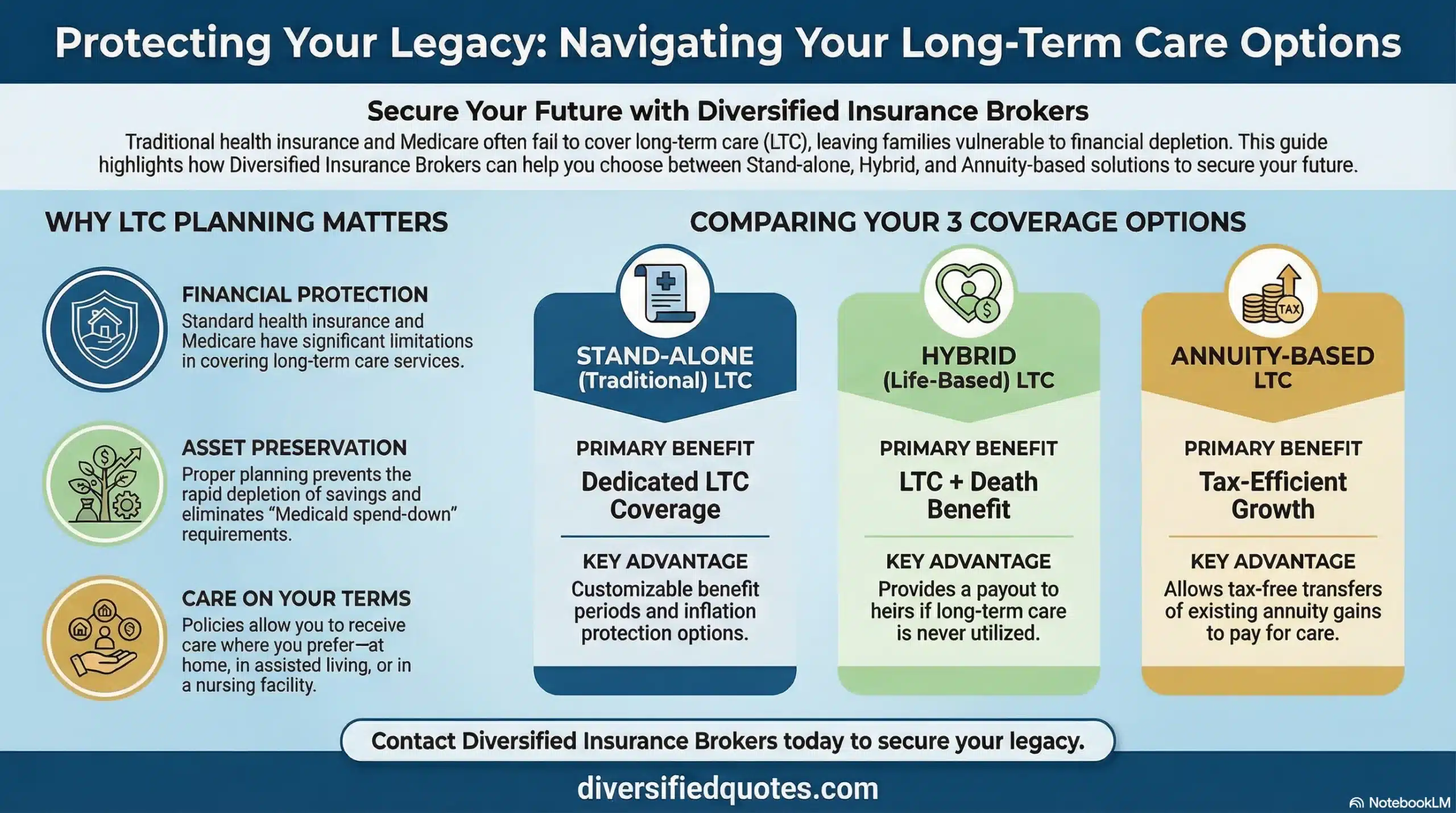
Traditional Long-Term Care Insurance
Traditional long-term care insurance remains the most direct mechanism for transferring extended care financial risk from the household to an insurance carrier — and for many retirees who qualify medically and purchase at the right age, it provides the strongest insurance leverage per premium dollar of any available LTC protection strategy. These policies are designed specifically to fund extended care events, providing monthly or daily benefit payments that can continue for two years, three years, five years, or through lifetime benefit period options depending on the design selected. Most traditional LTC policies include an elimination period — typically thirty, sixty, or ninety days of care costs before benefits begin, functioning analogously to a deductible — and accumulate a total benefit pool calculated as the daily or monthly benefit multiplied by the benefit period selected. Inflation protection riders that grow the benefit amount annually help preserve the purchasing power of benefits that may not be used until ten, fifteen, or twenty years after the policy is purchased, when care costs have risen substantially from the levels at policy issuance.
Traditional LTC insurance is often strongest for individuals who prioritize maximum insurance leverage relative to premium — because pure insurance designs without cash value or death benefit components allow more of every premium dollar to purchase care benefit capacity rather than funding a savings or investment component. These policies can be particularly effective for households focused on protecting retirement assets against catastrophic multi-year care events where the alternative is self-funding from investment accounts during the most financially damaging phase of retirement. Tax efficiency is another meaningful consideration alongside coverage structure — premium deductibility under certain conditions and the tax-free nature of qualifying LTC benefits can meaningfully improve the after-tax value of traditional LTC coverage when evaluated within the context of the broader retirement tax picture. Tax benefits of long-term care insurance covers how LTC premiums, benefits, and HSA interactions work across different tax situations. Partnership-qualified long-term care insurance covers the state Partnership programs that allow LTC policyholders to protect retirement assets from Medicaid spend-down requirements when Partnership-qualified benefits have been received — an additional layer of financial protection available with specific policy designs. How to buy long-term care insurance covers the full purchasing process including benefit design decisions, carrier selection, and underwriting navigation. How to get the best long-term care insurance rates covers the underwriting and comparison approach that produces the most competitive pricing across the carrier market. LTC insurance with lifetime benefits covers the design option for retirees who want protection against care events of any duration without a defined maximum benefit period.
Hybrid Life Insurance and Long-Term Care Policies
Hybrid life and long-term care policies combine permanent life insurance with long-term care benefits in a single contract structure whose core appeal is dual-use value — if long-term care is needed during the insured’s lifetime, the policy provides LTC benefits that can fund care costs for a defined period; if care is never needed or the benefits are not fully used, beneficiaries receive a death benefit that preserves some or all of the premiums paid. This structure addresses the “what if I never need care” concern that makes many pre-retirees reluctant to commit to traditional LTC premiums that produce no financial return if care is not used. The dual-use value proposition allows hybrid products to be positioned as financial assets with protection benefits rather than pure insurance costs, which resonates with retirees who are asset-conscious and want every dollar deployed to serve multiple planning purposes rather than single-purpose insurance protection.
Some hybrid structures are funded through regular scheduled premiums similar to traditional life insurance. Others allow single-pay or limited-pay funding structures that appeal to retirees who want to reposition a lump sum of existing assets — often lower-yield savings accounts, CDs, or investment assets earmarked for specific financial roles — into a hybrid contract that provides immediate LTC benefit access and a death benefit while eliminating ongoing premium obligations. These asset repositioning designs are particularly attractive for retirees who have identified assets that are not efficiently deployed in their current allocation but would serve a clear purpose within a hybrid LTC structure. Hybrid long-term care covers the foundational design concepts and planning applications across the range of hybrid LTC products. Hybrid life insurance with long-term care benefits covers specifically how life insurance chassis hybrid designs structure and deliver LTC benefits. Hybrid life vs traditional long-term care insurance covers the comprehensive comparison across cost, benefit flexibility, underwriting, and planning objectives. Long-term care insurance with return of premium covers how return-of-premium provisions in both traditional and hybrid designs affect the value proposition for retirees who want to preserve premiums paid if care is never fully used.
Annuity-Based Long-Term Care Strategies
Annuity-based long-term care strategies represent a third major category of short-term care alternatives that has grown significantly in availability and planning application over the past decade. These designs typically involve repositioning an existing retirement asset into an annuity structure that can increase the available monthly benefit when qualified long-term care is needed, effectively multiplying the care funding capacity available from the repositioned asset through the annuity’s LTC rider or multiplier feature. Instead of paying ongoing insurance premiums for pure care coverage, the retiree exchanges an existing asset into an annuity contract that preserves the asset’s value in the accumulation phase while providing substantially enhanced care benefits — often two to three times the contract value available for care costs — when qualifying care events trigger the LTC benefit.
For many retirees, the most compelling aspect of annuity-based LTC strategies is asset retention. Unlike pure insurance premiums that are fully consumed by the carrier if no claim is filed, the annuity remains an asset on the household balance sheet with potential income functionality and growth capacity during the non-claim period. The LTC component enhances available benefits during care events without requiring the asset to leave the household in the way that traditional insurance premiums do. The annuity can also be structured to provide guaranteed lifetime income independent of whether LTC benefits are activated — making it useful as a retirement income vehicle alongside its care funding role. Annuity with long-term care benefits and fixed annuity with long-term care benefits cover how these specific annuity-LTC combination structures are designed and how they function across different care and non-care scenarios. Annuities planning overview provides the broader annuity context for understanding how LTC-enabled annuities fit within comprehensive retirement income design. Guaranteed income from annuities covers how annuity income structures function when both care and retirement income roles are served simultaneously within the same contract.
Spousal Planning and Coordinated Care Coverage
Many couples evaluate long-term care alternatives through the lens of household survivorship planning rather than individual risk management — because when one spouse experiences an extended care event, the financial impact extends far beyond the direct care costs. The healthy spouse must maintain their own housing, lifestyle, healthcare costs, and ongoing financial obligations while potentially losing Social Security income or pension income that was structured around the care-receiving spouse’s continued presence in the household. The combined financial pressure of care costs and reduced household income can create a survivorship crisis that is more financially damaging than either factor alone, which is why coordinated coverage structures that consider both spouses’ care risk simultaneously often produce better household outcomes than two independently designed policies.
Shared benefit designs allow couples to link their individual LTC policies so that one spouse can access the other’s unused benefit pool if their own benefits are exhausted — addressing the asymmetric care risk that many couples face where one spouse has a significantly longer or more expensive care need than the other. Shared benefit long-term care planning covers how shared benefit provisions work and what they deliver in the asymmetric care scenarios that most justify the additional cost. Long-term care insurance with shared spousal benefits covers the full landscape of benefit-sharing approaches across different product types and carrier designs. Shared care riders in long-term care insurance covers the specific mechanics of shared care rider designs and how they function within the policy structure. Best independent long-term care insurance broker covers why working with an advisor who has access to the full range of LTC carriers — across traditional, hybrid, and annuity-based designs — produces the most appropriate coordinated coverage structure for any specific couple’s profile.
Inflation, Duration, and the True Long-Term Financial Risk
One of the most consistently underestimated factors in long-term care planning is the interaction between inflation and duration — because the care events that create the most severe financial damage to retirement plans are precisely the ones that are both long in duration and most affected by the cumulative inflation that accumulates across that duration. Long-term care costs are among the most inflation-sensitive categories in the healthcare sector — they are labor-intensive services provided by a workforce facing its own labor market pressures, regulated environments with increasing compliance costs, and demographic demand that is structurally growing as the baby boom generation ages through the peak long-term care utilization period. Care costs can rise significantly faster than general inflation over periods of ten to twenty years, which means a monthly benefit amount that provides adequate coverage at the time a policy is purchased may cover substantially less actual care when the benefit is finally used in retirement.
Policies with benefit growth features — compound or simple inflation riders that increase the monthly benefit by a defined percentage annually — are designed to maintain purchasing power across this long pre-claim period. The choice of inflation protection option is one of the most consequential benefit design decisions in traditional and hybrid LTC planning precisely because it determines whether the coverage delivers on its financial protection promise when it is actually needed, not just at the point of purchase. Self-funding strategies that do not explicitly account for inflation in the care cost projection also frequently underestimate the financial demand that care will create fifteen or twenty years into retirement. A realistic self-funding analysis must project care costs at actual care-inflation rates over the expected time horizon to maturity, not at general CPI inflation rates, and must evaluate how those costs interact with sequence-of-returns risk at the specific phase of retirement when care most commonly occurs. Sequence-of-returns risk covers the specific mechanism by which large forced withdrawals during market downturns permanently impair portfolio sustainability — the exact scenario that long-term care alternatives are designed to prevent when care costs create exactly this type of large, sustained withdrawal demand. How to find, evaluate, and apply for long-term care insurance covers the complete end-to-end process for evaluating and purchasing appropriate LTC coverage. How to choose the right long-term care insurance policy covers the full benefit design framework for making optimal coverage decisions across benefit amount, elimination period, benefit duration, and inflation protection options.
Build a Stronger Long-Term Care Plan
Compare traditional LTC, hybrid policies, and annuity-based strategies side by side.
Request LTC Planning OptionsSelf-Funding and When It Is a Realistic Alternative
Some retirees choose to self-fund care costs using designated retirement assets rather than purchasing formal insurance coverage — and for households with sufficient asset levels, well-structured retirement income, and a realistic assessment of care cost risk, intentional self-funding can be an appropriate component of a long-term care financial strategy. Self-funding works best when it is explicitly planned rather than the residual outcome of not purchasing coverage. Assets designated for care funding should be identified in advance and separated from the portfolio serving regular retirement income needs, so that care withdrawals have a defined source and do not compete directly with the income-generating assets the household depends on for ongoing living expenses.
The primary risk in self-funding approaches is underestimation of duration and cost. Most retirees who plan to self-fund estimate care needs based on average care durations and near-term care costs rather than worst-case scenarios, which means their self-funding reserve is calibrated for an average outcome in an experience category where variance is extremely high — some care events are short and inexpensive, and some are very long and very expensive, and the financial damage comes almost entirely from the long expensive scenarios rather than the average ones. A self-funding strategy that is adequate for an eighteen-month care event may be completely insufficient for a five-year care event with memory care facility costs, and the difference between those two scenarios is not predictable at the time the strategy is designed. The most effective self-funding approaches are typically structured as part of a hybrid strategy — using formal insurance or annuity-based coverage for the catastrophic long-duration scenarios while self-funding the more manageable early-phase care costs through the elimination period and early benefit period.
Protect Retirement Assets From Long-Term Care Risk
Build a personalized strategy using traditional LTC, hybrid solutions, or asset-based planning.
Request LTC Planning OptionsRelated Long-Term Care Planning Pages
Explore additional strategies for protecting retirement income and long-term care funding.
Talk With an Advisor Today
Choose how you’d like to connect—call or message us, then book a time that works for you.
Schedule here:
calendly.com/jason-dibcompanies/diversified-quotes
Licensed in all 50 states • Fiduciary, family-owned since 1980
Frequently Asked Questions: Short-Term Care Insurance Alternatives
What is the biggest limitation of short-term care insurance for retirement planning?
The biggest limitation is duration. Short-term care policies typically cover care for up to twelve months — which aligns well with surgical recovery and temporary rehabilitation but does not align with the care events that create the most severe financial damage in retirement. The care scenarios that most destabilize retirement income are multi-year events: progressive cognitive decline, chronic illness that requires ongoing supervision, and degenerative conditions that intensify gradually over years. When short-term coverage expires at the twelve-month mark of a care event that ultimately lasts three or four years, the household is left self-funding through the most expensive and most financially straining phase of the care trajectory — exactly when short-term coverage was expected to have helped but no longer applies.
What are the three primary alternatives to short-term care insurance?
The three primary alternative categories are traditional long-term care insurance, hybrid life and long-term care policies, and annuity-based long-term care strategies. Traditional LTC insurance provides the strongest insurance leverage relative to premium for individuals who prioritize maximum care benefit capacity and qualify medically. Hybrid policies combine permanent life insurance with long-term care benefits — providing dual-use value where the policy delivers either LTC benefits if care is needed or a death benefit to heirs if care is not used. Annuity-based strategies reposition existing retirement assets into annuity contracts that can multiply available care benefits through LTC riders or multipliers while retaining the asset value and potential income functionality during non-claim periods. Each approach has different cost structures, underwriting requirements, and planning applications that make one more appropriate than another depending on individual circumstances.
How does long-term care risk affect retirement income sustainability?
Extended care costs can disrupt retirement income plans in ways that are difficult to recover from. Many retirees design retirement income around predictable withdrawal rates calibrated to last across their expected retirement horizon. When investment accounts are simultaneously supporting normal retirement living expenses and large ongoing care costs, the combined withdrawal rate can significantly exceed what the portfolio was designed to sustain. This creates sequence-of-returns risk in its most damaging form — where large withdrawals occur during market downturns, permanently reducing the portfolio balance available for future growth. Unlike planned retirement withdrawals that can be managed strategically over time, care cost withdrawals often arrive suddenly, persist at high monthly levels, and cannot be reduced or deferred when markets are unfavorable — which is why formal care coverage that transfers this risk to an insurance company is one of the most important financial protection tools available in retirement planning.
What makes annuity-based long-term care strategies different from traditional LTC insurance?
Annuity-based long-term care strategies involve repositioning an existing asset into an annuity contract that provides multiplied care benefits when qualifying care is needed, rather than paying ongoing insurance premiums for pure care coverage. The key difference is asset retention — the annuity remains on the household balance sheet as a financial asset with potential income and growth functionality during the non-claim period, while traditional LTC premiums are fully consumed by the carrier if no claim is filed. If care is never needed, the annuity value is available as retirement income or to heirs; if care is needed, the LTC rider provides substantially enhanced benefit capacity beyond the contract value. This makes annuity-based strategies particularly attractive for asset-conscious retirees who want to reposition lower-yield assets into structures that serve multiple planning purposes — retirement income and care funding — simultaneously.
When is self-funding a realistic alternative to formal long-term care coverage?
Self-funding is most realistic for households with significant retirement assets, minimal debt, multiple income streams, and a realistic assessment of care cost risk that accounts for duration variance and care inflation. For self-funding to work effectively, it should be explicitly planned rather than the residual outcome of not purchasing coverage — with assets designated for care funding identified in advance and separated from income-generating portfolio assets. The primary risk in self-funding approaches is underestimating duration and cost, because the financial damage in long-term care risk comes almost entirely from the long expensive scenarios rather than average ones. Most effective self-funding strategies operate as part of a hybrid approach — using formal coverage for catastrophic long-duration scenarios while self-funding more manageable early-phase care costs.
About the Author:
Jason Stolz, CLTC, CRPC, DIA, CAA and Chief Underwriter at Diversified Insurance Brokers (NPN 20471358), is a senior insurance and retirement professional with more than 25 years of real-world experience helping individuals, families, and business owners protect their income, assets, and long-term financial stability. As a long-time partner of the nationally licensed independent agency Diversified Insurance Brokers, Jason provides trusted guidance across multiple specialties—including fixed and indexed annuities, long-term care planning, personal and business disability insurance, life insurance solutions, Group Health, Travel Medical and Evacuation Insurance, and short-term health coverage. Diversified Insurance Brokers maintains active contracts with over 100 highly rated insurance carriers, ensuring clients have access to a broad and competitive marketplace.
His practical, education-first approach has earned recognition in publications such as VoyageATL, and contributions from his agency featured in Kiplinger and GoBankingRates— highlighting his commitment to financial clarity and client-focused planning. Drawing on deep product knowledge and years of hands-on field experience, Jason helps clients evaluate carriers, compare strategies, and build retirement and protection plans that are both secure and cost-efficient. Visitors who want to explore current annuity rates and compare options across multiple insurers can also use this annuity quote and comparison tool.
Explore More Long Term Care Insurance Options: Browse our complete guide to LTC Insurance Costs, Rates & Planning — covering how much it costs, best rates, calculators, planning strategies & is it worth it from top carriers.
Last Reviewed: September 18, 2026 |
Reviewed by: Jason Stolz, CLTC, CRPC, DIA, CAA
Chief Underwriter, Diversified Insurance Brokers, Inc. | NPN: 20471358 | Diversified Insurance Brokers, Inc. — Licensed in all 50 states
Fact Checked by: Tonia Pettitt, CMIP©
Medicare Specialist, Diversified Insurance Brokers, Inc. | NPN: 14374308 | Diversified Insurance Brokers, Inc. — Licensed in all 50 states
Did you find this content helpful? Leave us a Google review — it helps others find trustworthy guidance too.
Editorial Standards: Diversified Insurance Brokers maintains rigorous editorial standards to ensure accuracy, clarity, and independence in all content. Learn more about our editorial standards and commitment to transparency.
