
How to Buy Long Term Care Insurance
As an Independent Long Term Care Insurance Broker, we compare traditional, hybrid, and partnership-qualified policies across dozens of carriers to find the structure that actually fits your situation.
How to Buy Long Term Care Insurance

Jason Stolz CLTC, CRPC, DIA, CAA
Buying long-term care insurance the right way is one of the most consequential financial decisions a person makes in the decade before retirement — and one of the most frequently mishandled. The typical mistakes are predictable: buyers wait too long, apply to a single carrier without comparing alternatives, select benefit designs that look affordable but are structurally inadequate, or default to whatever a general financial advisor recommends without specialized LTC expertise. The result is either coverage that does not function as needed when a claim occurs, premiums that rise over time because the carrier selection process was not rigorous, or no coverage at all because health changes intervened before the application was ever submitted. At Diversified Insurance Brokers, Jason Stolz, CLTC, CRPC, DIA, CAA, holds the Certified in Long-Term Care designation and has guided clients through LTC insurance purchases across all fifty states, coordinating coverage design with retirement income, estate planning, and tax optimization strategies rather than treating it as an isolated product transaction.
The financial case for acting is direct. According to CareScout’s 2025 Cost of Care Survey, the national median daily rate for a semi-private nursing home room is $315 per day, or approximately $114,975 annually. A private room runs approximately $355 per day, totaling roughly $129,575 annually. Assisted living communities cost a national median of $6,200 per month. In-home care at full-time hours runs approximately $80,080 annually based on national median rates. The Department of Health and Human Services projects that approximately seventy percent of Americans turning sixty-five will need some form of long-term care before they die. The average care duration is approximately three years across all care types, though dementia-related care frequently extends significantly longer. No Medicare benefit covers extended custodial care — the type most people actually need — as our resource on whether Medicare covers long-term care explains in detail. The financial exposure is real, foreseeable, and large enough to eliminate decades of accumulated retirement savings without a structured protection strategy in place.
Request a Long-Term Care Insurance Strategy Review
Compare traditional and hybrid LTC options from multiple carriers — designed around your retirement income, estate goals, and health profile.
Start Your LTC Strategy ReviewStep One: Measure Your Care Cost Exposure Before Choosing a Policy
The starting point for any long-term care insurance purchase is not selecting a product — it is measuring the financial exposure you are protecting against. Care costs vary significantly by geography, care setting, and duration. A buyer in rural Georgia faces meaningfully different nursing home costs than a buyer in suburban Connecticut or urban California. A buyer who strongly prefers to age at home with in-home care assistance has a different coverage architecture than one who expects facility-based care. And a buyer with a family history of Alzheimer’s disease — where care needs can persist for eight to twelve years — has a materially different duration risk than the three-year average suggests. Our cost of long-term care by state calculator provides regional cost data specific to your location, which is the correct baseline for benefit design — not national averages.
The financial exposure calculation must also account for the household’s specific vulnerability. A couple where both spouses have meaningful retirement income faces a different risk than a single person entirely dependent on Social Security and a modest IRA. A household with most of its wealth in illiquid real estate faces a different liquidity challenge than one with accessible investment accounts. The central question is not “what does a nursing home cost nationally?” but rather “if I or my spouse needed care for three to five years starting at age seventy-eight, which of our assets would be consumed first, how quickly, and what would be left for the surviving spouse or heirs?” Answering that question produces the correct coverage target. Our resource on how much long-term care insurance you actually need provides a structured framework for this calculation.
Step Two: Choose Between Traditional and Hybrid LTC Coverage
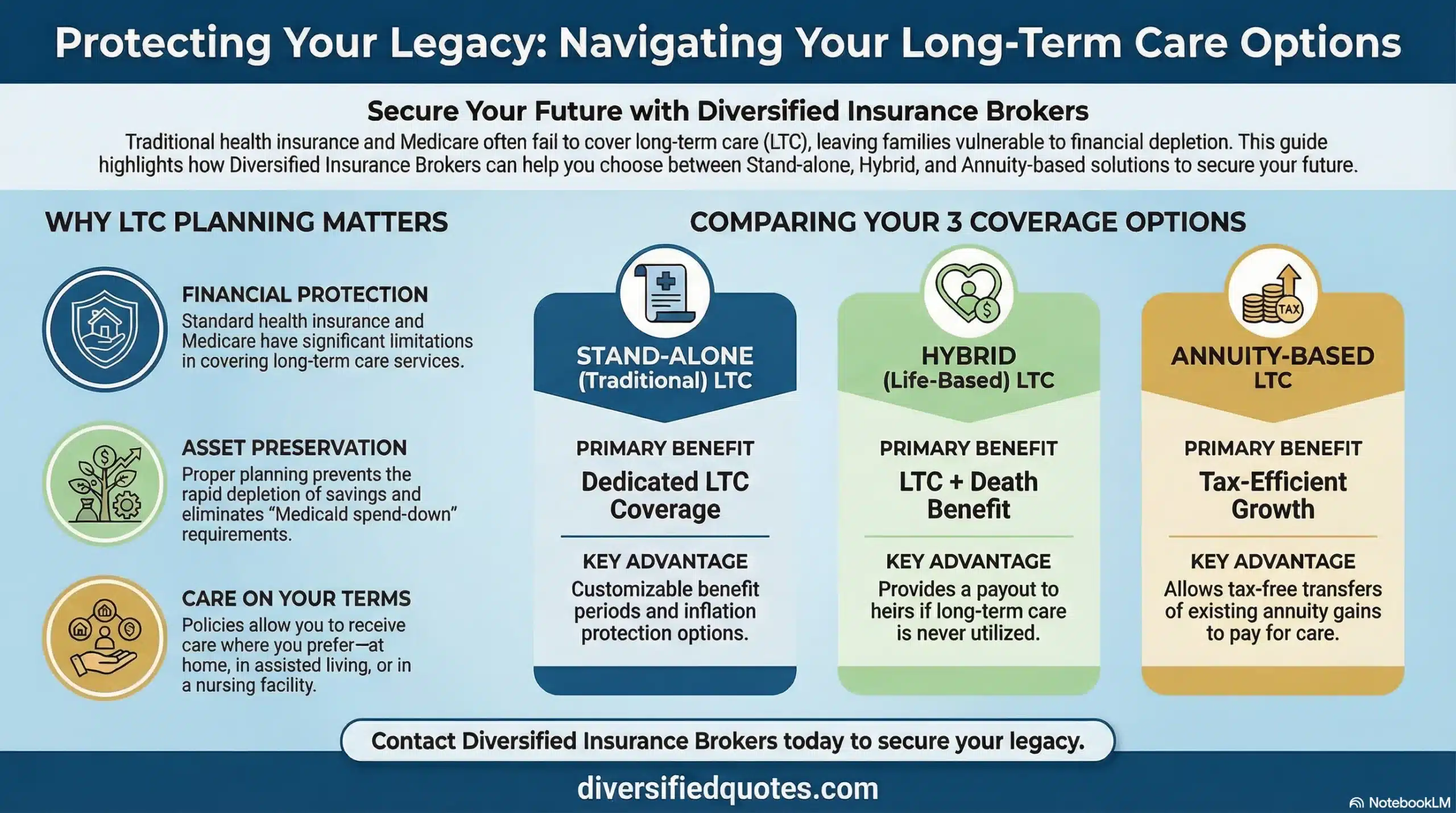
The most significant structural decision in buying long-term care insurance is whether to purchase a traditional standalone policy or a hybrid product that combines long-term care coverage with life insurance or annuity funding. This is not a minor detail — the two structures operate under fundamentally different premium mechanics, accumulate value differently, carry different risk profiles for the buyer, and serve different household financial goals. Understanding the distinction before evaluating specific carriers or benefit designs is essential.
Traditional standalone long-term care insurance charges an ongoing annual premium for as long as the policy is maintained. Premiums are level at issue but are subject to carrier rate increases — which have occurred meaningfully in the industry and should be factored into any long-term planning assumption. If a claim is never filed, the premiums are not returned. The primary advantage of traditional coverage is that it typically delivers the highest benefit-per-premium-dollar for the care protection itself, making it the most cost-efficient structure for buyers who are primarily focused on maximizing the coverage pool at the most affordable ongoing premium. Hybrid life/LTC policies combine a life insurance death benefit with a long-term care benefit, funded through a single premium, limited-pay structure, or ongoing premiums. If the long-term care benefit is never fully used, a death benefit passes to heirs — eliminating the “use it or lose it” concern that deters many buyers from traditional standalone coverage. Hybrid annuity/LTC structures use annuity assets to fund an LTC benefit that is larger than the annuity itself, often with favorable tax treatment under IRS Section 1035 exchanges. Our resources on hybrid life versus traditional LTC insurance and understanding hybrid long-term care insurance provide the detailed comparison needed to evaluate which structure fits a specific household’s financial profile and planning goals.
LTC Insurance Structures: Comparison at a Glance
| Feature | Traditional Standalone | Hybrid Life / LTC | Hybrid Annuity / LTC | Self-Insurance |
|---|---|---|---|---|
| Ongoing premium required | Yes — annually | Single or limited pay options | Single premium (lump sum) | No premium |
| Benefit if no claim filed | None (unless ROP rider) | Death benefit to heirs | Annuity value returned | Full assets retained |
| Premium increase risk | Yes — class-based increases possible | Eliminated or locked | Eliminated | N/A |
| Benefit pool per dollar | Highest | Moderate | Moderate | Limited to available assets |
| Tax advantages | Deductible as medical expense; benefits tax-free | Benefits tax-free; 1035 exchange eligible | 1035 exchange; benefits tax-free | Care costs potentially deductible |
| Best for | Maximum benefit per premium, income-based buyers | Asset-based buyers, use-it-or-lose-it concerns | Existing annuity or CD assets, single-premium preference | Very high net worth with diversified liquid assets |
Step Three: Design the Policy Correctly
Policy design determines whether coverage actually pays for meaningful care — or merely offsets a fraction of the expense. The four most consequential design variables are the daily or monthly benefit amount, the benefit period, the inflation protection rider, and the elimination period. Each of these was covered in detail in the context of rate optimization in our companion resource on how to get the best LTC insurance rates. In the purchase context, the design decisions must be made in the correct sequence: first calibrate the benefit amount to actual local care costs, then select the benefit period based on duration risk and asset depth, then choose the inflation rider based on the likely time horizon before claims, and finally select the elimination period based on the liquidity available to self-fund the waiting period.
The daily benefit amount is the per-day ceiling the policy will reimburse for covered care. A daily benefit of $150 may appear adequate based on national averages but may cover less than half of actual nursing home costs in high-cost states like New York, Massachusetts, or California. Regional cost benchmarking using current care survey data is the only accurate basis for setting this number. The benefit period — the length of time the policy will pay — is the design variable most directly connected to the duration risk the household actually faces. A two-year benefit period may be appropriate for a household with substantial assets that can self-fund extended care beyond two years; a five-year benefit period or unlimited lifetime benefit is more appropriate for buyers with family history of prolonged cognitive decline or limited assets available for self-funding beyond the benefit pool. Our resource on what the benefit period means and the comparison at limited versus lifetime benefits provide the decision framework in detail.
For married couples, two additional design features deserve dedicated attention. Shared care riders allow spouses to draw from each other’s benefit pools if one exhausts their individual coverage — a structural protection against the scenario where one spouse has a prolonged care event that exceeds the individual policy’s benefit pool while the other has unused benefits. Spousal discounts, available at most carriers when both spouses apply simultaneously, reduce per-policy premiums by fifteen to thirty percent and represent one of the most direct cost-reduction levers available to couples. Our resources on LTC insurance for couples and LTC with shared spousal benefits cover both features in detail. The state LTC partnership program — which provides Medicaid asset disregard benefits for policyholders who exhaust their private LTC insurance — is covered in our resources on partnership-qualified LTC insurance and LTC partnership reciprocity between states.
Step Four: Understand How LTC Underwriting Works
Long-term care insurance underwriting evaluates functional and cognitive health risk rather than mortality risk — which makes it structurally different from life insurance underwriting in ways that matter practically. Carriers assess the probability that an applicant will eventually require extended care assistance, the likely duration of that care, and the progression risk of conditions already present. This means conditions that do not significantly affect life expectancy can still materially affect LTC insurability. A history of arthritis that causes chronic joint pain but is not terminal will receive more underwriting scrutiny in an LTC application than in a life insurance application because it suggests an elevated probability of future functional impairment.
The LTC underwriting process typically involves several components: a written health application covering full medical history, current medications, ADL function, and cognitive self-assessment; telephone health interview with an underwriting nurse; review of medical records from the applicant’s primary care physician and any specialists seen in the prior three to five years; and, for applicants above certain ages or with health concerns identified during the application, a face-to-face cognitive assessment conducted by a licensed examiner. The full process typically takes four to eight weeks from application submission to decision, depending primarily on how quickly medical records are retrieved from physician offices. Applicants can meaningfully accelerate this timeline by notifying their physicians of the pending records request at the time of application. Our resource on whether LTC insurance requires a medical exam covers the exam requirement specifically, and the resource on how to qualify for LTC insurance covers the full eligibility criteria in detail.
Cognitive screening is the area of LTC underwriting that most differentiates it from life insurance evaluation. Because dementia and Alzheimer’s disease are among the most common drivers of long-term care claims, carriers pay close attention to any indication of cognitive impairment in medical records. A diagnosis of mild cognitive impairment, any dementia notation in medical records, or a poor result on standardized cognitive assessment tools will typically result in a decline. This is why the optimal timing for LTC insurance application is before any cognitive concerns appear in medical records — not after symptoms have been noted or evaluated. The conditions most likely to result in automatic decline across most carriers include dementia of any type, Parkinson’s disease with functional impairment, multiple sclerosis with progression, current need for assistance with activities of daily living, and recent stroke with residual neurological deficits. Our resource on who qualifies for long-term care insurance and the companion page on LTC with pre-existing conditions address eligibility for applicants with specific health histories.
Step Five: Select the Right Carrier
Carrier selection in long-term care insurance is more consequential than in most other insurance products, for two compounding reasons. First, the policy may be maintained for thirty or more years before a claim occurs, meaning the carrier’s financial strength and operational stability at the time of claim depends on decisions made decades in the future. Second, LTC carriers have a history of premium increases on in-force policies — some carriers have sought state regulatory approval for cumulative increases of fifty percent or more over the life of their in-force blocks — and the carrier’s rate action history is one of the most important predictors of future premium stability.
Evaluating carriers for LTC insurance requires examining four factors simultaneously: current premium competitiveness for the specific benefit design and health profile, AM Best financial strength rating (A- or better is the prudent minimum), historical rate action record on in-force policies, and claims-paying reputation for prompt and fair benefit delivery. Because these four factors do not always align in a single carrier — the carrier with the most competitive current premium may also have the most aggressive rate increase history — the comparison must be multi-dimensional rather than purely premium-focused. Similar long-term care insurance policies from different carriers can differ by up to twenty-six percent in annual premium for the same applicant profile and benefit design, as noted in industry research. Working with an independent LTC broker who has access to multiple carriers and can present a genuine multi-carrier comparison — not a single carrier recommendation — is the most direct path to optimal carrier selection. Our resources on finding the best independent LTC broker and why to work with an independent LTC broker explain how this selection process works and what to expect from it.
Step Six: Submit the Application and Navigate the Review Period
Once carrier and benefit design are confirmed, the formal application is submitted. The application collects complete personal and medical history, current medications, functional status, primary care and specialist physician information, financial justification for the benefit amount requested, and beneficiary designations. Accuracy is critical — misrepresentation or omission on an LTC application can provide grounds for claim denial even years after the policy is issued, and underwriters specifically cross-reference application answers against medical record content.
During the underwriting review period, applicants should remain available for the telephone health interview, promptly communicate the records request to their physicians, and respond quickly to any requests for additional information from the carrier. Once the underwriting decision is issued, the policy is delivered with a free-look period — typically ten to thirty days depending on the state — during which the buyer can review every term of the policy and cancel for a full refund if anything is not as expected. This period should be used actively, not passively: read the benefit triggers, confirm the daily benefit amount, verify the elimination period, confirm the inflation protection terms, and review the conditions that qualify for benefits. The free-look period is the final checkpoint before the policy is irrevocable, and using it thoroughly prevents expensive misunderstandings at claim time. Our resource on how to find, evaluate, and apply for LTC insurance covers this entire process in step-by-step detail for buyers who want a comprehensive application walkthrough.
Tax Advantages: The Net Cost Is Often Lower Than the Gross Premium
Qualified long-term care insurance premiums are deductible as medical expenses for individuals who itemize, subject to age-based IRS limits that increase with age. Self-employed individuals can deduct qualified LTC premiums as a business expense up to the age-based limit without itemizing. C-corporation owners may be able to deduct one hundred percent of LTC premiums as a business expense for themselves and their employees. Benefits received from a qualified LTC policy are generally received income-tax-free. The combination of premium deductibility and tax-free benefit receipt makes the after-tax economics of qualified LTC coverage significantly more favorable than the gross premium alone suggests. Our resources on the tax advantages of long-term care insurance, tax benefits of LTC insurance, and the specialized resource on using qualified funds for LTC coverage cover the full range of tax-advantaged funding strategies. Hybrid annuity/LTC arrangements that use a 1035 exchange from an existing annuity or life insurance policy to fund LTC coverage carry particularly favorable tax treatment, covered in our resource on tax advantages of LTC and hybrid policies.
When to Buy: The Optimal Window and What Delay Actually Costs
The optimal window for long-term care insurance application is between age fifty and age sixty-five. Premiums are meaningfully lower at younger application ages, the range of available carriers and benefit designs is broadest, and preferred health classifications are most attainable. According to the AALTCI’s price index data, a fifty-five-year-old male applying for a policy with $165,000 in initial benefits and three-percent compound inflation pays approximately $2,200 annually on average. A fifty-five-year-old female pays approximately $3,750 annually — reflecting women’s statistically longer care durations. These premiums rise substantially at sixty and sixty-five, and certain conditions that become more prevalent with age — particularly early cognitive concerns — may eliminate coverage options entirely at older application ages.
The cost of delay operates on two simultaneous tracks: the premium track, where every year of delay locks in a higher rate for the life of the policy; and the health track, where conditions that develop before application permanently close certain carrier options. A buyer who delays application from fifty-five to sixty-two and then develops a health condition at sixty-one has lost not just the seven years of lower-rate premiums, but potentially the ability to obtain coverage at all. Our resource on whether you can still get LTC insurance after age sixty addresses the realistic options for buyers who have passed the optimal window, and our resource on affordable LTC insurance for retirees covers strategies for managing cost at older application ages. For buyers at the oldest end of the spectrum, the specific options and limitations are addressed in our resource on LTC insurance after age eighty. For buyers who have already received a quote and want to verify it against the competitive market, our second opinion on an existing LTC quote frequently identifies superior carrier alternatives at lower premium for equivalent benefit designs.
Talk With an Advisor Today
Choose how you’d like to connect—call or message us, then book a time that works for you.
Schedule here:
calendly.com/jason-dibcompanies/diversified-quotes
Licensed in all 50 states • Fiduciary, family-owned since 1980
Frequently Asked Questions: How to Buy Long-Term Care Insurance
What triggers benefits in a long-term care insurance policy?
Benefits in a qualified long-term care insurance policy are triggered when the insured meets one of two standard criteria: either they require substantial assistance with at least two of six Activities of Daily Living (ADLs) — bathing, dressing, eating, toileting, continence, and transferring or mobility — or they have severe cognitive impairment such as dementia that requires substantial supervision to protect their health or safety. Both triggers must be expected to last at least ninety days, and the care need must be certified by a licensed health care practitioner. The ADL and cognitive impairment triggers are the federally established standards for tax-qualified policies, which means they apply consistently across most traditional LTC policies and hybrid life/LTC structures. Indemnity-style policies may pay the full daily benefit once triggered regardless of actual costs incurred, while reimbursement-style policies pay up to the daily maximum for covered expenses actually incurred. Understanding which trigger structure applies to your policy is important because it determines when benefits begin and how they are paid. For more detail on the full qualification process, see our resource on how to qualify for LTC insurance.
What conditions will disqualify me from getting long-term care insurance?
Several conditions result in automatic decline across most long-term care insurance carriers, and understanding them is one of the most important reasons to apply before health changes make coverage unavailable. Conditions that typically produce automatic declines include any form of diagnosed dementia or Alzheimer’s disease, Parkinson’s disease with any degree of functional impairment, multiple sclerosis with active progression or significant neurological involvement, current need for assistance with any of the six Activities of Daily Living, recent stroke with residual neurological deficits or functional impairment, ALS, Huntington’s disease, and HIV/AIDS. Other conditions — including Type 2 diabetes with complications, obesity above certain thresholds, history of cancer depending on type and recurrence status, and serious mental health history — may result in rating, limited benefits, exclusion riders, or decline depending on the carrier and the specific circumstances. Conditions that are well-controlled and documented — such as managed hypertension, controlled cholesterol, or a distant history of successfully treated cancer — are evaluated differently across carriers, with some carriers being significantly more favorable than others for specific profiles. This is why carrier pre-screening before formal application is one of the most valuable services an independent LTC broker provides. See our resource on LTC insurance with pre-existing conditions for condition-specific guidance.
Can LTC insurance premiums increase after I buy my policy?
Yes. Traditional standalone long-term care insurance premiums can be increased after issue, though carriers cannot raise rates on an individual basis — they must file for regulatory approval to raise rates on an entire class of policyholders within a state, and approval is required from the state insurance department. Rate increases have occurred in the LTC industry, sometimes significantly, because early-generation policies were priced on actuarial assumptions that turned out to be too optimistic about lapse rates and claims duration. Evaluating a carrier’s historical rate action record on in-force policies is one of the most important carrier selection criteria, alongside current pricing and financial strength rating. Hybrid life/LTC and annuity/LTC structures typically eliminate ongoing premium increase risk because the premium funding is made upfront in a single payment or defined limited-pay schedule, locking in the cost structure at purchase. For buyers who want premium certainty and are willing to accept a higher upfront cost, hybrid structures specifically address this concern. If you have already received a quote and want to evaluate the rate action history of the carriers presented, our second opinion service includes carrier history analysis as part of the review.
Does Medicare cover long-term care?
Medicare does not cover custodial long-term care — the type of assistance with Activities of Daily Living that constitutes the majority of actual long-term care need. Medicare does cover limited short-term skilled nursing facility care following a qualifying hospital stay of at least three days, but this benefit is strictly time-limited and condition-specific: Medicare covers days one through twenty at no cost to the beneficiary and days twenty-one through one hundred with a co-insurance payment per day, after which Medicare coverage ends entirely. Once the skilled nursing benefit is exhausted, the beneficiary is responsible for the full cost of ongoing custodial care. Medicare does not cover in-home companion care, non-medical personal care aides, or long-term assisted living facility costs. Medicaid does cover extended nursing home care for individuals who have spent down their assets to meet eligibility thresholds, but Medicaid does not allow beneficiaries to choose their care provider, typically restricts coverage to nursing home settings rather than home care or assisted living, and requires forfeiture of nearly all personal assets before coverage begins. The state LTC partnership program addresses this gap by allowing policyholders who exhaust their private LTC insurance to qualify for Medicaid while protecting a portion of their assets equal to the benefits they received. For a complete explanation of what Medicare does and does not cover, see our resource on whether Medicare covers long-term care.
What is the difference between a hybrid LTC policy and a traditional standalone policy?
Traditional standalone long-term care insurance is a dedicated LTC product that charges an ongoing annual premium and pays benefits only when a qualifying care event occurs. If no claim is ever filed, premiums paid are not recovered unless a return-of-premium rider was purchased. The primary advantage is that traditional coverage delivers the highest benefit pool per premium dollar for the care protection itself. Hybrid life/LTC insurance combines a permanent life insurance death benefit with a long-term care acceleration or extension feature. If LTC benefits are never used, the full death benefit passes to heirs. If LTC benefits are partially used, the remaining death benefit after repayment passes to heirs. Single-premium or limited-pay funding options eliminate ongoing premium commitment and premium increase risk. The hybrid structure is specifically designed to address the “use it or lose it” concern that prevents many buyers from committing to traditional coverage. Hybrid annuity/LTC structures use annuity assets — sometimes through a 1035 exchange from an existing annuity or life insurance contract — to fund a larger LTC benefit pool, often with favorable tax treatment on the LTC benefit payments. The right choice depends on whether the buyer is optimizing for maximum LTC benefit per dollar of premium, premium certainty, estate efficiency, or tax-advantaged asset repositioning. Our hybrid life versus traditional LTC comparison provides the full side-by-side analysis.
What is the LTC state partnership program and how does it work?
The Long-Term Care Partnership Program is a state-federal collaboration that allows individuals who purchase a qualifying partnership LTC insurance policy to protect a portion of their assets equal to the benefits they received from their policy if they later need to apply for Medicaid. Without a partnership policy, Medicaid eligibility for long-term care requires spending down virtually all personal assets — typically to $2,000 for a single person in most states — before Medicaid begins paying. With a partnership policy, a policyholder who receives $200,000 in LTC insurance benefits can protect $200,000 in personal assets from the Medicaid spend-down requirement — meaning those assets can pass to heirs rather than being spent on care. Partnership policies must include compound inflation protection as a required design feature, which is the regulatory mechanism that ensures the asset protection grows alongside the care benefit. Most states participate in the reciprocity provisions that recognize partnership policies purchased in other states, though the specific reciprocity rules vary. The partnership program represents one of the most tangible demonstrations of the LTC insurance policy’s value beyond the benefit it pays directly: it creates Medicaid planning leverage that non-partnership policies do not provide. For more detail see our resources on partnership-qualified LTC insurance and LTC partnership reciprocity.
What happens during the LTC underwriting process?
The LTC underwriting process begins after formal application submission and typically takes four to eight weeks, with the primary variable being how quickly the applicant’s physicians respond to medical records requests. The standard process includes several components. A written health application collects complete medical history, current medications, ADL self-assessment, and cognitive self-assessment. A telephone health interview — conducted by an underwriting nurse — covers health history, functional status, and cognitive screening questions. Medical records from the primary care physician and any specialists seen in the prior three to five years are requested and reviewed by the carrier’s underwriting team. For applicants above certain ages, or where the telephone interview or application identifies potential cognitive concerns, a face-to-face assessment conducted by a licensed examiner in the applicant’s home may be required. The underwriting team compares all gathered information against the carrier’s published and internal underwriting guidelines to assign an offer, rating, modification, or decline decision. Applicants can accelerate the process by notifying their physician offices of the pending records request at the time of application and ensuring contact information for all physicians is accurate and complete. The resulting underwriting decision — if an offer is made — includes a specified health classification that determines the final premium. If the carrier discovers information during underwriting that was not disclosed on the application, the offer may be modified or withdrawn. See our resource on how to qualify for LTC insurance for a complete overview of eligibility criteria.
Is long-term care insurance worth buying?
For most people in the fifty to sixty-five age range with retirement assets between $300,000 and $3 million, long-term care insurance provides the most efficient mechanism for protecting those assets against a care event that is more likely than most buyers appreciate. The Department of Health and Human Services projects that approximately seventy percent of Americans turning sixty-five will need some form of long-term care. A nursing home private room costs approximately $129,575 annually nationally per the 2025 CareScout survey, and care durations for dementia-related conditions can extend well beyond the three-year average. A couple where both spouses need care — even for different durations and in different settings — can face combined care costs that substantially erode or eliminate retirement savings that took decades to accumulate. LTC insurance is not worth buying for individuals with very low assets who would qualify for Medicaid immediately or with very high liquid assets that could absorb an extended care event without material impact on financial security. For the broad middle of the wealth spectrum, however, the premium cost of appropriate LTC coverage is consistently a fraction of the care costs it protects against — and the protection extends to asset preservation for the surviving spouse, family independence from caregiving burdens, and choice of care setting. The specific answer for any individual depends on their assets, income, health profile, family situation, and state of residence. Our resource on whether LTC insurance is worth it provides a structured framework for working through this evaluation.
About the Author:
Jason Stolz, CLTC, CRPC, DIA, CAA and Chief Underwriter at Diversified Insurance Brokers (NPN 20471358), is a senior insurance and retirement professional with more than 25 years of real-world experience helping individuals, families, and business owners protect their income, assets, and long-term financial stability. As a long-time partner of the nationally licensed independent agency Diversified Insurance Brokers, Jason provides trusted guidance across multiple specialties—including fixed and indexed annuities, long-term care planning, personal and business disability insurance, life insurance solutions, Group Health, Travel Medical and Evacuation Insurance, and short-term health coverage. Diversified Insurance Brokers maintains active contracts with over 100 highly rated insurance carriers, ensuring clients have access to a broad and competitive marketplace.
His practical, education-first approach has earned recognition in publications such as VoyageATL, and contributions from his agency featured in Kiplinger and GoBankingRates— highlighting his commitment to financial clarity and client-focused planning. Drawing on deep product knowledge and years of hands-on field experience, Jason helps clients evaluate carriers, compare strategies, and build retirement and protection plans that are both secure and cost-efficient. Visitors who want to explore current annuity rates and compare options across multiple insurers can also use this annuity quote and comparison tool.
Explore More Long Term Care Insurance Options: Browse our complete guide to How to Buy, Qualify & Coverage Details — covering how to buy, who qualifies, policy types, shared benefits, partnership plans & more from top carriers.
Last Reviewed: October 7, 2026 |
Reviewed by: Jason Stolz, CLTC, CRPC, DIA, CAA
Chief Underwriter, Diversified Insurance Brokers, Inc. | NPN: 20471358 | Diversified Insurance Brokers, Inc. — Licensed in all 50 states
Fact Checked by: Tonia Pettitt, CMIP©
Medicare Specialist, Diversified Insurance Brokers, Inc. | NPN: 14374308 | Diversified Insurance Brokers, Inc. — Licensed in all 50 states
Did you find this content helpful? Leave us a Google review — it helps others find trustworthy guidance too.
Editorial Standards: Diversified Insurance Brokers maintains rigorous editorial standards to ensure accuracy, clarity, and independence in all content. Learn more about our editorial standards and commitment to transparency.
