
Disability Insurance for Race Car Drivers
As an Independent Disability Insurance Broker, we have access to exclusive discounts and negotiated pricing most captive agents can’t offer — see the full breakdown near the end of this page.
Disability Insurance for Race Car Drivers

Jason Stolz CLTC, CRPC, DIA, CAA
Race car driving is one of the most physically demanding and risk-intensive professions in the world. Whether you compete professionally, semi-professionally, or as a high-earning independent driver, your income depends on precision, reaction time, physical conditioning, and the ability to withstand extreme forces. Disability insurance for race car drivers exists to protect that income when an accident, injury, or medical condition prevents you from racing, training, or fulfilling professional obligations. Unlike traditional occupations, race car drivers face underwriting scrutiny that few other professionals encounter. High speeds, crash exposure, repetitive physical stress, and travel demands elevate risk. As a result, many drivers assume disability insurance is unavailable or prohibitively expensive. In reality, coverage is often possible — but it must be structured correctly and placed with carriers that understand motorsports risk. At Diversified Insurance Brokers, we help drivers across multiple racing disciplines design individual disability income insurance that reflects the realities of the profession. The goal is to protect income, sponsorship stability, and long-term financial security with contract language that fits what “disabled” actually means in motorsports. For the comprehensive resource covering disability insurance across high-risk occupations more broadly — including how underwriters evaluate physical risk, hazardous activities, and specialized income structures — our resource on disability insurance for high-risk occupations provides the foundational framework that applies to race car driver underwriting.
Request a Race Car Driver Disability Quote
Compare coverage designed for high-risk occupations, variable income, and career-specific disability definitions. Confidential. Nationwide. No obligation.
Get a Disability Quote Call 800-533-5969Underwriting Factors for Race Car Driver Disability Insurance — Quick Reference
Coverage availability, pricing, and contract terms for race car drivers depend on a combination of factors that underwriters evaluate differently than they would for a standard occupation. The table below maps each key factor to how it affects coverage, what profile is most favorable, and what planning action gives you the best outcome.
General reference only. Underwriting outcomes vary by carrier, individual health and income profile, and state. This table is illustrative and does not represent a guarantee of coverage or specific policy terms from any carrier.
| Underwriting Factor | How It Affects Coverage | Most Favorable Profile | Potentially Limiting Profile | Key Planning Action |
|---|---|---|---|---|
| Racing Discipline and Series Level | Determines which carrier categories apply; open-wheel, stock car, rally, and drag racing each carry different risk profiles; professional series with recognized governing bodies are evaluated differently than amateur or unsanctioned events | Professional driver in a regulated series with documented earnings; clear sanctioned competition structure; modern safety equipment standards (HANS device, fire suppression, roll cage per series specs) | Unsanctioned events, amateur or recreational racing with no clear income tie, extreme motorsports categories with limited carrier appetite or higher exclusion frequency | Document racing as primary earned income with tax records; confirm series/sanctioning body classification before applying; work with a broker who can identify carrier appetite by discipline before submitting formal applications |
| Occupation vs. Avocation Classification | Whether racing is treated as a primary occupation or a hazardous avocation controls which policy types are available, whether racing-related claims are covered, and whether own-occupation definitions apply to motorsports duties | Racing is the primary or majority source of documented earned income; income tax returns clearly show racing-related compensation; no separate full-time employer exists | Racing is recreational while primary income comes from another occupation; some carriers may apply a racing exclusion rider even if a policy is issued, meaning racing-related claims would not trigger benefits | If racing is your primary livelihood, document it clearly as such in application materials; if racing is a paid side activity, discuss with an advisor whether a racing exclusion rider is being applied and whether that’s acceptable for your situation |
| Income Type and Documentation | Variable income from winnings, sponsor retainers, and endorsements requires multi-year averaging; carriers have specific rules about which income sources are eligible and how benefit amounts are calculated from non-W2 income | Consistent documented earnings over 2+ years via tax returns; clear earned income from racing-related activities; sponsorship contracts that show predictable recurring payments | Highly variable single-year income with no multi-year track record; large passive income (rental, investments) that carriers exclude from benefit calculations; recent career entrant with limited income history | Gather 2-3 years of tax returns before applying; separate earned income clearly from passive income; keep documentation of sponsorship and retainer contracts; if income is new or growing rapidly, ask about a future increase option at policy issue |
| Medical and Orthopedic History | Prior orthopedic injuries, surgical history, ongoing treatment, or documented pain issues can produce standard approval, modified rates, specific exclusions, or declines depending on the condition and its current status | Clean musculoskeletal history; any prior injuries fully resolved without residual symptoms or ongoing treatment; no orthopedic surgeries with incomplete recovery; stable physical conditioning | Active treatment for back, neck, or joint conditions; recent surgeries still in recovery; documented chronic pain or nerve compression; unresolved injury history from crash events | Apply before injuries accumulate; fully resolve and complete treatment before applying when possible; complete physical therapy and obtain discharge documentation; a prescreening with the carrier before formal application can prevent unnecessary declines from being recorded |
| Concussion and Neurological History | Concussion history is flagged in DI underwriting because post-concussion syndrome can affect reaction time, cognitive function, and endurance — all career-critical capacities for drivers; multiple documented concussions significantly complicate underwriting | No diagnosed concussion history or any single remote concussion fully resolved without residual symptoms; clear neurological status on physical examination | Multiple diagnosed concussions; any current neurological symptoms (headache, cognitive fog, balance issues); recent head trauma without medical clearance; documented post-concussion syndrome | Obtain proper medical clearance documentation after any head injury before applying; avoid applying during active neurological treatment; discuss the specific neurological risk category with an advisor before formal application to identify carrier tolerance |
| Elimination Period Selection | The elimination period (waiting period before benefits begin) directly affects premium cost and how quickly benefits activate; longer elimination periods lower premiums but require more out-of-pocket reserves during the gap | Elimination period coordinated with liquid savings, sponsor payment continuity, or other short-term income sources; 90-day elimination is common for active drivers with moderate reserves | Very short elimination period (30 days) may not be available for motorsports risk categories; elimination period too long relative to savings creates a dangerous gap between disability onset and benefit start | Match elimination period to realistic savings runway; if seasonal income creates cash flow variability, time elimination period to align with expected reserves; review with an advisor how the elimination period interacts with any group or sponsor coverage already in place |
| Benefit Period Selection | The benefit period defines how long benefits continue while disability persists; longer benefit periods provide more complete career protection but increase premium; benefit periods should reflect the career window being protected | Benefit period to age 65 or 67 for comprehensive long-term protection; benefit period aligned with the career window being protected; younger drivers benefit more from longer benefit periods | 5-year benefit period for a 30-year-old driver may leave a 30+ year income gap unaddressed; benefit period too short relative to age at peak earning years creates significant unprotected exposure | Evaluate the career window being protected; younger drivers should generally prioritize longer benefit periods because a career-ending event early in the career creates the largest long-term income loss; discuss benefit period vs. premium tradeoffs with an advisor |
Why Race Car Drivers Face Unique Income Risk
Race car driving places extraordinary demands on the body. Drivers are exposed to extreme g-forces, heat stress, vibration, and repetitive strain — often for hours at a time. Neck injuries, spinal compression, concussion exposure, and joint degeneration are not theoretical risks; they are common realities of the sport. Even minor injuries can end a season or permanently impair a driver’s ability to compete. Reduced reaction time, vision issues, balance disturbances, or lingering pain may not look “catastrophic” to a generic disability policy, but they can be career-ending in motorsports. The income risk is immediate because winnings, appearance fees, sponsorship payments, endorsements, and team retainers can change the moment a driver is unable to race. This career structure mirrors other performance-driven occupations where income depends on personal output rather than employer continuity, which is why drivers often relate to the planning approach discussed in disability insurance for self-employed professionals. Drivers in other high-risk physical occupations — such as pilots who face similar specialized underwriting for a transportation-based high-risk profession — encounter parallel challenges in the DI marketplace. Our resource on disability insurance for pilots covers the aviation underwriting framework that parallels motorsports underwriting in important ways.
Why Traditional Disability Insurance Often Fails Drivers
Many standard disability insurance policies are not designed for race car drivers. Some group plans and association policies exclude hazardous activities outright. Others will issue coverage but restrict claims if the disabling event is tied to racing or related training, or they classify motorsports as a disqualifying avocation. Even when coverage exists, definitions of disability may be too narrow. A policy that pays only if you are unable to work in any occupation may deny benefits if you could still earn income coaching, consulting, or working in a non-driving role — even if your racing career is effectively over. For drivers, the distinction between “can work” and “can race” is the entire point of the coverage strategy. Understanding whether disability insurance is worth the premium investment — particularly for high-risk occupations where underwriting is more restrictive — is covered in our resource on whether disability insurance is worth it, which addresses the cost-benefit calculation from a risk exposure perspective.
The Importance of Own-Occupation Coverage for Drivers
Own-occupation disability insurance is often the most important feature for a professional driver because it can tie benefits to your ability to perform the material and substantial duties of your occupation. For motorsports, that typically means being able to compete, test, train, and fulfill racing obligations at a safe and professional level. Without own-occupation protection, a driver who can no longer compete but can still earn some income elsewhere may receive no benefits at all. That is why drivers frequently compare policy language alongside our education on own occupation disability insurance, where the focus is preserving career-specific earning power rather than generic employability. For a comparison of how the benefit period structure affects the overall value of own-occupation coverage — including how to choose between 5-year, 10-year, and to-age-65 benefit periods — our resource on disability insurance covers the mechanics and value tradeoffs in detail.
Racing Disciplines and How Classification Affects Underwriting
Not all motorsports are underwritten equally. Open-wheel racing, stock car racing, rally and off-road competition, drag racing, and dirt track racing each present different risk profiles to underwriters based on speeds involved, crash frequency data, fire risk, rollover exposure, and course conditions. Professional circuits governed by recognized sanctioning bodies — such as NASCAR, IndyCar, IMSA, or FIA-sanctioned series — often have more defined carrier appetite than amateur, unsanctioned, or emerging motorsports categories. Drivers who compete in recognized professional series and can document their income from those series are in the most favorable underwriting position. Drivers who race recreationally while earning primary income in another field are often treated as having a hazardous avocation — which triggers very different policy terms. When racing is an avocation rather than a primary occupation, some carriers will issue coverage but exclude claims tied to racing activities. The key question an applicant must answer clearly: is this my primary livelihood, or is this a paid recreational activity alongside another occupation? The answer fundamentally determines which coverage architecture applies. Other professional driving occupations — such as taxi and rideshare drivers, who face very different but still transportation-specific DI considerations — encounter their own underwriting nuances, covered in our resource on disability insurance for taxi and rideshare drivers.
Common Disabilities That Impact Race Car Drivers
Drivers tend to see predictable patterns in injury and disability risk. Musculoskeletal issues are common, especially involving the cervical spine, thoracic spine, lumbar spine, shoulders, and wrists. Neck strain and compression injuries from sustained g-forces can build over time and become limiting even without a single crash event. Traumatic injuries from crashes — fractures, internal injuries, and neurological trauma — are the obvious risk category, but many career-ending conditions develop gradually. Chronic back pain, nerve compression, joint degeneration, and post-concussion syndromes can reduce endurance, coordination, and reaction speed. Cardiovascular events, heat-related illness, and vision impairments also represent significant risks because racing performance demands physical stability under extreme conditions. The physical risk pattern in racing has parallels to other high-intensity physical occupations such as law enforcement SWAT units, where sudden high-stress events and cumulative physical demands both contribute to career disability risk. Our resource on disability insurance for SWAT team members covers the DI underwriting framework for another high-adrenaline, physically concentrated occupation. Similarly, the physical demand profile of search and rescue work — extreme physical exertion in unpredictable environments — creates DI planning challenges covered in our resource on disability insurance for search and rescue team members. For outdoor high-risk occupations like hunting and safari guide work — where remote conditions and physical intensity combine with specialized occupational classification — our resource on disability insurance for hunting and safari guides covers the parallel underwriting considerations.
How Disability Income Insurance Replaces Racing Income
Individual disability income insurance typically replaces a portion of earned income, and benefits can be structured to be tax-efficient when premiums are paid personally. For race car drivers, underwriting often focuses on documented income over multiple years because income is frequently variable. Depending on documentation and carrier rules, eligible income may include winnings, team retainers, sponsorship payments, endorsement income, and appearance fees. When income fluctuates, averaging methodologies can help stabilize benefit eligibility so the policy design reflects real earning capacity rather than one unusually strong or weak year. Benefit periods are commonly designed to protect long-term earning risk if a career-ending disability occurs early. The right structure depends on age, income stability, and how dependent earnings are on active competition versus brand sponsorship and off-track income. For the complete framework on how to evaluate and size benefit periods — and how to coordinate short-term and long-term disability coverage — our resources on disability insurance waiting period cover those specific design decisions in detail.
Elimination Periods and Cash Flow Planning
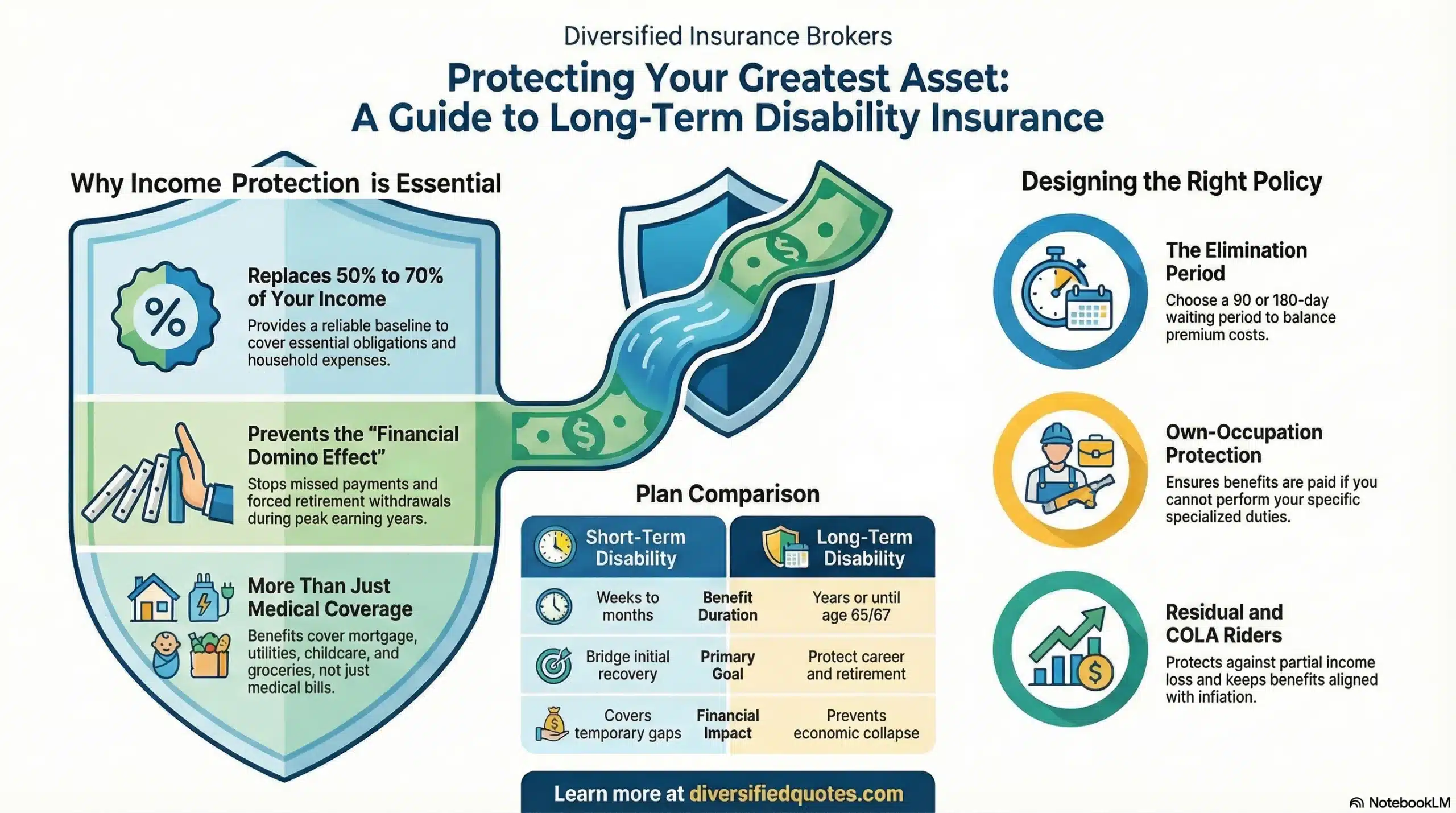
The elimination period (waiting period) is one of the most important customization points. Many drivers choose an elimination period in the 90-180 day range, balancing premium cost with available reserves and the reality of how quickly income changes after an injury. Drivers with seasonal schedules often coordinate elimination periods with savings, sponsor guarantees, or off-track work. The goal is to have benefits begin at the point where income risk becomes real, not at a point that is too early to be affordable or too late to be practical. Understanding how the elimination period interacts with short-term disability coverage — which can bridge the gap before long-term benefits begin — is covered in our resource on short-term disability insurance. For drivers who have team or association short-term coverage in place, coordinating the elimination period of an individual long-term policy with that existing coverage often produces the most cost-efficient overall protection architecture.
Critical Policy Riders for Race Car Drivers
Riders matter because real-world disabilities are not always “all or nothing.” A residual or partial disability rider can be especially important for drivers because many conditions reduce capacity before they end a career. If you can still participate in limited events, testing, sim work, or sponsor obligations but your racing income drops, a strong residual rider can be the difference between meaningful benefits and none. Some drivers also evaluate cost-of-living adjustment (COLA) protection for longer claims, especially when career earnings would have increased over time. A future increase option can also matter for younger drivers moving into higher-profile series or improving sponsor stability, because it can allow coverage to grow as income grows without restarting medical underwriting.
Professional vs. Independent Race Car Drivers
Drivers operate under a wide range of income structures. Some are contracted by teams with predictable retainers. Others are independent drivers whose income is shaped by sponsorships, winnings, and endorsements. That income structure affects underwriting, documentation requirements, and how carriers view benefit eligibility. Independent drivers often share planning challenges with the self-employed. In some cases, drivers ask about simplified coverage pathways similar to what is discussed in no exam disability insurance, but fully underwritten policies typically provide stronger definitions and longer-term architecture for serious career protection.
Medical Underwriting and Timing Matters
Disability insurance is medically underwritten, and prior injuries can change outcomes. Orthopedic histories, concussion exposure, neurological symptoms, and ongoing treatment can affect eligibility, pricing, or exclusions. That is why timing matters. Applying before injuries accumulate often preserves access to broader coverage and better contract terms. Waiting until after a significant injury is one of the most common reasons drivers face exclusions or limited options. Because racing is physically intense, underwriting tends to reward stability and clean documentation more than “explaining it later.” For other high-risk physical occupations where pre-emptive application timing is similarly critical — such as firefighters and police officers, whose physical demands also accelerate underwriting complexity over time — our resources on disability insurance for firefighters and disability insurance for police officers cover the timing and preparation considerations that parallel the motorsports context.
The Cost of Being Uninsured as a Driver
Many race car drivers rely on savings, sponsor goodwill, or short-term arrangements to manage income risk. That approach can work during minor interruptions, but it often fails after a serious injury. Without disability insurance, drivers may be forced to liquidate investments, abandon long-term plans, or exit the sport without a stable financial bridge. Disability insurance converts uncertain physical risk into predictable financial protection. It provides a defined monthly benefit that can help stabilize household cash flow while you recover, reassess sponsorships, or transition roles if necessary.
How Disability Insurance Fits Into a Driver’s Financial Strategy
Disability insurance protects cash flow so long-term plans remain intact. Without income protection, retirement contributions can stop, investment plans can unwind, and financial decisions can become reactive under pressure. That is why disability coverage often sits at the center of a driver’s risk-management plan — especially during peak earning years. Some drivers also coordinate disability planning with broader retirement-income planning concepts discussed in whether annuities are worth it, particularly when they want a long-term Plan B for future income stability if a driving career ends earlier than expected.
Protect Your Income as a Race Car Driver
Tell us your racing discipline, income structure, and goals. We’ll show you clear options built for high-risk occupations.
Request a Disability Quote Call 800-533-5969Related Pages
Explore related disability topics and planning guides.
Financial Protection Essentials
Burial insurance comparisons, travel protection planning, carrier reviews, and post-heart attack life insurance guidance.
Talk With an Advisor Today
Choose how you’d like to connect—call or message us, then book a time that works for you.
Schedule here:
calendly.com/jason-dibcompanies/diversified-quotes
Licensed in all 50 states • Fiduciary, family-owned since 1980
FAQs: Disability Insurance for Race Car Drivers
Can race car drivers get disability insurance?
Yes. Disability insurance is often available for race car drivers, but underwriting is more specialized than it is for typical occupations. Approval, pricing, and exclusions depend on factors like racing level, frequency, income documentation, medical history, and whether racing is treated as a primary occupation or a hazardous avocation. Working with an independent broker who has experience placing coverage for motorsports professionals significantly improves the process — because carrier appetite varies and a misplaced application to the wrong carrier can produce a decline that becomes part of the MIB record used by subsequent carriers.
Is race car driving considered a hazardous occupation or a hazardous hobby?
It can be either. If driving is your primary source of earned income, it’s typically underwritten as an occupation. If you race recreationally while earning income in another field, it may be treated as a hazardous avocation. The classification can affect carrier eligibility, policy pricing, exclusions, and coverage definitions. When racing is classified as a hazardous avocation, some carriers will issue a policy but attach a racing exclusion rider — meaning injuries directly tied to racing activities would not trigger disability benefits. Understanding how your profile will be classified before applying is one of the most valuable things a broker can do in this space.
What type of disability policy is best for race car drivers?
In most cases, an individually owned long-term disability (DI) policy with strong definitions, clear occupational language, and the right riders is the best fit. For drivers, own-occupation or occupation-specific language is often a priority because the ability to perform specialized driving duties is what drives income. Group coverage through a team or association can supplement individual coverage but typically has weaker definitions, benefit caps, and portability limitations that make it unsuitable as a primary protection strategy for drivers whose career is their primary financial asset.
Why does “own-occupation” matter for race car drivers?
Own-occupation coverage is designed to pay benefits if you can’t perform the material and substantial duties of your specific occupation — even if you can still work in another role. For drivers, this matters because you could be physically able to do coaching, consulting, or media work while still being unable to race at a professional level. Without own-occupation protection, a policy with an “any-occupation” definition could deny benefits because you are technically employable in a different capacity — even though your racing career and its associated income are gone. The difference between these two definitions can be the difference between receiving meaningful monthly benefits and receiving nothing.
How much income can disability insurance replace for a race car driver?
Most individual disability policies are designed to replace roughly 50-70% of eligible earned income, subject to carrier limits and underwriting. For drivers with variable income, carriers may average income over multiple years and require documentation to support benefit amounts. The income averaging approach means a driver who had one exceptional year followed by a lower year may receive benefits based on an average rather than the peak year — which is why maintaining consistent documented earnings over 2+ years before applying tends to produce the most favorable benefit level. The maximum monthly benefit available also varies by carrier and is influenced by the overall benefit amount across all in-force DI policies.
What income counts for a race car driver — winnings, sponsorships, and endorsements?
It depends on how the income is structured and documented. Carriers generally focus on earned income that can be substantiated through tax returns and related financial records. Some sponsorship or endorsement income may be considered if it’s consistent, contractual, and reported as earned income rather than passive income. Winnings reported as earned income on Schedule C (for self-employed drivers) are generally more clearly eligible than passive or investment income. Keeping income documentation organized — including sponsorship contracts, team agreements, and 2-3 years of tax returns — is one of the most important underwriting preparation steps.
What riders are most important for race car drivers?
Commonly valuable riders include residual/partial disability (to protect income if you can work but at reduced capacity), future increase options (to grow coverage as earnings rise without restarting medical underwriting), and cost-of-living adjustments (COLA) for long-term claims. The residual rider is often considered the highest-priority add-on for drivers because real-world disabilities frequently involve partial loss of capacity rather than complete inability to race — and without it, benefits may not trigger until you are entirely unable to compete. The right combination depends on income type, career stage, and budget.
What is a residual (partial) disability rider and why is it important?
A residual or partial disability rider can pay benefits when you’re not totally disabled but your income drops due to reduced duties, reduced events, medical restrictions, or a longer recovery period. Because many real-world disability claims involve partial loss of capacity — a driver who can participate in some activities but not at full competitive level — this rider is often a priority. Without it, a driver who earns 40% of their pre-disability income during recovery might receive zero benefits because they haven’t met the total disability threshold. With a strong residual rider, the income reduction itself triggers proportional benefits.
How do elimination periods work for race car driver disability insurance?
The elimination period is the waiting period before benefits begin after a covered disability starts. Common elimination periods are 90 or 180 days for long-term disability coverage. Choosing a longer elimination period usually lowers the premium but requires more savings to cover the gap. Drivers with seasonal schedules often coordinate elimination periods with savings, sponsor payment continuity, or short-term disability coverage so the gap period is funded before the long-term benefits begin. The elimination period is not a deductible — it is a time-based waiting period that must be satisfied each time a new claim begins.
How long do disability benefits last?
Benefit periods vary by policy design. Many long-term disability policies pay benefits to age 65 or 67, while some offer shorter durations (such as 5 or 10 years) at a lower cost. Drivers often choose benefit periods that protect peak earning years and align with retirement plans. Younger drivers moving into competitive careers have the most to gain from longer benefit periods — a career-ending disability at age 25 with a 5-year benefit period leaves 35+ years of unprotected income. The premium difference between a 5-year and to-age-65 benefit period is significant, but so is the protection gap.
Will prior injuries or concussion history affect approval?
Possibly. Underwriters review medical history carefully, especially for orthopedic injuries, neurologic symptoms, and any concussion history. Some applicants are approved at standard rates, while others may receive higher premiums, exclusions, or modified coverage depending on stability, recency, and severity. Concussion history is particularly scrutinized because post-concussion syndrome can affect reaction time, cognitive function, and endurance — all career-critical for drivers. The timing of application relative to injury history is important: applying during active treatment or before medical records show stabilization typically produces worse outcomes than applying after full recovery with clear documentation.
Can a policy exclude racing-related injuries?
Some carriers may apply exclusions related to racing or hazardous activities, especially if driving is considered an avocation rather than your occupation. The goal is to place coverage with carriers whose underwriting guidelines are compatible with your racing profile and income structure so coverage aligns with your real risk. When a racing exclusion is applied, any disability that originates from a racing event (crash, training incident, or related physical exposure) would not trigger benefits. This is why the occupation vs. avocation classification is so important — and why working with a broker who knows which carriers treat professional motorsports differently from recreational racing can change the outcome significantly.
Is disability insurance for race car drivers tax-free?
Benefits are typically tax-free when premiums are paid personally with after-tax dollars. If premiums are paid in a way that makes them deductible (for example, in certain employer-paid arrangements or business structures), benefits may be taxable. How you structure premium payment matters and should be coordinated with your tax professional. For most individual drivers paying premiums personally — which is the most common structure — the benefit they receive during a disability claim will be income tax-free, which is one of the primary reasons individually owned DI coverage tends to outperform group or employer-sponsored plans in net benefit value.
What documents are typically needed for underwriting?
Common requirements include a disability application, health history, prescription review, and income documentation such as tax returns (often 2 years), W-2s or K-1s when applicable, and sometimes contracts if income is highly variable. For drivers, sponsorship agreements, team contracts, and racing license documentation may also be requested to support occupational classification and income substantiation. Requirements depend on benefit amount, age, and carrier rules. Getting documentation organized before starting the application typically speeds the process and reduces the risk of follow-up requests that delay placement.
How long does underwriting take?
Timeframes vary. Some simplified programs can move quickly, while fully underwritten individual DI may take several weeks depending on medical records, exams (if required), and financial verification. For drivers with significant medical history, the medical records retrieval process is often the longest part of underwriting — requesting records from treating physicians, reviewing imaging and consultation notes, and underwriting assessment together can add 2-4 weeks to the timeline. Getting documentation organized early and working with a broker who manages the process actively typically produces the fastest results.
What if I already have coverage through a team or association?
Group or association coverage can help, but it may have limitations such as caps on benefits, weaker disability definitions, benefit offsets, or lack of portability. Many drivers supplement group coverage with an individually owned policy that stays with them if teams, sponsors, or associations change. Group coverage is rarely sufficient on its own for a driver whose primary financial asset is their racing career — because group plans are designed for the average workforce, not for occupation-specific income structures and the unique definition of disability that motorsports professionals need.
Can I increase coverage later if my income grows?
Often yes. Many individual DI policies offer a future increase option that allows you to raise benefits as income rises — sometimes without additional medical underwriting. This is particularly useful for younger drivers whose earnings can increase quickly over a few seasons as they move to higher-profile series, secure larger sponsorships, or improve performance results. The future increase option is most valuable when purchased at policy issue, since it preserves the right to grow coverage based on financial need without being subject to new medical underwriting at a time when health history may have accumulated more complexity.
About the Author:
Jason Stolz, CLTC, CRPC, DIA, CAA and Chief Underwriter at Diversified Insurance Brokers (NPN 20471358), is a senior insurance and retirement professional with more than 25 years of real-world experience helping individuals, families, and business owners protect their income, assets, and long-term financial stability. As a long-time partner of the nationally licensed independent agency Diversified Insurance Brokers, Jason provides trusted guidance across multiple specialties—including fixed and indexed annuities, long-term care planning, personal and business disability insurance, life insurance solutions, Group Health, Travel Medical and Evacuation Insurance, and short-term health coverage. Diversified Insurance Brokers maintains active contracts with over 100 highly rated insurance carriers, ensuring clients have access to a broad and competitive marketplace.
His practical, education-first approach has earned recognition in publications such as VoyageATL, and contributions from his agency featured in Kiplinger and GoBankingRates— highlighting his commitment to financial clarity and client-focused planning. Drawing on deep product knowledge and years of hands-on field experience, Jason helps clients evaluate carriers, compare strategies, and build retirement and protection plans that are both secure and cost-efficient. Visitors who want to explore current annuity rates and compare options across multiple insurers can also use this annuity quote and comparison tool.
Explore More Disability Insurance Options: Browse our complete guide to Disability Insurance for Transportation, Maritime & Hazardous Occupations — covering truck drivers, flight attendants, merchant marines, divers, chauffeurs & drivers from 100+ carriers.
Last Reviewed: May 31, 2026 |
Reviewed by: Jason Stolz, CLTC, CRPC, DIA, CAA
Chief Underwriter, Diversified Insurance Brokers, Inc. | NPN: 20471358 | Diversified Insurance Brokers, Inc. — Licensed in all 50 states
Fact Checked by: Tonia Pettitt, CMIP©
Medicare Specialist, Diversified Insurance Brokers, Inc. | NPN: 14374308 | Diversified Insurance Brokers, Inc. — Licensed in all 50 states
Did you find this content helpful? Leave us a Google review — it helps others find trustworthy guidance too.
Editorial Standards: Diversified Insurance Brokers maintains rigorous editorial standards to ensure accuracy, clarity, and independence in all content. Learn more about our editorial standards and commitment to transparency.
