
Trip Cancellation Insurance
Trip Cancellation Insurance

Jason Stolz CLTC, CRPC, DIA, CAA
At Diversified Insurance Brokers, we know that even the best-planned trips can be disrupted by events completely outside your control. Flights get canceled, storms close airports, family members experience sudden medical emergencies, and sometimes life changes your plans with no warning and no recourse through the travel vendor alone. When that happens, the financial impact can be just as significant as the disruption to the itinerary — especially when you have already paid for non-refundable flights, hotel blocks, cruise deposits, prepaid resort packages, guided tours, or special-event tickets that cannot simply be returned or exchanged when circumstances change. Trip cancellation insurance — offered through International Medical Group (IMG) — is designed to help protect that financial investment by reimbursing covered prepaid expenses if your trip must be canceled or interrupted for a covered reason, so that a forced change in plans does not become a forced financial loss on top of everything else. Trip cancellation coverage also fits best when coordinated with the right health protection while traveling. If you are building a complete travel safety plan, pairing trip cancellation with travel medical insurance ensures you are protecting both your trip costs and your exposure to medical bills abroad — because the two risks are related but require different products to address adequately.
Trip Cancellation — International Medical Group (IMG)
Safeguard your travel plans with coverage for non-refundable expenses when life’s surprises interrupt your trip.
If you are unsure which level is right, request help and we will point you to the best fit for your itinerary.
Why Trip Cancellation Insurance Matters
Today’s trips often involve a chain of non-refundable or only partially refundable costs that are committed months in advance — discounted airfares purchased far out to capture better pricing, cruise deposits that lock in a cabin but are non-refundable within a defined window before departure, prepaid resort packages that bundle accommodation and amenities into a single non-divisible cost, guided tours and excursions that must be booked far ahead to secure availability, and special-event tickets or experiences that are non-transferable by design. If you have to cancel after those commitments are made, many of these expenses cannot be recovered through the travel vendor alone — cancellation policies are designed to protect the vendor’s revenue, not your investment. Without trip cancellation protection, a family emergency, a sudden illness, or any of the covered disruptions that travel cancellation policies address can mean losing thousands of dollars on a trip you never get to take, in addition to the stress and logistical complexity of the disruption itself.
Trip cancellation insurance is designed to step in when specific covered events force you to cancel before departure or cut the trip short and return home earlier than planned. Instead of absorbing the full financial loss of non-refundable expenses, you can file a claim for eligible prepaid costs and recoup meaningful portions of what you have invested — allowing the financial impact of the disruption to be managed rather than fully absorbed from savings or personal income. For frequent travelers, families coordinating multi-leg itineraries, and retirees planning higher-cost bucket-list travel that has been saved for and planned over months or years, this type of protection is an important component of a complete travel risk strategy rather than an optional add-on that only makes sense for expensive trips. If you are also concerned about worst-case scenarios while traveling — such as a serious injury or illness in a remote area where local care is inadequate — our resource on emergency medical evacuation insurance covers how evacuation benefits coordinate with trip cancellation coverage, particularly for international itineraries where local access, transport logistics, and cost levels can make a serious medical event dramatically more financially disruptive than the same event would be at home.
Trip Cancellation vs. Travel Medical: What Each Covers
| Feature | Trip Cancellation Insurance | Travel Medical Insurance | Combined (Both) |
|---|---|---|---|
| Primary protection | Financial investment in the trip — non-refundable prepaid costs | Medical bills, emergency treatment, and evacuation costs while abroad | Both financial trip investment and medical cost exposure — full spectrum protection |
| When it activates | Before departure (cancellation) or during trip (interruption) when a covered event forces a change in plans | During the trip when a covered illness or injury occurs and medical care is needed | Either scenario — whichever occurs triggers the relevant product |
| What it reimburses | Non-refundable prepaid expenses: flights, hotels, cruises, tours, excursions, event tickets | Emergency medical treatment, hospitalization, diagnostics, prescriptions, and evacuation transport | All of the above — no gap between financial and medical protection |
| Cancel For Any Reason option | Available on some plans for additional premium — partial reimbursement for cancellations not meeting covered reason criteria | Not applicable — medical coverage activates based on medical events, not cancellation decisions | CFAR can be added to the cancellation component — broadens the trigger conditions for financial reimbursement |
| Trip interruption | Covers unused prepaid costs and additional transportation to return home when trip must be cut short | Medical coverage continues during the abbreviated trip period — does not address non-refundable trip costs | Both dimensions addressed — medical care during the event and financial recovery of non-refundable costs |
| Evacuation coverage | Not included — financial trip cost focus does not extend to medical transport logistics | Core benefit on most plans — covers medical transport to appropriate facilities and repatriation when necessary | Travel medical component covers evacuation — full protection from both financial disruption and evacuation cost |
| Best for | Travelers with significant non-refundable costs committed months ahead who need protection against forced plan changes | Travelers going abroad who need emergency medical and evacuation protection that domestic health plans do not provide internationally | Any traveler with both non-refundable financial exposure and international medical risk — the most complete protection approach |
Common Covered Reasons for Trip Cancellation
Policies vary by plan design and carrier, but most IMG trip cancellation options include protection for the major disruption categories that most commonly force travelers to cancel or cut trips short. Illness, injury, or death affecting the traveler, a traveling companion, or a close family member — when the event prevents starting or continuing the trip — is one of the most common covered triggers and one of the most significant reasons many travelers coordinate cancellation coverage with health coverage from the outset. Medical events are among the most frequent trip disruptors, and when illness or injury forces a cancellation, the financial consequences compound: non-refundable trip costs are lost at the same time medical expenses are accumulating, creating a double financial hit that cancellation coverage can prevent from becoming a catastrophic outcome.
Severe weather and natural disasters can also trigger coverage when conditions materially affect the departure, the destination, or even the traveler’s home — making the planned travel unsafe, impossible, or impractical. For travelers who plan around hurricane season, winter storm exposure, or volatile shoulder seasons in destinations prone to weather disruptions, cancellation coverage meaningfully reduces the financial damage of a last-minute change that no amount of advance planning could have predicted or avoided. Other commonly covered triggers include certain employment-related events such as unexpected job loss or mandatory work obligations that were unknown at the time the trip was booked, transportation disruptions beyond the traveler’s control such as strikes, mechanical failures of common carriers, or airline cancellations that significantly affect the planned itinerary, and in some plan designs emergency evacuation scenarios or government-issued travel restrictions depending on the specific policy language and circumstances. Emergency travel health insurance covers the medical-side protection that addresses the same triggering events from the healthcare cost perspective rather than the financial trip investment perspective. International travel health coverage covers the broader range of international medical protection options that coordinate with cancellation coverage for complete trip protection.
Who Benefits Most From Trip Cancellation Insurance
Almost any traveler with meaningful non-refundable financial exposure can benefit from trip cancellation coverage, but certain traveler profiles have the most to gain from the protection it provides. Retirees planning cruises, escorted tours, or extended international itineraries are among the travelers for whom cancellation coverage tends to be most valuable — because the bookings are often larger in dollar terms, the planning timeline is longer, the proportion of non-refundable costs is higher, and the financial consequences of a forced cancellation are more significant relative to fixed retirement income that cannot be replenished by continued employment. A single health event — the traveler’s own or a family member’s — that forces cancellation of a long-planned bucket-list trip can represent a loss of many thousands of dollars without protection in place.
Families coordinating multi-ticket international itineraries benefit significantly because one forced cancellation event typically triggers losses across all travelers simultaneously — a sick child cancels the entire family’s trip, and every non-refundable expense across every traveler’s booking is affected. Travelers heading to destinations with significant weather or seasonal risk — hurricane-path Caribbean cruises, coastal resorts during monsoon season, mountainous destinations during unpredictable winter conditions — may see particular value because a single weather event can unravel a complicated multi-segment itinerary quickly and completely. For those doing specialized travel that involves prepaid group programs, mission activities, or humanitarian deployments, trip disruption can be more complicated due to shared schedules, prepaid group costs, and organizational financial exposure that extends beyond the individual traveler. Our resources on mission trip travel insurance, travel insurance for humanitarian aid workers, travel insurance for youth mission trips, and travel insurance for church groups cover how trip protection is structured for those specific travel contexts where group financial exposure and organizational coordination add complexity to the standard individual trip cancellation framework.
Trip Cancellation vs. Travel Medical Insurance: Different Problems, Different Products
Trip cancellation insurance and travel medical insurance are the two foundational products in a complete travel protection plan, and understanding the distinction between them is essential for building coverage that addresses all of the financial risks a trip creates rather than only some of them. Trip cancellation insurance focuses on the financial investment in the trip itself — the prepaid non-refundable costs that represent money already committed and at risk if the trip cannot proceed as planned. Travel medical insurance focuses on emergency medical care and evacuation while the traveler is outside their home country — the costs that a serious illness or injury abroad generates in terms of treatment, hospitalization, diagnostic work, and transport to appropriate facilities. They solve different problems, address different risk categories, and are structured around different triggering events, which is why combining them creates genuinely more complete protection than either delivers independently.
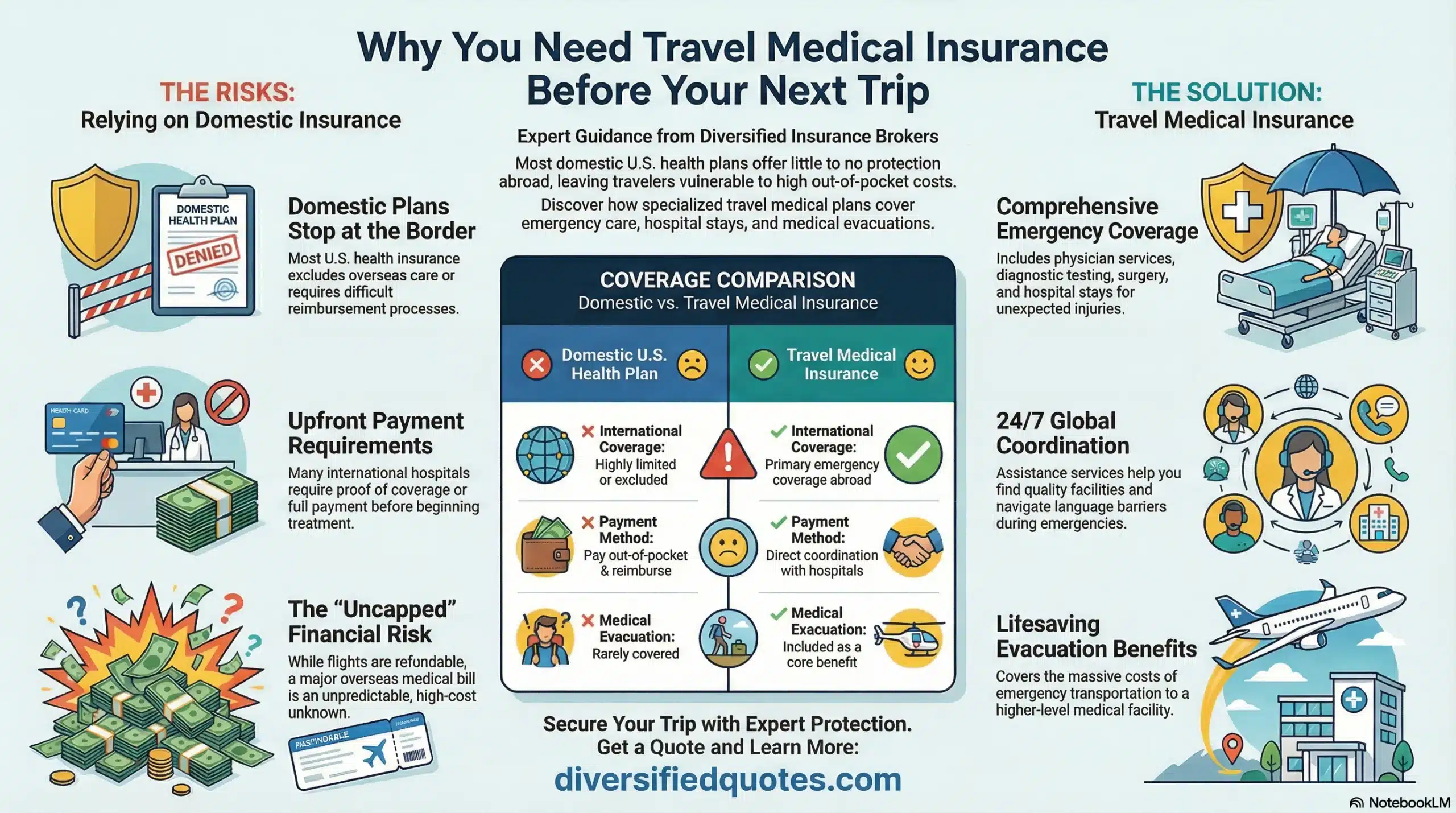
If a trip involves international travel, the medical side of protection often matters as much as the financial side — because a serious illness or injury abroad can generate expenses that dwarf the total cost of the trip itself, especially when evacuation is involved. The non-refundable cost of a flight and hotel is a defined, manageable number. The cost of an emergency hospitalization, surgical intervention, and air ambulance evacuation from a remote international destination is open-ended, can reach six figures in serious scenarios, and cannot be managed through vendor negotiation or goodwill. For U.S. citizens traveling internationally, our resource on emergency travel medical insurance for US citizens covers the plan structures most relevant for American travelers whose domestic plans leave them without international medical coverage. For foreign nationals traveling, our resource on emergency travel health insurance for foreign nationals addresses the specific plan designs that fit that traveler profile. For longer stays, expat scenarios, or recurring international travel, comparing international health insurance and international major medical insurance ensures the plan selected is appropriate for the duration and nature of the international presence rather than a short-term product stretched beyond its design parameters.
How to Think About Cost, Value, and Cancel For Any Reason
Trip cancellation coverage is most valuable when the potential financial loss from a forced cancellation is meaningful relative to the traveler’s financial situation and when a meaningful portion of the trip costs are non-refundable from day one of booking. If a trip is modest in cost and mostly refundable, the case for cancellation coverage is weaker — the product is solving a smaller problem than the premium cost may justify. If a trip involves large non-refundable commitments, long advance booking horizons, and meaningful health or weather risk in the intervening period, the case for cancellation coverage is strong — the product is solving a large and realistic financial risk for a relatively modest premium.
Standard trip cancellation plans cover a defined list of covered reasons — the specific events that qualify for reimbursement under the policy terms. Cancel For Any Reason coverage is a more flexible and more expensive upgrade that allows partial reimbursement for cancellations that do not meet the standard covered-reason criteria — typically reimbursing 50 to 75 percent of non-refundable costs for any cancellation made within a defined period before departure. CFAR is most valuable for travelers who have significant financial exposure and want protection not just against the covered reasons but against any circumstance that causes them to decide not to travel — including circumstances that are personal, precautionary, or simply a change of mind driven by changing life conditions. Plans typically cost in the range of four to ten percent of the total insured trip cost, with pricing varying based on traveler ages, total trip cost and duration, destinations, and selected options. Our resource on cheap travel insurance covers how pricing shifts by coverage level and structure for travelers where cost is a primary consideration. Our resource on how to get the best travel medical insurance rates covers the key variables that affect cost for the medical protection layer that pairs with cancellation coverage for complete protection. Our resource on whether travel medical insurance is expensive provides the cost context for understanding both products together as a combined investment in full-spectrum trip protection. High-risk travel insurance covers how coverage design and cost shift for travelers whose destinations or activities create elevated risk profiles that affect both cancellation and medical coverage priorities. Travel medical insurance for expats covers how coverage needs shift for extended international stays where standard trip cancellation structures may not be appropriate or sufficient.
Get Help Choosing the Right Combination
Start with emergency travel health insurance or explore international travel health coverage if you want a broader plan design.
Related Travel Pages
Talk With an Advisor Today
Choose how you’d like to connect—call or message us, then book a time that works for you.
Schedule here:
calendly.com/jason-dibcompanies/diversified-quotes
Licensed in all 50 states • Fiduciary, family-owned since 1980
Trip Cancellation Insurance — Frequently Asked Questions
Trip cancellation insurance is coverage that reimburses your prepaid non-refundable trip costs if you must cancel for a covered reason. Common covered reasons include unexpected illness, injury, or death of yourself or a traveling companion, severe weather or natural disasters affecting your destination or home, and certain employment or transportation disruptions. It is typically purchased as part of a travel insurance plan — either shortly after booking or before your final trip payment — so that eligible costs are protected from the moment coverage begins. The key distinction between trip cancellation coverage and other travel protections is that it focuses specifically on the financial investment you have already made in the trip, rather than on medical expenses or health coverage while abroad. If you must cancel before departure, trip cancellation reimburses eligible prepaid costs. If you must cut the trip short after departure, trip interruption benefits — often included in the same plan — address the unused portion and additional return travel costs.
Most trip cancellation plans cover unexpected illness, injury, or death affecting you, a traveling companion, or a close family member when the event prevents you from starting or completing the trip with proper documentation. Severe weather or natural disasters that make your destination uninhabitable or your departure impossible are also commonly covered. Common carrier cancellations due to strikes, mechanical failures, or weather events are typically included in standard plans, subject to the policy’s specific definitions and terms. Certain employment-related events — such as unexpected job loss or mandatory work requirements that could not be anticipated when the trip was booked — may also qualify depending on the plan. Some plans address emergency evacuation of your destination or home and documented theft of travel documents such as passports or visas. Exact triggers vary meaningfully by insurer and plan level, which is why reviewing the specific certificate of coverage — not just marketing materials — is essential before purchase.
Trip cancellation coverage reimburses prepaid non-refundable expenses that you have insured under the plan, typically including airfare, cruise deposits and fares, hotel stays, tour packages and guided excursion bookings, resort packages, and certain event tickets. Some plans also cover non-refundable taxes and fees, supplier change penalties up to the plan limit, and deposits that are forfeited by contract when you cancel with the vendor. The critical requirement is that the expenses must be prepaid, non-refundable, and insured — meaning you must have included them in the trip cost when you purchased coverage. Expenses for which you receive a full refund, a travel credit, or a voucher from the supplier are generally not eligible for reimbursement because you have not suffered a financial loss. Keeping thorough documentation of what you paid, what refund or credit you received, and what remains as a genuine loss is essential for a successful claim.
Trip cancellation applies before departure when you must cancel the trip entirely and never leave. Trip interruption applies after departure when a covered event forces you to return home early or pause the trip mid-travel. Interruption benefits typically cover the unused prepaid non-refundable portion of the trip that you did not get to use — for example, the hotel nights and tours remaining after you returned early — as well as additional transportation costs to get you back home safely. Because these are two different benefit categories that apply at different phases of travel, some plans separate them and others bundle them together under a single trip protection benefit. The practical importance of interruption coverage can be significant for long or multi-leg itineraries where one disruption can cascade into multiple losses across connecting bookings. Understanding how both cancellation and interruption benefits work in a given plan — including their individual limits and triggers — helps ensure the overall protection matches the actual financial risk of the trip.
Pre-existing conditions are often excluded from trip cancellation coverage unless you qualify for a pre-existing condition waiver. Waivers are time-sensitive — they typically require purchasing the plan shortly after your first trip payment, with the specific window varying by plan but commonly ranging from 14 to 21 days after initial deposit. In addition to meeting the purchase timing requirement, you must also be medically able to travel at the time of purchase. If both conditions are met, the waiver removes the pre-existing condition exclusion and allows your medical history to be treated similarly to a new illness or injury that occurs after the policy is purchased. If you miss the waiver window — by purchasing coverage too late or by not being medically able to travel at purchase — the pre-existing condition exclusion typically applies for the life of the policy. For travelers with known health histories, understanding the waiver requirements before booking and purchasing coverage immediately after the first payment is the most important step to ensuring adequate protection.
Cancel For Any Reason is an optional upgrade that allows you to cancel the trip for reasons not otherwise covered under the standard policy and receive a partial reimbursement of eligible insured costs — commonly 50 to 75 percent depending on the plan. CFAR is specifically designed to address the gap in standard coverage created by cancellations driven by personal preference, concern about conditions not rising to the level of a covered reason, or circumstances that do not fit the defined trigger list in the base plan. CFAR must be purchased within a defined window after the initial trip deposit — typically within 14 to 21 days — and you must insure 100 percent of your prepaid non-refundable trip costs to be eligible for the upgrade. It must also be purchased before any covered event becomes foreseeable. If you cancel under CFAR, the cancellation must typically occur a defined number of days before departure — commonly 48 hours or more — or the benefit may not apply. CFAR is generally the most expensive optional upgrade available on travel insurance plans because it provides the broadest cancellation flexibility.
Many current trip cancellation plans treat a COVID-19 diagnosis in the same manner as any other covered illness — meaning if you or a traveling companion tests positive and cannot travel, you may be eligible to file a cancellation claim with proper medical documentation confirming the diagnosis and the provider’s recommendation not to travel. However, government travel bans, fear of traveling to a destination due to COVID conditions, or a destination being considered high risk are generally not covered under standard trip cancellation benefits unless you have added Cancel For Any Reason coverage. The specific treatment of COVID-19 related claims varies by plan and carrier, and it is worth reviewing the policy’s infectious disease wording specifically rather than assuming standard illness coverage automatically extends to pandemic-related scenarios. If full flexibility around pandemic-related cancellations is important to you, CFAR is typically the most reliable coverage mechanism since it does not require the cancellation to qualify under a specific covered reason.
The best time to purchase trip cancellation coverage is as soon as you make your first trip payment — not shortly before departure. Purchasing early preserves eligibility for time-sensitive benefits that are often the most valuable features of comprehensive plans. A pre-existing condition waiver requires purchase within a defined window after the first deposit. Cancel For Any Reason coverage must be purchased before any events become foreseeable and within a defined window after the initial payment. Once a covered event becomes foreseeable — a storm that has been named, a diagnosis that has been made, or a job situation that has already changed — it is no longer insurable under most standard plan terms. Purchasing late eliminates these benefits and may leave you with a plan that does not cover the scenarios you were most concerned about when you bought it. As you make subsequent trip payments — adding hotels, tours, or excursions — keeping your insured trip cost updated to reflect the total non-refundable investment ensures all eligible expenses are covered rather than only the initial booking.
Documentation requirements vary by the reason for cancellation, but most claims require proof of the covered event itself — for medical cancellations, this means a physician’s note or documentation confirming the diagnosis, the treatment recommendation, and the recommendation not to travel. For weather or carrier cancellations, airline or cruise line cancellation notices, government declarations, or official weather service documentation typically serves as the primary evidence. In addition to proof of the covered event, you will generally need receipts and invoices for all non-refundable costs being claimed, refund or credit statements from each supplier showing what amounts were returned to you, proof of payment such as credit card statements showing the original charges, and your original trip itinerary. Because suppliers are required to provide whatever refunds or credits they will offer before the claim can be finalized, it is important to request refunds from each vendor first and document what was returned before filing. Delays in obtaining supplier refund confirmations are a common source of claims processing delays.
Some trip cancellation plans pay on a primary basis, meaning they reimburse eligible costs without requiring you to first collect refunds or credits from other sources. Primary plans generally process claims faster because you do not need to exhaust other recovery options first. Other plans are secondary and require you to collect whatever refunds, credits, or payments you can from suppliers and any other applicable insurance before the plan covers the remaining unreimbursed amount. For trip cancellation specifically, most plans work in coordination with supplier refund policies — they cover the non-refundable portion after you have received whatever refund or credit the vendor provides. The primary versus secondary distinction matters most when you have multiple potential recovery sources, such as both a travel insurance plan and a credit card benefit that offers some cancellation protection. Your plan’s certificate of coverage will specify how benefits are coordinated so you understand the claims sequence before you need to use it.
About the Author:
Jason Stolz, CLTC, CRPC, DIA, CAA and Chief Underwriter at Diversified Insurance Brokers (NPN 20471358), is a senior insurance and retirement professional with more than 25 years of real-world experience helping individuals, families, and business owners protect their income, assets, and long-term financial stability. As a long-time partner of the nationally licensed independent agency Diversified Insurance Brokers, Jason provides trusted guidance across multiple specialties—including fixed and indexed annuities, long-term care planning, personal and business disability insurance, life insurance solutions, Group Health, Travel Medical and Evacuation Insurance, and short-term health coverage. Diversified Insurance Brokers maintains active contracts with over 100 highly rated insurance carriers, ensuring clients have access to a broad and competitive marketplace.
His practical, education-first approach has earned recognition in publications such as VoyageATL, and contributions from his agency featured in Kiplinger and GoBankingRates— highlighting his commitment to financial clarity and client-focused planning. Drawing on deep product knowledge and years of hands-on field experience, Jason helps clients evaluate carriers, compare strategies, and build retirement and protection plans that are both secure and cost-efficient. Visitors who want to explore current annuity rates and compare options across multiple insurers can also use this annuity quote and comparison tool.
Explore More Travel Medical Insurance Options: Browse our complete guide to Travel Insurance Planning & Education — covering how it works, costs, last minute coverage, high risk travel & buying guides.
Last Reviewed: June 17, 2026 |
Reviewed by: Jason Stolz, CLTC, CRPC, DIA, CAA
Chief Underwriter, Diversified Insurance Brokers, Inc. | NPN: 20471358 | Diversified Insurance Brokers, Inc. — Licensed in all 50 states
Fact Checked by: Tonia Pettitt, CMIP©
Medicare Specialist, Diversified Insurance Brokers, Inc. | NPN: 14374308 | Diversified Insurance Brokers, Inc. — Licensed in all 50 states
Did you find this content helpful? Leave us a Google review — it helps others find trustworthy guidance too.
Editorial Standards: Diversified Insurance Brokers maintains rigorous editorial standards to ensure accuracy, clarity, and independence in all content. Learn more about our editorial standards and commitment to transparency.
