
Travel Insurance for Church Groups
Travel Insurance for Church Groups

Jason Stolz CLTC, CRPC, DIA, CAA
Travel insurance for church groups addresses a category of risk that standard vacation travel insurance is not specifically designed to handle — because church travel is fundamentally different from leisure travel in the composition of the group, the nature of the activities, the geographic reach of the missions, and the organizational responsibility that trip leaders carry for participants across a wide range of ages and health profiles. A youth mission trip to rural Central America, an elderly congregation’s Holy Land tour, a disaster relief team deploying to hurricane-affected communities, and a choir making a regional domestic concert tour all represent “church group travel” — and each requires a meaningfully different coverage structure to protect the participants effectively. What they share is the reality that trip leaders are responsible for people other than themselves, that the church organization may bear financial exposure if a trip goes wrong, and that standard health coverage frequently creates gaps — out-of-network limitations, international exclusions, reimbursement requirements, emergency evacuation gaps — that become apparent at the worst possible moment without advance planning.
At Diversified Insurance Brokers, Jason Stolz, CLTC, CRPC, DIA, CAA helps churches, faith-based nonprofits, and ministry organizations build travel insurance structures that fit the trip type, the group composition, and the organizational risk tolerance — whether that means a single policy for a one-time mission trip, an annual program for churches with frequent travel schedules, or coordination of travel coverage with existing group medical insurance or employee benefit programs. Our resource on how to get the best travel medical insurance rates covers the rate optimization framework for group travel coverage, and our resource on what is the primary reason people buy travel medical insurance covers the motivations and coverage decisions that most commonly drive group travel insurance purchases.
Get Travel Insurance for Your Church Group
Protect your mission team, youth group, or choir tour with travel medical coverage, evacuation planning, and trip protection. We’ll compare options and ensure the coverage fits your activities and destinations — not just your budget.
Request Church Group Options Quote & Apply OnlineChurch Group Travel Insurance Coverage Types — What Each Protects and When It Matters
The coverage structure for travel insurance for church groups is not a single product but a combination of coverage layers — each addressing a different category of financial risk. Understanding what each layer does, and which church travel scenarios make each layer most critical, is the foundation for building a coverage structure that actually protects the group rather than just checking a box before departure.
| Coverage Type | What It Protects | Church Trip Scenario | Domestic Priority | International Priority |
|---|---|---|---|---|
| Emergency Medical | Illness or injury requiring medical treatment away from home — hospital, urgent care, physician | Youth leader breaks an ankle on a construction site; senior member has cardiac event; child develops severe infection in remote area | Moderate — domestic care is available but may be expensive out-of-network | Critical — international care may require upfront payment; quality and access vary widely by destination |
| Emergency Medical Evacuation | Transport to a capable medical facility or repatriation to the U.S. when local care is inadequate | Mission team in rural Africa where nearest capable hospital is 200 miles away; disaster relief team in area with destroyed infrastructure | Lower — domestic evacuation more commonly available through standard EMS systems | Essential for remote destinations — evacuation without coverage can cost tens of thousands of dollars |
| Trip Cancellation / Interruption | Non-refundable airfare, lodging, and deposits lost when a trip is cancelled before departure or cut short after departure | Youth retreat cancelled due to leader illness; mission trip interrupted by political unrest; choir tour disrupted by weather-caused flight cancellation | High — domestic travel often involves significant non-refundable deposits for group lodging and activities | High — international airfare and lodging deposits can represent the largest financial exposure for the trip |
| 24/7 Emergency Assistance | Access to a multilingual emergency coordination team who can locate providers, arrange transportation, and guide leaders through medical emergencies | Team leader in unfamiliar country at 2am needing guidance on where to take a team member who is seriously ill | Moderate — domestic leaders often know how to navigate local care systems | Critical — reduces decision burden on volunteer leaders in unfamiliar environments |
| Baggage and Equipment | Lost, delayed, or damaged luggage and equipment — including musical instruments, sound gear, tools, and mission supplies | Choir’s instruments lost in airline transfer; mission team’s medical supplies delayed for three days; sound equipment damaged in transit | Moderate — domestic baggage delays less common but equipment loss can be significant for performance groups | Moderate — important for groups carrying specialized equipment or mission supplies |
| Pre-Existing Condition Coverage | Medical claims related to known health conditions — typically excluded without a specific waiver provision | Senior member with heart condition who experiences cardiac event; member with diabetes who has a glycemic crisis; participant with asthma requiring hospitalization | Important for groups with older members or known health histories | Critical for international travel — pre-existing exclusions without a waiver can create major out-of-pocket exposure |
The table reveals the most important principle in coverage design for travel insurance for church groups: the priority weighting of each coverage layer should follow the destination and group profile rather than a fixed generic structure. A domestic youth retreat prioritizes trip cancellation and interruption protection alongside basic emergency medical. An international mission trip to a developing country prioritizes emergency medical, evacuation, and 24/7 assistance as the core protection, with pre-existing condition provisions critical for any group that includes older participants or members with known health histories. Our resource on travel medical insurance covers the emergency medical dimension in detail, and our resource on emergency medical evacuation insurance covers the evacuation layer that is most commonly underestimated by church trip planners until they face a destination scenario where it would have been essential.
Why Church Travel Requires Different Thinking Than Leisure Travel
Travel insurance for church groups addresses organizational risk and individual participant protection simultaneously — a dual responsibility that leisure travel insurance is not designed to manage. When a family purchases vacation travel insurance for themselves, the insured is responsible only for their own decisions and outcomes. When a church sends a group — particularly a youth group, a mission team, or a mixed congregation of different ages and health profiles — the organizational risk extends to every participant, and the trip leader’s responsibility covers decisions made on behalf of others, not just themselves.
This organizational responsibility dimension creates specific insurance considerations that leisure travel policies typically don’t address. The consistency of coverage across the group is more important than the optimal individual coverage for any single participant — because an emergency situation affecting one group member affects the entire group’s response capacity. If one participant is hospitalized with a policy that requires different emergency contacts and procedures than the rest of the group, the leader’s ability to manage the situation coherently is reduced. A group policy with consistent coverage terms, a single 24/7 assistance phone number for all participants, and clear leader authorization to make decisions on behalf of incapacitated members simplifies emergency response in ways that matter significantly when the situation is already stressful.
The activity profile of church travel also frequently falls outside the standard leisure travel insurance envelope. Mission trips involve construction, medical outreach, agricultural work, and logistics in environments that are explicitly not tourist destinations. Disaster relief deployments involve hazardous conditions by definition. Youth retreats may include outdoor activities, water sports, or adventure elements. Each of these activity categories requires confirmation that the specific activities are covered under the policy’s terms — a plan that covers “tourism” and “light recreational activities” may not cover the work that defines a mission trip. Our resource on travel insurance for missionary groups covers the activity coverage considerations most specific to missionary work, and our resource on travel insurance for youth mission trips covers the age-specific and activity-specific provisions most important for youth group travel leaders.
Emergency Medical Coverage — The Core Protection Layer
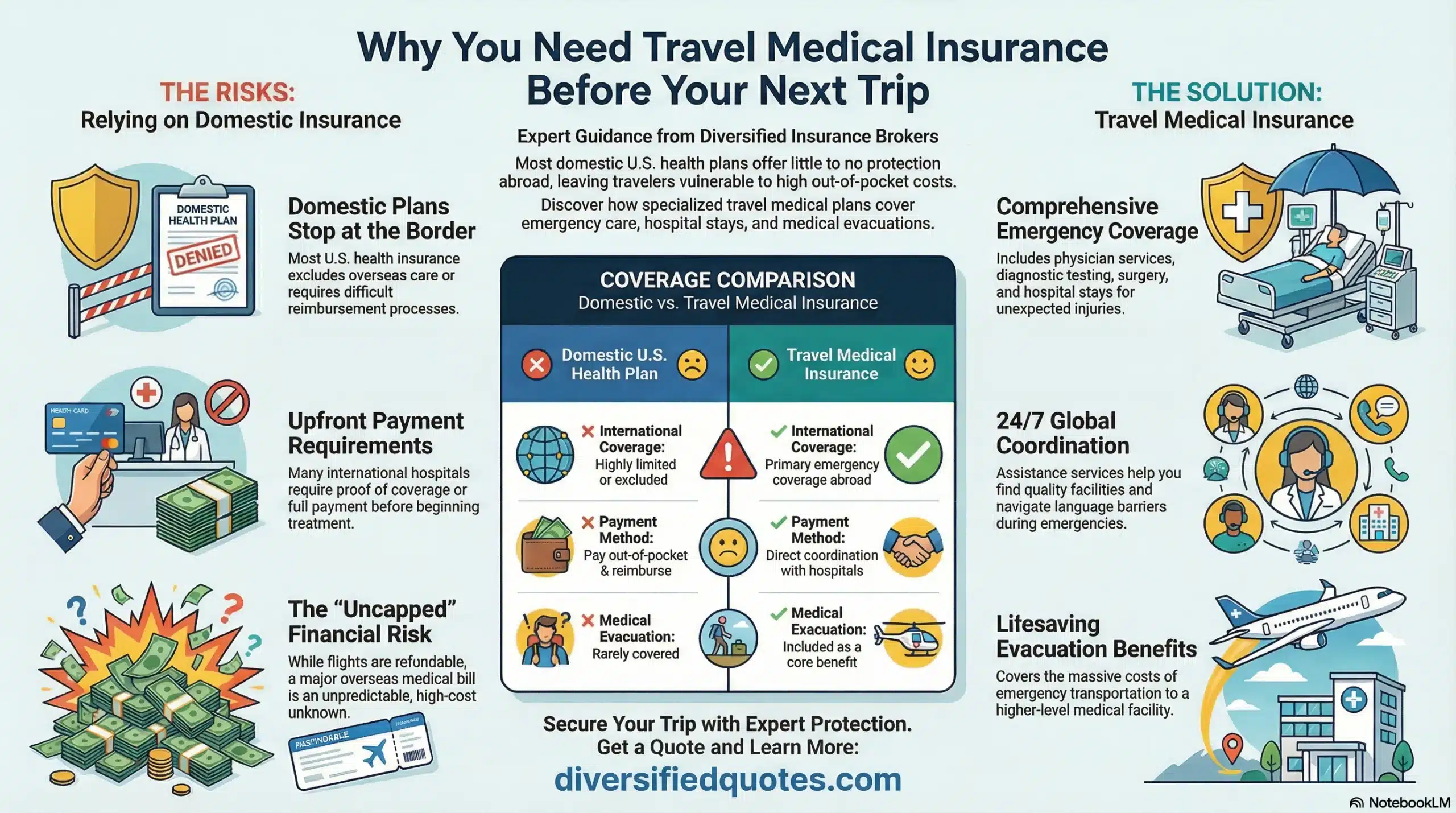
Emergency medical coverage is the foundation of travel insurance for church groups — particularly for any trip that takes participants outside their regular health insurance network, whether that means a trip to another region of the country or travel abroad. The reason emergency medical coverage matters so much is not simply that healthcare costs money — it is that the financial structure of emergency care away from home often requires participants or leaders to pay for care upfront and seek reimbursement later, rather than simply presenting an insurance card and leaving billing to the provider and insurer.
This upfront payment dynamic is most acute in international travel, where hospitals in many countries — particularly in developing regions where mission trips frequently operate — do not accept U.S. insurance cards and do not coordinate with U.S. carriers for direct billing. A church participant who needs hospitalization in rural Guatemala or coastal Philippines will typically need immediate financial arrangements for care before the clinical situation is resolved, and without advance planning through a travel insurance policy that has international medical coverage with a 24/7 assistance line capable of coordinating with local providers, the trip leader faces a financial and logistical crisis simultaneously with the medical crisis.
Medical coverage limits matter significantly for international church travel. Standard leisure travel policies may offer medical limits in the range of $50,000 to $100,000 — adequate for many situations but potentially insufficient for complex care requirements such as extended ICU stays, specialty procedures, or complicated obstetric emergencies for groups that include women of childbearing age. For mission trips to destinations with limited local care capacity, higher medical limits — $250,000 or more — provide meaningful additional protection because the cost of adequate care at the nearest capable facility may be substantial relative to what local facilities can offer. Our resource on emergency travel health insurance covers the structure of emergency medical benefits and how to evaluate coverage limits relative to destination-specific care costs.
Emergency Evacuation — The Most Underestimated Coverage
Emergency medical evacuation is the coverage that church trip planners most commonly underestimate — until they research the actual cost of a medical evacuation from a remote international location and recognize that the single incident cost routinely exceeds the entire travel budget for the group. Medical evacuation from Sub-Saharan Africa to a capable regional hospital, or from a Pacific Island to a facility with specialized surgical capabilities, can cost tens of thousands of dollars for a single patient transport, and full repatriation to the United States in a medical-configuration aircraft can cost significantly more. Without evacuation coverage, these costs fall directly on the participant, the family, and potentially the church organization if there is any perceived institutional responsibility.
The evacuation coverage question for church groups is not simply whether to include it — for any international mission trip to a developing country or remote destination, it is essential — but how to evaluate the specific terms. Evacuation coverage that requires transport only to the nearest adequate facility is different from coverage that allows transport to the United States if the participant prefers. Evacuation coverage that is triggered by the insurer’s medical team determination is different from coverage that follows the recommendation of the treating physician. And evacuation coverage that includes the cost of a medical escort for a minor traveling alone is different from evacuation that applies only to the direct transport cost. These distinctions matter, and confirming them before departure ensures the coverage actually delivers what the trip leader expects when the situation arises. Our resource on travel insurance for humanitarian aid workers covers evacuation considerations for high-risk destinations, which apply directly to mission trips and disaster relief deployments in the same regions.
Trip Cancellation and Interruption — Protecting the Financial Investment
Trip cancellation and interruption protection is the coverage layer most directly tied to the financial investment the church and participants make in advance of travel — non-refundable airfare, lodging deposits, program fees, and mission trip costs that are committed well before departure and that create real financial exposure if the trip cannot proceed as planned. For church groups with significant advance deposit commitments — international mission trips where airfare represents a large per-person cost, retreats with non-refundable venue contracts, concert tours with performance venue deposits — this coverage layer protects the trip’s financial foundation from disruption scenarios that are genuinely outside the group’s control.
The scenarios that trigger trip cancellation claims for church groups include participant illness or injury that prevents travel, illness or injury of an immediate family member that requires the participant to remain home, unforeseen destination events (natural disasters, civil unrest, government travel advisories) that make departure inadvisable, and organizational cancellation due to insufficient enrollment or leadership availability. Trip interruption benefits apply to trips that begin but must be cut short for covered reasons — a team member’s medical emergency that ends the trip early, a family emergency that requires a participant to return home, or a destination event that makes continuation unsafe. Our resource on cheap travel insurance covers the cost spectrum for travel protection and how to evaluate value relative to premium across different coverage structures, and our resource on is travel medical insurance expensive addresses the cost question most commonly asked by church trip coordinators comparing coverage options. Our resource on travel medical insurance for large groups covers the group-size considerations that affect both coverage terms and pricing for larger church travel programs.
Pre-Existing Condition Provisions — The Timing Imperative
Pre-existing condition coverage is the provision most commonly misunderstood by church trip coordinators — and the one whose timing requirements most consistently create preventable coverage gaps. Standard travel insurance policies exclude medical claims related to conditions that existed before the policy was purchased — which means a participant with controlled diabetes, a cardiac history, cancer in remission, or any other ongoing health management has no coverage for claims related to that condition unless the policy includes a pre-existing condition waiver.
Pre-existing condition waivers are available under most quality travel insurance plans, but they come with a critical timing requirement: the policy must be purchased within a defined window of the initial trip deposit — typically 14 to 21 days, though this varies by carrier and plan. A participant who makes a flight deposit six months before a mission trip and purchases travel insurance one month before departure has almost certainly passed the waiver eligibility window, leaving all pre-existing condition medical claims unprotected regardless of how comprehensive the rest of the policy’s coverage appears to be.
For church groups with participants over 60, or any group where health histories are complex, communicating the pre-existing condition waiver timing requirement to families at the time of initial deposit enrollment is one of the highest-value administrative steps a trip coordinator can take. It prevents the situation where a well-intentioned participant purchases coverage too late to qualify for the waiver and discovers only when filing a claim that their existing health condition’s medical costs are excluded. Our resource on travel medical insurance for religious groups covers the coverage coordination considerations specific to faith-based group travel, and our resource on protecting retirement income provides context for senior-age mission participants who are coordinating travel insurance with their broader retirement financial picture.
Group Policy vs. Individual Policies — Why Consistency Matters for Church Travel
One of the most common and consequential mistakes church trip coordinators make is allowing or encouraging individual participants to purchase their own travel insurance independently rather than coordinating a group policy that covers all participants under consistent terms. When each participant independently selects a policy — often based on price alone from a retail comparison website — the group ends up with participants carrying different coverage levels, different medical emergency contact numbers, different claims procedures, and different policy terms for activities and pre-existing conditions. This inconsistency creates real operational problems when a claim arises because the trip leader cannot speak consistently on behalf of all participants and because the insurer may have different obligations to different travelers who experienced the same incident.
A group policy for travel insurance for church groups provides consistent coverage terms across all enrolled participants, a single 24/7 emergency assistance contact for leaders to manage the entire group, and often more cost-effective overall pricing than the sum of equivalent individual retail purchases. It also allows the trip coordinator to confirm that the specific mission activities, the specific destination, and the specific participant health profiles are addressed before enrollment — rather than discovering after departure that one participant’s independent policy excludes the activities the entire group is performing. Our resource on group health insurance provides the organizational context for churches that already coordinate insurance on behalf of staff and members, and the group coordination discipline that applies to employer group health plans applies equally to group travel insurance coordination.
Building a Repeatable Coverage Process for Churches With Regular Travel
Churches with consistent annual travel programs — youth mission trips, senior pilgrimages, choir tours, summer camps, or regular international service deployments — benefit from developing a repeatable coverage process rather than rebuilding the insurance approach from scratch for each trip. A documented process that covers enrollment timing relative to deposit, communication of pre-existing condition waiver deadlines to families, activity confirmation for the specific trip’s work profile, and leader instructions for emergency procedures eliminates the most common gaps that create problems when actual incidents occur.
The process should designate a primary trip insurance contact — the person leaders call in an emergency — and ensure that contact information is distributed to all participants and families before departure rather than relying on documents that remain in a binder at the church office. It should include a clear protocol for what leaders should do first (contact the insurer’s 24/7 assistance line), what documentation is required for claim submission, and who at the church organization has authority to make financial decisions if advance payment for care is needed. This documentation is free to create and often more valuable than any individual coverage feature — because the coverage only protects participants when leaders know how to activate it.
Plan Your Church Group’s Travel Protection
Share your trip dates, destination, group size, and mission activities — we’ll map the right coverage structure and ensure your leaders and families know exactly how the protection works before departure.
Request Church Group Options Quote & Apply OnlineRelated Travel Medical Pages
Medical-first protection, evacuation planning, and emergency coverage options often used by church and mission travel teams.
Related Planning & Budget Pages
Cost-focused resources and specialty coverage options for churches planning realistic protection within a ministry budget.
Financial Protection Essentials
Travel protection resources, health coverage context, and personal financial protection planning for ministry leaders and participants.
Talk With an Advisor Today
Choose how you’d like to connect—call or message us, then book a time that works for you.
Schedule here:
calendly.com/jason-dibcompanies/diversified-quotes
Licensed in all 50 states • Fiduciary, family-owned since 1980
FAQs: Travel Insurance for Church Groups
Why do church groups need travel insurance?
Church trips are unique in ways that make travel insurance more important, not less, than typical leisure travel. Groups often include a wide range of ages and health profiles — teens, adults, and seniors traveling together — and may be engaged in mission work, construction, medical outreach, or service activities in environments far from the comfortable predictability of tourist destinations. Regular health insurance frequently creates gaps in this context: out-of-network limitations for domestic travel, international exclusions for foreign mission trips, reimbursement requirements that create financial exposure before claims are settled, and pre-existing condition exclusions that affect older participants without a waiver. Travel insurance for church groups provides dedicated coverage for medical emergencies, evacuation when local care is inadequate, trip investment protection through cancellation and interruption coverage, and 24/7 assistance that helps volunteer leaders manage emergency situations without being left without guidance in an unfamiliar environment. Our resource on travel medical insurance covers the core medical protection structure that forms the foundation of church group travel coverage.
Does regular health insurance cover medical care on a mission trip?
Sometimes, but not reliably — and the gaps can be significant in exactly the situations where church travelers most need coverage. For domestic mission trips, most health insurance plans cover emergency care but may impose significant out-of-network costs that create financial burden for participants far from home. For international mission trips, most U.S. health insurance plans provide very limited or no coverage outside the United States — and those that do provide international coverage typically require the participant to pay for care upfront and seek reimbursement later, rather than coordinating directly with international providers. Medicare provides essentially no international coverage beyond limited emergency provisions in border situations. For participants on government or employer plans, the specific international provisions should be confirmed before any international trip rather than assumed. Travel insurance adds dedicated medical and evacuation benefits specifically designed for travel situations, without the network restrictions, reimbursement delays, and international exclusions that make regular health insurance unreliable for mission trip medical needs. Our resource on emergency travel health insurance covers the benefit structure designed specifically for these travel medical gaps.
Can we buy one policy for the whole church group?
Yes — and for most church group travel, a group policy is strongly preferable to having each participant purchase individually. A group travel insurance policy provides consistent coverage terms for all participants, a single 24/7 emergency assistance contact that trip leaders can distribute to the entire group, and a unified claims process that the trip coordinator can oversee and support. Individual retail purchases often produce mismatched coverage levels, different emergency contact procedures, different activity exclusions, and coverage gaps that only become visible when a claim arises and the trip leader discovers that one participant’s independently purchased policy covers the situation while another’s does not. Group policies may also provide more cost-effective overall pricing than equivalent individual retail coverage, and they allow the trip coordinator to confirm before enrollment that the planned mission activities, destination, and participant health profiles are accommodated within the coverage terms. Our resource on travel medical insurance for large groups covers group policy considerations for larger church travel programs.
What if someone on the trip has a pre-existing medical condition?
Pre-existing condition coverage requires a specific waiver provision in the policy — standard travel insurance policies exclude medical claims related to conditions that existed before the policy was purchased. The waiver that removes this exclusion is available from most quality travel insurance carriers, but it comes with a critical timing requirement: the policy must be purchased within a defined window after the initial trip deposit — typically 14 to 21 days, though this varies by carrier. A participant who makes a flight or lodging deposit months before departure and purchases insurance later has likely passed the waiver eligibility window, meaning their existing health condition’s medical claims are excluded regardless of how comprehensive the rest of their coverage appears. For church trip coordinators, communicating this timing requirement to all participants at the time of initial deposit — not at the time of policy purchase — is one of the most valuable administrative steps for protecting participants with ongoing health conditions. This is especially important for groups with older participants who commonly have managed health conditions that fall under the pre-existing definition.
Does travel insurance cover mission work and service projects?
Activity coverage confirmation is one of the most important steps in travel insurance selection for church groups — because many standard leisure travel policies define covered activities in ways that may not include mission work. Construction projects, medical outreach, agricultural work, disaster relief activities, and physically demanding service projects may require specific policy wording, activity endorsements, or carriers that explicitly include volunteer service activities within their coverage scope. Reviewing the policy’s activity definitions against the actual planned activities — not the general trip description — before enrollment prevents the situation where a participant is injured during mission work and discovers that the activity that caused the injury is excluded from coverage. When we design coverage for a church group, we confirm that the planned activities are specifically accommodated rather than generally assumed to be covered under a broad “travel” definition. Our resource on travel insurance for missionary groups covers activity coverage considerations for different types of mission work specifically.
When should we buy travel insurance for a church trip?
As early as possible — ideally within 14 to 21 days of making any non-refundable financial commitment to the trip, including the first flight deposit or lodging reservation. This early purchase window is important for two reasons: it maximizes trip cancellation protection (some cancellation benefits require coverage to be in place from the time the trip investment begins) and it preserves pre-existing condition waiver eligibility for participants with ongoing health histories. For churches planning international mission trips where participants make commitments months before departure, establishing the group travel insurance program at the time of initial enrollment — and communicating clearly that participants should purchase individually (if not covered by a group policy) at that same time — prevents the coverage timing gaps that cause the most common and most avoidable claims problems. Waiting until close to departure limits cancellation protection, eliminates pre-existing condition waivers, and reduces the time available to address any coverage gaps discovered during the review process.
What information do we need to get a quote?
The information needed to compare travel insurance for church groups is straightforward: trip dates (departure and return), destination or destinations, approximate group size, age range of participants (particularly whether the group includes minors, seniors over 65, or participants over 70), estimated trip cost per person (for cancellation and interruption benefit sizing), and a description of the primary mission activities (construction, medical outreach, service work, touring, retreat activities). With these basics, we can compare carriers and recommend coverage structures that fit the specific trip profile — addressing the destination’s medical access challenges, the activity coverage requirements, the age-related pre-existing condition considerations, and the trip investment protection appropriate for the financial commitments involved. Our resource on is travel medical insurance expensive covers what typical group travel coverage costs so trip coordinators can plan budget allocations before requesting formal quotes.
How do families file a claim if something happens on the trip?
If a covered event occurs, the first step for participants or leaders is to contact the insurer’s 24/7 emergency assistance line — the number that should be distributed to all participants and leaders before departure. The assistance line coordinates emergency medical care, arranges evacuation when needed, communicates with local providers, and begins the claims documentation process. For medical claims, participants or leaders should retain all documentation of care — receipts, medical reports, treatment summaries, provider contact information — which will be needed for the formal claims submission. Claim forms are typically submitted after return from the trip, using documentation gathered during the emergency. Diversified Insurance Brokers stays available to help church leaders and families understand specific documentation requirements and navigate the process from initial notification through claim resolution — because the post-incident administrative burden should not fall entirely on volunteer leaders who have just managed a difficult experience while caring for their group.
About the Author:
Jason Stolz, CLTC, CRPC, DIA, CAA and Chief Underwriter at Diversified Insurance Brokers (NPN 20471358), is a senior insurance and retirement professional with more than 25 years of real-world experience helping individuals, families, and business owners protect their income, assets, and long-term financial stability. As a long-time partner of the nationally licensed independent agency Diversified Insurance Brokers, Jason provides trusted guidance across multiple specialties—including fixed and indexed annuities, long-term care planning, personal and business disability insurance, life insurance solutions, Group Health, Travel Medical and Evacuation Insurance, and short-term health coverage. Diversified Insurance Brokers maintains active contracts with over 100 highly rated insurance carriers, ensuring clients have access to a broad and competitive marketplace.
His practical, education-first approach has earned recognition in publications such as VoyageATL, and contributions from his agency featured in Kiplinger and GoBankingRates— highlighting his commitment to financial clarity and client-focused planning. Drawing on deep product knowledge and years of hands-on field experience, Jason helps clients evaluate carriers, compare strategies, and build retirement and protection plans that are both secure and cost-efficient. Visitors who want to explore current annuity rates and compare options across multiple insurers can also use this annuity quote and comparison tool.
Explore More Travel Medical Insurance Options: Browse our complete guide to Groups & Specialty Travel Insurance — covering church groups, missionaries, volunteers, students, expats, digital nomads & more.
Last Reviewed: May 26, 2026 |
Reviewed by: Jason Stolz, CLTC, CRPC, DIA, CAA
Chief Underwriter, Diversified Insurance Brokers, Inc. | NPN: 20471358 | Diversified Insurance Brokers, Inc. — Licensed in all 50 states
Fact Checked by: Tonia Pettitt, CMIP©
Medicare Specialist, Diversified Insurance Brokers, Inc. | NPN: 14374308 | Diversified Insurance Brokers, Inc. — Licensed in all 50 states
Did you find this content helpful? Leave us a Google review — it helps others find trustworthy guidance too.
Editorial Standards: Diversified Insurance Brokers maintains rigorous editorial standards to ensure accuracy, clarity, and independence in all content. Learn more about our editorial standards and commitment to transparency.
