
Travel Medical Insurance for Large Groups
Travel Medical Insurance for Large Groups

Jason Stolz CLTC, CRPC, DIA, CAA
Travel Medical Insurance for Large Groups — What Changes When the Whole Group Needs Coverage
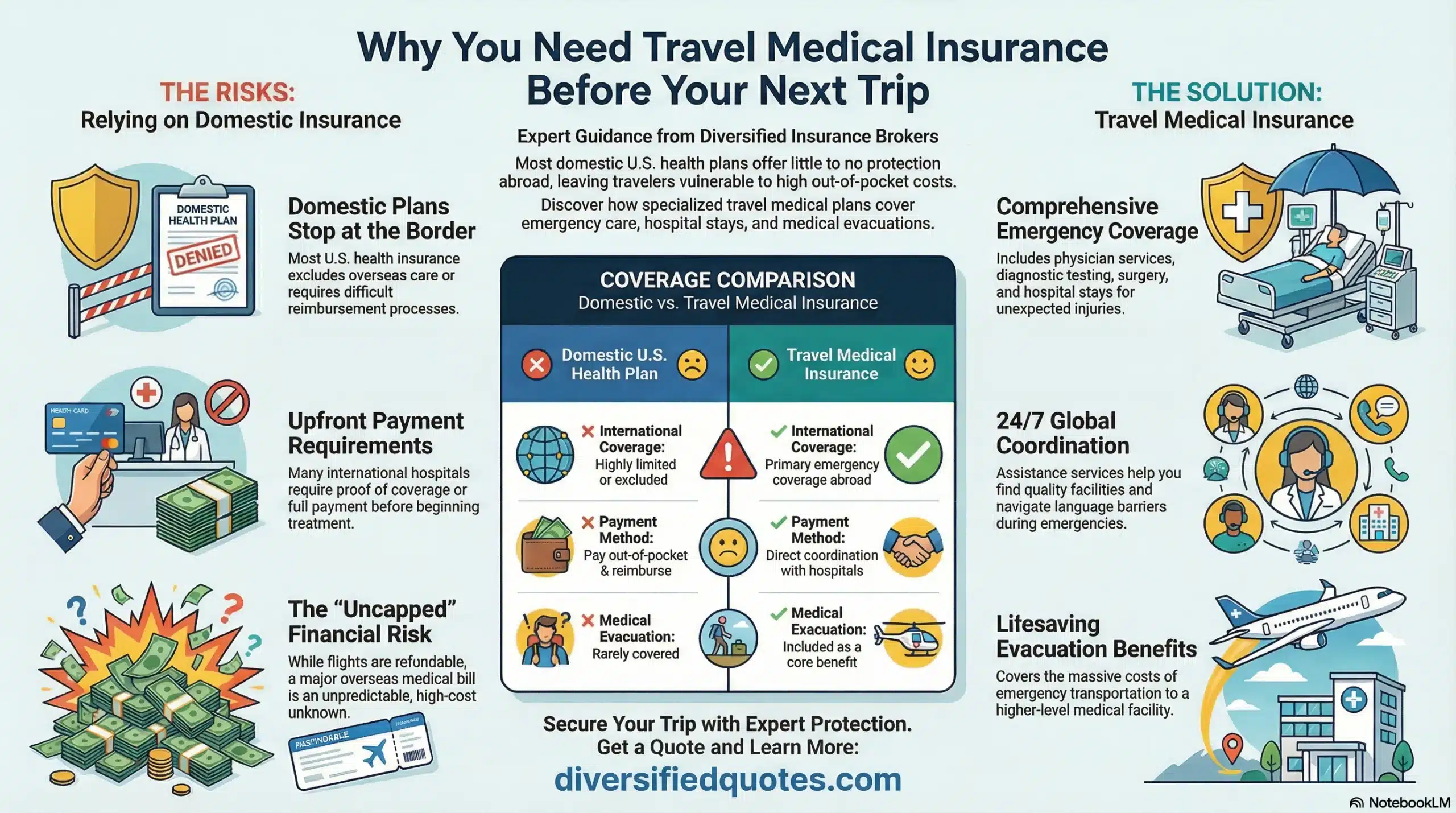
When large groups travel together, the medical risk calculus is not just about any individual traveler’s health — it is about the statistical near-certainty that across 30, 50, or 100 travelers, something will go wrong for someone. A foodborne illness, a twisted ankle, an asthma flare, an allergic reaction, a slip on a wet surface — the individual probability for any one person may be low, but aggregate across a large group and the probability that someone needs medical attention on any multi-day trip is high. The planning problem for organizers is not whether a medical event will occur; it is whether the group has a clear, consistent response when it does. Travel medical insurance for large groups addresses that problem by providing standardized coverage for all enrolled participants under a single master policy, with individual ID cards, consistent benefit terms, and a 24/7 assistance infrastructure that coordinates care without requiring the organizer to improvise under pressure. At Diversified Insurance Brokers, Jason Stolz, CLTC, CRPC, DIA, CAA helps organizations evaluate group travel medical plans matched to their specific destination, traveler profile, and trip activities — because a plan designed for a corporate conference in London is not the right plan for a student mission trip to rural Guatemala, and selecting without that distinction creates gaps that surface exactly when coverage is most needed. Travel medical insurance broadly — how treatment benefits, evacuation coverage, and assistance services fit together — provides the foundational framework for understanding what large-group coverage adds over and above individual traveler policies.
Why Group Coverage Outperforms Individual Purchases for Large Groups
The alternative to group travel medical coverage is requiring each participant to purchase individual policies independently — an approach that produces inconsistency, gaps, and coordination problems that surface precisely when the organizer is already managing a medical emergency. When travelers have different coverage levels, different carriers, different claims procedures, and different emergency contact numbers, the organizer cannot provide a single clear answer to the question every participant will ask when something goes wrong: “What do I do right now?” Group coverage eliminates that inconsistency. All enrolled participants have the same benefits, the same emergency assistance line, and the same claims process. The organizer can document one set of procedures, communicate one set of emergency steps, and rely on one assistance team to coordinate response across all affected travelers simultaneously. Group plans also typically deliver pricing advantages — group rates commonly run 10% or more below equivalent individual policy costs for the same destination and coverage terms, with the discount increasing as group size grows. Group coverage versus individual coverage as a structural comparison establishes why the administrative and pricing advantages of group enrollment extend across insurance categories — the same logic that applies to group life insurance applies here.
Compare Group Travel Medical Plans
View plan options by destination, dates, and group size. The fastest way to see benefit structures and pricing.
What Group Travel Medical Insurance Covers — and What Determines Whether It Applies
| Coverage Area | What It Typically Includes | Key Planning Consideration |
|---|---|---|
| Emergency medical treatment | Physician visits, emergency room care, hospitalization, diagnostic testing, and prescription medications for illness or injury occurring during the covered trip period; benefits apply whether care is received domestically out-of-network or internationally | Policy maximums vary widely — $50,000, $100,000, $500,000, or $1,000,000 per person per trip; the right maximum depends on destination healthcare costs and how long the group will be traveling; remote or high-cost healthcare markets warrant higher limits |
| Emergency evacuation and repatriation | Transport to the nearest appropriate medical facility when local care is inadequate; repatriation to the traveler’s home country when medically necessary; repatriation of remains if the traveler dies during the trip | For groups traveling to remote destinations or countries with limited healthcare infrastructure, evacuation coverage is often the most critical benefit — international air ambulance costs routinely exceed $100,000; confirming that evacuation is included and at what limit is essential before departure; see also emergency medical evacuation insurance for the complete mechanics |
| 24/7 assistance services | Multilingual emergency assistance available around the clock — facility location, physician referrals, coordination of care between the local treating provider and the insurance team, translation support, and embassy or consulate referrals when needed | The assistance service is the operational backbone of the plan — the number organizers call first, not last; a plan with strong assistance infrastructure coordinates faster and produces better outcomes than a plan where the organizer must manage the logistics independently; all enrolled travelers and group leaders should have the assistance number saved before departure |
| Pre-existing condition coverage | Coverage terms for pre-existing conditions vary by plan — some plans cover acute onset of pre-existing conditions; others require the traveler to have a current primary U.S. health plan for pre-existing conditions to be eligible; some plans exclude pre-existing conditions entirely | Groups with older travelers, participants with managed chronic conditions, or members who are not currently enrolled in a primary health plan need to confirm the pre-existing condition terms before selecting a plan — the most common coverage gap in large-group travel medical planning is assuming pre-existing conditions are covered when the plan’s terms exclude or limit them |
The table establishes the four coverage dimensions that determine whether a group travel medical plan actually performs when it is needed. The assistance service in particular deserves emphasis: for large groups, the difference between a good travel medical plan and a poor one is often not the benefit schedule on paper but the quality of the assistance team on the phone at 2 AM when a student is in a foreign emergency room and the group leader is trying to manage 49 other travelers simultaneously. Organizers evaluating plans should ask specifically about how the assistance team operates, what languages it supports, and how it coordinates with local providers — not just what the policy maximum is.
Matching Coverage to Group Type — Why Activities and Destination Determine the Right Plan
A single generic group travel medical plan is not the right answer for every type of group travel. The activities the group will engage in, the destination’s healthcare infrastructure, and the age and health profile of participants all affect both the risk exposure and the appropriate plan structure. Corporate and conference groups traveling to major urban destinations with developed healthcare systems — Western Europe, Japan, Australia, major Canadian cities — face a different risk profile than athletic teams competing in developing countries, mission groups serving in rural villages, or student programs in medically underserved regions. Selecting the plan without accounting for those differences means either over-insuring for groups with low complexity or — more dangerously — under-insuring for groups with high complexity.
Corporate and Conference Travel
Corporate groups and conference travelers typically need coverage that handles common travel medical events — illness, minor injury, emergency care — plus the coordination support that prevents a medical incident from cascading into schedule disruptions for the rest of the group. These groups are generally healthy, traveling to accessible destinations, and have employer-sponsored health plans that may provide some domestic coverage. The gap that international group travel medical fills is the lack of coverage outside the U.S. by those employer plans — most employer-sponsored health insurance provides no coverage internationally. Group health insurance as the employer’s domestic coverage architecture establishes what already exists for employed travelers — and makes clear that the employer plan’s international gap is exactly what the travel medical plan fills. Level-funded group health plans for corporate employers are the domestic coverage foundation alongside which international travel medical coverage operates as a travel-period supplement.
Student, Athletic, and Mission Groups
Student groups, athletic teams, and mission or volunteer groups present different coverage considerations. Student groups often include minors, which may trigger specific organizational or parental notification requirements alongside the coverage itself. Athletic groups face a higher physical risk profile — sports injuries, overuse conditions, and concussions are common — and plans should be confirmed to cover injuries related to organized athletic activities rather than just illness. For groups where sport or physically demanding activity is the primary purpose, confirming that the specific activities are within the plan’s coverage scope before departure is essential, not optional. Mission and volunteer groups often travel to destinations with limited local healthcare infrastructure where the evacuation benefit is not a secondary consideration but the primary protection mechanism — the nearest qualified medical facility may be hours away by ground or require air transport. High-risk travel insurance addresses the specific coverage framework when destinations involve elevated operational risk, limited healthcare access, or activities that standard travel medical plans may not fully cover. Emergency travel health insurance provides the specific emergency-focused coverage structure that mission groups in remote areas often need as their primary protection design.
Domestic vs. International Group Travel — The Coverage Gap That Surprises Organizers
A common assumption among organizers of domestic U.S. group travel is that travel medical insurance is only relevant for international trips because all domestic travelers have personal health insurance. In practice, domestic group travel creates two meaningful coverage problems that personal health insurance does not solve cleanly. The first is out-of-network emergency care — if a traveler receives emergency treatment at a facility outside their primary plan’s network, the cost-sharing can be substantial even after the ACA’s surprise billing protections apply to the facility bill, and the coordination burden falls on the individual traveler rather than on any assistance team. The second is the coordination problem: when multiple travelers need care simultaneously, or when an incident requires decisions about which facility to use and how to coordinate care for someone who cannot advocate for themselves, personal health insurance provides no operational support — just a claims reimbursement process after the fact. Hospital indemnity coverage for observation stays and ER and urgent care indemnity benefits are the supplemental domestic coverage tools that address the cost-sharing exposure that remains after personal health insurance processes an out-of-network or ER claim — relevant for any organization whose members face those domestic gaps during group travel.
For international group travel, the coverage gap is more fundamental. Original Medicare and Medicare Advantage plans do not cover medical care outside the United States — a critical planning gap for groups that include older participants or participants who are enrolled in Medicare rather than commercial health insurance. Medicare supplement plans include a limited foreign travel emergency benefit on most Medigap plan types, but the lifetime maximum on that benefit ($50,000 on most plans) may be inadequate for a serious international evacuation event. Groups that include Medicare-enrolled participants need to confirm that the group travel medical plan’s benefits apply regardless of the traveler’s primary coverage status — and that the evacuation benefit is sufficient for the destination even if the traveler’s Medigap provides some baseline foreign coverage. Medicare enrollment planning at 65 establishes the coverage framework for participants approaching or in retirement — relevant for organizations whose membership includes older adults who travel with the group. For international travel with foreign nationals traveling to or from the U.S., emergency travel health insurance for foreign nationals and emergency travel medical insurance for U.S. citizens address the specific coverage eligibility considerations for mixed-nationality groups. Long-term international assignments or programs extending beyond a standard trip duration are better served by international health insurance than by a trip-specific travel medical plan — the plan structure shifts when the overseas period is measured in months rather than weeks.
Administrative Planning — What Organizers Need to Do Before Departure
The value of a group travel medical plan is realized only if the operational infrastructure is in place before departure. Enrollment must be completed before the trip begins — coverage cannot be purchased retroactively once a traveler has already experienced the medical event that prompted the claim. For groups with staggered departure dates, varied itineraries, or participants traveling from different origin points, the enrollment logistics require intentional planning to ensure all participants are covered for their specific travel dates rather than a single standardized period that may not match everyone’s actual travel window.
Pre-trip documentation is the second operational requirement. Every group leader and every participant should have the plan’s emergency assistance number saved before departure — not printed in a packet that gets left at home and not embedded in an email that requires cellular data to retrieve. The assistance team is the first call when a medical event occurs, not the insurance company’s claims department; the difference matters because the assistance team coordinates care in real time while the claims process happens after the fact. Documenting one clear emergency procedure — who calls first, what number they call, what information they provide — and communicating it consistently across all group leaders reduces the response time and reduces the probability that a medical event produces downstream coordination failures. Organizations that travel internationally on a recurring basis, and whose leadership includes older participants approaching retirement age, benefit from connecting the travel coverage conversation to the broader retirement income and healthcare planning conversation. Whether Medicare covers long-term care — it does not — and IRMAA planning for Medicare premium management are the healthcare cost planning conversations relevant for organizational leaders whose own finances are intertwined with their travel and leadership responsibilities. Social Security planning guidance and maximizing Social Security benefits are income planning topics for the same leadership demographic. Annuities for conservative investors, guaranteed income from annuities, and the annuity rescue plan process provide retirement income planning resources that connect to organizational leaders who want the complete financial picture alongside their operational coverage planning. Current fixed annuity rates near multi-year highs are relevant for leaders approaching retirement who want guaranteed accumulation alongside their other planning decisions. For the organizational leadership’s personal protection needs — whether life insurance is still needed in retirement, burial insurance for seniors, and non-qualified long-term care annuities for care cost planning — Diversified provides complete personal financial planning alongside the organizational coverage conversation. Disability insurance for higher earners and business owners protects the income of organizational leaders whose earning capacity would be affected by a serious health event on or off a group trip. Key person life insurance is the organizational protection instrument for organizations whose operations depend on specific leaders — relevant when the group travel’s leadership and the organization’s operational continuity are intertwined. Whether working past 65 affects Social Security benefits is the planning question for older organizational leaders who are actively managing both continued professional responsibilities and retirement income timing simultaneously.
Build Your Group Travel Medical Plan
Share your group size, destinations, trip dates, and what the group will be doing — we’ll help you identify coverage that fits the actual risk profile rather than a generic template.
Talk With an Advisor Today
Choose how you’d like to connect—call or message us, then book a time that works for you.
Schedule here:
calendly.com/jason-dibcompanies/diversified-quotes
Licensed in all 50 states • Fiduciary, family-owned since 1980
FAQs: Travel Medical Insurance for Large Groups
What counts as a “large group” for travel medical insurance purposes?
Most travel medical insurance carriers define a group as 5 or more travelers enrolled under a single master policy. The threshold for “large group” pricing — where discounts and consolidated enrollment processes become more significant — is typically 10 or more travelers, though this varies by carrier. At 10 or more travelers, groups commonly receive discounts of 10% or more compared to equivalent individual policy rates for the same destination, coverage terms, and traveler ages. Some carriers offer larger tiered discounts as group size increases — 20, 50, or 100+ traveler brackets may produce different pricing structures.
For planning purposes, any organized group of 5 or more travelers where the organizer wants consistent coverage, a single emergency procedure, and consolidated enrollment should evaluate group travel medical coverage rather than directing participants to purchase individually. The operational advantages of group coverage — one master policy, individual ID cards, standardized benefits, shared emergency assistance number — apply regardless of whether the group qualifies for the specific “large group” pricing tier at a given carrier. Organizations that travel repeatedly with groups of similar composition should confirm whether annual or multi-trip arrangements are available, which can simplify planning further for recurring programs.
Do participants in the group need to purchase their own coverage or can the organizer buy for everyone?
For group travel medical plans, the organizer typically makes a single purchase for all enrolled participants under a master policy — each participant receives their own individual ID card and coverage confirmation, but the enrollment, payment, and administration happen at the group level rather than requiring each individual to shop, apply, and purchase separately. This is one of the primary administrative advantages of group coverage: one application, one payment process, one policy document, and one set of emergency procedures that applies to every enrolled participant.
Whether the organizer pays for the coverage or passes the cost to participants varies by organization type and program structure. Some organizations cover the full cost as part of the trip fee or as an employer benefit. Others add it as a line item in the participant fee. Others offer it as an optional add-on that participants choose to include. The enrollment process can accommodate any of these arrangements — what matters for the group pricing and standardized coverage structure is that all enrolled participants are submitted under the same group application with consistent travel dates and destination information rather than each purchasing independently on separate timelines.
Does our group’s employer health insurance cover international travel?
Most employer-sponsored group health insurance plans in the United States provide limited or no coverage for medical care received outside the U.S. The plan may cover emergency care if the traveler returns to the U.S. for treatment, or it may process international claims as out-of-network with high cost-sharing — but the operational reality is that foreign providers frequently require payment at the time of service, the claims submission process for international care is often burdensome for the employee, and the plan provides no real-time assistance coordination when someone is in a foreign emergency room at midnight. Even when the employer plan technically covers some international expenses, it does not provide the 24/7 multilingual assistance service, the evacuation coordination, or the real-time care navigation that dedicated travel medical coverage includes.
For groups where all participants have the same employer health plan, the gap between what the employer plan provides domestically and what it provides internationally is the exact gap that group travel medical insurance fills. For groups with mixed insurance status — some participants on employer plans, some on individual marketplace plans, some on Medicare — the variability in international coverage is even greater, and group travel medical coverage provides the consistent baseline that eliminates the “what does my plan cover here?” question for every participant in the group.
What happens if a participant needs to be evacuated — who coordinates it?
When a participant requires evacuation, the process is initiated by contacting the plan’s 24/7 assistance line — not by the organizer attempting to arrange transport independently. The assistance team confirms medical necessity, identifies the appropriate destination facility, arranges the transport (ground ambulance, helicopter, or fixed-wing air ambulance depending on the patient’s condition and location), coordinates physician-to-physician communication between the local treating provider and the receiving facility, and manages the logistics throughout the process. The organizer’s role is to contact the assistance team immediately and provide the patient’s information — the assistance team takes over the coordination from there.
Independent arrangements made without contacting the assistance team first are typically not covered — the plan’s coverage for evacuation is contingent on the assistance team arranging and authorizing the transport. This is the single most important operational fact for group leaders to communicate before departure: the assistance line number is the first call, not a backup option. International air ambulance transport costs routinely exceed $100,000 for serious evacuations — a cost that falls entirely on the participant or organization if it is arranged outside the plan’s authorization process. Building the assistance number into pre-trip documentation and requiring all group leaders to have it saved before departure is basic risk management, not optional preparation.
Are athletic activities and adventure sports covered under group travel medical plans?
Coverage for athletic activities and adventure sports varies significantly by plan and must be confirmed before the group departs — not assumed. Standard group travel medical plans cover illness and accidental injury during the trip, but many plans either exclude injuries resulting from specifically defined hazardous activities or require an optional rider or specialized plan for those activities to be covered. Organized competitive sports, contact sports, extreme sports (skiing at certain elevations, scuba diving beyond defined depths, mountaineering, etc.), and adventure activities common on volunteer and mission trips (river crossings, construction work, heavy lifting) may fall outside the base plan’s coverage scope.
For athletic teams, the most important pre-purchase confirmation is whether organized team sports participation — including practices and competitions — is explicitly covered under the plan being purchased. For mission and volunteer groups, confirming that the physical activities involved in the service project are within the plan’s coverage scope is equally important. Plans designed specifically for higher-risk activity profiles are available and should be evaluated when the group’s itinerary includes activities that could produce the most significant injuries — since those are precisely the events that the plan needs to cover and that a generic plan may exclude.
Can we enroll participants who are on Medicare rather than commercial health insurance?
Yes — Medicare-enrolled participants can be enrolled in group travel medical plans, and doing so is particularly important given Medicare’s lack of international coverage. Original Medicare and Medicare Advantage plans do not cover medical care outside the United States, which means Medicare-enrolled participants traveling internationally have no primary health insurance coverage for any medical event that occurs abroad unless a dedicated travel medical plan is in place. Even participants with Medigap plans that include a foreign travel emergency benefit face a $50,000 lifetime maximum on most plans — which may be insufficient for a serious international evacuation event that costs significantly more.
When enrolling Medicare participants in a group travel medical plan, confirm whether the plan requires a current U.S. primary health plan for pre-existing condition coverage to apply. Some plans limit pre-existing condition benefits to participants who have a qualifying primary health plan — Medicare does qualify as a primary health plan for this purpose on most plan designs, but confirming this specific plan term is important for groups that include older participants managing chronic conditions. The group plan’s coverage for the Medicare-enrolled participant fills the international gap that Medicare leaves — it is not duplicating coverage but providing coverage in the geographic dimension where Medicare does not operate.
About the Author:
Jason Stolz, CLTC, CRPC, DIA, CAA and Chief Underwriter at Diversified Insurance Brokers (NPN 20471358), is a senior insurance and retirement professional with more than 25 years of real-world experience helping individuals, families, and business owners protect their income, assets, and long-term financial stability. As a long-time partner of the nationally licensed independent agency Diversified Insurance Brokers, Jason provides trusted guidance across multiple specialties—including fixed and indexed annuities, long-term care planning, personal and business disability insurance, life insurance solutions, Group Health, Travel Medical and Evacuation Insurance, and short-term health coverage. Diversified Insurance Brokers maintains active contracts with over 100 highly rated insurance carriers, ensuring clients have access to a broad and competitive marketplace.
His practical, education-first approach has earned recognition in publications such as VoyageATL, and contributions from his agency featured in Kiplinger and GoBankingRates— highlighting his commitment to financial clarity and client-focused planning. Drawing on deep product knowledge and years of hands-on field experience, Jason helps clients evaluate carriers, compare strategies, and build retirement and protection plans that are both secure and cost-efficient. Visitors who want to explore current annuity rates and compare options across multiple insurers can also use this annuity quote and comparison tool.
Explore More Travel Medical Insurance Options: Browse our complete guide to Groups & Specialty Travel Insurance — covering church groups, missionaries, volunteers, students, expats, digital nomads & more.
Last Reviewed: June 17, 2026 |
Reviewed by: Jason Stolz, CLTC, CRPC, DIA, CAA
Chief Underwriter, Diversified Insurance Brokers, Inc. | NPN: 20471358 | Diversified Insurance Brokers, Inc. — Licensed in all 50 states
Fact Checked by: Tonia Pettitt, CMIP©
Medicare Specialist, Diversified Insurance Brokers, Inc. | NPN: 14374308 | Diversified Insurance Brokers, Inc. — Licensed in all 50 states
Did you find this content helpful? Leave us a Google review — it helps others find trustworthy guidance too.
Editorial Standards: Diversified Insurance Brokers maintains rigorous editorial standards to ensure accuracy, clarity, and independence in all content. Learn more about our editorial standards and commitment to transparency.
