
International Travel Health Coverage
International Travel Health Coverage

Jason Stolz CLTC, CRPC, DIA, CAA
At Diversified Insurance Brokers, we help travelers secure international travel health coverage that is built for the moments that matter most — sudden illness abroad, accidental injuries, emergency room visits, hospitalization in an unfamiliar healthcare system, and the possibility of medical evacuation when local care is not adequate for the condition. Many travelers assume their domestic health plan will “work overseas” in some meaningful way, but once you leave your home country, the rules, reimbursement structures, and access to care change quickly and often dramatically. A dedicated international travel health policy closes those gaps and creates a practical operational plan for what to do if you need medical care while traveling.
International travel health coverage is most valuable not just because it pays benefits — it is because it pairs the financial benefit with 24/7 coordination assistance. In a real overseas medical emergency, you need more than a promise of reimbursement. You need someone who knows which local facility can treat the condition, who can arrange payment guarantees so you are not denied care while waiting for insurance processing, who can coordinate evacuation when the nearest adequate facility is not in the city where you are located, and who can guide you through the claim process in real time. That is why international travel health coverage is an operational decision as much as a financial one — and why comparing plans on premium alone misses what actually determines whether the policy works when you need it.
Get International Travel Health Coverage
Fast, secure online quote and enrollment for international travelers seeking medical protection abroad.
Questions? Call 800-533-5969
What International Travel Health Coverage Is Designed to Do
International travel health coverage is designed to protect you from the financial shock and logistical disruption that can happen when you need medical care outside your home country. The design philosophy of a good international travel health plan is fundamentally different from domestic health insurance — not because the conditions covered are different, but because the environment in which care is delivered is different in ways that demand a specific infrastructure response.
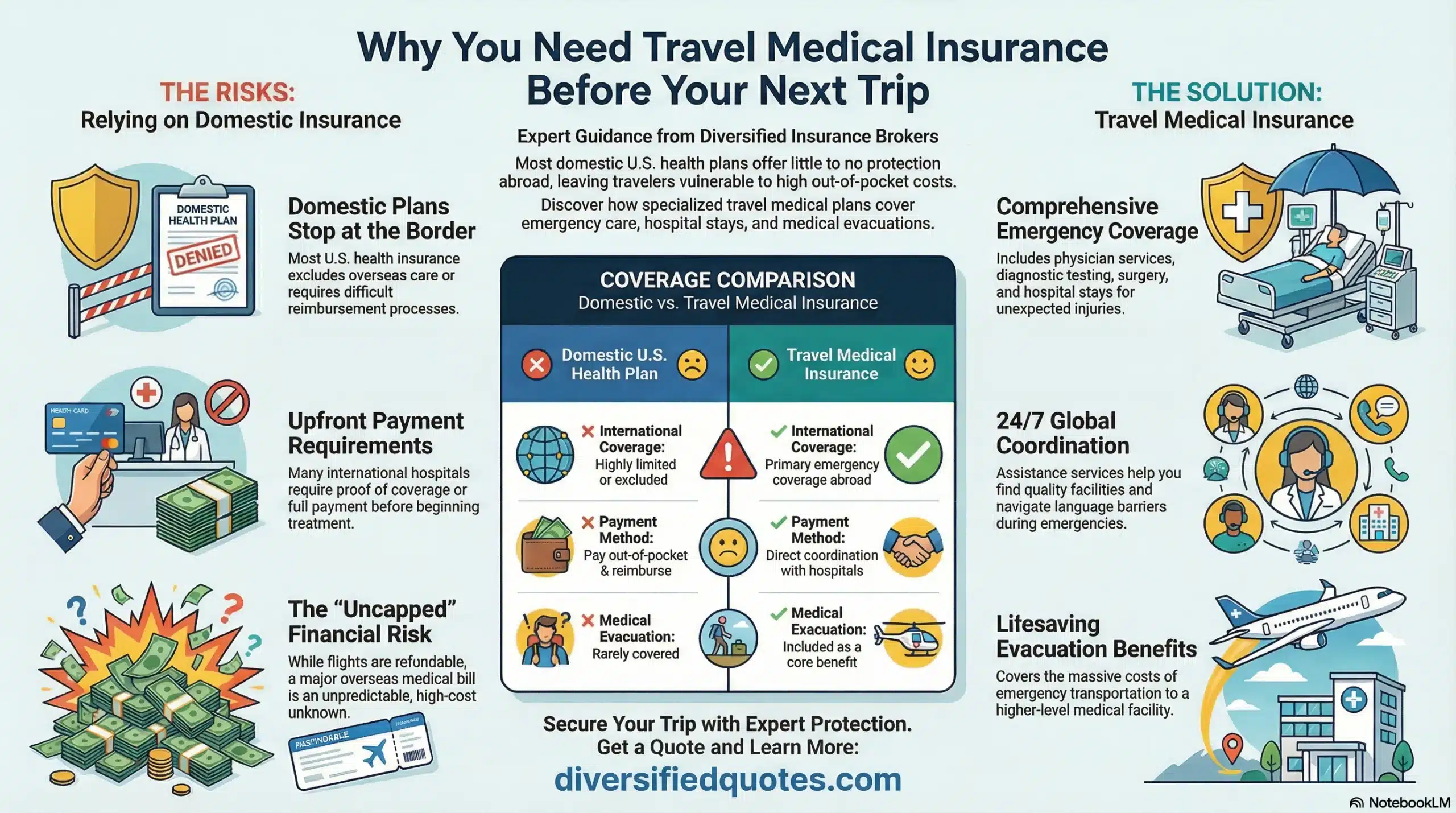
Domestic health insurance assumes you are within its network structure, that providers can verify coverage electronically in real time, that language and communication barriers are minimal, and that your location relative to needed care is predictable. None of those assumptions hold when you are traveling internationally. Overseas hospitals and clinics may not accept your domestic insurance card, may not be able to verify your coverage on a Sunday night when you arrive at the emergency room, and may require a payment deposit or guarantee before treatment begins — a requirement that catches many travelers completely unprepared.
A dedicated international travel health policy creates a different framework: a plan that is specifically designed to function in foreign healthcare environments, with an assistance team that operates 24 hours a day across time zones, that has relationships with hospitals and providers in major destinations globally, and that can issue payment guarantees or coordinate direct billing when the hospital requires it. For a traveler who genuinely needs care abroad, the assistance team’s ability to make a phone call and secure a payment guarantee at a local hospital is often what determines whether treatment begins immediately or is delayed. That infrastructure is as important as any specific benefit limit — and it is what separates quality international travel health coverage from low-cost plans that technically provide a reimbursement benefit but offer nothing in terms of real-time coordination.
What International Travel Health Coverage Typically Includes
The benefit structure of most international travel health plans centers on emergency and urgent medical needs — the unexpected events that make up the vast majority of overseas medical claims. Understanding what is and is not included in a standard plan, and what optional coverage is available, allows travelers to select coverage that matches their actual risk profile and trip characteristics.
Emergency and urgent care — including emergency room evaluation, physician services, urgent care facility visits, and treatment for sudden illness or injury — is the core benefit of all international travel health plans. This covers the situations that most commonly generate claims: a respiratory infection that develops into pneumonia requiring hospitalization, a fracture from a fall that needs surgical repair, an allergic reaction requiring emergency treatment, a cardiac event during travel. Coverage is typically triggered when the need for care is unexpected and not the result of a pre-planned medical procedure.
Hospitalization and inpatient care — including room and board at semi-private room rates, inpatient nursing care, medically necessary surgery, anesthesia, intensive care unit services, and medically necessary diagnostic procedures — are covered under standard international travel health plans up to the policy’s medical maximum. Hospitalization costs represent the largest financial exposure in most serious overseas medical events and are why the medical maximum selection is one of the most consequential decisions in plan design. A single day in an ICU in Tokyo, London, or Sydney can cost $5,000 to $15,000 or more. A surgical hospitalization can easily produce bills of $50,000 to $150,000.
Outpatient services and diagnostics — laboratory work, imaging, outpatient specialist consultations when medically necessary — are covered under most plans for conditions related to a covered illness or injury. The documentation requirements for outpatient claims are more administrative than for emergency care, which is why understanding the claim process before travel and keeping itemized bills and medical records from all provider encounters is important.
Prescription medications related to a covered medical condition are typically covered under standard plans. Medications needed for ongoing management of pre-existing conditions are generally not covered under travel medical plans — those are excluded as pre-existing condition treatment rather than covered as emergency care.
Emergency medical evacuation is one of the most important and most misunderstood benefits in international travel health coverage. Evacuation covers the cost of medically necessary transport from your location to the nearest facility capable of treating your condition when that facility is not available locally. Air ambulance evacuation is the most expensive component of many international medical events — costs routinely reach $100,000 to $500,000 for air ambulance transport from Asia, Africa, or remote regions of Latin America. Plans without adequate evacuation coverage, or plans where the evacuation benefit is poorly defined, leave travelers exposed to exactly the scenario where the financial consequence is largest. Our dedicated resource on emergency medical evacuation insurance explains how evacuation triggers work, what “medically necessary” means in practice, and why the coordination requirement is critical for the benefit to function when needed.
Repatriation of remains — covering the cost of transporting a deceased insured’s remains back to the United States — is included in most international travel health plans. The costs of international repatriation of remains can be substantial ($10,000 to $25,000 or more depending on the country of death and distance), and domestic health insurance and life insurance typically do not cover this expense.
24-hour assistance services are the operational infrastructure that makes the other benefits functional in real emergencies. The assistance team provides medical provider referrals in unfamiliar locations, direct communication with treating hospitals, payment guarantee coordination, claim guidance, translation assistance, evacuation coordination and approval, and emergency contact with family at home. For a traveler dealing with a medical crisis in a country where they do not speak the language, do not know the local healthcare system, and do not know which hospitals are capable of treating their condition, the assistance team is the practical bridge between the insurance benefit and the actual delivery of care.
Matching Coverage to Destination and Trip Type
One of the most significant mistakes travelers make when selecting international travel health coverage is treating all destinations as equivalent. They are not. The appropriate coverage levels, the value of the evacuation benefit, and the importance of the assistance team’s local infrastructure vary dramatically depending on where you are going, how long you are traveling, and what activities you plan to do while abroad.
Western Europe, Canada, Australia, Japan, and other high-income countries with well-developed healthcare infrastructure generally provide high-quality care for international visitors — but at costs that are genuinely high for uninsured travelers. A hospitalization in France, Germany, or Japan can produce bills of $5,000 to $20,000 per day in intensive care settings. The evacuation risk is relatively lower in these destinations because advanced medical care is broadly available, but the medical bill risk is substantial. Coverage with a medical maximum of $100,000 to $250,000 is generally appropriate for travel to these destinations for most trip durations.
Southeast Asia, Latin America, Eastern Europe, and similar middle-income destinations present a different risk profile. Quality of care varies significantly by city and region — major cities may have internationally accredited hospitals capable of treating complex conditions, while rural or remote areas may have very limited medical infrastructure. Evacuation risk is higher because the probability of needing to transport someone to a larger city or to another country for appropriate care is meaningfully elevated compared to Western Europe. Medical cost risk is generally lower than in high-income countries, but the evacuation cost risk is higher. Coverage with a medical maximum of $250,000 to $500,000 and robust evacuation coverage is appropriate for these destinations.
Sub-Saharan Africa, remote Asia, Central Asia, and other lower-infrastructure destinations represent the highest risk profile for both medical care quality and evacuation logistics. Advanced medical care for serious conditions is often only available in capital cities or major regional hubs, which may require evacuation from remote locations. Air ambulance costs in these regions are among the highest globally due to distance, aircraft requirements, and the complexity of coordinating medical transport in areas with limited aviation infrastructure. Coverage with a medical maximum of $500,000 or more and an evacuation benefit of at least $500,000 to $1,000,000 is appropriate for travel to these destinations. Our resource on high risk travel insurance provides detailed guidance on how plan design should be adjusted for higher-risk destination profiles.
Cruises and multi-country itineraries present a unique coverage consideration: coverage must extend to every country or port visited during the voyage, including embarkation and disembarkation points, transit countries, and all cruise ports of call. Travelers who enroll in coverage without verifying that all destinations are included may find that a medical event in a port country that was not listed on the application generates a coverage dispute. Providing a complete itinerary — including all cruise ports and transit countries — at enrollment is essential for multi-destination travel.
Plan Design Choices That Determine Real Coverage Quality
International travel health coverage is not all equivalent — two policies with similar premium prices can produce dramatically different outcomes in an actual claim scenario based on the design choices built into the plan. Understanding the specific choices that determine whether a plan provides genuinely useful protection is the prerequisite for good plan selection.
Medical maximum selection is the most visible and most frequently under-chosen design variable. Many travelers select low medical maximums — $50,000 or $100,000 — because they seem large in the abstract. Against the actual cost of serious international medical events, they are often inadequate. A single surgical hospitalization in Western Europe can easily exceed $50,000. A multi-day ICU admission in Japan or Australia can reach $100,000 to $200,000. For most international travel, a minimum medical maximum of $100,000 is appropriate, $250,000 is better for most destinations, and $500,000 provides genuine protection against worst-case scenarios. Higher maximums are available and appropriate for longer trips, remote destinations, or travelers with health conditions that increase the probability of complex medical events.
Deductible and coinsurance structure determines the traveler’s out-of-pocket responsibility when a covered medical event occurs. Plans typically offer deductible options ranging from $0 to $500 or more. A zero-deductible plan provides the most predictable outcome — after enrollment, a covered medical event produces no out-of-pocket cost beyond the premium paid. Higher deductible options reduce premium but require the traveler to fund the first portion of any claim from personal resources. For travelers whose primary concern is eliminating surprise large bills — rather than minimizing premium — a zero or low deductible plan with 100% coverage above the deductible is the right choice.
Evacuation benefit structure and limits are where many budget-priced plans fail in ways that matter most. A plan with a $50,000 evacuation benefit sounds meaningful until you understand that air ambulance evacuation from East Africa, Southeast Asia, or remote Latin America routinely costs $150,000 to $500,000. A plan with a $50,000 evacuation limit leaves the traveler personally responsible for the difference — potentially $100,000 to $450,000 in unexpected out-of-pocket costs. Quality international travel health plans include evacuation benefits of $500,000 to $1,000,000 or more as a standalone benefit separate from the medical maximum, ensuring that evacuation costs do not compete with medical cost reimbursement for the same benefit pool.
Pre-existing condition treatment in the policy language is especially important for travelers over 50 who are more likely to have documented health histories. As discussed in detail in our resource on emergency travel health insurance, plan approaches range from complete exclusions through acute onset provisions to time-sensitive waivers. For travelers with managed chronic conditions, confirming the specific pre-existing condition language before purchase is not optional due diligence — it determines whether the conditions most likely to generate a claim are covered or excluded.
Activity coverage and exclusions matter for travelers whose itineraries include activities beyond standard tourism. Scuba diving, hiking, skiing, kayaking, cycling tours, and other physical activities may be covered under the base policy at some carriers and require optional riders at others. Mountaineering above certain elevations, racing, BASE jumping, and organized contact sports are commonly excluded even with optional riders at some carriers. If your trip includes any activity beyond casual tourism, verifying the plan’s specific activity language prevents coverage surprises.
International Travel Health Coverage vs. International Health Insurance
International travel health coverage and international health insurance are distinct products designed for different use cases — and selecting the wrong product for the intended use is a common and consequential mistake that generates claims disputes and coverage gaps.
International travel health coverage is designed for short-to-medium-term trips where the traveler’s primary residence and healthcare relationships remain in the United States (or their home country). The plan activates when the traveler departs the home country and terminates when they return — or at the end of the policy period, whichever comes first. It is optimized for emergency and urgent care rather than ongoing management of chronic conditions or routine primary care. For travelers spending weeks to several months abroad on vacation, business, study, or mission trips, international travel health coverage is the appropriate product.
International health insurance is designed for travelers who are relocating abroad for extended periods — expatriates, long-term assignment employees, foreign retirees, and others whose primary healthcare needs will occur outside their home country for an extended period. These plans are structured more like traditional comprehensive health insurance — including routine and preventive care, ongoing management of chronic conditions, specialist access, and in some designs dental and vision coverage — designed to function as the traveler’s primary health plan rather than as emergency-only supplemental coverage. Our resource on international health insurance clarifies the differences between these product categories and helps travelers identify which is appropriate for their specific situation.
International major medical insurance occupies a middle position — providing more comprehensive coverage than emergency travel health coverage but structured for shorter durations than long-term expat plans. Our resource on international major medical insurance explains this category for travelers whose needs fall between standard travel health coverage and full expat health insurance.
Common Mistakes That Leave Travelers Exposed
The most expensive international travel health coverage mistakes are not made at claim time — they are made at enrollment time, when travelers select coverage without fully understanding what they are buying or assuming that “having something” is the same as “having adequate protection.” The following patterns appear consistently among travelers who end up with inadequate coverage when they need it most.
Selecting a “travel plan” that is primarily trip cancellation coverage. Many products marketed as “travel insurance” emphasize trip cancellation, trip delay, and baggage benefits — with medical coverage as a secondary feature with low limits and restrictive definitions. A traveler who purchases a trip cancellation plan believing they have emergency medical protection may discover at claim time that their medical maximum is $25,000 and their evacuation benefit is $50,000 — both entirely inadequate for a serious overseas medical event. Products that are primarily travel protection products are appropriate for their intended purpose (protecting the financial investment in a trip) but should not be confused with dedicated emergency medical coverage.
Underestimating the medical maximum needed. The instinct to select a lower medical maximum to reduce premium is understandable but frequently counterproductive. The premium difference between a $100,000 and a $500,000 medical maximum is typically modest — often $10 to $30 for a short trip — while the financial exposure difference is enormous. The risk of needing $50,000 to $150,000 in overseas medical care for a serious illness or injury is real and not rare. Selecting an adequate medical maximum at enrollment costs a small amount more; discovering an inadequate maximum at claim time can cost tens or hundreds of thousands of dollars.
Failing to understand evacuation coordination requirements. Most international travel health plans require that evacuation be coordinated and approved by the plan’s assistance team before it occurs — except in situations of immediate life threat where prior notification is impossible. Travelers who arrange their own evacuation independently, or whose family arranges an unauthorized evacuation without contacting the assistance team, may find the evacuation cost is not covered or covered only at a reduced benefit. Saving the 24-hour assistance phone number before travel and contacting the assistance team as the first step when a serious medical event occurs is the single most important procedural preparation for using evacuation coverage effectively.
Ignoring pre-existing condition language when health history exists. For travelers with any documented health history — managed blood pressure, diabetes, cardiac conditions, respiratory disease, past surgeries — the pre-existing condition provisions of a travel health plan determine whether the conditions most likely to generate a claim are covered or excluded. Travelers who assume coverage is comprehensive without reading the pre-existing condition language may have significant conditions excluded from coverage. Our resource on cheap travel insurance explains where budget-priced plans typically reduce quality — pre-existing condition coverage, evacuation limits, and medical maximums are the three most common areas where low-priced plans trade protection for premium savings.
How Diversified Insurance Brokers Helps
Diversified Insurance Brokers is an independent, family-owned agency licensed nationally that helps travelers and organizations compare international travel health coverage options based on destination, trip duration, traveler profile, health situation, and the specific level of medical and evacuation protection required. Our focus is clarity: we help you understand what the plan is built to do, where it is strong, what limitations to watch for, and how to use the assistance services properly if a medical event occurs.
For travelers making their first international trip or who have previously relied on domestic coverage abroad, we help contextualize the coverage gap and identify the plan structure that closes the most important risks. For frequent international travelers, we compare single-trip versus annual multi-trip structures to identify the most cost-efficient approach for the travel pattern. For group travel — missions, student programs, volunteer organizations, business groups — we help coordinate group enrollment with consistent coverage dates, benefit confirmations, and pre-departure documentation for all travelers. For travelers with health complexity, we help identify plan structures with the most favorable pre-existing condition provisions for the specific health history. And for all travelers, we help calibrate medical maximums and evacuation limits to the specific destinations being visited — because adequate coverage for a two-week trip to France looks very different from adequate coverage for a three-week trip to rural Kenya.
Protect Your Next Trip
Enroll online in minutes and travel with a clear plan for medical care and emergency support abroad.
Questions? Call 800-533-5969
Related Travel Medical Coverage Pages
Compare core travel medical protection options for international travelers, expats, and frequent global travelers.
Evacuation & Specialty Travel Coverage Guides
Explore evacuation protection, high-risk travel coverage, and specialty travel medical planning resources.
Financial Protection Essentials
Additional coverage resources for international travelers, seniors, groups, and those building complete financial protection plans.
Talk With an Advisor Today
Choose how you’d like to connect—call or message us, then book a time that works for you.
Schedule here:
calendly.com/jason-dibcompanies/diversified-quotes
Licensed in all 50 states • Fiduciary, family-owned since 1980
FAQs: International Travel Health Coverage
What does international travel health coverage include?
International travel health coverage is designed to help with eligible medical expenses while you are outside your home country. Depending on the plan, this typically includes physician visits, emergency room evaluation and treatment, urgent care services, hospital stays, outpatient diagnostics when medically necessary, surgery and anesthesia related to a covered condition, and prescription medications for covered illnesses or injuries. Most plans also include emergency medical evacuation — covering transport to the nearest appropriate medical facility when adequate local care is not available — and repatriation of remains.
Beyond the financial benefit, quality international travel health plans include 24/7 assistance services that provide medical provider referrals, direct billing coordination with hospitals, payment guarantee arrangements when hospitals require upfront payment, claim guidance, multilingual translation assistance, and evacuation coordination. In a genuine overseas emergency, the assistance team’s ability to make calls, issue payment guarantees, and coordinate logistics is often as valuable as any specific benefit limit. Our resource on travel medical insurance provides a comprehensive overview of the standard benefit structure across different plan types.
Does international travel health coverage include medical evacuation and repatriation?
Most quality international travel health plans include emergency medical evacuation and repatriation of remains as standard benefits. Emergency medical evacuation covers the cost of medically necessary transport from your location to the nearest appropriate medical facility capable of treating your condition when adequate care is not available locally. Air ambulance evacuation is the most expensive component of many international medical events — costs routinely reach $100,000 to $500,000 for transport from Asia, Africa, or remote Latin America. Plans without adequate evacuation limits — $50,000 to $100,000 — leave travelers personally responsible for the difference, which can be catastrophic.
The most important thing to understand about evacuation coverage is the coordination requirement: in virtually all plans, emergency medical evacuation must be coordinated and approved by the plan’s assistance team before evacuation occurs, except in life-threatening situations where prior notification is impossible. Unauthorized evacuations arranged independently may not be covered. Saving the 24-hour assistance phone number before travel and contacting the team when a serious medical event occurs is the most important procedural preparation for using the evacuation benefit effectively. Our dedicated resource on emergency medical evacuation insurance explains these mechanics in detail.
Do I still need this if I have U.S. health insurance?
For most Americans, yes — and often emphatically so. Most U.S. domestic health plans provide very limited coverage outside the United States. They typically have no overseas provider networks, meaning every international provider is automatically out-of-network with the highest available cost-sharing. Most domestic plans have no direct billing relationships with overseas hospitals, meaning you may be required to pay the full bill upfront and submit for reimbursement after the fact. Most domestic plans have no meaningful emergency medical evacuation benefit — and evacuation is where the largest single bills in international medical events occur, regularly exceeding $100,000 to $500,000. And Medicare provides essentially no coverage outside the United States in most circumstances.
International travel health coverage is specifically designed to address all four of these domestic coverage failures — providing an overseas-specific benefit structure, assistance team coordination, direct billing capability where available, and meaningful evacuation coverage. The cost is typically modest ($50 to $300 or more for a two-week trip depending on destination, age, and coverage levels), while the potential financial exposure from traveling without it can be hundreds of thousands of dollars.
Is this coverage for U.S. citizens only?
No. International travel health coverage can be purchased by U.S. citizens traveling abroad — the most common use case — but can also be available to foreign nationals traveling internationally or visiting the United States, depending on the specific plan’s eligibility rules and geographic coverage scope. Different plans are designed for different directions of travel and different residency situations. Plans designed for U.S. residents traveling abroad are generally appropriate for U.S. citizens and permanent residents. Plans designed for visitors to the United States are appropriate for foreign nationals visiting or temporarily residing in the U.S. Our resource on emergency travel health insurance for foreign nationals addresses coverage specifically designed for visitors to the United States.
How long can I keep the coverage?
Coverage duration depends on plan design. Single-trip plans cover one specific trip for a defined period — from the departure date to the return date. These are appropriate for travelers making one or two international trips per year. Annual multi-trip plans cover all international trips taken within a 12-month period, subject to maximum trip duration limits per individual trip (commonly 30 to 90 days per trip depending on the plan). Annual plans are cost-effective for frequent international travelers who travel three or more times per year. Long-stay plans cover extended international stays of several months, and expat health insurance is designed for travelers living abroad for a year or more. The right structure depends on how frequently you travel, how long your typical trip is, and whether the annual multi-trip model or individual trip enrollment makes more sense for your travel pattern.
Are pre-existing conditions covered?
Pre-existing condition coverage varies significantly by carrier and plan, and confirming the specific plan language before purchase is essential if you have any documented health history. Some plans exclude pre-existing conditions entirely — any medical event causally related to a condition diagnosed, treated, or symptomatic within the look-back period before enrollment is not covered. Others offer “acute onset” provisions covering emergency treatment for a sudden unexpected crisis related to a pre-existing condition even when that condition is otherwise excluded. Some plans offer time-sensitive waivers that eliminate pre-existing condition exclusions entirely for travelers who purchase within a defined window of their initial trip deposit.
For travelers with managed chronic conditions — controlled hypertension, diabetes, cardiac history, respiratory conditions — reviewing the pre-existing condition provisions before purchase determines whether the conditions most likely to generate a claim are covered or excluded. When in doubt, contact our team and we can help identify plans with the most favorable pre-existing condition provisions for your specific health situation.
What costs should I expect beyond the premium?
Most international travel health plans include deductibles — the amount you pay before plan benefits begin — and may include coinsurance or copays for certain services. The deductible you select at enrollment (typically ranging from $0 to $500 or more) applies per policy period in most plans. Plans with lower deductibles have higher premiums; plans with higher deductibles reduce premium but increase the out-of-pocket responsibility when a medical event occurs. Some plans pay 100% of covered costs above the deductible; others apply 80/20 or similar coinsurance where you remain responsible for a percentage of costs above the deductible. Plans also have benefit maximums — the total available for covered medical expenses during the policy period — which is why selecting an adequate maximum at enrollment is essential.
How do claims work while I’m traveling?
Claims processes vary depending on whether the provider participates in the plan’s direct billing network. At facilities where direct billing is available, the hospital bills the insurance company directly and the traveler is responsible only for their applicable cost-sharing. At facilities without direct billing relationships — which is common in many countries — the traveler pays the medical bill upfront and submits for reimbursement after the fact. For reimbursement claims, keeping itemized bills, receipts, proof of payment, medical records, and documentation of the treating providers from all encounters is essential. Contacting the 24-hour assistance team as early as possible when a medical event occurs helps with real-time claim guidance and can facilitate direct billing arrangements at facilities where those relationships exist.
Is this coverage a replacement for international major medical insurance?
International travel health coverage and international major medical insurance serve different use cases, and one is not simply a better or worse version of the other. International travel health coverage is designed for travelers who are temporarily outside their home country — optimized for emergency and urgent care protection during a defined trip. International major medical insurance is designed for travelers who need more comprehensive coverage for extended stays, including potentially routine and preventive care, ongoing management of chronic conditions, and broader specialist access. The right product depends on how long you will be outside your home country and what types of care you need protected. Our resource on international major medical insurance explains the distinction and helps travelers identify which product category fits their situation.
How do I choose the right plan and where can I start a quote?
Start with four questions: Where are you going? How long is the trip? What is your health profile, including any chronic conditions? And what activities do you plan to do? The answers to these questions determine the appropriate medical maximum (higher for remote destinations or longer trips), the evacuation limit (higher for remote or lower-infrastructure destinations), the pre-existing condition provisions needed (more robust for travelers with health history), and the activity coverage requirements (rider or different plan if activities beyond standard tourism are included).
For travelers who want help comparing specific plan options against their itinerary, our team can provide guidance on plan selection based on destination, duration, and health profile. You can request coverage options through our contact form or start your quote and online enrollment directly here: Start Your Quote. For coverage guidance specific to your itinerary, request plan guidance through: Request Coverage Options.
Browse Europe, Asia & Pacific Travel Medical Insurance
About the Author:
Jason Stolz, CLTC, CRPC, DIA, CAA and Chief Underwriter at Diversified Insurance Brokers (NPN 20471358), is a senior insurance and retirement professional with more than 25 years of real-world experience helping individuals, families, and business owners protect their income, assets, and long-term financial stability. As a long-time partner of the nationally licensed independent agency Diversified Insurance Brokers, Jason provides trusted guidance across multiple specialties—including fixed and indexed annuities, long-term care planning, personal and business disability insurance, life insurance solutions, Group Health, Travel Medical and Evacuation Insurance, and short-term health coverage. Diversified Insurance Brokers maintains active contracts with over 100 highly rated insurance carriers, ensuring clients have access to a broad and competitive marketplace.
His practical, education-first approach has earned recognition in publications such as VoyageATL, and contributions from his agency featured in Kiplinger and GoBankingRates— highlighting his commitment to financial clarity and client-focused planning. Drawing on deep product knowledge and years of hands-on field experience, Jason helps clients evaluate carriers, compare strategies, and build retirement and protection plans that are both secure and cost-efficient. Visitors who want to explore current annuity rates and compare options across multiple insurers can also use this annuity quote and comparison tool.
Explore All Travel Medical Insurance Options: Browse our complete Travel Medical Insurance guide — covering international coverage, medical evacuation, group travel & high risk destinations.
Last Reviewed: June 13, 2026 |
Reviewed by: Jason Stolz, CLTC, CRPC, DIA, CAA
Chief Underwriter, Diversified Insurance Brokers, Inc. | NPN: 20471358 | Diversified Insurance Brokers, Inc. — Licensed in all 50 states
Fact Checked by: Tonia Pettitt, CMIP©
Medicare Specialist, Diversified Insurance Brokers, Inc. | NPN: 14374308 | Diversified Insurance Brokers, Inc. — Licensed in all 50 states
Did you find this content helpful? Leave us a Google review — it helps others find trustworthy guidance too.
Editorial Standards: Diversified Insurance Brokers maintains rigorous editorial standards to ensure accuracy, clarity, and independence in all content. Learn more about our editorial standards and commitment to transparency.
