
Travel Insurance for Digital Nomads
Travel Insurance for Digital Nomads

Jason Stolz CLTC, CRPC, DIA, CAA
For many digital nomads, the freedom to live and work from anywhere in the world is one of the biggest advantages of a remote lifestyle. But that freedom also comes with real risk — especially when you are moving between countries, navigating unfamiliar healthcare systems, relying on your laptop and connectivity to earn income, and managing the practical complexity of being continuously abroad without the safety net of a domestic support network nearby. A medical event that would be a manageable inconvenience at home can become a financial and logistical crisis when you are five time zones away, in a country where you do not speak the language, where your domestic health insurance does not apply, and where the nearest advanced care facility may require transport across a border.
Travel insurance for digital nomads is designed to provide flexible protection that matches how nomads actually live and travel: longer stays than traditional vacation travelers, repeated border crossings across multiple countries in a single trip, a higher likelihood of schedule disruptions from delays and health events, and a greater dependence on gear and connectivity that makes equipment loss more financially significant than it would be for a tourist. A good nomad travel plan removes the expensive surprises that can derail a trip, disrupt your income, and force difficult decisions about whether to continue traveling or return home at significant cost. At Diversified Insurance Brokers, we help nomads compare travel medical and travel insurance structures based on where they are going, how long they will be abroad, how frequently they cross borders, and how much risk they are comfortable carrying out of pocket before insurance responds. If your primary concern is emergency care while outside your home country, the core protection layer starts with travel medical insurance designed specifically for international emergency medical coverage.
Get Travel Insurance Options for Digital Nomads
We’ll help you compare travel insurance and travel medical plans that fit your countries, trip length, and border-crossing frequency.
Quote & Apply Online (Travel Medical)
If you want a fast starting point for emergency medical coverage abroad, you can quote and apply online in minutes.
What Travel Insurance for Digital Nomads Actually Covers
Digital nomads typically need more flexibility than traditional single-trip vacation travel policies, which are designed around a defined departure date, a fixed destination, and a return to the home country within a few weeks. Most nomads travel for longer stretches, cross borders multiple times per year without returning home between trips, and rely on their health, mobility, and gear to keep earning income from wherever they happen to be located. The coverage structure a nomad chooses should reflect that operational reality — particularly on the medical and evacuation side, where the stakes of inadequate coverage are highest and where the costs of a serious event can escalate rapidly in ways that budget-oriented vacation plans are not designed to absorb.
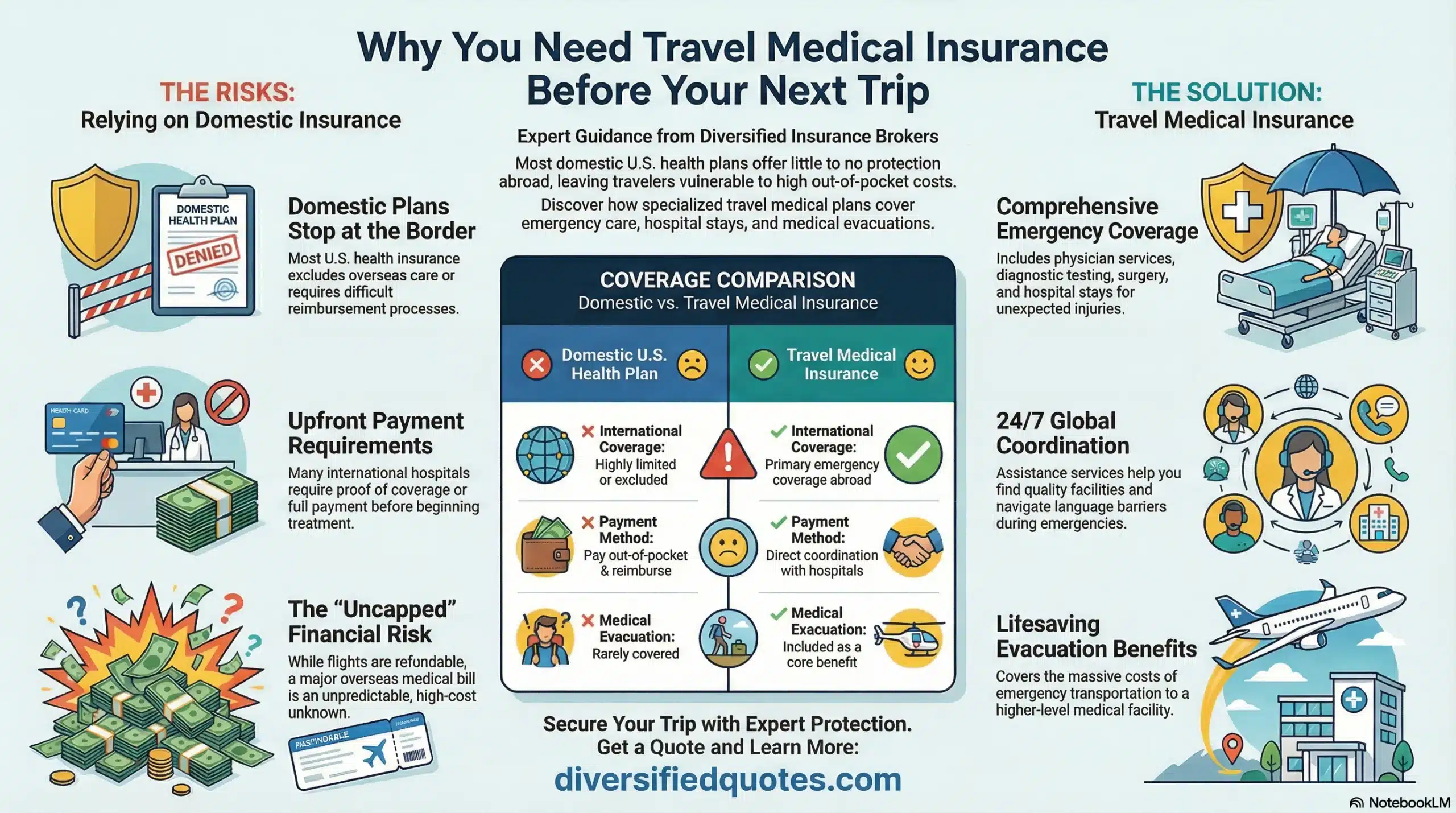
Most nomad-friendly travel protection starts with medical coverage abroad. If you get sick or injured while traveling, travel medical benefits can help cover doctor visits, urgent care, hospitalization, diagnostic imaging, prescription medications, and medically necessary treatment by licensed providers in the country where you receive care. This matters because most domestic health plans — including most U.S. employer-sponsored plans and individual ACA marketplace plans — provide limited or no coverage for medical treatment outside the home country. International providers frequently expect payment at the point of care rather than billing through insurance, meaning a nomad without adequate travel medical coverage may need to pay out of pocket upfront and attempt reimbursement later, or face delayed or denied treatment if they cannot demonstrate payment capacity.
Emergency medical evacuation is another core protection layer for nomads — particularly for those working from smaller towns, islands, rural regions, mountainous areas, or destinations where advanced care may require significant transport to reach a facility with appropriate capabilities. Evacuation can be lifesaving when the nearest hospital capable of treating a serious injury or illness is hours away or across a border, but it can also be financially catastrophic without coverage. Air ambulance and medical transport costs are among the highest single-event costs in travel insurance claims, routinely reaching tens of thousands of dollars for regional evacuation and significantly more for repatriation to the home country. Emergency medical evacuation insurance covers this specific protection layer in detail, including how evacuation benefits work, what triggers activation, and how coordination with local providers and receiving facilities operates in practice. Emergency travel health insurance covers the broader emergency medical and evacuation coverage package designed for travelers facing unexpected serious health events abroad.
Travel Insurance Coverage: What Nomads Need vs. What Vacation Plans Provide
| Coverage Feature | Standard Vacation Plan | Nomad-Appropriate Plan | Why It Matters for Nomads |
|---|---|---|---|
| Trip duration | Fixed period — typically 7 to 21 days with defined return date | Extended or open-ended — designed for months-long travel with renewability or extension options | Nomads rarely travel on fixed schedules — duration limits and renewal rules determine whether coverage holds when plans change |
| Geographic scope | Single country or defined region — may require separate policy for each destination | Multi-country or worldwide — covers repeated border crossings across multiple destinations within one policy period | Nomads move between countries frequently — single-destination plans create gaps every time a border is crossed |
| Emergency medical | Usually included but may have low limits relative to destination medical costs | Higher limits with direct-pay capability — covers inpatient hospitalization, surgery, and specialist care at destination | Medical cost exposure abroad varies dramatically by country and condition — adequate limits prevent out-of-pocket catastrophe |
| Evacuation coverage | Sometimes limited or excluded — may cover only basic transport without full medical evacuation | Comprehensive medical evacuation — covers air ambulance, border transport, and repatriation coordination | Nomads frequently base in areas where advanced care requires evacuation — evacuation cost without coverage can reach six figures |
| Renewability | Non-renewable — fixed trip, fixed end date, no extension mechanism | Renewable or extendable — allows continued coverage when travel extends beyond original dates without returning home | Nomadic travel rarely follows original schedules — renewal capability prevents forced coverage gaps when stays extend |
| Equipment coverage | Basic baggage — may limit electronics, exclude work equipment, or have low per-item caps | Higher limits for electronics and work equipment — some plans cover income-generating gear separately | A lost or delayed laptop is a work stoppage for a nomad — equipment coverage determines how quickly work capacity is restored |
Why Digital Nomads Are Exposed to Higher Travel Risk
Digital nomads spend more time abroad, move more often, and encounter more unpredictable variables than most travelers — and the cumulative exposure of continuous international travel is meaningfully different from the concentrated risk of a single vacation trip. Different healthcare systems in every country mean different payment expectations, different provider network access, different standards of care, and different practical mechanisms for getting from an acute health event to an appropriate treatment environment. What is a straightforward medical interaction in a familiar domestic context can become a complex, expensive, and stressful navigation challenge when it occurs in an unfamiliar country without a support network, without fluency in the local language, and without a clear understanding of which providers accept international patients and which payment mechanisms they require.
Even when nomads are not pursuing adventure travel or high-risk activities, ordinary daily life in unfamiliar environments carries elevated risk relative to life at home. Food-borne illness, dehydration in tropical climates, infections from minor wounds that receive delayed treatment, accidents on unfamiliar streets or on local transportation, scooter and motorbike incidents in countries where these are the primary local transport, falls on uneven terrain or poorly maintained stairs, and injuries from ordinary activities in environments the nomad has not yet learned to navigate — all of these create medical exposure that continuous travel compounds relative to a fixed domestic life. Travel coverage is not about predicting that something will happen — it is about removing the financial damage and logistical crisis that results when unpredictable events occur in contexts where the nomad has no domestic safety net to fall back on. High-risk travel insurance and travel and medical insurance for high-risk travel cover the specialized coverage considerations for nomads whose destinations include more volatile, remote, or operationally complex environments. What is the primary reason people buy travel medical insurance covers the core risk calculation that drives the purchase decision for international travelers across different trip types and risk profiles.
Plan Structures That Work for Digital Nomads
The plan structure question is the most practically important decision nomads face in travel insurance, because structure determines whether coverage actually holds across the reality of nomadic travel rather than being technically purchased but practically inadequate for how the nomad actually moves. The most common structural mismatch is the single-trip vacation plan — designed for a defined departure, a fixed destination, and a return home — applied to nomadic travel that crosses multiple borders, extends beyond original dates, and may not involve a return home for many months. That mismatch creates coverage gaps precisely at the transitions that nomadic travel involves most frequently: country crossings, date extensions, and changes in destination that were not specified on the original policy.
Annual multi-trip plans work well for nomads who take frequent defined trips throughout a year with meaningful time at home between each trip — covering each international trip up to a maximum duration per trip without requiring a separate policy for each destination. Long-stay or extended travel plans fit better for nomads who live abroad continuously for months at a time without returning home between countries, providing coverage across the entire extended period with renewability or extension mechanisms that keep coverage intact when plans change. Some nomads whose lifestyle has become more settled around a primary base country transition toward international health insurance that provides more comprehensive ongoing medical benefits including preventive care, chronic condition management, and higher annual limits that resemble a domestic health plan rather than pure emergency coverage. International health insurance covers how longer-term international medical coverage is structured for individuals living abroad more continuously. International travel health coverage covers the range of international medical protection options across different duration, renewability, and benefit structures. International major medical insurance covers the higher-limit comprehensive international medical coverage appropriate for nomads who want benefits closer to a full medical plan than emergency-only travel coverage. Emergency travel medical insurance for US citizens covers the specific coverage considerations for American nomads whose domestic coverage typically does not extend internationally.
Key Factors to Evaluate Before Purchasing
The practical decision points for nomads usually come down to geographic coverage scope, duration limits and renewability, evacuation benefit adequacy, and how the plan coordinates with any domestic coverage maintained at home. Geographic coverage scope determines whether every country the nomad plans to visit is covered under the same policy or whether border crossings create coverage gaps that require separate policies or geographic endorsements. Duration limits determine how long a single stay in one country can extend before coverage lapses — a consideration that matters most when a nomad’s plans change and a stay extends beyond the original timeline. Renewability rules determine whether coverage can continue without returning home, and what conditions govern the renewal process in terms of timing, health status disclosure, and continuity of benefits across renewal periods.
Evacuation benefit adequacy deserves particular attention because it is the coverage feature with the largest potential single-event cost and the greatest consequence of inadequacy at claim time. A plan with strong routine medical coverage but low evacuation limits can still produce a catastrophic out-of-pocket event if the nomad experiences a serious injury or illness in a location where advanced care requires substantial transport. Confirming evacuation coverage limits, the mechanism by which evacuation decisions are made, and what coordination assistance the plan provides in organizing transport and receiving facility arrangements before purchasing any travel plan is essential for nomads whose destinations include locations where evacuation is a realistic possibility rather than a remote contingency. How to get the best travel medical insurance rates covers the comparison approach and purchase strategies that produce the most competitive pricing across the carrier market for any given coverage profile and destination set. How to get travel medical insurance last minute covers the options available when coverage needs arise without advance planning time — a practical scenario for nomads whose travel decisions are sometimes made quickly. Is travel medical insurance expensive covers the pricing framework and cost expectations for travel medical coverage across different plan types, coverage levels, and traveler profiles.
Not sure which structure fits your travel rhythm?
Send us your next few countries and your expected travel cadence. We’ll help you pick a structure that won’t fall apart when your dates change.
Common Challenges Digital Nomads Face With Travel Insurance
The most common and consequential problem nomads encounter is purchasing a plan built for short, fixed vacations and assuming it will function adequately for nomadic travel. Single-trip vacation plans have duration limits, fixed return dates, and no renewal mechanisms — meaning that when the nomad stays longer than planned, crosses into a country not listed on the original policy, or cannot return home within the plan’s defined trip period, coverage lapses without automatic continuation. The gap that results is not theoretical — it is the period when the nomad is most likely to have needed the coverage, because plans change precisely when circumstances change, and circumstances change most significantly during travel disruptions, health events, and unexpected itinerary modifications.
A second common challenge is misunderstanding how a travel plan coordinates with domestic health coverage the nomad continues to maintain at home. Many nomads maintain a domestic health plan either because it is required or because they want coverage for the periods when they are in their home country between trips. The assumption that the domestic plan provides meaningful international coverage is often incorrect — most US domestic plans provide little to no international benefit outside the home country, and the few that do typically provide only emergency coverage at high cost-sharing levels that do not eliminate the need for travel medical insurance abroad. The travel plan is the practical protection layer while abroad, and the domestic plan is typically irrelevant to international medical events.
Underestimating the evacuation component is the third most consistent gap in nomad travel planning. Nomads who base in smaller cities, rural areas, islands, or developing-market destinations often discover that the practical cost of getting to appropriate care — when something genuinely serious happens — is as significant as the cost of the care itself. Confirming that evacuation coverage is adequate, that it covers the specific destinations on the travel itinerary, and that the plan includes meaningful coordination assistance rather than just financial reimbursement is an essential step before departure. Travel medical insurance for expats covers the coverage options for individuals whose international lifestyle has developed to the point where their primary life context is abroad rather than domestically based. Life insurance for foreign travel and residency covers the life insurance considerations that become relevant for nomads and expats whose extended international residence affects coverage options, beneficiary planning, and policy portability. Business travel accident insurance covers the employer-provided or individually purchased accident coverage that addresses travel-related injury risk for nomads whose business operations involve regular international travel.
How Diversified Insurance Brokers Helps Digital Nomads
We help digital nomads map coverage to real travel patterns rather than choosing a plan based on a generic description that may not reflect how nomadic travel actually operates. That process starts with understanding where you will be, how often you will move between countries, whether your lifestyle includes remote or higher-risk environments, how long you plan to remain abroad before any return home, and what your primary risk concerns are — emergency medical, evacuation, equipment, trip disruption, or some combination of all of these. From that profile we can identify plan structures that actually match the coverage need rather than appearing to match it on the surface while containing duration limits, geographic gaps, or renewal restrictions that will create problems when the nomad’s plans evolve.
We also help clarify exclusions and activity limitations so there are no coverage surprises at claim time. Many travel plans include exclusions for specific activities — motorized vehicles, motorcycles, scooters, certain water sports, adventure activities — that nomads engage in as part of ordinary local transportation and recreation rather than as specialized high-risk pursuits. Understanding what activities are covered and which require endorsements or separate coverage before purchasing prevents the worst outcome in travel insurance: paying premiums for coverage that will be denied precisely at the moment it is needed because the activity involved was excluded. Cheap travel insurance covers cost-forward coverage options for nomads whose primary driver is affordability — with guidance on where coverage can be reduced without creating critical gaps and where cost reduction creates coverage inadequacy that is likely to matter at claim time.
Quote & apply online when you’re ready
If you want a direct starting point, you can quote and apply online for travel medical coverage now.
Want a quick plan check before you buy?
We’ll sanity-check coverage dates, country list, evacuation limits, and renewability so your plan stays aligned with your lifestyle.
Related Travel Medical Pages
Explore core medical coverage, evac planning, and emergency-first protection for international travel.
Emergency Medical Evacuation Insurance
Emergency Travel Health Insurance
Is Travel Medical Insurance Expensive?
Travel Medical Insurance for Expats
How to Get the Best Travel Medical Insurance Rates
How to Get Travel Medical Insurance Last Minute
Emergency Travel Medical Insurance for US Citizens
Related Nomad & Budget Pages
Compare cost-focused options and coverage built for frequent travelers and border crossings.
Talk With an Advisor Today
Choose how you’d like to connect—call or message us, then book a time that works for you.
Schedule here:
calendly.com/jason-dibcompanies/diversified-quotes
Licensed in all 50 states • Fiduciary, family-owned since 1980
Frequently Asked Questions: Travel Insurance for Digital Nomads
What makes travel insurance for digital nomads different from regular vacation travel insurance?
Standard vacation travel plans are built around a defined departure date, a fixed destination, and a return home within a few weeks. Nomadic travel crosses multiple borders, extends for months, changes itineraries mid-trip, and may not involve a return home between countries. The structural differences that matter most are duration limits — how long a single stay or total trip can last — renewability rules — whether coverage can continue without returning home — and geographic scope — whether every country on the nomad’s itinerary is covered under one policy. A plan that works for a two-week vacation will often fail for a four-month multi-country nomadic trip because the duration and renewability limitations are incompatible with how the nomad actually travels.
Do I still need travel insurance if I have a domestic health plan?
For most nomads, yes. Most domestic US health plans provide little or no coverage for medical treatment received outside the United States. The few plans that offer some international benefit typically cover only emergencies at high cost-sharing levels and do not provide direct-pay capability with overseas providers — meaning the nomad pays upfront and attempts reimbursement, which can be slow and incomplete. International providers often expect payment at the point of care and may not accept domestic US insurance at all. Travel medical insurance is the practical protection layer while abroad, providing direct-pay access to international providers, coordination assistance for complex medical situations, and evacuation coverage that domestic plans do not include.
How important is evacuation coverage for digital nomads?
Evacuation coverage is one of the most important protection features for nomads and frequently the most underestimated. Nomads often base in smaller cities, rural areas, islands, or developing-market destinations where advanced medical care may require significant transport to reach — regional air ambulance, border transport, or repatriation to a country with higher-capability facilities. Air ambulance and medical transport costs routinely reach tens of thousands of dollars without coverage, and the decision to evacuate is often made under time pressure when negotiating cost is not practical. Confirming that evacuation coverage limits are adequate for the specific destinations on the nomad’s itinerary, and that the plan includes coordination assistance rather than just reimbursement, is essential before departure.
Should I choose travel medical insurance or international health insurance?
Travel medical insurance is typically built around emergency events — unexpected illness, injury, urgent care, and evacuation coordination — and is most appropriate for nomads whose stays abroad are temporary or who want a flexible emergency protection layer without paying for comprehensive routine care benefits. International health insurance behaves more like a long-term medical plan, including preventive services, chronic care management, and higher annual limits — appropriate for nomads who have established a primary base in a country or region and want comprehensive ongoing medical benefits that resemble domestic coverage. Many nomads start with travel medical coverage and transition to international health insurance as their lifestyle becomes more settled. The right choice depends on how continuously you are abroad, whether you need routine care coverage, and whether you have a defined base country or remain fully mobile.
What activity exclusions should digital nomads watch for in travel plans?
Many travel plans include exclusions for activities that nomads engage in as ordinary transportation and recreation rather than as specialized high-risk pursuits. Motorbikes, scooters, and motorcycles are among the most commonly excluded activities — and in many nomad destinations, scooters are the standard local transportation. Adventure sports, water activities, hiking, and off-road activities may also be excluded or require specific endorsements. The practical risk is paying premiums for coverage that will be denied at claim time because the activity involved was excluded in the policy language. Reviewing activity exclusions and confirming that the nomad’s typical transportation and recreational activities are covered — or purchasing endorsements that add coverage for specific activities — before purchasing any plan prevents this outcome.
About the Author:
Jason Stolz, CLTC, CRPC, DIA, CAA and Chief Underwriter at Diversified Insurance Brokers (NPN 20471358), is a senior insurance and retirement professional with more than 25 years of real-world experience helping individuals, families, and business owners protect their income, assets, and long-term financial stability. As a long-time partner of the nationally licensed independent agency Diversified Insurance Brokers, Jason provides trusted guidance across multiple specialties—including fixed and indexed annuities, long-term care planning, personal and business disability insurance, life insurance solutions, Group Health, Travel Medical and Evacuation Insurance, and short-term health coverage. Diversified Insurance Brokers maintains active contracts with over 100 highly rated insurance carriers, ensuring clients have access to a broad and competitive marketplace.
His practical, education-first approach has earned recognition in publications such as VoyageATL, and contributions from his agency featured in Kiplinger and GoBankingRates— highlighting his commitment to financial clarity and client-focused planning. Drawing on deep product knowledge and years of hands-on field experience, Jason helps clients evaluate carriers, compare strategies, and build retirement and protection plans that are both secure and cost-efficient. Visitors who want to explore current annuity rates and compare options across multiple insurers can also use this annuity quote and comparison tool.
Explore More Travel Medical Insurance Options: Browse our complete guide to Groups & Specialty Travel Insurance — covering church groups, missionaries, volunteers, students, expats, digital nomads & more.
Last Reviewed: June 17, 2026 |
Reviewed by: Jason Stolz, CLTC, CRPC, DIA, CAA
Chief Underwriter, Diversified Insurance Brokers, Inc. | NPN: 20471358 | Diversified Insurance Brokers, Inc. — Licensed in all 50 states
Fact Checked by: Tonia Pettitt, CMIP©
Medicare Specialist, Diversified Insurance Brokers, Inc. | NPN: 14374308 | Diversified Insurance Brokers, Inc. — Licensed in all 50 states
Did you find this content helpful? Leave us a Google review — it helps others find trustworthy guidance too.
Editorial Standards: Diversified Insurance Brokers maintains rigorous editorial standards to ensure accuracy, clarity, and independence in all content. Learn more about our editorial standards and commitment to transparency.
