
International Health Insurance
International Health Insurance

Jason Stolz CLTC, CRPC, DIA, CAA
International health insurance is designed for people and families who live, work, study, or spend extended time outside their home country. Unlike short-term travel medical plans that focus primarily on emergency events during a defined trip, international health insurance is built for ongoing global living. It functions more like a major medical plan — portable across borders, renewable for longer time horizons, and structured to support both unexpected medical needs and the routine reality that life abroad includes clinic visits, prescriptions, specialist consultations, follow-up appointments, and continued treatment when something changes. The distinction matters because the wrong product creates gaps at exactly the moments coverage is most needed: a prescription that needs refilling six weeks into a three-month stay, a specialist referral that takes longer to coordinate than the original emergency, or an ongoing condition that requires consistent management regardless of what country you happen to be in that month.
At Diversified Insurance Brokers, Jason Stolz, CLTC, CRPC, DIA, CAA, helps expatriates, global employees, retirees abroad, missionaries, international students, digital nomads, and globally mobile families compare international health insurance options that fit their coverage area, travel patterns, and expectations for provider access. The goal is straightforward: you should be able to live internationally without wondering whether a clinic visit, a specialist consultation, or a hospital event will create a financial surprise or a logistics problem that disrupts your plans. That requires the right plan structure from the start — not the closest available approximation of one. For people evaluating how international health insurance compares to shorter-duration options, emergency travel health insurance and emergency travel medical insurance for U.S. citizens both provide useful context for understanding where short-term emergency coverage ends and where an ongoing health plan becomes the more appropriate structure.
Get Your International Health Insurance Quote
Compare long-term global medical plans designed for international living and cross-border care.
Get My International Health Insurance Quote
Questions? Call 800-533-5969
What International Health Insurance Is
International health insurance is long-term medical coverage designed for people who will be outside their home country for months or years rather than for a specific trip with defined dates. These plans are typically renewable annually, can be structured with high annual or lifetime maximums, and are tailored to a defined area of coverage rather than a specific destination or itinerary. Depending on the plan, that coverage area may be worldwide excluding the United States, or worldwide including the United States, with U.S.-inclusive coverage generally costing more because American healthcare is significantly more expensive than care in most other markets. This flexibility matters because many globally mobile people spend most of the year overseas but return to the U.S. for limited periods, and they need medical protection that follows them across all of those situations without creating coverage gaps based on geography or duration.
International health insurance is also built around access and logistics in ways that short-term plans are not. A strong plan supports how care is actually delivered abroad — through global assistance services, a network of hospitals and clinics, and a claims process that functions when you are in a different time zone or navigating a healthcare system in another language. These operational features are invisible until you need them, at which point the difference between a plan with robust assistance infrastructure and one without it becomes immediately apparent. For U.S. citizens abroad who want to understand the baseline gap that domestic insurance creates outside the country, emergency travel health insurance for foreign nationals provides a parallel reference point for how coverage needs shift when home-country plans do not extend internationally.
Who International Health Insurance Is Best For
International health insurance is most valuable when your life is genuinely international rather than trip-based. That profile includes expats on multi-year assignments who need coverage that functions as an ongoing medical infrastructure, digital nomads who are abroad for the majority of the year and cannot practically reset trip-based coverage continuously, retirees who have relocated internationally and need routine care access in addition to emergency response, students enrolled in extended overseas programs, missionaries and humanitarian staff living in-country for months at a time, and families who move between countries and need a consistent medical structure that does not require renegotiation with every address change. In all of these situations, the healthcare need extends well beyond a single emergency event. Follow-up care, prescriptions, specialist referrals, and ongoing management of chronic conditions become part of normal life abroad — and international health insurance is built to handle that pattern rather than stopping where a travel product ends.
If your international travel is more occasional — two weeks here, a month there — travel medical insurance is generally sufficient and considerably less expensive. The practical dividing line is whether you expect healthcare usage abroad to extend beyond an acute emergency event into the kind of ongoing care that requires a workable, continuing insurance relationship. If you also want to understand how evacuation planning fits into this framework — particularly for remote living or destinations where local medical infrastructure is uneven — emergency medical evacuation insurance explains why evacuation wording and assistance coordination can matter as much as the dollar limit, and why the evacuation benefit embedded in some international health plans functions differently from standalone evacuation coverage.
International Health Insurance vs. Travel Medical — The Practical Difference
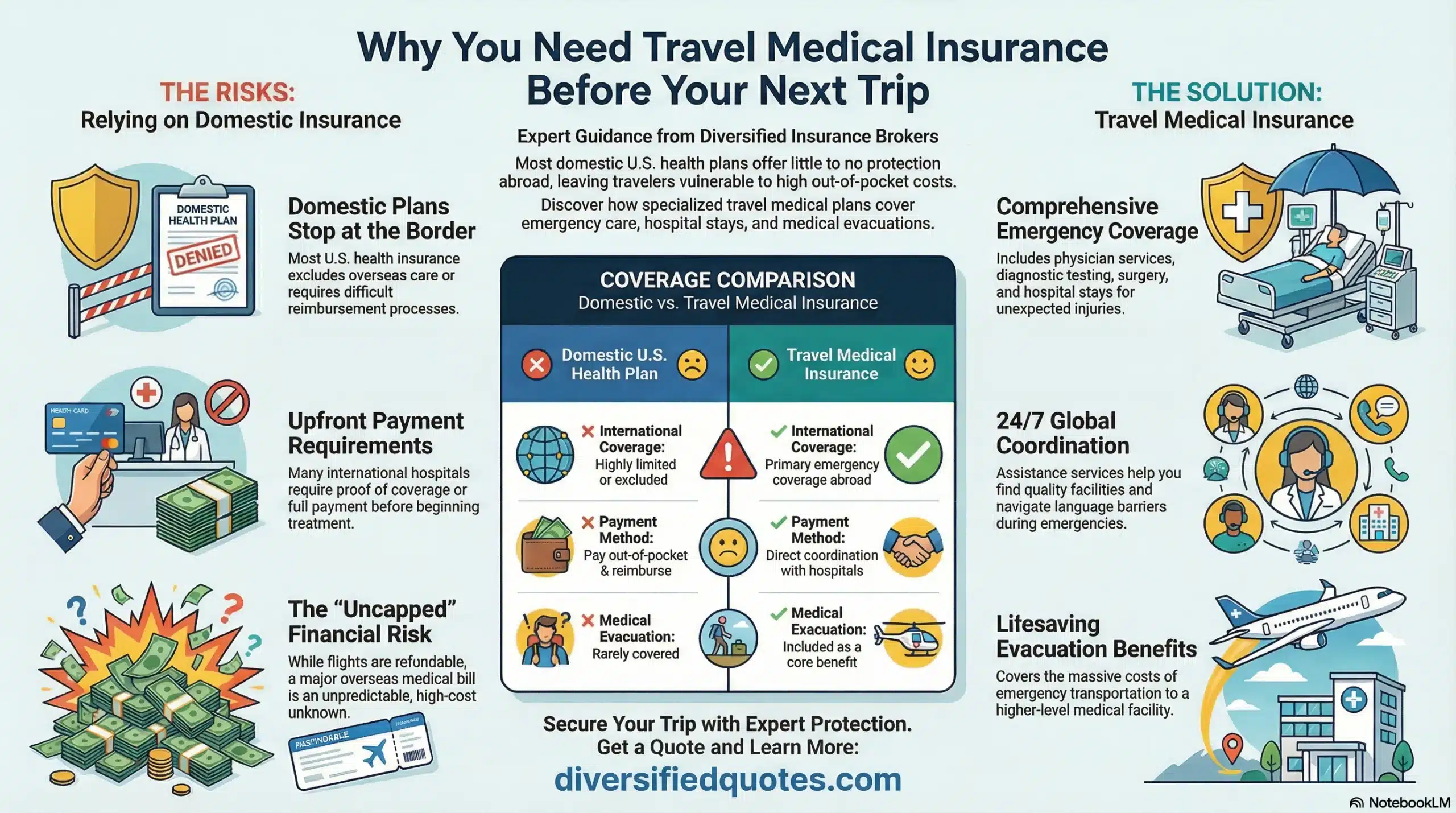
Travel medical insurance is designed for a specific duration and is primarily emergency-oriented. It handles unexpected illness or injury during travel and typically ends when you return home. International health insurance is designed for ongoing coverage and supports a broader spectrum of care across a longer time horizon — outpatient visits, specialist consultations, prescription refills, diagnostic imaging, and continued treatment after an initial event. The benefit design reflects the reality that if something happens to your health overseas, you may need weeks or months of care rather than a single emergency room encounter, and the plan should remain viable and accessible across that entire arc.
A practical decision framework involves two questions. First, will you be outside your home country long enough that routine healthcare needs will likely arise? Second, would a significant medical event require more than an emergency room visit — specialist care, imaging, prescriptions, and extended follow-up? If the answer to either is yes, international health insurance is the more appropriate structure. For high-risk destinations or complex itineraries where medical infrastructure is unpredictable, high-risk travel insurance and travel and medical insurance for high-risk travel both cover how plan structure changes when destinations involve elevated risk — which applies equally to long-term international living in those environments as to short-term travel through them.
What International Health Insurance Covers — and How Plans Differ
| Coverage Area | Short-Term Travel Medical | International Health Insurance |
|---|---|---|
| Duration | Trip-based with a defined end date tied to return home | Renewable annually; designed for months or years of continuous coverage |
| Emergency Care | Primary benefit; built around unexpected illness or injury response | Included; typically comprehensive inpatient, surgery, and emergency services |
| Outpatient Care | Limited or not included in most basic plans | Generally included — physician visits, specialist consultations, diagnostic testing |
| Prescriptions | Often excluded or very limited | Typically covered as an ongoing benefit |
| Coverage Area | Based on trip itinerary; tied to specific destinations | Defined zone (worldwide excluding U.S. or worldwide including U.S.) regardless of specific destination |
| Optional Riders | Generally limited; evacuation is sometimes included or added | Maternity, mental health, dental, vision, wellness, and preventive care often available |
| Best For | Occasional travelers, short defined trips, primarily emergency protection | Expats, digital nomads, retirees abroad, international students, missionaries, globally mobile families |
Provider Networks, Direct Billing, and How Access Works Abroad
Many international health insurance plans are built around global provider networks and assistance services that coordinate care rather than simply reimbursing after the fact. For inpatient hospitalization, network facilities may be able to receive direct payment from the insurer, eliminating the requirement to pay a large bill out of pocket and wait for reimbursement — a meaningful practical advantage when the bill is substantial and advance payment would be impractical. For outpatient care, the process typically involves paying at the point of service and submitting for reimbursement, which is standard across international medical products. The variable that distinguishes carriers in this dimension is the quality and responsiveness of the assistance infrastructure: how accessible the claims process is across time zones, how clear the guidance is when you are navigating an unfamiliar healthcare system, and how quickly reimbursement is processed once documentation is submitted.
In destinations where local medical infrastructure is uneven, evacuation functions as an access benefit rather than only a financial one. When a local facility cannot provide the level of care a condition requires, the plan’s assistance team coordinates movement to an appropriate facility — which may be in a different city or a different country entirely. The authority the plan actually has to initiate and fund that movement, and the speed at which the coordination occurs, matters as much as the dollar maximum assigned to the evacuation benefit. For group travelers, religious organizations, or volunteer teams living abroad for extended periods, travel medical insurance for religious groups and travel medical insurance for large groups cover the group-specific coverage structures that apply when multiple people share a common international living or travel situation.
How Premiums Are Determined
International health insurance premiums reflect age, area of coverage, chosen deductible level, benefit maximums, and any optional riders selected. Coverage area is one of the most significant pricing variables: worldwide including the United States costs substantially more than worldwide excluding the United States because of American healthcare pricing. Many globally mobile people who spend limited time in the U.S. and would not realistically seek care during those visits choose worldwide excluding U.S. coverage and purchase a separate short-term domestic plan for U.S. presence periods, producing a lower total annual cost than maintaining U.S.-inclusive international coverage year-round. Deductible selection meaningfully affects monthly premium, and structuring the plan around a deductible that fits both your expected usage pattern and your financial comfort with out-of-pocket exposure produces better long-term outcomes than optimizing solely for the lowest monthly number.
For digital nomads and globally mobile professionals who are self-employed or working remotely, one of the structural advantages of international health insurance is that it is not tied to an employer plan. Coverage does not change when work arrangements change, when contracts end, or when countries of residence shift — the plan remains consistent as long as it is renewed. For those wanting to understand how to identify the most competitive rates in this product category before committing, how to get the best travel medical insurance rates covers the comparison framework that applies across both travel medical and international health products, and how to get travel medical insurance last minute covers what to expect when timeline is compressed — a situation that arises more often than people anticipate when international assignments or relocations accelerate.
Pre-Existing Conditions and Underwriting
Some international health insurance plans involve medical underwriting, particularly when the coverage is comprehensive and designed for long-term use. Pre-existing conditions may be excluded entirely, covered subject to waiting periods, or included with pricing adjustments depending on the carrier and plan tier. The practical objective is to understand how any known health considerations are treated before purchasing rather than after you are abroad and need care. A plan that appears less expensive because it excludes a condition you manage with regular prescriptions is not actually less expensive when you need that medication refilled internationally and the plan declines the claim. Comparing how each plan defines and handles pre-existing conditions is as important as comparing premium levels and benefit maximums for any applicant with ongoing health considerations.
Ready to Compare International Health Insurance Plans?
Get a quote for global medical coverage designed for long-term international living — matched to your coverage area, timeline, and care expectations.
Questions? Call 800-533-5969
Talk With an Advisor Today
Choose how you’d like to connect—call or message us, then book a time that works for you.
Schedule here:
calendly.com/jason-dibcompanies/diversified-quotes
Licensed in all 50 states • Fiduciary, family-owned since 1980
Frequently Asked Questions: International Health Insurance
What is the difference between international health insurance and travel medical insurance?
Travel medical insurance is designed for a specific trip of defined duration and is primarily emergency-oriented — it handles unexpected illness or injury during travel and ends when you return home. International health insurance is designed for people living internationally rather than traveling through a destination. It is renewable, covers a broader range of care including outpatient visits, specialist consultations, ongoing prescriptions, and follow-up treatment, and functions more like a major medical plan than a trip product. The practical dividing line is whether your healthcare needs abroad are likely to extend beyond a single emergency event into the kind of ongoing care that requires a working, continuous insurance relationship. If you will be outside your home country long enough for routine healthcare to arise — or if a significant medical event would require more than an emergency room visit — international health insurance is the more appropriate structure.
Does international health insurance cover care in the United States?
It depends on the coverage area option selected at purchase. Most international health insurance plans offer two primary area choices: worldwide excluding the United States, or worldwide including the United States. U.S.-inclusive coverage costs significantly more because American healthcare is among the most expensive in the world and the plan’s pricing reflects that liability. Many globally mobile people who return to the U.S. for visits but would not realistically seek medical care during those visits choose the worldwide excluding U.S. option and purchase a separate short-term domestic plan for U.S. presence periods — producing a lower total annual cost than maintaining U.S.-inclusive international coverage year-round. If you spend meaningful time in the U.S. and might use domestic care during those periods, the inclusive option provides continuity through a single plan. The right choice depends on how frequently you return and whether you would actually use medical care during U.S. visits.
Are pre-existing conditions covered under international health insurance?
The treatment of pre-existing conditions varies significantly by carrier and plan type. Some plans exclude pre-existing conditions entirely for the policy duration. Others cover them after a waiting period — a defined interval during which the condition is excluded, after which it becomes eligible for coverage if no treatment has been required. Some comprehensive plans include pre-existing conditions without waiting periods but reflect the risk in pricing or through underwriting review at application. The key is understanding what the specific plan does with any known health considerations before purchasing — discovering that a condition is excluded after you are living abroad and need care is significantly worse than evaluating that exclusion upfront and selecting a different plan. If you have ongoing prescriptions or managed conditions, comparing how each plan defines and handles pre-existing conditions is as important as comparing premium levels and benefit maximums.
How does the claims process work when I am living abroad?
For inpatient hospitalization, many international health insurance plans can arrange direct billing with network hospitals — the insurer pays the facility directly rather than requiring out-of-pocket payment and subsequent reimbursement. This is a meaningful practical advantage for major events where the bill is substantial. For outpatient care, the process typically involves paying at the point of service and submitting a claim for reimbursement, which is standard across international medical products. The variable that distinguishes carriers is the operational quality of their assistance infrastructure: how accessible the claims process is across time zones and languages, how clearly care is coordinated when you are in an unfamiliar healthcare system, and how quickly reimbursement is processed once documentation is submitted. A plan with strong benefits but slow, difficult claims handling creates a materially different real-world experience than one with equivalent benefits and a responsive, efficient assistance operation.
How are international health insurance premiums determined?
Premiums primarily reflect age, coverage area, deductible level, benefit maximums, and optional riders selected. Coverage area is one of the most significant pricing variables — worldwide including the United States costs substantially more than worldwide excluding the United States because of American healthcare pricing. Deductible selection has a meaningful impact on monthly premium: a higher deductible lowers the premium but increases out-of-pocket exposure when care is needed, so structuring the deductible around realistic expected usage and financial comfort with out-of-pocket risk produces better outcomes than minimizing the monthly number. Age at the time of application affects the pricing of most plans, and pre-existing conditions may affect pricing or availability depending on the carrier’s underwriting approach. Optional riders — maternity, dental, vision, mental health, wellness — add cost but can be worth evaluating if those benefits align with anticipated needs during the period of international living.
About the Author:
Jason Stolz, CLTC, CRPC, DIA, CAA and Chief Underwriter at Diversified Insurance Brokers (NPN 20471358), is a senior insurance and retirement professional with more than 25 years of real-world experience helping individuals, families, and business owners protect their income, assets, and long-term financial stability. As a long-time partner of the nationally licensed independent agency Diversified Insurance Brokers, Jason provides trusted guidance across multiple specialties—including fixed and indexed annuities, long-term care planning, personal and business disability insurance, life insurance solutions, Group Health, Travel Medical and Evacuation Insurance, and short-term health coverage. Diversified Insurance Brokers maintains active contracts with over 100 highly rated insurance carriers, ensuring clients have access to a broad and competitive marketplace.
His practical, education-first approach has earned recognition in publications such as VoyageATL, and contributions from his agency featured in Kiplinger and GoBankingRates— highlighting his commitment to financial clarity and client-focused planning. Drawing on deep product knowledge and years of hands-on field experience, Jason helps clients evaluate carriers, compare strategies, and build retirement and protection plans that are both secure and cost-efficient. Visitors who want to explore current annuity rates and compare options across multiple insurers can also use this annuity quote and comparison tool.
Browse More Resources: Return to our complete Health Insurance, Dental, Vision & Disability guide — covering short term health, dental, vision, group health & disability.
Last Reviewed: June 13, 2026 |
Reviewed by: Jason Stolz, CLTC, CRPC, DIA, CAA
Chief Underwriter, Diversified Insurance Brokers, Inc. | NPN: 20471358 | Diversified Insurance Brokers, Inc. — Licensed in all 50 states
Fact Checked by: Tonia Pettitt, CMIP©
Medicare Specialist, Diversified Insurance Brokers, Inc. | NPN: 14374308 | Diversified Insurance Brokers, Inc. — Licensed in all 50 states
Did you find this content helpful? Leave us a Google review — it helps others find trustworthy guidance too.
Editorial Standards: Diversified Insurance Brokers maintains rigorous editorial standards to ensure accuracy, clarity, and independence in all content. Learn more about our editorial standards and commitment to transparency.
