
Emergency Travel Health Insurance for Foreign Nationals
Emergency Travel Health Insurance for Foreign Nationals

Jason Stolz CLTC, CRPC, DIA, CAA
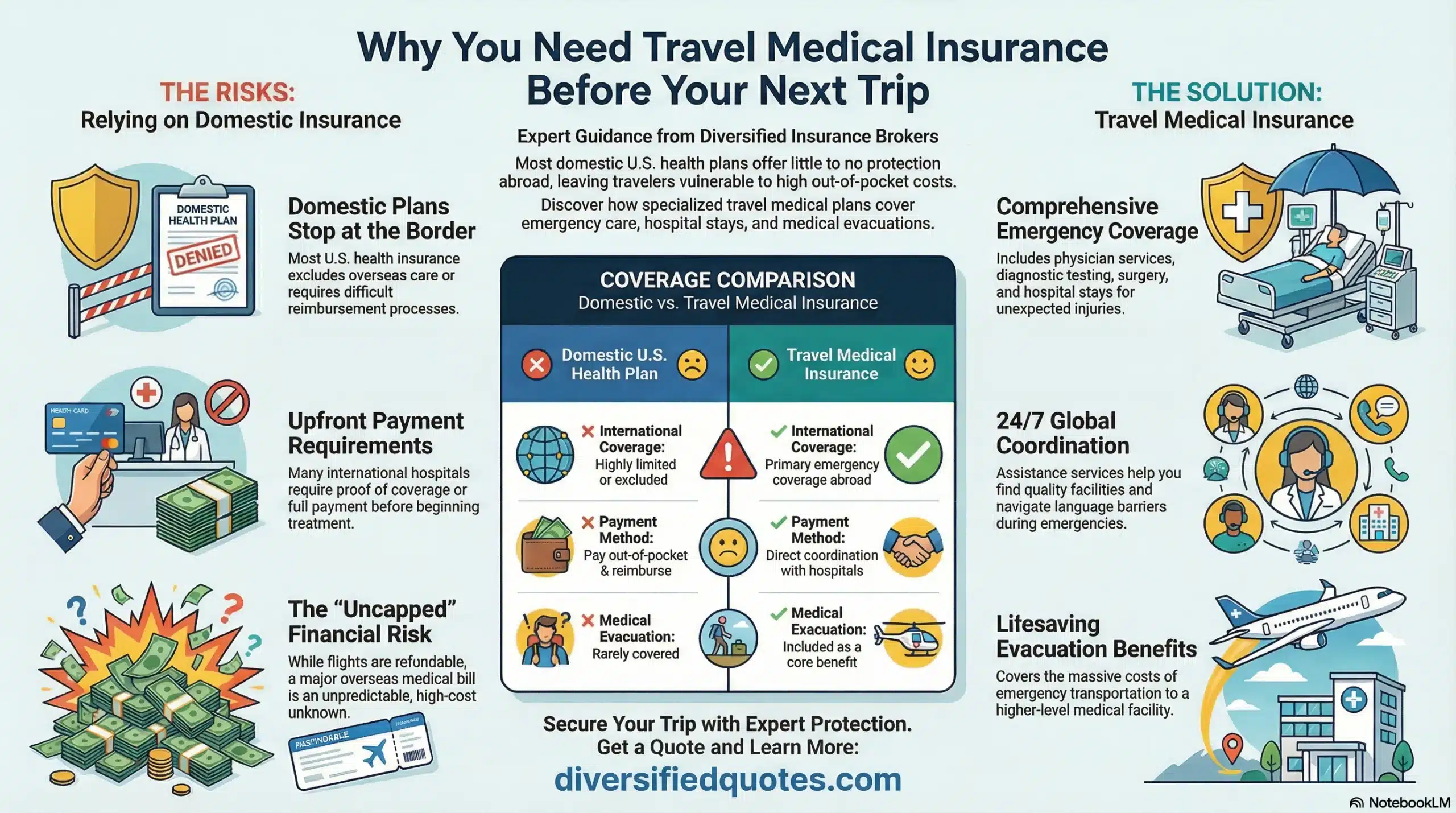
At Diversified Insurance Brokers, we help visitors secure emergency travel health insurance for foreign nationals who are traveling worldwide or visiting the United States. The U.S. healthcare system can be expensive and confusing for visitors, and many domestic health plans provide little to no protection once you leave your home country. A dedicated foreign national travel insurance policy can help pay for unexpected hospital bills, coordinate urgent care, and arrange evacuation when medically necessary — so your trip does not turn into a financial crisis. Emergency travel health insurance for foreign nationals is built for the real-world risks that come up during travel: sudden illness, an injury that requires imaging or surgery, an unexpected hospital stay, or a medical event that must be coordinated through an assistance team. If you want the big picture on how emergency-focused plans differ from longer-term international coverage, our overview on international travel health coverage is a helpful starting point. If your itinerary involves higher-risk destinations or more complex travel, it can also help to review high risk travel insurance to see what changes in plan structure when risk is elevated.
Get Emergency Travel Health Insurance for Foreign Nationals
Fast, secure online quote and enrollment for foreign nationals traveling worldwide or visiting the U.S.
Questions? Call 800-533-5969
What Emergency Travel Health Insurance for Foreign Nationals Typically Covers
Emergency travel health insurance for foreign nationals is designed to protect you from the most financially damaging problems that can occur during a trip: emergency care, hospitalization, and the logistics of getting appropriate treatment when you are away from your normal healthcare system. If you are traveling to the United States, the medical benefit and the practical rules around claims matter more than almost anything else. U.S. hospitals may require payment or deposit arrangements, and the cost of diagnostics, emergency rooms, and inpatient care can escalate quickly — often to amounts that surprise visitors accustomed to different healthcare systems. That is why foreign national travel insurance should be secured before arrival, so the effective date and documentation are already in place when you land.
Typical benefits in emergency travel health insurance for foreign nationals include emergency physician and hospital services, diagnostic imaging and labs when medically necessary, prescription medications related to a covered illness or injury, and emergency medical evacuation coordination when local care is not adequate. Some travelers also want trip-related benefits, and depending on plan design there may be limited trip interruption or return-home benefits following a covered medical event. But for most foreign nationals and visitors, the core value is medical coverage plus evacuation and assistance coordination — not vacation-style features. If you want a deeper explanation of evacuation triggers and why coordination rules matter, our guide to emergency medical evacuation insurance explains what to look for in real policy wording.
Want Us to Confirm the Plan Fits Your Visa and Itinerary?
Send your travel dates, destinations, and traveler ages and we’ll point you to the best-fit foreign national travel insurance structure before you enroll.
Who This Foreign National Travel Insurance Is Best For
Emergency travel health insurance for foreign nationals is a strong fit for travelers who will be away from their home healthcare system and want protection against unexpected, high-cost medical events during the trip. It is especially common for visitors to the United States, where out-of-pocket medical costs can be significantly higher than many visitors expect. Foreign nationals visiting family in the U.S., tourists on B-1/B-2 visas, and short-term guests often use emergency travel medical coverage as a safety net so a hospital visit does not become a major financial burden. International students and visiting scholars may also rely on foreign national travel insurance for emergency protection and evacuation benefits, especially when they need documentation or proof of coverage for a program requirement. Business travelers and temporary workers often use emergency coverage for the same reason: they need a plan that can respond quickly and coordinate care while away from home.
If the traveler is a senior or the trip involves ages where medical risk is naturally higher, it can help to review how plan limits, deductibles, and stability rules vary by age for foreign national travel insurance. Our page on travel medical insurance for seniors provides additional context on how travelers structure coverage when age is a bigger factor in both risk and plan selection.
Foreign National Travel Insurance Plan Design Basics
Emergency travel health insurance for foreign nationals is built for short-term protection during travel and typically applies only while you are outside your home country or outside a defined home area. The main design choices that change how a foreign national travel insurance policy performs in real life are the medical maximum, deductible, coinsurance structure, and coverage length. For trips to the United States, many travelers choose higher medical maximums because U.S. emergency care and hospital pricing can be substantially higher than care in many other regions. A low-limit foreign national travel insurance plan can provide a false sense of security if the medical maximum is exhausted by a short hospital stay or a single significant procedure.
Deductibles and coinsurance are the levers that control premium and out-of-pocket exposure in foreign national travel insurance. A higher deductible can reduce premium, but the deductible amount should be realistic for what you could pay if an urgent care or ER visit happens. Trip length is also important — some travelers need coverage for a defined window and buy a single-trip plan, while others travel frequently and prefer a structure supporting multiple trips. Geographic scope matters too: most foreign national travel insurance plans can be structured for worldwide travel, but there may be exclusions for sanctioned or restricted locations that should be confirmed before enrollment. If you are deciding between budget coverage and higher protection, our cheap travel insurance guide explains the tradeoffs that often reduce premium, including lower medical limits and more restrictive exclusions.
Common Questions Foreign Nationals Should Understand Before Buying
Pre-existing conditions are one of the most important topics to understand before purchasing emergency travel health insurance for foreign nationals. Many plans exclude pre-existing conditions, while some offer limited protection or “acute onset” coverage under specific rules. The exact definitions matter, and the best way to avoid disappointment is to review the policy certificate and confirm how a pre-existing condition is defined, the look-back period, and any stability or age limitations that apply to your specific health history. Adventure activities can also change coverage — some foreign national travel insurance plans exclude hazardous activities such as mountaineering, certain types of trekking, or scuba diving unless an optional rider is selected. If your itinerary includes anything outside basic tourism, confirming the activity category against plan exclusions before purchase is essential.
Direct billing is another common question among foreign nationals. Some facilities and regions support direct billing arrangements, while many outpatient visits are reimbursement-based where the traveler pays upfront and submits itemized bills and medical notes to the carrier for reimbursement. Evacuation benefits in foreign national travel insurance also come with rules — evacuation is typically for medically necessary transfers and often requires approval and coordination by the assistance provider, not simply the traveler’s preference to be closer to home. Documentation matters too: many foreign national travel insurance plans can generate confirmation letters that outline benefits and dates for program or visa requirements, so matching the plan to that requirement should be part of the shopping process rather than an afterthought.
How Diversified Insurance Brokers Helps Foreign Nationals
As an independent brokerage, Diversified Insurance Brokers compares multiple emergency travel health insurance options for foreign nationals and visitors to the United States. We align benefits with your destination, right-size limits for higher-cost regions like the U.S., and clarify exclusions before you buy — so you avoid surprises at claim time and travel with confidence. The most important rule with foreign national travel insurance is simple: secure it before you depart. Once a medical emergency happens, coverage gaps cannot be fixed retroactively. When your foreign national travel insurance is in place, you gain access not only to financial protection but to global support resources that can help coordinate care, guide you to appropriate facilities, and manage emergency transportation when needed.
We also help travelers understand the practical steps that make coverage usable: selecting an effective date that matches the trip window, saving assistance contact information where it is accessible offline, and knowing who calls first if an emergency happens. This is where many travelers go wrong — they purchase foreign national travel insurance but do not understand how to activate it effectively in a real emergency. If you are a U.S. citizen traveling abroad instead of a foreign national visiting the U.S., be sure to review emergency travel medical insurance for U.S. citizens so the policy structure matches your specific direction of travel.
Apply for Foreign National Travel Insurance Before You Depart
Purchase coverage before your departure — once a medical emergency begins, gaps cannot be remedied retroactively.
Questions? Call 800-533-5969
Financial Protection Essentials
Foreign national travel insurance is one layer of a complete protection strategy. Explore these related resources.
Related Travel Medical Pages
Explore additional travel medical options and plan structures for visitors, seniors, and emergency-focused travel coverage.
Related Evacuation and High-Risk Guides
Use these guides to understand evacuation rules, coordination requirements, and coverage considerations for more complex travel.
Talk With an Advisor Today
Choose how you’d like to connect—call or message us, then book a time that works for you.
Schedule here:
calendly.com/jason-dibcompanies/diversified-quotes
Licensed in all 50 states • Fiduciary, family-owned since 1980
FAQs: Emergency Travel Health Insurance for Foreign Nationals
Emergency travel health insurance for foreign nationals is short-term medical coverage designed for non-U.S. citizens traveling outside their home country — including visitors to the United States. It helps pay for covered illness or injury treatment such as urgent care, ER care, hospitalization, and medically necessary services during the trip. Unlike long-term international health insurance or domestic plans, foreign national travel insurance is specifically structured for the temporary medical risks that arise during travel and typically activates at the beginning of the trip and terminates at the end of the coverage period.
For visitors to the United States specifically, foreign national travel insurance is particularly important because U.S. healthcare costs can be dramatically higher than those in many other countries. A single emergency room visit, overnight hospitalization, or diagnostic imaging session can generate expenses that most visitors from countries with nationalized or heavily subsidized healthcare systems find surprising. Having proper foreign national travel insurance in place before arrival provides both the financial protection and the assistance support needed to navigate U.S. healthcare effectively if an unexpected medical event occurs.
Eligibility for emergency travel health insurance for foreign nationals varies by plan, but most policies are available for a broad range of visitor types: tourists and leisure travelers visiting on B-1/B-2 visas, business travelers and temporary workers, foreign nationals visiting family members in the U.S., international students and visiting scholars needing proof of coverage for program requirements, participants in exchange visitor programs, and travelers on multi-country itineraries who want one plan to provide consistent coverage across borders. Age limits and destination rules may apply depending on the specific plan and carrier.
The common thread for eligibility is that the applicant is traveling outside their home country and is not covered by U.S. domestic health insurance. Foreign national travel insurance is not designed for people who already have comprehensive U.S. health coverage — it is specifically for visitors and travelers whose home country health plan provides little to no coverage in the United States or other travel destinations. If you are unsure whether your existing coverage extends to your travel destinations, confirming that gap before purchasing foreign national travel insurance ensures you are not duplicating coverage unnecessarily or leaving a critical gap unaddressed.
Many foreign national travel insurance plans can provide proof of coverage documentation — typically a benefit summary letter or certificate of insurance — that includes medical benefit limits and evacuation or repatriation coverage amounts. Whether a specific plan meets a specific visa type’s or program’s requirements depends entirely on that requirement’s specific terms: the minimum medical benefit required, whether evacuation and repatriation must be included, the maximum deductible allowed, and how long the coverage must extend. These requirements vary significantly by visa category, school program, employer, or exchange program sponsor.
The most reliable approach is to identify the specific requirements of your visa type or program before selecting a plan, then verify that each element of the requirement is satisfied by the specific plan you are considering — not just generally. Some programs have very specific minimum coverage thresholds that exclude lower-tier plans that would otherwise seem adequate for a short trip. Bringing the documentation requirements to the plan selection process rather than discovering a mismatch after purchase is what ensures the foreign national travel insurance you choose is also the foreign national travel insurance that satisfies your institutional obligations.
Coverage for pre-existing conditions in foreign national travel insurance varies significantly by plan. Many travel medical policies exclude pre-existing conditions entirely — meaning any emergency during the trip that is related to a condition that existed before the coverage effective date may not be covered, regardless of how serious the event is. Some plans offer limited coverage for what they define as an acute onset event: a sudden, unexpected manifestation of a pre-existing condition requiring immediate emergency treatment that the traveler had no reason to anticipate. Acute onset provisions are subject to strict definitional requirements that vary across plans, so the policy certificate rather than the marketing materials is the authoritative source for understanding what is and is not covered.
For foreign nationals with pre-existing health conditions — hypertension, diabetes, asthma, prior cardiac history, or other ongoing conditions — the pre-existing condition language in any foreign national travel insurance plan is one of the most critical details to review before purchasing. A plan that excludes your primary health concern provides significantly less protection than it appears to at the quote stage. If you have concerns about how a specific health history would be treated, comparing how multiple plans define and handle your specific condition produces a more reliable outcome than selecting a plan based on price alone and hoping your conditions fall outside the exclusion language.
Many modern foreign national travel insurance plans treat COVID-19 like other covered illnesses — meaning emergency treatment, hospitalization, and related medically necessary care for a COVID-19 diagnosis during the trip may be covered subject to the same plan terms, exclusions, and benefit limits that apply to other illnesses. However, coverage varies meaningfully across plans, and some plans may include specific sub-limits for COVID-19, different deductible requirements, or additional documentation requirements for COVID-19 claims compared to standard illness claims.
The most reliable way to confirm COVID-19 coverage is to review the specific plan’s policy certificate and any COVID-19 specific endorsements or exclusions before purchasing the foreign national travel insurance. Some plans specifically list COVID-19 as a covered condition; others address it through the general illness coverage framework without specific mention. Plans purchased during periods when COVID-19 was already a known and widely documented pandemic may apply different rules than plans purchased before it was declared a public health emergency, though most modern plans have aligned their COVID-19 treatment with standard illness coverage. When in doubt, confirming coverage for COVID-19 specifically with the carrier or a knowledgeable broker before purchase is the most straightforward approach.
Many foreign national travel insurance plans include emergency medical evacuation to the nearest appropriate facility and repatriation of remains up to stated benefit maximums. These are typically among the most valuable benefits in a foreign national travel insurance plan because evacuation and repatriation costs — particularly in the United States, where medical transport can be extremely expensive — can far exceed the cost of the medical treatment itself in some scenarios. Evacuation coverage typically requires that the transfer be medically necessary, and most plans require coordination and approval through the plan’s assistance provider rather than allowing the traveler to independently arrange transport and seek reimbursement.
The distinction between evacuation to the “nearest adequate facility” and evacuation all the way to your home country is an important detail to confirm in any foreign national travel insurance plan. Some plans limit evacuation to the nearest facility with appropriate capabilities, while others allow for repatriation to the home country once the patient is stable and transport is medically appropriate. For visitors to the United States who would prefer to receive ongoing care at home following an initial emergency, a plan that includes home country repatriation is often worth the potential premium difference over a plan that limits evacuation to the nearest U.S. facility.
Often yes — many foreign national travel insurance plans can be purchased after the traveler has already arrived in the United States, with coverage beginning on the effective date selected at enrollment. However, purchasing after arrival means coverage begins only from that effective date forward and does not cover any medical events that occurred before the coverage was purchased. This means that a traveler who experiences a medical event on day one of their U.S. visit and then attempts to purchase foreign national travel insurance on day two would not have coverage for that initial event, even if the ongoing treatment continues after the effective date.
Purchasing foreign national travel insurance before arrival in the U.S. is the safest approach because it eliminates any potential timing gaps and ensures coverage is in place from the moment of arrival. It also avoids the practical challenge of purchasing insurance while already dealing with a medical situation or while jet-lagged and focused on the initial days of a trip. For travelers who have already arrived and have not yet purchased coverage, purchasing as early as possible during the stay rather than waiting until later in the trip provides maximum coverage for the remaining travel duration.
In any genuine emergency, care comes first — contact the treating facility and seek treatment immediately without delaying for administrative reasons. As soon as the immediate situation is stabilized, contact the plan’s global assistance line so they can provide guidance on appropriate facilities, coordinate care, and confirm next steps for both treatment and the claims process. Early contact with the assistance team is particularly important when evacuation may be needed, when hospitalization is anticipated, or when the care situation is complex — because the assistance team’s role is most valuable when activated early rather than after decisions have already been made.
For reimbursement claims — which cover situations where the traveler paid upfront and seeks repayment from the insurer — collecting complete documentation at the time of care is the most important practical step. This includes itemized bills that detail each service and its cost separately, clinical notes or a discharge summary from the treating provider, proof of payment such as a receipt or credit card statement, and proof of travel such as passport stamps or flight records. Claims submitted with complete documentation process more smoothly and quickly than claims with missing records. Submitting the claim within the deadlines specified in the plan — which vary by carrier but are often 90 to 180 days from the date of service — ensures the claim is eligible for processing.
About the Author:
Jason Stolz, CLTC, CRPC, DIA, CAA and Chief Underwriter at Diversified Insurance Brokers (NPN 20471358), is a senior insurance and retirement professional with more than 25 years of real-world experience helping individuals, families, and business owners protect their income, assets, and long-term financial stability. As a long-time partner of the nationally licensed independent agency Diversified Insurance Brokers, Jason provides trusted guidance across multiple specialties—including fixed and indexed annuities, long-term care planning, personal and business disability insurance, life insurance solutions, Group Health, Travel Medical and Evacuation Insurance, and short-term health coverage. Diversified Insurance Brokers maintains active contracts with over 100 highly rated insurance carriers, ensuring clients have access to a broad and competitive marketplace.
His practical, education-first approach has earned recognition in publications such as VoyageATL, and contributions from his agency featured in Kiplinger and GoBankingRates— highlighting his commitment to financial clarity and client-focused planning. Drawing on deep product knowledge and years of hands-on field experience, Jason helps clients evaluate carriers, compare strategies, and build retirement and protection plans that are both secure and cost-efficient. Visitors who want to explore current annuity rates and compare options across multiple insurers can also use this annuity quote and comparison tool.
Explore More Travel Medical Insurance Options: Browse our complete guide to Groups & Specialty Travel Insurance — covering church groups, missionaries, volunteers, students, expats, digital nomads & more.
Explore More: Browse our complete Travel Medical Insurance guide — covering international health coverage, medical evacuation & trip protection plans from 100+ carriers.
Last Reviewed: June 9, 2026 |
Reviewed by: Jason Stolz, CLTC, CRPC, DIA, CAA
Chief Underwriter, Diversified Insurance Brokers, Inc. | NPN: 20471358 | Diversified Insurance Brokers, Inc. — Licensed in all 50 states
Fact Checked by: Tonia Pettitt, CMIP©
Medicare Specialist, Diversified Insurance Brokers, Inc. | NPN: 14374308 | Diversified Insurance Brokers, Inc. — Licensed in all 50 states
Did you find this content helpful? Leave us a Google review — it helps others find trustworthy guidance too.
Editorial Standards: Diversified Insurance Brokers maintains rigorous editorial standards to ensure accuracy, clarity, and independence in all content. Learn more about our editorial standards and commitment to transparency.
