
Travel Medical Insurance for Seniors
Travel Medical Insurance for Seniors

Jason Stolz CLTC, CRPC, DIA, CAA
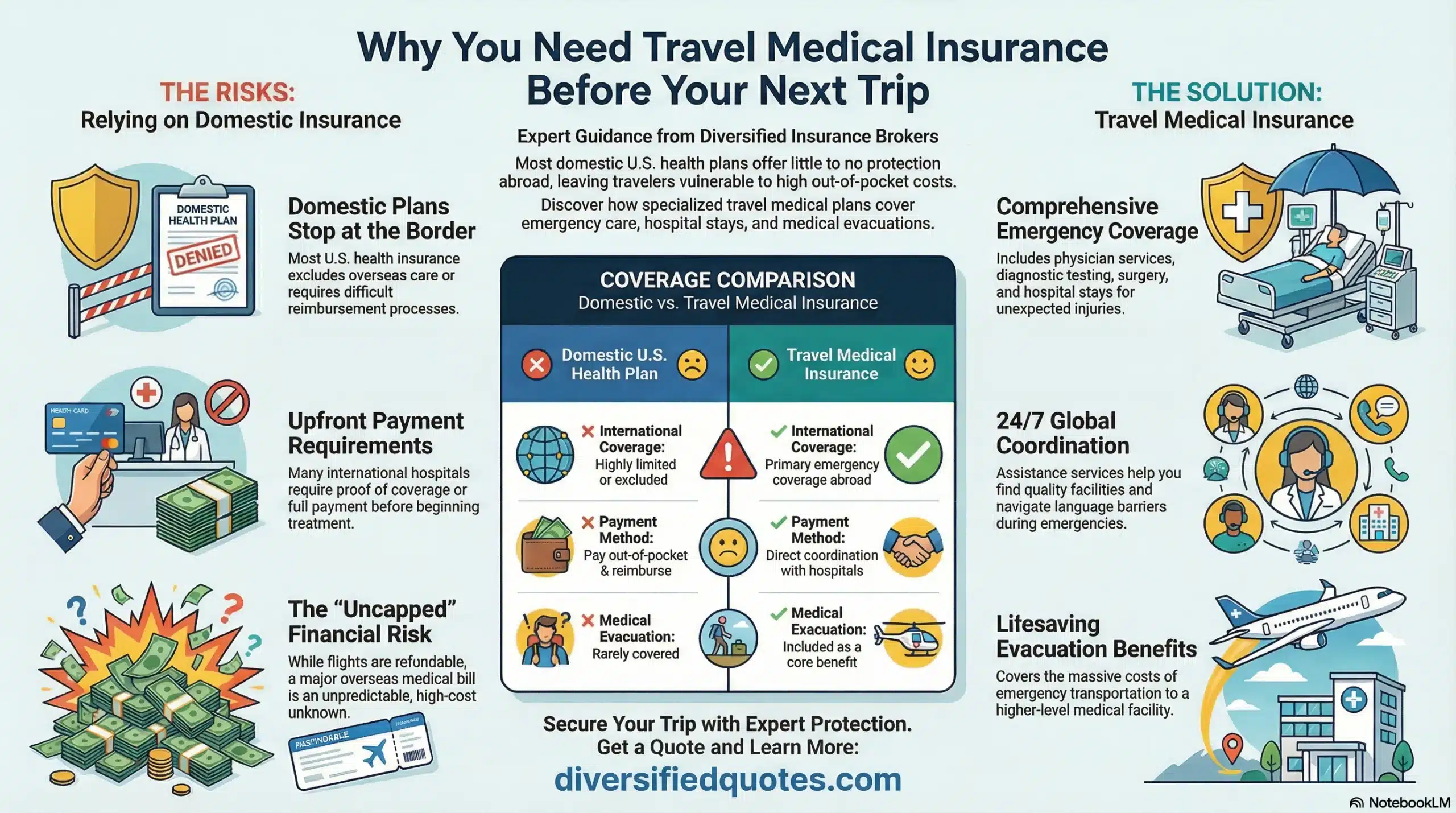
Travel medical insurance for seniors is one of the most practical steps a retiree can take before traveling internationally — and one of the most commonly underestimated. Even healthy seniors can encounter unexpected medical situations abroad: an infection requiring antibiotics and observation, a fall that needs imaging and orthopedic evaluation, a cardiac irregularity that demands monitoring, or a respiratory illness that escalates in ways it might not have at home. The challenge is not just the medical cost itself — it is that standard Medicare coverage offers little to no help outside the United States, many overseas providers require payment upfront, and the logistics of navigating an unfamiliar healthcare system under stress are genuinely difficult without a support structure already in place.
At Diversified Insurance Brokers, we help seniors choose travel medical coverage based on the trip they are actually taking — the destination, trip length, medical history, activity level, and the degree of protection they want for worst-case scenarios. Some travelers want a lean plan covering the basics at a low premium. Others want higher medical limits, strong emergency medical evacuation benefits, and robust assistance services. The goal in either case is the same: the ability to travel knowing that a medical surprise will not force you to drain savings, abandon the trip, or make critical decisions about care while under stress in an unfamiliar system.
Get Travel Medical Insurance for Seniors
Quick, secure online enrollment for seniors needing medical coverage while traveling abroad.
Start Your QuoteWhy Seniors Need Travel Medical Insurance
International travel is different in retirement from a health and logistics perspective, and that difference matters for how you plan coverage. The immune system’s response to new pathogens, the physical demands of long flights and unfamiliar environments, time zone changes affecting medication timing, dietary shifts, and the cumulative stress of travel days all interact in ways that can make minor issues escalate more quickly than they would at home. This is not a reason to avoid international travel — retirement is precisely when many people have the time and resources to travel meaningfully — but it is a reason to have a clear, pre-arranged plan for medical care rather than assuming improvisation will be sufficient.
Seniors also face a practical financial reality when seeking care abroad: many overseas private hospitals and clinics expect deposits or advance payment arrangements before providing non-emergency services, and even in emergency situations, payment documentation is often required quickly. Reimbursement-after-the-fact through personal credit cards, travel company lines, or later insurance filing can create significant cash flow stress at exactly the moment when your focus should be entirely on recovery. A travel medical policy that pairs financial coverage with 24/7 assistance services — including help locating appropriate facilities, communicating with providers in local languages, coordinating billing, and managing documentation — reduces that stress substantially by providing both the financial protection and the operational infrastructure to navigate care in unfamiliar systems.
| Planning Factor | Under Age 65 | Age 65–74 (Medicare Eligible) | Age 75 and Older |
|---|---|---|---|
| Domestic health plan international coverage | Employer or ACA plans may offer limited emergency coverage abroad — confirm specifically before travel | Original Medicare covers almost nothing outside the US — Medigap Plans C, D, F, G, M, N offer limited foreign emergency benefit up to a lifetime maximum | Same as 65–74 Medicare dynamic — travel medical fills the gap that Medicare and most Medigap plans leave for international travel |
| Pre-existing condition treatment | More plan options available with acute-flare coverage for stable pre-existing conditions — fewer exclusions in younger age bands | Pre-existing condition definitions and stability requirements become more important — review lookback windows carefully for any ongoing conditions | Pre-existing condition exclusions most consequential at older ages — some carriers add restrictions or sublimits; confirms terms explicitly before purchase |
| Medical benefit limits needed | Lower actuarial risk generally — standard limits often sufficient for most destination and trip types | Higher medical probability increases value of strong limits — inpatient and cardiac events are among the most common senior travel claims | Higher limits most important — older travelers have greatest probability of a serious event requiring inpatient care, surgery, or specialist treatment abroad |
| Evacuation coverage priority | Important for remote or high-risk destinations — lower baseline medical probability means evacuation is the primary worst-case scenario protection | High priority — cardiac and orthopedic events that require specialized surgery often need evacuation when occurring in destinations with limited capabilities | Critical — older travelers have the highest probability of a medical event requiring evacuation; limits should reflect realistic transport costs from the destination |
| Premium cost relative to coverage | Lowest premiums — age is the primary pricing driver for travel medical; younger travelers access the best rates | Moderate premium increase — still typically affordable relative to the financial exposure of an international medical event | Highest premiums — but cost of a single serious international medical event without coverage typically far exceeds lifetime premium paid |
| Coverage age limits | All carriers — no age restrictions apply below standard eligibility thresholds | Most carriers — some begin applying sublimits or reduced benefit maximums at specific age thresholds; verify carrier terms | Carrier selection matters most — some carriers cap coverage at 79 or 84; others extend to 99; confirm age eligibility and any age-based benefit restrictions explicitly |
| Key planning action | Confirm domestic plan has no meaningful international benefit; purchase travel medical to fill the gap | Confirm Medigap foreign emergency benefit limit; purchase travel medical to supplement and to cover evacuation Medicare does not address | Prioritize carriers with high age eligibility limits, strong pre-existing condition language, and robust evacuation limits; never travel internationally without coverage in place |
What Medicare and Retiree Plans Typically Don’t Cover Abroad
The Medicare coverage gap for international travel is more significant than many retirees realize. Original Medicare — Parts A and B — generally does not cover medical care received outside the United States or its territories. There are narrow exceptions: Medicare Part A may cover care at a foreign hospital in very specific geographic circumstances where a foreign hospital is closer than a U.S. hospital for a U.S. citizen experiencing a medical emergency in certain border areas. But these exceptions apply to a small subset of situations and do not represent a meaningful overseas coverage safety net for the vast majority of international travel scenarios.
Medicare Supplement (Medigap) plans do include a foreign travel emergency benefit under most standardized plan letters — plans C, D, F, G, M, and N include this benefit, which covers 80 percent of medically necessary care received abroad after a $250 deductible for the first 60 days of a trip, up to a lifetime maximum of $50,000. This benefit is meaningful but limited: the $50,000 lifetime cap can be consumed by a single significant hospitalization in high-cost regions, the 60-day trip limitation affects extended travelers, and the benefit does not include evacuation coordination or assistance services. Medicare Advantage plans may include international emergency coverage under their terms but structures vary considerably across carriers and plan designs — reviewing the specific international benefit terms in any Advantage plan before traveling is important.
The net result for most senior travelers is a coverage gap that travel medical insurance is specifically designed to address: coverage that activates for international emergency medical expenses, provides meaningful evacuation benefits when care is insufficient locally, and includes assistance services that connect the traveler to appropriate care rather than leaving them to navigate the system independently. If you want to review your specific Medicare setup before your trip, our Medicare calculator can help you compare options and confirm what you have in place. For longer stays or extended international residence, comparing travel medical coverage with broader international health insurance options is worth the additional research.
What Senior Travel Medical Insurance Typically Covers
Travel medical insurance for seniors is designed around the expenses that create the largest financial risk during international travel: emergency treatment, hospitalization, and the logistics of getting to appropriate care when it is not available locally. While specific benefits vary by plan and provider, the core coverage structure for most senior travel medical plans includes the following components.
Emergency medical care covers the costs of physician visits, urgent care services, diagnostic testing including laboratory work and imaging, hospitalization and inpatient services, surgical and anesthesia services, and medically necessary prescriptions directly related to a covered condition arising during the trip. Some plans include limited follow-up care needed to stabilize recovery before the traveler can safely continue or return home. The specific benefit limits and any coinsurance apply to these costs according to the plan’s terms.
Emergency medical evacuation is often the most financially significant benefit for senior travelers and frequently the most important to evaluate carefully. Evacuation benefits cover medically necessary transport to the nearest facility capable of adequately treating the condition when local care is insufficient — including air ambulance transport with appropriate medical crew and equipment when the patient’s medical condition during transport requires it. For seniors, evacuation scenarios arise not just in remote or high-risk destinations but in cruises, island stops, rural areas, and even in major destinations where the specific condition requires specialist care at a higher-capability facility. Air medical transport costs can reach tens or hundreds of thousands of dollars depending on origin, destination, and medical complexity — coverage that prevents that cost from falling to the traveler is one of the most financially protective elements of the plan.
Repatriation of remains — coverage for the cost of returning the traveler’s remains to their home country in the event of death abroad — is commonly included in travel medical plans. This benefit addresses a meaningful logistical and financial burden for families who would otherwise need to coordinate and fund international repatriation arrangements independently under emotionally difficult circumstances.
The 24/7 emergency assistance services component is operationally critical and often undervalued in plan comparisons that focus exclusively on benefit dollar limits. The assistance team provides multilingual support, real-time help identifying appropriate facilities in the area of the emergency, direct communication with local providers, guidance on authorization and documentation procedures, and coordination of the evacuation process when it is medically necessary. For senior travelers in unfamiliar systems, under stress, and potentially dealing with language barriers, having a professional assistance team available at any hour is frequently the most practically valuable element of the entire plan.
How Age Affects Travel Medical Insurance for Seniors
Age is one of the most significant factors in travel medical insurance pricing and availability, and it affects seniors in several specific ways that younger travelers do not face. Premiums for travel medical coverage increase with age because medical claim probability and severity both increase — older travelers statistically file claims more frequently and for higher amounts than younger travelers. For senior travelers in their 70s and 80s, premium levels can be meaningfully higher than for younger travelers with otherwise similar plans, which makes comparing benefit structures carefully against cost particularly important.
Some travel medical plans impose age limits on coverage availability — certain plans may not be available to travelers above a specified age, or may offer reduced maximum benefit limits above certain age thresholds. Understanding what age limits apply to any plan under consideration before purchasing is essential. Other plans are specifically designed to serve older travelers without age-based benefit reductions, though at premium levels that reflect the higher actuarial risk. For senior travelers who find standard travel medical pricing high relative to the benefits needed, reviewing plan designs that focus on catastrophic protection — high evacuation limits and meaningful emergency medical coverage — at higher deductibles can produce a better value proposition than lower-deductible, lower-limit plans at similar premium levels.
Pre-existing condition considerations also intensify with age. Most senior travelers have at least one ongoing health condition — managed hypertension, well-controlled diabetes, a prior cardiac history, arthritis, or other chronic conditions that are stable but medically documented. How each plan defines and handles pre-existing conditions, what look-back period applies, and what stability requirements must be met before travel begins determine whether the traveler’s most likely medical events are covered under the plan. These questions deserve explicit review for senior travelers rather than assumption that standard plan language will be favorable.
Choosing the Right Coverage Limits and Deductible
The most common mistake in selecting a senior travel medical plan is choosing the lowest-premium option without connecting that choice to the coverage tradeoffs it represents. Premium is one variable in a decision that also includes the emergency medical benefit limit, the evacuation limit, the deductible structure, the pre-existing condition terms, and the quality and accessibility of the assistance services. A plan with a low premium but an inadequate evacuation limit, a very high deductible, or weak pre-existing condition coverage may produce significantly worse financial outcomes in an actual emergency than a slightly more expensive plan with better-structured protection.
For most senior travelers, the emergency medical limit and the evacuation benefit are the two most financially consequential coverage elements. A serious hospitalization in many international markets can cost $30,000 to $100,000 or more. Air medical evacuation can cost $50,000 to $200,000 depending on origin and destination. A plan with a $50,000 combined limit may be adequate for some scenarios but potentially insufficient for the most serious events — particularly in expensive healthcare markets or when evacuation over long distances is required. For travelers who want high confidence in worst-case scenario protection, meaningful limits on both medical and evacuation coverage provide that confidence at a premium cost that is typically modest relative to the financial exposure being addressed.
The deductible represents the amount the traveler pays before the plan begins to cover covered expenses. Higher deductibles reduce the plan premium but increase the out-of-pocket amount the traveler absorbs in any covered event. A $500 deductible is appropriate for travelers comfortable self-funding a moderate first layer of cost in exchange for lower premium. A $0 or $100 deductible is appropriate for travelers who prefer minimal out-of-pocket exposure even for more routine medical events — an urgent care visit or a physician consultation should not create a stressful financial decision during a trip. For senior travelers on extended trips or in destinations where even routine care can carry significant cost, lower deductibles often represent a better tradeoff against the premium savings they forgo. Our resource on cheap travel insurance explains how limits, deductibles, and exclusions interact to affect real-world value — useful context for understanding where budget plans reduce protection relative to more comprehensive designs.
Why Medical Evacuation Matters More for Senior Travelers
For senior travelers, medical evacuation is not primarily a “remote jungle” scenario — it is a realistic coverage need that can arise on cruises, at island destinations, in rural touring routes, and even in major metropolitan destinations when a specific condition requires specialist intervention at a facility that is not the nearest available hospital. A senior traveler who experiences a significant cardiac event at a cruise port may need evacuation to a specialized cardiac center. A traveler who suffers a stroke at a European destination may need transfer to a facility with the specific neurological capabilities the condition requires. A traveler dealing with a serious fall in a rural area may need air transport to a trauma center. In each of these scenarios, the evacuation benefit is not hypothetical emergency preparedness — it is a financially critical coverage element for a realistic medical scenario.
The distinction between medical evacuation and other evacuation concepts travelers sometimes encounter is important to maintain. Travel medical plans are focused on medically necessary evacuation — transport to an appropriate treatment facility as determined by a physician working with the assistance team based on the patient’s medical condition. Security evacuation, political evacuation, or non-medical extraction from dangerous situations is typically a separate coverage type and is not included in standard travel medical plans. If an itinerary includes higher-risk regions where security evacuation might also be relevant, our resources on high-risk travel insurance and travel and medical insurance for high-risk travel cover those additional considerations.
For travelers who also want to protect prepaid trip costs against cancellation or interruption — deposits, flights, hotel reservations, tour bookings — trip cancellation insurance addresses that separate financial risk. Many senior travelers use both travel medical and trip cancellation coverage because they solve genuinely different problems: one protects you medically during the trip, the other protects the financial investment in the trip itself.
Cruise Travel and Senior Travel Medical Coverage
Cruises present a specific and frequently underappreciated coverage scenario for senior travelers. Many retirees choose cruise travel precisely because it feels like a manageable way to visit multiple destinations with logistics handled — accommodation, meals, transportation, and activities all packaged together. But from a travel medical perspective, cruises create a coverage challenge that on-land travel does not: the ship’s medical facility has limited capabilities compared to a hospital ashore, ports of call may have very limited local healthcare infrastructure, and the traveler’s location at sea or at remote ports means that evacuation to appropriate care can be particularly logistically complex and expensive.
The ship’s medical center can handle minor medical events — a medication refill, a minor injury, treatment for seasickness or a mild infection. For anything more serious, the ship’s physician typically recommends transfer to shore, and from there the traveler’s location at the specific port determines what care is actually available. At a major port city with strong healthcare infrastructure, options are reasonably good. At a small island port or a remote destination on the itinerary, options may be very limited. A senior traveler who experiences a cardiac event, a stroke, a serious fall, or a significant illness at sea or at a remote port faces both a medical challenge and a logistics challenge — and the evacuation benefit, combined with the assistance team’s ability to coordinate the response in real time, is what makes the difference between a manageable crisis and a financially and medically catastrophic one.
Senior cruise travelers should confirm that the travel medical plan they select explicitly covers emergency care received on board the ship and at ports of call, and that the evacuation benefit includes medevac from shipboard or remote port locations when medically necessary. Not all plans handle maritime medical scenarios identically, and reviewing this element specifically is worthwhile for any traveler planning a cruise.
Pre-Existing Conditions and Stability Rules
Many senior travelers assume that a pre-existing health condition automatically disqualifies them from travel medical coverage or makes obtaining meaningful coverage impossible. In practice, the question is more specific: how the plan defines a pre-existing condition, what look-back period the definition applies to, and whether the condition meets the plan’s stability requirement during the period immediately before the effective date of coverage. “Stability” in most travel medical plan contexts typically means that within a defined window before coverage begins — commonly 60, 90, or 180 days depending on the plan — there have been no new diagnoses, no changes in medication type or dosage, no new symptoms requiring physician evaluation, no hospitalization, and no recommended treatment that has not been completed.
A senior with well-controlled hypertension who has been on the same medication at the same dosage for two years, with no recent hospitalization and no pending treatment recommendations, will typically meet stability requirements for most plans. A senior who had a medication change three months ago, or who had a cardiac procedure six months ago, may or may not meet stability requirements depending on the specific plan’s look-back window and stability definition. These distinctions matter significantly for whether the traveler’s most likely medical events — a recurrence or complication of the existing condition — are covered under the plan.
The practical approach for senior travelers with any ongoing health conditions is to review the specific plan’s pre-existing condition definition and stability requirements before purchasing rather than assuming that coverage will apply. This is an area where plan selection matters more than most travelers realize, and where matching the plan to the traveler’s actual health profile produces meaningfully better coverage outcomes than selecting a plan primarily on premium.
Who This Coverage Is Best For
Senior travel medical insurance is broadly appropriate for any retiree traveling internationally — whether for leisure, a milestone trip, a cruise, a cultural journey, or a visit to family living abroad. The coverage becomes more important for longer trips because the probability of encountering a medical situation increases with time away from home. It becomes more important for destinations with limited healthcare infrastructure because the gap between what is locally available and what a serious condition requires is larger. And it becomes more important for senior travelers with any health history because the realistic medical events they might face are more likely to intersect with pre-existing conditions, making plan selection and pre-existing condition terms particularly consequential.
Grandparents visiting children or grandchildren living abroad represent a specific and growing segment of senior international travelers for whom this coverage is especially relevant. These trips often involve significant travel distances, extended stays, and destinations that may not have the same healthcare infrastructure as major tourist destinations. The freedom to make those visits comfortably — knowing that unexpected medical costs and logistics have a pre-arranged solution — is precisely what well-structured travel medical coverage provides.
How to Choose a Senior Travel Medical Plan That Fits Your Trip
The most effective approach to selecting a senior travel medical plan is to start with the specific risks your trip creates rather than starting with the price. For a short trip to a major European city with excellent healthcare infrastructure, the primary coverage needs are emergency medical treatment coverage at adequate limits, a manageable deductible, and clear assistance services. For a cruise itinerary visiting remote Caribbean or Pacific island ports, evacuation coverage at meaningful limits becomes the dominant consideration. For an extended stay in a destination with limited specialist care, both medical limits and evacuation coverage require more careful evaluation.
After identifying the primary coverage priorities for your specific itinerary, select the deductible level that matches how you prefer to manage the first layer of out-of-pocket costs. A higher deductible reduces premium and is appropriate when you are comfortable self-funding that first layer. A lower deductible costs more in premium but provides greater predictability in total out-of-pocket exposure for any covered event. Finally, review the pre-existing condition terms against your specific health history to confirm that the plan’s stability requirements and look-back period are compatible with your current medical situation.
Enrolling online is straightforward and can be completed in minutes before departure. Having coverage in place before any new symptoms, treatment changes, or medical events occur protects both your insurability and the plan’s coverage terms. The best time to enroll is when health is stable and the trip is planned — not during or after the trip when coverage can no longer begin.
Protect Your Next Trip
Enroll online in minutes and travel with confidence knowing you have protection for medical emergencies abroad.
Start Your QuoteFinancial Protection Essentials
Explore travel medical, international health, and retirement healthcare protection resources for senior travelers.
Related Travel Medical Pages
Explore related resources to compare travel medical benefits, evacuation planning, and cost-protection options.
Related Planning Pages
If you’re planning travel around retirement healthcare decisions, these tools help confirm coverage gaps before you leave.
Talk With an Advisor Today
Choose how you’d like to connect—call or message us, then book a time that works for you.
Schedule here:
calendly.com/jason-dibcompanies/diversified-quotes
Licensed in all 50 states • Fiduciary, family-owned since 1980
FAQs: Travel Medical Insurance for Seniors
In most situations, Original Medicare — Parts A and B — provides little to no coverage for medical care received outside the United States or its territories. There are very narrow geographic exceptions for border-area emergencies involving a foreign hospital closer than a U.S. facility, but these cover a small subset of situations and do not represent a meaningful overseas safety net for most international travel. Medicare Supplement (Medigap) plans include a foreign travel emergency benefit under most standardized plan letters — covering 80 percent of covered costs after a $250 deductible up to a $50,000 lifetime maximum for the first 60 days of a trip. This is a meaningful benefit but limited by the lifetime cap, the 60-day trip restriction, and the absence of evacuation coordination services. Medicare Advantage plans vary — some include international emergency benefits, but terms differ significantly across carriers and plan designs. For the vast majority of senior international travelers, the Medicare-related coverage available domestically leaves a meaningful gap that travel medical insurance is specifically designed to fill.
Travel medical insurance and trip cancellation insurance solve genuinely different financial problems, and understanding the distinction prevents both overpaying for coverage you don’t need and being unprotected against risks you thought you had covered. Travel medical insurance focuses on the medical dimension of international travel — paying for emergency treatment, hospitalization, and medically necessary evacuation when a covered illness or injury occurs during the trip. The financial risk it addresses is the cost of getting appropriate medical care while abroad. Trip cancellation insurance addresses the investment dimension — reimbursing prepaid, non-refundable trip costs such as flights, hotel deposits, cruise bookings, and tour payments when a trip must be cancelled, interrupted, or cut short for a covered reason. Many senior travelers benefit from having both types of coverage because they protect against different risks: one protects you during the trip medically, the other protects the money you invested in the trip itself. Purchasing only trip cancellation coverage and no travel medical coverage leaves you financially exposed to the largest potential costs — hospitalization and evacuation — that international travel creates.
Most senior travel medical plans include evacuation benefits, but limits, definitions, and the coordination process vary significantly across plans — and for senior travelers, the evacuation benefit deserves more careful evaluation than any other single coverage element. Medical evacuation covers medically necessary transport to the nearest facility capable of adequately treating the condition when local care is insufficient. For seniors, this scenario arises not only in remote or high-risk destinations but on cruises at island ports, in rural areas of otherwise well-served countries, and in major cities where a specific condition requires specialist care at a different facility. Air medical transport with a medical crew and appropriate equipment can cost $50,000 to $200,000 or more depending on origin, destination, and the patient’s medical complexity during transport. The difference between a plan with a $50,000 evacuation limit and one with a $500,000 limit can be the difference between being fully covered and being left with a six-figure gap. For senior travelers, selecting an evacuation limit that genuinely covers the worst credible scenario for their itinerary is one of the most financially important decisions in plan selection.
Not necessarily — but how a pre-existing condition is handled depends on the plan’s specific definition, the look-back period the definition applies to, and whether the condition meets the plan’s stability requirement in the period before coverage begins. Most plans define stability as a period — commonly 60, 90, or 180 days — during which there were no new diagnoses, no medication changes in type or dosage, no new symptoms requiring physician evaluation, no hospitalization, and no pending treatment recommendations. A senior with well-controlled hypertension on a stable medication for two years with no recent changes will typically meet most plans’ stability requirements. A senior who had a dosage change three months ago may or may not qualify depending on the look-back window. For senior travelers with any ongoing health conditions, reviewing the specific plan’s pre-existing condition definition and stability requirements explicitly before purchasing — not assuming coverage will apply — is the correct approach. Different plans treat the same health history differently, which is why plan selection specifically matched to the traveler’s health profile produces meaningfully better coverage than selecting primarily on premium.
Start with the specific financial risks your itinerary creates rather than with the price. For emergency medical coverage, consider that a serious hospitalization in many international markets can cost $30,000 to $100,000 or more, and select a limit that would realistically cover that range for your destination. For evacuation, consider that air ambulance from many international locations can cost $50,000 to $200,000 and select a limit accordingly — particularly if your itinerary includes cruises, island destinations, or areas with limited local healthcare. For deductible, choose the level that matches how you prefer to manage the first layer of out-of-pocket costs: a higher deductible reduces premium but increases what you pay before coverage activates; a lower deductible costs more in premium but provides more predictable total exposure in any covered event. The most common mistake is selecting the lowest-premium plan without evaluating whether the limits, deductible, and pre-existing condition terms are actually appropriate for the trip and the traveler’s health situation.
Most travel medical plans cover medical emergencies that occur on cruise ships as well as at cruise ports — but the specific coverage mechanics and how evacuation is handled in maritime and port scenarios vary across plans. A cruise ship’s medical center has limited capabilities and typically functions as stabilization rather than definitive treatment for serious conditions. For anything beyond minor care, the ship’s physician typically recommends transfer to shore, and from there, the local healthcare infrastructure at the specific port determines what care is available. At major port cities with strong hospitals, options are reasonable. At small island ports or remote destinations on a cruise itinerary, options may be very limited, and evacuation to a capable facility may be the only path to appropriate care. Senior cruise travelers should confirm that any travel medical plan they purchase explicitly covers care received on board the ship and at all ports of call, and that the evacuation benefit includes medevac from shipboard or remote port situations. This is worth verifying explicitly rather than assuming standard plan coverage adequately addresses the maritime travel scenario.
Age is one of the most significant pricing factors in travel medical insurance — premiums increase substantially with age because both the probability of filing a claim and the expected cost of claims increase for older travelers. For seniors in their 70s and 80s, premiums are meaningfully higher than for younger travelers selecting otherwise comparable plans. Some plans also impose age limits on coverage availability or on maximum benefit levels available above certain ages. Before selecting any plan, confirming that it is available without age-based benefit reductions for your specific age is an important first step. For senior travelers who find standard pricing high relative to their coverage needs, designs that prioritize catastrophic protection — high evacuation limits and meaningful emergency medical coverage with a higher deductible — often provide better value than lower-deductible, lower-limit plans at similar premium levels. The objective is ensuring that the coverage that matters most financially — evacuation and major hospitalization — is adequately protected even if that means accepting a higher first-layer deductible for more routine medical events.
For most senior travelers, yes — because the financial justification for travel medical coverage is not primarily the probability of a claim but the potential cost if one occurs. A single emergency room visit, hospitalization, or evacuation event can exceed the cost of coverage by an enormous multiple regardless of trip length. A five-day trip does not reduce the cost of an air ambulance evacuation or a hospitalization — those costs are determined by the medical event, not the itinerary length. The premium for a short-trip travel medical policy is typically modest, and the financial protection it provides against a low-probability, high-consequence event is the same value proposition that all insurance provides: you pay a predictable small amount to eliminate exposure to an unpredictable large amount. For senior travelers who are in good health and taking trips to destinations with solid healthcare infrastructure, the risk of a claim is relatively low — but the value of coverage exists precisely because if something does happen, the financial exposure without coverage can be severe enough to affect retirement financial stability in ways that go well beyond the trip itself.
The ideal time to purchase travel medical coverage is before departure and before any new symptoms, treatment changes, or medical events occur — not because these things are anticipated, but because the plan’s effective date and the pre-existing condition stability calculation both run from the purchase date relative to the travel dates. Purchasing earlier gives more time to review plan terms, confirm that stability requirements are met for any ongoing conditions, verify effective dates and coverage periods, and address any questions before departure makes them urgent. Some plans also offer pre-existing condition waiver provisions that apply when coverage is purchased within a specified window of the initial trip deposit payment — if that window matters for your situation, earlier purchase may be the difference between having pre-existing conditions covered and having them excluded. The worst time to think about travel medical coverage is after a new symptom appears, after a medication change, or — obviously — after departure, when coverage can no longer begin for the current trip.
The most important action when a medical situation develops during international travel is to contact the plan’s 24/7 emergency assistance line as early as possible — before making independent decisions about facilities, treatment, or transport that may be difficult or impossible to reverse. The assistance team provides immediate guidance on locating appropriate care in the area where you are, communicates with local providers in the local language, helps confirm coverage and coordinate billing where direct payment arrangements are possible, and manages the authorization and logistics of evacuation if the situation requires it. For most plans, evacuation benefits require coordination through the assistance process to apply — independently arranged transport that is not authorized through the assistance team may not be covered even when the underlying medical need is legitimate. Save the assistance team’s 24/7 emergency number in your mobile phone before departure, write it down separately, and share it with a travel companion or family member at home who can initiate the call on your behalf if you are unable to communicate. Documentation throughout the medical event — physician notes, itemized bills, diagnostic results, discharge summaries — supports the claim process and reduces friction when the claim is submitted.
About the Author:
Jason Stolz, CLTC, CRPC, DIA, CAA and Chief Underwriter at Diversified Insurance Brokers (NPN 20471358), is a senior insurance and retirement professional with more than 25 years of real-world experience helping individuals, families, and business owners protect their income, assets, and long-term financial stability. As a long-time partner of the nationally licensed independent agency Diversified Insurance Brokers, Jason provides trusted guidance across multiple specialties—including fixed and indexed annuities, long-term care planning, personal and business disability insurance, life insurance solutions, Group Health, Travel Medical and Evacuation Insurance, and short-term health coverage. Diversified Insurance Brokers maintains active contracts with over 100 highly rated insurance carriers, ensuring clients have access to a broad and competitive marketplace.
His practical, education-first approach has earned recognition in publications such as VoyageATL, and contributions from his agency featured in Kiplinger and GoBankingRates— highlighting his commitment to financial clarity and client-focused planning. Drawing on deep product knowledge and years of hands-on field experience, Jason helps clients evaluate carriers, compare strategies, and build retirement and protection plans that are both secure and cost-efficient. Visitors who want to explore current annuity rates and compare options across multiple insurers can also use this annuity quote and comparison tool.
Explore More Travel Medical Insurance Options: Browse our complete guide to Groups & Specialty Travel Insurance — covering church groups, missionaries, volunteers, students, expats, digital nomads & more.
Last Reviewed: September 17, 2026 |
Reviewed by: Jason Stolz, CLTC, CRPC, DIA, CAA
Chief Underwriter, Diversified Insurance Brokers, Inc. | NPN: 20471358 | Diversified Insurance Brokers, Inc. — Licensed in all 50 states
Fact Checked by: Tonia Pettitt, CMIP©
Medicare Specialist, Diversified Insurance Brokers, Inc. | NPN: 14374308 | Diversified Insurance Brokers, Inc. — Licensed in all 50 states
Did you find this content helpful? Leave us a Google review — it helps others find trustworthy guidance too.
Editorial Standards: Diversified Insurance Brokers maintains rigorous editorial standards to ensure accuracy, clarity, and independence in all content. Learn more about our editorial standards and commitment to transparency.
