
How to Prescreen a Life Insurance Application
As an Independent Life Insurance Broker, we compare rates across 100+ carriers and prescreen every application before submission.
How to Prescreen a Life Insurance Application

Jason Stolz CLTC, CRPC, DIA, CAA
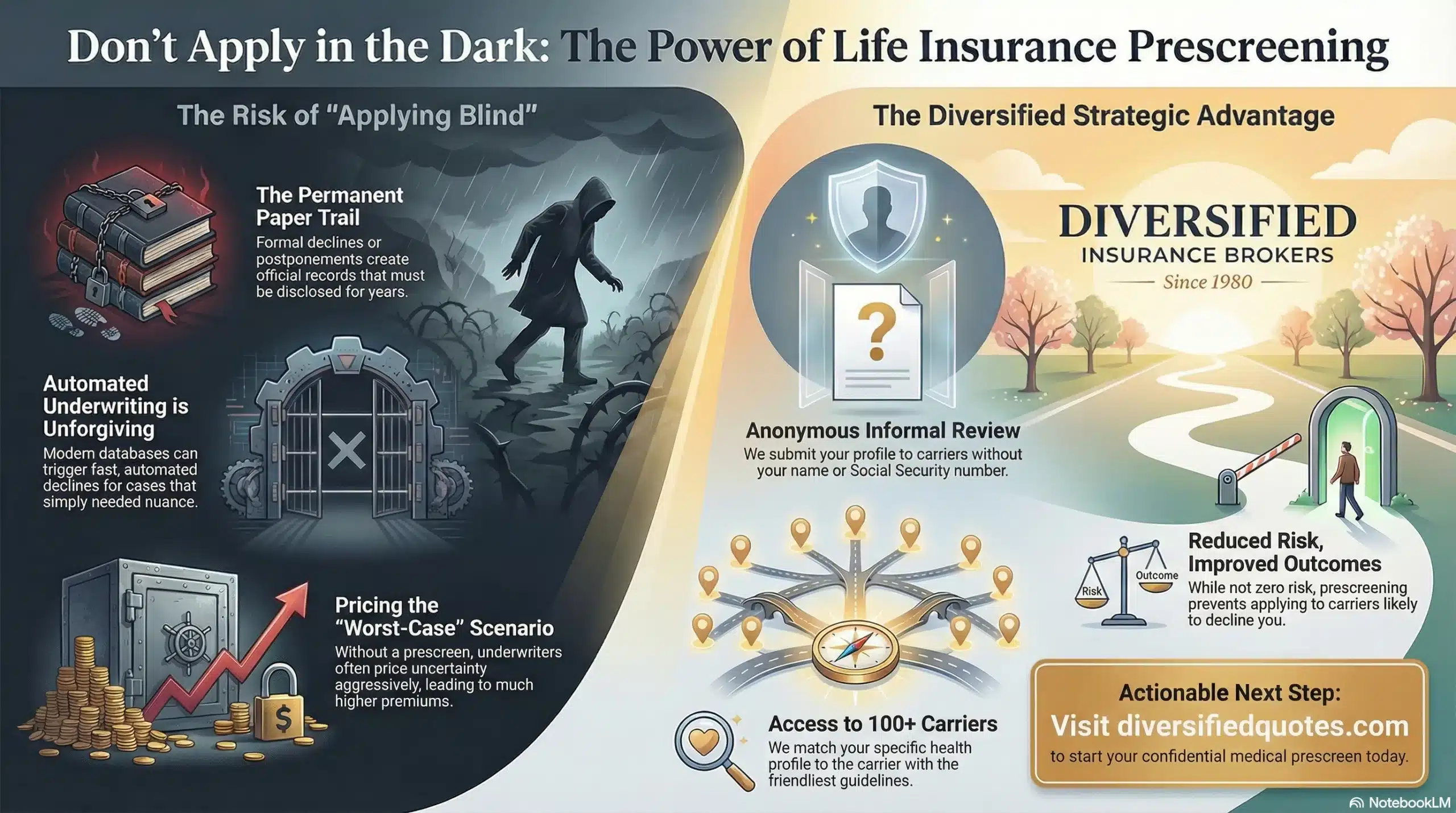
Prescreening a life insurance application is one of the most important steps in the underwriting process — and one of the least understood by people who haven’t navigated a complex case before. Done correctly, a prescreen can be the difference between a clean approval at a competitive rate and an unnecessary decline that follows an applicant in underwriting databases for years. At Diversified Insurance Brokers, prescreening is not a shortcut or a guess. It is a structured underwriting workflow that gathers a full picture of the case, presents it anonymously to multiple carriers’ underwriting teams, and uses their informal feedback to select the right carrier and structure the application before anything is formally submitted.
The core principle is straightforward: slow down at the beginning to avoid permanent problems later. Modern underwriting technology processes applications very quickly — electronic health records, prescription databases, MIB reports, and motor vehicle records can be pulled within minutes of a formal application being submitted. Speed is an advantage for simple cases, but it is a liability for complex ones, because a formal review creates a record regardless of the outcome. A prescreen creates no such record. It allows experienced underwriting professionals to evaluate the case and predict outcomes before any permanent footprint is made. This page explains how that process works, when it matters, what it covers, and how to use it to protect your insurability and maximize the chance of the strongest approval available at the most competitive rate.
Start a Confidential Life Insurance Prescreen
Submit your case securely and we will prescreen anonymously with multiple carriers to determine the best underwriting path.
See Real-Term Rates Side by Side
Life Insurance Quoter
What Is a Life Insurance Prescreen?
A life insurance prescreen is an informal underwriting review completed before submitting a formal application. It involves presenting the applicant’s health profile, medication history, lifestyle factors, and relevant background information to one or more carrier underwriting teams in an anonymous format — meaning no name, Social Security number, date of birth, or other identifying information that would trigger a formal inquiry in underwriting databases. The underwriter reviews the case and provides an opinion on how it would likely be classified if a formal application were submitted: what rate class it would likely receive, whether any exclusions or modifications would apply, and whether the carrier would prefer additional documentation before making a decision.
This feedback is not binding. Formal underwriting can produce different results based on the actual application data, the medical exam results, and the specific documentation available at the time. But a well-structured prescreen from an experienced underwriting team produces feedback that is highly predictive of the formal outcome — predictive enough to make meaningful carrier selection and application structuring decisions with confidence. The result is fewer surprises, better carrier fit, and a meaningfully reduced risk of the kind of unnecessary formal decline that can complicate an applicant’s insurability for years. For anyone with any level of medical, lifestyle, or occupational complexity, the prescreen is not optional. It is the professional standard for how complex life insurance applications should be handled.
Understanding the Underwriting Databases Carriers Check
One of the most important reasons to prescreen before formally applying is the set of underwriting databases that a formal application triggers. Most applicants are unaware of how comprehensive this data collection is and how quickly it occurs. Understanding what carriers actually check — and what records they access — explains why a formal decline has consequences that extend well beyond the application that generated it.
The Medical Information Bureau — more fully explained in our resource on what the MIB is in insurance — is the industry’s shared database of coded health and lifestyle information derived from previous insurance applications. When a carrier submits an MIB inquiry as part of formal underwriting, any prior MIB entries associated with the applicant become visible. More importantly, the inquiry itself creates a new entry. If a prior application was declined or rated because of a health condition, future carriers can see that history and may weigh it in their own decisions. Prescreening does not trigger MIB reporting, which is one of the most important reasons to prescreen before applying anywhere.
Prescription drug databases — accessed through services such as Milliman IntelliScript or ExamOne’s ScriptCheck — allow underwriters to pull a comprehensive history of filled prescriptions associated with an applicant’s name and date of birth. This history often reveals medical conditions, treatment histories, and medication patterns that do not appear on the application itself. Prescriptions for psychiatric medications, controlled substances, cardiac drugs, or diabetes management can all influence underwriting classification even when the applicant did not voluntarily disclose the underlying condition. Knowing what a carrier’s prescription database check will reveal before the formal application is submitted allows the application to be structured accurately and strategically rather than defensively.
Motor vehicle records reveal driving history that is relevant to both standard life insurance underwriting and to occupational or lifestyle risk assessments. DUIs, multiple moving violations, or a pattern of serious traffic infractions can affect rate class or trigger exclusions in certain carriers’ underwriting guidelines. Some carriers are considerably more lenient on older driving history than others, making carrier selection a meaningful variable when an applicant’s driving record is a potential factor. An attending physician statement — a formal request by the carrier to the applicant’s treating physician for medical records — may be required in certain cases and can reveal detailed health history that the applicant’s summary did not include. Anticipating whether an APS will be required and what it is likely to contain is one of the professional underwriting tasks that a prescreen process addresses before the formal submission.
Life Insurance Rate Classes: What They Mean and Why They Matter
Life insurance rate classes are the carrier’s classification of an applicant’s mortality risk, and they directly determine the premium the applicant will pay. Understanding how rate classes work — and how much premium difference exists between adjacent classes — is essential context for understanding why the prescreen matters financially, not just procedurally.
Most carriers offer a tiered classification system that typically includes Preferred Plus (or Super Preferred), Preferred, Standard Plus, and Standard at the fully underwritten level. Below Standard, table ratings apply — additional premium loads expressed as multiples of the Standard rate, typically in increments of 25 percent (Table B is Standard plus 25 percent, Table C is Standard plus 50 percent, and so on through Table H or higher depending on the carrier). A flat extra is an additional annual premium per thousand dollars of coverage, used for specific risks that are considered time-limited or difficult to quantify in percentage terms. Some applications receive a postpone response — meaning the carrier will not evaluate the case until a defined waiting period passes, typically after a medical event or treatment stabilization period. Some applications receive a decline — meaning the carrier will not offer coverage at any price under current circumstances.
The difference between Preferred Plus and Standard on a $1,000,000 policy can represent thousands of dollars per year in premium. The difference between Standard and Table D can represent even more. And the difference between a clean standard approval at one carrier and an unnecessary decline at another — when both outcomes reflect the same underlying health profile — is entirely a function of which carrier’s underwriting guidelines most favorably accommodate that specific health profile. That is what a prescreen produces: carrier selection based on which underwriting philosophy fits the applicant’s risk profile best. Our resource on the best life insurance for pre-existing conditions and our guide to the best high-risk life insurance companies provide a market-level overview of which carriers tend to be most competitive for different risk profiles.
Who Should Always Prescreen Before Applying
Not every applicant needs a formal prescreen. Young, healthy individuals with no medical diagnoses, no prescriptions, no significant family history, and straightforward lifestyle profiles often qualify for accelerated underwriting and can apply directly with confidence. But complexity increases rapidly with age, medical history, lifestyle factors, and the amount of coverage being sought. The following profiles should always prescreen before submitting a formal application to any carrier.
Anyone with a current or recent diagnosis of a significant medical condition should prescreen without exception. This includes diabetes of any type, particularly when A1C levels are elevated or complications are present; heart disease in any form, including history of heart attack and atrial fibrillation; cancer of any type; stroke or transient ischemic attack; COPD or other significant respiratory conditions; kidney disease; lupus or other autoimmune conditions; and significant mental health history including hospitalization or treatment for depression, anxiety disorders, or PTSD.
Anyone with a history of substance use — including treatment for alcohol use or substance abuse — should prescreen to identify which carriers have the most favorable treatment of recovery timelines and which require specific waiting periods after completion of treatment programs. Anyone with sleep apnea, regardless of whether it is treated with CPAP, should prescreen because carriers vary significantly in how they classify treated versus untreated sleep apnea and how much weight they give to compliance data. Anyone with high blood pressure, elevated cholesterol, or BMI above standard build guidelines should prescreen to understand which carriers’ build and lab guidelines most favorably accommodate their current measurements.
Occupational risk also triggers the prescreen recommendation. Applicants in hazardous professions — including aviation, commercial fishing, mining, oil and gas extraction, logging, and certain construction roles — should prescreen before applying because carriers evaluate occupational risk differently and the difference between carriers’ standard exclusions, flat extra loading, and clean approval for the same occupation can be significant. Our resource on life insurance for high-risk occupations covers the spectrum of occupational risk and how it interacts with underwriting, and our high-risk life insurance playbook provides a comprehensive framework for approaching any high-risk underwriting situation.
Finally, anyone who has previously been declined, postponed, rated, or offered a policy with exclusions should prescreen for any subsequent application — regardless of whether the underlying health issue has changed. Prior adverse underwriting history in MIB databases is visible to future carriers, and understanding how that history interacts with a new application requires professional guidance. Our dedicated resource on life insurance after a prior decline addresses this specific situation and the strategies available for applicants with adverse underwriting history.
| Dimension | Prescreen First | Direct Application Without Prescreen |
|---|---|---|
| MIB record impact | None — prescreen is anonymous and does not trigger MIB inquiries or create adverse notations | Immediate — formal application triggers MIB report query; adverse outcome creates notation visible to subsequent carriers for up to 7 years |
| Carrier selection | Informed — prescreen identifies which specific carriers will treat the profile most favorably before any application is filed | Blind — application goes to one carrier based on rate comparison or agent familiarity without knowing that carrier’s specific guidelines for the medical profile |
| Decline risk | Managed — carriers with decline probability for the profile are identified before application; application goes only to carriers with approval probability | Unmanaged — decline may occur with no advance warning; decline creates MIB record that complicates all subsequent applications |
| Rate class optimization | High — multiple carrier guidelines compared; application targets carrier most likely to offer the best rate class for the specific profile | Variable — may get a competitive rate or may pay significantly more than necessary because a better carrier wasn’t identified |
| Complex medical profile | Protected — case is structured to present the medical narrative in the framing most favorable to underwriters; documentation gaps identified before submission | Exposed — underwriters interpret incomplete or ambiguous documentation conservatively; gaps in follow-up or documentation trigger more cautious classification |
| Time to final decision | Slightly longer upfront — prescreen adds a few business days before formal application, but often faster to final approval because right carrier is targeted first | Faster initial submission but often slower overall — adverse outcomes require starting over with a different carrier after weeks of underwriting review |
| Recommended for | Any applicant with medical conditions, medications, prior declines, occupational risk, high-value face amounts, or concern about how the health history will be interpreted | Straightforward applicants: younger, no diagnoses, no medications, no prior applications, standard health history — accelerated underwriting appropriate |
How a Professional Prescreen Memo Is Structured
The quality of a prescreen is directly proportional to the quality of the information presented to the underwriter. A professionally structured prescreen memo is not a summary of concerns — it is a complete, organized presentation of the applicant’s health profile written in the format that underwriters use internally to evaluate cases. This distinction matters because an incomplete or poorly organized prescreen can produce conservative feedback that does not reflect what a fully documented case would receive.
A strong prescreen memo documents each relevant condition with a timeline: when it was diagnosed, what treatment was initiated, what the current medication regimen includes with specific doses, what the most recent relevant lab values show, and what the treating physician’s current assessment of the condition’s stability is. For cardiac conditions, this means documenting ejection fraction, stress test results, catheterization findings, and current functional status. For diabetes, this means documenting the specific type, the duration, the current A1C, the presence or absence of complications such as neuropathy or nephropathy, and the current medication regimen. For cancer history, this means documenting the type, stage, treatment modality, date of last treatment, and current remission status.
The memo also documents build, blood pressure readings, non-nicotine lifestyle factors, family history relevant to the conditions being assessed, and any occupational or avocational risk factors. It presents the profile as a complete picture rather than a selective summary, because underwriters know what they are looking for and will ask for missing information if the initial presentation omits it. Presenting the complete picture from the outset accelerates the feedback timeline and produces more reliable predictions. Understanding what happens during a life insurance medical exam — and what data the exam will produce — helps applicants and brokers anticipate what the formal underwriting record will contain and structure the prescreen accordingly.
The Postpone vs. Decline Distinction
One of the most practically important concepts in complex life insurance underwriting is the distinction between a postpone and a decline — because the two outcomes have very different long-term implications for the applicant’s insurability and future options.
A postpone means the carrier will not evaluate the case at this time, typically because a medical event is too recent to assess stability, because a treatment is ongoing and the outcome is unknown, or because a defined waiting period has not yet elapsed. Common postpone triggers include recent cardiac events where less than six months of post-event monitoring has occurred, active cancer treatment, recent major surgery within a defined window, or recent changes in psychiatric medication. A postpone is not a statement that the case is uninsurable — it is a statement that the carrier needs more time and stability data before making a determination. Most postpones resolve into standard or rated approvals once the required waiting period has passed and supporting documentation confirms stability.
A decline means the carrier will not offer coverage under any terms. Declines are typically issued for current malignant conditions under active treatment, certain organ failure diagnoses, advanced neurodegenerative conditions, or profiles that present mortality risk the carrier is unwilling to accept at any premium level. A formal decline triggers an MIB entry that is visible to other carriers for a period of years. This is the outcome that prescreening is specifically designed to prevent when avoidable — because many cases that would receive a decline from one carrier would receive a standard or table-rated approval from another carrier whose underwriting guidelines are better aligned with the specific risk profile. Identifying the right carrier through a prescreen, rather than discovering the wrong carrier through a formal decline, is the core value of the process.
Table Ratings and Flat Extras: What They Mean in Practice
When a case does not qualify for a standard rate class but is still insurable, carriers typically offer coverage through table ratings or flat extra premiums. Understanding how these pricing mechanisms work helps applicants evaluate whether an offer is appropriate for their profile and whether shopping other carriers is likely to improve the outcome.
Table ratings add a percentage premium over the Standard rate class. Table B adds 25 percent, Table C adds 50 percent, Table D adds 75 percent, Table E adds 100 percent, and so on through Table H (200 percent above Standard) and sometimes higher. A $2,000 annual premium at Standard becomes $4,000 at Table D (Standard +100%) for the same coverage amount. For many conditions, table ratings are temporary — meaning the carrier expects to reconsider the classification after a defined period of stability, which can result in the policy being “bought down” to a lower table or to standard as health documentation improves. Knowing at the prescreen stage which table rating a carrier is likely to offer — and whether a competing carrier offers a more favorable classification for the same profile — directly affects the financial outcome.
Flat extra premiums are a per-thousand surcharge added to the base premium, typically used for risks that have a defined elevated mortality period that is expected to resolve over time. For example, a recent recovery from a serious cardiac event might attract a flat extra of $5 per thousand of coverage for three years, after which the flat extra terminates and the base premium applies. Understanding when a carrier is likely to use a flat extra rather than a table rating — and which approach produces a lower total premium for a specific coverage amount and term length — is part of what a professional prescreen analysis provides.
How Prescription History Shapes the Underwriting Picture
Prescription history is one of the most revealing underwriting data sources, and it frequently contains information that applicants have not explicitly disclosed on the application — not because they intended to omit it, but because they did not realize the prescription was relevant or did not connect a medication to the condition it treats. Underwriters are trained to interpret prescription histories, and a single medication can reveal a pattern of treatment that shifts the entire underwriting analysis.
Psychiatric medications are among the most commonly overlooked disclosures. An applicant who received short-term treatment for situational depression following a life event and no longer takes the medication may not think to mention it — but if the prescription appears in the fill history, the underwriter will ask about it. The outcome depends entirely on the specific medication, the duration of treatment, the reason for treatment, and the current status. An isolated six-month SSRI prescription years ago for situational anxiety is handled very differently from a current maintenance regimen for major depressive disorder. Prescreening allows this history to be disclosed and explained in context before formal underwriting makes a determination based on the raw prescription data alone.
The same principle applies to cardiac medications, diabetes management drugs, sleep aids, pain medications, and anything else that implies an underlying condition. Blood pressure medications are extremely common and generally well-tolerated by underwriters when the condition is controlled — but an applicant on multiple antihypertensives with documented end-organ effects faces a very different analysis than one on a single low-dose medication with clean cardiac workups. Understanding which prescription combinations suggest good management versus escalating intervention is part of how professional underwriting guidance adds value beyond what any applicant can navigate alone. Our guide to how to get life insurance with health issues and our broader resource on life insurance with pre-existing conditions cover the general principles across different condition categories.
Timing: When to Apply and When to Wait
One of the most valuable strategic insights a prescreen can produce is guidance on timing. Many conditions create a formal waiting period before insurers will evaluate the case — or create a situation where applying immediately would produce a suboptimal rate class that could significantly improve if the application were delayed by six to twelve months while health documentation accumulates. The decision of when to apply is not always obvious to the applicant, but it is usually very clear to an experienced underwriting professional who knows what data the carrier needs to see and how long that data needs to demonstrate stability.
Recent cardiac events — heart attacks, catheterizations, bypass surgeries, and stent placements — typically require a minimum of six to twelve months of post-event stability before most carriers will consider formal underwriting. Applying within that window almost always produces a postpone or adverse decision that could have been avoided by waiting. Cancer treatment creates its own timing framework that depends heavily on the type and stage of cancer, the treatment modality, and the time since last treatment. Many cancer survivors can qualify for standard or near-standard life insurance once specific time thresholds have been met, but applying before those thresholds is reached produces consistently poor outcomes. Our resource on life insurance for cancer survivors covers the carrier-specific waiting periods and documentation requirements for different cancer types.
Weight loss — whether through lifestyle, medication, or bariatric surgery — creates a specific timing consideration. Most carriers require that weight loss be maintained for a defined period before crediting it in the rate class calculation. An applicant who has recently lost thirty pounds and is now within standard build guidelines may still be classified based on recent average weight rather than current weight unless a sufficient maintenance period has elapsed. The prescreen identifies the specific waiting period required by each carrier and allows the timing of the formal application to be optimized around it. For applicants who have had bariatric surgery specifically, our resource on life insurance after bariatric surgery covers the surgical underwriting timeline in detail.
How Carrier Relationships Change Prescreen Quality
Not all prescreens are equal, and the quality of the feedback depends heavily on the depth of the broker’s underwriting relationships. When a broker submits a prescreen to a carrier’s underwriting team with whom they have an established working relationship, the informal feedback reflects the underwriter’s genuine assessment of the case rather than a conservative generic response. Underwriters who trust that a broker presents cases accurately, completely, and professionally are more likely to engage substantively with the prescreen rather than issuing a vague or overly conservative preliminary opinion.
This is why the prescreen process is most effective when conducted by brokers with significant volume at specific carriers — brokers who have submitted enough complex cases through a given carrier’s underwriting department to have established credibility and communication channels that allow for genuine case-specific feedback. An independent broker with active relationships at 20 or more carriers can gather informal opinions from multiple underwriting teams simultaneously and identify the carrier whose guidelines, underwriting culture, and pricing philosophy are best aligned with a specific applicant’s profile. The outcome of that comparison — identifying the right carrier before the formal application is submitted — is the core deliverable of a professional prescreen. Our resource on why to work with an independent life insurance broker explains why access to this breadth of carrier relationships is not available through captive agents who represent only one company’s underwriting standards.
What to Prepare Before Starting a Prescreen
The more complete the information provided at the start of the prescreen, the more reliable the feedback and the faster the process. Before initiating a prescreen, applicants should gather the following: a list of all current medications with specific names, dosages, and the conditions they treat; dates of any diagnoses that may be relevant to underwriting; dates and outcomes of any relevant medical procedures, hospitalizations, or specialist visits within the past five to ten years; most recent values for any relevant lab work including blood glucose, A1C, lipid panel, blood pressure readings, liver function tests, and kidney function markers; current height and weight; and any family history of conditions that appear in the applicant’s personal medical history such as heart disease, cancer, or diabetes.
Occupational details are also relevant for anyone in a non-standard role: specific job title, the nature of the duties performed, any travel required to unusual locations, and any aviation activities are all questions that underwriters will ask. For lifestyle risk factors such as tobacco use, aviation, recreational extreme sports, or significant foreign travel, providing specific details — type of tobacco, frequency of use, cessation date if applicable; type of aviation activity, license held, hours flown, category of aircraft — allows the underwriter to assess the risk accurately rather than applying a conservative default. Our high-risk life insurance services page and the high-risk life insurance playbook together provide comprehensive guidance on how to document and present complex risk profiles.
For anyone whose first instinct is to avoid prescreening and apply directly — perhaps because the condition seems minor or because the amount of coverage needed is modest — it is worth considering that getting the best life insurance rates and finding affordable life insurance for seniors with health issues are both significantly more achievable through a professional prescreen process than through direct application without underwriting guidance. Our resource on how to get life insurance provides a broader framework for navigating the application process effectively from the beginning. For anyone who has already received an offer they believe is unfavorable, our second opinion on your life insurance quote service is specifically designed to evaluate whether a better outcome is available from the broader marketplace.
Confidential Medical Prescreen
Avoid unnecessary declines by prescreening anonymously with experienced underwriting guidance before any formal application is submitted.
Related Pages
Underwriting guidance, high-risk resources, and MIB database education for complex life insurance cases.
Financial Protection Essentials
Life insurance planning resources, underwriting guides, and advanced coverage structures.
Talk With an Advisor Today
Choose how you’d like to connect—call or message us, then book a time that works for you.
Schedule here:
calendly.com/jason-dibcompanies/diversified-quotes
Licensed in all 50 states • Fiduciary, family-owned since 1980
FAQs: How to Prescreen a Life Insurance Application
What is a life insurance prescreen?
A life insurance prescreen is an informal, anonymous underwriting review completed before a formal application is submitted to any carrier. The applicant’s health profile, medication history, lifestyle factors, and relevant background information are presented to one or more carrier underwriting teams without identifying information — no name, Social Security number, date of birth, or other details that would trigger a formal inquiry. The underwriter reviews the profile and provides an opinion on how the case would likely be classified: what rate class it would receive, whether any modifications or exclusions would apply, and whether the carrier would need additional documentation before making a decision.
This feedback is not a binding offer, but when conducted by experienced brokers with established carrier relationships, it is highly predictive of the formal outcome. The prescreen process allows meaningful decisions about carrier selection and application structure to be made before any permanent underwriting record is created. For anyone with medical complexity, prior adverse underwriting history, or significant lifestyle or occupational risk factors, the prescreen is the professional standard for how applications should be prepared. Our resource on high-risk life insurance options provides broader context for how complex cases are approached.
Does prescreening affect my MIB or insurance record?
No. A properly conducted prescreen does not trigger MIB reporting, prescription database inquiries, motor vehicle record checks, or any of the other formal underwriting data pulls that accompany a submitted application. Because no formal application is submitted, no formal inquiry is made, and no entry is created in the shared insurance databases that future underwriters would see. This is one of the most important protections the prescreen process provides — the ability to test multiple carriers’ responses to a complex health profile without creating the kind of permanent footprint that a formal decline would leave.
Understanding what the MIB is in insurance and how it affects future underwriting is important context for anyone who has previously received an adverse underwriting decision. Prior MIB entries from declined or rated applications are visible to future carriers during formal underwriting and can influence their assessments. Prescreening allows a subsequent application to be structured and targeted to the carrier most likely to produce a favorable outcome before that carrier is asked to open a formal file.
Who should consider a prescreen before applying?
Anyone with a current or recent significant medical diagnosis should prescreen before applying — without exception. This includes diabetes, heart disease, cancer, stroke, COPD, kidney disease, lupus, autoimmune conditions, and significant mental health history including hospitalizations or ongoing psychiatric treatment. Anyone with a history of substance use disorder, significant prescription drug history, or multiple concurrent conditions should also prescreen, as should anyone who has previously been declined, postponed, or table-rated by any carrier.
Beyond medical factors, occupational and lifestyle risk triggers include aviation, commercial fishing, logging, mining, oil and gas extraction, skydiving, and similar high-hazard activities. Tobacco users — particularly those who are recent quitters or who use non-cigarette tobacco products — benefit from prescreening to identify which carriers’ tobacco-free waiting periods and product-specific guidelines are most favorable for their specific history. Our resource on how to get life insurance with health issues covers the general principles, and the high-risk life insurance playbook addresses complex cases comprehensively.
How accurate are prescreen results?
Prescreen feedback is highly predictive when conducted correctly — meaning when the case is presented completely, accurately, and in the format underwriters use to evaluate risk. When experienced brokers with active carrier relationships submit a well-documented prescreen memo to underwriters they work with regularly, the informal feedback reflects genuine case-specific analysis rather than a generic conservative response. In most cases where the prescreen is thorough and the subsequent formal application aligns with what was presented, the formal outcome matches or closely approximates the prescreen prediction.
Cases where formal outcomes diverge from prescreen predictions typically involve new information discovered during formal underwriting — a medical exam result that was not anticipated, a prescription history entry that disclosed an undisclosed condition, or an attending physician statement that contained information the prescreen did not reflect. This is why accuracy in the prescreen presentation is so critical: the more complete and accurate the information provided, the more reliable the prediction. Prescreens conducted with incomplete information, or by brokers without established underwriting relationships, tend to produce less reliable feedback that creates false confidence or unnecessary pessimism.
Can a prescreen guarantee approval?
No. A prescreen is an informal advisory process, not a binding underwriting decision. Formal approval always depends on the full formal underwriting process — including the application, medical exam if required, prescription database check, MIB inquiry, attending physician statements if ordered, and any other information the carrier deems necessary. The prescreen guides strategy and carrier selection, and when conducted well it dramatically improves the probability of a favorable formal outcome, but it cannot guarantee one.
The most accurate way to understand the prescreen’s value is as risk reduction rather than outcome guarantee. It reduces the risk of applying to the wrong carrier, reduces the risk of unnecessary formal declines, reduces the risk of creating adverse MIB history, and increases the probability that the formal application is structured correctly for the specific carrier’s underwriting guidelines. For applicants who want to understand what formal approval or rating is realistic for their specific health profile, the prescreen provides the most reliable preview available outside of formal underwriting itself.
How long does the prescreen process take?
Typically two to five business days from the time complete information is received and the prescreen memo is submitted to underwriters. Simpler cases where the primary concerns are straightforward and well-documented may receive informal feedback within 24 to 48 hours. More complex cases — particularly those involving multiple concurrent conditions, recent major medical events, or unusual occupational or lifestyle factors — may require additional back-and-forth with underwriting teams and can take up to a week or longer if additional documentation or clarification is needed.
The timeline is most reliably shortened by providing thorough, organized information from the outset. Incomplete submissions that require follow-up requests for missing medication details, lab values, or treatment timelines extend the process and sometimes produce more conservative initial feedback that requires revision once the missing information is provided. Preparing a complete health summary before initiating the prescreen — including all current medications with doses, recent lab values, diagnosis timelines, and specialist contact information if an APS may be needed — allows the process to proceed efficiently from the first submission.
What is the difference between a table rating, flat extra, postpone, and decline?
These four outcomes represent the range of responses a carrier can provide for a life insurance application. A table rating is an approved offer at a premium rate above the Standard class — typically expressed as Standard plus an increment of 25 percent per table (Table B = +25%, Table C = +50%, and so on). A flat extra is an additional per-thousand-dollar premium added to the base rate, typically used for risks expected to diminish over time. Both table ratings and flat extras represent offers where the carrier is willing to provide coverage, just at a higher premium than a standard applicant would pay.
A postpone means the carrier declines to evaluate the case at this time, usually because a medical event is too recent, treatment is ongoing, or a defined stability period has not elapsed. A postpone is not a permanent decision — most postpones resolve into approvals once the required time and documentation conditions are met. A decline means the carrier will not offer coverage under any terms at this time. A formal decline triggers an MIB entry that other carriers will see during future applications. Prescreening is specifically designed to identify which of these outcomes is likely from a given carrier for a specific profile, allowing the application to be directed to the carrier most likely to produce an approval — or a less adverse offer — before any formal record is created.
How does prescription history affect life insurance underwriting?
Prescription history is one of the most revealing sources of underwriting information, and it frequently discloses conditions, treatment patterns, and risk factors that are not explicitly addressed on the formal application. Carriers access prescription fill histories through third-party data services, and underwriters are trained to interpret patterns in that history — including medications that suggest conditions the applicant may not have thought to mention, dosage changes that suggest worsening control of a chronic condition, or prescription patterns that raise questions about substance use or psychiatric treatment history.
The prescreen process allows prescription history to be disclosed, explained, and contextualized before formal underwriting accesses it through the database check. A six-month SSRI prescription from five years ago for situational grief after a family loss is a very different underwriting profile than a current maintenance regimen for major depressive disorder — but both might appear similarly in a raw prescription database entry. Presenting the context during the prescreen allows the underwriter to evaluate the actual risk rather than making assumptions from the raw data. Our resource on life insurance for depression and our broader guide to life insurance with pre-existing conditions cover how specific medication categories are treated across different carriers.
About the Author:
Jason Stolz, CLTC, CRPC, DIA, CAA and Chief Underwriter at Diversified Insurance Brokers (NPN 20471358), is a senior insurance and retirement professional with more than 25 years of real-world experience helping individuals, families, and business owners protect their income, assets, and long-term financial stability. As a long-time partner of the nationally licensed independent agency Diversified Insurance Brokers, Jason provides trusted guidance across multiple specialties—including fixed and indexed annuities, long-term care planning, personal and business disability insurance, life insurance solutions, Group Health, Travel Medical and Evacuation Insurance, and short-term health coverage. Diversified Insurance Brokers maintains active contracts with over 100 highly rated insurance carriers, ensuring clients have access to a broad and competitive marketplace.
His practical, education-first approach has earned recognition in publications such as VoyageATL, and contributions from his agency featured in Kiplinger and GoBankingRates— highlighting his commitment to financial clarity and client-focused planning. Drawing on deep product knowledge and years of hands-on field experience, Jason helps clients evaluate carriers, compare strategies, and build retirement and protection plans that are both secure and cost-efficient. Visitors who want to explore current annuity rates and compare options across multiple insurers can also use this annuity quote and comparison tool.
Explore More Life Insurance Options: Browse our complete guide to Life Insurance Buying & Cost Education — covering how to buy, costs, calculators, rates & buying guides from 100+ carriers.
Last Reviewed: August 27, 2026 |
Reviewed by: Jason Stolz, CLTC, CRPC, DIA, CAA
Chief Underwriter, Diversified Insurance Brokers, Inc. | NPN: 20471358 | Diversified Insurance Brokers, Inc. — Licensed in all 50 states
Fact Checked by: Tonia Pettitt, CMIP©
Medicare Specialist, Diversified Insurance Brokers, Inc. | NPN: 14374308 | Diversified Insurance Brokers, Inc. — Licensed in all 50 states
Did you find this content helpful? Leave us a Google review — it helps others find trustworthy guidance too.
Editorial Standards: Diversified Insurance Brokers maintains rigorous editorial standards to ensure accuracy, clarity, and independence in all content. Learn more about our editorial standards and commitment to transparency.
