
How to Get Life Insurance with Health Issues
As an Independent Life Insurance Broker, we compare rates across 100+ carriers and prescreen every application before submission.
How to Get Life Insurance with Health Issues

Jason Stolz CLTC, CRPC, DIA, CAA
How to get life insurance with health issues is one of the most consequential questions any applicant can answer correctly — because the wrong approach can lead to declines that follow you across the industry, while the right approach can produce affordable coverage at rates that often surprise applicants who assumed their condition made them uninsurable. The single most important reality to understand about life insurance with health issues is this: the same medical history can produce wildly different outcomes from different carriers. A diagnosis of well-controlled diabetes might be quoted at Table 4 by one carrier and at standard rates by another. Sleep apnea on a CPAP can be a flat rate at the right carrier and a significant rate-up at the wrong one. A prior cancer diagnosis can be a decline at most carriers and a competitive offer at the two or three carriers whose underwriting niche fits your exact history. Your job — or your broker’s job — is to find the right carrier before you submit an application that creates a permanent record.
At Diversified Insurance Brokers, we specialize in placing life insurance with health issues across more than 100 highly rated carriers, using the anonymous prescreen process to identify the carrier most likely to offer favorable terms for your specific medical profile before any formal application is filed. This page covers how the process works, what underwriters actually evaluate, which policy types fit different health situations, and how to give yourself the best possible chance of an affordable approval. Working with an independent life insurance broker rather than a captive agent is the foundation of this approach — independent brokers can shop your case across many carriers, while captive agents are limited to one company’s underwriting guidelines.
Start with a confidential prescreen — no application, no permanent record
Our underwriting team will review your medical profile anonymously and identify the carriers most likely to approve you at favorable rates — before any formal application creates a record that follows you across the industry.
See Real-Term Rates Side by Side
Life Insurance Quoter
Why Carrier Selection Matters Most for Life Insurance With Health Issues
The single most important fact about life insurance with health issues is that underwriting outcomes vary dramatically across carriers for identical medical histories. Each life insurance company maintains its own underwriting manual, its own reinsurance arrangements, and its own competitive niches — and those differences mean that a case that gets declined at one carrier may receive a preferred or standard offer at another. There is no “industry standard” for how a particular condition is rated. There is only what each individual carrier’s underwriting team decides for your specific case based on their internal guidelines.
This carrier-by-carrier variability is most pronounced for conditions where underwriting requires nuanced judgment: diabetes severity by A1C and complications, cancer history by type and time since treatment, heart disease by event type and time stable, mental health by medications and stability, and other conditions where the same diagnosis can range from low-risk-controlled to high-risk-active. For these conditions, applying to the wrong carrier first does not just produce a higher rate — it can produce an outright decline that becomes part of your MIB (Medical Information Bureau) record and follows you to every subsequent carrier you approach. Avoiding that outcome by identifying the right carrier first, through a prescreen, is the difference between an affordable policy and years of expensive declines. Our resource on best high-risk life insurance companies covers which carriers are most accommodating across different medical condition categories.
How Health Conditions Impact Life Insurance With Health Issues Rates
Underwriters evaluate health conditions through five core variables: the specific diagnosis, the severity of the condition, the stability of the condition over time, the medications and treatments being used, and any complications or related conditions. The table below shows how these factors typically combine to produce different underwriting outcomes — and what you can do to improve the outcome before applying.
How Different Health Factors Affect Life Insurance Underwriting
| Health Factor | Typical Underwriting Impact | How to Improve the Outcome |
|---|---|---|
| Well-Controlled Chronic Condition | Standard to mild rate-up | Document consistent compliance and stable labs |
| Recent Diagnosis (Under 1 Year) | Higher rate-up or postpone | Wait 6–24 months for stability period |
| Multiple Conditions | Compounded risk; multiple rate-ups stack | Target carriers with niche tolerance for comorbidities |
| Poor Recent Lab Results | Significant rate-up or decline | Improve labs before applying; retest in 3–6 months |
| Recent Cardiac Event | Postpone 1–2 years typically | Wait for stability; document recovery |
| Cancer History (Treated, In Remission) | Depends on type, stage, time since treatment | Document remission; target cancer-friendly carriers |
| Mental Health (Treated, Stable) | Often standard with stable history | Document treatment compliance and stability |
| Prior Decline | More restrictive subsequent applications | Use prescreen path; understand decline reason |
Understanding where your situation falls on this map is the starting point for a successful application. For applicants whose health profile puts them in the rate-up range, our resource on life insurance table ratings explained covers how rate-ups work and what each table level adds to standard premium. For applicants who have been declined previously, our resource on life insurance with a prior decline covers how to reposition the case properly and which carriers are most likely to approve where others declined.
Policy Types: Choosing the Right Structure for Life Insurance With Health Issues
Life insurance with health issues can be obtained through several policy types, each with different underwriting intensity, coverage limits, and cost structures. Choosing the right policy type for your specific situation is as important as choosing the right carrier. Applying for a fully underwritten policy when a simplified-issue product would have been a better fit can result in a higher rate or a decline that could have been avoided. Applying for a guaranteed-issue policy when you could have qualified for a fully underwritten policy means overpaying significantly for coverage with lower limits than you needed.
Life Insurance Policy Types for Applicants With Health Issues
| Policy Type | Medical Exam? | Typical Coverage Range | Best For |
|---|---|---|---|
| Fully Underwritten | Yes — exam plus records review | $50,000–$10,000,000+ | Best rates; well-controlled conditions; larger face amounts |
| Accelerated Underwriting | No exam if approved | $100,000–$3,000,000 | Healthier applicants; faster decisions; mild conditions |
| Simplified Issue | No exam; health questions only | $25,000–$500,000 | Moderate health issues; faster issue; smaller policies |
| Guaranteed Issue | No exam; no health questions | $5,000–$50,000 | Serious conditions; previously declined; small face amounts |
| Final Expense / Burial | Varies — exam-free options available | $2,500–$50,000 | Covering funeral and final expenses; seniors with health issues |
For applicants with moderate health issues who want to avoid an exam, our resource on life insurance with no medical questions asked covers the no-questions-asked options and how their cost compares to underwritten alternatives. For applicants whose health profile is most appropriate for a guaranteed issue path, our resource on guaranteed issue burial insurance covers small-face-amount coverage that activates regardless of medical history, and our resource on burial insurance with no medical exam covers no-exam options for final expense coverage. For younger applicants with health issues, our resource on guaranteed issue life insurance under age 50 covers options when traditional carriers have declined. Understanding what happens during the underwriting exam itself — when one is required — is covered in our resource on what a life insurance exam is.
Common Health Conditions and How They’re Underwritten
Almost every common health condition has at least one carrier in the marketplace that underwrites it favorably. The challenge is finding that carrier before you submit an application to the wrong one. Below is a summary of how some of the most common health conditions are typically evaluated — each linking to a dedicated resource for the specific underwriting nuances of that condition.
Diabetes is one of the most commonly underwritten conditions, and outcomes vary dramatically by A1C levels, type, complications, and time since diagnosis. Our resources on life insurance for diabetes generally, life insurance for type 1 diabetes specifically, and life insurance for type 2 diabetes cover the carrier-specific underwriting nuances for each diabetes type. Stable Type 2 diabetes with an A1C under 7 and no complications can qualify for standard or near-standard rates at the right carrier — outcomes that surprise applicants who have been quoted higher elsewhere.
Sleep apnea is another condition where carrier selection produces dramatically different outcomes. CPAP-compliant applicants with documented usage data routinely qualify for standard rates at carriers whose underwriting niche includes sleep apnea, while less specialized carriers may rate the case meaningfully higher. Our resource on life insurance for sleep apnea covers what carriers want to see and how to present the case for the best outcome.
Cardiovascular conditions span a wide range of underwriting outcomes. Our resources on life insurance for heart disease, life insurance for heart attack, life insurance after a heart attack, life insurance for high blood pressure, life insurance for bundle branch block, and life insurance for deep vein thrombosis cover the carrier-specific approaches for each cardiovascular profile. Time since the cardiac event is the most important variable — applicants are generally postponed for 6 to 24 months after a heart attack or significant cardiac procedure, after which underwriting becomes feasible.
Cancer history is highly underwritable when properly documented and matched to the right carrier. Our resources on life insurance for prostate cancer, life insurance for skin cancer, life insurance for testicular cancer, life insurance for ovarian cancer, life insurance for cervical cancer, and life insurance for bladder cancer cover each cancer type’s underwriting considerations. Time in remission and cancer stage at diagnosis are the most important variables — most carriers want to see at least 2 to 5 years post-treatment for most cancer types, though some carriers will consider earlier with the right documentation.
Other commonly underwritten conditions where the right carrier produces dramatically better outcomes include multiple sclerosis, lupus, arthritis, colitis and Crohn’s disease, kidney disease, fatty liver disease, pulmonary diseases, sickle cell anemia, hepatitis B, and recovery from drug abuse. For applicants who have had a lung transplant, our resource on life insurance for lung transplants covers the post-transplant underwriting landscape. For applicants navigating multiple health issues, our resource on life insurance with pre-existing conditions covers how carriers evaluate complex medical profiles.
The Prescreen Process: How to Get Life Insurance With Health Issues Approved Successfully
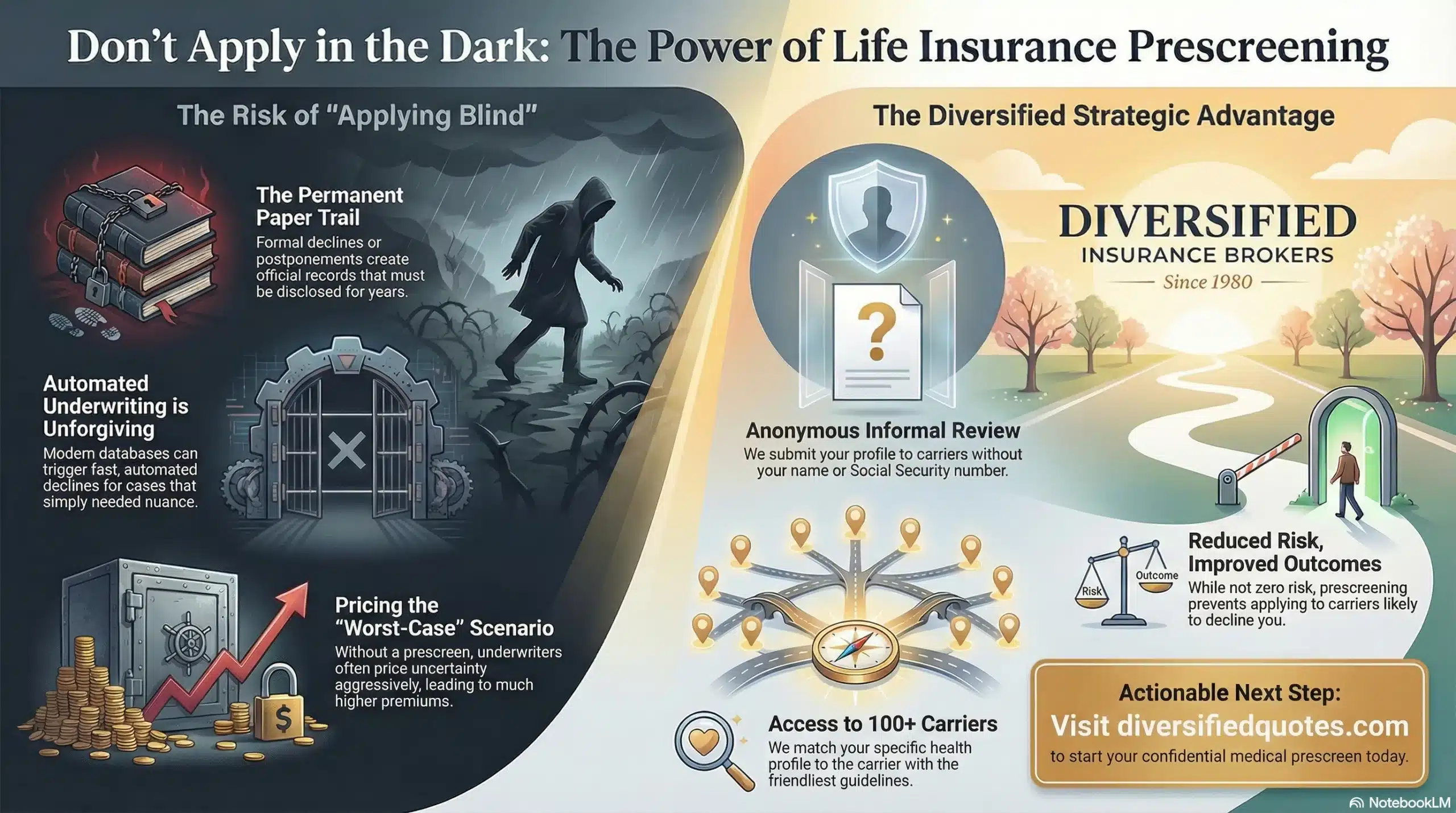
The single most important strategic decision in obtaining life insurance with health issues is whether to apply directly to a single carrier or to use the anonymous prescreen process first. Direct application creates a formal record that all subsequent carriers can see through the Medical Information Bureau (MIB) database. A decline at the first carrier becomes part of that record, and every subsequent carrier sees that decline when evaluating your case. The prescreen process, by contrast, allows underwriters at multiple carriers to review your medical profile anonymously and indicate likely underwriting decisions — without creating any formal application record.
The mechanics of an effective prescreen are straightforward. We collect a detailed medical summary including specific diagnoses, treatment history, medication list, recent lab values, height and weight, smoking status, family history, and any specific underwriting concerns. That summary — without your identifying information — is presented to underwriting teams at carriers whose underwriting niches align with your medical profile. Each carrier responds with their likely offer (standard, table rating with specific table level, postpone, or decline) and we use those responses to identify the carrier most likely to produce the best outcome before any application is filed. Our detailed resource on how to prescreen a life insurance application covers the full process in detail.
The value of this approach is most pronounced for applicants whose conditions are likely to produce variable underwriting outcomes. For straightforward cases with clean medical history, accelerated underwriting at a major carrier may produce a fast, competitive result without a prescreen. For any case involving meaningful health issues — controlled chronic conditions, cancer history, cardiovascular conditions, mental health treatment, or multiple comorbidities — the prescreen is the difference between an affordable approval at the right carrier and a series of declines at the wrong ones.
Common Mistakes That Hurt Life Insurance With Health Issues Outcomes
Several common mistakes consistently produce worse outcomes for applicants with health issues. The first is applying without a prescreen, especially with a captive agent who can only access one carrier. If that carrier’s underwriting niche doesn’t match the applicant’s profile, a decline or significant rate-up is the predictable result — and that decline now follows the applicant to every subsequent carrier.
The second common mistake is applying too soon after a diagnosis or treatment event. Underwriters value stability over time. A recent cardiac event, cancer diagnosis, or significant medication change creates underwriting uncertainty that resolves with time. Waiting 6 to 24 months for the appropriate stability period — and documenting that stability — produces dramatically better outcomes than rushing the application immediately after an event.
The third common mistake is applying for an excessively large face amount relative to financial justification. Underwriters scrutinize large applications more carefully, and a $3,000,000 policy applied for by someone with $200,000 in annual income will trigger additional scrutiny that a $750,000 policy would not. Starting with a realistic coverage amount and adding coverage over time when health improves often produces a better total outcome than swinging for maximum coverage from the start. Our resource on how much life insurance do I need covers how to calculate the realistic coverage amount that matches your financial situation, and our life insurance calculator provides a quick tool for estimating that amount.
The fourth common mistake is incomplete or inaccurate disclosure on the application. Carriers verify all disclosed information through MIB records, prescription history databases, and physician records — and they detect undisclosed information regularly. An application with material omissions or inaccuracies can be rescinded later, or worse, can result in a death benefit denial when the family needs it most. Complete, accurate disclosure presented through the right carrier produces dramatically better outcomes than incomplete disclosure ever could.
When to Get a Second Opinion on a Life Insurance Quote With Health Issues
If you have already received a quote for life insurance with health issues that seems high — or if you have been declined by a single carrier — getting a second opinion before accepting the outcome can produce a meaningfully better result. The same medical history that produced a Table 4 rate-up at one carrier may produce a standard offer at another whose underwriting niche better matches your specific situation. A decline at one carrier does not mean every carrier will decline. Our resource on getting a second opinion on your life insurance quote covers how to use the second opinion process to identify whether a better outcome is available before accepting the first offer.
For applicants who are evaluating specific carriers known for working with health issues, our resources on Symetra and Baltimore Life cover the underwriting approaches of two carriers commonly used for higher-risk cases. For applicants whose situation suggests starting with a quote and applying online quickly, our resource on Ethos instant decision term covers the streamlined application path. For overall context on the high-risk life insurance landscape, our resource on high-risk life insurance and our guide to general life insurance quotes provide the framework within which health-related cases are placed.
Get Life Insurance With Health Issues Approved
Our prescreen process identifies the carrier most likely to approve your case at favorable rates — before you create a formal application record.
Related Pages: Life Insurance Resources
High-risk underwriting strategies, policy types, table ratings, and carrier-specific resources.
Financial Protection Essentials
Inherited account guides, Medicare resources, and supporting financial planning topics.
Talk With an Advisor Today
Choose how you’d like to connect—call or message us, then book a time that works for you.
Schedule here:
calendly.com/jason-dibcompanies/diversified-quotes
Licensed in all 50 states • Fiduciary, family-owned since 1980
FAQs: How to Get Life Insurance With Health Issues
Can I get life insurance with health issues?
Yes — life insurance with health issues is available for the vast majority of medical conditions, and outcomes are often more favorable than applicants expect. The key is choosing the right carrier for your specific condition before applying. Different carriers underwrite the same condition very differently, and the same medical history that produces a decline at one carrier can produce a competitive offer at another whose underwriting niche matches your specific profile. Common conditions including diabetes, sleep apnea, high blood pressure, heart disease, cancer history, mental health treatment, and many others are routinely underwritten favorably at the right carriers.
For more complex situations — recent diagnoses, multiple conditions, or prior declines — the path may include a guaranteed issue policy, a final expense policy, or a postpone period followed by traditional underwriting. The right structure depends on the specific situation, which is why an anonymous prescreen is the recommended starting point for life insurance with health issues. Our resource on life insurance with pre-existing conditions covers how multiple-condition profiles are evaluated.
Will my rates be higher because of health issues?
Rates for life insurance with health issues are typically higher than rates for applicants with no health concerns, but the increase varies enormously by condition, by carrier, and by how well the condition is presented to the underwriter. A well-controlled chronic condition with documented stability often qualifies for standard or near-standard rates at carriers whose underwriting niche includes that condition. A moderate condition may qualify at Table 2 or Table 4 — adding 50 to 100 percent to standard premium. A severe or recently diagnosed condition may require a more significant rate-up or a postpone period before traditional underwriting becomes feasible.
Our resource on life insurance table ratings explained covers exactly how rate-ups work and what each table level adds to standard premium. The most important way to minimize rate-ups for life insurance with health issues is to apply to the carrier whose underwriting niche best matches your specific medical profile — which is exactly what the prescreen process is designed to identify.
Do I need a medical exam to get life insurance with health issues?
It depends on the policy type and your specific situation. Fully underwritten policies typically require a medical exam — usually a brief in-home or in-office exam covering height, weight, blood pressure, blood draw, and urine sample. Accelerated underwriting programs can sometimes waive the exam for healthier applicants with smaller face amounts. Simplified-issue policies skip the exam entirely and rely only on health questions. Guaranteed-issue policies require neither an exam nor health questions, but offer smaller face amounts at higher premiums than underwritten alternatives.
For applicants with health issues, the right choice depends on weighing the lower premiums of fully underwritten policies against the certainty of approval that no-exam options provide. The prescreen process helps determine which path is most likely to produce an affordable approval — sometimes an underwritten policy at standard or near-standard rates is achievable even with significant health issues, making the exam well worth the time. Our resource on what a life insurance exam is covers what to expect during the exam and how to prepare.
What is a life insurance prescreen and how does it help?
A life insurance prescreen is an informal, anonymous underwriting review where carriers evaluate your medical profile without creating any formal application record. The prescreen presents your medical history — diagnoses, medications, lab values, treatment history — to underwriting teams at multiple carriers, and each carrier responds with their likely offer for your case. We use those responses to identify the carrier most likely to produce the best outcome before any formal application is submitted.
The value of the prescreen is most pronounced for applicants with health issues whose conditions might produce different outcomes at different carriers. Without a prescreen, an applicant might submit to a carrier whose underwriting niche doesn’t match their condition, receive a decline, and have that decline follow them across the industry through the MIB database. With a prescreen, that decline never happens — the application goes to the carrier most likely to approve, and the formal record reflects an approval rather than a series of declines. Our detailed resource on how to prescreen a life insurance application covers the full process.
What if I’ve been declined for life insurance before?
A prior decline does not mean every carrier will decline you — but it does mean the next application needs to be approached very carefully. The prior decline is part of your MIB record, and every subsequent carrier you apply to will see it. The right strategy after a decline is to understand exactly why the decline occurred, identify the carrier whose underwriting niche is best suited to your specific situation, and apply only after thorough preparation through a prescreen.
Common reasons for prior declines that have favorable second-look outcomes include applying to the wrong carrier (the right carrier can approve where the wrong one declined), applying too soon after a diagnosis (waiting for stability often resolves the underwriting concern), and incomplete documentation that gave the underwriter insufficient information to approve. Our resource on life insurance with a prior decline covers the full strategy for repositioning a case that was previously declined, and our resource on getting a second opinion on your life insurance quote covers how to evaluate whether a better outcome is available before accepting a difficult first offer.
Should I work with an independent broker for life insurance with health issues?
Yes — and the reason is structural. Captive agents represent a single insurance company and can only place your application with that one carrier’s underwriting team. If that carrier’s underwriting niche doesn’t match your medical profile, the predictable outcome is a decline or significant rate-up — and you have no path forward through that agent because they cannot access other carriers. Independent brokers like Diversified Insurance Brokers maintain contracts with over 100 highly rated carriers, allowing us to shop your case across the entire market and identify the carrier whose underwriting niche actually matches your situation.
For life insurance with health issues, this structural difference is the single most important factor in producing favorable outcomes. The right carrier exists for nearly every medical condition — the only question is whether your broker can find it. An independent broker with access to many carriers can; a captive agent cannot. Our resource on why working with an independent life insurance broker matters covers this in full detail.
About the Author:
Jason Stolz, CLTC, CRPC, DIA, CAA and Chief Underwriter at Diversified Insurance Brokers (NPN 20471358), is a senior insurance and retirement professional with more than 25 years of real-world experience helping individuals, families, and business owners protect their income, assets, and long-term financial stability. As a long-time partner of the nationally licensed independent agency Diversified Insurance Brokers, Jason provides trusted guidance across multiple specialties—including fixed and indexed annuities, long-term care planning, personal and business disability insurance, life insurance solutions, Group Health, Travel Medical and Evacuation Insurance, and short-term health coverage. Diversified Insurance Brokers maintains active contracts with over 100 highly rated insurance carriers, ensuring clients have access to a broad and competitive marketplace.
His practical, education-first approach has earned recognition in publications such as VoyageATL, and contributions from his agency featured in Kiplinger and GoBankingRates— highlighting his commitment to financial clarity and client-focused planning. Drawing on deep product knowledge and years of hands-on field experience, Jason helps clients evaluate carriers, compare strategies, and build retirement and protection plans that are both secure and cost-efficient. Visitors who want to explore current annuity rates and compare options across multiple insurers can also use this annuity quote and comparison tool.
Browse More Resources: Return to our complete Life Insurance Special Topics guide — covering permanent life, estate planning, key person, IUL, infinite banking & special needs.
Last Reviewed: September 22, 2026 |
Reviewed by: Jason Stolz, CLTC, CRPC, DIA, CAA
Chief Underwriter, Diversified Insurance Brokers, Inc. | NPN: 20471358 | Diversified Insurance Brokers, Inc. — Licensed in all 50 states
Fact Checked by: Tonia Pettitt, CMIP©
Medicare Specialist, Diversified Insurance Brokers, Inc. | NPN: 14374308 | Diversified Insurance Brokers, Inc. — Licensed in all 50 states
Did you find this content helpful? Leave us a Google review — it helps others find trustworthy guidance too.
Editorial Standards: Diversified Insurance Brokers maintains rigorous editorial standards to ensure accuracy, clarity, and independence in all content. Learn more about our editorial standards and commitment to transparency.
