
Gerber Life Accidental Death
Gerber Life Accidental Death

Jason Stolz CLTC, CRPC, DIA, CAA

Gerber Life Accidental Death Insurance is a supplemental coverage product that pays a lump-sum benefit to named beneficiaries if the insured dies as a direct result of a covered accident. Adults between ages 18 and 69 are eligible to apply with guaranteed acceptance within that age range — no medical exam and no health questions required. Approval is not conditioned on occupation, travel habits, or any health-related factor. The policy provides immediate supplemental coverage once the first premium is received and processed, and premiums are fixed for life — they will not increase due to age, health changes, or any other factor as long as payments are made. Coverage applies worldwide, 24 hours a day, whether the insured is at home, traveling domestically, or abroad. In addition to the accidental death benefit, the policy may provide benefits for qualifying disabling injuries such as loss of a limb or loss of eyesight, depending on the specific policy provisions — extending the product’s financial protection function beyond death alone to serious injury scenarios that interrupt income and create financial hardship during recovery. Understanding both what the policy covers and what it specifically does not cover is the foundation for deciding whether and how it fits within a complete financial protection plan. Accidental death insurance is never a substitute for comprehensive life insurance — most deaths result from illness and natural causes, not accidents, meaning a protection plan that relies solely on accidental death coverage leaves the majority of mortality risk entirely unaddressed. The appropriate role of Gerber Life Accidental Death Insurance is as a supplemental layer that adds affordable additional coverage on top of comprehensive term or permanent life insurance — increasing the total death benefit available to beneficiaries in the specific scenario of accidental death at a fraction of the cost of additional comprehensive coverage. At Diversified Insurance Brokers, Jason Stolz, CLTC, CRPC, DIA, CAA works with clients to evaluate where accidental death coverage fits within their complete protection portfolio — ensuring the product serves its intended supplemental function rather than being purchased as a standalone coverage solution that leaves critical gaps. The full life insurance product landscape at Diversified establishes the foundational coverage framework within which accidental death insurance plays its supplemental role — the comprehensive term or permanent policy covering all causes of death is always the primary layer, with accidental death coverage adding protection for the specific accident scenario above that base.
The Coverage Scope — Covered Causes and Common Exclusions
Accidental death insurance pays only when death is directly caused by a covered accident — and the policy language’s definition of covered accidents, along with its list of exclusions, determines exactly which circumstances trigger the benefit and which do not. Covered causes typically include motor vehicle accidents, falls, drowning, exposure to the elements, accidents involving machinery or heavy equipment, and other sudden, external, unintentional events that directly cause death. The accident must be the direct and proximate cause of death, and most policies require that death occur within a defined timeframe — often 90 days — following the accident for the claim to be eligible. Deaths that occur from complications arising long after the accident, or from an underlying illness that the accident aggravated rather than directly causing, may not qualify depending on the specific policy language. Common exclusions across the accidental death insurance category include deaths from illness or natural causes, drug overdoses, suicide, war or act of war, high-risk recreational activities specifically excluded by the policy such as skydiving or professional motor racing, and in many policies deaths caused by the insured operating a vehicle while under the influence of alcohol or controlled substances. These exclusions matter practically because they represent scenarios where a beneficiary may reasonably expect coverage but will not receive the benefit — understanding them before purchasing prevents the expectation gap that leads to dispute at claim time. How much accidental death insurance costs relative to the coverage it provides is the cost-benefit question that frames any evaluation of whether the product is appropriate for a specific individual’s budget and coverage objectives — the premium is low specifically because the coverage scope is narrow, and the narrow scope is what makes it a supplemental rather than primary product.
Affordable Accident Protection Starts Today
No medical exams. No health questions. Fast online approval for eligible applicants ages 18–69.
Get a Quote or Apply NowAccidental Death Insurance vs. Comprehensive Life Insurance — Understanding the Critical Difference
| Coverage Dimension | Gerber Life Accidental Death Insurance | Comprehensive Term or Whole Life Insurance |
|---|---|---|
| Causes of death covered | Covered accidental deaths only — the accident must be the direct cause of death within the policy’s defined timeframe; illness, disease, natural causes, and non-covered circumstances produce no benefit regardless of the insured’s age or premium payment history | Death from virtually any cause — illness, accident, cancer, heart disease, stroke, organ failure, and most other causes all trigger the full death benefit; the vast majority of actual deaths are covered, not a narrow subcategory |
| Underwriting requirement | Guaranteed acceptance for ages 18–69 — no medical exam, no health questions, no possibility of decline based on health history; premiums are the same for all approved applicants in the same age range regardless of health status or medical history | Varies by product — fully underwritten policies require medical exam and detailed health history; simplified issue products ask health questions without requiring an exam; guaranteed issue products (for burial coverage) accept all applicants with a two-year graded benefit period |
| Premium level | Significantly lower than comprehensive life insurance for the same coverage amount — the narrow coverage scope means the insurer’s expected claim rate is much lower, enabling very affordable premiums; the lower premium reflects lower probability of claim, not equal value per dollar of coverage | Higher premium than accidental death coverage for the same face amount — the comprehensive coverage of all-cause death is more likely to produce a claim, which is reflected in the higher premium; the premium difference directly represents the broader coverage being purchased |
| Appropriate planning role | Supplemental — adds affordable additional coverage for the specific accident scenario on top of a comprehensive life insurance foundation; appropriate as a standalone purchase only for individuals who cannot qualify for any comprehensive coverage and need some protection rather than none | Primary — the foundation of any sound life insurance protection plan because it covers the full range of mortality causes that actually account for the majority of deaths; comprehensive coverage is the base layer within which accidental death insurance provides targeted supplemental depth |
The comparison establishes the most important planning principle for any buyer evaluating Gerber Life Accidental Death Insurance: illness, cancer, heart disease, stroke, and other natural causes collectively account for the large majority of deaths in the United States — leaving accidental causes as a meaningful but minority share of actual mortality. A protection plan built around accidental death coverage alone leaves the primary cause of mortality entirely unprotected. The accidental death policy’s appropriate function is to sit above a comprehensive life insurance foundation, adding benefit for the specific scenario of accidental death without replacing the broader coverage that most deaths will actually require. Understanding how to build a complete life insurance plan — starting with the comprehensive coverage layer and adding supplemental products where budget and risk profile support them — is the planning discipline that ensures the accidental death policy serves its intended purpose rather than creating a false sense of comprehensive coverage. The relationship between group life insurance and individual policies is relevant for buyers who already have employer-provided group life coverage — because many employer group plans include an accidental death rider, a standalone accidental death policy may duplicate coverage the buyer already holds through their employer benefits.
Who Benefits Most From Gerber Life Accidental Death Coverage
The specific profiles for whom Gerber Life Accidental Death Insurance provides genuine planning value are worth defining clearly — because the product’s guaranteed acceptance and low premium make it broadly accessible in ways that can obscure whether it is actually the most appropriate choice for any given individual. The buyer who benefits most from this coverage is one who already carries comprehensive term or permanent life insurance for the primary all-cause death protection need, and who wants to increase their total death benefit specifically for the accident scenario at the lowest possible incremental premium cost. For this buyer, the accidental death policy adds a meaningful additional layer — doubling or significantly increasing the total benefit available to beneficiaries in the event of accidental death — at a fraction of what an equivalent increase in comprehensive coverage would cost.
Individuals who work in occupations or lifestyles that involve elevated accident exposure — frequent driving, physical labor, extensive travel, work with machinery or equipment — have specific reasons to value the additional accident-specific coverage beyond their base life insurance protection. Families with dependent children or mortgage obligations who need to maximize total available coverage within a constrained budget can use the accidental death policy to extend coverage dollars further than comprehensive coverage alone would allow at the same premium expenditure. Individuals who are between major life stages — early career, post-job-transition, rebuilding financially — and who need some coverage immediately while the budget for full comprehensive coverage is not yet available can use accidental death insurance as a starting point, with the explicit intention of adding comprehensive coverage as financial capacity increases. Individuals with pre-existing health conditions who cannot qualify for comprehensive life insurance underwriting can access accidental death coverage through the guaranteed acceptance structure — receiving at minimum protection for the accident scenario while pursuing other coverage options available for their specific health profile. Business owners and key person coverage contexts where accident risk is elevated relative to the key person’s role may include accidental death coverage as a supplemental layer above the primary key person life insurance policy — though the key person’s primary protection need remains all-cause coverage regardless of accident exposure. Converting term coverage to permanent insurance as life circumstances evolve is the comprehensive coverage planning strategy that accidental death coverage supplements rather than replaces — the long-term protection architecture should move toward permanent comprehensive coverage as the financial foundation, with the accidental death policy serving its supplemental function within that architecture. Gerber Life Accident Protection — the separate injury-focused product — complements the Accidental Death policy by covering injury-related costs during accident recovery rather than only the death scenario; together they address both the death benefit need and the injury cost and income disruption need that serious accidents create.
Accidental Death Coverage in the Context of the Complete Protection Plan
The most financially sound approach to integrating accidental death insurance into a family’s protection plan begins with confirming that the comprehensive life insurance foundation is in place and appropriately sized — and then evaluating whether the incremental cost of accidental death coverage is justified by the additional accident-specific protection it adds. Families whose comprehensive coverage is already sized to replace the full income loss scenario — mortgage, dependent support, education funding, retirement security for the surviving spouse — have a stronger case for adding accidental death coverage as an affordable layer than families whose comprehensive coverage is itself inadequate and whose premium dollars would produce more planning value by increasing the comprehensive coverage amount. How much life insurance a family actually needs for income replacement, mortgage protection, and dependent support is the baseline calculation that should precede any decision about supplemental products — confirming the comprehensive coverage level is appropriate before layering supplemental coverage on top of it. Fifteen-year term life insurance and twenty-year term life insurance are the comprehensive coverage building blocks most commonly used by working-age families with dependent children — the term period covering the years of greatest financial dependency while the premium remains affordable, with accidental death coverage potentially added as a supplemental layer. Whole life insurance with cash value growth provides the permanent coverage foundation that some families use as their comprehensive life insurance base — particularly for needs that extend beyond the term period, such as estate planning, legacy goals, or final expense coverage in later years. Permanent life insurance structures more broadly are the foundation for protection needs that term insurance cannot serve — accidental death coverage supplements permanent coverage the same way it supplements term coverage, adding accident-specific depth above the comprehensive all-cause base. Life insurance for cancer survivors illustrates the impaired-risk underwriting landscape — some cancer survivors can qualify for simplified issue or even fully underwritten comprehensive coverage with appropriate waiting periods, and should not assume they are limited to accidental death or guaranteed issue products without exploring the full market. Life insurance with chronic illness riders represents a more comprehensive alternative for some health-impaired individuals — providing all-cause death benefit with additional living benefit access rather than the narrower accident-only coverage of the accidental death product. Burial insurance for seniors over 80 and the best-rated burial insurance companies serve the final expense coverage need for older applicants who have aged out of the Gerber Accidental Death policy’s 18–69 eligible age range — confirming that alternative coverage options remain available for seniors who need final expense protection but are no longer eligible for the accidental death product. Whether life insurance remains necessary in retirement is the broader coverage review that accidental death insurance holders should conduct as they approach and enter retirement — evaluating whether the supplemental accidental death coverage continues to serve a planning function within the retirement protection architecture or whether the budget is better allocated to other retirement financial planning priorities. How annuity death benefits are taxed is a related planning topic for protection plan holders who also own annuity contracts — the combination of life insurance death benefit and annuity account value death benefit creates the total financial picture available to beneficiaries, and understanding the tax treatment of both allows for more complete estate and legacy planning. Whether annuities have a death benefit by default is relevant for individuals who are evaluating how annuity assets and life insurance coverage work together in the overall legacy and survivor income plan. Annuities for conservative investors represent the income security complement to the life insurance protection architecture — the annuity providing guaranteed retirement income while the life insurance coverage ensures survivor income obligations are met if the primary earner dies. Social Security planning guidance intersects with life insurance planning for working-age adults — because the survivor Social Security benefit available to a spouse and dependent children if the insured dies reduces the income replacement obligation that life insurance must cover, affecting the appropriate coverage level calculation. Maximizing Social Security benefits through optimal claiming strategy is a retirement income planning dimension that works alongside the life insurance and protection architecture — ensuring that both the living income plan and the survivor income plan are optimized together rather than in isolation. What Medicare covers for long-term care establishes the healthcare cost gap that neither life insurance nor accidental death coverage addresses — the custodial care cost risk that requires its own planning vehicle. Long-term care insurance with shared spousal benefits addresses the custodial care coverage gap as a standalone protection product. Annuities with long-term care benefits address both income security and care cost risk in a single contract — a multi-purpose planning approach that complements the life insurance and accidental death coverage dimension of the complete protection plan. The best annuity for guaranteed income in retirement is the retirement income planning foundation that works alongside the life insurance protection architecture — the annuity ensuring income security regardless of market conditions, the life insurance ensuring survivor income obligations are met if the insured dies. The annuity rescue plan process at Diversified reviews existing annuity and insurance positions together — ensuring the full financial protection and income security architecture is optimized rather than evaluating each product in isolation from the others. How Medicare works for individuals approaching retirement age establishes the healthcare coverage foundation that complements life insurance and accidental death coverage in the complete retirement protection plan.
Protect Your Family Against the Unexpected
Low-cost accidental death coverage with fast online enrollment — no medical exam, no health questions, guaranteed acceptance for ages 18–69.
Apply Now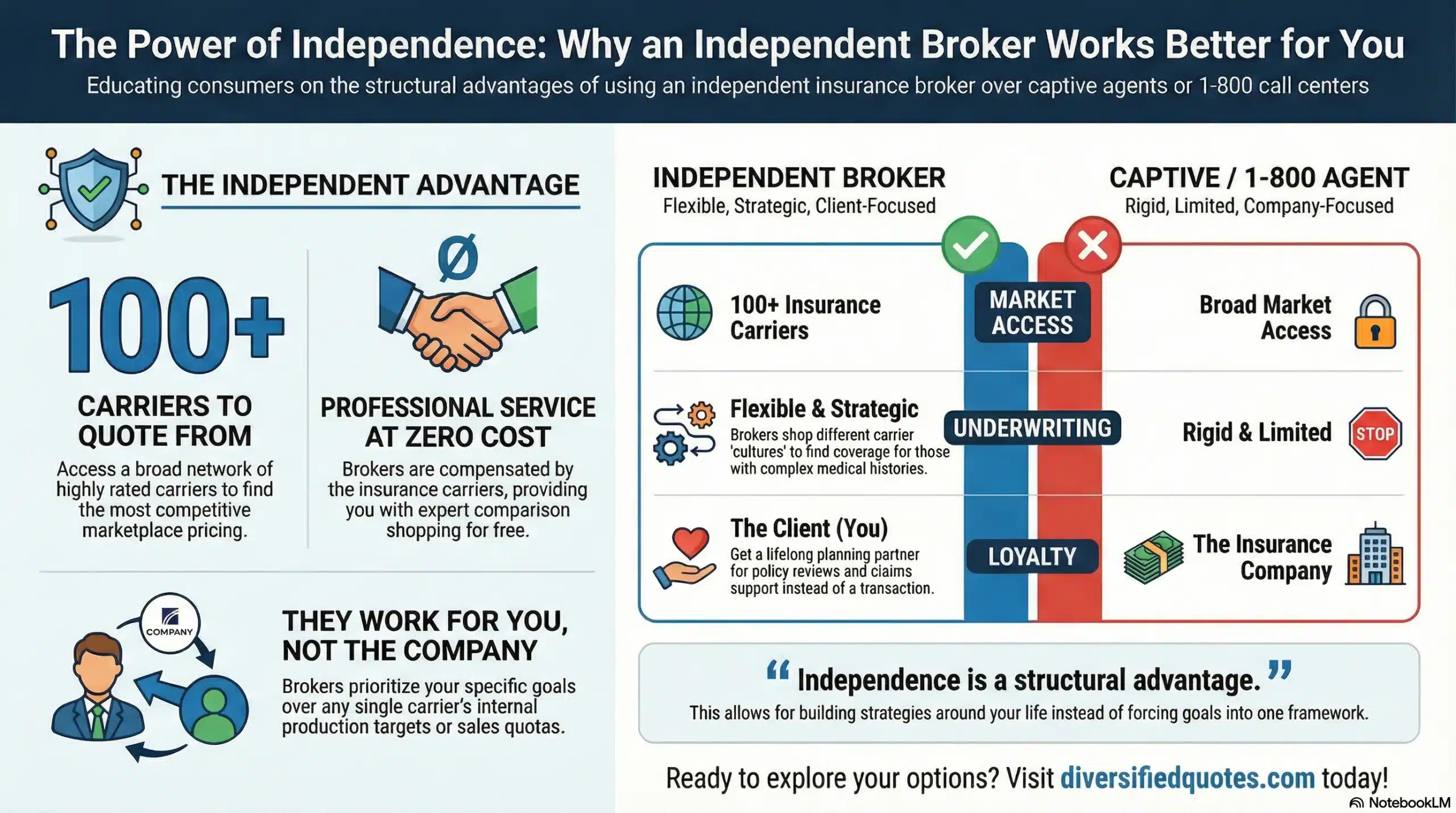
Talk With an Advisor Today
Choose how you’d like to connect—call or message us, then book a time that works for you.
Schedule here:
calendly.com/jason-dibcompanies/diversified-quotes
Licensed in all 50 states • Fiduciary, family-owned since 1980
FAQs: Gerber Life Accidental Death Insurance
Can accidental death insurance replace my regular life insurance policy?
No — accidental death insurance is a supplemental product designed to work alongside comprehensive life insurance, not to replace it. The fundamental limitation of accidental death coverage is that it only pays when death is directly caused by a covered accident. The majority of deaths — from cancer, heart disease, stroke, organ failure, respiratory illness, and other natural causes — do not qualify as covered accidental deaths and will produce no benefit from an accidental death policy. A family that relies on accidental death insurance as its only life insurance protection has covered only a minority of the actual mortality risk the breadwinner faces and has left the primary cause of death entirely unprotected.
Comprehensive term or permanent life insurance pays the full death benefit for death from virtually any cause — illness, accident, or otherwise — which is why it serves as the foundation of any sound life insurance plan. Accidental death insurance adds affordable supplemental coverage specifically for the accident scenario on top of that foundation, increasing the total benefit available to beneficiaries if death results from an accident without requiring the full premium of additional comprehensive coverage. The appropriate sequence is always to establish adequate comprehensive coverage first, then evaluate whether supplemental accidental death coverage adds meaningful value within the available budget. Purchasing accidental death coverage as a substitute for comprehensive coverage leaves a protection gap that will not be visible until the claim is filed for an illness-related death that produces no benefit.
What specifically is excluded from Gerber Life Accidental Death coverage?
While specific policy exclusions should always be confirmed in the actual policy document, standard exclusions in accidental death insurance products across the market include: death from illness, disease, or natural causes of any kind; death from suicide or intentional self-inflicted injury; death from drug or alcohol overdose; death from operating a vehicle while under the influence of alcohol or controlled substances; death from war or act of war; and death from high-risk recreational activities specifically excluded by the policy, such as skydiving, bungee jumping, or professional racing.
An important practical nuance: the accident must be the direct and proximate cause of death, and death generally must occur within a defined timeframe after the accident — often 90 days — for the claim to be eligible. A death that occurs from complications of an underlying illness that was worsened by an accident, or from a medical condition that preceded the accident, may not qualify as a covered accidental death even if the accident was a contributing factor. Policy language is specific and claims are evaluated against that language, not against the general expectation that the accident was involved. Reading the specific policy’s exclusions and coverage definitions before purchasing — and asking the insurance agent to clarify any ambiguous scenarios — is the most effective way to understand exactly what is and is not covered under the specific policy being considered.
Does the Gerber Life Accidental Death policy also cover injuries that don’t result in death?
Yes — in addition to the accidental death benefit, the Gerber Life policy may provide benefits for qualifying disabling injuries such as loss of a limb or loss of eyesight, depending on the specific provisions of the policy. This dismemberment component extends the product’s financial protection function beyond the death scenario to serious injury situations that create financial hardship during recovery — addressing both the medical cost dimension and the income disruption that a severe accidental injury can produce even when the insured survives.
Dismemberment benefits are typically paid on a schedule — a defined percentage of the face amount for specific covered injuries — rather than as the full face amount. Loss of two or more limbs or both eyes generally triggers the full benefit; loss of one limb or one eye triggers a defined partial benefit. The specific schedule should be reviewed in the actual policy document, as the benefit percentages for different injury categories vary across products and carriers. The dismemberment benefit is one reason the product is sometimes described as accidental death and dismemberment (AD&D) coverage even when marketed primarily around the death benefit — the injury component provides meaningful financial protection in the substantial number of serious accident cases where the insured survives but faces permanent disability or significant recovery costs. Gerber Life Accident Protection is a separate, complementary product that more broadly addresses accident-related injury costs during the recovery period beyond the specific dismemberment structure of the accidental death policy.
I was declined for regular life insurance due to health reasons — is accidental death coverage a good alternative?
Accidental death coverage provides some meaningful protection for individuals who cannot qualify for comprehensive life insurance underwriting — specifically covering the accident scenario that would not be addressed by guaranteed issue burial insurance with a two-year waiting period, since accidental death coverage typically pays the full benefit from day one for covered accidental deaths. For an individual whose only other option is a guaranteed issue burial policy with a two-year waiting period for illness-related deaths, the accidental death policy adds immediate accident-specific coverage that the burial policy does not provide during the graded benefit period.
However, accidental death coverage is not a complete solution for an individual with significant protection needs who has been declined for comprehensive coverage. The health conditions that lead to life insurance decline are often the same conditions that increase mortality risk — and those conditions are specifically excluded from accidental death coverage because they represent illness-related mortality rather than accident-related mortality. An individual with a serious health condition who holds only accidental death coverage has addressed the least likely cause of their death while leaving the most likely cause entirely unprotected. The more productive approach is to work with an independent broker who has access to the full impaired risk and simplified issue life insurance market to identify whether any comprehensive coverage is available for the specific health condition involved — many individuals who believe they cannot qualify for any life insurance have not gone through the full impaired risk market comparison that could reveal available options. Diversified Insurance Brokers specializes in this market access and can identify coverage options that a single-carrier or direct-to-consumer search would not reveal.
Does accidental death coverage apply if I’m traveling outside the United States?
Yes — the Gerber Life Accidental Death policy provides worldwide coverage, 24 hours a day. Whether the covered accident occurs in the United States, while traveling domestically, or while abroad, the policy applies as long as the death results from a covered accidental cause within the policy’s terms. There is no geographic limitation that restricts coverage to domestic accidents or U.S.-based incidents.
The worldwide coverage feature is specifically relevant for frequent travelers — individuals who travel internationally for business or personal reasons and who face elevated accident exposure through transit, unfamiliar environments, and transportation modes with different safety profiles than domestic travel. For these individuals, the assurance that accidental death coverage follows them globally rather than applying only while in the U.S. is a meaningful feature of the product. War exclusions — which are standard across the accidental death insurance category — remain in effect worldwide, meaning deaths resulting from war or acts of war in any country are not covered regardless of the circumstances. As with any coverage, the specific policy document governs what qualifies as a covered accident in any given scenario, and the worldwide coverage is subject to the same covered-cause definitions and exclusions that apply domestically.
Is accidental death insurance the same as the accidental death rider on a life insurance policy?
They serve the same coverage function but are structured differently. An accidental death rider is an add-on provision attached to an existing comprehensive life insurance policy — when the insured dies from a covered accident, the rider pays an additional benefit on top of the base policy’s death benefit, effectively doubling the payout (hence “double indemnity” as a common informal term). The accidental death rider is priced as an addition to the existing policy’s premium and does not exist independently — it requires the base comprehensive life insurance policy to be in force.
A standalone accidental death policy like the Gerber Life product operates independently — it does not require an existing life insurance policy and pays the defined benefit entirely on its own if the covered accident claim is filed. The standalone product is appropriate when the buyer does not have an existing life insurance policy to which a rider can be attached, when the existing policy does not offer an accidental death rider, or when the buyer wants accidental death coverage through a different carrier than their existing life insurance carrier. The cost comparison between an accidental death rider on an existing policy versus a standalone product from Gerber Life is worth evaluating before purchasing, since the rider may be less expensive per dollar of coverage within the context of an existing policy’s economics than a standalone product purchased separately. An independent broker review of both options provides the comparison needed to identify the more cost-efficient path to the same accidental death protection.
About the Author:
Jason Stolz, CLTC, CRPC, DIA, CAA and Chief Underwriter at Diversified Insurance Brokers (NPN 20471358), is a senior insurance and retirement professional with more than 25 years of real-world experience helping individuals, families, and business owners protect their income, assets, and long-term financial stability. As a long-time partner of the nationally licensed independent agency Diversified Insurance Brokers, Jason provides trusted guidance across multiple specialties—including fixed and indexed annuities, long-term care planning, personal and business disability insurance, life insurance solutions, Group Health, Travel Medical and Evacuation Insurance, and short-term health coverage. Diversified Insurance Brokers maintains active contracts with over 100 highly rated insurance carriers, ensuring clients have access to a broad and competitive marketplace.
His practical, education-first approach has earned recognition in publications such as VoyageATL, and contributions from his agency featured in Kiplinger and GoBankingRates— highlighting his commitment to financial clarity and client-focused planning. Drawing on deep product knowledge and years of hands-on field experience, Jason helps clients evaluate carriers, compare strategies, and build retirement and protection plans that are both secure and cost-efficient. Visitors who want to explore current annuity rates and compare options across multiple insurers can also use this annuity quote and comparison tool.
Browse More Resources: Return to our complete Supplemental, Hospital Indemnity & Critical Illness guide — covering hospital indemnity, accident insurance & critical illness coverage.
Last Reviewed: June 9, 2026 |
Reviewed by: Jason Stolz, CLTC, CRPC, DIA, CAA
Chief Underwriter, Diversified Insurance Brokers, Inc. | NPN: 20471358 | Diversified Insurance Brokers, Inc. — Licensed in all 50 states
Fact Checked by: Tonia Pettitt, CMIP©
Medicare Specialist, Diversified Insurance Brokers, Inc. | NPN: 14374308 | Diversified Insurance Brokers, Inc. — Licensed in all 50 states
Did you find this content helpful? Leave us a Google review — it helps others find trustworthy guidance too.
Editorial Standards: Diversified Insurance Brokers maintains rigorous editorial standards to ensure accuracy, clarity, and independence in all content. Learn more about our editorial standards and commitment to transparency.
