
Maximize Social Security Benefits
Maximize Social Security Benefits

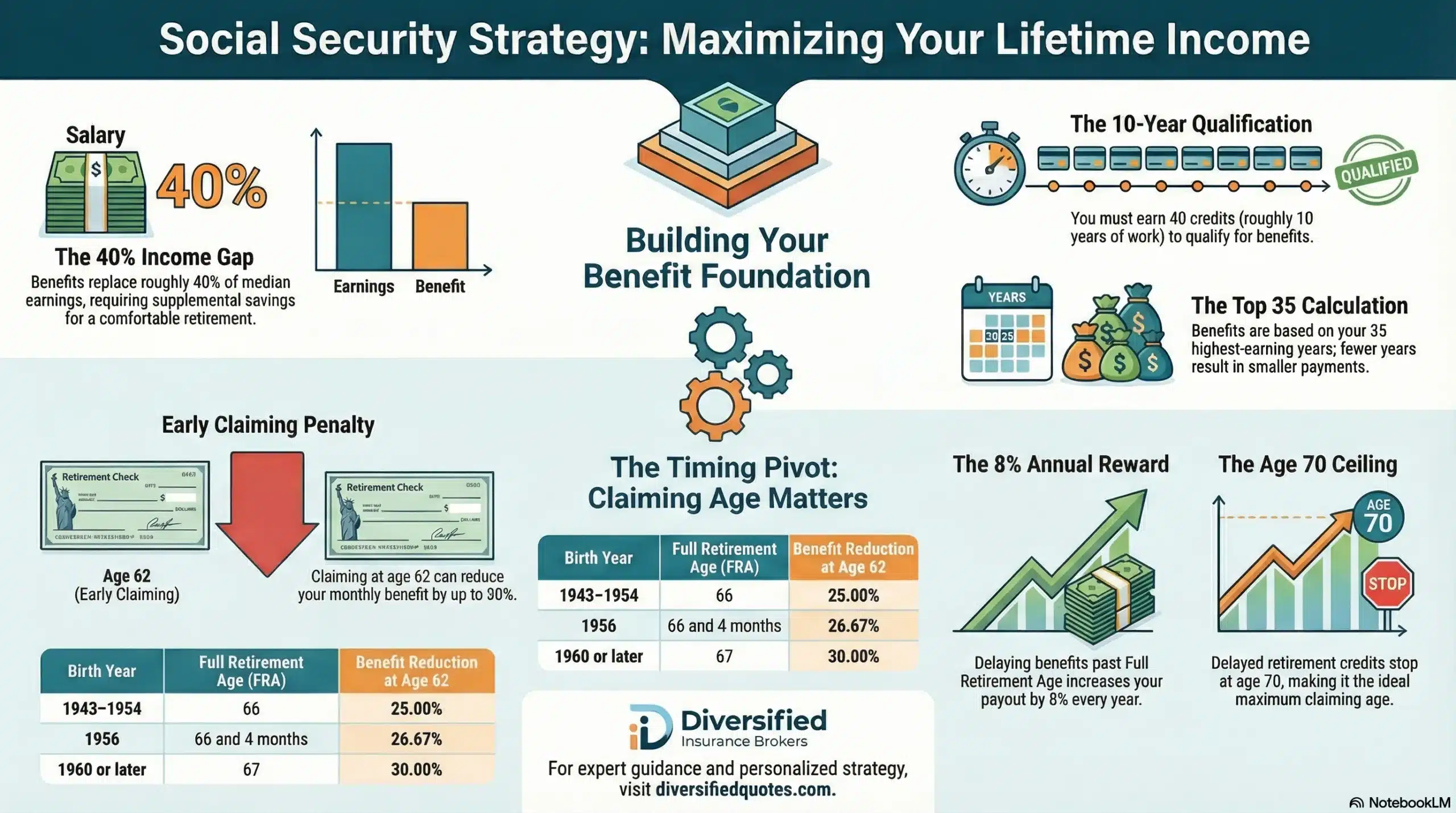
Maximizing Social Security benefits is one of the highest-leverage financial decisions available to households approaching retirement — and one of the most misunderstood. The decision window runs from age 62 to age 70, and the choices made within that window permanently shape the monthly benefit, the spousal protection structure, and the survivor income that may support the longer-living spouse for decades. A benefit claimed at 62 is permanently reduced compared to the benefit available at f, and the FRA benefit is permanently lower than the benefit available at 70. For those born in 1960 or later, FRA is now 67 — the final step in the decades-long scheduled increase from age 65 — and the maximum monthly benefit in 2026 for someone claiming at 70 who consistently earned at or above the taxable wage base reaches $5,181 per month, compared to $2,969 for claiming at 62. That $2,212 monthly difference compounds over a long retirement, is adjusted annually by COLA, and — critically — is the benefit that the surviving spouse may live on for many years after the first death. The 2026 COLA is 2.8%, bringing the average monthly benefit to approximately $2,071, a $56/month increase from 2025. Our resource on Social Security services covers the full Social Security planning framework, and our resource on Social Security advice provides the strategic starting point for households evaluating their complete set of claiming options.
The Social Security landscape changed significantly with the January 5, 2025 signing of the Social Security Fairness Act, which permanently eliminated both the Government Pension Offset (GPO) and the Windfall Elimination Provision (WEP). For approximately 3.2 million former public sector workers — teachers, police officers, firefighters, and state and local government employees — the maximization conversation now includes Social Security spousal and survivor benefits that were previously reduced to zero or near-zero. These workers should entirely recalculate their claiming strategy, as the income available to them — and the household’s survivor income structure — changed fundamentally with the repeal. Our resource on government pension offset explained covers the GPO repeal in detail, and our resource on windfall elimination provision guide covers the WEP repeal — both of which affect how public sector workers should approach the maximization conversation today versus before January 2024.
The word “maximize” in Social Security planning does not mean a single universal answer. It means designing the strongest lifetime household outcome when longevity, spousal needs, survivor protection, work plans, taxes, Medicare timing, and retirement income sequencing are all considered together. A strategy that produces the highest gross monthly check is not always the strategy that produces the highest net after-tax, after-Medicare income. A strategy that maximizes the individual’s check is not always the strategy that protects the household best if one spouse dies early. At Diversified Insurance Brokers, we model multiple claiming paths side by side — breaking down each scenario through the lens of survivor income, taxes, Medicare premiums, and portfolio withdrawal coordination — so every household can make a fully informed decision rather than following a generic rule. Our resource on how to not run out of money in retirement covers the longevity planning framework that makes Social Security optimization such a high-priority planning decision.
Ensure you are receiving the absolute top rates
Current Fixed Annuity Rates
Compare today’s best fixed annuity rates from top carriers.
Current Bonus Annuity Rates
See which annuities offer the highest upfront bonus today.
Request an Annuity Quote
Submit our annuity request form to get personalized rate options.
Lifetime Income Calculator
Use our calculator to see how much guaranteed income your annuity can provide alongside Social Security.
Schedule a Personalized Social Security Strategy Review
We compare claiming ages, model survivor outcomes, coordinate with Medicare and taxes, and show you the after-net result for each scenario.
Schedule an AppointmentClaiming Age Decision Framework — What Changes at 62, FRA, and 70
Every Social Security retirement benefit is defined relative to your Primary Insurance Amount (PIA) — the benefit you have earned at Full Retirement Age. Claiming before FRA permanently reduces that benefit; claiming after FRA permanently increases it through Delayed Retirement Credits. The table below maps the key variables that change at each major claiming age.
| Variable | Claiming at 62 (Earliest) | Claiming at FRA (Age 66–67 by Birth Year) | Claiming at 70 (Maximum) |
|---|---|---|---|
| Benefit amount vs. PIA | Permanently reduced — 25-30% below PIA depending on exact birth year; born 1960+: 30% reduction | 100% of PIA — the earned baseline benefit; no reduction, no increase for the FRA-specific month | 132% of PIA for those with FRA of 67 — 8% per year × 4 years of Delayed Retirement Credits beyond FRA |
| Maximum monthly benefit in 2026 | $2,969/month | $4,152/month | $5,181/month (up to $5,251 for max wage base earners) |
| Spousal benefit reduction | Spousal benefit also reduced — born 1960+: 35% reduction from maximum spousal benefit if claimed at 62 | Full spousal benefit available — up to 50% of spouse’s PIA; not increased by spouse delaying past FRA | No spousal benefit increase for delaying past FRA — spousal benefit is capped at 50% of spouse’s PIA regardless of how long you wait |
| Earnings limit applies? | Yes — $24,480 in 2026; $1 withheld per $2 earned over the limit (withheld benefits are eventually added back through benefit recalculation after FRA) | In the year you reach FRA: $65,160 limit; $1 withheld per $3 earned over limit until the month of reaching FRA; after FRA: no limit | No earnings limit — you can earn any amount without benefit reduction or withholding after reaching FRA |
| Survivor benefit impact | Permanently reduced — surviving spouse receives the lower benefit the deceased claimed, which was 30% below FRA benefit; this reduction persists for the survivor’s lifetime | Survivor receives 100% of FRA benefit; not the full DRC-enhanced amount if the higher earner claimed exactly at FRA rather than delaying | Surviving spouse receives the full DRC-enhanced benefit — up to 132% of the deceased spouse’s PIA; the single most powerful reason for the higher earner to delay |
| COLA compounding base | COLA applies to the permanently reduced amount — the lower base grows by the same percentage annually but from a smaller starting point, creating a compounding gap vs. delayed claiming | COLA applies to 100% of PIA | COLA applies to 132% of PIA — the combination of the DRC premium plus COLA compounding makes the later-life income gap between claiming ages very large |
| Best planning fit | Household needs income immediately; health factors suggest shorter retirement; portfolio bridge to 70 is not feasible; lower earner in a couple claiming early to begin household income while higher earner delays | Balanced approach when bridge income is available but full delay to 70 is not the priority; often the right answer for the lower earner in a couple when the household has other income sources | Higher earner in a couple maximizing survivor protection; individuals with longevity advantage (family history, good health); households with other bridge income; those wanting the strongest inflation-adjusted income base in late retirement |
Maximum monthly benefit figures reflect levels for workers who earned at or above the Social Security taxable wage base for 35 or more years. Average benefits for most retirees are significantly lower. COLA adjusts all benefit amounts annually. FRA is 67 for those born 1960 or later. All benefit amounts are subject to future legislative changes.
Full Retirement Age — The Baseline Every Other Decision References
Full Retirement Age is the foundational reference point for every Social Security benefit calculation. Your PIA — the standard benefit you earned through your work history — is payable in full at FRA and only at FRA. Every other claiming age is defined as a discount below FRA (if claiming early) or a premium above it (if claiming late through Delayed Retirement Credits). For those born in 1959, FRA is 66 years and 10 months. For those born in 1960 or later, FRA is 67 — the final step in the scheduled increase that began with the 1983 Social Security amendments. The FRA increase for 1960+ birthyears is the reason that claiming at 62 now reduces benefits by 30% rather than the smaller reductions that applied to earlier birth cohorts. Understanding your specific FRA — not a generalized approximation — matters because the precise month you reach FRA determines when earnings limits expire, when DRCs accumulate, and when survivor benefit rules change. Our resource on delayed retirement credits covers the exact DRC accumulation mechanics in detail.
Delayed Retirement Credits — The 8% Per Year Value Proposition
Delayed Retirement Credits accumulate at a rate of 8% per year (2/3 of 1% per month) for each year you delay claiming past FRA, up to age 70. For someone with a FRA of 67, delaying to 70 adds exactly 24% in DRCs (3 years × 8%) to the FRA benefit — bringing the total benefit to 132% of PIA. Credits stop accumulating at age 70: there is no benefit to waiting beyond 70. The DRC is not a temporary premium that decays — it is a permanent increase to the base benefit, which then receives all future COLA adjustments applied to the higher amount. This compounding structure makes the benefit divergence between claiming at 62 and claiming at 70 very large over a long retirement. A retiree claiming at 62 with a $1,500/month benefit versus claiming at 70 with $2,600/month ($1,100 monthly difference) experiences over $13,000 per year of income difference — and that difference grows each year COLA is applied to the higher base. The DRC strategy is most powerful when it strengthens the survivor benefit. Our resource on Social Security annual recomputation covers how continued work earnings can further increase the benefit through the SSA’s annual earnings recomputation process, which can add incrementally to benefits even after claiming begins.
Couples — Coordination That Protects a Spouse
Household optimization is where Social Security strategy creates its largest returns. A couple does not have two independent Social Security decisions — they have one interdependent household income structure that must be designed together. The most important dimension of that design is survivor protection: when one spouse dies, one Social Security check stops. The surviving spouse receives the higher of the two benefit amounts, not both. This means the higher earner’s benefit — the one that will likely become the survivor benefit — is the one that most deserves careful timing. Delaying the higher earner’s benefit to 70 produces a 32% higher monthly amount (for FRA of 67) that the surviving spouse may rely on for decades. This is often the single most effective survivor income strategy available in retirement planning. The lower earner, meanwhile, might claim earlier — at FRA or even earlier — to begin household income while the higher earner’s benefit continues to accumulate DRCs. Our resource on divorced spousal benefits timing covers the timing rules for divorced spouses who may qualify for benefits on an ex-spouse’s record — a scenario where household optimization involves a different set of rules but the same fundamental need for careful coordination. For self-employed spouses whose income varies and creates irregular earnings test exposure, our resource on Social Security benefits for self-employed covers the specific rules that apply.
Working While Collecting — Earnings Limits and What Actually Happens
Working while collecting Social Security before FRA creates a specific financial mechanic that many retirees do not fully understand: benefits are withheld, not permanently lost. In 2026, the earnings limit for those claiming before FRA is $24,480 — the SSA withholds $1 for every $2 earned above this threshold. In the year you reach FRA, the limit increases to $65,160 with a less punitive $1-per-$3 withholding rate until the specific month of reaching FRA. After reaching FRA for the full year, the earnings limit disappears entirely — you can earn any amount without any benefit withholding. The withheld benefits are not lost permanently: the SSA recalculates your benefit after FRA to credit back the months when benefits were withheld, resulting in a higher monthly benefit than you would have had without the withholding. However, that recalculation is prospective and takes time to recover, so understanding the net income math before claiming early and working is essential. Our resource on earnings test after FRA covers the post-FRA work rules, and our resource on does working past 65 affect Social Security benefits covers the full work-and-claim interaction. Our resource on Social Security income limits provides the specific current limits and the calculation methodology.
Taxes — Why Net Benefit Matters More Than Gross
Up to 85% of Social Security benefits can be taxable when combined income — adjusted gross income plus nontaxable interest plus half of Social Security — exceeds $44,000 for married couples filing jointly, or $34,000 for individuals. This threshold does not adjust for inflation, which means more retirees are affected each year as incomes rise while the threshold stays fixed. The implication for Social Security maximization is significant: the “biggest gross benefit” can sometimes produce a higher taxable income burden than a carefully coordinated alternative. Sequencing retirement account withdrawals before Social Security begins — reducing future RMD-driven income that will coincide with Social Security — is a strategy many households can use to manage the combined income that determines Social Security’s taxable portion. Our resource on is Social Security taxable covers the full taxation framework and the income thresholds in detail, our resource on reduce taxes on Social Security covers practical reduction strategies, and our resource on how to minimize Social Security taxes covers complementary approaches including Roth conversion timing before Social Security begins. Our resource on Roth conversions covers the specific mechanics of converting traditional IRA assets to Roth in the years before Social Security begins — a window that can meaningfully reduce future RMD income and lower the combined income that makes Social Security taxable. Our resource on required minimum distributions covers how RMD income interacts with Social Security taxation in the years after 73.
Social Security Fairness Act — A New Landscape for Public Sector Workers
The January 2025 repeal of the Government Pension Offset and Windfall Elimination Provision fundamentally changed the Social Security maximization conversation for millions of former public employees. Teachers, police officers, firefighters, and state and local government workers who previously received no Social Security spousal or survivor benefit due to GPO — or a reduced own-worker benefit due to WEP — are now entitled to full benefits. For these workers, the entire maximization framework must be recalculated from scratch. The survivor benefit strategies, spousal benefit timing, and break-even analyses built around zero or minimal Social Security are no longer accurate. Many of these workers should now apply for Social Security if they have not, and those already receiving benefits should verify that the SSA has recalculated their monthly amount correctly. Our resource on government pension offset explained covers the repeal and what affected workers should do now, and our resource on windfall elimination provision guide covers the WEP repeal and its implications for own-worker benefit restoration.
Medicare Timing — The Hidden Variable in Net Benefit Calculations
Medicare Part B premiums are deducted directly from Social Security checks for most beneficiaries, which means the net monthly cash flow from Social Security — what actually arrives in your bank account — depends heavily on Medicare premium levels. The 2026 Part B standard premium is $201.96/month, up from $185 in 2025 — a 9.6% increase that partially offset the 2.8% COLA for many beneficiaries. Higher-income beneficiaries pay additional IRMAA surcharges on top of the standard premium: those with incomes above approximately $106,000 (individual) or $212,000 (married couple) pay significantly higher Part B and Part D premiums. Because IRMAA is based on income from two years prior, the income generated in the years immediately before Medicare enrollment affects premiums for the first years of Medicare coverage. A Social Security optimization plan that ignores Medicare premium implications can produce a gross benefit that looks strong but a net benefit that is significantly weaker. Our resource on how Medicare and Social Security work together covers the coordination of these two systems, our resource on Medicare services covers the full Medicare planning landscape, and our resource on Medicare calculator provides a premium modeling tool for the Medicare cost-sharing dimension of retirement income planning.
Integrating Social Security With Withdrawals and Guaranteed Income
Social Security works best as an income floor — the reliable, inflation-adjusted base that covers essential expenses regardless of what markets do. The strongest retirement income plans layer Social Security alongside other guaranteed income sources so the household has predictable coverage for fixed costs without requiring portfolio withdrawals in down markets. Annuity income serves this role for many households: a fixed or fixed-indexed annuity provides a guaranteed monthly payment that, combined with Social Security, covers essential expenses and reduces the pressure on invested assets to generate current income in volatile years. Our resource on guaranteed income from annuities covers how annuity income layers with Social Security in the income floor, our resource on annuities hub covers the full annuity landscape, and our resource on pension alternative covers strategies for households building pension-like income security without a traditional pension. The sequencing of retirement account withdrawals before, during, and after Social Security begins also affects the portfolio’s longevity. Our resource on retirement annuity calculator provides a tool for modeling how guaranteed income options interact with Social Security timing. Our resource on get a 2nd opinion on your annuity quote covers the review process for beneficiaries evaluating existing annuity products in the context of an updated Social Security strategy.
Schedule A Free Consultation
FAQs: Maximize Social Security Benefits
What does it mean to maximize Social Security benefits?
Maximizing Social Security benefits means designing the claiming strategy that produces the strongest lifetime household income outcome — not simply the largest monthly check at any given age. It requires considering longevity, spousal needs, survivor protection, work plans, taxes, Medicare premium impacts, and the sequencing of retirement account withdrawals. A plan that produces the highest gross monthly benefit is not always the plan that produces the highest net after-tax, after-Medicare income. A plan that maximizes the individual’s check is not always the plan that protects the household’s income when one spouse dies. The goal is the best total household outcome over a complete retirement.
How much more do I get for waiting to age 70 versus FRA?
Delayed Retirement Credits accumulate at 8% per year (2/3 of 1% per month) for each year you delay past Full Retirement Age, up to age 70. For someone with a FRA of 67, waiting to 70 adds exactly 32% to the FRA benefit — bringing total benefits to 132% of your PIA. Credits stop at 70; there is no advantage to waiting beyond that age. In 2026, the maximum monthly benefit at FRA is $4,152, while the maximum at 70 reaches $5,181 — a $1,029/month difference that also receives COLA adjustments each year on the higher base, compounding the long-term advantage of delay.
Should both spouses delay claiming to age 70?
Not necessarily — household optimization typically does not require both spouses to delay to 70. The higher earner delaying to 70 typically produces the strongest household result because that benefit often becomes the survivor benefit when the first spouse dies. The lower earner may reasonably claim at FRA or even earlier — providing household income while the higher earner’s benefit accumulates Delayed Retirement Credits. The optimal approach depends on each spouse’s age, health, income needs, and other retirement resources. The key principle: prioritize the higher earner’s delay because it strengthens both the household benefit in the years when both are alive and the survivor benefit for the longer-living spouse.
Does claiming early permanently reduce my benefit?
Yes — claiming before FRA permanently reduces the monthly benefit for the rest of your life. For those born in 1960 or later (FRA of 67), claiming at 62 reduces the benefit by 30%. The spousal benefit is reduced by 35%. These reductions are applied to the PIA and remain in effect permanently, including the base from which all future COLA increases are calculated. If you claim early and continue working, the SSA withholds benefits above the earnings limit, but those withheld amounts are credited back after FRA through a benefit recalculation — the early claiming reduction itself is never reversed.
I’m a teacher or government worker — how does the Social Security Fairness Act affect my strategy?
Significantly. The Social Security Fairness Act, signed January 5, 2025, permanently repealed both the Government Pension Offset (GPO) and the Windfall Elimination Provision (WEP), effective retroactively to January 2024. If you were previously receiving reduced or zero Social Security spousal or survivor benefits due to GPO, your benefit has been restored. If your own worker benefit was reduced by WEP, that reduction is gone. If you never applied for Social Security because GPO would have eliminated the benefit entirely, you must apply now — the SSA cannot automatically pay a benefit that was never applied for. Your entire Social Security maximization strategy should be recalculated in light of the restored benefits.
Can working after claiming Social Security affect my benefit?
Yes, in two ways. First, if you claim before FRA and continue working, the earnings limit ($24,480 in 2026 for those under FRA all year) can trigger benefit withholding — $1 withheld per $2 earned over the limit. Those withheld amounts are credited back through recalculation after FRA. Second, if your current earnings are higher than any of the 35 years used in your benefit calculation, the SSA’s annual earnings recomputation may increase your benefit going forward. After reaching FRA for the full year, there is no earnings limit — you can earn any amount without benefit reduction or withholding.
About the Author:
Jason Stolz, CLTC, CRPC, DIA, CAA and Chief Underwriter at Diversified Insurance Brokers (NPN 20471358), is a senior insurance and retirement professional with more than 25 years of real-world experience helping individuals, families, and business owners protect their income, assets, and long-term financial stability. As a long-time partner of the nationally licensed independent agency Diversified Insurance Brokers, Jason provides trusted guidance across multiple specialties—including fixed and indexed annuities, long-term care planning, personal and business disability insurance, life insurance solutions, Group Health, Travel Medical and Evacuation Insurance, and short-term health coverage. Diversified Insurance Brokers maintains active contracts with over 100 highly rated insurance carriers, ensuring clients have access to a broad and competitive marketplace.
His practical, education-first approach has earned recognition in publications such as VoyageATL, and contributions from his agency featured in Kiplinger and GoBankingRates— highlighting his commitment to financial clarity and client-focused planning. Drawing on deep product knowledge and years of hands-on field experience, Jason helps clients evaluate carriers, compare strategies, and build retirement and protection plans that are both secure and cost-efficient. Visitors who want to explore current annuity rates and compare options across multiple insurers can also use this annuity quote and comparison tool.
Explore All Social Security Planning Guides: Browse our complete Social Security Planning guide — covering filing strategies, spousal benefits, survivor benefits, taxes, WEP, GPO & more.
Last Reviewed: June 5, 2026 |
Reviewed by: Jason Stolz, CLTC, CRPC, DIA, CAA
Chief Underwriter, Diversified Insurance Brokers, Inc. | NPN: 20471358 | Diversified Insurance Brokers, Inc. — Licensed in all 50 states
Fact Checked by: Tonia Pettitt, CMIP©
Medicare Specialist, Diversified Insurance Brokers, Inc. | NPN: 14374308 | Diversified Insurance Brokers, Inc. — Licensed in all 50 states
Did you find this content helpful? Leave us a Google review — it helps others find trustworthy guidance too.
Editorial Standards: Diversified Insurance Brokers maintains rigorous editorial standards to ensure accuracy, clarity, and independence in all content. Learn more about our editorial standards and commitment to transparency.
