
Social Security Filing Checklist
Social Security Filing Checklist

A Social Security filing checklist is the practical tool that separates retirees who make confident, informed filing decisions from those who discover too late that a timing choice, a missed spousal opportunity, or an overlooked earnings limit has permanently reduced their monthly income. The Social Security filing checklist matters because Social Security applications are not simple forms — they are lifetime decisions. The month you choose to begin benefits, the benefit type you file for, whether you account for spousal sequencing and survivor implications, and how your filing interacts with taxes, earnings, and Medicare enrollment all determine an income stream that may pay for twenty to thirty years. Getting the filing sequence right from the beginning produces permanently better outcomes than attempting corrections after the first check arrives.
At Diversified Insurance Brokers, Jason Stolz, CLTC, CRPC helps pre-retirees and retirees use the Social Security filing checklist as the foundation of a coordinated retirement income plan — not just a paperwork exercise. This page provides a complete Social Security filing checklist covering pre-filing preparation, documents, the Full Retirement Age framework, step-by-step filing sequence, spousal and survivor considerations, income limits, tax coordination, Medicare timing, and what to monitor after benefits begin. Our resource on when should you start taking Social Security benefits covers the timing decision that anchors the entire checklist, and our resource on maximize Social Security benefits covers the lifetime optimization framework that the filing checklist supports.
Get a Personalized Social Security Filing Plan
We review your earnings record, confirm spousal and survivor eligibility, model claiming ages from 62 through 70, and identify the filing month and sequence that best supports your household’s lifetime income.
Explore Social Security Planning ServicesFull Retirement Age by Birth Year — The Anchor of Every Social Security Filing Checklist
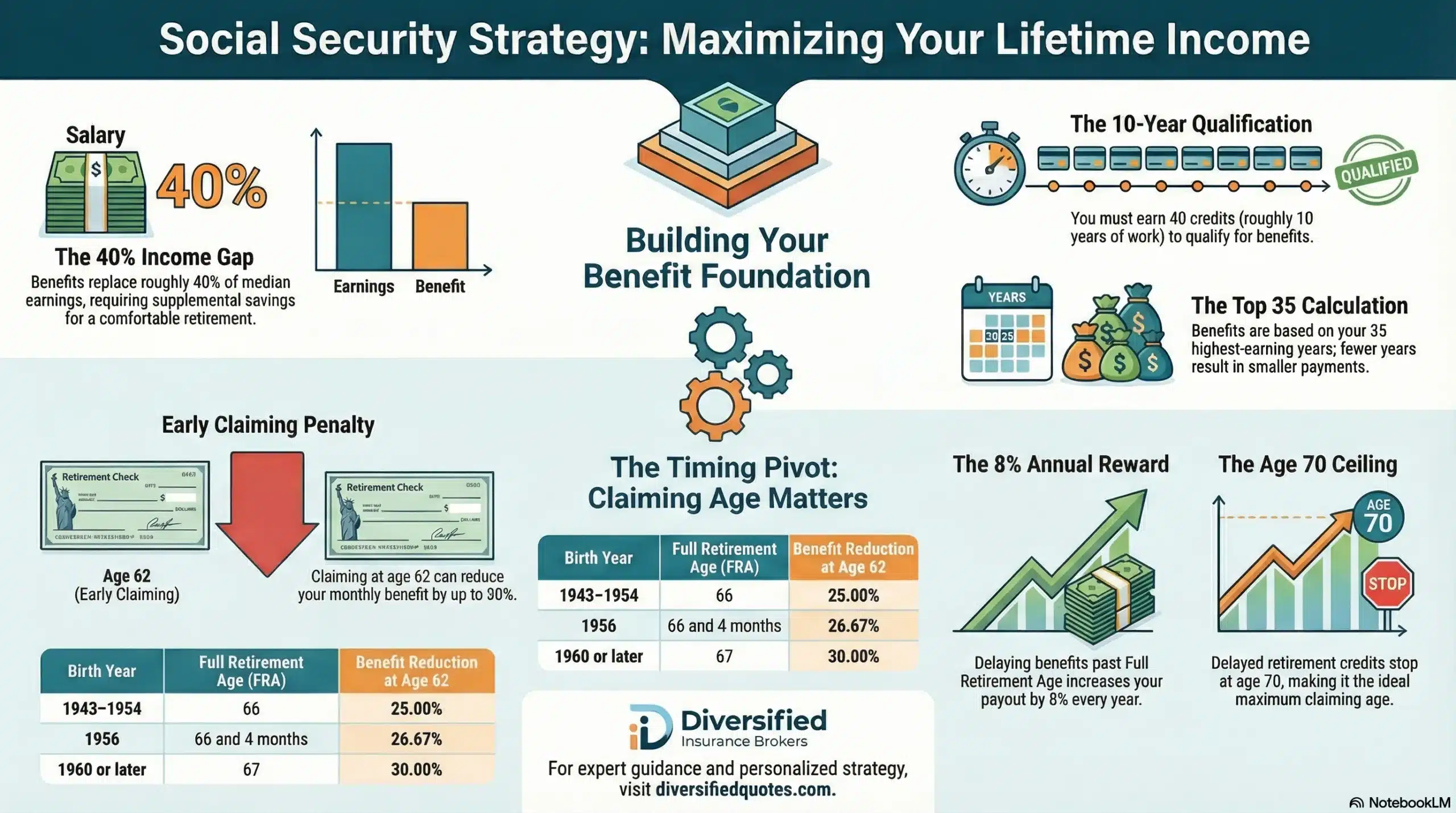
The most foundational fact in any Social Security filing checklist is your Full Retirement Age — the age at which you receive 100% of your Primary Insurance Amount without reduction. FRA is not universal: it depends on the year you were born, and it directly determines how early claiming reduces benefits and how late claiming increases them. Every other decision in the Social Security filing checklist — whether to claim at 62, at FRA, or later; how much a spousal benefit will be; what the survivor benefit maximum is — anchors to FRA as its reference point.
| Birth Year | Full Retirement Age (FRA) | Benefit % if Claimed at 62 | Benefit % if Claimed at 70 | Maximum Delayed Credit Beyond FRA |
|---|---|---|---|---|
| 1943–1954 | 66 exactly | 75% of FRA benefit | 132% of FRA benefit | 32% (4 years × 8%/year) |
| 1955 | 66 and 2 months | 74.17% | 130.7% | ~30.7% |
| 1956 | 66 and 4 months | 73.33% | 129.3% | ~29.3% |
| 1957 | 66 and 6 months | 72.5% | 128% | 28% |
| 1958 | 66 and 8 months | 71.67% | 126.7% | ~26.7% |
| 1959 | 66 and 10 months | 70.83% | 125.3% | ~25.3% |
| 1960 and later | 67 exactly | 70% of FRA benefit | 124% of FRA benefit | 24% (3 years × 8%/year) |
The table makes the FRA framework concrete for every applicant working through the Social Security filing checklist. Early claiming at 62 produces a permanent monthly reduction — 5/9 of 1% per month for the first 36 months of early claiming (approximately 6.67% per year), and 5/12 of 1% for each additional month beyond 36 months early (5% per year). Delaying past FRA produces a permanent monthly increase through delayed retirement credits of 2/3 of 1% per month (8% per year) through age 70. After age 70, no further delayed credits accumulate — making age 70 the absolute latest the Social Security filing checklist should target for own retirement benefit claiming. Our resource on delayed retirement credits covers the growth mechanics in full, and our resource on delayed retirement credits and payout increases covers the specific monthly benefit amounts at different claiming ages.
Phase 1 of the Social Security Filing Checklist — Before You File
The Social Security filing checklist begins well before the online application is opened. The pre-filing phase is where the most consequential strategic decisions are made — decisions about claiming age, benefit type, household sequencing, and income coordination that will determine monthly income for decades. The pre-filing phase of the Social Security filing checklist has three primary components: verifying the earnings record, establishing the timing strategy, and confirming all benefit types the household is eligible for.
Creating and reviewing your My Social Security account at ssa.gov is the essential first step of any Social Security filing checklist. Your My Social Security account provides your complete earnings history, projected benefit amounts at age 62, FRA, and 70, and your Full Retirement Age. The earnings history review is not a formality — it is a material financial review. Your Social Security benefit is calculated based on your highest 35 years of earnings, indexed for inflation. If years are missing, earnings are underreported, or periods of self-employment were not properly recorded, your lifetime benefit could be lower than it should be. Correcting earnings record errors before filing is straightforward — correcting them after benefits begin is significantly more complex and sometimes requires extensive documentation of income from years past. The Social Security filing checklist item is to review every year in the earnings record and flag any year where reported earnings appear lower than actual W-2 or self-employment income for that year.
Establishing the timing strategy before opening the application form is the second critical pre-filing phase of the Social Security filing checklist. This means explicitly deciding — not defaulting to — a claiming age. The Social Security filing checklist should prompt this question: is your claiming age based on an actual analysis of lifetime income, household cash flow, spousal timing, survivor protection, and health outlook — or is it based on “as soon as I can” or “wait until later sounds better”? The difference between these two approaches can be tens of thousands of dollars in lifetime Social Security income. Our resource on when should you start taking Social Security benefits covers the timing decision framework that should anchor this phase of the checklist.
Confirming all benefit types the household qualifies for is the third pre-filing element of the Social Security filing checklist — and the most commonly overlooked. Many applicants assume they are filing for a single obvious benefit (their own retirement) without evaluating whether spousal, divorced spousal, survivor, or disability-related benefits create different or better options. The Social Security filing checklist should explicitly ask: Am I married and potentially eligible for spousal benefits? Am I widowed and potentially eligible for survivor benefits? Am I divorced with a marriage of 10 or more years and potentially eligible for divorced spousal benefits? Is any disability history relevant to my record or my spouse’s record? Answering these questions before applying prevents the most common and most expensive Social Security filing checklist failure — filing for the first available benefit without knowing that a better option exists.
Phase 2 — The Social Security Filing Checklist Documents
The document preparation phase of the Social Security filing checklist is straightforward once organized into categories. The application can be submitted online at ssa.gov, and while original documents are generally not submitted electronically, having them accessible ensures that every question can be answered accurately — and that any SSA requests for follow-up documentation can be fulfilled quickly rather than causing processing delays.
Core documents that virtually every Social Security filing checklist includes: a government-issued photo ID; your Social Security number (and your spouse’s Social Security number if applicable); proof of age — typically an original birth certificate or certified copy; W-2 forms or self-employment tax returns from the current year and the two prior years; direct deposit banking information including routing number and account number; and, if you have military service that may affect your record, DD-214 or equivalent discharge documentation. If you were not born in the United States, additional citizenship or lawful resident alien documentation may be required.
Spousal, survivor, and divorce-related documents that the Social Security filing checklist should include as applicable: original or certified marriage certificate for spousal or survivor benefit claims; divorce decree(s) for divorced spousal benefit claims — confirming the marriage lasted at least 10 years and that the divorce applicant is not currently married; death certificate(s) for survivor benefit claims; and information about any pension from government or non-covered employment, which may affect benefit calculation through the Windfall Elimination Provision or Government Pension Offset.
For applicants near age 65, the Social Security filing checklist should also include Medicare-related preparation. Medicare enrollment and Social Security filing timelines intersect at age 65, and understanding both before submitting either application prevents coordination errors that result in coverage gaps, premium penalties, or unnecessary financial surprises. Our resource on Medicare calculator provides a starting point for comparing plan options alongside Social Security timing decisions, and our resource on how Medicare and Social Security work together covers the coordination mechanics that belong in any complete Social Security filing checklist.
Phase 3 — The Social Security Filing Sequence, Step by Step
The application execution phase of the Social Security filing checklist is most effective when completed in a deliberate sequence that prevents errors, confirms eligibility at each step, and ensures the correct benefit type and start month are applied for. The most common Social Security filing checklist failures are not paperwork errors — they are sequencing errors: filing for the wrong benefit type, selecting the wrong start month, or applying without having confirmed spousal implications.
Step 1: Confirm the correct benefit type for this application. The Social Security filing checklist should explicitly state whether this application is for your own retirement benefit, spousal benefits, divorced spousal benefits, survivor benefits, or a combination. If your plan involves claiming one benefit type now and switching to another later — a valid and often powerful strategy for married couples and widows — document that sequence clearly before submitting so the current application is consistent with the longer-term plan.
Step 2: Identify the specific month you want benefits to begin. You can apply up to four months before the month you want benefits to start. Your first payment will arrive the month after your chosen start month — Social Security pays one month in arrears. Payment dates are tied to birthday: if your birthday falls on the 1st through 10th, expect the second Wednesday of the month; 11th through 20th, the third Wednesday; 21st through 31st, the fourth Wednesday. Selecting your start month intentionally — rather than accepting whatever the SSA system defaults to — is a meaningful Social Security filing checklist step because the start month affects the first year’s total benefit income and can interact with Medicare enrollment timing and tax planning for the filing year.
Step 3: Confirm whether the earnings test applies. If you plan to claim before your FRA and continue working, the Social Security filing checklist must account for the earnings test. In 2025, the annual earnings limit for those under FRA all year is approximately $23,400 — for every $2 earned above this limit, $1 in benefits is withheld. In the year you reach FRA, a higher limit applies with a less aggressive withholding formula. After FRA, the earnings test no longer applies. Our resource on Social Security income limits covers the 2025 earnings test limits and mechanics, and our resource on earnings test after FRA covers how the rules change when FRA is reached.
Step 4: Review deemed filing rules before submitting if spousal benefits are involved. The deemed filing provision means that when you apply for your own retirement benefit, you are in many cases automatically deemed to have applied for any available spousal benefit as well — and vice versa. You cannot currently selectively file for only spousal benefits while deferring your own in most circumstances (with narrow exceptions based on birth year). Understanding deemed filing rules before submitting ensures the application does what you intend rather than triggering an outcome you didn’t anticipate. Our resource on deemed filing rules for Social Security covers this in detail, and it is a required Social Security filing checklist item for any household with two Social Security-eligible spouses.
Step 5: Submit the application and document the confirmation. After submitting online, save or print the confirmation number, take screenshots of the completed application summary, and retain copies of any uploaded or mailed documents. The Social Security filing checklist post-submission item is to track the status of the application through the My Social Security account, respond promptly to any SSA information requests, and confirm the award letter details when it arrives — verifying the start month, benefit amount, and direct deposit information. Our resource on how to apply for Social Security covers the step-by-step application process.
Phase 4 — Spousal, Divorced, and Survivor Considerations in the Filing Checklist
The Social Security filing checklist for married couples, divorced individuals, and widows or widowers requires explicit attention to benefit sequencing that does not apply to single applicants filing only on their own record. This phase of the Social Security filing checklist is where the most significant lifetime income optimization opportunities exist — and where the most consequential mistakes are made when applicants file without evaluating all available options.
For married households, the Social Security filing checklist should include a joint strategy analysis that considers both spouses’ benefit amounts, FRAs, and likely lifetime income scenarios. The higher earner’s claiming decision affects not just their own monthly check but the survivor benefit the lower-earning spouse will receive if widowed. A higher earner who claims at 70 rather than 62 not only increases their own monthly benefit by approximately 24 to 32% compared to FRA — they potentially create a larger survivor benefit for their partner that may pay for years or decades after the higher earner’s death. The Social Security filing checklist for married couples should explicitly answer: have we modeled the survivor benefit implications of each claiming age, not just the immediate monthly income at each age?
For divorced individuals, the Social Security filing checklist must confirm eligibility for divorced spousal benefits — a benefit many qualified applicants are unaware they can claim. To qualify: the marriage must have lasted at least 10 years, the applicant must currently be unmarried, both parties must be at least 62 years old, and the divorced spousal benefit must be larger than the applicant’s own retirement benefit. Critically, claiming a divorced spousal benefit does not reduce the ex-spouse’s own benefit or any benefits their current spouse may receive. This is often misunderstood — and the misunderstanding prevents some applicants from claiming benefits they are legitimately entitled to. Our resource on divorced spousal benefits timing covers the complete eligibility and timing framework that belongs in the Social Security filing checklist for divorced applicants.
For widows and widowers, the Social Security filing checklist includes one of the most strategically valuable provisions in the entire Social Security system: the ability to claim survivor benefits and own retirement benefits at different times to maximize lifetime income. A widow can claim survivor benefits as early as age 60 (or 50 if disabled) while deferring her own retirement benefit to allow it to accumulate delayed retirement credits through age 70 — or she can claim her own benefit first and switch to the survivor benefit later when it is larger. The optimal sequence depends on the relative amounts of both benefits and the household’s income needs during different life phases. Our resource on strategies for claiming Social Security for widows covers the widow-specific claiming strategies that belong in every Social Security filing checklist for surviving spouses.
Phase 5 — Tax Coordination, IRMAA, and Income Planning in the Filing Checklist
The Social Security filing checklist is incomplete without explicitly addressing how Social Security benefits interact with income taxes and Medicare premium surcharges — because the timing decisions made in the filing checklist directly affect the tax character of the household’s retirement income for years after the first check arrives.
Social Security benefits become partially taxable when the household’s combined income — defined as Adjusted Gross Income plus non-taxable interest plus half of Social Security benefits — exceeds defined thresholds. For single filers, up to 50% of benefits may be taxable when combined income is between $25,000 and $34,000; up to 85% of benefits may be taxable when combined income exceeds $34,000. For married filing jointly, the thresholds are $32,000 to $44,000 for the 50% tier and above $44,000 for the 85% tier. These thresholds are not indexed to inflation and have not changed since the 1980s, meaning a growing number of retirees find that most or all of their Social Security benefits are subject to federal income tax even when their total retirement income is modest. Our resource on how to reduce taxes on Social Security covers the planning strategies for managing the provisional income calculation.
The Social Security filing checklist should also address federal income tax withholding from Social Security benefits. Retirees can elect to have taxes withheld directly from monthly benefit payments at rates of 7%, 10%, 12%, or 22% — eliminating the need to make quarterly estimated tax payments on Social Security income and reducing the likelihood of a tax surprise at filing time. Selecting the appropriate withholding percentage is a Social Security filing checklist item that prevents one of the most common first-year retirement financial surprises.
Medicare IRMAA — the Income-Related Monthly Adjustment Amount that adds surcharges to Medicare Part B and Part D premiums for higher-income beneficiaries — is another Social Security filing checklist consideration for households whose income from all sources (including Social Security) may push them into IRMAA-triggering brackets. Because IRMAA is calculated based on income from two years prior (called the look-back period), the income decisions made now can affect Medicare premiums two years later. Our resource on IRMAA planning strategies covers the surcharge brackets and the planning approaches available for managing IRMAA exposure. Our resource on qualified charitable distributions guide covers the QCD strategy for IRA owners over 70½ that can reduce taxable income and prevent IRMAA bracket escalation.
Work Through Your Social Security Filing Checklist With an Expert
We verify earnings records, confirm spousal and survivor eligibility, model claiming ages from 62 through 70, coordinate Medicare and tax planning, and identify the filing month and sequence that maximizes lifetime household income.
Explore Social Security Planning ServicesComplete Social Security Planning Resources
Explore every dimension of the Social Security filing checklist — timing, spousal strategy, taxes, Medicare, and income coordination.
Financial Protection Essentials
Connect your Social Security filing checklist to Medicare, annuity income planning, IRMAA strategy, and the complete retirement income picture.
Frequently Asked Questions: Social Security Filing Checklist
What documents do I need for my Social Security filing checklist?
The core documents for any Social Security filing checklist include: government-issued photo ID, your Social Security number, original or certified birth certificate as proof of age, W-2 forms or self-employment tax returns from the current year and the two prior years, and direct deposit banking information. For spousal benefit claims, add the marriage certificate. For divorced spousal claims, add the divorce decree confirming the marriage lasted at least 10 years. For survivor benefit claims, add the death certificate and, if available, information about the deceased spouse’s Social Security record. Military veterans should have DD-214 discharge papers accessible. If you receive a pension from non-covered government employment, document that pension as it may affect benefit calculation through the Windfall Elimination Provision or Government Pension Offset.
How early can I apply for Social Security as part of the filing checklist?
You can submit the Social Security filing application up to four months before the month you want benefits to begin. Benefits cannot start before age 62. Applying early gives the SSA processing time and ensures your first payment arrives on schedule. Note that your first Social Security payment arrives the month after your selected start month — Social Security pays one month in arrears. Payment dates are tied to birthday: birthday on 1st-10th receives payment the second Wednesday of the month; 11th-20th receives the third Wednesday; 21st-31st receives the fourth Wednesday.
What is Full Retirement Age and why does it matter for the Social Security filing checklist?
Full Retirement Age is the age at which you receive 100% of your Primary Insurance Amount without reduction. It is determined by birth year: 66 for those born 1943-1954, rising gradually to 67 for those born in 1960 or later. FRA matters because it is the reference point for all benefit calculations. Claiming before FRA permanently reduces benefits — approximately 5/9 of 1% per month for the first 36 months early and 5/12 of 1% for months beyond 36. Delaying past FRA permanently increases benefits through delayed retirement credits of 2/3 of 1% per month (8% per year) through age 70. After age 70, no additional delayed credits accumulate. Your specific FRA determines whether the earnings test applies while you work and how spousal benefits are calculated.
What does the Social Security filing checklist include for working retirees?
For retirees who plan to continue working while collecting Social Security before Full Retirement Age, the filing checklist must include explicit evaluation of the earnings test. In 2025, the annual earnings limit is approximately $23,400 for those under FRA all year — for every $2 earned above this limit, $1 in benefits is withheld. A higher limit applies in the year you reach FRA, with $1 withheld per $3 above the higher threshold. After FRA, the earnings test no longer applies and you keep all benefits regardless of work income. Withheld amounts are not permanently lost — they trigger a recalculation at FRA that permanently increases your monthly benefit going forward. The Social Security filing checklist should specifically confirm the applicable earnings limit for the year of claiming and model how work income affects cash flow during the first year of benefits.
What are deemed filing rules and why do they appear in the Social Security filing checklist?
Deemed filing rules mean that when you apply for your own retirement benefit, you are in most circumstances automatically deemed to have applied for any spousal benefit you may be eligible for — and vice versa. You cannot currently file for only a spousal benefit while deferring your own retirement benefit in most situations (with narrow exceptions based on specific birth years and circumstances). This matters for the Social Security filing checklist because a married applicant who expects to claim a spousal benefit later while deferring their own — or vice versa — may discover that applying triggers both claims simultaneously and eliminates the planned sequential strategy. Understanding deemed filing rules before submitting the application prevents the most common spousal benefit sequencing errors.
How do I correct an earnings record error before completing the Social Security filing checklist?
Earnings record errors should be corrected before filing by contacting the SSA with documentation showing the correct earnings for the disputed year — W-2 forms, tax returns, pay stubs, or employer records. Missing or underreported years reduce your lifetime benefit because Social Security calculates your Primary Insurance Amount based on your highest 35 years of earnings. Each year of missing earnings counts as zero in the calculation, potentially reducing lifetime benefits significantly if the correction would replace a $0 year with actual earned income. The Social Security filing checklist item is to review every year in the earnings record through your My Social Security account, compare it against tax returns or W-2 history, and submit corrections for any discrepancies before the filing application is submitted.
How is Social Security taxed and what does the filing checklist say about withholding?
Social Security benefits may be partially taxable depending on combined income — defined as Adjusted Gross Income plus non-taxable interest plus half of Social Security benefits. Up to 50% of benefits may be taxable when combined income falls between $25,000 and $34,000 for single filers (or $32,000 to $44,000 for married filing jointly); up to 85% of benefits may be taxable when combined income exceeds $34,000 single ($44,000 married filing jointly). The Social Security filing checklist should include a withholding election decision: retirees can elect to have 7%, 10%, 12%, or 22% of monthly benefits withheld for federal income taxes by submitting Form W-4V, eliminating the need for quarterly estimated tax payments and reducing year-end tax surprise risk.
About the Author:
Jason Stolz, CLTC, CRPC, DIA, CAA and Chief Underwriter at Diversified Insurance Brokers (NPN 20471358), is a senior insurance and retirement professional with more than 25 years of real-world experience helping individuals, families, and business owners protect their income, assets, and long-term financial stability. As a long-time partner of the nationally licensed independent agency Diversified Insurance Brokers, Jason provides trusted guidance across multiple specialties—including fixed and indexed annuities, long-term care planning, personal and business disability insurance, life insurance solutions, Group Health, Travel Medical and Evacuation Insurance, and short-term health coverage. Diversified Insurance Brokers maintains active contracts with over 100 highly rated insurance carriers, ensuring clients have access to a broad and competitive marketplace.
His practical, education-first approach has earned recognition in publications such as VoyageATL, and contributions from his agency featured in Kiplinger and GoBankingRates— highlighting his commitment to financial clarity and client-focused planning. Drawing on deep product knowledge and years of hands-on field experience, Jason helps clients evaluate carriers, compare strategies, and build retirement and protection plans that are both secure and cost-efficient. Visitors who want to explore current annuity rates and compare options across multiple insurers can also use this annuity quote and comparison tool.
Explore All Social Security Planning Guides: Browse our complete Social Security Planning guide — covering filing strategies, spousal benefits, survivor benefits, taxes, WEP, GPO & more.
Last Reviewed: May 25, 2026 |
Reviewed by: Jason Stolz, CLTC, CRPC, DIA, CAA
Chief Underwriter, Diversified Insurance Brokers, Inc. | NPN: 20471358 | Diversified Insurance Brokers, Inc. — Licensed in all 50 states
Fact Checked by: Tonia Pettitt, CMIP©
Medicare Specialist, Diversified Insurance Brokers, Inc. | NPN: 14374308 | Diversified Insurance Brokers, Inc. — Licensed in all 50 states
Did you find this content helpful? Leave us a Google review — it helps others find trustworthy guidance too.
Editorial Standards: Diversified Insurance Brokers maintains rigorous editorial standards to ensure accuracy, clarity, and independence in all content. Learn more about our editorial standards and commitment to transparency.
