
Restricted Application Eligibility
Restricted Application Eligibility
Restricted application eligibility is one of the most searched Social Security strategy topics — and as of May 2026, it is also one of the most important to understand accurately before drawing any conclusions about your own filing options. The restricted application strategy — which allowed an eligible person to claim spousal benefits only at Full Retirement Age (FRA) while letting their own retirement benefit accumulate delayed retirement credits until age 70 — was grandfathered for people born on or before January 1, 1954 when the Bipartisan Budget Act of 2015 eliminated it for everyone else. In May 2026, the youngest person in that eligible birth cohort is 72 years old. Since delayed retirement credits stop growing at age 70, the window for executing the traditional restricted application benefit-collection strategy has effectively closed for the original eligible group.
That does not mean this page has no value for retirees in 2026. Three categories of people still have meaningful reasons to understand restricted application rules: those who may have already filed a restricted application and need to confirm when and how to switch to their own benefit; those in survivor and widower situations where restricted filing principles apply under different rules that are not limited by the 1954 birthdate cutoff; and those with specific exceptions — including child-in-care situations and Social Security disability recipients — where the restricted approach still functions differently. For everyone else — the vast majority of people considering Social Security filing in 2026 — the most important planning work is understanding which strategies actually remain available and how to build the strongest possible income plan within today’s deemed filing framework. At Diversified Insurance Brokers, we confirm exactly which rules apply to your specific dates and household situation before any planning begins. Our resource on maximizing Social Security benefits covers the full current strategy landscape for both eligible and ineligible households, and our resource on deemed filing rules for Social Security covers the modern framework that governs most 2026 retirement filings.
Confirm Your Filing Options Before You File Anything
Whether you are confirming a prior restricted application, exploring survivor benefit options, or building a complete household income plan under today’s deemed filing rules, we verify the specific rules that apply to your dates before recommending any action.
What the Restricted Application Strategy Was and How It Worked
Before the Bipartisan Budget Act of 2015 was signed into law in November 2015, Social Security law included a planning opportunity that financial advisors widely called the “restricted application” strategy. The mechanics were straightforward: a person who had reached their Full Retirement Age could file an application that explicitly restricted the scope of their claim to spousal benefits only — without triggering the start of their own retirement benefit at the same time. By collecting the spousal benefit (up to 50% of the other spouse’s Primary Insurance Amount when claimed at FRA) while allowing their own retirement benefit to continue accumulating delayed retirement credits, the eligible person could build a meaningfully larger personal benefit by the time they switched at age 70.
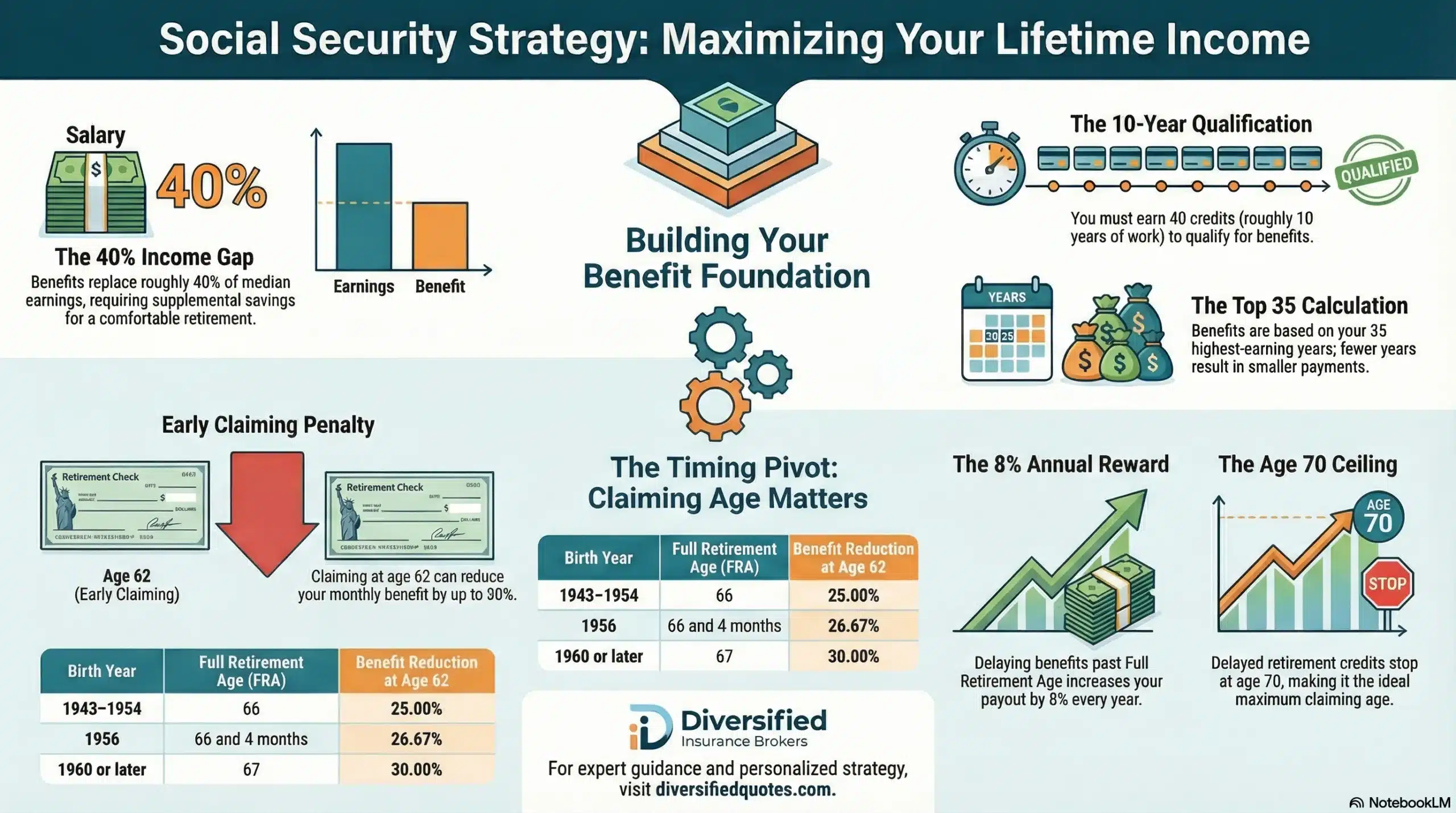
The financial value of the strategy came from the delayed retirement credit — the approximately 8% annual increase in the personal retirement benefit for each year of delay beyond FRA, up to age 70. For someone with a FRA of 66, delaying from 66 to 70 added approximately 32% to the personal retirement benefit permanently. If the spousal benefit covered meaningful income during those four years, the household could collect income now while the personal retirement benefit grew — arriving at 70 with a substantially larger personal check that also served as the larger survivor benefit for the spouse likely to live longer.
The strategy was available because the Social Security law at the time did not prevent a person at FRA from choosing to restrict their application to a specific benefit type. It was not a legislatively designed “benefit” — it was a planning opportunity that existed because of how the rules were written. Congress recognized it as a “loophole” and eliminated it through the Bipartisan Budget Act of 2015, which extended deemed filing rules (previously applicable only to claimants below FRA) to apply at all ages — with a grandfather provision for those born on or before January 1, 1954.
The Birthdate Cutoff and the 2026 Timing Reality
The restricted application birthdate cutoff — born on or before January 1, 1954 — was the Bipartisan Budget Act’s grandfathering provision. It was designed to protect those who had already built retirement plans around the strategy’s availability. The cutoff itself is clear and absolute: anyone born January 2, 1954 or later cannot file a restricted application under the spousal-only benefit provision. The Social Security Administration’s own policy manual confirms this rule without exception. There is no income threshold, no work history threshold, and no circumstances under which someone born after the cutoff date becomes eligible for this specific strategy under normal Social Security rules.
In May 2026, the implications of the birthdate cutoff must be understood in their current context. A person born on January 1, 1954 — the most recently born person in the eligible cohort — turned 72 in January 2026. A person born on January 1, 1953 turned 73. The FRA for these birth years is 66 — meaning the restricted application strategy was designed to be executed at age 66, with the switch to the personal retirement benefit occurring at age 70 after four years of collecting spousal benefits and accumulating delayed credits. For anyone born in the eligible cohort and still managing a restricted application strategy, that switch to the personal retirement benefit at 70 should have already occurred by January 2024 at the latest — because the youngest eligible person (born January 1, 1954) reached age 70 in January 2024.
If you believe you filed a restricted application and have not yet switched to your own retirement benefit, verify your claim status immediately with the Social Security Administration. Delayed retirement credits stop growing at 70. If you reached 70 and have not yet switched, you may be leaving the higher benefit amount unclaimed. The filing switch from spousal-only to personal retirement benefit is not automatic in all cases — it requires action, and missing the window does not extend the credit growth. Our resource on deemed filing rules for Social Security covers the modern framework and helps clarify which filing rules govern your specific situation.
Restricted Application Eligibility: Comparison With Deemed Filing
| Characteristic | Restricted Application (Grandfathered) | Modern Deemed Filing (Post-2015) |
|---|---|---|
| Who it applies to | Born on or before January 1, 1954 only | Born January 2, 1954 or later (all current filers) |
| Can you claim “spousal only” at FRA? | Yes — with correct filing restriction | No — claiming any benefit triggers all eligible benefits simultaneously |
| Does own retirement benefit keep growing? | Yes — personal benefit accumulates 8%/year until age 70 | No — deemed filing starts personal benefit at same time as spousal |
| What benefit is paid? | Spousal only, while personal benefit grows | Higher of personal or spousal benefit at time of filing |
| Must file at FRA? | Yes — filing before FRA triggers deemed filing for eligible cohort too | Deemed filing applies at any age |
| Is this available in May 2026 for new filers? | Essentially no — youngest eligible person is 72, past age 70 growth window | Yes — this governs all current standard retirement filings |
| Survivor exceptions to deemed filing? | Survivors can restrict regardless of birthdate | Survivors remain exempt from deemed filing restrictions |
Three Situations Where Restricted Filing Concepts Still Apply in 2026
While the traditional restricted application strategy is effectively closed for new executions in 2026, three categories of retirees should still understand the restricted filing concept because specific rules permit benefit-type separation that modern deemed filing otherwise prevents. Each category operates under distinct legal frameworks that are separate from the grandfathered 1954 birthdate provision.
The first is the survivor and widow/widower category. Surviving spouses and surviving divorced spouses have the ability to claim survivor benefits while allowing their own retirement benefit to grow — or, conversely, to claim their own retirement benefit while allowing survivor benefits to accumulate — regardless of their birthdate. This survivor benefit flexibility is a different rule from the grandfathered restricted application provision, and it is not limited to the pre-1954 birth cohort. A widow born in 1960 can, in the right circumstances, claim survivor benefits at age 60 (at a reduced amount) while allowing her own retirement benefit to grow to a larger amount at FRA or age 70. The reverse is also possible: a surviving spouse who is currently receiving their own reduced retirement benefit may be able to switch to the survivor benefit at a later age if the survivor benefit would be higher. Our resource on Social Security survivor benefits covers the survivor benefit framework in detail. Our resource on survivor benefits for disabled adults covers related survivor benefit categories.
The second is the child-in-care exception. A spouse or divorced spouse who is caring for a child of the retired worker who is under age 16 or has a qualifying disability may be able to claim spousal benefits based on the child-in-care provision, even if they have not reached FRA and even if they would otherwise be subject to deemed filing. This provision creates a specific situation where claiming spousal benefits does not necessarily trigger the start of the claimant’s own retirement benefit in the same way that standard deemed filing would — though the specific rules depend on the exact circumstances and should be confirmed directly with the Social Security Administration or a Social Security planning professional.
The third is the Social Security Disability Insurance (SSDI) recipient. A person who is receiving SSDI benefits is already receiving their own Social Security benefit and may be able to also receive a spousal benefit without the same deemed filing framework that applies to standard retirement benefit claimants. The interaction between SSDI and spousal benefits involves its own rule set that operates differently from the retirement benefit context — and the specific outcome depends on the benefit amounts involved and the timing of the SSDI award relative to the spousal claim.
The Survivor Benefit Strategy That Remains Fully Available in 2026
For surviving spouses and surviving divorced spouses, the ability to strategically separate two benefit types — own retirement benefit and survivor benefit — represents the most significant Social Security timing opportunity still fully available to retirees of any age in 2026. Understanding how survivor benefit strategies work is now the more important focus for many households that previously might have focused on restricted application eligibility for the traditional spousal strategy.
A surviving spouse who has not yet reached FRA and whose own retirement benefit is smaller than the survivor benefit they would eventually receive has two meaningful options. They can claim the survivor benefit as early as age 60 (at a permanently reduced amount) while allowing their own retirement benefit to continue growing through delayed credits until age 70 — then switch to the larger personal retirement benefit when the comparison favors it. Or they can claim their own retirement benefit first at whatever reduced or full amount applies, then switch to the survivor benefit later if the survivor benefit becomes higher than the current personal benefit and other eligibility conditions are met. The optimal sequence depends on the relative sizes of the two benefit types, the claimant’s age, and health and longevity expectations.
For surviving divorced spouses, similar flexibility exists, though the eligibility rules require a minimum of 10 years of marriage and the claimant must be currently unmarried at the time of the survivor benefit claim. Our resources on divorced spousal benefits timing, Social Security spousal benefits after divorce, and how remarriage affects Social Security spousal benefits cover the divorced spouse framework in detail.
What Strategies Are Actually Available for 2026 and Future Retirees
For retirees born after January 1, 1954 — who represent the overwhelming majority of people filing for Social Security in 2026 and beyond — the restricted application strategy is not available. This does not mean Social Security strategy is dead for this group. It means the tools are different, and understanding which tools remain powerful is the foundation of any worthwhile Social Security planning process in today’s environment.
The claiming age decision remains among the most impactful financial choices a retiree makes. Each year of delay beyond FRA adds approximately 8% to the monthly retirement benefit permanently — a guaranteed, inflation-adjusted return that no investment product can match. Claiming at 70 instead of 62 produces approximately a 77% larger monthly benefit for a retiree with a FRA of 67. For many retirees in reasonably good health, this decision alone — when, not whether, to claim — creates more lifetime income value than any other single retirement planning choice. The loss of the restricted application strategy does not eliminate this opportunity. It simply changes what the strategy looks like: instead of collecting spousal benefits while delaying personal benefits, the 2026 retiree focuses on coordinating the claims of both spouses to optimize the combination of immediate income, delayed credit growth, and survivor protection.
The annuity bridge strategy replaces some of what restricted filing provided for the eligible cohort — it uses retirement savings to fund guaranteed income during the delay years, reducing portfolio withdrawal pressure and preserving the ability to claim Social Security at a higher age and therefore a higher amount. An annuity bridge funded by a portion of IRA, 401(k), or 403(b) savings can provide contractually guaranteed monthly income during the gap between retirement and Social Security activation, allowing the retiree to delay Social Security without depending on volatile portfolio withdrawals for bridge income. Our resource on how Social Security and annuities work together covers the full coordination framework for this approach, and our resource on the best annuity for guaranteed income in retirement covers which annuity structures most effectively serve the bridge income role. Our resource on guaranteed income from annuities covers the income mechanics that make this approach work as a functional alternative to the restricted application bridge that was available to earlier cohorts.
Household Coordination in the Deemed Filing Era: What Couples Must Plan For
The elimination of the restricted application strategy for most current retirees did not eliminate the value of coordinated Social Security planning for couples — it changed what coordination looks like. Under deemed filing, both members of a married couple are still making filing decisions with household-level implications that affect total lifetime income and survivor income in ways that deserve careful analysis.
The primary coordination principle that remains highly valuable is the higher-earner delay decision. When the higher-earning spouse delays Social Security to age 70, they lock in both a larger personal benefit and a larger survivor benefit that the surviving spouse will receive after the first death. This survivor benefit optimization is independent of restricted application eligibility — it is available to every married couple regardless of birth year. The lower-earning spouse’s filing timing, whether they claim earlier to provide some income during the delay period or delay their own benefit for a larger personal amount, is a secondary optimization that depends on the household’s income gap, healthcare costs, and tax situation.
For households where both spouses have meaningful earnings records, the deemed filing framework means that neither spouse can collect one benefit type while the other grows — both benefits start simultaneously at the chosen filing age. The optimization therefore focuses on the timing of when each spouse files, rather than which benefit type each files for. Modeling the household income, tax, and Medicare picture year by year for the period between retirement and the activation of both Social Security benefits — and comparing the outcomes of different filing age combinations — produces the same kind of strategic insight that restricted application planning once did for the eligible cohort. Our resources on the earnings test after full retirement age, reducing taxes on Social Security, and IRMAA planning strategies cover the secondary coordination considerations that affect the net after-tax, after-Medicare value of any claiming strategy.
Common Questions and Mistakes Around Restricted Application Eligibility
The most common mistake retirees make is assuming the restricted application strategy is currently available to them because they read about it or heard about it from someone who used it. The overwhelming probability — given that the eligible cohort is now age 72 and above — is that any retiree in 2026 who has not yet filed Social Security is not in the eligible cohort and cannot use the restricted application approach. Confirming your birthdate against the January 1, 1954 cutoff resolves this question definitively.
The second most common mistake is assuming that the deemed filing limitation is an obstacle that can be worked around with timing tricks. It cannot be. Under modern rules, filing for any Social Security retirement or spousal benefit triggers the automatic application for all benefits the person is currently eligible for. There is no wording of the application, no administrative technique, and no advisor strategy that enables someone born after January 1, 1954 to claim spousal benefits only at FRA under standard retirement filing rules. The deemed filing provision was specifically designed to prevent that.
The third mistake is conflating survivor benefit flexibility with restricted application eligibility. Survivors have genuinely different rules that allow benefit-type switching in ways that standard retirement benefit claimants cannot access after the 2015 Act. Many retirees learn about survivor benefit switching and incorrectly generalize it as evidence that restricted application is still available. The two concepts are legally separate and should be evaluated distinctly. Our resource on deemed filing rules for Social Security covers the distinction in clear detail.
The fourth mistake — relevant to the small number of retirees who did execute a restricted application correctly — is failing to switch from the spousal benefit to the personal retirement benefit at age 70. The delayed retirement credits stop growing at 70 regardless of when the switch happens. A restricted application filer who does not switch by 70 collects spousal benefits indefinitely but permanently forfeits the larger personal benefit they delayed in order to build. If there is any uncertainty about whether a prior restricted application claim is active and whether the switch to personal retirement benefit has occurred, contacting the Social Security Administration to review the claim record is the correct first step.
Using Annuity Income to Replace What Restricted Filing Provided for the Eligible Cohort
The restricted application strategy was valuable primarily because it provided a reliable income source during the delay years between FRA and age 70 — eliminating the financial pressure to file for personal retirement benefits prematurely simply because income was needed. For retirees who do not have access to the restricted application approach, the annuity bridge strategy serves this same functional purpose: providing guaranteed income during the delay period so that portfolio withdrawals and financial pressure do not force an early Social Security claim at a reduced lifetime benefit amount.
A fixed annuity or MYGA purchased with a portion of IRA, 401(k), or other retirement savings before the intended Social Security claim date can generate predictable monthly income during the bridge years without market risk, without withdrawal rate uncertainty, and without the behavioral pressure to claim Social Security early simply to stop watching the portfolio decline. This bridge function — contractually guaranteed income that covers essential expenses during the delay — is exactly what the restricted application’s spousal benefit once provided for the eligible cohort. The mechanism is different (annuity premium versus spousal benefit eligibility), but the planning outcome is functionally similar: income now, while the personal Social Security benefit grows to its maximum.
Our resource on how Social Security and annuities work together covers the three primary coordination strategies — bridge to maximum, layered paycheck, and activate-later — that replace and in some cases improve on what restricted application provided for earlier cohorts. Our resource on sequence of returns risk explains why market-dependent bridge income during the delay period is less reliable than guaranteed annuity bridge income. Our resource on how to protect funds in retirement covers the complete income floor architecture that positions annuity income alongside Social Security for the strongest possible guaranteed retirement paycheck. Our resource on pension replacement — turning savings into guaranteed lifetime income covers how annuities replicate the pension-equivalent income security that Social Security optimization and annuity coordination together can produce.
Confirm Your Filing Options and Build the Right Income Plan
Whether you are confirming restricted application status, exploring survivor benefit flexibility, or building a complete income plan under today’s deemed filing rules — we verify the specific rules for your dates and model the complete household income picture before any filing decision is made.
Start My Social Security ReviewRelated Social Security Pages
Explore the Social Security strategies that remain fully available to retirees in 2026.
Retirement Income and Annuity Bridge Resources
Explore how annuity income can replace what restricted application provided — and how to build the strongest guaranteed income foundation for your complete retirement plan.
We are not affiliated with or endorsed by the Social Security Administration. Social Security rules referenced on this page reflect our research as of May 2026 and are subject to change. Always verify your specific eligibility and filing options directly with the Social Security Administration or a qualified Social Security planning professional before filing.
Schedule an Appointment with a Social Security Expert
We’ll confirm eligibility, compare benefit options, and map the best filing timeline for your household.
We are not affiliated with or endorsed by the Social Security Administration.
Frequently Asked Questions: Restricted Application Eligibility
Who still qualifies for the restricted application strategy in 2026?
In May 2026, the traditional restricted application strategy — claiming spousal benefits only at FRA while allowing personal retirement credits to grow — is effectively closed for new executions. The strategy was grandfathered for people born on or before January 1, 1954. As of May 2026, the youngest person in that eligible cohort is 72 years old. Since delayed retirement credits stop growing at age 70, any eligible person who executed the strategy correctly should have already switched to their personal retirement benefit by age 70. If you believe you filed a restricted application and have not yet switched, contact the Social Security Administration immediately to verify your claim status. For anyone born after January 1, 1954, the strategy is not available under standard retirement filing rules — modern deemed filing rules govern all such claims.
What is the birthdate cutoff for restricted application eligibility?
Born on or before January 1, 1954. Anyone born January 2, 1954 or later cannot file a restricted application for spousal benefits under standard Social Security rules — their filing is governed by deemed filing rules, which require the simultaneous start of all eligible benefits. This cutoff was established by the Bipartisan Budget Act of 2015 as a grandfathering provision protecting those who had already built retirement plans around the strategy. The cutoff is absolute — there is no income threshold, work history exception, or administrative technique that enables someone born after the cutoff date to use this specific strategy under standard retirement filing rules.
Can a surviving spouse use restricted application principles in 2026?
Yes — survivor benefit rules create a meaningful form of benefit-type switching that is not limited by the 1954 birthdate cutoff and is not governed by the same deemed filing restrictions that apply to standard retirement benefit claimants. A surviving spouse or surviving divorced spouse can, in appropriate circumstances, claim survivor benefits while allowing their own personal retirement benefit to grow — or claim their own reduced benefit while preserving the option to switch to the survivor benefit at a later age if it becomes more advantageous. This survivor benefit flexibility is one of the most important Social Security strategies remaining fully available in 2026 and should be evaluated carefully for any household with a surviving spouse situation.
What happens if I filed a restricted application but never switched to my own retirement benefit?
Delayed retirement credits stop growing at age 70 regardless of when you switch. If you reached age 70 and have not yet switched from spousal benefits to your personal retirement benefit, you are potentially leaving a higher monthly benefit unclaimed. The switch is not always automatic — it may require action on your part. Contact the Social Security Administration to verify your current claim status, what benefit you are currently receiving, and what your personal retirement benefit amount would be if you switched now. If you are past age 70 and have been receiving only the spousal benefit, you may be owed retroactive payments for some period — the rules on retroactivity in this situation are complex and should be confirmed directly with the SSA.
What strategy replaces the restricted application for retirees born after 1954?
The most comparable functional approach available to retirees born after January 1, 1954 is the annuity bridge strategy combined with delayed Social Security claiming. Rather than collecting spousal benefits during the delay years (which is no longer available), the retiree funds a guaranteed income bridge from retirement savings — typically through a fixed annuity, MYGA, or income annuity — that covers essential expenses during the delay period without requiring portfolio withdrawals at market-vulnerable early retirement prices. When Social Security activates at the higher delayed amount, the combination of maximum SS income and continuing annuity income creates a strong guaranteed retirement income foundation that is functionally similar to what restricted application once provided for the eligible cohort.
Does filing for Social Security disability affect restricted application rules?
Social Security disability recipients have different rules governing how their benefits interact with spousal benefits — the deemed filing provisions that govern retirement benefit claimants do not apply identically in the disability context. A person receiving SSDI may be able to receive a spousal benefit in addition to their disability benefit under rules that differ from the retirement benefit framework. The specific outcome depends on the benefit amounts, the timing, and the claimant’s specific situation. Anyone in an SSDI situation who wants to understand the interaction with spousal benefits should review their situation with the Social Security Administration directly or work with a Social Security planning professional who is familiar with the disability benefit context.
Is delaying Social Security still valuable even without restricted application eligibility?
Yes — significantly. The value of delaying Social Security claiming does not depend on restricted application eligibility. Each year of delay beyond Full Retirement Age adds approximately 8% to the monthly benefit permanently. Claiming at age 70 instead of FRA (67 for those born in 1960 or later) produces approximately 24% more per month for life — plus inflation adjustments through COLA for every year of retirement. For the higher-earning spouse in a couple, this delay also produces a larger survivor benefit that protects the surviving spouse’s income after the first death. The loss of restricted application eligibility changes the mechanism for funding the delay period — but the financial case for delaying Social Security to age 70 for healthy retirees in good health with family longevity remains compelling regardless of that eligibility.
About the Author:
Jason Stolz, CLTC, CRPC, DIA, CAA and Chief Underwriter at Diversified Insurance Brokers (NPN 20471358), is a senior insurance and retirement professional with more than 25 years of real-world experience helping individuals, families, and business owners protect their income, assets, and long-term financial stability. As a long-time partner of the nationally licensed independent agency Diversified Insurance Brokers, Jason provides trusted guidance across multiple specialties—including fixed and indexed annuities, long-term care planning, personal and business disability insurance, life insurance solutions, Group Health, Travel Medical and Evacuation Insurance, and short-term health coverage. Diversified Insurance Brokers maintains active contracts with over 100 highly rated insurance carriers, ensuring clients have access to a broad and competitive marketplace.
His practical, education-first approach has earned recognition in publications such as VoyageATL, and contributions from his agency featured in Kiplinger and GoBankingRates— highlighting his commitment to financial clarity and client-focused planning. Drawing on deep product knowledge and years of hands-on field experience, Jason helps clients evaluate carriers, compare strategies, and build retirement and protection plans that are both secure and cost-efficient. Visitors who want to explore current annuity rates and compare options across multiple insurers can also use this annuity quote and comparison tool.
Explore All Social Security Planning Guides: Browse our complete Social Security Planning guide — covering filing strategies, spousal benefits, survivor benefits, taxes, WEP, GPO & more.
Last Reviewed: May 24, 2026 |
Reviewed by: Jason Stolz, CLTC, CRPC, DIA, CAA
Chief Underwriter, Diversified Insurance Brokers, Inc. | NPN: 20471358 | Diversified Insurance Brokers, Inc. — Licensed in all 50 states
Fact Checked by: Tonia Pettitt, CMIP©
Medicare Specialist, Diversified Insurance Brokers, Inc. | NPN: 14374308 | Diversified Insurance Brokers, Inc. — Licensed in all 50 states
Did you find this content helpful? Leave us a Google review — it helps others find trustworthy guidance too.
Editorial Standards: Diversified Insurance Brokers maintains rigorous editorial standards to ensure accuracy, clarity, and independence in all content. Learn more about our editorial standards and commitment to transparency.
