
How Social Security and Annuities Work Together
As an Independent Annuity Broker, we compare rates across 100+ carriers and 1,000 different annuities— not just one company’s product offerings — to find the best fit for your goals.
How Social Security and Annuities Work Together

Jason Stolz CLTC, CRPC, DIA, CAA
Social Security and annuities work together as the two most powerful guaranteed income sources available in retirement — and when they are deliberately coordinated rather than decided in isolation, they create a retirement income foundation that is structurally stronger, more tax-efficient, and more resilient to longevity than either source can provide alone. Social Security delivers an inflation-adjusted, lifetime income stream that increases annually through cost-of-living adjustments and provides unique survivor protections for spouses. An annuity delivers a contractually guaranteed second income stream — sized precisely to fill the gap between Social Security and essential monthly expenses — that the insurance carrier must pay for as long as the covered person lives, regardless of market performance. Together, they make the central retirement income question stop being “will my portfolio hold up?” and start being “are my guaranteed income sources enough to cover what matters?” When the answer to that second question is yes, the rest of the portfolio can be managed for growth, flexibility, and legacy rather than survival.
The coordination of Social Security and annuities starts with a specific decision chain that most retirees get backwards: they file for Social Security when it feels like time, then consider an annuity later if the market makes them nervous. The correct approach reverses that sequence. Social Security’s claiming age is an irreversible decision that permanently sets the size of the lifetime check — and it directly determines how much annuity income is needed to complete the income floor. An annuity’s start date, premium, and structure should be chosen to complement and optimize the Social Security timing decision, not react to it after the fact. At Diversified Insurance Brokers, we compare annuity income options across 100+ A-rated carriers and model the complete income picture — Social Security timing, annuity income, taxes, and Medicare costs — so clients see the full retirement paycheck before they commit to any single decision. Our resource on maximizing Social Security benefits covers the claiming strategy side of this coordination, and our resource on guaranteed income from annuities covers the annuity income side.
Ensure you are receiving the absolute top rates
Current Fixed Annuity Rates
Compare today’s best fixed annuity rates from top carriers.
View Current RatesCurrent Bonus Annuity Rates
See which annuities offer the highest upfront bonus today.
View Bonus RatesBuild Your Income Floor
Get a personalized Social Security and annuity income comparison.
Request Income ComparisonLifetime Income Calculator
Estimate how much guaranteed annuity income your savings could generate to pair with Social Security — model immediate and deferred start dates, single and joint life options.
Why Social Security Alone Is Not Enough — The Income Gap an Annuity Fills
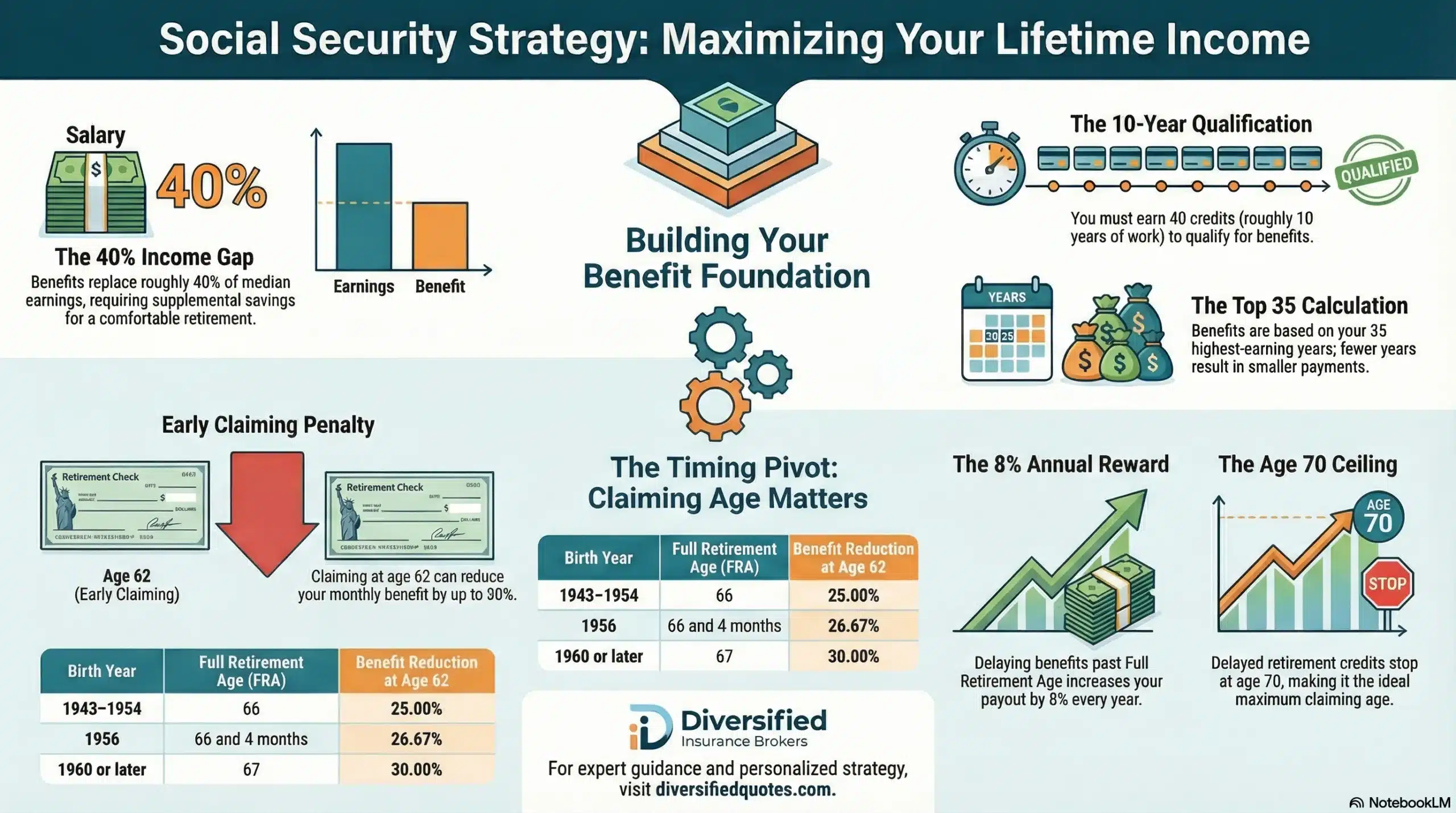
Social Security is the best single source of guaranteed lifetime income most retirees have access to — inflation-adjusted, survivor-protected, and contractually obligated to continue for life regardless of market conditions. But Social Security was designed to replace approximately 40% of pre-retirement income for average earners, not to cover the full cost of retirement. The gap between Social Security income and total essential monthly expenses — housing, utilities, food, healthcare, transportation, and debt obligations — is the income gap that determines whether a retirement plan is genuinely secure or perpetually dependent on market performance to fund basic living costs.
For the average retiree, the Social Security and annuities coordination is most clearly visible in this gap. A retired couple whose combined Social Security income is $4,500 per month but whose essential monthly expenses total $7,000 per month has a $2,500 monthly income gap. If that gap is funded by portfolio withdrawals from market-exposed accounts, the household faces sequence of returns risk, behavioral risk during market downturns, and the constant possibility of outliving the portfolio if withdrawals continue longer than expected. If that gap is instead funded by guaranteed annuity income — a contractual $2,500 per month that the carrier must pay regardless of market conditions or how long the couple lives — the essential expense problem is permanently solved. The portfolio becomes discretionary capital available for growth, inflation protection, flexibility, and legacy rather than a necessary income engine that cannot afford to decline.
This income gap is also why the decision to delay Social Security and the decision to purchase an annuity are naturally connected. A retiree who delays Social Security from age 63 to age 70 captures a meaningfully larger monthly benefit for life — and the annuity’s role changes as Social Security grows. If Social Security at 63 would be $2,200 per month but Social Security at 70 would be $3,800 per month, the income gap the annuity must fill is $1,600 smaller at the later start date. That $1,600 of reduced annuity need translates to a smaller required premium, more capital remaining in the growth portfolio, and a higher total guaranteed income floor for life. Our resource on sequence of returns risk covers why funding the gap with guaranteed income rather than portfolio withdrawals is the most structurally resilient approach to retirement income planning.
The Bridge Strategy: Using an Annuity to Delay Social Security and Maximize Lifetime Income
The Social Security bridge strategy is one of the most powerful — and most underutilized — retirement income planning tools available. Research confirms that claiming at age 70 versus age 62 can increase the monthly Social Security benefit by approximately 77% for workers with a full retirement age of 67. The 8% annual increase for each year of delay beyond full retirement age is a return that no market investment can guarantee — and the larger monthly payment carries that advantage forward permanently, inflation-adjusted, for every month of the retiree’s remaining life.
The challenge is funding the income gap during the delay period — the years between retirement and Social Security activation at 70 when earned income has stopped and Social Security has not yet begun. Without a bridge strategy, this gap forces retirees to withdraw aggressively from their investment portfolios during the period when sequence of returns risk is most acute — the early retirement years when a market decline causes the most permanent damage. A bridge strategy solves this problem by using a portion of retirement savings to fund guaranteed income during the bridge years, reducing portfolio withdrawals and preserving more capital for long-term compounding after Social Security activates.
An annuity as the bridge vehicle provides a critical advantage over unstructured portfolio withdrawals: the bridge income is contractually guaranteed rather than market-dependent. A retiree who purchases a MYGA or a fixed annuity to generate systematic withdrawals during a 5 to 8-year bridge period knows with certainty what monthly income that annuity will provide, regardless of what interest rates or markets do during those years. The bridge period passes without the household experiencing forced selling at depressed prices, and Social Security activates at its maximum level precisely when the annuity bridge income may be reducing or transitioning to a longer-term income structure. A rough sizing formula for a bridge annuity: monthly income gap × 12 × bridge years, plus a 10% to 15% cushion for flexibility, determines the approximate premium needed for the bridge vehicle. Our resource on what an immediate annuity is covers the structure that delivers bridge income from day one, and our resource on multi-year guaranteed annuities for retirees covers the MYGA structure that provides safe, rate-driven bridge growth and systematic withdrawals.
Three Proven Strategies for Coordinating Social Security and Annuities
| Strategy | Social Security Timing | Annuity Role | Best For | Primary Benefit |
|---|---|---|---|---|
| Bridge to Maximum Strategy | Delay to 70 for higher earner | Bridge income during delay period; permanent income supplement after SS begins | Healthy retirees with retirement savings, family longevity, and at least 5-year delay capacity | Maximizes lifetime SS income and survivor benefit; annuity fills the gap permanently |
| Layered Paycheck Strategy | Claim at or near FRA; supplement immediately | Immediate income layer on top of SS to reach essential expense target from day one | Retirees with large income gaps who need full coverage immediately; couples seeking stability | Essential expenses covered 100% by guaranteed income immediately; least market dependency |
| Activate-Later Strategy | Variable — coordinate with annuity income start | FIA or DIA with deferred income start; benefit base grows until activation; liquidity preserved early | Retirees who value early liquidity; those who expect income needs to increase later | Higher income at activation due to deferral growth; preserved liquidity in early retirement |
Each of these Social Security and annuity coordination strategies produces a different monthly income outcome, a different tax profile, and a different survivor protection structure. The right strategy is the one matched to the household’s actual cash flow needs, health and longevity expectations, liquidity preferences, and overall portfolio size. Our resource on lifetime income annuity options covers the annuity structure side of each strategy, and our resource on Social Security planning services covers the claiming strategy framework that anchors the timing decisions in each approach.
The 8% Annual Bonus: Why Delaying Social Security Is the Most Reliable Return in Retirement
The actuarial advantage of delaying Social Security is significant and underappreciated. Every year of delay beyond full retirement age increases the monthly benefit by approximately 8% — a guaranteed, permanent increase that applies for every month the retiree lives after the higher benefit begins. For a worker with a full retirement age of 67, claiming at age 70 instead of age 67 adds approximately 24% to the monthly benefit permanently. Claiming at 70 instead of 62 produces approximately a 77% increase in the monthly benefit. For 2025, the maximum Social Security benefit for a worker claiming at 70 was approximately $5,108 per month — only achievable with 35 or more years at or above the Social Security wage base. This number is approximate and subject to annual adjustment.
Critically, the increase applies to both the inflation-adjusted COLA that grows the benefit each year and to any survivor benefit the surviving spouse will receive. A higher earner who delays to 70 locks in not just a larger personal benefit but a larger survivor anchor — the income the surviving spouse receives after the first death. For couples, this survivor dimension often makes delaying the higher earner’s Social Security to 70 one of the highest-value financial decisions available, because the surviving spouse’s lifetime is the longest horizon over which the larger benefit has time to compound through COLA increases.
Despite this mathematical advantage, research from the National Bureau of Economic Research found that only approximately 10% of Social Security beneficiaries wait until age 70 to claim. The primary reason is the discomfort of watching retirement savings decline during the delay period without the psychological comfort of the Social Security check that is accumulating growth. The annuity bridge strategy directly addresses this discomfort by replacing the uncertain portfolio withdrawal during the delay with a guaranteed income stream — so the Social Security delay happens not from a position of portfolio anxiety but from a position of income certainty. Our resource on guaranteed income at age 70 covers what annuity income looks like at the age when the full Social Security delay benefit typically activates.
Which Annuity Type Pairs Best With Each Social Security Strategy
The selection of which annuity type best complements a given Social Security timing strategy depends on whether income is needed immediately, whether a growth period before income activation is available, whether the primary goal is bridge income or permanent supplemental income, and whether liquidity during early retirement is a priority. Understanding the relationship between Social Security and annuity structure choices helps avoid the common mistake of purchasing an annuity that conflicts with the Social Security timing strategy it is supposed to support.
Immediate income annuities (SPIAs) pair most naturally with the bridge-to-maximum strategy and with the layered paycheck strategy where income is needed from the first month of retirement. A SPIA converts a premium directly into a guaranteed monthly income stream beginning within 30 days of purchase — no growth period, no activation decision, just a contractual monthly paycheck that starts immediately and continues for life. The SPIA is the highest-immediate-income-per-dollar annuity structure and is most effective when the annuity is needed to replace earned income immediately, bridge the gap to a delayed Social Security start, or permanently supplement a Social Security benefit that does not fully cover essential expenses. Our resource on best immediate annuity for monthly income covers how SPIA payouts compare across carriers and income structures.
Deferred income annuities (DIAs) pair most naturally with the activate-later strategy where income is needed starting at a future date — either coinciding with Social Security activation at 70 or beginning later in retirement when healthcare and care costs tend to increase. The DIA is funded today but delivers income beginning at a contractually defined future date, typically producing a higher monthly income at the start date than a SPIA purchased with the same premium at the same future date. The DIA is particularly effective for retirees who want to lock in today’s income pricing for a larger future income amount, reducing the reinvestment risk of waiting to purchase closer to the income start date. Our resource on what a deferred income annuity is covers the mechanics and best-fit scenarios for this structure.
Fixed indexed annuities with GLWB income riders pair most naturally with strategies where both principal protection during a growth period and guaranteed future income are both priorities. During the deferral period, the FIA protects principal from market losses while crediting index-linked interest under contract terms. When the income rider is activated — either at retirement or at a chosen future date — the guaranteed lifetime withdrawal amount is based on the benefit base that has grown at the rider’s roll-up rate during the deferral period. This structure is most effective when there is a 5 to 10-year period between annuity purchase and income activation, when the growth period makes the benefit base meaningfully larger than the initial premium, and when the household values maintaining account value access alongside the lifetime income guarantee. Our resource on best fixed indexed annuities for income covers how income rider designs compare across carriers, and our resource on what a GLWB is covers the income rider mechanics in detail. Our resource on what an income annuity roll-up rate is explains how the benefit base grows during the deferral period to determine the eventual income amount.
The Income Floor Framework: Building the Guaranteed Monthly Retirement Paycheck
The most practical framework for designing Social Security and annuity income coordination is the income floor approach: identify essential monthly expenses, subtract guaranteed income already in place (Social Security plus any pension), and fund the remaining gap with annuity income so that essential expenses are 100% covered by guaranteed contractual income. Everything above the income floor — discretionary spending, travel, major purchases, and legacy accumulation — comes from the portfolio, which is now freed from the obligation to fund survival expenses and can be managed for long-term growth.
Building this income floor is a sequential planning process. Step one: list all essential monthly household expenses with the honesty to include healthcare costs (Medicare premiums, supplemental coverage, estimated out-of-pocket) that frequently exceed pre-retirement estimates as coverage gaps emerge. Step two: total the guaranteed monthly income that will be in place — Social Security for each spouse at the planned claiming age, plus any defined benefit pension income. Step three: calculate the gap between essential expenses and guaranteed income. Step four: determine what premium amount, at the specific annuity structure and income start date planned, produces enough guaranteed income to close that gap. The annuity premium is the investment that converts the income floor deficit into an income floor surplus — and that conversion happens contractually, not probabilistically.
Many households discover that the income floor gap is larger than they anticipated — because Social Security typically replaces only 40% to 50% of pre-retirement income for average earners, and because essential expenses in retirement tend to be underestimated, particularly healthcare costs. Our resource on how to protect funds in retirement covers the complete income architecture framework, our resource on best annuity for guaranteed income in retirement covers the annuity structure selection for closing the income floor gap, and our resource on annuity for monthly retirement income covers the product designs specifically oriented toward producing a reliable monthly paycheck.
Spousal Protection: Designing a Plan That Works After the First Death
For married couples, the coordination of Social Security and annuity income is incomplete without modeling what the retirement income plan looks like after the first spouse dies — because the survivor’s income situation frequently changes dramatically in ways that create significant financial vulnerability if not planned for explicitly.
When the first spouse dies, the survivor loses one of the two Social Security payments (retaining the higher of the two) and loses any single-life pension or annuity income that was not structured for joint continuity. Household expenses do not fall proportionally — housing costs, healthcare, and many fixed expenses remain similar for a single person to what they were for a couple. The result is an income cliff for the surviving spouse that can be devastating if not addressed during the planning phase when both spouses are alive and coordinated decisions are still possible.
The higher earner’s Social Security claiming decision is the most consequential survivor income planning tool available. When the higher earner delays to 70, the surviving spouse inherits the larger Social Security benefit permanently — a COLA-adjusted lifetime income that may represent the majority of the survivor’s guaranteed income for 10 to 20 or more years after the first death. Annuities can reinforce this survivor protection in specific ways. A joint-life annuity structure continues income for as long as either covered spouse is alive, preventing the annuity income from disappearing when the annuitant dies. A spousal continuation feature preserves the annuity’s remaining account value for the surviving spouse in a format that can continue generating income. Our resource on what a joint lifetime income annuity is, our resource on how a joint lifetime income annuity works, and our resource on what a spousal continuation annuity is cover the survivor protection structures in detail.
Inflation: Social Security COLA and Annuity Income Design
Social Security’s annual cost-of-living adjustment is one of its most underappreciated features in the context of Social Security and annuity income coordination. Social Security benefits have increased by over 40% since 2010 through COLA adjustments, providing a compounding purchasing power protection that most private income sources cannot replicate. This inflation adjustment makes Social Security an increasingly valuable income source over a long retirement — a $2,000 monthly Social Security benefit in year one of retirement may be worth $3,000 or more per month in nominal terms 25 years later, having maintained its real purchasing power through the annual adjustment mechanism.
Annuity income designs vary significantly in how they handle inflation. Level-payment annuities provide a fixed monthly amount for life — maximizing the starting paycheck but providing no automatic inflation adjustment. This design is most effective when other income sources (Social Security COLA, portfolio growth distributions) are expected to provide inflation protection for discretionary spending, and when the guaranteed income amount is sized to cover only essential expenses rather than the full budget. Increasing income annuity designs reduce the starting payment but build in a fixed annual increase (typically 1% to 3% per year) or tie increases to an index — these designs sacrifice initial income for long-term purchasing power protection. Our resource on what COLA is on an annuity covers the inflation adjustment options and their trade-offs in detail.
The practical planning implication is that when Social Security and annuity income are combined, Social Security’s COLA adjustment can effectively serve as the inflation protection mechanism for the entire guaranteed income floor — because as Social Security grows each year, it covers an increasing portion of inflation-elevated essential expenses, reducing the demand on the level-pay annuity income for inflation fighting. This allows the annuity to be sized and structured for maximum initial payout rather than sacrificing starting income for built-in increases that Social Security’s COLA already provides. This is another reason the two sources work together more effectively than either works alone.
Taxes: How Social Security and Annuity Income Interact
The coordination of Social Security and annuity income in retirement must account for how the two sources interact from a tax perspective, because the combined income picture determines whether Social Security benefits are partially or fully taxable — and the answer affects how much after-tax income the household actually receives each month.
Social Security benefits become taxable based on the retiree’s “combined income” — a specific calculation equal to adjusted gross income plus nontaxable interest plus half of Social Security benefits. When combined income exceeds $25,000 for individuals or $32,000 for couples filing jointly, up to 50% of Social Security becomes taxable. When combined income exceeds $34,000 for individuals or $44,000 for couples, up to 85% of Social Security becomes taxable. Adding annuity income to the picture increases combined income, which can push a larger portion of Social Security into the taxable range. This does not make annuities a bad choice — it makes the tax modeling essential for understanding net spendable income rather than gross income.
The practical planning response to this interaction is to evaluate the retirement income plan in after-tax terms from the start, and to consider whether the annuity income structure (qualified versus non-qualified, immediate versus deferred) can be optimized for tax efficiency alongside the Social Security claiming strategy. Non-qualified annuity income — from after-tax funded contracts — partially benefits from the exclusion ratio that reduces taxable income per payment, which may minimize the extent to which annuity distributions push Social Security into higher taxability. Our resource on how annuities are taxed covers the tax treatment of different annuity structures, and our resource on reducing taxes on Social Security covers strategies for managing the combined income threshold that determines Social Security taxability. Our resource on whether annuitization satisfies RMDs covers how annuity structures interact with required minimum distribution obligations from qualified accounts.
Medicare and IRMAA: The Hidden Cost That Changes the Income Plan
Medicare planning is the frequently overlooked third dimension of Social Security and annuity income coordination. Medicare Part B and Part D premiums are income-tested through the IRMAA (Income-Related Monthly Adjustment Amount) surcharge system — when a retiree’s modified adjusted gross income from two years prior exceeds defined thresholds, Medicare premiums increase substantially. The surcharges begin at roughly $103,000 MAGI for individuals and $206,000 MAGI for couples filing jointly in 2026 (thresholds adjust annually — verify current levels with the Medicare program), and each tier adds hundreds or thousands of dollars per year to Medicare costs.
The interaction between Social Security benefits, annuity income, required minimum distributions, and IRMAA thresholds can significantly affect the household’s net retirement income. When annuity income from a qualified account (IRA, 401(k), 403(b)) is combined with Social Security benefits, RMD distributions, and other income sources, the total may push MAGI above IRMAA thresholds in ways that were not anticipated during the initial income planning. The two-year lookback means IRMAA in any given year is based on income two years prior — which is exactly the period when many retirees are taking larger distributions, completing partial Roth conversions, or activating annuity income for the first time. Our resource on how Medicare and Social Security work together covers this third-dimension interaction in detail, and our resource on the earnings test after full retirement age covers the work-income rules that affect Social Security benefits for retirees who continue working after Social Security begins.
Annuity Income Terminology That Matters When Comparing Alongside Social Security
When evaluating Social Security and annuity income together, several annuity terms appear regularly in carrier illustrations and marketing materials that deserve specific attention because they affect how the annuity income figure is calculated and what the household actually receives each month.
Annuity income bonuses can increase the value used for income calculations, but the critical evaluation is whether the bonus actually increases the guaranteed monthly income at the planned start date after accounting for any associated costs, longer surrender periods, or modified rider terms. A bonus that increases the benefit base by 15% sounds impressive but is only valuable if the net income after bonus-related adjustments is higher than what a non-bonus design from a competing carrier produces. Our resource on what an annuity income bonus is covers the bonus evaluation framework for income planning purposes. The annuity payout calculator at our annuity payout calculator provides a reference point for checking income ranges before comparing carrier-specific illustrations.
Roll-up rates — the rate at which the benefit base grows during the deferral period — are frequently misunderstood as investment returns. A 7% roll-up rate does not mean the account value grows at 7% annually. It means the benefit base — the number used to calculate future guaranteed withdrawals — grows at 7% annually during the deferral period. The account value grows separately through index crediting (for FIAs) or declared interest (for fixed annuities), and the two values serve different purposes. The roll-up rate matters for income planning because it determines how much the benefit base will have grown by the time income is activated, which determines the guaranteed monthly withdrawal amount. Our resource on what an income annuity roll-up rate is covers this important distinction clearly.
Build Your Social Security and Annuity Income Plan Today
We model Social Security claiming strategies, annuity income options, taxes, and Medicare costs together — so you see the complete retirement paycheck before committing to any single decision. Compare income across 100+ A-rated carriers.
Request My Income ComparisonRelated Social Security Planning Pages
Coordinate claiming timing, survivor strategy, and Medicare with your annuity income plan.
Related Annuity Income Pages
Explore income structures, payout designs, and carrier comparisons for building guaranteed income alongside Social Security.
Financial Protection Essentials
Coordinate Social Security and annuity income with pension alternatives, sequence risk protection, and complete retirement income planning.
Talk With an Advisor Today
Choose how you’d like to connect—call or message us, then book a time that works for you.
Schedule here:
calendly.com/jason-dibcompanies/diversified-quotes
Licensed in all 50 states • Fiduciary, family-owned since 1980
Frequently Asked Questions: How Social Security and Annuities Work Together
How do Social Security and annuities work together in a retirement plan?
Social Security acts as the inflation-adjusted lifetime income foundation — COLA-protected, survivor-structured, and contractually guaranteed by the federal government. Annuities fill the gap between Social Security income and essential monthly expenses, creating a complete guaranteed income floor where no essential expense depends on market performance. When coordinated correctly, Social Security and annuities together cover all essential household costs contractually, leaving the investment portfolio to manage only discretionary spending, growth, and legacy goals — functions it can perform without the existential risk of being the sole income source. The coordination decision involves choosing Social Security claiming ages, annuity structure and start date, premium allocation, and income amount together as a single system rather than as separate isolated decisions.
Should I delay Social Security and use an annuity to bridge the income gap?
For many retirees in good health with family longevity, delaying Social Security — especially for the higher earner — to capture the 8% annual increase beyond full retirement age is one of the highest-value retirement income decisions available. The bridge strategy uses a portion of retirement savings to fund guaranteed income during the delay period, avoiding the need to make large portfolio withdrawals at the worst time (early retirement, when sequence of returns risk is highest). An annuity as the bridge vehicle provides a contractually guaranteed income stream during the delay years — more reliable than portfolio withdrawals and without the market risk that makes bridge-period portfolio drawdowns dangerous. Whether the bridge-to-delay strategy makes sense for a specific household depends on health, longevity expectations, other income sources, and the size of the delay benefit relative to the bridge cost.
What type of annuity works best alongside Social Security?
The best annuity type depends on timing and priority. For immediate income — to start covering the essential expense gap as soon as retirement begins — an immediate income annuity (SPIA) typically produces the highest monthly income per dollar of premium and requires no growth period. For income starting at a future date — to supplement Social Security when it activates at 67 or 70 — a deferred income annuity (DIA) locks in future income at today’s pricing and often produces a larger monthly amount at the start date than the equivalent SPIA premium. For flexibility during a growth period alongside a future income guarantee — when the household wants to preserve account value access while building toward future income — a fixed indexed annuity with a GLWB income rider provides principal protection, index-linked growth potential, and guaranteed lifetime income when activated at the chosen start age.
How does the higher earner’s Social Security decision affect the annuity choice for couples?
The higher earner’s Social Security claiming age is the single most consequential survivor income decision a couple makes, because the surviving spouse inherits the higher earner’s benefit when the first spouse dies. Delaying the higher earner’s Social Security to 70 creates a larger, permanently COLA-adjusted survivor income anchor that may represent the majority of the survivor’s guaranteed income for decades. Annuity income can be structured to complement this survivor strategy — either as joint-life income that continues for both spouses, or as single-life income that supplements Social Security while both spouses are living, with legacy value passing to the surviving spouse from the account value. The right combination depends on how much income the surviving spouse needs beyond the delayed Social Security benefit, and how the household values income continuity versus account value flexibility.
Can Social Security and annuity income interact to create tax problems?
Yes — the combination can increase the taxable portion of Social Security benefits. Social Security becomes taxable based on “combined income” (AGI + nontaxable interest + half of SS benefits). When combined income exceeds $32,000 for couples, up to 50% of Social Security becomes taxable; above $44,000, up to 85% is taxable. Annuity distributions from qualified accounts (IRAs, 401(k)s) add to AGI and raise combined income, potentially pushing more Social Security into taxable territory. This does not make annuities a bad choice — it means the income plan should be evaluated in after-tax terms and the annuity income structure (qualified versus non-qualified, timing of activation) should be coordinated with Social Security claiming strategy to minimize the lifetime tax burden on the combined income.
How do I calculate how much annuity income I need alongside Social Security?
Start by listing all essential monthly household expenses — housing, utilities, food, healthcare premiums and out-of-pocket costs, transportation, insurance, and debt service. Subtract your expected Social Security income at the planned claiming age for each spouse. The remaining gap is the monthly annuity income needed to complete the income floor. That gap amount, combined with your age and planned income start date, determines the approximate premium needed to fund the income floor with a guaranteed annuity. The lifetime income calculator on this page allows you to model different premium amounts and income start dates to see projected income outcomes, and our advisors provide carrier-specific comparisons showing guaranteed income amounts across competing designs for any premium and income start date you specify.
Does an annuity replace Social Security?
No — and it should not be positioned that way. Social Security and annuities serve complementary rather than competing roles in a retirement income plan. Social Security provides an inflation-adjusted, survivor-structured income that no private annuity can fully replicate — particularly its COLA mechanism and its unique spousal and survivor benefit rules. An annuity fills the gap between Social Security and essential expenses, providing additional guaranteed lifetime income that is not subject to the political and funding uncertainties that Social Security carries as a government program. The most resilient retirement income plans use both: Social Security as the inflation-adjusting foundation, and an annuity as the permanent private supplement that closes the income floor gap and ensures essential expenses are covered contractually regardless of what either source individually provides.
About the Author:
Jason Stolz, CLTC, CRPC, DIA, CAA and Chief Underwriter at Diversified Insurance Brokers (NPN 20471358), is a senior insurance and retirement professional with more than 25 years of real-world experience helping individuals, families, and business owners protect their income, assets, and long-term financial stability. As a long-time partner of the nationally licensed independent agency Diversified Insurance Brokers, Jason provides trusted guidance across multiple specialties—including fixed and indexed annuities, long-term care planning, personal and business disability insurance, life insurance solutions, Group Health, Travel Medical and Evacuation Insurance, and short-term health coverage. Diversified Insurance Brokers maintains active contracts with over 100 highly rated insurance carriers, ensuring clients have access to a broad and competitive marketplace.
His practical, education-first approach has earned recognition in publications such as VoyageATL, and contributions from his agency featured in Kiplinger and GoBankingRates— highlighting his commitment to financial clarity and client-focused planning. Drawing on deep product knowledge and years of hands-on field experience, Jason helps clients evaluate carriers, compare strategies, and build retirement and protection plans that are both secure and cost-efficient. Visitors who want to explore current annuity rates and compare options across multiple insurers can also use this annuity quote and comparison tool.
Explore All Social Security Planning Guides: Browse our complete Social Security Planning guide — covering filing strategies, spousal benefits, survivor benefits, taxes, WEP, GPO & more.
Explore More Annuity Options: Browse our complete guide to Annuity Strategies & Retirement Income — covering tax strategies, retirement income planning, lifetime income & annuity comparisons from 100+ carriers.
Last Reviewed: May 24, 2026 |
Reviewed by: Jason Stolz, CLTC, CRPC, DIA, CAA
Chief Underwriter, Diversified Insurance Brokers, Inc. | NPN: 20471358 | Diversified Insurance Brokers, Inc. — Licensed in all 50 states
Fact Checked by: Tonia Pettitt, CMIP©
Medicare Specialist, Diversified Insurance Brokers, Inc. | NPN: 14374308 | Diversified Insurance Brokers, Inc. — Licensed in all 50 states
Did you find this content helpful? Leave us a Google review — it helps others find trustworthy guidance too.
Editorial Standards: Diversified Insurance Brokers maintains rigorous editorial standards to ensure accuracy, clarity, and independence in all content. Learn more about our editorial standards and commitment to transparency.
