
Does Annuitization Satisfy RMDs?
As an Independent Annuity Broker, we compare rates across 100+ carriers and 1,000 different annuities— not just one company’s product offerings — to find the best fit for your goals.
Does Annuitization Satisfy RMDs?

Jason Stolz CLTC, CRPC, DIA, CAA
Does Annuitization Satisfy RMDs? Annuitization is the act of converting a retirement account value into a structured payout stream, often for life or for a defined period. When that annuity is held inside a traditional IRA and is formally annuitized according to contract rules, the scheduled payments are typically treated as the distribution pattern for that contract. That means the payout stream itself fulfills the RMD obligation for that annuitized IRA. However, this does not automatically eliminate RMD requirements from other IRAs, 401(k)s, or employer plans you may still own. Each account type must be evaluated individually.
Before going further, if you are still evaluating whether an annuity belongs in your IRA at all, review current fixed annuity rates and compare those with current bonus annuity rates. Understanding how accumulation products differ from income structures makes the RMD discussion much easier to follow. And if you are evaluating annuity income specifically in the context of retirement distribution planning, our resource on annuitization vs. lifetime withdrawals helps frame the two primary income approaches before engaging with RMD mechanics.
Lifetime Income Calculator
Use the calculator below to estimate how much guaranteed lifetime income your annuity could provide based on your age and premium amount.
Does Annuitization Satisfy Required Minimum Distributions?
In most real-world retirement scenarios, yes — if you annuitize an IRA annuity properly under IRS rules, the scheduled lifetime payments generally satisfy the RMD for that specific contract. However, other retirement accounts you own may still require their own distributions. Understanding the difference can prevent over-withdrawals, tax surprises, and compliance mistakes.
Request a Personalized Illustration
Required Minimum Distributions are one of the most misunderstood parts of retirement income planning, especially once annuities are introduced into the equation. Many retirees move IRA funds into annuities for stability, principal protection, or guaranteed lifetime income, but once RMD age arrives, a practical question surfaces: if the annuity has been annuitized into a stream of payments, do those payments automatically satisfy the annual RMD requirement? The short answer is generally yes for that specific annuitized IRA contract, but the longer answer requires understanding how aggregation rules work, how multiple accounts interact, and how annuitization differs from simple withdrawals or income riders.
How Annuitization Interacts with RMD Rules
When you reach the IRS-required beginning date for RMDs, you must withdraw at least a minimum calculated amount from your traditional IRA each year. If the IRA contains an annuity that remains in accumulation mode, you would normally calculate the RMD based on the account value and withdraw accordingly. However, when you formally annuitize that IRA annuity into a life-only, joint-life, or period-certain payout, the structured payments typically become the mechanism that satisfies the RMD for that contract. In other words, the IRS generally treats those payments as fulfilling the annual distribution requirement tied to that specific annuity.
The key phrase is “for that specific contract.” If you own multiple traditional IRAs, only the annuitized contract is considered satisfied by its payment stream. Other non-annuitized IRAs still require RMD calculations. Fortunately, traditional IRAs typically allow aggregation, meaning you can total the RMDs across non-annuitized IRAs and take the combined amount from one IRA if desired. The annuitized IRA usually stands in its own lane with its own payment pattern. This separation often simplifies retirement planning — many retirees intentionally annuitize a portion of their IRA assets to create a stable income floor that automatically covers that portion’s RMD obligation, while the remaining IRA assets stay flexible for strategic withdrawals based on tax planning, market conditions, or legacy goals.
The legal basis for this treatment flows from IRS regulations under IRC Section 401(a)(9), which govern RMD rules for annuity contracts held in qualified accounts. Under these regulations, an annuity contract that has been annuitized under a payment method that satisfies the distribution period requirements is treated as having satisfied the RMD for that contract. The payment stream must conform to the applicable distribution period rules — most commonly, life expectancy or a joint life expectancy with a beneficiary — and the payments must actually commence. The IRS provides specific rules for what qualifies as a compliant annuitization, and reviewing those rules with a tax advisor before completing the annuitization election is advisable to confirm the specific payment structure satisfies the requirement for the specific contract. Our resource on required minimum distributions and RMDs after SECURE 2.0 provide the current RMD age and calculation framework context.
Common RMD and Annuitization Scenarios
| Situation | RMD Treatment | What This Means for You |
|---|---|---|
| IRA annuity fully annuitized | Payments generally satisfy RMD for that contract | No extra withdrawal usually required from that annuitized IRA |
| Annuitized IRA + other traditional IRAs | Annuitized contract satisfied; others calculated separately | You may aggregate non-annuitized IRAs but not typically with the annuitized contract |
| GLWB income rider withdrawals (not annuitized) | Treated as withdrawals — may or may not meet the RMD depending on amount | The RMD is calculated on the account value; if withdrawals equal or exceed the RMD, requirement is met |
| Non-qualified annuity | No RMD requirement | RMD rules apply only to qualified retirement accounts — non-qualified annuities are exempt |
| 401(k) or employer plan annuity | Separate RMD rules apply; annuitization may satisfy the 401(k) RMD | Cannot use IRA withdrawals to satisfy 401(k) RMD — these are separate accounts requiring separate compliance |
| QLAC (Qualified Longevity Annuity Contract) | QLAC assets excluded from RMD calculation until income begins (up to age 85) | Reduces RMD base temporarily; income must begin no later than the first day of the month after your 85th birthday |
This structured view helps clarify the common confusion. The annuitized IRA satisfies its own requirement, but retirement planning rarely involves just one account. Proper coordination prevents unnecessary tax acceleration — and in some cases, understanding the QLAC option can reduce near-term RMD burdens while deferring income to advanced ages when it may be most needed.
The GLWB vs. Annuitization Distinction for RMD Purposes
One of the most practically important distinctions in this discussion is between a contract that has been formally annuitized and a contract where income is being taken through a Guaranteed Lifetime Withdrawal Benefit (GLWB) rider. These are fundamentally different mechanisms — and they interact with RMD rules differently. Understanding this distinction prevents the most common compliance error retirees make when IRA annuity income begins.
When an annuity is formally annuitized, the account value is irrevocably converted into a payment stream — the contract no longer has an accessible balance in the traditional sense. The IRS treats the payment schedule of the annuitized contract as the RMD-compliant distribution pattern for that contract. The contract exits the standard RMD calculation framework because there is no longer an account value to apply the Uniform Lifetime Table calculation to.
When an annuity remains in deferred accumulation mode and income is taken through a GLWB rider, the contract has not been annuitized. The account value still exists, is still growing (subject to withdrawals and rider fees), and is still subject to standard RMD calculations. GLWB withdrawals count toward the RMD for that account — if the annual GLWB withdrawal amount equals or exceeds the calculated RMD for that IRA, the RMD is satisfied. If the GLWB withdrawal is less than the required minimum, a supplemental withdrawal is needed to complete the RMD. Many GLWB contract designs accommodate RMDs specifically — the annual withdrawal amount is structured to meet or exceed the projected RMD without triggering the excess withdrawal provisions that would reduce the income guarantee. Confirming that a specific contract’s GLWB amount will satisfy the RMD before income begins is important planning due diligence for retirees approaching or past RMD age.
Our resource on how annuity income riders work and annuitization vs. lifetime withdrawals covers the structural differences between these two income approaches and their respective implications for beneficiary access, account flexibility, and RMD treatment.
QLACs: Using Annuities to Manage RMD Timing
A Qualified Longevity Annuity Contract (QLAC) is a specific type of deferred income annuity authorized under IRS regulations that allows a portion of IRA assets to be set aside in a way that temporarily reduces the RMD calculation base. Under current rules (updated by SECURE 2.0), IRA owners can allocate up to $200,000 (indexed for inflation) into a QLAC, and those QLAC assets are excluded from the IRA balance used to calculate annual RMDs until income from the QLAC begins — which must start no later than the first day of the month after the owner reaches age 85.
The practical effect of a QLAC is a meaningful reduction in near-term RMDs for retirees who do not need all of their required minimum distributions as current income, combined with the guarantee of income at advanced ages when other assets may be depleted. The RMD reduction in early retirement years reduces taxable income during those years, potentially lowering tax brackets, Medicare IRMAA surcharges, and the taxation of Social Security benefits. At advanced ages when the QLAC income activates, the payments provide income precisely when longevity risk is highest. The combination of near-term tax management and longevity income protection is the QLAC’s unique planning value proposition. For retirees evaluating whether a QLAC fits within a broader annuity income strategy, our resource on deferred annuities with lifetime payouts provides additional context.
Strategic Planning Considerations
RMD planning should never be isolated from your overall retirement income strategy. Many retirees coordinate annuity income with Social Security timing, pension benefits, and portfolio withdrawals into a comprehensive income plan where each source serves a defined role. If your annuitized payments already exceed the required minimum, you may still owe RMDs on other accounts. If your payment stream is smaller than expected due to timing or partial annuitization, supplemental withdrawals from non-annuitized IRAs will be necessary.
Tax sequencing is another critical dimension. Taking more than the required minimum may push you into higher tax brackets, increase Medicare IRMAA premium surcharges, or alter the taxation of Social Security benefits. The two-year lookback period for IRMAA means that income recognized in the current year affects Medicare premiums two years later — making large IRA distributions in any single year potentially costly beyond just the immediate tax liability. Conversely, taking only the minimum preserves flexibility for later years but may miss opportunities for strategic Roth conversions or bracket management during lower-income years before Social Security and annuity income fully phase in.
Annuitization creates income predictability that simplifies one aspect of RMD planning — but that predictability comes at the cost of irrevocability. Once annuitized, the payment structure cannot be changed, the contract cannot be surrendered, and the income amount is fixed (unless an inflation adjustment feature was included at annuitization). Many retirees appropriately annuitize only a portion of their IRA assets, leaving the remainder in non-annuitized IRAs or accumulation annuities where strategic flexibility remains available. Our resources on fixed annuity laddering and lifetime income annuity options provide frameworks for how different retirees structure the annuity vs. flexible IRA balance across their retirement income plans.
The right balance also depends on legacy goals. A fully annuitized IRA typically leaves no remaining account value for beneficiaries (depending on the payout option chosen). An IRA that remains in accumulation or GLWB mode continues to hold account value that can pass to heirs — subject to the 10-year rule for inherited qualified annuities under current law. Retirees who want to combine lifetime income certainty with legacy flexibility often use a combination: annuitize a portion for the income floor, maintain a separate IRA for legacy and flexibility. Our resource on annuity beneficiary death benefits explains how different distribution structures interact with beneficiary planning.
Finally, product selection before RMD age has long-term implications. Some retirees prefer traditional fixed annuities for guaranteed growth before income begins. Others prefer fixed indexed annuities that offer upside potential with principal protection. If you are evaluating accumulation before annuitization, our fixed annuity rate comparisons and bonus annuity opportunities help determine whether accumulation or income optimization better fits your remaining pre-RMD timeline.
Coordinate Income and RMDs the Smart Way
We’ll compare annuitization, income riders, QLACs, and strategic withdrawals so your RMD plan aligns with taxes, liquidity, and lifetime income goals.
Related Retirement Planning Resources
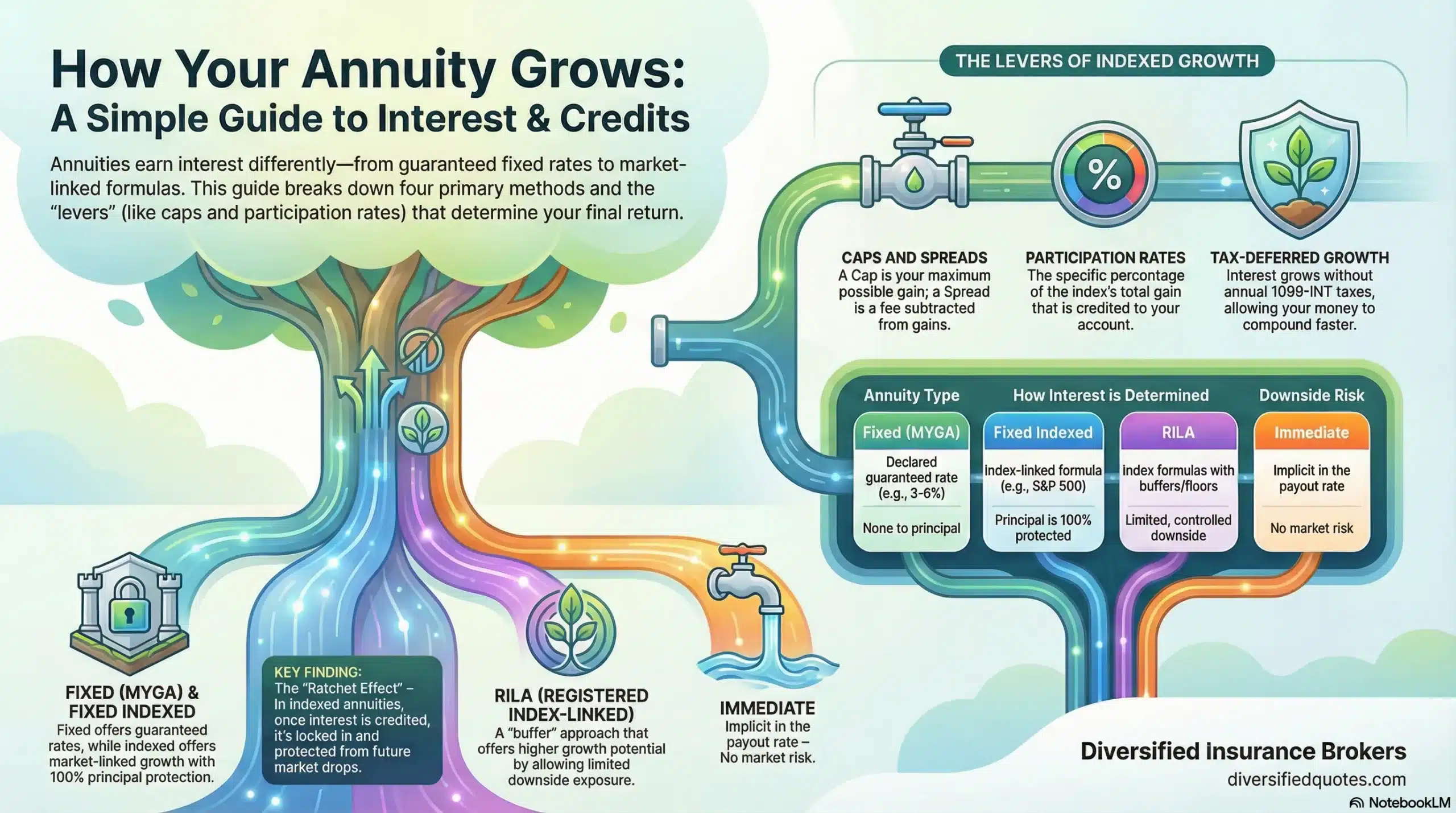
Explore indexed annuity mechanics, income planning strategies, and retirement income education.
Financial Protection Essentials
Chronic condition underwriting, burial insurance solutions, legal funding guidance, and specialized life insurance structures.
Talk With an Advisor Today
Choose how you’d like to connect—call or message us, then book a time that works for you.
Schedule here:
calendly.com/jason-dibcompanies/diversified-quotes
Licensed in all 50 states • Fiduciary, family-owned since 1980
FAQs: Does Annuitization Satisfy RMDs?
Does annuitizing an IRA annuity satisfy RMDs?
In most common situations, yes — if an IRA annuity is formally annuitized under the contract terms in a way that meets the IRS’s qualified distribution requirements under IRC Section 401(a)(9), the scheduled payments generally satisfy the RMD for that specific annuity contract. The IRS treats the payment stream of a properly annuitized IRA as the distribution mechanism for that contract, meaning no separate RMD calculation or additional withdrawal is required from that annuity.
The critical qualifications are that the annuitization must be irrevocable, the payment structure must conform to the applicable distribution period rules (most commonly based on life expectancy or joint life expectancy with a beneficiary), and payments must actually commence. The compliance requirements vary based on the specific payment option selected and the ages involved, which is why reviewing the annuitization election with a tax advisor before executing is advisable. Our resources on required minimum distributions and RMDs after SECURE 2.0 provide the current RMD age and calculation framework context.
If I annuitize one IRA, do I still have RMDs on my other IRAs?
Yes — annuitization satisfies the RMD for the annuitized contract specifically, but other non-annuitized traditional IRAs you own still have their own RMD requirements that must be met independently. The annuitized IRA “stands in its own lane” — its payment stream is treated as satisfying the distribution requirement for that contract, but it does not count toward or eliminate the RMD obligations from your other IRAs. You must calculate RMDs for your non-annuitized IRAs separately and ensure those distributions are taken from the appropriate accounts each year.
Fortunately, the IRS aggregation rules for traditional IRAs allow you to total the RMD amounts across multiple non-annuitized IRAs and take the combined amount from any one or combination of those IRAs — you do not need to withdraw from each non-annuitized IRA separately. The annuitized IRA is generally excluded from this aggregation, since its RMD is being satisfied by the payment stream rather than a discrete withdrawal decision. Keeping clear records of which accounts are annuitized and which are not is essential for RMD compliance when managing multiple accounts.
Can annuitized IRA payments be aggregated with other IRA RMDs?
Generally no — annuitized IRA payments are treated as satisfying the RMD for that contract only and are not included in the aggregation calculation for non-annuitized IRAs. The standard IRA aggregation rule allows you to combine RMDs across multiple non-annuitized traditional IRAs and satisfy the total from any single IRA or combination. But an annuitized IRA has exited the standard account-value-based RMD calculation framework, because the account no longer has a traditional balance to apply the Uniform Lifetime Table to — the payment stream from the annuitized contract is the distribution mechanism rather than a calculated withdrawal amount from a balance.
The practical planning implication is that a retiree with one annuitized IRA and two non-annuitized traditional IRAs has three separate RMD considerations: the annuitized IRA’s payment stream satisfies its own requirement, and the two non-annuitized IRAs’ combined RMD can be taken from either or both of those accounts in whatever allocation is most tax-efficient. The annuitized contract does not contribute to the non-annuitized pool. Consulting with a CPA or tax advisor who understands the interaction of annuitization and RMD aggregation rules for your specific account portfolio ensures accurate compliance.
Is a GLWB income rider the same as annuitization for RMD purposes?
No — and this is the most practically important distinction for retirees using income riders versus annuitized contracts. When you take income through a Guaranteed Lifetime Withdrawal Benefit (GLWB) rider, the annuity has not been annuitized. The contract remains in accumulation mode, the account value still exists and is subject to standard RMD calculations, and the GLWB withdrawals are treated as ordinary IRA distributions rather than an annuitized payment stream. The RMD for a GLWB-based IRA annuity is calculated on the account value in the same way as any other non-annuitized IRA asset.
Whether GLWB withdrawals satisfy the RMD depends entirely on whether the annual withdrawal amount equals or exceeds the calculated RMD for that account. If the GLWB provides, say, $8,400 in annual withdrawals but the calculated RMD is $9,200, a supplemental $800 withdrawal is needed. Many GLWB contract designs specifically accommodate RMDs — the annual withdrawal amount is structured to meet or exceed projected RMDs without triggering the excess withdrawal provisions that would reduce the income guarantee. Confirming this for a specific contract before income begins is an important planning step. Our resource on annuitization vs. lifetime withdrawals explains the full structural differences between these two income approaches.
Do non-qualified annuities have RMDs?
No. Non-qualified annuities are funded with after-tax, non-IRA dollars and do not have Required Minimum Distribution requirements. RMD rules apply exclusively to qualified retirement accounts — Traditional IRAs, 401(k)s, 403(b)s, SEP IRAs, SIMPLE IRAs, and similar tax-advantaged accounts funded with pre-tax contributions. A non-qualified annuity held outside of any retirement account wrapper has no RMD obligation regardless of the owner’s age, account size, or whether the annuity has been annuitized.
Annuitization of a non-qualified annuity does affect the tax treatment of the income payments received — the exclusion ratio determines what portion of each payment represents a return of the original cost basis (tax-free) versus the accumulated gain (taxable as ordinary income) — but it does not create an RMD obligation because no RMD obligation exists for non-qualified assets. Our resource on non-qualified annuity taxation explains the exclusion ratio and tax treatment of non-qualified annuity distributions in detail.
What is a QLAC and how does it affect RMDs?
A Qualified Longevity Annuity Contract (QLAC) is a specific type of deferred income annuity authorized under IRS regulations that allows a portion of IRA assets to be set aside in a way that temporarily reduces the RMD calculation base. Under SECURE 2.0 rules, IRA owners can allocate up to $200,000 (indexed for inflation) into a QLAC, and those QLAC assets are excluded from the IRA balance used to calculate annual RMDs until the QLAC income begins — which must start no later than the first day of the month after the owner reaches age 85. By removing a portion of the IRA balance from the RMD calculation in the years between purchase and income activation, a QLAC reduces the mandatory annual taxable distribution during those earlier years.
The practical planning value of a QLAC is twofold: near-term RMD reduction that can lower taxable income, reduce Medicare IRMAA surcharges, and potentially keep Social Security benefits less subject to taxation; and longevity income protection at advanced ages when other assets may be depleted. The QLAC is specifically designed for retirees who do not need all of their RMD income currently and want a tax-efficient way to defer some income to later in retirement when it may be most needed. QLAC assets must come from IRA funds; workplace plan assets (401k, 403b) can also be used in some cases. Consulting with a tax advisor before purchasing a QLAC to confirm it fits the specific retirement income and tax situation is advisable.
What is the biggest RMD mistake retirees make after annuitization?
The most common RMD mistake after annuitization is double-counting — either taking unnecessary extra distributions from other accounts that count the annuitized contract’s payment as a shortfall, or including the annuitized IRA’s (no longer applicable) account value in the aggregated RMD calculation for non-annuitized IRAs. Retirees accustomed to calculating a combined RMD across all their IRAs sometimes continue to include the annuitized contract’s former balance in the calculation even after annuitization, producing an overstated RMD obligation from the remaining accounts.
The opposite error also occurs: assuming the annuitized contract’s payment stream satisfies all RMD obligations across all retirement accounts, leading to missed distributions from non-annuitized IRAs. Both errors produce tax and compliance problems — either unnecessary over-withdrawal that accelerates taxable income needlessly, or actual RMD failure that subjects the missed distribution to the 25% excise tax penalty (reduced to 10% if corrected promptly under SECURE 2.0). Keeping annuitized and non-annuitized accounts clearly tracked, calculating the non-annuitized IRA RMD separately each year, and confirming with a tax advisor that the specific annuitized contract’s payment structure qualifies as RMD-compliant prevents these errors from accumulating over years of retirement.
Can annuitization help with tax planning in retirement?
Yes — annuitization can be a useful tool within a broader retirement tax strategy, particularly for retirees who want to convert a portion of their deferred tax liability into a predictable, level income stream rather than facing highly variable RMDs that may produce large taxable income spikes in some years. When an IRA is annuitized, the tax obligation on that portion of the account is essentially converted into a known, regular income that can be planned around rather than a calculation-dependent variable that changes with account values each year.
For retirees who expect tax rates to rise or whose non-annuitized IRAs will generate growing RMDs as they age, annuitizing a portion of the IRA locks in a specific annual tax obligation from that contract while allowing remaining flexible assets to be managed with Roth conversions, charitable qualified distributions, or other strategies that address the remaining tax exposure. The QLAC strategy provides an additional layer by temporarily removing assets from the RMD base, deferring the tax obligation while protecting against longevity risk at advanced ages. Social Security benefit taxation and Medicare IRMAA surcharges both respond to total taxable income — making the coordination of annuity income, RMDs, and these income-tested programs a meaningful retirement tax planning opportunity that benefits from holistic analysis.
Should I annuitize my entire IRA to satisfy RMDs?
Probably not — full annuitization of all IRA assets is generally not the optimal approach for most retirees, because it sacrifices all flexibility, beneficiary rights on remaining account value, and access to supplemental distributions for unexpected needs in exchange for the RMD simplicity it provides. The irrevocability of annuitization means that once completed, the payment structure cannot be changed, the contract cannot be surrendered, and no lump sum is available for large expenses. For retirees with long-term care needs, significant healthcare costs, or planned large expenditures, maintaining some non-annuitized IRA assets is important for preserving financial flexibility that annuitization permanently eliminates.
The more common and generally more appropriate approach is partial annuitization — annuitizing enough of the IRA to create a stable income floor that addresses essential living expense needs and satisfies the RMD obligation for that annuitized portion, while maintaining the remaining IRA assets in non-annuitized products (accumulation annuities, investment accounts, or liquid IRAs) that provide flexibility, growth potential, and beneficiary access. Our resources on lifetime income annuity options and fixed annuity laddering help frame how retirees structure the balance between annuitized and non-annuitized assets in their retirement income plans.
About the Author:
Jason Stolz, CLTC, CRPC, DIA, CAA and Chief Underwriter at Diversified Insurance Brokers (NPN 20471358), is a senior insurance and retirement professional with more than 25 years of real-world experience helping individuals, families, and business owners protect their income, assets, and long-term financial stability. As a long-time partner of the nationally licensed independent agency Diversified Insurance Brokers, Jason provides trusted guidance across multiple specialties—including fixed and indexed annuities, long-term care planning, personal and business disability insurance, life insurance solutions, Group Health, Travel Medical and Evacuation Insurance, and short-term health coverage. Diversified Insurance Brokers maintains active contracts with over 100 highly rated insurance carriers, ensuring clients have access to a broad and competitive marketplace.
His practical, education-first approach has earned recognition in publications such as VoyageATL, and contributions from his agency featured in Kiplinger and GoBankingRates— highlighting his commitment to financial clarity and client-focused planning. Drawing on deep product knowledge and years of hands-on field experience, Jason helps clients evaluate carriers, compare strategies, and build retirement and protection plans that are both secure and cost-efficient. Visitors who want to explore current annuity rates and compare options across multiple insurers can also use this annuity quote and comparison tool.
Browse More Resources: Return to our complete Fixed Indexed Annuity Products & Education guide — covering FIA products and education from top carriers.
Last Reviewed: July 18, 2026 |
Reviewed by: Jason Stolz, CLTC, CRPC, DIA, CAA
Chief Underwriter, Diversified Insurance Brokers, Inc. | NPN: 20471358 | Diversified Insurance Brokers, Inc. — Licensed in all 50 states
Fact Checked by: Tonia Pettitt, CMIP©
Medicare Specialist, Diversified Insurance Brokers, Inc. | NPN: 14374308 | Diversified Insurance Brokers, Inc. — Licensed in all 50 states
Did you find this content helpful? Leave us a Google review — it helps others find trustworthy guidance too.
Editorial Standards: Diversified Insurance Brokers maintains rigorous editorial standards to ensure accuracy, clarity, and independence in all content. Learn more about our editorial standards and commitment to transparency.
