
Deferred Annuity with Lifetime Payout
As an Independent Annuity Broker, we compare rates across 100+ carriers and 1,000 different annuities— not just one company’s product offerings — to find the best fit for your goals.
Deferred Annuity with Lifetime Payout

Jason Stolz CLTC, CRPC, DIA, CAA
A deferred annuity with lifetime payout combines two separate but coordinated phases in a single contract: a tax-deferred accumulation period where capital grows without annual taxation, followed by a lifetime income period where the contract generates guaranteed payments that cannot be outlived regardless of how long the owner lives or what happens to markets. The core value of this structure is that it converts the risk of longevity — the possibility of living longer than your savings can sustain — from an existential planning threat into a solved problem. Once lifetime income is activated, it continues. Period. Not until the contract value runs out, not subject to market conditions, not contingent on investment performance. The contractual guarantee of lifetime income is backed by the financial strength of the issuing insurance company and defined precisely in the policy document. Our resources on current fixed annuity rates and current bonus annuity rates cover the current market for the accumulation side of this equation, and our resource on annuities 101 provides foundational context for buyers who are evaluating annuities as a retirement income tool for the first time.
The mechanics of how a deferred annuity generates lifetime income after a period of growth depend on the specific product structure. The most common modern design uses a fixed indexed annuity (FIA) as the accumulation vehicle combined with a Guaranteed Lifetime Withdrawal Benefit (GLWB) rider that builds a separate “income base” — a calculation value that grows at a guaranteed roll-up rate during the deferral period and then generates a specified annual withdrawal amount when income is activated. The account value and the income base are separate: the account value is the actual money in the contract, subject to index crediting and rider fees; the income base is the guaranteed calculation engine that determines the lifetime payment, which continues even if the account value eventually depletes to zero. Buyers evaluating FIA-based designs frequently ask about the downside scenarios. Our resources on do you lose your principal in an indexed annuity and what happens to my indexed annuity if the market goes down cover the principal protection and floor mechanics that underpin how the accumulation phase of these products manages market risk.
At Diversified Insurance Brokers, we evaluate deferred annuity structures across more than 100 carriers for the same client profile because the income efficiency of these products varies dramatically. Two contracts advertised with similar roll-up rates can produce meaningfully different guaranteed lifetime income at the same activation age when rider fees, cap rates, participation rates, and income base bonus structures are compared on a side-by-side basis. The right evaluation is not “which product has the highest number on the cover page” — it is “which product produces the highest verified guaranteed income at your actual planned activation age, with the most transparent and manageable cost structure, from a carrier with the financial strength to honor the guarantee for 20 or 30 years.” Our resource on lifetime income annuity options covers the full spectrum of income-generating annuity structures available in the current market.
Ensure you are receiving the absolute top rates
Current Fixed Annuity Rates
Compare today’s best fixed annuity rates from top carriers.
Current Bonus Annuity Rates
See which annuities offer the highest upfront bonus today.
Request an Annuity Quote
Submit our annuity request form to get personalized rate options.
Lifetime Income Calculator
Use our calculator to estimate how much guaranteed lifetime income a deferred annuity could generate at your planned activation age.
Types of Deferred Annuity With Lifetime Payout — How Each Structure Works
The term “deferred annuity with lifetime payout” describes a category of products, not a single contract type. Several distinct product structures can deliver this outcome, each with different accumulation mechanics, income determination methods, liquidity features, and cost structures. Selecting the right structure depends on the buyer’s timeline, income activation age, risk tolerance, and need for account value access.
| Product Type | Accumulation Mechanism | How Lifetime Income Is Generated | Account Value Access After Income Begins | Best Fit |
|---|---|---|---|---|
| Fixed Indexed Annuity (FIA) with GLWB Rider | Index-linked credits with 0% floor against negative years; principal protected from market loss; tax-deferred growth; separate income base grows at guaranteed roll-up rate (typically 5-8%/year) | Guaranteed Lifetime Withdrawal Benefit rider applies an age-based payout percentage to the income base; income continues for life even if account value depletes to zero; no annuitization required | Yes — remaining account value accessible within contract rules; excess withdrawals reduce benefit base; beneficiaries receive remaining account value at death | Buyers who want index-linked accumulation potential, principal protection, guaranteed income floor, and the flexibility of maintaining account value access without full annuitization |
| Fixed Deferred Annuity with Income Rider | Declared credited interest rate (similar to a MYGA structure); fully guaranteed accumulation; tax-deferred growth; income base may grow at a separate guaranteed roll-up rate | Income rider generates lifetime withdrawals from benefit base at activation; payments continue for life; account value may be depleted before death with income payments continuing | Yes, within contract rules — simpler structure than FIA, easier to track; beneficiaries receive remaining account value | Conservative buyers who want guaranteed accumulation certainty alongside guaranteed lifetime income; those who prefer predictability in both phases |
| Deferred Income Annuity (DIA) / Longevity Annuity | No account value during deferral — premium is deposited and income begins at a future date; highly efficient income design because there is no accumulation cost layer | Lifetime income begins automatically at the elected start date; income amount is contractually guaranteed at purchase and locked in permanently; no activation decision required | No — no account value to access; the trade-off for higher income efficiency is the absence of liquidity; death benefit options vary by contract (return of premium, period certain) | Buyers who want maximum income efficiency at a specific future age and do not need ongoing access to the premium; ideal as a longevity hedge on a portion of assets |
| Traditional Annuitization of a Deferred Contract | Deferred annuity accumulates over time (fixed, FIA, or variable); at income start date, the full account value is annuitized — converted into a stream of payments | Account value is exchanged for a guaranteed income stream based on actuarial calculations; life-only, period certain, joint life, and other payout options available; typically higher per-dollar income than GLWB riders | No — once annuitized, the contract is irrevocable; the account value no longer exists as a lump sum; the trade-off is higher income efficiency for complete loss of liquidity | Buyers who prioritize maximum income per dollar above all else and are comfortable with irrevocable commitment; those with other liquid assets who can separate income from liquidity needs |
Product features, rider terms, and income mechanics vary significantly by carrier and specific contract. GLWB payout rates, roll-up rates, and rider fees are subject to carrier-specific guidelines and are not standardized across the industry. Guarantees are backed by the financial strength and claims-paying ability of the issuing insurance company, not by any government agency. This table is educational and does not represent the terms of any specific contract. Obtain carrier-specific illustrations before making any purchasing decision.
Phase 1 — The Deferred Accumulation Phase
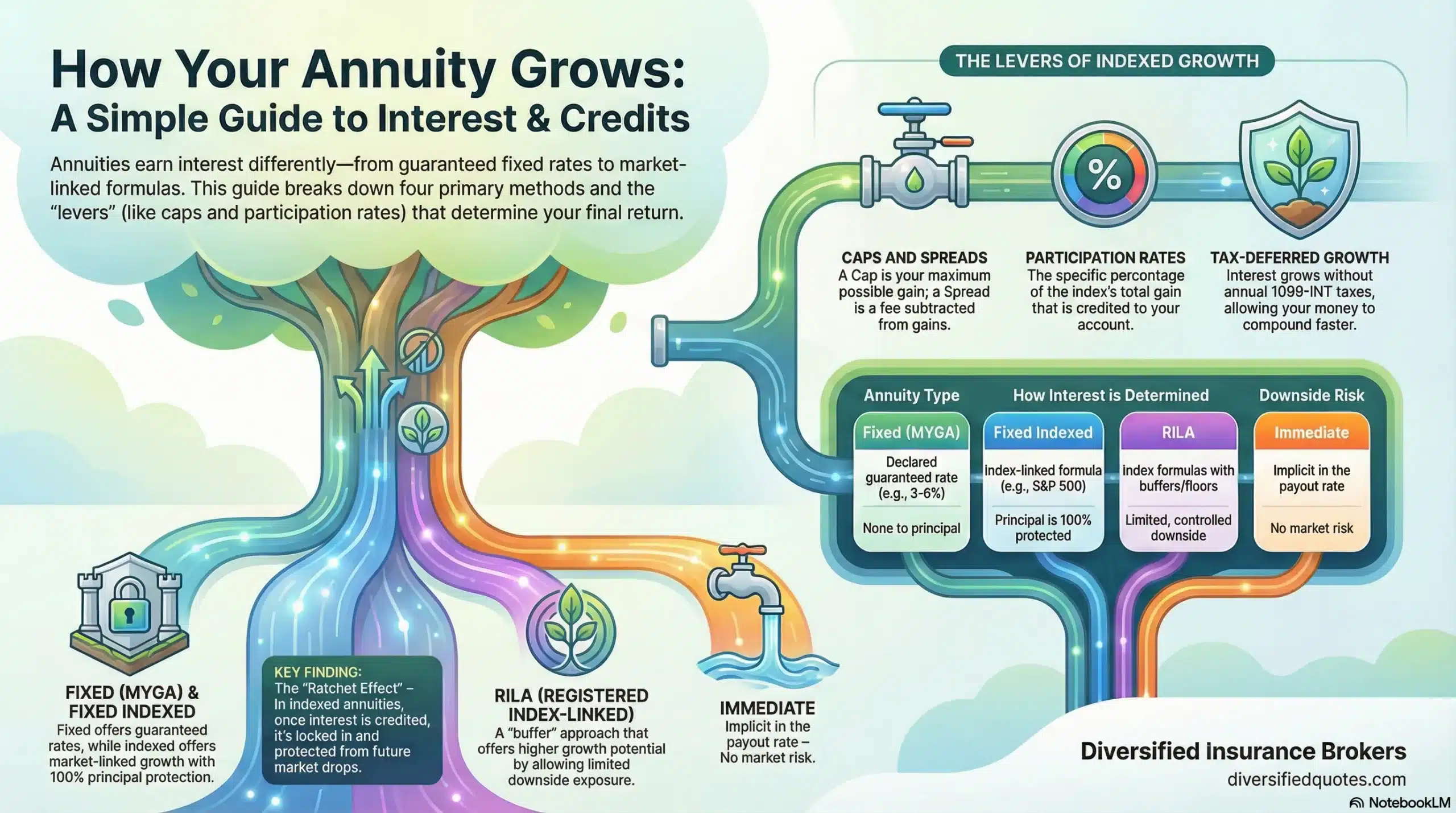
The accumulation phase is where the value is built before income begins. In a fixed indexed annuity, the accumulation phase uses index-linked crediting strategies — tracking the performance of an index such as the S&P 500 with a cap or participation rate applied, and a 0% floor that prevents negative crediting in a year when the index declines. The 0% floor is what distinguishes FIA accumulation from direct equity market exposure: the account cannot receive a negative index credit in a down year, though it also does not participate in the full upside in strong years due to the cap or participation rate constraint. Our resource on what is a fixed indexed annuity covers the crediting mechanics and product structure in full detail, and our resource on who is best suited for an indexed annuity covers the buyer profile and financial planning scenarios where FIA accumulation makes the most sense. For buyers evaluating shorter-term guaranteed accumulation alongside lifetime income planning, our resource on best MYGA annuity rates covers the fixed-rate alternative that some buyers use for an initial accumulation period before repositioning into an income-bearing contract through a 1035 exchange. The accumulation phase is also where crediting adjustments happen: cap rates and participation rates can change at renewal within the parameters defined in the contract. Our resource on do fixed indexed annuity rates change covers how these renewal adjustments work and what buyers should understand about long-term accumulation assumptions before committing to a specific product design. Knowing the potential downside of an FIA structure before committing is equally important. Our resource on what is the downside of a fixed indexed annuity covers the tradeoffs buyers should evaluate before selecting an FIA-based income strategy.
How Income Riders Work — The GLWB Mechanism
The Guaranteed Lifetime Withdrawal Benefit rider is the most common mechanism for delivering lifetime income from a deferred annuity without requiring full annuitization. The GLWB works through a parallel tracking system: the actual account value — the real money in the contract — follows its own trajectory based on index credits, rider fees, and withdrawals. Simultaneously, an income base (also called a benefit base) tracks a separate guaranteed value that grows at a contractually specified roll-up rate regardless of account value performance. The income base is not money you can withdraw as a lump sum — it is a calculation number whose sole purpose is to determine the amount of the guaranteed lifetime withdrawal when income is activated. Our resource on what is an income rider covers the GLWB structure and the distinction between account value and income base in plain terms. The GLWB’s most important feature is continuity: if the account value eventually depletes to zero — because guaranteed withdrawals exceed index credits and rider fees over many years — the income payments continue for life regardless. The insurance company honors the guarantee from its general account reserves, not from the policyholder’s remaining contract value. This is the longevity protection mechanism at the heart of the product: no matter how long you live, the income does not stop. Our resource on guaranteed income from annuities covers the income guarantee framework across product types, and our resource on lifetime income annuity options covers the full income landscape for buyers comparing multiple lifetime income strategies.
The Benefit Base — Roll-Up Rates, Step-Ups, and Deferral Bonuses
The income base grows during the deferral period through one or more of three mechanisms: guaranteed roll-up rates, step-ups triggered by account value performance, and upfront deferral bonuses on certain contracts. Understanding each is essential for accurately comparing competing proposals. Roll-up rates are guaranteed annual increases to the income base, typically expressed as 5-8% per year and applied on either a simple or compound interest basis. Simple roll-up of 7% on a $200,000 premium produces a $14,000 income base increase each year — the income base grows by $140,000 over 10 years of deferral regardless of what the account value does. Compound roll-up of 7% applied annually to the running income base produces a larger result because each year’s increase is applied to the prior balance rather than the original premium. Step-ups work differently: on each contract anniversary, if the account value exceeds the current income base, the income base “steps up” to lock in the higher account value as the new base — capturing real market gains in the income calculation. Some contracts offer both roll-up and step-up as competing options on each anniversary, automatically applying whichever produces the higher income base on that date. Premium bonuses credited to the income base at contract issue — sometimes expressed as 10%, 20%, or higher percentages of the first-year premium — can meaningfully increase starting income efficiency by front-loading the income base before any roll-up accumulates. Our resource on bonus annuity comparison covers how income base bonuses differ from account value bonuses and which type matters more for a buyer focused on lifetime income rather than accumulation.
Phase 2 — Activating Lifetime Income and Age-Based Payout Percentages
When you are ready to begin income, you elect to “turn on” the GLWB rider. At that point, the insurance carrier calculates the guaranteed annual withdrawal amount by applying an age-based payout percentage to the income base that exists at the activation date. The payout percentage is a key contract term that increases with the age at which you begin income — rewarding longer deferral with higher income efficiency. Typical payout percentage schedules (which vary by carrier and contract) follow this general pattern: age 60 approximately 4%, age 65 approximately 5%, age 70 approximately 5.5-6%, age 75 approximately 6-7%, and age 80 approximately 7% or higher. Applied to an income base, these percentages determine the guaranteed annual withdrawal amount. For example, a benefit base of $350,000 at age 70 with a 5.5% payout percentage produces a guaranteed annual withdrawal of $19,250 — approximately $1,604 per month — for life, regardless of account value performance. For a joint life election, the payout percentage is typically reduced by 0.5-1.5 percentage points to account for the extended coverage duration when two lives are covered. The choice between activating income earlier at a lower payout percentage versus deferring longer to capture both additional roll-up growth on the income base and a higher payout percentage is one of the most consequential optimization decisions in lifetime income planning. Our resource on guaranteed income from annuities covers how to evaluate this trade-off for different retirement timelines.
What Happens to Account Value and Death Benefits
One of the most important distinctions between a GLWB-based lifetime payout and traditional annuitization is that the GLWB preserves the account value as a separate asset during and after income activation. After income begins, the account value continues to be tracked — it receives any index credits minus rider fees, and is reduced by the annual guaranteed withdrawal amount. As long as the account value remains positive, beneficiaries named on the contract receive the remaining account value at the contract owner’s death. When the account value eventually depletes to zero due to the guaranteed income withdrawals exceeding earnings, the income payments continue for life but there is no remaining lump sum to pass to heirs. This is the critical distinction between account value and income guarantee: the income is guaranteed for life; the residual legacy benefit depends on how long the owner lives and how the account value performs during that period. Excess withdrawals — amounts taken above the annual guaranteed withdrawal — are permitted but reduce the income base, which lowers future guaranteed income amounts. Our resource on annuity beneficiary death benefits covers the full range of death benefit structures and what beneficiaries can expect depending on when the death occurs relative to the income activation date and account value balance.
Tax Treatment of Deferred Annuity Income
Tax treatment of deferred annuity income depends on whether the contract was funded with qualified or non-qualified dollars. Qualified annuities — funded with pre-tax IRA, 401(k), or other qualified retirement account dollars through a rollover — generate fully taxable ordinary income on every distribution, because no income tax was ever paid on those dollars. Non-qualified annuities — funded with after-tax personal savings — use the LIFO rule for withdrawals (gains come out first and are taxable) or the exclusion ratio for annuitized payments (splitting each payment between taxable gain and tax-free return of principal). During the deferral phase, growth in both qualified and non-qualified annuities accumulates tax-deferred — no annual 1099 for credited interest or index gains. The income payments that begin in Phase 2 also follow these same qualified/non-qualified rules. A significant planning consideration is that annuity income — because it is taxed as ordinary income rather than at the lower capital gains rate — should be sequenced carefully alongside Social Security, RMDs, and other income sources to manage total AGI across retirement years. Our resource on how annuities are taxed in retirement covers the full tax framework including LIFO, exclusion ratio, and the 10% early withdrawal penalty for distributions before age 59½. Our resource on required minimum distributions covers how qualified annuity income interacts with RMD requirements — including how properly structured annuity payments can satisfy RMDs for that specific contract.
Surrender Charges and Liquidity Planning
Deferred annuities with income riders include surrender charge periods — typically 7-10 years from the contract issue date — during which full contract surrender triggers a declining percentage penalty on the amount withdrawn above the permitted free withdrawal amount. Most contracts allow 10% of the contract value per year to be withdrawn without surrender charge — this is the “free withdrawal” provision that provides a limited annual liquidity window during the surrender period. Understanding the surrender schedule before purchase is essential because the surrender period directly constrains how much of the premium is accessible without penalty during the accumulation phase. After the surrender period ends, full liquidity is available without carrier-imposed charges — though tax consequences and the impact on the income base still apply to excess withdrawals. Our resource on annuity surrender charges explained covers the mechanics of surrender schedules and how to evaluate them as part of a complete product comparison, and our resource on annuity free withdrawal rules covers the annual penalty-free access provisions in detail. The practical planning implication is straightforward: money designated for short-term emergencies, near-term large expenses, or high-probability liquidity needs should be held outside the annuity. The annuity portion of the retirement portfolio should represent money with a long-term income objective where liquidity is not the primary need.
Sequence of Returns Risk — The Retirement Challenge That Guaranteed Income Solves
Sequence of returns risk is the danger that a poor sequence of early investment returns permanently impairs a retirement portfolio’s ability to sustain withdrawals across a long retirement, even when long-term average returns are acceptable. A retiree withdrawing 4-5% annually from an investment portfolio who experiences a significant market decline in years two and three of retirement is drawing down a smaller portfolio value — reducing the base available to recover in subsequent up years. The same average return spread over a different sequence can produce dramatically different portfolio survival outcomes. Guaranteed lifetime income from a deferred annuity immunizes the portion of retirement spending it covers from sequence of returns risk entirely. The guaranteed withdrawal is not drawn from a portfolio that can be impaired by early returns — it is contractually fixed and paid regardless of market conditions. Our resource on sequence of returns risk covers the mathematics and real-world impact of this risk in detail. Our resource on how to not run out of money in retirement covers the broader longevity planning framework that places guaranteed income as the foundational layer of a durable retirement income plan.
Coordinating With Social Security, Pensions, and RMDs
A deferred annuity with lifetime payout functions best as a coordinated component of the overall retirement income structure rather than a standalone product. The income activation date should align with the household’s broader income sequencing strategy — when Social Security begins, when pension income starts, and when RMDs from qualified accounts create mandatory taxable distributions. Activating annuity income before Social Security can create an income bridge that allows the higher earner to delay Social Security to 70 and capture the maximum benefit, while the annuity income covers living expenses during the 3-5 year deferral window. Activating annuity income after Social Security and pension creates a reinforcing income floor where multiple guaranteed sources cover essential expenses without portfolio withdrawal dependency. Avoiding simultaneous income activation from multiple sources in the same year prevents unintentional AGI spikes that push Social Security benefits from partially to fully taxable or trigger IRMAA Medicare premium surcharges. Our resource on pension alternative covers how annuity income can replicate the structure and security of a pension for households without traditional defined benefit plans. Our resource on required minimum distributions covers how RMD timing interacts with annuity income from qualified contracts, and our resource on how to not run out of money in retirement covers the overall income sequencing framework.
Evaluating Existing Annuities and Getting a Second Opinion
Many buyers who are evaluating a deferred annuity with lifetime payout already own an annuity — sometimes one purchased years ago with different rates, different rider terms, or income provisions that no longer align with the current income objective. The question of whether to maintain the existing contract or reposition through a 1035 exchange into a newer contract with stronger income features deserves careful modeling. The older contract’s surrender schedule, accumulated income base, and any existing step-up credits must be weighed against what the new contract would provide from a fresh start with current rider terms and current account value. Our resource on annuity rescue plan covers the evaluation framework for existing annuities that may be underperforming relative to current market alternatives. Our resource on get a 2nd opinion on your annuity quote covers the independent review process for buyers who have received a specific proposal and want to verify they are seeing the most competitive income available for their premium amount, age, and planned activation date before committing.
Talk With an Advisor Today
Choose how you’d like to connect—call or message us, then book a time that works for you.
Schedule here:
calendly.com/jason-dibcompanies/diversified-quotes
Licensed in all 50 states • Fiduciary, family-owned since 1980
FAQs: Deferred Annuity With Lifetime Payout
What is a deferred annuity with a lifetime payout?
A deferred annuity with a lifetime payout is a contract that first accumulates value tax-deferred during a deferral period, and then converts that accumulated value into guaranteed lifetime income payments that continue regardless of how long the owner lives. The most common modern design uses a fixed indexed annuity (FIA) with a Guaranteed Lifetime Withdrawal Benefit (GLWB) rider — allowing the owner to maintain account value access while receiving guaranteed lifetime withdrawals. Unlike traditional annuitization, the GLWB does not require surrendering the account value; income payments continue even if the account value eventually depletes to zero due to withdrawals.
What is the difference between the account value and the income base (benefit base)?
The account value is the actual money in the contract — what you could receive if you surrendered the contract (subject to surrender charges). It is affected by index credits, rider fees, and any withdrawals taken. The income base (benefit base) is a separate calculation value that exists only to determine the guaranteed lifetime withdrawal amount. It is not money you can withdraw as a lump sum. During the deferral period, the income base grows at a guaranteed roll-up rate (typically 5-8%/year) regardless of account value performance. When you activate income, the guaranteed annual withdrawal is calculated as a percentage of the income base at that date. If the account value depletes to zero, the income base-driven payments continue for life.
How is the guaranteed lifetime withdrawal amount calculated?
The guaranteed annual withdrawal equals the income base at activation multiplied by the age-based payout percentage. The payout percentage is defined in the contract and increases with the age at which you begin income — typically ranging from approximately 4% at age 60 to 5-6% at age 70 and 7%+ at age 80, though these vary by carrier and contract. For example, an income base of $350,000 at age 70 with a 5.5% payout percentage produces $19,250 per year (approximately $1,604/month) in guaranteed lifetime income. The withdrawal amount is fixed once income begins, though some riders include cost-of-living adjustment or step-up features that can increase the payment over time under specific conditions.
What happens to my contract if I die before the account value runs out?
If you die while the account value is still positive, the remaining account value generally passes to your named beneficiaries according to the contract’s death benefit provisions and applicable tax rules. Beneficiaries receive the account value — not the income base — as the death benefit. If you elected a joint life income option and your spouse survives you, income payments continue for your spouse’s lifetime. If you die after the account value has depleted to zero (because guaranteed withdrawals exceeded earnings over time), there is no remaining account value to pass to heirs. This is why some buyers elect period-certain income guarantees or return-of-premium death benefit riders that provide a minimum legacy regardless of when death occurs relative to income commencement.
Does deferring income longer always produce a higher payout?
Generally yes, for two reinforcing reasons: the income base continues to grow at the guaranteed roll-up rate during each additional year of deferral, and the payout percentage applied to the income base increases with each year of age at activation. A one-year deferral might increase the income base by 7% through roll-up AND increase the payout percentage from 5% to 5.25% — both of which increase the guaranteed annual withdrawal. However, deferral also has an opportunity cost: you forego income that could have started earlier. The optimal activation age depends on the specific contract’s roll-up and payout schedule, the rider fee drag on account value, and your personal income needs and retirement timeline.
Are deferred annuity income payments subject to RMDs?
If the deferred annuity is held inside a qualified retirement account such as a traditional IRA, Required Minimum Distributions apply once you reach the applicable RMD age (73 for those born 1951-1959; 75 for those born 1960 or later). When a qualified annuity is structured to make guaranteed lifetime income payments that meet or exceed the calculated RMD amount, those payments typically satisfy the RMD requirement for that specific contract. Non-qualified deferred annuities — funded with after-tax personal savings outside of any IRA or employer plan — are not subject to RMDs and have no mandatory withdrawal schedule during the owner’s lifetime.
About the Author:
Jason Stolz, CLTC, CRPC, DIA, CAA and Chief Underwriter at Diversified Insurance Brokers (NPN 20471358), is a senior insurance and retirement professional with more than 25 years of real-world experience helping individuals, families, and business owners protect their income, assets, and long-term financial stability. As a long-time partner of the nationally licensed independent agency Diversified Insurance Brokers, Jason provides trusted guidance across multiple specialties—including fixed and indexed annuities, long-term care planning, personal and business disability insurance, life insurance solutions, Group Health, Travel Medical and Evacuation Insurance, and short-term health coverage. Diversified Insurance Brokers maintains active contracts with over 100 highly rated insurance carriers, ensuring clients have access to a broad and competitive marketplace.
His practical, education-first approach has earned recognition in publications such as VoyageATL, and contributions from his agency featured in Kiplinger and GoBankingRates— highlighting his commitment to financial clarity and client-focused planning. Drawing on deep product knowledge and years of hands-on field experience, Jason helps clients evaluate carriers, compare strategies, and build retirement and protection plans that are both secure and cost-efficient. Visitors who want to explore current annuity rates and compare options across multiple insurers can also use this annuity quote and comparison tool.
Explore More Annuity Options: Browse our complete guide to Annuity Strategies & Retirement Income — covering tax strategies, retirement income planning, lifetime income & annuity comparisons from 100+ carriers.
Last Reviewed: June 5, 2026 |
Reviewed by: Jason Stolz, CLTC, CRPC, DIA, CAA
Chief Underwriter, Diversified Insurance Brokers, Inc. | NPN: 20471358 | Diversified Insurance Brokers, Inc. — Licensed in all 50 states
Fact Checked by: Tonia Pettitt, CMIP©
Medicare Specialist, Diversified Insurance Brokers, Inc. | NPN: 14374308 | Diversified Insurance Brokers, Inc. — Licensed in all 50 states
Did you find this content helpful? Leave us a Google review — it helps others find trustworthy guidance too.
Editorial Standards: Diversified Insurance Brokers maintains rigorous editorial standards to ensure accuracy, clarity, and independence in all content. Learn more about our editorial standards and commitment to transparency.
