
Do You Lose your Principal in an Indexed Annuity
As an Independent Annuity Broker, we compare rates across 100+ carriers and 1,000 different annuities— not just one company’s product offerings — to find the best fit for your goals.
Do You Lose your Principal in an Indexed Annuity

Jason Stolz CLTC, CRPC, DIA, CAA
Do you lose your principal in an indexed annuity? In most standard designs, no — and the reason is structural rather than promotional. A fixed indexed annuity is not a market investment. It does not purchase shares of any index fund, ETF, or market portfolio. It is an insurance contract where the index serves as a reference benchmark for calculating how much interest to credit in any given period. When the benchmark index declines, the contract’s crediting floor — most commonly set at zero percent — prevents that decline from reducing the account value. Prior credited interest stays locked in. The account value does not drop because the index dropped, because the index is not something you own inside the contract. Understanding this structural distinction is the foundation for evaluating whether an indexed annuity belongs in a retirement plan, at what allocation, and for what purpose.
That said, “principal protection” in an indexed annuity is a precise term with specific scope — and understanding that scope prevents the confusion that frustrates buyers who later discover their account value changed in ways they did not expect. The protection is strongest against one specific type of loss: index-driven market decline. It does not extend to withdrawals taken beyond the contract’s penalty-free provision, surrender charges incurred when the contract is exited early, income rider fees for optional benefits that were elected, or the tax consequence of withdrawing accumulated gains. Those are four entirely different ways an account value can be reduced that have nothing to do with the market going down. Knowing which risks the indexed annuity protects against and which it does not is what separates informed buyers from frustrated ones. At Diversified Insurance Brokers, Jason Stolz, CLTC, CRPC, DIA, CAA evaluates indexed annuity designs across 100+ carriers with this clarity as the starting point — confirming how the principal protection floor works in a specific contract before any comparison is finalized. Our resource on what is a fixed indexed annuity covers the complete FIA structural overview, and our resource on common annuity myths covers the most persistent misconceptions that cause buyers to misinterpret what principal protection does and does not provide.
Ensure you are receiving the absolute top rates
Current Fixed Annuity Rates
Compare today’s best fixed annuity rates from top carriers.
Current Bonus Annuity Rates
See which annuities offer the highest upfront bonus today.
Request an Annuity Quote
Submit our annuity request form to get personalized rate options.
Lifetime Income Calculator
Use our calculator to see how much guaranteed income your annuity can provide.
What Can and Cannot Reduce Your Indexed Annuity Account Value
The clearest way to answer whether you lose principal in an indexed annuity is to map every scenario that could reduce account value against whether the reduction is market-driven or contract-driven. The table does that explicitly — showing exactly where principal protection is strong and where it has natural limits.
| Scenario | Reduces Account Value? | Key Details |
|---|---|---|
| Market index declines significantly | No — 0% floor applies | When the referenced index falls, the crediting floor (typically 0%) prevents any negative credit from reaching the account value. Prior gains remain locked in. This is principal protection functioning as designed. |
| Interest already credited in prior positive periods | No — locked in permanently | Once interest is credited to the account value, it cannot be reversed by subsequent index declines. The “stair-step” growth pattern means prior gains are protected regardless of what the index does in future crediting periods. |
| Withdrawals within the free withdrawal provision | Yes — but by your choice, not the market | Most contracts allow 10% of account value annually without surrender charges. Taking this provision reduces account value, but this is a deliberate withdrawal — not a market loss. The contract is performing as intended. |
| Withdrawals exceeding the free withdrawal provision during surrender period | Yes — surrender charges apply | Accessing more than the penalty-free amount during the surrender period triggers carrier-imposed surrender charges that reduce the distributed amount below account value. Unrelated to index performance — this is early contract exit cost. |
| Full surrender during the surrender period | Yes — surrender charge schedule applies | Surrendering the full contract before the surrender period expires can reduce the net amount received. The surrender charge schedule is defined at contract issue and declines annually to zero. After the surrender period, full access is available without penalty. |
| Income rider fees (if an income rider was elected) | Yes — annual fee reduces account value | Optional income riders typically carry an annual fee (commonly 0.50%–1.25% of the account value or benefit base). In a 0% crediting year, the rider fee can produce a slight net decline in account value. This is the tradeoff for the income guarantee — not a failure of principal protection. |
| Taxes on gain withdrawals from non-qualified accounts | Reduces net proceeds — not account value directly | Non-qualified annuity gains are taxed as ordinary income when withdrawn. This doesn’t reduce the contract account value shown on the statement, but it reduces the net amount you actually receive. “Principal protection” does not include protection from income taxes. |
| Insurance carrier financial difficulty | Potential risk — state guaranty association applies | Indexed annuities are backed by the carrier’s general account, not FDIC or SIPC. State guaranty associations provide protection up to applicable state limits (commonly $250,000 in annuity benefits) if a carrier becomes insolvent. Carrier financial strength evaluation is part of responsible due diligence. |
The table’s central message is the distinction between market risk — which the FIA’s 0% floor protects against — and contract-usage risk, which consists of decisions the contract owner makes. The first two rows represent what principal protection actually covers. The remaining rows represent risks that exist in virtually any long-term financial contract and are not what people mean when they ask whether indexed annuities are “safe.” Our resource on annuity surrender charges explained covers rows four and five in detail, and our resource on annuity free withdrawal rules covers how the free withdrawal provision in row three works across different contract designs — including cumulative versus non-cumulative structures that meaningfully affect real-world liquidity. Our resource on state guaranty association covers the row eight carrier risk dimension and the protection that applies up to state-specific limits.
What “Principal Protection” Really Means in an Indexed Annuity
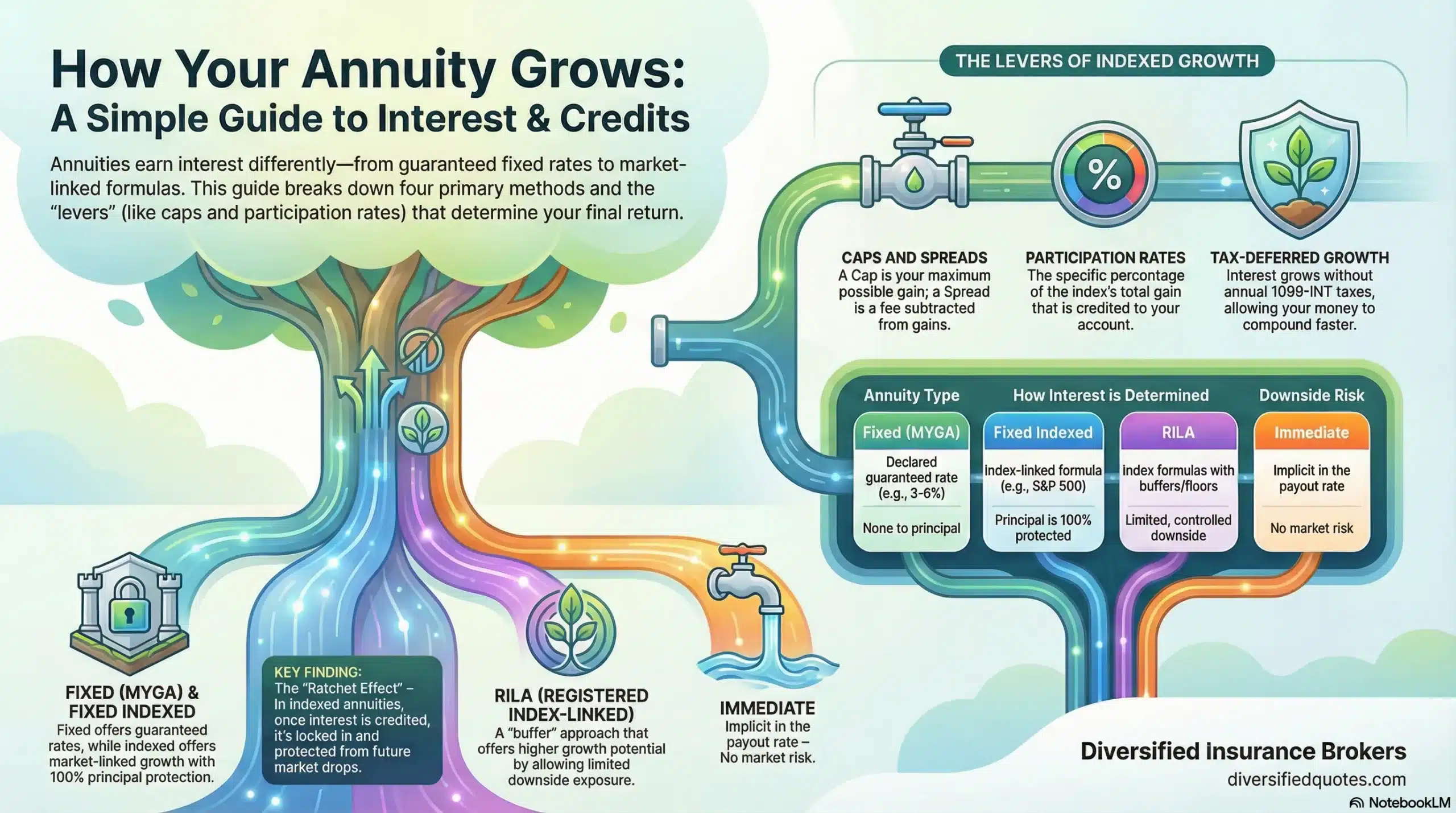
In an indexed annuity, principal protection refers specifically to the floor mechanism built into the crediting strategy — a contractual provision that prevents negative index performance from producing a negative credit to the account value. The most common floor is zero percent: if the index used for the crediting strategy is down over the measurement period, the credited rate for that strategy is zero rather than a negative number. Prior credited interest generally remains locked in. The account value does not decline due to the index declining, because the contract’s design prevents that transmission.
This floor-based protection creates the characteristic “stair-step” account value pattern that distinguishes indexed annuities from direct market investments. In positive index years, the account value moves upward as interest is credited. In negative index years, the account value stays level — neither gaining nor losing — rather than declining with the market. Over long periods with multiple market cycles, this stair-step profile produces an account value trajectory that reflects the positive market years while skipping the losses — producing consistent growth without the “digging out of holes” dynamic that characterizes direct market investment during volatile periods.
The tradeoff for this floor protection is that the upside is managed through product parameters — caps, participation rates, or spreads — that limit how much of the index’s positive performance is credited in any given period. A cap-based design might credit the first 8% of index gains but nothing above that; a participation rate design might credit 60% of index gains without a cap. These parameters reflect how the carrier funds the floor protection through its investment and hedging strategy. The indexed annuity is not marketed as a maximum-growth vehicle; it is designed for stable, protected accumulation where the elimination of market losses is the primary value proposition. Our resource on fixed annuities vs. fixed indexed annuities covers how this upside tradeoff compares between the two principal-protected product types, and our resource on fixed indexed annuity with guaranteed rates covers designs that incorporate additional guaranteed crediting elements alongside the index-linked strategy.
Why Indexed Annuities Don’t Transmit Market Losses to the Account Value
The simplest explanation for why an indexed annuity account value doesn’t decline when the market falls is that the contract owner does not own the index. In a mutual fund or ETF, the investor owns a pro-rata share of the underlying assets — when those assets lose value, the investor’s account value declines proportionally. In an indexed annuity, the insurer uses the index as a calculation reference for determining how much interest to credit in a given period. The contract owner has no ownership stake in the index. When the index falls, the insurer simply credits zero interest for that period rather than a negative amount — because the contract’s design specifies that the floor prevents negative credits.
From a retirement planning perspective, this matters because of recovery mathematics. A portfolio that declines 30% must then gain approximately 43% to return to its original value — a recovery burden that takes years in a rising market. A retiree who is drawing income from a portfolio during the recovery period faces an even more severe challenge: the withdrawals permanently remove capital at depressed values, leaving less available to recover as the market rises. This is the sequence-of-returns problem, and it is one of the most consequential risks in retirement income planning. Our resource on sequence of returns risk covers this dynamic in detail — explaining why the same average annual return can produce very different outcomes depending on the sequence in which those returns are received, and why principal-protected vehicles are one of the tools that can reduce this timing vulnerability for the portion of assets allocated to them.
Market Loss vs. Contract Risk — Understanding Both Before Buying
The most productive way to think about indexed annuity principal protection is: “The market cannot take it from me, but I can still reduce it through my own actions or the contract’s fee structure.” When buyers experience disappointment, it is almost always because they interpreted principal protection as an absolute guarantee covering every possible scenario rather than a contractual protection against one specific type of loss: index-driven market decline. Recognizing the distinction between market risk and contract-usage risk sets realistic expectations that prevent the confusion that leads to poor decisions — like surrendering a contract early specifically to avoid “losing money” that the contract was never actually at risk of losing to the market.
The practical response to this distinction is straightforward in contract design: money going into an indexed annuity should be money that can stay committed for the surrender period without creating a liquidity problem, with adequate cash reserves maintained outside the annuity for near-term and emergency spending needs. The surrender schedule and free withdrawal provision define the liquidity terms — and understanding those terms before purchase is the most effective way to ensure the contract’s principal protection does its job without the contract-usage risks interfering. Our resource on what is an annuity cost basis covers the related tax framework — explaining how the cost basis interacts with gain withdrawals in non-qualified contracts and why “principal protection” from market loss does not translate to “no tax on distributed gains.”
Why Principal Protection Becomes Most Valuable Near and During Retirement
Principal protection is a planning tool whose value is time-dependent — it matters most when the portfolio is transitioning from accumulation to distribution. During the accumulation years, market volatility is tolerable for most investors because time is available to recover from drawdowns through continued contributions and portfolio growth. In the transition to retirement, the math changes fundamentally: withdrawals from a declining portfolio permanently remove capital at depressed prices, accelerating depletion rather than waiting for recovery. The sequence-of-returns problem is most severe in the five years before and the five years after retirement — precisely when principal protection is most valuable for the portion of assets that will fund near-term spending needs.
Many retirement income plans use a segmented or “bucket” approach to address this timing risk: a protected or stable bucket that can fund spending needs without requiring asset sales at unfavorable times, a growth bucket that continues pursuing longer-term appreciation, and a liquidity reserve for short-term cash flow. An indexed annuity is commonly positioned as the protected bucket in this architecture — providing the stability that allows the growth portion of the portfolio to remain invested through market volatility without forcing panic-driven decisions. Our resource on guaranteed income from annuities covers how indexed annuities can be activated from the accumulation phase into the income phase — converting the protected account value into a guaranteed income stream. Our resource on annuity payout calculator provides the income projection tool for modeling what different account values produce in monthly income at various activation ages. And our resource on deferred annuity calculator covers the accumulation-phase modeling that shows how a protected account value grows before income begins.
The Floor, Crediting Resets, and How Gains Lock In
The indexed annuity’s floor protection operates within defined crediting periods — typically annual, though some products use different measurement intervals. At the beginning of each crediting period, the relevant index value is recorded. At the end of the period, the ending index value is compared to the starting value. If the ending value is higher, the strategy credits interest based on that positive movement, filtered through the applicable cap, participation rate, or spread. If the ending value is lower or the same, the floor applies and the credited rate is zero. The account value neither gains nor loses from the index’s movement in that negative period.
The gain-locking mechanism is the other half of this picture. When interest is credited in a positive period, most contracts treat that credited interest as part of the new account value base — it becomes the starting point for the next period’s calculations. Once an interest credit is applied to the account value, it is generally not subject to loss from future index declines. This is the mechanism that creates the characteristic stair-step growth pattern: each positive crediting period moves the account value up, each negative period leaves it level, and the accumulated gains from prior positive periods remain in the account regardless of what the index does in subsequent periods.
The practical effect over a multi-year holding period is that the indexed annuity captures meaningful portions of market upside during positive periods while completely avoiding the downside during negative periods. Over long periods with multiple market cycles, this pattern can produce competitive accumulation outcomes relative to conservative alternatives like money market accounts, CDs, or short-term bond funds — while providing protection against the market losses that could disrupt a retirement plan at precisely the wrong time. Our resource on best MYGA annuity rates covers the fixed-rate alternative for comparison — showing where guaranteed declared rates sit relative to the index-linked approach — and our resource on current annuity rates provides the current rate environment benchmark across both product types.
Income Riders and Principal Protection — Understanding the Fee Tradeoff
Many indexed annuities are purchased with an optional guaranteed lifetime withdrawal benefit (GLWB) income rider attached — a feature that provides a contractual guarantee of lifetime income payments based on a benefit base (which may be different from the account value) rather than requiring full annuitization. These riders are among the most valuable features in the FIA market for retirees who want guaranteed income that cannot be outlived, and they are worth understanding in the context of principal protection because they interact with the account value in a specific way.
Income rider fees are typically charged annually as a percentage of the account value or the benefit base — commonly ranging from 0.50% to 1.25% or more depending on the carrier and the specific rider terms. In a year when the index is negative and the account credits zero interest, the rider fee is still charged — which means the account value can decline slightly in a zero-credit year when a rider is active. This is not a failure of principal protection against market loss; it is the expected and disclosed cost of maintaining the income guarantee. The rider fee is the premium the contract owner pays for the income certainty that the rider provides. Our resource on what is a fixed indexed annuity with an income rider covers the complete income rider framework — including how the benefit base grows, what the payout rates produce in monthly income, and how the rider fee interacts with the account value over the accumulation period. Our resource on annuity with nursing home care rider covers a related rider design that provides enhanced liquidity specifically for care cost situations — another optional benefit that involves a fee but may provide significant value in the right circumstances.
Insurance Company Strength — The Foundation of the Guarantee
Principal protection in an indexed annuity is a contractual promise backed by the financial strength of the issuing insurance carrier — not a government guarantee like FDIC insurance. This is a meaningful distinction: the floor that prevents market losses from reaching the account value is only as reliable as the insurer that wrote the contract. For most major carriers with strong financial ratings and decades of operating history, this backing is very substantial — these are regulated institutions with significant capital requirements and oversight designed specifically to ensure their ability to meet long-term contractual obligations.
For due diligence purposes, understanding what AM Best ratings actually measure and what they indicate about a carrier’s financial position is an important step in evaluating whether the annuity’s guarantees are credible. Our resource on what does an insurance company’s AM Best rating mean covers the rating methodology and what different rating categories indicate about insurer financial strength. For large allocations, some households prefer to diversify across multiple carriers — placing individual annuity contracts with two or three different insurers rather than concentrating a large sum with a single carrier — to reduce the counterparty concentration that comes with any single long-term contract commitment. Our resource on best annuity rates covers the current competitive landscape across carriers, which is also relevant for identifying which carriers combine strong financial ratings with competitive crediting terms.
How Indexed Annuities Compare to Direct Market Investing — The Honest Tradeoff
The indexed annuity’s principal protection comes at a cost that should be clearly understood before any purchase: limited upside. In a strong bull market, a direct market investment in the same index will almost certainly produce higher credited returns than an indexed annuity tracking that index through a cap or participation rate. A direct S&P 500 index fund that gains 25% in a calendar year will deliver 25% minus fees. An indexed annuity using the S&P 500 as its benchmark with an 8% annual cap will deliver 8% regardless of how far above 8% the index actually rose.
This tradeoff is the heart of the principal protection value proposition: you give up the full upside in exchange for removing the full downside. Whether that tradeoff is worth it for a specific household depends on what problem is being solved. For a 35-year-old with 30 years of accumulation ahead, removing market downside may cost enough upside over time that direct market investing produces better outcomes. For a 62-year-old who is two years from retirement and has enough accumulated assets that a 30% market decline would materially disrupt their retirement plan, removing the downside risk for a portion of assets may be the most valuable thing that portion of money can do — regardless of the upside it forgoes. Our resource on are annuities worth it covers this tradeoff framework in depth, and our resource on best independent annuity broker covers how independent market access across 100+ carriers produces better comparison outcomes than evaluating a single carrier’s product in isolation.
Principal Protection and Inflation — An Important Clarification
Protecting principal from market loss does not automatically protect its purchasing power from inflation. This is one of the most important distinctions for retirees evaluating principal-protected strategies, and it requires clear-eyed evaluation rather than the assumption that “safe” in a market loss context means “safe” in all contexts. If inflation runs at 4–5% annually and an indexed annuity credits 2–3% in modest index performance years, the account value is growing in nominal terms while potentially losing ground in real (inflation-adjusted) terms. The protection is functioning as designed — no market losses are occurring — but the purchasing power of the future income the account will produce is being eroded by inflation.
This dynamic does not make principal-protected strategies bad choices; it identifies their proper role within a diversified retirement plan. Principal-protected tools like indexed annuities provide stability, predictability, and loss avoidance — qualities that are most valuable for the portion of a retirement plan that must remain stable and not be subject to market loss risk. The inflation management dimension is typically addressed by the other portions of the retirement portfolio — growth assets, Social Security that includes cost-of-living adjustments, and other income sources that provide inflation linkage. A retirement plan that consists entirely of principal-protected, low-volatility assets without any inflation-sensitive components may face long-term purchasing power erosion; a plan that uses principal protection for an appropriate portion of assets while maintaining growth exposure for the remainder manages both risks simultaneously.
See Which Indexed Annuities Protect Principal Most Effectively
We compare protection floors, crediting options, rider choices, and surrender schedules side by side — so you see the full picture before committing.
Request Indexed Annuity Comparison Call 800-533-5969Related Principal-Protection Resources
Rates, comparisons, income planning tools, and carrier evaluation resources for FIA buyers.
Financial Protection Essentials
Chronic condition underwriting, burial insurance solutions, legal funding guidance, and specialized life insurance structures.
Talk With an Advisor Today
Choose how you’d like to connect—call or message us, then book a time that works for you.
Schedule here:
calendly.com/jason-dibcompanies/diversified-quotes
Licensed in all 50 states • Fiduciary, family-owned since 1980
FAQs: Indexed Annuity Principal Protection
Can you lose money in an indexed annuity?
In most standard indexed annuity designs, you cannot lose principal due to market declines. The contract’s 0% floor prevents index losses from producing negative credits to the account value. When the referenced index falls during a crediting period, the credited interest rate for that period is zero — not negative — and prior gains that were already credited remain locked in. The account value stays level during down index periods rather than declining with the market. However, the account value can be reduced by non-market factors: surrender charges if the contract is exited early during the surrender period, withdrawals that exceed the free withdrawal provision, income rider fees if an optional income rider was elected, and taxes on gain withdrawals from non-qualified accounts. Understanding the distinction between market risk (which the floor protects) and contract-usage risk (which requires careful planning) is the foundation for using indexed annuities correctly. Our resource on common annuity myths covers the most persistent misconceptions that cause buyers to misinterpret what principal protection does and does not guarantee.
Is indexed annuity principal contractually guaranteed?
Yes — the principal protection in an indexed annuity is contractually guaranteed by the issuing insurance carrier, within the scope of the guarantee. The contract specifies the crediting floor (most commonly 0%), the crediting mechanism, and the conditions under which the guarantee applies. When the contract is used as intended — held through the surrender period, with withdrawals within the penalty-free provision, without excessive rider fees offsetting growth — the floor prevents index losses from reducing the account value. The guarantee’s reliability depends on the financial strength of the issuing insurer, since indexed annuities are backed by the carrier’s general account rather than a government deposit insurance program. The state guaranty association provides an additional layer of protection up to applicable state limits if a carrier becomes insolvent — typically $250,000 in annuity benefits in most states. Our resource on what does an insurance company’s AM Best rating mean covers how to evaluate carrier financial strength as part of the due diligence process for any annuity purchase.
Do indexed annuities ever post negative returns?
In standard indexed annuity designs with a 0% floor, the credited interest rate cannot be negative in any crediting period — the minimum credit is zero regardless of how far the referenced index falls. This is fundamentally different from direct market investments, where a 20% or 30% index decline produces a corresponding decline in account value. In an indexed annuity, the floor converts any negative index period into a zero-credit period, leaving the account value unchanged for that term. Prior credited interest from earlier positive periods remains locked in. It is important to clarify, however, that “zero return” is what the crediting strategy delivers in down index years — the account value stays level, not that the owner earns zero percent on their money for the year. If an income rider fee is being charged while the credit is zero, the net effect on the account value may be a slight decline equal to the rider fee. This is a contractual cost for the income guarantee, not a failure of the principal protection floor. Our resource on sequence of returns risk covers why earning zero instead of negative in down market years can have a significant positive impact on long-term retirement outcomes, particularly when income is being withdrawn simultaneously.
Can you lose gains already credited in an indexed annuity?
No — once interest is credited to the account value in an indexed annuity, it is generally locked in and cannot be reversed by subsequent index declines. This is the mechanism that creates the “stair-step” growth pattern: each positive crediting period moves the account value up, each negative period leaves it level, and the accumulated interest from prior positive periods remains in the account regardless of what the index does in future periods. For example, if you earned 7% in year one, 0% in year two (index down), and 5% in year three, the 7% you earned in year one was not at risk during year two’s down period — it remained credited to your account while the index was negative and continued to compound into year three’s crediting calculation. This locking-in of prior gains is one of the most distinctive and valuable features of the indexed annuity design, because it means good years are preserved and bad years do not erase prior progress. The only exception would be certain contract-specific scenarios involving loans or unusual provisions — always review the specific contract language. Our resource on annuity surrender charges explained covers how surrender charges interact with account value, which is a different topic from the crediting lock-in mechanism but equally important for understanding the full contract picture.
Are indexed annuities safer than market investments?
They are designed differently from market investments and address a different set of risks — so “safer” depends on what specific risk is being evaluated. Indexed annuities remove direct market loss exposure: the account value does not decline when the referenced index declines, and prior gains are locked in. In this specific risk dimension — protection from market loss — indexed annuities are more protected than direct equity market investments. In other risk dimensions — liquidity risk (surrender charges during the surrender period), inflation risk (principal protection does not mean purchasing power protection), and carrier counterparty risk (backed by insurer general account rather than FDIC) — indexed annuities have considerations that require active management and planning. The honest evaluation is that indexed annuities and direct market investments are not simply “safe versus risky” alternatives but tools designed for different roles in a portfolio: direct market investments pursue maximum long-term growth with full market exposure; indexed annuities pursue stable, protected accumulation with limited upside and limited downside. Our resource on are annuities worth it covers the comprehensive value framework for evaluating whether the indexed annuity’s specific risk and return profile fits a particular retirement plan objective.
What happens to principal protection if I take withdrawals from an indexed annuity?
Taking withdrawals from an indexed annuity reduces the account value regardless of market performance — but the character of that reduction depends on whether the withdrawal is within or beyond the contract’s penalty-free provision. Most indexed annuities allow withdrawal of up to 10% of the account value annually without surrender charges — this is the free withdrawal provision. Withdrawals within this provision reduce the account value, but that reduction is a deliberate, planned drawdown of the protected asset rather than a market-driven loss. The remaining account value continues to benefit from the floor protection for future crediting periods. Withdrawals beyond the free withdrawal provision during the surrender period trigger surrender charges that further reduce the net amount received. This is not a market loss — it is the cost of early access beyond the contract’s terms. The practical design principle is straightforward: money placed in an indexed annuity should be money that can be committed for the surrender period, with adequate liquidity maintained outside the annuity for near-term needs. Our resource on annuity free withdrawal rules covers the specific mechanics of how free withdrawal provisions work, including cumulative versus non-cumulative structures and how the provision interacts with income rider rules when both are active.
How do income rider fees affect principal in an indexed annuity?
Income rider fees — typically charged annually as a percentage of the account value or benefit base — can reduce the net account value even in years when the credited interest rate is zero. If an indexed annuity credits 0% in a year when the index is down, and an income rider fee of 1% is charged, the account value will decline by approximately 1% for that year even though the market-related floor protection is functioning correctly. This is not a failure of principal protection against market losses — it is the expected and disclosed cost of maintaining the income guarantee that the rider provides. The rider fee is, in effect, the premium the contract owner pays each year for the contractual promise of guaranteed lifetime income payments. Whether that cost is justified depends on whether the income guarantee the rider provides is valuable for the specific retirement plan. For retirees whose primary objective is guaranteed lifetime income rather than pure principal accumulation, the rider fee is often a reasonable cost for income certainty that cannot be outlived. Our resource on what is a fixed indexed annuity with an income rider covers the complete income rider framework, including how the benefit base grows separately from the account value and how the payout rate determines the actual monthly income the rider provides.
Does principal protection in an indexed annuity also protect against inflation?
No — and this is one of the most important clarifications for retirees evaluating principal-protected strategies. Protecting principal from market loss is a specific guarantee about the index crediting mechanism; it does not extend to purchasing power protection against inflation. If inflation runs at 4% annually and the indexed annuity credits an average of 3% in years when the index performs modestly, the account value is growing in nominal terms but losing ground in real (inflation-adjusted) terms. The principal protection floor is functioning correctly — no market losses are reducing the account value — but the real value of the account’s future income is being gradually eroded by inflation. This does not make principal-protected strategies inappropriate; it identifies their correct role within a comprehensive retirement plan. The stability and loss-protection that indexed annuities provide is most valuable for the portion of a retirement plan that must remain stable. The inflation management dimension is typically addressed through other portfolio components: growth assets that can outpace inflation over time, Social Security benefits that include annual cost-of-living adjustments, and other income sources with inflation sensitivity. Our resource on guaranteed income from annuities covers income structures including those with cost-of-living adjustment options that can provide some degree of inflation protection within the annuity framework.
What should I compare when evaluating indexed annuity principal protection across carriers?
Evaluating indexed annuity principal protection across carriers requires looking beyond the headline 0% floor — which is nearly universal — to the factors that determine how well the protection functions in practice and what tradeoffs come with it. The crediting strategy parameters matter most: caps, participation rates, and spreads determine how much of positive index performance reaches the account value, which affects accumulation over time. The surrender schedule defines how long the commitment period is and what access costs during that period — this is where liquidity risk lives, and where most unfavorable outcomes occur when the product is mismatched to the buyer’s timeline. Rider fees for optional income benefits vary significantly across carriers and affect net accumulation in years when crediting is low. The carrier’s financial strength — reflected in AM Best or other ratings — determines how reliable the contractual guarantees are over a long holding period. And the specific index and crediting methodology selected within the contract affects how the protection interacts with different market environments. Our resource on fixed annuities vs. fixed indexed annuities covers the product comparison between the two principal-protected structures, and our resource on best annuity rates provides the current rate benchmark for evaluating how specific carriers’ crediting terms compare in the current market environment.
Is the indexed annuity’s principal protection just a marketing claim?
No — the principal protection in an indexed annuity is a contractual feature with a specific mechanical basis, not a marketing statement. The 0% floor on the crediting strategy is written into the contract at issue and is binding on the insurer for the life of the contract. When the referenced index falls, the insurer is contractually obligated to credit zero interest rather than a negative amount — this is not a discretionary decision the carrier makes year by year but a contractual specification that defines how the product works. The carrier’s ability to deliver on this contractual commitment is supported by its investment strategy — carriers that issue indexed annuities typically invest in fixed income instruments to fund the guaranteed floor and use a portion of returns to purchase options on the index that fund the upside crediting. This structure is specifically designed to allow the carrier to honor the floor guarantee while funding the potential for positive credits. Where the “marketing claim” concern is most legitimate is in areas beyond the floor itself: bonus amounts that may not be fully accessible as cash, income benefit base values that are separate from account values, and projected crediting rates that assume favorable future index performance. Understanding the difference between the contractually guaranteed floor (real and binding) and the non-guaranteed projected upside (an estimate based on historical data) is the most important distinction for evaluating any indexed annuity illustration. Our resource on common annuity myths covers the most persistent misrepresentations in annuity marketing alongside the accurate mechanics that distinguish genuine features from promotional framing.
About the Author:
Jason Stolz, CLTC, CRPC, DIA, CAA and Chief Underwriter at Diversified Insurance Brokers (NPN 20471358), is a senior insurance and retirement professional with more than 25 years of real-world experience helping individuals, families, and business owners protect their income, assets, and long-term financial stability. As a long-time partner of the nationally licensed independent agency Diversified Insurance Brokers, Jason provides trusted guidance across multiple specialties—including fixed and indexed annuities, long-term care planning, personal and business disability insurance, life insurance solutions, Group Health, Travel Medical and Evacuation Insurance, and short-term health coverage. Diversified Insurance Brokers maintains active contracts with over 100 highly rated insurance carriers, ensuring clients have access to a broad and competitive marketplace.
His practical, education-first approach has earned recognition in publications such as VoyageATL, and contributions from his agency featured in Kiplinger and GoBankingRates— highlighting his commitment to financial clarity and client-focused planning. Drawing on deep product knowledge and years of hands-on field experience, Jason helps clients evaluate carriers, compare strategies, and build retirement and protection plans that are both secure and cost-efficient. Visitors who want to explore current annuity rates and compare options across multiple insurers can also use this annuity quote and comparison tool.
Explore More Annuity Options: Browse our complete guide to What Is a Fixed Indexed Annuity? — covering FIA education, mechanics, crediting methods & indexed annuity strategies from 100+ carriers.
Last Reviewed: May 27, 2026 |
Reviewed by: Jason Stolz, CLTC, CRPC, DIA, CAA
Chief Underwriter, Diversified Insurance Brokers, Inc. | NPN: 20471358 | Diversified Insurance Brokers, Inc. — Licensed in all 50 states
Fact Checked by: Tonia Pettitt, CMIP©
Medicare Specialist, Diversified Insurance Brokers, Inc. | NPN: 14374308 | Diversified Insurance Brokers, Inc. — Licensed in all 50 states
Did you find this content helpful? Leave us a Google review — it helps others find trustworthy guidance too.
Editorial Standards: Diversified Insurance Brokers maintains rigorous editorial standards to ensure accuracy, clarity, and independence in all content. Learn more about our editorial standards and commitment to transparency.
