
Multi-Year Guaranteed Annuity for Retirees
As an Independent Annuity Broker, we compare rates across 100+ carriers and 1,000 different annuities— not just one company’s product offerings — to find the best fit for your goals.
Multi-Year Guaranteed Annuity for Retirees

Jason Stolz CLTC, CRPC, DIA, CAA
A Multi-Year Guaranteed Annuity serves a retiree differently than it serves any other buyer. The distinction is not subtle — it is structural. A pre-retiree or accumulation-phase buyer uses a MYGA as a conservative growth vehicle: a way to earn a competitive guaranteed rate on savings they do not currently need for income. A retiree uses a MYGA as a stability anchor in a distribution-phase portfolio: a principal-protected, fixed-return allocation that earns predictably while other portfolio segments handle variable income needs, that coordinates with Social Security and pension income, that respects Required Minimum Distribution rules, and that creates defined liquidity windows through scheduled maturities. The retiree’s planning environment is categorically different because money is now flowing out of the portfolio — not primarily flowing in — and the risks that matter most are not market returns but income predictability, sequence-of-returns risk in the drawdown phase, RMD compliance, and whether the portfolio’s conservative anchor is generating returns that keep pace with real retirement costs. Today’s MYGA declared rates of 6.00%–6.35% at mid-term lengths provide retirees with one of the best conservative income-anchoring options available in decades — rates that significantly exceed what bonds, savings accounts, or typical money market alternatives offer, in a principal-protected, tax-deferred structure that does not require market exposure. Understanding how multi-year guaranteed annuities work from the product mechanics level provides the foundation for evaluating whether any specific MYGA design serves the retiree’s particular income and liquidity plan. The full landscape of current MYGA options is covered on our current fixed annuity rates page and our best fixed annuity for retirees guide.
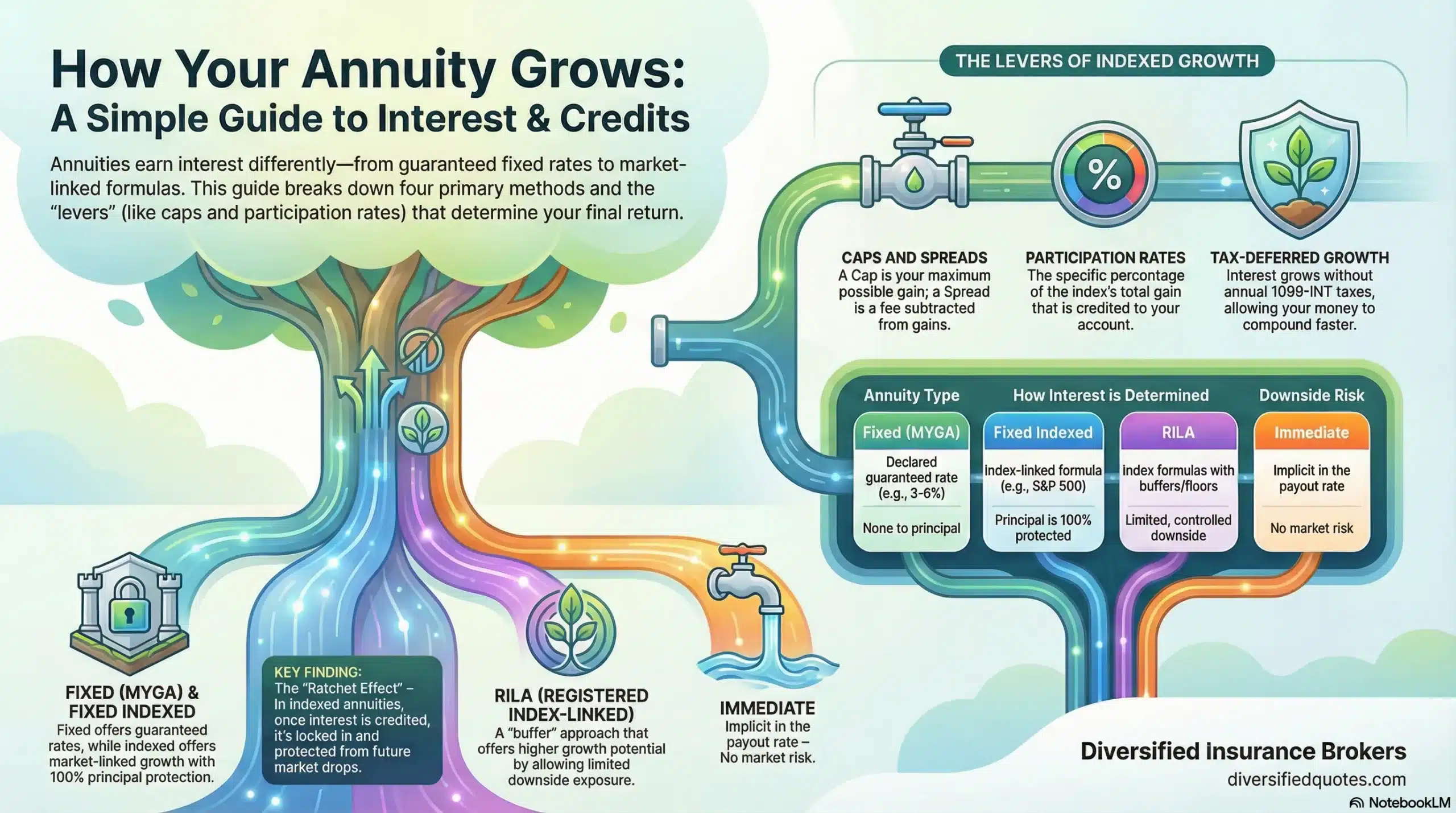
The most important concept for any retired MYGA buyer to understand is what “retirement income stability” actually requires. A retired household typically has three income categories: guaranteed income (Social Security, pension, MYGA interest withdrawal), semi-variable income (systematic portfolio withdrawals, dividend income), and emergency or discretionary reserves (liquid savings, cash equivalents). The MYGA serves the guaranteed income category — providing a declared interest rate that does not change based on market conditions, providing principal protection that means the base from which interest is calculated cannot decline due to market losses, and providing tax-deferred treatment that allows non-qualified MYGA interest to compound without annual tax drag until withdrawn. For retirees whose primary concern is maintaining their standard of living regardless of what markets do, the MYGA’s certainty is not a limitation — it is the exact feature they need. For those evaluating whether the fixed annuity structure is the right choice compared to a fixed indexed annuity with potentially higher variable crediting, the critical evaluation factor is: can the retiree’s income plan tolerate years when the indexed annuity credits zero? For many retired households, the answer is no — the consistency of the MYGA’s declared rate is not just preferred but required. Our resource on safe fixed annuity options covers the full safety evaluation framework for retirees evaluating conservative annuity structures.
Today’s MYGA market is unusually favorable for retirees specifically because the declared rates available reflect the elevated investment-grade bond yield environment that emerged post-2022 — rates that reward the conservative fixed-income allocation that retirees have traditionally needed but that was punishingly unrewarding during the 2015–2021 low-rate era. A retiree who positioned $300,000 in a 5-year MYGA at 6.35% earns approximately $19,050 in guaranteed tax-deferred interest in year one — interest that reflects today’s competitive rate rather than the 2%–3% yields available only a few years ago. The ability to lock this rate for the full 5-year term regardless of future rate movements provides the retiree with multi-year income certainty that floating-rate alternatives cannot deliver. For retirees who also want to evaluate whether a bonus annuity structure — with an upfront premium credit above 20% — might serve them better than a straight MYGA for specific planning goals, our resource on bonus annuities over 20% covers the retiree-specific evaluation framework for that decision. For the complete comparison of fixed annuities vs. CDs — the most common alternative comparison for retirees — our dedicated resource provides the full after-tax mechanics. And for retirees who hold common misconceptions about annuities that may be affecting their evaluation, addressing those misconceptions directly is the productive first step.
Ensure you are receiving the absolute top rates
Current Fixed Annuity Rates
Compare today’s best fixed annuity rates from top carriers.
Current Bonus Annuity Rates
See which annuities offer the highest upfront bonus today.
Request an Annuity Quote
Submit our annuity request form to get personalized rate options.
Lifetime Income Calculator
Use our calculator to see how much guaranteed income your annuity can provide.
The Three Core Problems MYGAs Solve for Retirees
Most financial products are designed with broad audiences in mind, but MYGAs solve specific problems that are particularly acute in retirement. Understanding which problems a MYGA addresses for a retiree — and how it addresses them — determines whether a MYGA is the right tool for a specific retiree’s situation or whether a different structure would serve better.
Problem 1 — Sequence-of-Returns Risk in the Distribution Phase
Sequence-of-returns risk is the danger that a portfolio suffers significant market losses in the early years of retirement — precisely when the retiree is drawing income from it. Early losses on a distribution-phase portfolio are mathematically more damaging than the same losses in the accumulation phase because each withdrawal depletes a permanently reduced base. A 30% market decline in year two of retirement, while the retiree is also taking $50,000 per year in portfolio withdrawals, creates a compounding deficit that the portfolio may never fully recover from even if markets subsequently perform well. The MYGA solves the sequence-of-returns problem for the assets allocated to it by removing those assets from market exposure entirely. The MYGA allocation earns its declared rate regardless of what equity and bond markets do during the contract period. For retirees who build a “MYGA floor” — a portion of their portfolio in a MYGA that earns a guaranteed rate while the rest of the portfolio remains in market-sensitive investments — the floor provides income and principal protection that cannot be impaired by a market downturn. This is the core planning value of the MYGA in retirement: not that it produces the highest possible return, but that it produces a guaranteed, uninterruptible return from assets the retiree cannot afford to lose.
Problem 2 — Low-Yield Conservative Vehicle Replacement
Many retirees entered the current rate environment holding significant conservative allocations in savings accounts, money markets, CDs, or short-term bonds at yields of 3%–4% — or lower for those who locked in during the 2020–2021 rate environment. As these low-yield instruments mature, today’s MYGA rates of 6.00%–6.35% provide a genuinely attractive repositioning opportunity: capturing significantly higher guaranteed yields in a principal-protected structure without accepting market risk. For a retiree with $400,000 in maturing CDs previously yielding 3.5%, repositioning into a 5-year MYGA at 6.35% generates an additional $11,400 per year in guaranteed interest — $57,000 additional guaranteed income over the full 5-year term compared to renewing at the prior CD rate. This yield improvement is not speculative — it is locked in at issuance and cannot be reduced during the term. The after-tax advantage for non-qualified money adds further value because MYGA interest is tax-deferred while CD interest generates an annual 1099 regardless of withdrawal. Our resource on fixed annuities vs. CDs provides the full after-tax yield comparison for retirees doing this evaluation.
Problem 3 — Income Certainty vs. Income Variability in Retirement
Retirees face a fundamental tension between wanting income to keep pace with inflation and needing income to be predictable enough to budget around. Variable income sources — portfolio withdrawals, dividends, part-time work — can address the inflation dimension but create budgeting uncertainty. Fixed income sources — Social Security, pensions, MYGA interest withdrawal — provide certainty but may not keep pace with rising costs over long retirements. The optimal retiree income structure typically layers both: a guaranteed income floor large enough to cover essential fixed expenses, plus a variable income layer for discretionary spending and inflation protection. The MYGA’s role is in the guaranteed floor — providing a declared rate that funds a defined annual interest withdrawal, which the retiree can budget around with the same confidence as Social Security or pension income. For retirees building this income floor, the combination of Social Security optimization and MYGA interest withdrawal creates a strong guaranteed income foundation. Our resource on how Social Security and annuities work together covers the coordination mechanics for retirees building this income architecture. The broader framework for guaranteed retirement income is covered in our resources on lifetime income planning, annuities for monthly retirement income, and lifetime income annuity options.
💰 Current MYGA Rates for Retirees (as of October 2026)
The table below shows today’s highest available MYGA declared rates across common term lengths. For retirees, the most relevant terms are typically 3 to 7 years — long enough to lock today’s competitive rates meaningfully, short enough to provide regular maturity windows for reassessment and income conversion decisions. The 5-year rate of 6.35% represents the peak of today’s MYGA market and the strongest option for retirees with a 5-year holding horizon. Confirm your specific state availability and premium band rate enhancement by requesting a live quote for your exact profile.
| Term | Rate | Provider | Product | AM Best Rating |
|---|---|---|---|---|
| 1 Year | 3.90% | GCU Life | 1+4 Choice | A- |
| 2 Years | 5.25% | Mountain Life | Secure Summit | B |
| 3 Years | 6.10% | Mountain Life | Secure Summit | B |
| 4 Years | 6.05% | Mountain Life | Secure Summit | B |
| 5 Years | 6.45% | Mountain Life | Secure Summit | B |
| 6 Years | 6.35% | Oxford Life | Multi Select Annuity | A |
| 7 Years | 6.25% | Sentinel Security | Personal Choice | B |
| 8 Years | 6.45% | Oxford Life | Multi Select Annuity | A |
| 9 Years | 6.30% | Oxford Life | Multi Select Annuity | A |
| 10 Years | 6.35% | Oxford Life | Multi Select Annuity | A |
Rates are subject to change and may vary by state, age, and deposit size. Higher premiums may qualify for enhanced rates. A-rated carrier alternatives at modestly lower declared rates are available — request a full comparison for your specific situation.
Annuity Interest Rate Examples by Deposit Size
See how annuity interest and income potential can vary depending on the size of your investment.
Why FIA Rate Variability Matters More for Retirees Than Accumulation Buyers
Fixed indexed annuities can be excellent retirement tools — particularly when income riders are involved — but the variable annual crediting of an FIA creates specific challenges for retirees that accumulation-phase buyers do not face to the same degree. Understanding whether fixed indexed annuity rates change is important context: the answer is yes, significantly. An FIA may credit 8% in a strong index year and 0% in a flat or negative index year — with the actual annual credit depending on the index’s performance against the product’s cap rate, spread rate, or participation rate terms. For an accumulation-phase buyer with a 10-year horizon, the variability of annual crediting matters less because the long time horizon allows strong years to offset weak ones. For a retired buyer who is withdrawing income annually and whose plan depends on the MYGA or FIA generating consistent annual returns, a string of zero-credit years (which are realistic in flat or range-bound markets) can create meaningful income shortfalls if the plan assumed the FIA would credit near its historical average every year. The MYGA’s declared rate eliminates this variability entirely — the retiree knows exactly what the contract will earn in year one, year three, and year five regardless of market conditions, which is precisely what distribution-phase income planning requires. The comparison is not that FIAs are “bad” for retirees — many retirees benefit from FIAs with income riders — but that the MYGA’s income consistency serves a different, equally valid retiree planning objective that the FIA’s variable crediting cannot match.
MYGA Safety for Retirees — How the Protection Framework Actually Works
Retirees evaluating MYGAs frequently ask whether MYGAs are safe — particularly when the highest declared rates come from carriers with B-range AM Best ratings rather than the A-rated carriers of larger national insurance groups. For retirees, this question has a specific and important answer. Our dedicated resource on safe fixed annuity options covers the full safety framework, but the core elements are: all licensed MYGA carriers must meet state insurance regulatory capital and reserve requirements regardless of their AM Best rating; state guaranty associations provide protection up to applicable limits (typically $250,000 per insurer per state for fixed annuities) for all licensed carriers including B-rated ones; and AM Best ratings reflect relative financial strength above regulatory minimums — not whether a carrier is safe in the absolute sense. For retirees with premium amounts at or below state guaranty association limits, the financial backstop from regulation and the guaranty association applies equally to B-rated and A-rated carriers. For retirees with larger premium amounts — particularly those repositioning significant IRA or 401(k) assets significantly above guaranty association limits — prioritizing A-rated carriers or diversifying across multiple carriers is the more prudent approach. The annuity surrender charges and MVA mechanics that affect early exit decisions are covered in depth in our resource on annuity surrender charges and MVA — understanding these before purchase is part of the complete safety evaluation for any retiree considering a MYGA. For a comprehensive view of the highest guaranteed annuity rates available today across all carrier quality tiers, our dedicated resource provides the full market view.
The MYGA Ladder Strategy for Retirees — Scheduling Liquidity and Rate Reassessment
Rather than positioning all conservative assets in a single MYGA term, many retirees use a MYGA ladder strategy that divides the allocation across multiple terms with staggered maturity dates. For retirees, the ladder serves purposes beyond those of accumulation-phase buyers: it creates scheduled maturity windows that can be aligned with specific retirement planning milestones, allows rate reassessment at regular intervals, and ensures that a portion of the conservative allocation matures at least every few years without any surrender charge exposure. A retiree with $300,000 to allocate might build a 3-5-7 ladder: $100,000 in a 3-year MYGA (maturing 2029, potentially aligned with a specific financial decision or the start of planned healthcare expenses), $100,000 in a 5-year MYGA (maturing 2031, providing a mid-term liquidity window and rate reassessment opportunity), and $100,000 in a 7-year MYGA (maturing 2033, locking today’s competitive rates for the longest practical period). At each maturity, the retiree evaluates the rate environment and decides whether to renew at then-current rates, convert to a different structure, or access the funds for a specific purpose. The ladder ensures that no single interest rate environment determines the entire conservative portfolio’s return — each rung captures a different rate lock point and a different maturity window. For retirees specifically interested in the short-term tier of the ladder — 1-to-3-year MYGAs that provide near-term flexibility — our resource on best short-term MYGA annuities covers the products and mechanics most relevant for that tier.
RMDs, SECURE 2.0, and MYGAs in Qualified Retirement Accounts
For retirees whose MYGA is funded with IRA, 401(k), 403(b), or other qualified account money, Required Minimum Distribution rules create an important interaction with the MYGA’s surrender period. The RMD rules after SECURE 2.0 require qualified account holders to begin taking minimum distributions at a specified starting age (age 73 under SECURE 2.0 for most individuals). If a retiree places IRA money into a MYGA and the required beginning date for RMDs arrives during the surrender period, the RMD amount must be withdrawn — and the MYGA contract must accommodate this without triggering surrender charges or an MVA adjustment. Most MYGA contracts include an explicit RMD accommodation provision that waives surrender charges on amounts needed to satisfy the RMD for that contract year. However, this must be confirmed for any specific product before funding. The RMD calculation for a MYGA inside a traditional IRA uses the prior year-end contract value — which for a MYGA is the accumulated value including credited interest. As the MYGA accumulates interest over the term, the contract value increases, which means the RMD amount also increases each year. Retirees who fund MYGAs with significant IRA balances should model the expected RMD amounts across the full MYGA term to confirm that the annual RMD withdrawals will remain within the MYGA’s free-withdrawal allowance — or that the excess (if any) will be accommodated by the specific product’s RMD waiver provision. Understanding the full context of what an IRA annuity is and how the IRA account framework interacts with the annuity contract’s access provisions is an important foundation for any retiree doing this evaluation.
IRA Annuity Mechanics — Using MYGAs Inside Qualified Retirement Accounts
When a MYGA is funded with IRA money — either through a direct trustee-to-trustee transfer or as part of a rollover from a former employer’s 401(k) or 403(b) — the contract operates as an IRA annuity: an annuity contract that holds tax-deferred retirement assets within the IRA’s regulatory framework. The key mechanics for retirees to understand are: the IRA account type provides the tax deferral (so the MYGA’s tax-deferral feature is not an additional benefit for qualified money), all distributions from an IRA annuity are taxed as ordinary income, RMD rules apply as described above, and beneficiary designations on the IRA annuity should be reviewed and updated to reflect current estate planning intentions. Our resource on what an IRA annuity is provides the full mechanics for this structure. For retirees evaluating what to do with IRA balances that are currently in lower-yielding vehicles, our resources on what to do with an IRA after retiring and what to do with a 401(k) after retiring provide the full decision framework for repositioning qualified assets into a MYGA or another appropriate structure.
The MYGA vs. Bonus Annuity Decision for Retirees
Retirees evaluating fixed annuities will encounter products advertised with large upfront bonus credits — including products offering bonuses over 20% of the initial premium. The bonus annuity question for retirees requires a specific analytical framework because the bonus’s value depends entirely on what the retiree plans to do with the contract over the holding period. A 26% bonus on a 10-year FIA creates a substantially larger income base for a retiree who plans to activate a guaranteed lifetime income rider at year 10 — but it also requires a 10-year surrender commitment and typically comes with index crediting terms that are more conservative than non-bonus FIAs. For a retiree whose primary goal is guaranteed accumulation over a defined term with a known maturity date, the MYGA’s clean declared rate — without the complexity of bonus vesting, income base mechanics, and crediting term trade-offs — frequently produces a better outcome than the bonus FIA for that specific goal. The correct choice depends entirely on what the retiree is trying to accomplish: guaranteed accumulation with a known outcome date (MYGA is typically better), or maximizing guaranteed lifetime income with a long deferral horizon (bonus FIA may be better). For the complete comparison in the retiree-specific context, our resource on the annuity rescue plan addresses repositioning decisions for retirees who are holding products that no longer serve their current needs.
Tax Planning for Retired MYGA Holders
The tax treatment of MYGA earnings in retirement is meaningfully different for qualified versus non-qualified money, and retired MYGA holders benefit from understanding both. For qualified account MYGAs (IRA, 401k): all distributions are taxed as ordinary income at the retiree’s tax rate in the year received. RMD amounts are ordinary income whether or not the retiree “needs” the money. Converting IRA annuity proceeds to non-qualified accounts (Roth conversions, MYGA maturity distributions) may create significant income in the conversion year and should be coordinated with Medicare premium thresholds (IRMAA) and other income-sensitive benefits. For non-qualified MYGAs (after-tax money): earned interest is tax-deferred until distributed. When distributions begin, the IRS applies LIFO ordering — earnings come out first as ordinary income, then the original basis is returned tax-free. The exclusion ratio provides a method for spreading basis recovery across annuity payments when the MYGA is annuitized rather than surrendered, which can create a more tax-efficient income stream than treating all distributions as interest income. For non-qualified MYGAs where the tax-deferral advantage has been accumulating for several years, the accumulated earnings may be significant — and a coordinated withdrawal strategy that manages the ordinary income impact across multiple years is more tax-efficient than large lump-sum distributions. Our resources on non-qualified annuities and qualified annuity taxation provide the complete mechanics for both scenarios.
MYGAs in the Retiree Income Stack — Social Security, Pension, and Portfolio Coordination
A MYGA functions best in retirement as part of a coordinated income stack rather than as a standalone allocation. The typical retiree income stack in 2026 includes: Social Security (guaranteed, inflation-adjusted, maximized through delayed claiming strategy), pension income if available (guaranteed, fixed or with COLA), MYGA or fixed annuity interest withdrawal (guaranteed at the declared rate, principal-protected), and portfolio withdrawals from IRA/brokerage accounts (variable, used for discretionary expenses and inflation buffer). The MYGA’s role is in the third tier — providing guaranteed, non-market-dependent income that supplements Social Security and pension without requiring portfolio liquidation. This positioning is particularly important for retirees who face a gap between Social Security income and total living expenses, where that gap must be filled with reliable, predictable income rather than variable portfolio returns. The coordination between Social Security timing decisions and MYGA positioning is covered in our resource on how Social Security and annuities work together. For retirees who are building toward a full pension-replacement income structure using annuities, our resource on the pension alternative strategy provides the complete framework. The annuity income calculator embedded on this page provides a practical tool for estimating how different MYGA accumulation amounts translate to guaranteed lifetime income options when the retiree is ready to convert from accumulation to income phase.
Beneficiaries, Death Benefits, and Estate Planning for Retired MYGA Holders
MYGAs provide a contractual death benefit equal to the accumulated contract value — premium plus credited interest minus any withdrawals taken — that passes directly to named beneficiaries outside of probate upon the owner’s death. This death benefit is a meaningful estate planning feature for retirees who want to ensure their conservative retirement savings pass efficiently to the next generation. The beneficiary provisions on any MYGA should be reviewed and updated to reflect current estate planning intentions — particularly for retirees who have experienced life changes (marriage, divorce, deaths, new grandchildren) since the contract was issued. For married retirees, the spousal continuation provision available in most MYGA contracts allows the surviving spouse to continue the contract at the existing declared rate without triggering a distribution — an important planning advantage that preserves the guaranteed rate for the survivor’s continued use. The retiree should also understand how beneficiaries receive MYGA proceeds after the owner’s death: typically, named beneficiaries can elect to receive a lump sum (fully taxable as ordinary income for qualified money, taxable only on the earnings portion for non-qualified money) or, in some contracts, to stretch distributions over a defined period. The stretching option — where available — can meaningfully reduce the income tax impact for beneficiaries by spreading the taxable income across multiple years. Understanding these beneficiary election options at the time of purchase — not just at the time of death — allows the retiree and their estate planning advisor to build the most tax-efficient legacy plan for the MYGA assets.
Compare MYGAs for Your Retirement Plan
We help retirees compare guaranteed fixed annuity rates, evaluate carrier strength for their premium size, and design laddered strategies aligned with income timing, RMD coordination, and liquidity needs — across 100+ carriers.
Talk With an Advisor Today
Choose how you’d like to connect—call or message us, then book a time that works for you.
Schedule here:
calendly.com/jason-dibcompanies/diversified-quotes
Licensed in all 50 states • Fiduciary, family-owned since 1980
FAQs: Multi-Year Guaranteed Annuity for Retirees
What is a Multi-Year Guaranteed Annuity and how does it serve retirees specifically?
A multi-year guaranteed annuity (MYGA) is a fixed annuity that declares a guaranteed interest rate for a specific term — typically 1 to 10 years — with no market exposure and full principal protection. For retirees specifically, the MYGA serves as a distribution-phase income anchor: a principal-protected, fixed-return allocation that earns a declared rate regardless of market conditions, that can fund a defined annual interest withdrawal or accumulate for later income conversion, and that coordinates with Social Security, pension income, and RMD obligations. Unlike accumulation-phase buyers for whom the MYGA is primarily a growth vehicle, retirees use MYGAs as a stability anchor in a portfolio that is now distributing income — where the certainty of the declared rate is not just preferred but essential to reliable income planning.
How are MYGAs different from CDs for retirees?
Both MYGAs and CDs offer guaranteed interest for a defined term with no market exposure. For retirees specifically, the key differences are: (1) Rate — today’s MYGA declared rates (6.00%–6.35% at mid-term lengths) typically exceed comparable-term national bank CD rates. (2) Tax treatment — for non-qualified (after-tax) money, MYGA interest accumulates tax-deferred with no annual 1099, while CD interest generates taxable income annually regardless of withdrawal; for retirees in higher tax brackets, this deferral can add 0.25%–0.75%+ to effective after-tax yield. (3) Beneficiary provisions — MYGAs include named beneficiary designations that direct assets outside of probate; CDs pass through the estate unless jointly titled. (4) Safety backstop — CDs are FDIC-insured up to $250,000 per depositor per institution; MYGAs are backed by the insurance carrier and state guaranty associations within applicable limits.
Are MYGAs safe for retirees who depend on this money for income?
MYGAs are among the most conservative fixed-income alternatives available to retirees — principal is protected from market loss, the declared rate is contractually locked for the full term, and the contract is backed by state insurance regulatory oversight including capital and reserve requirements. State guaranty associations provide additional protection within applicable limits (typically $250,000 per insurer per state for fixed annuities), covering all licensed carriers regardless of AM Best rating. For retirees with premium amounts within those guaranty limits, the safety backstop applies equally to B-rated higher-rate carriers and A-rated carriers. For retirees positioning larger amounts, prioritizing A-rated carriers or diversifying across multiple carriers reduces concentration above protection limits. The MYGA’s primary risk is not market risk — which it eliminates — but the carrier’s financial ability to honor its obligations, which is why carrier evaluation and appropriate premium sizing relative to guaranty limits is part of any complete MYGA selection process for retirees.
What happens when a MYGA term ends — what are the retiree’s options?
At maturity — the end of the declared term — most MYGA contracts provide a penalty-free window (typically 30 days) during which the retiree can take any of four actions without surrender charges: (1) Withdraw all or part of the accumulated value for immediate use or repositioning; (2) Renew into a new MYGA term at then-current declared rates, which may be higher or lower depending on the rate environment at maturity; (3) Transfer to a new MYGA at a different carrier for a better rate or different provisions; or (4) Convert the accumulated value into a lifetime income stream through annuitization or a new income-rider-equipped annuity. Retirees who build a MYGA ladder create multiple maturity decision points across several years, each providing an independent opportunity to reassess the rate environment and adjust the income plan accordingly. Knowing the maturity window length and the default auto-renewal terms before purchasing is important — if no action is taken, most contracts auto-renew at the carrier’s current rate, which may not be optimal.
Can I withdraw money from a MYGA during the term without penalty?
Yes, within defined limits. Most MYGA contracts allow annual penalty-free withdrawals of 5%–10% of the accumulation value per year after the first contract anniversary — without triggering surrender charges. This free-withdrawal provision allows retirees to take modest annual income from the contract (for example, $18,000–$30,000 per year on a $300,000 MYGA at a 6%–10% free-withdrawal rate) without any early-exit cost. For qualified-account MYGAs, most contracts also include an RMD accommodation provision that waives surrender charges on required minimum distribution amounts — but this must be confirmed for any specific product. Withdrawals above the annual free-withdrawal allowance trigger surrender charges (typically 7%–10% in year one, declining toward zero by surrender period end) and, in contracts with Market Value Adjustment provisions, a possible interest rate adjustment to the surrendered amount.
How do MYGAs interact with Required Minimum Distributions under SECURE 2.0?
Under SECURE 2.0, the required beginning date for RMDs is generally age 73 for most qualified account holders. When a MYGA is funded with qualified account money (IRA, 401k, etc.), RMD amounts apply at that age. The RMD amount for a MYGA inside a traditional IRA is calculated from the prior year-end contract value divided by the appropriate IRS life expectancy factor. As the MYGA accumulates interest over the term, the contract value increases, causing RMD amounts to increase each year. Most MYGA contracts include an explicit RMD accommodation provision that waives surrender charges on RMD amounts — but this must be confirmed for any specific product before purchase. Retirees should model expected RMD amounts across the full MYGA term to ensure they remain within the free-withdrawal allowance or that the specific product’s RMD waiver will accommodate the required withdrawals without friction.
Do MYGAs provide lifetime income for retirees?
Standard MYGAs are accumulation products — they credit a declared rate to the accumulation value for the selected term but do not inherently provide guaranteed lifetime income. At maturity, the retiree can convert the accumulated MYGA value into a lifetime income stream through annuitization — receiving a guaranteed monthly payment for life based on the accumulated value, age, and the carrier’s income rates at the time of conversion. Alternatively, the retiree can transfer the matured MYGA value into a new annuity with a guaranteed lifetime withdrawal benefit (GLWB) rider, which creates guaranteed lifetime income without requiring full annuitization. The MYGA’s role in this framework is as the accumulation vehicle — building value at a competitive guaranteed rate during the deferral period before income is needed. The income conversion decision at maturity is separate from the MYGA’s core function and should be planned for before the MYGA matures.
Can I use IRA or 401(k) money to fund a MYGA in retirement?
Yes. MYGAs accept qualified retirement account funding — traditional IRA, 401(k), 403(b), 457, TSP, and SEP-IRA — through direct rollover or trustee-to-trustee transfer without triggering a taxable event. For IRA-to-MYGA transfers, a direct trustee-to-trustee transfer is cleanest — the receiving carrier accepts assets directly from the existing custodian without funds passing through the retiree’s hands. The MYGA then operates as an IRA annuity within the IRA account framework. All distributions are taxed as ordinary income. RMD rules continue to apply at the required beginning date. The MYGA does not add tax deferral for IRA money — the IRA account type already provides that — but it does add the declared rate lock, principal protection, and defined term structure that may be preferable to other IRA investment alternatives for the conservative portion of the retirement portfolio.
How are MYGA earnings taxed for retirees?
For qualified MYGAs (funded with IRA/401k money): all distributions are taxed as ordinary income at the retiree’s marginal tax rate in the year received. RMD amounts are ordinary income regardless of withdrawal preference. For non-qualified MYGAs (funded with after-tax money): interest accumulates tax-deferred with no annual 1099. When distributions begin, IRS LIFO ordering applies — earnings come out first as ordinary income, then the original premium (basis) is returned tax-free. If the MYGA is annuitized rather than surrendered, the exclusion ratio method spreads basis recovery across payments, creating a more tax-efficient income stream than treating all withdrawals as earnings. Non-qualified MYGA holders should also be aware of the 3.8% Net Investment Income Tax (NIIT) that may apply to annuity earnings above certain income thresholds, and should coordinate MYGA withdrawals with Medicare premium thresholds (IRMAA) to avoid unexpected premium surcharges from income spikes in withdrawal years.
Can I name beneficiaries on a MYGA and what happens when I pass away?
Yes. MYGAs allow the owner to designate named beneficiaries who receive the accumulated contract value at the owner’s death — typically outside of probate according to the contract’s beneficiary provisions and applicable state law. The death benefit equals the accumulation value (premium plus credited interest minus any withdrawals taken) at the time of death. For qualified-account MYGAs, beneficiaries receive the distribution as ordinary income subject to their own tax situations. For non-qualified MYGAs, beneficiaries pay ordinary income tax only on the earnings portion (the excess above the owner’s cost basis). Named beneficiaries should be reviewed and updated at any major life event — marriage, divorce, death of a prior beneficiary, birth of grandchildren — to ensure the MYGA’s death benefit distributes according to current intentions. For married retirees, the spousal continuation provision allows the surviving spouse to continue the contract at the existing declared rate without triggering a distribution, preserving the guaranteed structure for the survivor’s continued use.
Who is a MYGA best suited for among retirees?
MYGAs are best suited for retirees who need some or all of the following: principal protection on a defined conservative allocation that should not be exposed to market loss under any market conditions; income certainty from a guaranteed declared rate rather than variable annual returns; replacement for low-yield conservative vehicles (maturing CDs, savings accounts, money markets, short-term bonds) at today’s more competitive MYGA rates; scheduled liquidity through a MYGA ladder with staggered maturity dates aligned to specific planning milestones; or a tax-deferred accumulation vehicle for non-qualified savings that avoids annual 1099 interest reporting during the growth phase. MYGAs are less suited for retirees who need significant near-term liquidity (where the surrender period creates friction), retirees whose primary goal is guaranteed lifetime income (where a bonus FIA with an income rider may serve better), or retirees whose conservative allocation is already earning competitive guaranteed rates in existing vehicles they have no reason to change.
About the Author:
Jason Stolz, CLTC, CRPC, DIA, CAA and Chief Underwriter at Diversified Insurance Brokers (NPN 20471358), is a senior insurance and retirement professional with more than 25 years of real-world experience helping individuals, families, and business owners protect their income, assets, and long-term financial stability. As a long-time partner of the nationally licensed independent agency Diversified Insurance Brokers, Jason provides trusted guidance across multiple specialties—including fixed and indexed annuities, long-term care planning, personal and business disability insurance, life insurance solutions, Group Health, Travel Medical and Evacuation Insurance, and short-term health coverage. Diversified Insurance Brokers maintains active contracts with over 100 highly rated insurance carriers, ensuring clients have access to a broad and competitive marketplace.
His practical, education-first approach has earned recognition in publications such as VoyageATL, and contributions from his agency featured in Kiplinger and GoBankingRates— highlighting his commitment to financial clarity and client-focused planning. Drawing on deep product knowledge and years of hands-on field experience, Jason helps clients evaluate carriers, compare strategies, and build retirement and protection plans that are both secure and cost-efficient. Visitors who want to explore current annuity rates and compare options across multiple insurers can also use this annuity quote and comparison tool.
Explore More Annuity Options: Browse our complete guide to What Is a Fixed Annuity? — covering fixed annuities, MYGAs, laddering strategies & conservative growth options from 100+ carriers.
Last Reviewed: October 1, 2026 |
Reviewed by: Jason Stolz, CLTC, CRPC, DIA, CAA
Chief Underwriter, Diversified Insurance Brokers, Inc. | NPN: 20471358 | Diversified Insurance Brokers, Inc. — Licensed in all 50 states
Fact Checked by: Tonia Pettitt, CMIP©
Medicare Specialist, Diversified Insurance Brokers, Inc. | NPN: 14374308 | Diversified Insurance Brokers, Inc. — Licensed in all 50 states
Did you find this content helpful? Leave us a Google review — it helps others find trustworthy guidance too.
Editorial Standards: Diversified Insurance Brokers maintains rigorous editorial standards to ensure accuracy, clarity, and independence in all content. Learn more about our editorial standards and commitment to transparency.
