
American Gulf Anchor MYGA – Guaranteed Growth, Liquidity, and Principal Protection
As an Independent Annuity Broker, we compare rates across 100+ carriers and 1,000 different annuities— not just one company’s product offerings — to find the best fit for your goals.
American Gulf Anchor MYGA – Guaranteed Growth, Liquidity, and Principal Protection
At Diversified Insurance Brokers, we help clients protect retirement savings with annuity strategies designed for stability, predictability, and peace of mind. The American Gulf Anchor Multi-Year Guaranteed Annuity (MYGA) — issued by American Gulf — is built for people who want a clearly defined return, tax-deferred accumulation, and principal protection without worrying about market volatility. If your goal is to lock in a guaranteed rate for a set number of years and let your money compound quietly in the background, this is exactly the type of contract that belongs on your short list.

Ensure you are receiving the absolute top rates
Current Fixed Annuity Rates
Compare today’s best fixed annuity rates from top carriers.
Current Bonus Annuity Rates
See which annuities offer the highest upfront bonus today.
Request an Annuity Quote
Submit our annuity request form to get personalized rate options.
Lifetime Income Calculator
Use our calculator to see how much guaranteed income your annuity can provide.
American Gulf Anchor MYGA: Key Product Features at a Glance
| Product Feature | Details |
|---|---|
| Issuing Carrier | Gulf Guaranty Life Insurance Company (marketing brand: American Gulf), Flowood, Mississippi. AM Best: B++ (Good). Approximately $81 million in total assets. Founded 1970; acquired by Acturion in 2025. Previously issued Credit Life, Disability, and Final Expense Life products; now focused on fixed annuities and retirement solutions. Not FDIC insured. Guarantees backed by claims-paying ability of Gulf Guaranty Life Insurance Company. Not available in all states. |
| Product Type | Single-premium fixed deferred Multi-Year Guaranteed Annuity (MYGA) with Market Value Adjustment. Compound interest — interest earned each year credited to the full account value and earns additional interest in subsequent years. Principal protected from market loss. Tax-deferred growth until withdrawal. No market indexes, caps, spreads, or participation rates. Not a direct market investment. |
| Guarantee Period Options | 5-year, 6-year, or 7-year terms. The same guaranteed interest rate applies to all three term lengths — the choice is driven by your preferred commitment horizon, not rate optimization between terms. At term end, a 30-day window allows penalty-free renewal, partial or full withdrawal, or annuitization. |
| Minimum / Maximum Premium | Minimum: $10,000 single purchase payment. Maximum: $1,000,000 without prior approval (higher amounts may be considered). Single premium — no additional premiums accepted after issue. Qualified and non-qualified funds accepted. |
| Issue Ages / Eligible Funds | Issue ages 0 to 89 for both qualified and non-qualified accounts. Eligible account types: Non-Qualified, Traditional IRA, Roth IRA, SEP IRA, and other qualified rollovers. |
| Rate Options at Issue | Two base rate configurations: No Liquidity — higher guaranteed rate, no built-in free withdrawal provision (RMDs still available); or 10% Liquidity — rate is 0.15% lower, includes the Free Partial Withdrawal Rider allowing 10% annual free withdrawals beginning in year two. Both options available across all three term lengths. Rates subject to change prior to contract issue and funding. |
| RMD Compatibility | Qualified accounts may take annual required minimum distributions without withdrawal charges or MVA — built into the base contract regardless of which rate option or riders are selected. No rider election required to access RMDs penalty-free. RMD withdrawals also do not require the Free Partial Withdrawal Rider to be elected. |
| Surrender Charges | 5-year: 9%, 8%, 7%, 6%, 5% (declining annually). 6-year: 9%, 8%, 7%, 6%, 5%, 4%. 7-year: 9%, 8%, 7%, 6%, 5%, 4%, 3%. Surrender charges apply to withdrawals above the applicable free withdrawal amount during the guarantee period. MVA may also apply on excess withdrawals. No surrender charges at term end during the 30-day window or at death (if Death Benefit Rider is elected). |
| Market Value Adjustment (MVA) | Applies to withdrawals exceeding free allowances during the guarantee period. If interest rates have risen since issue, the MVA may reduce the surrender value. If rates have fallen, the MVA may increase it. Does not apply to RMDs, the 10% free withdrawal (if rider elected), death benefit (if rider elected), or withdrawals during the 30-day end-of-term window. |
| Optional Riders and Rate Adjustments | Riders may be elected individually and independently. Each rider reduces the base guaranteed rate for the full contract term. Free Partial Withdrawal Rider: −0.15% (allows 10% annual free withdrawals beginning year two; this is equivalent to electing the 10% Liquidity rate option). Death Benefit Rider: −0.15% (waives surrender charges and MVA at death; without this rider, death benefit equals the cash surrender value, not the full accumulation value). Terminal Illness Rider: −0.05% (waives surrender charges and MVA upon physician certification of life expectancy 12 months or less). Nursing Home Confinement Rider: −0.05% (waives surrender charges and MVA after 90+ consecutive days of qualifying confinement). Riders may be combined — each adds its rate reduction independently. The total rate reduction from all four riders combined is 0.40%. |
| Death Benefit | Without the Death Benefit Rider: death benefit equals the cash surrender value (which includes applicable surrender charges and MVA). With the Death Benefit Rider (−0.15% rate reduction): death benefit equals the greater of the full contract value or the minimum surrender value — no surrender charges or MVA applied at death. Buyers who prioritize clean beneficiary transfer should carefully evaluate whether electing the Death Benefit Rider justifies the rate reduction for their situation. Proceeds pass to named beneficiaries by contract designation. |
| Tax Treatment | Interest grows tax-deferred until withdrawal. Non-qualified: LIFO taxation (earnings before principal). Qualified: full distributions taxed as ordinary income. Withdrawals before age 59½ subject to 10% IRS early withdrawal penalty. Note: placing an annuity inside a qualified plan provides no additional tax deferral — the IRA already provides deferral. The value inside an IRA is the guaranteed rate and principal protection. Not FDIC insured. |
| State Availability | Available in a limited number of states — not available in AZ, CA, CO, CT, DE, HI, ID, ME, MD, MA, MI, MN, NE, NJ, NM, NY, NC, OH, OR, RI, VT, VA, WA, WI, WY as of January 2026. Availability and product terms may vary by state. Confirm availability in your state before applying. |
Most retirement savers reach a point where “how much could I earn?” becomes less important than “how much can I safely keep and reliably grow?” That shift is why many people compare MYGAs alongside CDs and other conservative fixed options. The difference is that a MYGA is an insurance-based contract with tax-deferred growth, and it is often used inside rollover strategies when a client wants to move funds out of a 401(k) or IRA and into a fixed, contractually guaranteed rate environment. If you are still at the research stage, our broader overview of current annuity rates can help you see how MYGA terms and rates tend to compare across carriers.
What the Anchor MYGA Is Designed to Do
The Anchor MYGA is fundamentally an accumulation annuity. It is not trying to mimic the stock market, and it is not trying to outsmart volatility. Its job is simpler and, for the right person, more valuable: provide a guaranteed interest rate for a chosen term so you can plan around a known outcome. That makes it appealing for retirees and pre-retirees who want to preserve principal, avoid market losses, and still earn meaningful interest that compounds year after year.
Unlike investments that can fluctuate month to month, a MYGA is built on contractual guarantees. You pick a term, the company credits interest based on that guarantee, and the account grows according to the schedule — without the daily stress of market pricing. If you are comparing fixed annuities in general, it also helps to understand how MYGAs differ from indexed annuities and income-focused annuities; our annuities hub breaks down the main categories and what each one is built to accomplish.
About American Gulf and Gulf Guaranty Life Insurance Company
American Gulf is the marketing brand of Gulf Guaranty Life Insurance Company, which was founded in 1970 in Flowood, Mississippi. The company originally issued Credit Life and Disability policies and later expanded into Final Expense Life Insurance before being acquired by Acturion in 2025 and refocusing its business around fixed annuity and retirement solutions. The Anchor MYGA was launched in October 2025 as the company’s flagship product in this new strategic direction. Gulf Guaranty Life Insurance Company holds an AM Best Financial Strength Rating of B++ (Good) and carries approximately $81 million in total assets. The B++ rating is below the A- threshold that many financial advisors consider a preferred minimum for long-term annuity placements — buyers comparing the Anchor MYGA against A-rated MYGA alternatives should evaluate whether the rate advantage of the Anchor MYGA justifies the carrier strength difference at their specific allocation size and term. Guarantees are backed solely by the claims-paying ability of Gulf Guaranty Life Insurance Company.
Fixed Rates and Guaranteed Growth
The Anchor MYGA allows you to lock in a guaranteed interest rate for the entire term you select. The product is offered in 5-, 6-, and 7-year terms, and the same rate applies to all three durations — making the term selection driven by your preferred holding horizon rather than rate optimization between terms. For many conservative savers, that middle range of 5 to 7 years can be a practical sweet spot: long enough to earn a strong fixed rate and let compound interest work, but not so long that the contract feels restrictive.
There are two base rate configurations: the No Liquidity option offers the higher guaranteed rate with no built-in free withdrawal provision (RMDs remain available penalty-free regardless); the 10% Liquidity option is 0.15% lower but includes the Free Partial Withdrawal Rider, allowing 10% annual free withdrawals beginning in year two. Both options are available across all three term lengths. Rates are subject to change prior to contract issue and funding, and current rates should be confirmed with a current rate sheet before application. Because growth is tax-deferred, interest compounds without annual taxation until distributions occur. That tax treatment is a major reason MYGAs are frequently considered for retirement accumulation — especially for clients who want fixed growth but would prefer to postpone taxes on interest compared to a taxable fixed account.
Liquidity and Built-In Flexibility
One of the most common concerns with any MYGA is access. People like guarantees, but they do not want to feel locked in. The Anchor MYGA addresses that concern through its rider structure. The base contract includes penalty-free RMD access for qualified accounts from the start — no rider required for RMDs. For clients who want broader annual access, the Free Partial Withdrawal Rider (0.15% rate reduction) allows withdrawals of up to 10% of the accumulation value annually beginning in the second contract year, without withdrawal charges or MVA.
There is an important distinction that buyers should understand about the Anchor MYGA’s death benefit structure: without the optional Death Benefit Rider, the death benefit equals the cash surrender value — which means it reflects any applicable surrender charges and MVA if the owner dies during the guarantee period. With the Death Benefit Rider elected (0.15% rate reduction), the death benefit is the greater of the full contract value or the minimum surrender value, with no surrender charges or MVA applied at death. For buyers whose priority is ensuring the full accumulated value passes to beneficiaries, this rider distinction is one of the more consequential product choices in the Anchor MYGA, and it should be evaluated explicitly rather than assumed. For a broader overview of how annuity liquidity provisions and waivers work, see annuity free withdrawal rules.
Optional Riders and Rate Tradeoffs
The Anchor MYGA offers four optional riders, each of which may be elected independently. Each rider that is elected reduces the base guaranteed rate for the full contract term. The riders are designed to help the contract fit real-life planning needs — not just ideal scenarios. The right combination depends entirely on what you value most: maximum interest growth, or additional access and protection provisions that create a more flexible contract.
The Free Partial Withdrawal Rider reduces the base rate by 0.15% and allows 10% annual free withdrawals beginning in year two. The Death Benefit Rider also reduces the base rate by 0.15% and waives surrender charges and MVA at death so the full contract value passes to beneficiaries. The Terminal Illness Rider reduces the base rate by 0.05% and waives all surrender charges and MVA upon physician certification that the owner’s life expectancy is 12 months or less — a second medical opinion may be requested by the insurer at its expense. The Nursing Home Confinement Rider reduces the base rate by 0.05% and waives surrender charges and MVA after 90 or more consecutive days of qualifying nursing home confinement, available once per contract year. Riders may be combined — each adds its rate reduction independently, so electing all four would reduce the base rate by a combined 0.40%. In many retirement plans, the right choice is not the maximum rate at all costs, but the rate that still meets your growth goals while providing the flexibility that makes you comfortable with the multi-year commitment.
Simplicity and Security
The Anchor MYGA is a straight-line annuity. It avoids the moving parts that can make some retirement products harder to evaluate: there are no market indexes to track, no participation rate renewal discussions, and no day-to-day volatility. For conservative planners, that simplicity is a feature, not a limitation. It means you can set expectations clearly, track progress easily, and focus on the rest of your retirement plan rather than constantly monitoring an account.
This simplicity is also why MYGAs are frequently compared with certificates of deposit. Both are designed around fixed returns and defined terms. The key differences are usually tax treatment, contract structure, and the way liquidity features and surrender schedules work. The Anchor MYGA’s guarantees are backed by Gulf Guaranty Life Insurance Company — it is that specific legal entity named in the contract who is responsible for the claims-paying obligations, not the American Gulf marketing name. When we run comparisons at Diversified Insurance Brokers, we confirm the issuing company and provide side-by-side illustrations so you know exactly what entity is on the paper and what provisions apply in your jurisdiction.
Who the American Gulf Anchor MYGA Is Best For
This annuity is typically a strong fit for people who want predictable accumulation and are comfortable committing funds for a defined period in exchange for a guaranteed rate. Common planning situations where a MYGA like this can make sense include retirees who want to protect principal for the next phase of retirement, pre-retirees who are shifting a portion of their allocation away from market exposure, and conservative savers who want tax-deferred compounding in a fixed-rate structure. It can also be a practical choice for people building a bucket strategy where some funds are positioned for safety and near-term stability while other funds remain more growth-oriented.
From a timeline standpoint, this contract often works best when the term aligns with a real goal: a planned retirement date, a Social Security timing decision, the end of a bond ladder, or a period where you simply want stable growth without surprises. If you want to map annuity strategy alongside retirement income timing, it can also be helpful to read through adjacent planning resources like lifetime income annuities, since accumulation and income decisions frequently connect. The Anchor MYGA is not appropriate for clients who need significant annual liquidity beyond RMDs without rider elections, clients who require a lifetime income guarantee from day one, or clients who require top-tier carrier financial strength for the full amount being committed.
How We Compare the Anchor MYGA to Other MYGAs
Because MYGAs can look similar on the surface, it is easy to compare the wrong things. A good comparison is not just rate to rate. It is rate plus surrender schedule, rider tradeoffs, waiver language, free withdrawal timing, and how the contract behaves if you need access sooner than expected. Sometimes a contract with a slightly lower base rate can be a better fit if it offers materially better liquidity provisions or waiver language for situations you care about. The Anchor MYGA’s rider-based approach — where buyers choose which protections they want and pay only for those through reduced rates — gives buyers meaningful control over the cost-benefit tradeoff that most MYGAs do not provide with this level of granularity.
At Diversified Insurance Brokers, we compare MYGAs using a consistent framework: desired term, then comparable terms across carriers, premium banding confirmation, any rider costs or rate reductions, and surrender schedules reviewed in plain English. If you are comparing fixed annuities broadly, reviewing current annuity rates helps you confirm whether the American Gulf offer you are seeing is competitive for the same term and deposit size. We also keep an eye on how a contract fits alongside other retirement tools — for example, some people use MYGAs for the safe side of a plan and evaluate income strategies separately, which you can explore in our resource on lifetime income annuities.
Request an Annuity Quote
Submit our annuity request form to get personalized rate options.
Related Pages
Explore additional annuity comparisons, carrier insights, and retirement planning resources.
Financial Protection Essentials
Life insurance underwriting resources for complex health conditions and medical histories that may affect eligibility or pricing.
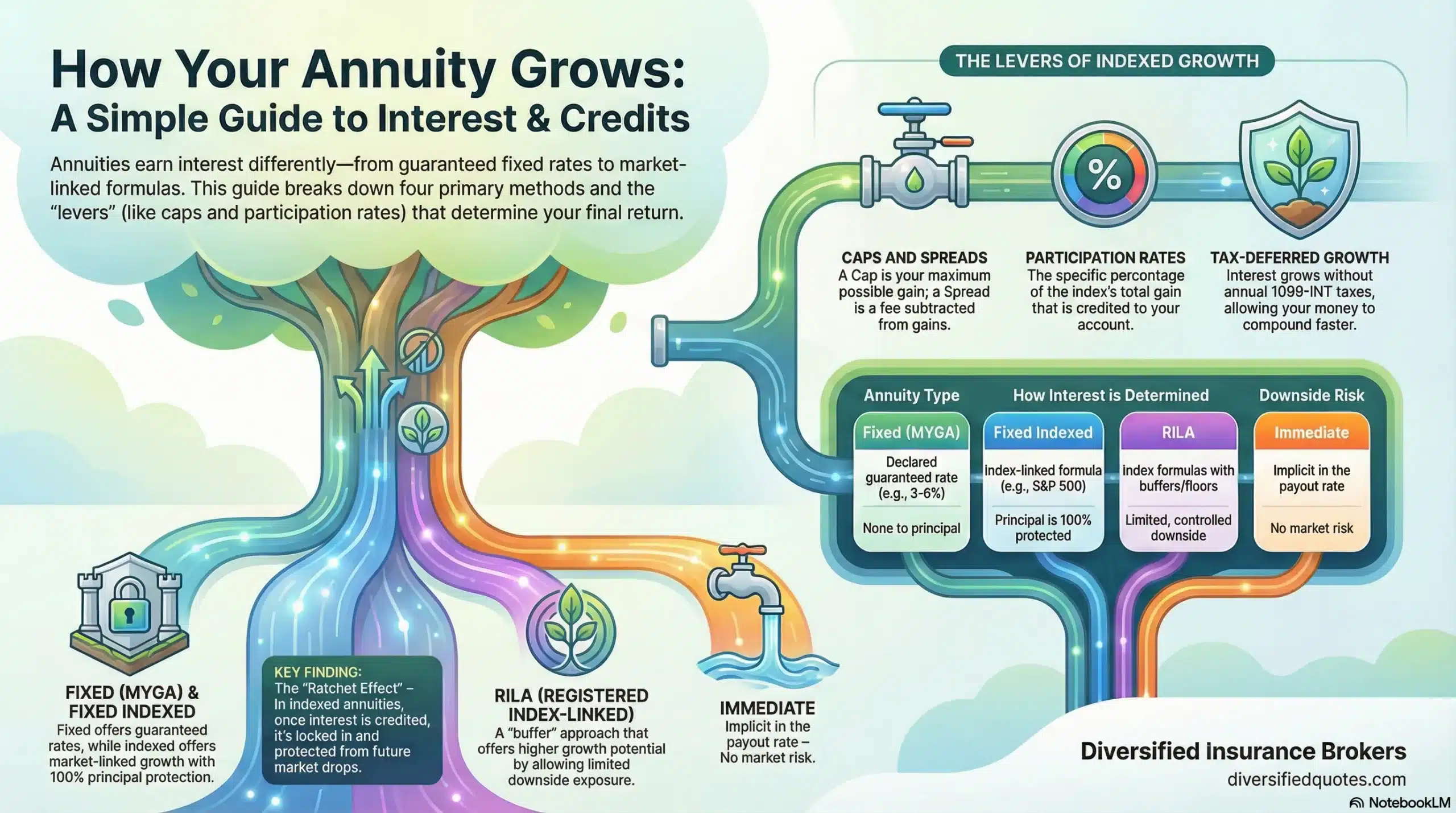
Talk to an Advisor or Request Your Annuity Quote
Ready to explore this annuity in more detail—or compare it with other carriers to see if even higher rates are available? With guaranteed income, principal protection, and long-term growth potential on the line, making the right choice is essential. The experienced advisors at Diversified Insurance Brokers will guide you through the options and design a strategy tailored to your retirement goals.
Schedule here:
calendly.com/jason-dibcompanies/diversified-quotes
Licensed in all 50 states • Fiduciary, family-owned since 1980
FAQs: American Gulf Anchor MYGA
Why does the death benefit differ based on whether I elect the Death Benefit Rider?
This is one of the most important product distinctions in the Anchor MYGA and one that many buyers do not investigate closely enough before purchasing. Without the optional Death Benefit Rider, the death benefit is equal to the cash surrender value — which means it reflects any applicable surrender charges and Market Value Adjustment if the owner dies during the guarantee period. In a rising rate environment during the early years of the contract, this could mean the beneficiary receives meaningfully less than the full accumulated value. With the Death Benefit Rider elected (at a 0.15% reduction to the base guaranteed rate), the death benefit is the greater of the full contract value or the minimum surrender value, with no surrender charges or MVA applied at death. The difference matters most when the owner passes away earlier in the guarantee period — when surrender charges are at their highest and when the MVA might also be negative if rates have risen. For buyers whose primary concern about the Anchor MYGA is ensuring the full accumulated value passes to heirs, electing the Death Benefit Rider is the appropriate choice and the 0.15% rate reduction is a reasonable cost for that protection. For buyers who are primarily using the MYGA for personal accumulation and where legacy is a secondary concern, the calculation is different. In either case, the decision should be made explicitly at application rather than assumed, because you cannot add the rider after the contract is issued.
Should I choose the No Liquidity rate or the 10% Liquidity rate?
The Anchor MYGA offers two base rate configurations: the No Liquidity rate (higher, with no built-in free withdrawal provision) and the 10% Liquidity rate (0.15% lower, includes the Free Partial Withdrawal Rider allowing 10% annual free withdrawals beginning in year two). The choice should be driven by an honest assessment of your anticipated annual access needs during the guarantee period. If your anticipated annual needs are limited to RMDs from a qualified account — which are penalty-free in the base contract without any rider election — and you do not expect to need additional penalty-free access beyond that, the No Liquidity rate is almost always the better choice. The higher guaranteed rate compounds over 5, 6, or 7 years and the difference in accumulated value at the end of the term is meaningful. If you have a non-qualified account and anticipate needing systematic annual withdrawals of up to 10% of the account value, the 10% Liquidity option provides that access at a 0.15% rate cost. The break-even analysis is relatively straightforward: if you never exercise the free withdrawal provision, the No Liquidity rate will always produce a higher accumulated value. If you consistently exercise the 10% free withdrawal every year, the value of that access must be weighed against the compounded rate reduction over the term. Most clients who can honestly say they are unlikely to need more than their RMD annually during the term will be better served by the No Liquidity rate. Clients who are genuinely uncertain about their liquidity needs during the term, or who are committing non-qualified funds and want the optionality of systematic annual access, will find the 10% Liquidity option provides useful flexibility for the modest rate cost.
How does the MVA work on the Anchor MYGA?
The Market Value Adjustment is a feature that applies when you take withdrawals above the permitted free amount during the guarantee period. It adjusts the net amount you receive based on how interest rates have moved since your contract was issued. If interest rates have risen since the day your contract began, the MVA is typically negative — it reduces the amount you receive on the excess withdrawal beyond the surrender charge already applied. If rates have fallen since issue, the MVA may be positive — it increases the net amount. The logic behind the MVA reflects the economic reality of the insurance company’s position: when you locked in your guaranteed rate, the company invested your premium in assets that support that guarantee. If you want to exit early in a higher-rate environment, the company needs an adjustment mechanism to reflect that the underlying assets have declined in market value relative to the new rate environment. The MVA does not apply to RMDs from qualified accounts, to withdrawals under the 10% free withdrawal provision if the rider is elected, to the death benefit if the Death Benefit Rider is elected, or to withdrawals taken during the 30-day end-of-term renewal window. The practical message is straightforward: the MVA is a mechanism that reinforces the long-term nature of the MYGA commitment. Clients who plan correctly — keeping adequate liquidity outside the annuity, using RMDs for qualified account withdrawals, and treating the MYGA as a hold-to-maturity investment — will rarely encounter the MVA in real practice.
Which term — 5, 6, or 7 years — should I choose?
An unusual feature of the Anchor MYGA is that the same guaranteed interest rate applies to all three available terms — 5, 6, and 7 years. This means the term selection is not a rate optimization decision but a planning horizon decision. In most MYGA markets, longer terms command higher rates because the carrier can support a better guarantee over an extended commitment. The Anchor MYGA’s flat-rate-across-terms design simplifies the comparison: choose the term that genuinely matches how long you can commit the funds. The 5-year term is most appropriate for clients with a nearer-term planning horizon — a specific financial decision or event within five years, a retirement transition, or a Social Security claiming date that aligns with the 5-year maturity. The 6-year term may appeal to buyers who want a middle horizon without the full 7-year commitment. The 7-year term is most appropriate for clients with the highest confidence that the committed funds will not be needed beyond RMDs (if applicable) and the standard access provisions for seven years — clients who want the full 7-year runway for compound interest to work, and for whom the maturity date aligns with a real retirement or income planning event. Since the rate is the same across all three terms, there is no financial incentive to extend unnecessarily. The appropriate choice is the term that matches your real planning timeline, confirmed against your broader retirement income plan before application.
What happens at the end of the guarantee period?
At the end of the guarantee period, you receive a 30-day renewal window during which you have full flexibility to act without surrender charges or MVA. During this window you may renew into the same term at the current declared renewal rate; change to a different available term; take a full or partial surrender of the contract value without penalty; roll the funds into another annuity contract (potentially a 1035 exchange if non-qualified); or annuitize the accumulated value into an income stream. If you take no action during the 30-day window, the contract automatically renews into the same term at the renewal rate declared by American Gulf at that time, with a new surrender schedule beginning. Automatic renewal into a new surrender period is the same risk that exists with other MYGAs — the renewal rate may differ from your original guaranteed rate, and the new surrender schedule means that early access during the renewed term would again be subject to surrender charges and potentially the MVA. Setting a calendar reminder 60 to 90 days before the guarantee period ends — to confirm the renewal rate, compare it against current MYGA market rates across carriers, and make an active decision — is the most important maintenance action for Anchor MYGA owners. The 30-day window is the one moment each term where you have complete penalty-free flexibility to reposition or continue without constraints.
How should I think about the B++ carrier rating for a 5- to 7-year annuity commitment?
Gulf Guaranty Life Insurance Company holds an AM Best Financial Strength Rating of B++ (Good) — one notch below the A- threshold that most independent financial advisors recommend as a minimum for long-term annuity placements. The B++ rating is a legitimate Good rating reflecting solid financial fundamentals, but it does carry more carrier risk than an A- or better placement. The company is a smaller carrier with approximately $81 million in total assets — much smaller than the established A-rated MYGA issuers that hold hundreds of millions or billions in assets and have multi-decade operating histories. For buyers evaluating the Anchor MYGA, the relevant questions are: how large is the allocation relative to state guaranty association coverage limits, and does the rate advantage over comparable A-rated MYGAs justify the additional carrier risk at that allocation size? For modest allocations within state guaranty coverage limits, the B++ carrier context is a factor to acknowledge rather than a disqualifying concern. For larger allocations — particularly amounts exceeding $250,000 or commitments to the full 7-year term — a side-by-side comparison against A-rated MYGA alternatives is a responsible step before finalizing the commitment. Diversified Insurance Brokers compares the Anchor MYGA alongside more than 75 carriers — including A-rated alternatives — so you can see the full rate and carrier strength comparison before making a decision.
Can I combine multiple riders, and how does that affect the guaranteed rate?
Yes — the four optional riders in the Anchor MYGA are designed to be independently elected and independently priced. You can select any combination of the four riders that matches your specific needs, and the rate reduction for each elected rider is additive. The Free Partial Withdrawal Rider reduces the base rate by 0.15%. The Death Benefit Rider reduces it by 0.15%. The Terminal Illness Rider reduces it by 0.05%. The Nursing Home Confinement Rider reduces it by 0.05%. If you elect all four riders, the combined rate reduction is 0.40%. The practical implication is that the Anchor MYGA gives buyers meaningful granularity in choosing which protections they pay for and which they forgo in exchange for a higher rate. A buyer who wants full flexibility — 10% free withdrawals, clean death benefit transfer, terminal illness access, and nursing home protection — pays 0.40% less than the headline No Liquidity rate but has the most comprehensive access structure available. A buyer who wants none of those provisions and only needs penalty-free RMDs gets the highest available rate. Most buyers fall somewhere in between: they might elect the Death Benefit Rider and perhaps the Nursing Home Rider, paying 0.20% combined for those two protections, while accepting no built-in free withdrawal beyond RMDs in exchange for the stronger rate on the remaining 0.20% not spent on riders. The ability to buy exactly the coverage you need and pay exactly for what you elect — rather than accepting a bundled product with features you may not value — is the Anchor MYGA’s most distinctive structural characteristic compared to competing MYGAs.
Is the Anchor MYGA available in my state?
The Anchor MYGA is available in a limited number of states — as of January 2026, the contract is not available in Arizona, California, Colorado, Connecticut, Delaware, Hawaii, Idaho, Maine, Maryland, Massachusetts, Michigan, Minnesota, Nebraska, New Jersey, New Mexico, New York, North Carolina, Ohio, Oregon, Rhode Island, Vermont, Virginia, Washington, Wisconsin, and Wyoming. If your state is not on this list, it is currently available for your state — but state approval status can change, and product terms may vary by state. Before completing an application or funding a transfer, confirming current state availability directly through your Diversified Insurance Brokers advisor or through American Gulf’s current state approval list is the most reliable approach. The American Gulf brand is the marketing name for Gulf Guaranty Life Insurance Company — the actual issuing entity and the legal entity backing the contract guarantees. Not available in New York under any circumstances, and state-specific variations may affect riders, rates, or surrender schedules even in available states.
About the Author:
Jason Stolz, CLTC, CRPC, DIA, CAA and Chief Underwriter at Diversified Insurance Brokers (NPN 20471358), is a senior insurance and retirement professional with more than 25 years of real-world experience helping individuals, families, and business owners protect their income, assets, and long-term financial stability. As a long-time partner of the nationally licensed independent agency Diversified Insurance Brokers, Jason provides trusted guidance across multiple specialties—including fixed and indexed annuities, long-term care planning, personal and business disability insurance, life insurance solutions, Group Health, Travel Medical and Evacuation Insurance, and short-term health coverage. Diversified Insurance Brokers maintains active contracts with over 100 highly rated insurance carriers, ensuring clients have access to a broad and competitive marketplace.
His practical, education-first approach has earned recognition in publications such as VoyageATL, and contributions from his agency featured in Kiplinger and GoBankingRates— highlighting his commitment to financial clarity and client-focused planning. Drawing on deep product knowledge and years of hands-on field experience, Jason helps clients evaluate carriers, compare strategies, and build retirement and protection plans that are both secure and cost-efficient. Visitors who want to explore current annuity rates and compare options across multiple insurers can also use this annuity quote and comparison tool.
Explore More Annuity Options: Browse our complete guide to What Is a Fixed Annuity? — covering fixed annuities, MYGAs, laddering strategies & conservative growth options from 100+ carriers.
Last Reviewed: June 21, 2026 |
Reviewed by: Jason Stolz, CLTC, CRPC, DIA, CAA
Chief Underwriter, Diversified Insurance Brokers, Inc. | NPN: 20471358 | Diversified Insurance Brokers, Inc. — Licensed in all 50 states
Fact Checked by: Tonia Pettitt, CMIP©
Medicare Specialist, Diversified Insurance Brokers, Inc. | NPN: 14374308 | Diversified Insurance Brokers, Inc. — Licensed in all 50 states
Did you find this content helpful? Leave us a Google review — it helps others find trustworthy guidance too.
Editorial Standards: Diversified Insurance Brokers maintains rigorous editorial standards to ensure accuracy, clarity, and independence in all content. Learn more about our editorial standards and commitment to transparency.
